

On July 6, 2026, Abu Dhabi AI company G42’s Inception42 and Microsoft announced a deeper partnership to connect Inception42’s Catalyst agentic AI platform with Microsoft 365 Copilot for government and enterprise users in the United Arab Emirates. The deal is not just another Copilot integration; it is an attempt to make sovereign AI feel ordinary inside Teams, Outlook, Word, and the rest of the Microsoft workday. As reported by The National and Arabian Business, the pitch is that agencies and companies can build AI agents on local infrastructure while employees invoke them through Microsoft’s familiar productivity layer. That makes this a Windows and Microsoft 365 story as much as it is a Gulf AI story, because the battleground is shifting from model bragging rights to who controls the workflow, the data boundary, and the audit trail.
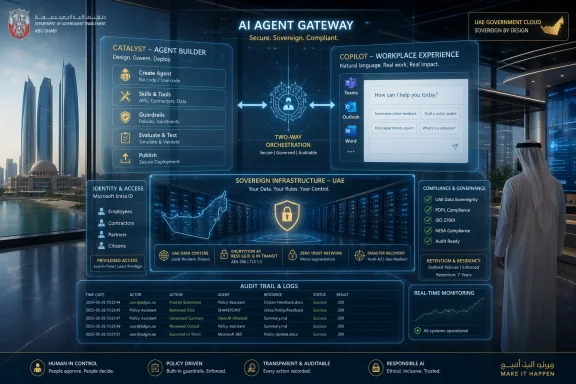
The most important line in the announcement is not that Catalyst will work with Microsoft Copilot. It is that agents built in one environment can appear in the other, allowing organizations to avoid rebuilding the same automation logic across separate platforms. In plain English, Inception42 wants to be the sovereign agent factory, while Microsoft wants Copilot to remain the place where workers actually meet those agents.
That is a shrewd division of labor. Governments do not want to expose sensitive public-sector data to a generic cloud abstraction, and enterprises operating in regulated sectors do not want to explain to auditors that a chatbot became a shadow integration layer. Microsoft, meanwhile, has spent the last several years trying to turn Microsoft 365 from a document-and-meeting suite into the operating system for knowledge work.
The UAE partnership gives both sides something they need. G42 gets Microsoft’s distribution and credibility with large organizations. Microsoft gets a route into sovereign AI deployments where American hyperscalers cannot simply say “trust us” and expect the room to relax.
For WindowsForum readers, the practical signal is clear: Copilot is no longer being positioned merely as a helper that summarizes email or drafts text. It is becoming the front end for business-specific and government-specific agents that may act across systems, policies, data stores, and approval chains. The assistant is turning into a doorway.
For years, cloud computing asked governments and regulated businesses to trade physical locality for operational scale. Data residency rules tried to patch over the anxiety, but the basic model remained: workloads moved to the cloud provider’s architecture, and customers negotiated the legal and technical boundaries afterward. AI has made that bargain more politically charged, because models do not merely store data; they infer from it, retrieve against it, summarize it, and sometimes act on it.
Agentic AI raises the stakes again. An agent that can read procurement records, draft a ministerial memo, schedule meetings, trigger a workflow, and query citizen-service systems is not just processing data. It is moving through the institutional nervous system. In that world, “where is the data?” becomes inseparable from “who can see the logs?”, “who governs the tools?”, and “who can stop the agent?”
This is why the G42-Microsoft integration matters beyond the UAE. It points to a model that other countries will watch closely: local AI infrastructure connected to global productivity software. The sales message is elegant because it avoids forcing customers into a binary choice between sovereignty and usability.
That makes the Microsoft-Inception42 deal look less like a product integration and more like plumbing for a government transformation agenda. If half of government operations are supposed to involve agents, those agents cannot live in demos, innovation labs, or executive dashboards. They have to be reachable from the applications civil servants already use all day.
Microsoft’s advantage here is mundane but powerful. Outlook still mediates organizational time. Teams mediates collaboration. Word and Excel still mediate formal knowledge work. SharePoint, OneDrive, Entra, Purview, and the rest of the Microsoft stack already sit under huge parts of enterprise and public-sector administration. If agentic AI is to move from aspiration to daily operations, it has to enter through those doors.
Inception42’s Catalyst is being positioned as the sovereign control plane for that shift. Microsoft 365 Copilot is being positioned as the user experience. That division could become a template for governments that want AI autonomy without giving up the muscle memory of Microsoft’s productivity empire.
That is where agentic AI differs from ordinary generative AI. A chatbot that answers a question can be wrong in a familiar way. An agent that takes an action can be wrong in an operational way. It can file something, route something, approve something, expose something, or quietly fail to complete a step that a human assumed had been handled.
The G42-Microsoft arrangement therefore depends on more than model quality. It depends on governance. Catalyst’s value proposition, according to Inception42, includes building, governing, and observing agents. Those verbs matter. The first wave of generative AI sold possibility; the next wave will be judged on observability, access control, rollback, and forensic accountability.
Enterprise IT will not ask only whether an agent can complete a task. It will ask whether the agent’s actions are logged, whether prompts and retrieved documents are retained appropriately, whether privileged data is blocked by design, whether human approvals are enforced, and whether administrators can prove all of that after an incident. The AI assistant is easy to demo; the audit trail is what decides deployment.
The context matters because AI sovereignty is not only about national pride. It is about export controls, chip access, data governance, cybersecurity, and diplomatic alignment. Advanced AI infrastructure has become a strategic asset, and the Gulf has become one of the places where American technology companies, regional sovereign wealth, and government AI ambitions intersect.
That also explains why Microsoft is willing to adapt. In many markets, hyperscalers prefer to sell their own vertically integrated cloud platforms as the default answer. In the UAE, the more durable strategy may be to embed Microsoft services into a sovereign AI architecture that local institutions can endorse politically and operationally.
There is a risk in that approach. The more Microsoft relies on sovereign partners to localize AI, the more fragmented the Copilot ecosystem may become. But the alternative is worse for Microsoft: a world where governments build national AI platforms that bypass Microsoft 365 entirely.
The UAE’s stated ambition is broad, but the early wins will probably be narrow. Agents can triage requests, assemble documents, check policies, summarize case files, populate forms, prepare decisions for human review, and coordinate routine processes across systems. These tasks are not glamorous, but they are exactly where bureaucracies spend enormous time.
The hard part is not building a demo agent that can complete a clean workflow. The hard part is handling exceptions. Government work is full of edge cases: missing documents, conflicting records, ambiguous eligibility, policy changes, language differences, emergency overrides, and citizens who do not fit neat schemas. Agents that perform well in rehearsed scenarios can become brittle when faced with institutional reality.
That is why the integration with Microsoft 365 is both powerful and dangerous. It places agents where work already happens, which lowers adoption friction. It also risks making automated action feel too casual. The most consequential design question may be whether Copilot makes agent execution feel like sending a message or like approving a controlled process.
If agents appear inside Microsoft 365, administrators will need to think of them as privileged application actors. They may need service identities, conditional access rules, data-loss prevention policies, lifecycle management, and monitoring. They may also need a new internal process for agent change control, because a modified agent prompt or tool permission can have the same practical effect as a software release.
This is where the Microsoft ecosystem has an advantage. Many enterprises already have the bones of governance in place, even if they are unevenly configured. Sensitivity labels, retention policies, access reviews, audit logs, and conditional access are not glamorous, but they become vital when an AI agent can traverse documents, messages, calendars, and line-of-business systems.
The challenge is that AI agents blur boundaries administrators are used to keeping separate. Is an agent an app, a user, a workflow, a bot, or a policy object? The answer is yes, depending on the moment. Microsoft and partners like Inception42 will have to make that ambiguity manageable, or organizations will either over-permit agents into danger or under-permit them into uselessness.
Both reactions are justified. Government services can be maddeningly slow because humans are forced to perform machine-like coordination work across fragmented systems. AI agents can help there. But government decisions also affect rights, benefits, business approvals, immigration status, health access, and legal obligations. In those contexts, efficiency is not the only value.
The key distinction is whether agents are used to support accountable humans or to obscure responsibility. A well-designed agentic system can produce better records than a messy email chain. It can show what data was used, what rule was applied, what exception was detected, and who approved the outcome. A poorly designed one can create a fog of plausible automation where everyone assumes the system knew what it was doing.
Microsoft’s involvement makes the stakes broader. If Copilot becomes the everyday interface for sovereign AI agents, the user experience choices made in Redmond will shape how millions of workers perceive machine agency. The button labels, warnings, approvals, explanations, and defaults may matter as much as the underlying model.
Interoperability sounds benign, but in agentic systems it is loaded. An agent is not just a portable file. It may include prompts, tool calls, permissions, knowledge sources, memory, evaluation criteria, workflows, and compliance constraints. Moving an agent between environments means preserving not only its function but also its boundaries.
This is where sovereign AI platforms will need more than local hosting. They will need policy portability. A government agency should be able to know that an agent’s permissions, logging requirements, data restrictions, and human-approval thresholds remain intact when the agent appears inside Teams or Word. Otherwise, convenience becomes a governance leak.
The Microsoft-G42 partnership is therefore testing a deeper idea: whether the AI agent ecosystem can develop something like enterprise-grade trust contracts between platforms. Without that, every integration becomes a bespoke security review. With it, agent marketplaces and cross-platform deployment become far more plausible.
Countries are increasingly unwilling to let foundational AI capability sit entirely outside their borders. Some want local models. Some want local infrastructure. Some want local data processing. Some want local governance guarantees. Microsoft can either fight that trend or package Copilot so it works inside it.
The UAE is an ideal test case because it has money, political will, infrastructure ambition, and a stated national AI timeline. It also has a relatively centralized public-sector modernization agenda, which makes large-scale deployment more feasible than in countries where government IT is fragmented across countless agencies and procurement regimes.
If the model succeeds, Microsoft can point to the UAE as proof that Copilot can participate in sovereign AI without losing its role as the workplace interface. If it struggles, the lesson will be just as important: agentic AI at national scale is less a software rollout than an institutional redesign.
That is why Microsoft’s position is formidable. Copilot can sit inside the daily flow of work in a way that standalone AI platforms cannot easily match. A sovereign AI system may be politically necessary, but if employees have to leave their normal applications to use it, adoption will suffer.
G42’s Inception42 appears to understand this. Catalyst can be the place where agents are built, governed, and observed, while Microsoft 365 remains the place where work is done. That arrangement mirrors a broader enterprise pattern: back-end specialization paired with front-end consolidation.
The risk for Microsoft is that Copilot becomes a thin veneer over other platforms’ intelligence. The opportunity is that even as intelligence becomes distributed, Microsoft owns the interaction layer. In enterprise software, the interaction layer is often where the economics settle.
Large organizations will not have that luxury. They will need to classify agents by risk, define what autonomy means in each context, set human review thresholds, and measure failure modes. An agent that drafts a meeting summary is not the same kind of system as one that recommends a licensing decision or initiates a procurement action.
The UAE’s public-sector push could help discipline the vocabulary. If 50 percent of operations are to be touched by agentic AI, officials will eventually need to explain what counts. Does AI-assisted document preparation count? Does routing a citizen request count? Does decision support count? Does autonomous execution count only when no human approves the final step?
Those definitions will matter far beyond press releases. They will shape budgets, audits, public trust, and international comparisons. They will also determine whether the UAE’s goal is seen as a genuine transformation or an inflated metric attached to ordinary automation.
Security teams will need to evaluate the entire agent lifecycle. How is an agent created? Who approves it? What data sources can it access? What tools can it invoke? How are prompts tested? How are outputs evaluated? How are hallucinations, prompt injection, and malicious documents handled? How is the agent retired?
Prompt injection deserves special attention. If an agent can read email, documents, or web content and then take action, hostile instructions hidden in those inputs become a real operational threat. The industry has learned to talk about phishing for humans; agentic AI introduces something closer to phishing for machines.
Microsoft has an incentive to wrap these concerns in familiar security products and admin controls. G42 has an incentive to assure UAE customers that sovereign infrastructure and local governance reduce strategic risk. Both are necessary. Neither is sufficient on its own.
The report also says Microsoft is assigning Forward Deployed Engineers to accelerate customer rollouts, suggesting the partnership is being treated as a production deployment problem rather than a simple connector announcement. For IT teams, that matters because integration, permissions, data mapping, and governance controls are likely to be hands-on work, not a switch-flip feature.
Tbreak further notes that Catalyst can run on-premises, in a sovereign cloud, or in the public cloud while enforcing UAE data residency, and that Microsoft 365 Copilot’s UAE in-country processing uses Dubai and Abu Dhabi datacentres for prompts and responses. That gives admins a clearer picture of how the sovereignty claim is supposed to map onto actual deployment choices.
Still unresolved are availability dates, licensing, named early customers, sector rollout priorities, and whether access will extend beyond federal entities and large enterprises. For now, the practical takeaway is narrower: the architecture is becoming clearer, but procurement and deployment details remain to be confirmed.
The report also includes direct executive framing from both sides. Inception42 CEO Ashish Koshy said the integration is meant to let Catalyst-built agents work in Copilot, and Copilot-built agents work in Catalyst, “with nothing to rebuild.” Microsoft UAE General Manager Amr Kamel described the architecture as combining Compass, Catalyst, and Microsoft 365 Copilot so organizations can scale AI while maintaining control, security, and compliance.
For IT leaders, the new detail is less about a new feature than about how the partners are selling the stack: not just as interoperability, but as a governed operating layer for enterprise AI across sovereign infrastructure, agent orchestration, and Microsoft’s productivity tools.
The rollout is more concrete than the earlier platform-integration announcements: Copilot is being deployed as the AI productivity layer for daily government work, with Advanced Data Residency enabled so AI processing remains within UAE borders. The program also includes training, certification, change management, security checks, data-governance reviews, and readiness assessments.
The report also adds scale targets around Abu Dhabi’s “AI-native government” push. An AI Factory capability is being established to develop and expand government AI use cases and agents, with a target of hundreds of use cases and more than 1,000 agents across the public sector. Those agents are expected to support tasks such as document processing, constituent query handling, policy analysis, and workflow automation.
For Windows and Microsoft 365 admins, the practical takeaway is that this is moving from strategic partnership language into live tenant-scale deployment. Copilot licensing, residency settings, Microsoft Sentinel and Defender XDR-backed security operations, user training, and agent governance are now part of the same operational stack.
 Microsoft Moves the AI Agent War Into the Office Suite
The most important line in the announcement is not that Catalyst will work with Microsoft Copilot. It is that agents built in one environment can appear in the other, allowing organizations to avoid rebuilding the same automation logic across separate platforms. In plain English, Inception42 wants to be the sovereign agent factory, while Microsoft wants Copilot to remain the place where workers actually meet those agents.That is a shrewd division of labor. Governments do not want to expose sensitive public-sector data to a generic cloud abstraction, and enterprises operating in regulated sectors do not want to explain to auditors that a chatbot became a shadow integration layer. Microsoft, meanwhile, has spent the last several years trying to turn Microsoft 365 from a document-and-meeting suite into the operating system for knowledge work.
The UAE partnership gives both sides something they need. G42 gets Microsoft’s distribution and credibility with large organizations. Microsoft gets a route into sovereign AI deployments where American hyperscalers cannot simply say “trust us” and expect the room to relax.
For WindowsForum readers, the practical signal is clear: Copilot is no longer being positioned merely as a helper that summarizes email or drafts text. It is becoming the front end for business-specific and government-specific agents that may act across systems, policies, data stores, and approval chains. The assistant is turning into a doorway.
Sovereignty Is the Feature, Not the Footnote
The National’s reporting emphasized the central promise: sensitive AI data remains inside the UAE. Inception42 says Catalyst is designed to run on sovereign infrastructure, with data processed in-country. That phrase has become one of the defining terms of the current AI infrastructure race.For years, cloud computing asked governments and regulated businesses to trade physical locality for operational scale. Data residency rules tried to patch over the anxiety, but the basic model remained: workloads moved to the cloud provider’s architecture, and customers negotiated the legal and technical boundaries afterward. AI has made that bargain more politically charged, because models do not merely store data; they infer from it, retrieve against it, summarize it, and sometimes act on it.
Agentic AI raises the stakes again. An agent that can read procurement records, draft a ministerial memo, schedule meetings, trigger a workflow, and query citizen-service systems is not just processing data. It is moving through the institutional nervous system. In that world, “where is the data?” becomes inseparable from “who can see the logs?”, “who governs the tools?”, and “who can stop the agent?”
This is why the G42-Microsoft integration matters beyond the UAE. It points to a model that other countries will watch closely: local AI infrastructure connected to global productivity software. The sales message is elegant because it avoids forcing customers into a binary choice between sovereignty and usability.
The UAE Is Treating Agentic AI Like National Infrastructure
The timing is not accidental. The UAE has announced an unusually ambitious target: move 50 percent of federal government operations, services, and sectors toward agentic AI models within two years. Official UAE government communications have framed this as a national operating-model shift rather than a pilot program, with tens of thousands of federal employees expected to receive training in AI agent use.That makes the Microsoft-Inception42 deal look less like a product integration and more like plumbing for a government transformation agenda. If half of government operations are supposed to involve agents, those agents cannot live in demos, innovation labs, or executive dashboards. They have to be reachable from the applications civil servants already use all day.
Microsoft’s advantage here is mundane but powerful. Outlook still mediates organizational time. Teams mediates collaboration. Word and Excel still mediate formal knowledge work. SharePoint, OneDrive, Entra, Purview, and the rest of the Microsoft stack already sit under huge parts of enterprise and public-sector administration. If agentic AI is to move from aspiration to daily operations, it has to enter through those doors.
Inception42’s Catalyst is being positioned as the sovereign control plane for that shift. Microsoft 365 Copilot is being positioned as the user experience. That division could become a template for governments that want AI autonomy without giving up the muscle memory of Microsoft’s productivity empire.
Copilot Is Becoming a Policy Surface
Microsoft has spent years trying to make Copilot sound friendly. It writes, summarizes, searches, and assists. But the more deeply Copilot is connected to enterprise systems, the more it becomes a policy surface: a place where permissions, compliance rules, data classifications, retention settings, and business logic meet user intent.That is where agentic AI differs from ordinary generative AI. A chatbot that answers a question can be wrong in a familiar way. An agent that takes an action can be wrong in an operational way. It can file something, route something, approve something, expose something, or quietly fail to complete a step that a human assumed had been handled.
The G42-Microsoft arrangement therefore depends on more than model quality. It depends on governance. Catalyst’s value proposition, according to Inception42, includes building, governing, and observing agents. Those verbs matter. The first wave of generative AI sold possibility; the next wave will be judged on observability, access control, rollback, and forensic accountability.
Enterprise IT will not ask only whether an agent can complete a task. It will ask whether the agent’s actions are logged, whether prompts and retrieved documents are retained appropriately, whether privileged data is blocked by design, whether human approvals are enforced, and whether administrators can prove all of that after an incident. The AI assistant is easy to demo; the audit trail is what decides deployment.
The Microsoft-G42 Relationship Has Always Been Bigger Than Software
Microsoft’s relationship with G42 became a geopolitical technology story in April 2024, when Microsoft announced a $1.5 billion strategic investment in the Abu Dhabi company. Microsoft later detailed a broader $15.2 billion UAE investment plan stretching from 2023 through 2029, including data centers, local operating expenses, and AI infrastructure. That spending placed the partnership squarely inside the global race for compute, influence, and trusted AI supply chains.The context matters because AI sovereignty is not only about national pride. It is about export controls, chip access, data governance, cybersecurity, and diplomatic alignment. Advanced AI infrastructure has become a strategic asset, and the Gulf has become one of the places where American technology companies, regional sovereign wealth, and government AI ambitions intersect.
That also explains why Microsoft is willing to adapt. In many markets, hyperscalers prefer to sell their own vertically integrated cloud platforms as the default answer. In the UAE, the more durable strategy may be to embed Microsoft services into a sovereign AI architecture that local institutions can endorse politically and operationally.
There is a risk in that approach. The more Microsoft relies on sovereign partners to localize AI, the more fragmented the Copilot ecosystem may become. But the alternative is worse for Microsoft: a world where governments build national AI platforms that bypass Microsoft 365 entirely.
Agentic AI Sounds Autonomous Until Procurement Gets Involved
The phrase agentic AI carries a whiff of science fiction, but most near-term deployments will look less like autonomous digital employees and more like carefully fenced workflow engines with language-model interfaces. That is not a criticism. In government and enterprise environments, fenced autonomy is the only kind likely to survive contact with compliance departments.The UAE’s stated ambition is broad, but the early wins will probably be narrow. Agents can triage requests, assemble documents, check policies, summarize case files, populate forms, prepare decisions for human review, and coordinate routine processes across systems. These tasks are not glamorous, but they are exactly where bureaucracies spend enormous time.
The hard part is not building a demo agent that can complete a clean workflow. The hard part is handling exceptions. Government work is full of edge cases: missing documents, conflicting records, ambiguous eligibility, policy changes, language differences, emergency overrides, and citizens who do not fit neat schemas. Agents that perform well in rehearsed scenarios can become brittle when faced with institutional reality.
That is why the integration with Microsoft 365 is both powerful and dangerous. It places agents where work already happens, which lowers adoption friction. It also risks making automated action feel too casual. The most consequential design question may be whether Copilot makes agent execution feel like sending a message or like approving a controlled process.
The Windows Admin’s Problem Is No Longer Just Endpoint Management
For sysadmins and IT pros, this story lands in familiar territory with unfamiliar vocabulary. The daily question will not be “should we use AI?” but “which identities, groups, apps, and data scopes can each agent touch?” That is a Microsoft Entra, Purview, Defender, Intune, and logging problem before it is a philosophical debate.If agents appear inside Microsoft 365, administrators will need to think of them as privileged application actors. They may need service identities, conditional access rules, data-loss prevention policies, lifecycle management, and monitoring. They may also need a new internal process for agent change control, because a modified agent prompt or tool permission can have the same practical effect as a software release.
This is where the Microsoft ecosystem has an advantage. Many enterprises already have the bones of governance in place, even if they are unevenly configured. Sensitivity labels, retention policies, access reviews, audit logs, and conditional access are not glamorous, but they become vital when an AI agent can traverse documents, messages, calendars, and line-of-business systems.
The challenge is that AI agents blur boundaries administrators are used to keeping separate. Is an agent an app, a user, a workflow, a bot, or a policy object? The answer is yes, depending on the moment. Microsoft and partners like Inception42 will have to make that ambiguity manageable, or organizations will either over-permit agents into danger or under-permit them into uselessness.
The Promise Is Efficiency; the Fear Is Institutional Autopilot
The UAE’s national goal is audacious because it treats government operations as something that can be re-engineered around AI agents at speed. Supporters will argue that this is exactly what public administration needs: faster services, less repetitive paperwork, better routing, and more consistent decision support. Critics will hear the same pitch and worry about opacity, automation bias, and diminished human accountability.Both reactions are justified. Government services can be maddeningly slow because humans are forced to perform machine-like coordination work across fragmented systems. AI agents can help there. But government decisions also affect rights, benefits, business approvals, immigration status, health access, and legal obligations. In those contexts, efficiency is not the only value.
The key distinction is whether agents are used to support accountable humans or to obscure responsibility. A well-designed agentic system can produce better records than a messy email chain. It can show what data was used, what rule was applied, what exception was detected, and who approved the outcome. A poorly designed one can create a fog of plausible automation where everyone assumes the system knew what it was doing.
Microsoft’s involvement makes the stakes broader. If Copilot becomes the everyday interface for sovereign AI agents, the user experience choices made in Redmond will shape how millions of workers perceive machine agency. The button labels, warnings, approvals, explanations, and defaults may matter as much as the underlying model.
Interoperability Is the Deal’s Sharpest Edge
The most intriguing part of the partnership is the claim that agents can move in both directions: Catalyst-built agents into Microsoft 365 Copilot, and Copilot-created agents back into Catalyst. If that works in a governed and auditable way, it solves a real enterprise problem. If it becomes another layer of integration ambiguity, it could create a new class of shadow automation.Interoperability sounds benign, but in agentic systems it is loaded. An agent is not just a portable file. It may include prompts, tool calls, permissions, knowledge sources, memory, evaluation criteria, workflows, and compliance constraints. Moving an agent between environments means preserving not only its function but also its boundaries.
This is where sovereign AI platforms will need more than local hosting. They will need policy portability. A government agency should be able to know that an agent’s permissions, logging requirements, data restrictions, and human-approval thresholds remain intact when the agent appears inside Teams or Word. Otherwise, convenience becomes a governance leak.
The Microsoft-G42 partnership is therefore testing a deeper idea: whether the AI agent ecosystem can develop something like enterprise-grade trust contracts between platforms. Without that, every integration becomes a bespoke security review. With it, agent marketplaces and cross-platform deployment become far more plausible.
The Copilot Era Is Becoming Less American-Centric
Microsoft’s AI strategy is often discussed through the lens of OpenAI, Windows, Azure, and Microsoft 365 subscriptions. But the G42 partnership shows another layer: Microsoft adapting Copilot to national and regional AI strategies. This is not charity or diplomacy for its own sake. It is market preservation.Countries are increasingly unwilling to let foundational AI capability sit entirely outside their borders. Some want local models. Some want local infrastructure. Some want local data processing. Some want local governance guarantees. Microsoft can either fight that trend or package Copilot so it works inside it.
The UAE is an ideal test case because it has money, political will, infrastructure ambition, and a stated national AI timeline. It also has a relatively centralized public-sector modernization agenda, which makes large-scale deployment more feasible than in countries where government IT is fragmented across countless agencies and procurement regimes.
If the model succeeds, Microsoft can point to the UAE as proof that Copilot can participate in sovereign AI without losing its role as the workplace interface. If it struggles, the lesson will be just as important: agentic AI at national scale is less a software rollout than an institutional redesign.
The Real Competition Is for the Default Work Interface
The AI industry loves to talk about models, but most users do not choose models. They choose interfaces, often by not choosing at all. They use the tools their employer gives them, and the tools become the path through which new capabilities enter the organization.That is why Microsoft’s position is formidable. Copilot can sit inside the daily flow of work in a way that standalone AI platforms cannot easily match. A sovereign AI system may be politically necessary, but if employees have to leave their normal applications to use it, adoption will suffer.
G42’s Inception42 appears to understand this. Catalyst can be the place where agents are built, governed, and observed, while Microsoft 365 remains the place where work is done. That arrangement mirrors a broader enterprise pattern: back-end specialization paired with front-end consolidation.
The risk for Microsoft is that Copilot becomes a thin veneer over other platforms’ intelligence. The opportunity is that even as intelligence becomes distributed, Microsoft owns the interaction layer. In enterprise software, the interaction layer is often where the economics settle.
The UAE Deployment Will Test Whether “Agentic” Can Survive Reality
The term agentic AI is currently doing too much work. It can mean a simple workflow with a language interface, a tool-using assistant, a multi-step planner, or a semi-autonomous system that acts with limited supervision. Vendors benefit from the ambiguity because it lets them sell ambition before every detail is nailed down.Large organizations will not have that luxury. They will need to classify agents by risk, define what autonomy means in each context, set human review thresholds, and measure failure modes. An agent that drafts a meeting summary is not the same kind of system as one that recommends a licensing decision or initiates a procurement action.
The UAE’s public-sector push could help discipline the vocabulary. If 50 percent of operations are to be touched by agentic AI, officials will eventually need to explain what counts. Does AI-assisted document preparation count? Does routing a citizen request count? Does decision support count? Does autonomous execution count only when no human approves the final step?
Those definitions will matter far beyond press releases. They will shape budgets, audits, public trust, and international comparisons. They will also determine whether the UAE’s goal is seen as a genuine transformation or an inflated metric attached to ordinary automation.
The Security Story Is Bigger Than Data Residency
Keeping sensitive data inside the UAE is central to the announcement, but data residency is only one layer of security. An AI agent can create risk even when every byte remains in-country. It can retrieve too much, infer too much, expose too much, or act too broadly.Security teams will need to evaluate the entire agent lifecycle. How is an agent created? Who approves it? What data sources can it access? What tools can it invoke? How are prompts tested? How are outputs evaluated? How are hallucinations, prompt injection, and malicious documents handled? How is the agent retired?
Prompt injection deserves special attention. If an agent can read email, documents, or web content and then take action, hostile instructions hidden in those inputs become a real operational threat. The industry has learned to talk about phishing for humans; agentic AI introduces something closer to phishing for machines.
Microsoft has an incentive to wrap these concerns in familiar security products and admin controls. G42 has an incentive to assure UAE customers that sovereign infrastructure and local governance reduce strategic risk. Both are necessary. Neither is sufficient on its own.
The Most Concrete Lessons Sit Behind the Press Release
The Inception42-Microsoft deal is not merely a regional partnership; it is a preview of how AI assistants may be deployed when national strategy, cloud platforms, productivity software, and compliance all collide. Strip away the ceremonial language and the message is practical: AI agents are moving from experimental side panels into the managed enterprise workflow.- Organizations in the UAE will be able to build agents in Inception42’s Catalyst platform and surface them inside Microsoft 365 Copilot applications used by employees.
- The partnership is designed around in-country data processing, reflecting the growing importance of sovereign AI for governments and regulated enterprises.
- The deal supports the UAE’s target of shifting 50 percent of federal government operations, services, and sectors toward agentic AI models within two years.
- Microsoft’s role is not limited to cloud infrastructure; Copilot is being positioned as the user-facing layer for governed, organization-specific agents.
- IT administrators should treat AI agents as privileged operational actors that require identity controls, logging, data governance, and lifecycle management.
- The success of the model will depend less on impressive demos than on whether agents can be audited, constrained, monitored, and trusted in messy real-world workflows.
Update: New Details Clarify Compass Layer and Microsoft Deployment Support (July 6, 2026)
Tbreak’s follow-up adds implementation detail that was not explicit in the initial coverage: the Catalyst-Copilot setup also involves Compass, Core42’s sovereign model and infrastructure layer, which serves agents built and governed in Inception42’s Catalyst before they appear inside Microsoft 365 Copilot apps.The report also says Microsoft is assigning Forward Deployed Engineers to accelerate customer rollouts, suggesting the partnership is being treated as a production deployment problem rather than a simple connector announcement. For IT teams, that matters because integration, permissions, data mapping, and governance controls are likely to be hands-on work, not a switch-flip feature.
Tbreak further notes that Catalyst can run on-premises, in a sovereign cloud, or in the public cloud while enforcing UAE data residency, and that Microsoft 365 Copilot’s UAE in-country processing uses Dubai and Abu Dhabi datacentres for prompts and responses. That gives admins a clearer picture of how the sovereignty claim is supposed to map onto actual deployment choices.
Still unresolved are availability dates, licensing, named early customers, sector rollout priorities, and whether access will extend beyond federal entities and large enterprises. For now, the practical takeaway is narrower: the architecture is becoming clearer, but procurement and deployment details remain to be confirmed.
Update: Inception42 and Microsoft Frame Catalyst as an Enterprise “AI Brain” (July 6, 2026)
MIT Sloan Management Review Middle East adds that Inception42 is positioning Catalyst as creating an institutional “AI Brain” by connecting governed agents to an organization’s existing data sources while keeping processing within national borders.The report also includes direct executive framing from both sides. Inception42 CEO Ashish Koshy said the integration is meant to let Catalyst-built agents work in Copilot, and Copilot-built agents work in Catalyst, “with nothing to rebuild.” Microsoft UAE General Manager Amr Kamel described the architecture as combining Compass, Catalyst, and Microsoft 365 Copilot so organizations can scale AI while maintaining control, security, and compliance.
For IT leaders, the new detail is less about a new feature than about how the partners are selling the stack: not just as interoperability, but as a governed operating layer for enterprise AI across sovereign infrastructure, agent orchestration, and Microsoft’s productivity tools.
Update: Abu Dhabi Rolls Out Copilot to 35,000 Government Employees (July 6, 2026)
Economy Middle East reports that Abu Dhabi Government has now standardized Microsoft 365 Copilot across much of its public sector, adding 26,000 civil servants through the Frontier Employee Program on top of 9,000 existing licenses, for a total of 35,000 users across 27 government entities.The rollout is more concrete than the earlier platform-integration announcements: Copilot is being deployed as the AI productivity layer for daily government work, with Advanced Data Residency enabled so AI processing remains within UAE borders. The program also includes training, certification, change management, security checks, data-governance reviews, and readiness assessments.
The report also adds scale targets around Abu Dhabi’s “AI-native government” push. An AI Factory capability is being established to develop and expand government AI use cases and agents, with a target of hundreds of use cases and more than 1,000 agents across the public sector. Those agents are expected to support tasks such as document processing, constituent query handling, policy analysis, and workflow automation.
For Windows and Microsoft 365 admins, the practical takeaway is that this is moving from strategic partnership language into live tenant-scale deployment. Copilot licensing, residency settings, Microsoft Sentinel and Defender XDR-backed security operations, user training, and agent governance are now part of the same operational stack.
References
- Primary source: Arabian Business
Published: 2026-07-06T08:18:12.181670
- Independent coverage: thenationalnews.com
Published: 2026-07-06T08:15:12.165952
G42 and Microsoft deepen partnership to keep sensitive AI data inside the UAE | The National
Move to integrate tools and platforms will allow governments and businesses to deploy AI agents securelywww.thenationalnews.com - Official source: blogs.microsoft.com
Microsoft’s $15.2 billion USD investment in the UAE - Microsoft On the Issues
Microsoft announced a $15.2 billion USD investment plan in the United Arab Emirates focusing on AI technology, talent development, and building trust between the two nations.blogs.microsoft.com - Related coverage: gulftoday.ae
UAE targets 50 per cent of federal operations on Agentic ...
Mohammad Bin Abdullah Al Gergawi, Minister of Cabinet Affairs and Chairman of the National Committee for the Agentic AI Project, affirmed that the UAE is... www.gulftoday.ae
- Related coverage: protocol.dubai.ae
- Related coverage: beincrypto.com
UAE Orders 50% of Government Operations to Run on Agentic AI by 2028
The UAE directs 50% of federal government operations to run on Agentic AI within two years, aiming for a global first.beincrypto.com
- Related coverage: digitaldubai.ai
UAE: 50% Government Services to AI in Two Years
The UAE will transform half of its government sectors, services and operations to autonomous artificial intelligence systems within two years, aiming to becomewww.digitaldubai.ai - Related coverage: sharjah24.ae
UAE to deploy Agentic AI across 50% of government within 2 years
The UAE Cabinet, chaired by His Highness Sheikh Mohammed bin Rashid Al Maktoum, approved a global-first framework to deploy Agentic AI across 50% of government ...sharjah24.ae
- Related coverage: techradar.com
Microsoft is investing $15.2 billion in the UAE to expand AI and cloud operations | TechRadar
Microsoft extends major investment in the UAEwww.techradar.com - Related coverage: windowscentral.com
Microsoft is investing $15.2 billion in the world's AI hotspot — Why that's great news for NVIDIA and its specialized GPUs | Windows Central
With billions flowing into UAE datacenters and export licenses secured, Microsoft’s AI bet is fueling NVIDIA’s dominance.www.windowscentral.com - Related coverage: aihola.com
UAE to Run 50% of Government on Agentic AI by 2028 | aiHola
Sheikh Mohammed announced a two-year plan to move half of UAE federal government services to autonomous AI agents. The timeline is aggressive.aihola.com - Related coverage: emirates247.com
UAE accelerates Agentic AI adoption with federal workshop involving 50 government entities - Emirates 24|7
UAE hosts nationwide workshop to accelerate Agentic AI adoption, aiming to transform 50% of federal services and operations within two years, with 300 officials from 50 entities launching 90-day implementation trackswww.emirates247.com
- Related coverage: techrepublic.com
Microsoft Makes $15B Investment in UAE - TechRepublic
Microsoft is interested in AI and cloud with its long-term investment plan in the United Arab Emirates.www.techrepublic.com
- Official source: news.microsoft.com
Microsoft invests $1.5 billion in Abu Dhabi’s G42 to accelerate AI development and global expansion - Source
This strategic investment will enhance the UAE’s position as a global AI hub and provide further opportunities for partners and customers to innovate and grow. G42 and Microsoft will collaborate to ensure the benefits of secure AI technologies and cloud capabilities are responsibly shared with... news.microsoft.com
- Related coverage: axios.com
Advanced AI chips cleared for export to UAE under Microsoft deal
The U.S. hopes to displace China as a key UAE tech partner but also worries chips could end up in Chinese government hands.www.axios.com
- Related coverage: fahr.gov.ae
- Related coverage: techxplore.com
Last edited:

