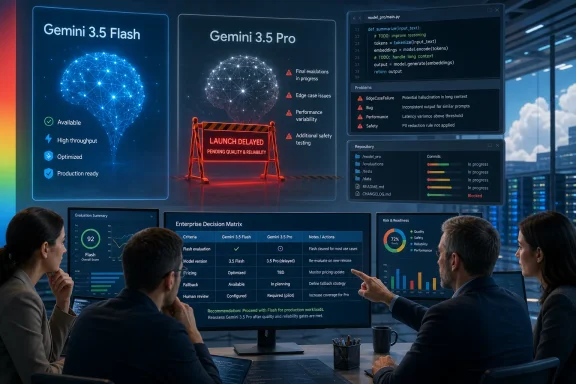
Verdict: build on Gemini 3.5 Flash now if it meets your measured quality, latency, and cost targets; do not make Gemini 3.5 Pro a release dependency. Gemini 3.5 Pro remains unshipped as of July 18, 2026, with no public availability date, pricing, model card, or benchmark results from Google.
Google announced the Gemini 3.5 family on May 19, released Gemini 3.5 Flash, and said Gemini 3.5 Pro was in internal use with a rollout planned for “next month.” That schedule has not materialized publicly. Reuters reported on June 24 that Google had moved the expected Pro launch from June to July to incorporate early-tester feedback, but Google has not confirmed a date.
For Windows developers, the immediate choice is therefore not Flash versus Pro. It is whether Gemini 3.5 Flash is good enough for the task in front of you—and whether your code can treat a future Pro rollout as a controlled model evaluation rather than an emergency migration.
Start with Flash in a production-like evaluation and make the model name a configuration value, not a hard-coded product decision.
The distinction matters because pre-release model expectations are not deployable capability. There is currently no public Gemini 3.5 Pro pricing page to plug into a budget, no model card to assess its documented behavior, and no published benchmark package to evaluate Google’s performance claims against a team’s own requirements.
That does not mean Pro will be unimportant. It means Pro belongs in the roadmap as an unknown variable, not in a committed July release plan. Teams that wait for it may lose useful weeks of learning about prompt design, tool integration, output validation, and developer workflow fit—work that should largely transfer if the application boundary is designed properly.
WindowsForum readers have already been weighing related questions around Google models in Microsoft-adjacent developer workflows, including whether Gemini access through paid GitHub Copilot plans beats lower-cost or free Gemini tooling for solo work. The more useful enterprise lesson is that the hosting relationship or subscription bundle should not dictate architecture. Your application needs a measurable model-selection layer regardless of where developers encounter the model.
The safest design is to keep four components separate:
The practical test for Pro, when it arrives, is straightforward: run it against the same evaluation corpus used for Flash. Compare task completion, required human correction, runtime behavior, latency, and cost under a controlled rollout. Promote it only for workload categories where it produces an outcome that is materially better for the business or engineering team.
Flash provides a route to answer the questions that are actually within a Windows developer’s control. Does it improve code review throughput? Can it summarize complex project context reliably enough to save time? Does it perform usefully in a restricted tool environment? Can developers spot and correct its mistakes without negating its productivity value?
If the answer is no, waiting for Pro may be reasonable, but only if the identified gap is genuinely model capability rather than an unclear workflow or weak validation design. If the answer is yes, shipping with Flash now gives the team an evidence-based baseline that Pro must beat.
Google’s silence on a specific Pro date also means teams should be careful with external commitments. Reuters’ report points to a planned July launch after early-tester feedback, but a reported target is not a public release promise. Product managers should describe Pro as a candidate future upgrade, not as a promised feature in a customer-facing schedule.
Until then, Flash is the only Gemini 3.5 product that can support a production decision. A team that uses it now with strong evaluation and an interchangeable model layer will be ready to test Pro immediately. A team that waits for Pro without that groundwork may simply exchange one unknown for another.
Google announced the Gemini 3.5 family on May 19, released Gemini 3.5 Flash, and said Gemini 3.5 Pro was in internal use with a rollout planned for “next month.” That schedule has not materialized publicly. Reuters reported on June 24 that Google had moved the expected Pro launch from June to July to incorporate early-tester feedback, but Google has not confirmed a date.
For Windows developers, the immediate choice is therefore not Flash versus Pro. It is whether Gemini 3.5 Flash is good enough for the task in front of you—and whether your code can treat a future Pro rollout as a controlled model evaluation rather than an emergency migration.
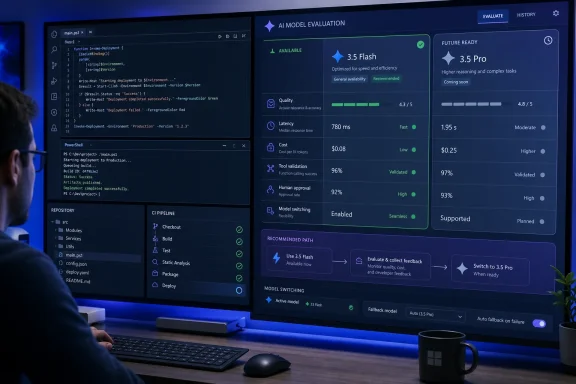 How should a Windows team proceed with Gemini 3.5 Flash now?
Start with Flash in a production-like evaluation and make the model name a configuration value, not a hard-coded product decision.- Define the workload narrowly. Separate code generation, code review, document processing, support automation, and agentic tasks instead of treating “AI coding” as a single use case.
- Build a representative test set from work your team already understands. Include successful cases, difficult cases, known failure modes, and tasks that should be rejected or escalated to a human.
- Measure output quality before measuring enthusiasm. Track whether the model completes the intended task, whether generated changes pass your existing checks, and how often developers must substantially correct the output.
- Measure latency and cost at the same time. A stronger result that arrives too slowly, or costs too much at expected volume, is not necessarily the better production choice.
- Put the model identifier behind an application setting or service-side configuration layer. Prompts, tool definitions, output parsing, logging, and evaluation data should remain independent of the selected model.
- Preserve a human approval point for consequential actions. This matters particularly for agents that can alter source code, create files, invoke tools, or make changes in administrative workflows.
- Establish a promotion gate now. Gemini 3.5 Pro should enter the same test suite when it becomes available; it should not be assumed to win merely because it carries the Pro label.
Why Gemini 3.5 Flash is the only practical 3.5 baseline today
Gemini 3.5 Flash is available through Google’s developer channels and is positioned for coding and long-horizon agentic work. That makes it the only Gemini 3.5 model Windows teams can presently put through realistic tests involving their repositories, Windows-based development environments, internal knowledge sources, and approval workflows.The distinction matters because pre-release model expectations are not deployable capability. There is currently no public Gemini 3.5 Pro pricing page to plug into a budget, no model card to assess its documented behavior, and no published benchmark package to evaluate Google’s performance claims against a team’s own requirements.
That does not mean Pro will be unimportant. It means Pro belongs in the roadmap as an unknown variable, not in a committed July release plan. Teams that wait for it may lose useful weeks of learning about prompt design, tool integration, output validation, and developer workflow fit—work that should largely transfer if the application boundary is designed properly.
WindowsForum readers have already been weighing related questions around Google models in Microsoft-adjacent developer workflows, including whether Gemini access through paid GitHub Copilot plans beats lower-cost or free Gemini tooling for solo work. The more useful enterprise lesson is that the hosting relationship or subscription bundle should not dictate architecture. Your application needs a measurable model-selection layer regardless of where developers encounter the model.
The Pro swap should be an experiment, not a rewrite
A future Gemini 3.5 Pro rollout could change the quality ceiling for difficult coding or longer-running agent tasks. But a different model can also change response structure, tool behavior, latency characteristics, and the amount of review an engineer needs before accepting an answer. “More capable” is not a guarantee of operational compatibility.The safest design is to keep four components separate:
- The application workflow should decide what job needs to be done, independent of which model performs it.
- The prompt and tool contract should have explicit expected inputs and outputs, so a model change can be tested for behavioral drift.
- The validation layer should verify code, structured output, permissions, and human approval before an automated result is trusted.
- The telemetry layer should retain enough information to compare Flash and Pro on the same tasks without relying on anecdotal developer impressions.
The practical test for Pro, when it arrives, is straightforward: run it against the same evaluation corpus used for Flash. Compare task completion, required human correction, runtime behavior, latency, and cost under a controlled rollout. Promote it only for workload categories where it produces an outcome that is materially better for the business or engineering team.
Waiting can create a false sense of safety
There is a temptation to delay an AI feature until the perceived flagship model arrives. That can sound cautious, but it often shifts risk rather than reducing it. The team still has to solve permissions, data handling, tool execution boundaries, output validation, and user expectations—only later, with less time to learn.Flash provides a route to answer the questions that are actually within a Windows developer’s control. Does it improve code review throughput? Can it summarize complex project context reliably enough to save time? Does it perform usefully in a restricted tool environment? Can developers spot and correct its mistakes without negating its productivity value?
If the answer is no, waiting for Pro may be reasonable, but only if the identified gap is genuinely model capability rather than an unclear workflow or weak validation design. If the answer is yes, shipping with Flash now gives the team an evidence-based baseline that Pro must beat.
Google’s silence on a specific Pro date also means teams should be careful with external commitments. Reuters’ report points to a planned July launch after early-tester feedback, but a reported target is not a public release promise. Product managers should describe Pro as a candidate future upgrade, not as a promised feature in a customer-facing schedule.
What Windows developers should watch next
The next meaningful signals are not rumors about a launch window. They are the materials Google has not yet published: a confirmed public availability date, pricing, a model card, developer documentation, and benchmark results that can be examined alongside independent testing.Until then, Flash is the only Gemini 3.5 product that can support a production decision. A team that uses it now with strong evaluation and an interchangeable model layer will be ready to test Pro immediately. A team that waits for Pro without that groundwork may simply exchange one unknown for another.
Frequently Asked Questions
Should Windows developers delay an AI feature until Gemini 3.5 Pro launches?
No. Build and evaluate with Gemini 3.5 Flash if it meets the workload’s requirements, while keeping the model choice configurable for a later Pro test.Is Gemini 3.5 Pro publicly available on July 18, 2026?
No. Google has not published a specific availability date, pricing page, model card, or public benchmark results for Gemini 3.5 Pro.Did Google confirm that Gemini 3.5 Pro was delayed?
Google has not confirmed a delay date. Reuters reported on June 24 that the planned launch had moved from June to July for early-tester feedback.What is the safest upgrade path when Gemini 3.5 Pro arrives?
Run Pro and Flash against the same evaluation set, compare measurable outcomes, and promote Pro only where it improves the workload enough to justify its operational tradeoffs.References
- Primary source: techtimes.com
Gemini 3.5 Pro Targets July 17 After Full Rebuild: Every Spec Remains Unconfirmed
Gemini 3.5 Pro release targets July 17, 2026 — four days away — but Google has not confirmed the date, the 2-million-token context window, or pricing. Google DeepMind reportedly scrapped its originalwww.techtimes.com - Independent coverage: investing.com
Google delays Gemini 3.5 Pro model release to July - Insider By Investing.com
Google delays Gemini 3.5 Pro model release to July - Insiderwww.investing.com - Independent coverage: developer.android.com
- Independent coverage: blog.google
Gemini 3: Introducing the latest Gemini AI model from Google
Today we’re releasing Gemini 3 – our most intelligent model that helps you bring any idea to life.blog.google - Independent coverage: arxiv.org
[2312.11805] Gemini: A Family of Highly Capable Multimodal Models
Abstract page for arXiv paper 2312.11805: Gemini: A Family of Highly Capable Multimodal Models arxiv.org
- Independent coverage: futuresearch.ai
Gemini 3.5 Pro Release Date and Frontier Forecast
FutureSearch forecasts DeepMind's Gemini 3.5 Pro reaching the public around July 1, 2026 and landing just behind the AI frontier, level with the best models anyone can run while Claude Fable 5 stays unavailable, priced near $4 input and $24 output per million tokens.futuresearch.ai