

Z.ai’s GLM-5.2, released in mid-June 2026 by the Beijing startup formerly known as Zhipu AI, has surged on developer platforms by offering near-frontier coding and agent performance at dramatically lower prices than leading U.S. proprietary models. The important part is not that China has “caught up” in every category. It is that the gap has narrowed in the exact workflows where developers, startups, and enterprise buyers feel model costs most directly. That makes GLM-5.2 less a single-model story than a warning flare for the economics of the AI stack.
The first DeepSeek shock was about whether a Chinese lab could undercut the assumed cost of frontier AI training. GLM-5.2 is different: it is about whether a Chinese open-weight model can become boringly useful in the everyday places where OpenAI and Anthropic have built their Western developer beachheads. If the answer is yes, even partially, the next phase of AI competition will not be decided only by who has the smartest model. It will be decided by who can make capable models cheap, deployable, and politically usable.
The excitement around GLM-5.2 is unusually practical. Developers are not merely asking whether it can write a poem, summarize a PDF, or pass a benchmark. They are asking whether it can sit inside coding tools, run long-context agent workflows, generate front-end applications, and complete tasks without bankrupting the usage budget.
That matters because the industry’s most valuable AI use cases are increasingly agentic. A model is no longer asked to answer one prompt and stop. It is asked to plan, call tools, inspect results, revise its own work, and continue until a task is finished. Each of those steps consumes tokens, and each token has a price.
This is where closed U.S. frontier models have begun to create sticker shock. A coding agent that loops through a repository, reads logs, edits files, runs tests, and tries again may generate enormous input and output volumes. The better the agent becomes, the more tempting it is to use it for larger jobs. The larger the job, the more visible the bill becomes.
GLM-5.2’s pitch lands directly in that pressure point. It does not need to be the undisputed best model in the world to change buying behavior. It only needs to be good enough for a meaningful slice of coding and agent work while being much cheaper to run. In software, “good enough and much cheaper” has a long history of beating “best and expensive,” especially when the cheaper option can be deployed flexibly.
For Windows developers and IT shops, the significance is immediate. AI coding assistants are moving from novelty to infrastructure, sitting in IDEs, CI/CD workflows, documentation pipelines, help desks, and internal automation tools. Once those workflows become recurring operational expenses, model selection starts to look less like a research decision and more like cloud cost management.
GLM-5.2 is now testing a more consequential claim: whether Chinese models can become part of the Western developer workflow rather than just a geopolitical talking point. The model’s climb on routing platforms such as OpenRouter is important because those platforms are where developers compare models by actual use, not by vendor keynote. If a model is unreliable, awkward, expensive, or weak in common tasks, developers tend to move on quickly.
The model’s reported strength in coding and front-end generation is also not incidental. Coding is the wedge market for advanced AI because it has built-in feedback. The code runs or it does not. The test passes or it fails. The website renders correctly or it breaks. This makes model quality easier to judge than in open-ended business prose, and it gives cheaper challengers a clear path to credibility.
Open-weight distribution sharpens that advantage. A closed API can be excellent, but it leaves customers dependent on the provider’s pricing, availability, policy changes, and regional access rules. An open-weight model gives advanced users and vendors more room to host, tune, route, inspect, and package it for specific environments. That flexibility is not the same as trust, but it is a form of leverage.
The result is a miniature replay of cloud history. Enterprises originally bought cloud services for convenience, then spent years trying to regain control over cost, portability, and vendor concentration. AI may compress that cycle into months. GLM-5.2 arrives at the moment when developers are asking whether they need one supreme model for everything, or a portfolio of models routed by task, price, latency, and risk.
Rankings that measure front-end generation, code repair, and broad “intelligence” are still imperfect. They can be gamed, they can overfit to popular tasks, and they often lag the messy reality of production use. But they are closer to the workflows where buyers are spending money. A model that can generate a coherent interface, reason through a repository, or serve as a coding agent is not merely winning trivia contests.
That is why GLM-5.2’s position on third-party leaderboards has generated so much attention. A Chinese open-weight model does not need to beat every OpenAI or Anthropic system across every benchmark to become disruptive. It simply needs to sit close enough to the top while charging a fraction of the price. In model markets, relative value can be more destabilizing than absolute victory.
This is also why the phrase “mini DeepSeek moment” fits better than a more dramatic claim. GLM-5.2 does not appear to have detonated the entire AI market in the way DeepSeek did. But it has created a focal point for developers who already suspected that the proprietary frontier was becoming expensive, constrained, and over-centralized.
The most serious reading is that GLM-5.2 represents a narrowing of usable capability, not a final crossing of the frontier. The former is enough. In enterprise technology, broad availability of near-frontier capability often matters more than possession of the single best system under laboratory conditions.
This is a delicate point. There are real reasons for governments to care about powerful AI systems, especially when they can assist cyber operations, automate vulnerability discovery, or lower the skill floor for misuse. No serious analysis should pretend that frontier model access is just another consumer software preference.
But policy can produce second-order effects. If U.S. firms face unpredictable constraints while foreign open-weight models remain broadly available, the restriction may not eliminate capability from the world. It may simply reroute demand toward models that are harder to supervise. That is the strategic anxiety behind the sudden Western interest in GLM-5.2.
The irony is sharp. U.S. companies have spent years arguing that closed models are safer because they can be monitored, rate-limited, updated, and withheld. Open-weight models challenge that safety model by making capability more portable. If open models approach the quality of restricted closed models, regulators face a harder problem: controlling the most visible American providers does not control the global capability curve.
For CIOs and CISOs, this means AI governance can no longer be written around brand names alone. A policy that approves or blocks “OpenAI,” “Anthropic,” or “Chinese models” is too crude for a world of model routers, local deployments, third-party wrappers, and fine-tuned derivatives. The relevant questions are increasingly about data flow, hosting jurisdiction, logging, retention, evaluation, and task boundary.
That distinction matters for GLM-5.2 because its greatest strength in developer circles is also the source of enterprise hesitation. If a model can be hosted outside the original vendor’s cloud, many data-security objections become more manageable. A bank, defense contractor, or healthcare organization may reasonably prefer a model it can run in a controlled environment over a foreign API endpoint.
Still, self-hosting does not erase every concern. Enterprises must consider license terms, provenance, model behavior, update control, vulnerability handling, and whether internal data could be exposed through poorly configured tooling. They must also ask whether the organization has the expertise to operate a powerful model safely. Running your own AI stack is not the same as installing a printer driver.
The geopolitical layer is even harder. Some U.S. and European customers will reject Chinese models regardless of hosting architecture, either because of formal rules or because the reputational risk is too high. Others will quietly test them behind firewalls, especially for low-risk code generation, internal prototypes, or non-sensitive workloads where price dominates.
This is why the most plausible adoption pattern is not mass defection from OpenAI and Anthropic. It is partial routing. A company might keep U.S. frontier models for sensitive strategy work, regulated workflows, or tasks requiring the strongest safety assurances, while using GLM-5.2 or similar models for coding drafts, UI generation, test scaffolding, documentation, and internal automation.
That hybrid world is less dramatic than a winner-take-all narrative. It is also more damaging to incumbent pricing power.
But the market is maturing into something more like compute procurement. Buyers are learning that not every task requires the best model. Some jobs need maximum reasoning. Others need long context, low latency, cheap bulk generation, predictable formatting, or local deployment. A single-model strategy becomes harder to justify when a cheaper model performs well enough for 60 or 70 percent of the workload.
This is where model routers become strategically important. Platforms that let developers swap between models make price-performance differences visible. They also reduce switching costs. If GLM-5.2 can be dropped into familiar coding agents or API-compatible workflows, the old moat of developer habit weakens.
WindowsForum readers will recognize the pattern from decades of enterprise IT. The official corporate standard is often one thing; the toolchain reality is another. Developers adopt what works, then procurement catches up. Shadow IT becomes pilot program, pilot program becomes supported platform, and supported platform becomes budget line.
AI vendors know this, which is why developer mindshare matters so much. A model that wins hobbyists and startup engineers today may become the default option inside enterprise tooling tomorrow. The path from GitHub experiment to corporate dependency is shorter than most governance teams would like.
But moats can shrink without disappearing. The strongest U.S. labs have often sold a bundle: frontier quality, managed access, reliability, safety, support, and prestige. GLM-5.2 attacks the bundle by separating quality from the rest. If a cheaper open-weight model is close enough for key tasks, customers can decide when they actually need the full proprietary package.
That kind of unbundling is dangerous. It does not require the challenger to replace the incumbent everywhere. It only requires enough substitution to pressure margins, weaken pricing discipline, and force incumbents to justify premium tiers more concretely.
OpenAI and Anthropic may respond by lowering prices, improving smaller models, expanding enterprise controls, or making their own routing more transparent. They may also lean harder into trust, compliance, and safety as differentiators. Those are real strengths, especially for regulated industries.
Yet even trust has to be priced. If the premium becomes too large, the market will segment. Highly regulated buyers will pay for the safest and most contractually defensible option. Startups, independent developers, and cost-sensitive teams will route around it. Mid-market companies will do both and hope their governance documents catch up.
On some dimensions, U.S. labs still appear ahead. The top proprietary systems remain deeply capable, heavily capitalized, and tightly integrated into Western enterprise software. They also benefit from access to hyperscaler infrastructure and mature go-to-market channels that Chinese startups cannot easily replicate in the U.S. and Europe.
On other dimensions, Chinese firms are clearly more competitive than many in Washington or Silicon Valley expected. They have shown an ability to produce strong open models, optimize around hardware constraints, and move aggressively on price. Their models are also attractive to developers in regions where U.S. pricing, access restrictions, or political alignment are less favorable.
The better framing is that the AI race is becoming asymmetric. U.S. labs may hold the absolute frontier at any given moment, while Chinese open-weight models compress the lag and spread capability broadly. That is a nightmare for anyone who assumes leadership is measured only by the best model behind a restricted API.
This asymmetry is especially relevant for software development. If the best proprietary model is 10 percent better but six times more expensive, many teams will not care. If the open model is weaker in high-stakes reasoning but strong in code generation and UI work, it can still win huge volumes of practical usage. In markets, volume can be its own form of power.
The same economics apply to attackers. If capable models become cheaper and more deployable, the cost of automating reconnaissance, phishing infrastructure, vulnerability research, and malware iteration may fall. The security community has already been debating this problem for years, but open-weight near-frontier systems make the debate less theoretical.
That does not mean every powerful open model is a cyber catastrophe. Models are tools, and their impact depends on surrounding systems, expertise, guardrails, and operational context. But defenders should assume that capability diffusion is real. If a model can help a legitimate developer reason across a codebase, it can also help an adversary reason across exposed software.
This has implications for Windows administrators. AI-assisted attacks are likely to increase pressure on patch management, identity hygiene, endpoint telemetry, and least-privilege enforcement. The answer is not to panic about one Chinese model. The answer is to recognize that the automation curve is bending upward for everyone.
Organizations should also avoid magical thinking about vendor safety. A closed model with strong safeguards may reduce some risks, but it does not stop adversaries from using other models. Defensive planning has to assume broad access to capable automation, not privileged access to one lab’s API.
In the agent era, the interface may matter more than the model brand. A developer using Cursor, Cline, Claude Code-style workflows, OpenRouter, or a custom internal agent may care primarily about results. If the model slot can be swapped, the vendor relationship becomes less sticky.
This is a familiar platform inversion. The company that owns the user interface, workflow, or routing layer can arbitrage model suppliers underneath. Model labs then compete not only on intelligence but also on price, latency, context length, uptime, compliance, and special-purpose performance. That is a colder, more commoditized market than today’s AI hype cycle suggests.
OpenAI and Anthropic understand this risk, which is why they are building products as well as models. Microsoft understands it too, which is why Copilot is not just a model wrapper but a distribution strategy across Windows, Microsoft 365, GitHub, Azure, and enterprise identity. The model is critical, but the workflow is where habits form.
GLM-5.2 does not need to win the consumer chatbot war to matter. It only needs to be a strong option in the routing menu. Once developers expect that menu to exist, every model vendor faces permanent comparison.
The first DeepSeek shock was about whether a Chinese lab could undercut the assumed cost of frontier AI training. GLM-5.2 is different: it is about whether a Chinese open-weight model can become boringly useful in the everyday places where OpenAI and Anthropic have built their Western developer beachheads. If the answer is yes, even partially, the next phase of AI competition will not be decided only by who has the smartest model. It will be decided by who can make capable models cheap, deployable, and politically usable.
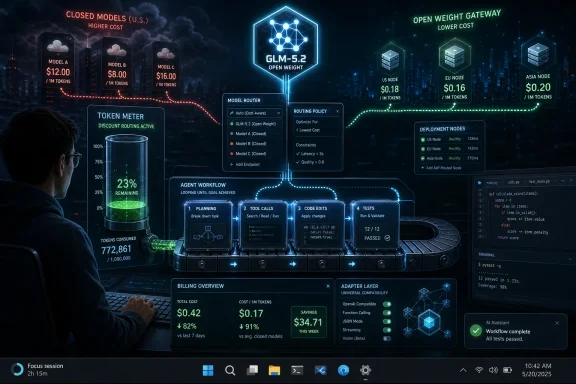 The New Threat Is Not a Chatbot, It Is a Line Item
The excitement around GLM-5.2 is unusually practical. Developers are not merely asking whether it can write a poem, summarize a PDF, or pass a benchmark. They are asking whether it can sit inside coding tools, run long-context agent workflows, generate front-end applications, and complete tasks without bankrupting the usage budget.That matters because the industry’s most valuable AI use cases are increasingly agentic. A model is no longer asked to answer one prompt and stop. It is asked to plan, call tools, inspect results, revise its own work, and continue until a task is finished. Each of those steps consumes tokens, and each token has a price.
This is where closed U.S. frontier models have begun to create sticker shock. A coding agent that loops through a repository, reads logs, edits files, runs tests, and tries again may generate enormous input and output volumes. The better the agent becomes, the more tempting it is to use it for larger jobs. The larger the job, the more visible the bill becomes.
GLM-5.2’s pitch lands directly in that pressure point. It does not need to be the undisputed best model in the world to change buying behavior. It only needs to be good enough for a meaningful slice of coding and agent work while being much cheaper to run. In software, “good enough and much cheaper” has a long history of beating “best and expensive,” especially when the cheaper option can be deployed flexibly.
For Windows developers and IT shops, the significance is immediate. AI coding assistants are moving from novelty to infrastructure, sitting in IDEs, CI/CD workflows, documentation pipelines, help desks, and internal automation tools. Once those workflows become recurring operational expenses, model selection starts to look less like a research decision and more like cloud cost management.
DeepSeek Opened the Door; GLM-5.2 Walked Into the Toolchain
DeepSeek’s early-2025 impact was dramatic because it challenged a market story. The prevailing assumption was that the frontier belonged to a handful of U.S. companies with massive capital budgets, privileged chip access, and hyperscaler partnerships. DeepSeek complicated that picture by showing that a Chinese model could be surprisingly capable and cheap enough to rattle investors.GLM-5.2 is now testing a more consequential claim: whether Chinese models can become part of the Western developer workflow rather than just a geopolitical talking point. The model’s climb on routing platforms such as OpenRouter is important because those platforms are where developers compare models by actual use, not by vendor keynote. If a model is unreliable, awkward, expensive, or weak in common tasks, developers tend to move on quickly.
The model’s reported strength in coding and front-end generation is also not incidental. Coding is the wedge market for advanced AI because it has built-in feedback. The code runs or it does not. The test passes or it fails. The website renders correctly or it breaks. This makes model quality easier to judge than in open-ended business prose, and it gives cheaper challengers a clear path to credibility.
Open-weight distribution sharpens that advantage. A closed API can be excellent, but it leaves customers dependent on the provider’s pricing, availability, policy changes, and regional access rules. An open-weight model gives advanced users and vendors more room to host, tune, route, inspect, and package it for specific environments. That flexibility is not the same as trust, but it is a form of leverage.
The result is a miniature replay of cloud history. Enterprises originally bought cloud services for convenience, then spent years trying to regain control over cost, portability, and vendor concentration. AI may compress that cycle into months. GLM-5.2 arrives at the moment when developers are asking whether they need one supreme model for everything, or a portfolio of models routed by task, price, latency, and risk.
Benchmarks Are Finally Pointing at Work People Actually Do
The AI industry has spent years arguing over benchmark theater. Every model launch arrives with charts showing selective wins, carefully framed comparisons, and suspiciously convenient axes. Yet GLM-5.2’s buzz is harder to dismiss because some of the most interesting signals are tied to developer-facing evaluations rather than abstract exam scores.Rankings that measure front-end generation, code repair, and broad “intelligence” are still imperfect. They can be gamed, they can overfit to popular tasks, and they often lag the messy reality of production use. But they are closer to the workflows where buyers are spending money. A model that can generate a coherent interface, reason through a repository, or serve as a coding agent is not merely winning trivia contests.
That is why GLM-5.2’s position on third-party leaderboards has generated so much attention. A Chinese open-weight model does not need to beat every OpenAI or Anthropic system across every benchmark to become disruptive. It simply needs to sit close enough to the top while charging a fraction of the price. In model markets, relative value can be more destabilizing than absolute victory.
This is also why the phrase “mini DeepSeek moment” fits better than a more dramatic claim. GLM-5.2 does not appear to have detonated the entire AI market in the way DeepSeek did. But it has created a focal point for developers who already suspected that the proprietary frontier was becoming expensive, constrained, and over-centralized.
The most serious reading is that GLM-5.2 represents a narrowing of usable capability, not a final crossing of the frontier. The former is enough. In enterprise technology, broad availability of near-frontier capability often matters more than possession of the single best system under laboratory conditions.
Washington’s Model Controls May Have Created Their Own Stress Test
The timing of GLM-5.2’s rise is impossible to separate from U.S. policy volatility around advanced models. Reports of restrictions, staged rollouts, and government scrutiny of high-capability Anthropic and OpenAI systems have made model access feel less predictable. Even when the rationale is national security, the market effect is straightforward: developers begin looking for alternatives that are less likely to vanish behind a compliance gate.This is a delicate point. There are real reasons for governments to care about powerful AI systems, especially when they can assist cyber operations, automate vulnerability discovery, or lower the skill floor for misuse. No serious analysis should pretend that frontier model access is just another consumer software preference.
But policy can produce second-order effects. If U.S. firms face unpredictable constraints while foreign open-weight models remain broadly available, the restriction may not eliminate capability from the world. It may simply reroute demand toward models that are harder to supervise. That is the strategic anxiety behind the sudden Western interest in GLM-5.2.
The irony is sharp. U.S. companies have spent years arguing that closed models are safer because they can be monitored, rate-limited, updated, and withheld. Open-weight models challenge that safety model by making capability more portable. If open models approach the quality of restricted closed models, regulators face a harder problem: controlling the most visible American providers does not control the global capability curve.
For CIOs and CISOs, this means AI governance can no longer be written around brand names alone. A policy that approves or blocks “OpenAI,” “Anthropic,” or “Chinese models” is too crude for a world of model routers, local deployments, third-party wrappers, and fine-tuned derivatives. The relevant questions are increasingly about data flow, hosting jurisdiction, logging, retention, evaluation, and task boundary.
Open Weight Does Not Mean Open Trust
The phrase open-weight is doing a lot of work in this debate. It usually means the model weights are available under terms that permit downloading, hosting, or adaptation. It does not automatically mean the training data is transparent, the safety process is auditable, the model is free of political constraints, or the supply chain is acceptable for regulated use.That distinction matters for GLM-5.2 because its greatest strength in developer circles is also the source of enterprise hesitation. If a model can be hosted outside the original vendor’s cloud, many data-security objections become more manageable. A bank, defense contractor, or healthcare organization may reasonably prefer a model it can run in a controlled environment over a foreign API endpoint.
Still, self-hosting does not erase every concern. Enterprises must consider license terms, provenance, model behavior, update control, vulnerability handling, and whether internal data could be exposed through poorly configured tooling. They must also ask whether the organization has the expertise to operate a powerful model safely. Running your own AI stack is not the same as installing a printer driver.
The geopolitical layer is even harder. Some U.S. and European customers will reject Chinese models regardless of hosting architecture, either because of formal rules or because the reputational risk is too high. Others will quietly test them behind firewalls, especially for low-risk code generation, internal prototypes, or non-sensitive workloads where price dominates.
This is why the most plausible adoption pattern is not mass defection from OpenAI and Anthropic. It is partial routing. A company might keep U.S. frontier models for sensitive strategy work, regulated workflows, or tasks requiring the strongest safety assurances, while using GLM-5.2 or similar models for coding drafts, UI generation, test scaffolding, documentation, and internal automation.
That hybrid world is less dramatic than a winner-take-all narrative. It is also more damaging to incumbent pricing power.
The Enterprise Buyer Is Learning to Arbitrage Models
For the past two years, many organizations treated AI model selection as a prestige ladder. The default assumption was that the newest flagship model from a top U.S. lab was the safest choice, even if it was expensive. That was understandable when capabilities were uneven and the cost of failure was high.But the market is maturing into something more like compute procurement. Buyers are learning that not every task requires the best model. Some jobs need maximum reasoning. Others need long context, low latency, cheap bulk generation, predictable formatting, or local deployment. A single-model strategy becomes harder to justify when a cheaper model performs well enough for 60 or 70 percent of the workload.
This is where model routers become strategically important. Platforms that let developers swap between models make price-performance differences visible. They also reduce switching costs. If GLM-5.2 can be dropped into familiar coding agents or API-compatible workflows, the old moat of developer habit weakens.
WindowsForum readers will recognize the pattern from decades of enterprise IT. The official corporate standard is often one thing; the toolchain reality is another. Developers adopt what works, then procurement catches up. Shadow IT becomes pilot program, pilot program becomes supported platform, and supported platform becomes budget line.
AI vendors know this, which is why developer mindshare matters so much. A model that wins hobbyists and startup engineers today may become the default option inside enterprise tooling tomorrow. The path from GitHub experiment to corporate dependency is shorter than most governance teams would like.
Anthropic and OpenAI Still Have Moats, But They Are Narrower Than They Look
It would be foolish to declare OpenAI and Anthropic suddenly cornered. They retain enormous advantages in research talent, infrastructure, product integration, enterprise sales, safety engineering, and ecosystem reach. Their models are deeply embedded in applications, workflows, and procurement contracts. They also benefit from trust among customers who would rather defend a U.S. vendor choice than explain a Chinese model in a board meeting.But moats can shrink without disappearing. The strongest U.S. labs have often sold a bundle: frontier quality, managed access, reliability, safety, support, and prestige. GLM-5.2 attacks the bundle by separating quality from the rest. If a cheaper open-weight model is close enough for key tasks, customers can decide when they actually need the full proprietary package.
That kind of unbundling is dangerous. It does not require the challenger to replace the incumbent everywhere. It only requires enough substitution to pressure margins, weaken pricing discipline, and force incumbents to justify premium tiers more concretely.
OpenAI and Anthropic may respond by lowering prices, improving smaller models, expanding enterprise controls, or making their own routing more transparent. They may also lean harder into trust, compliance, and safety as differentiators. Those are real strengths, especially for regulated industries.
Yet even trust has to be priced. If the premium becomes too large, the market will segment. Highly regulated buyers will pay for the safest and most contractually defensible option. Startups, independent developers, and cost-sensitive teams will route around it. Mid-market companies will do both and hope their governance documents catch up.
The China Catch-Up Debate Is Too Simple
The question “Has China caught up?” invites a bad answer. AI capability is not a single race with one finish line. It is a messy collection of research advances, training efficiency, inference cost, chip access, data pipelines, deployment ecosystems, safety regimes, and customer trust.On some dimensions, U.S. labs still appear ahead. The top proprietary systems remain deeply capable, heavily capitalized, and tightly integrated into Western enterprise software. They also benefit from access to hyperscaler infrastructure and mature go-to-market channels that Chinese startups cannot easily replicate in the U.S. and Europe.
On other dimensions, Chinese firms are clearly more competitive than many in Washington or Silicon Valley expected. They have shown an ability to produce strong open models, optimize around hardware constraints, and move aggressively on price. Their models are also attractive to developers in regions where U.S. pricing, access restrictions, or political alignment are less favorable.
The better framing is that the AI race is becoming asymmetric. U.S. labs may hold the absolute frontier at any given moment, while Chinese open-weight models compress the lag and spread capability broadly. That is a nightmare for anyone who assumes leadership is measured only by the best model behind a restricted API.
This asymmetry is especially relevant for software development. If the best proprietary model is 10 percent better but six times more expensive, many teams will not care. If the open model is weaker in high-stakes reasoning but strong in code generation and UI work, it can still win huge volumes of practical usage. In markets, volume can be its own form of power.
Security Teams Will Not Get a Simple Answer
For defenders, GLM-5.2 cuts in two directions. Cheaper agentic coding models can help security teams triage alerts, generate detection logic, inspect code, and automate tedious analysis. Smaller organizations that could not afford heavy use of premium U.S. models may suddenly gain access to powerful assistance.The same economics apply to attackers. If capable models become cheaper and more deployable, the cost of automating reconnaissance, phishing infrastructure, vulnerability research, and malware iteration may fall. The security community has already been debating this problem for years, but open-weight near-frontier systems make the debate less theoretical.
That does not mean every powerful open model is a cyber catastrophe. Models are tools, and their impact depends on surrounding systems, expertise, guardrails, and operational context. But defenders should assume that capability diffusion is real. If a model can help a legitimate developer reason across a codebase, it can also help an adversary reason across exposed software.
This has implications for Windows administrators. AI-assisted attacks are likely to increase pressure on patch management, identity hygiene, endpoint telemetry, and least-privilege enforcement. The answer is not to panic about one Chinese model. The answer is to recognize that the automation curve is bending upward for everyone.
Organizations should also avoid magical thinking about vendor safety. A closed model with strong safeguards may reduce some risks, but it does not stop adversaries from using other models. Defensive planning has to assume broad access to capable automation, not privileged access to one lab’s API.
The Real Market Shift Is From Model Loyalty to Model Routing
The most lasting consequence of GLM-5.2 may be psychological. Developers are being trained to think of models as interchangeable components. That is a major shift from the early ChatGPT era, when the product and the model were nearly synonymous in public imagination.In the agent era, the interface may matter more than the model brand. A developer using Cursor, Cline, Claude Code-style workflows, OpenRouter, or a custom internal agent may care primarily about results. If the model slot can be swapped, the vendor relationship becomes less sticky.
This is a familiar platform inversion. The company that owns the user interface, workflow, or routing layer can arbitrage model suppliers underneath. Model labs then compete not only on intelligence but also on price, latency, context length, uptime, compliance, and special-purpose performance. That is a colder, more commoditized market than today’s AI hype cycle suggests.
OpenAI and Anthropic understand this risk, which is why they are building products as well as models. Microsoft understands it too, which is why Copilot is not just a model wrapper but a distribution strategy across Windows, Microsoft 365, GitHub, Azure, and enterprise identity. The model is critical, but the workflow is where habits form.
GLM-5.2 does not need to win the consumer chatbot war to matter. It only needs to be a strong option in the routing menu. Once developers expect that menu to exist, every model vendor faces permanent comparison.
GLM-5.2 Turns the AI Race Into a Procurement Problem
The most concrete lesson from GLM-5.2 is that model capability is becoming a budget and governance issue as much as a research contest. The model’s rise does not make every claim about Chinese AI dominance true. It does make it harder for U.S. vendors to rely on a simple “we are the frontier” argument when customers can see cheaper models performing well in daily work.- GLM-5.2 matters because it appears strongest in coding and agentic workflows, where token consumption and recurring costs are especially visible.
- Its open-weight nature gives developers and vendors more deployment flexibility, but it does not automatically solve enterprise trust, provenance, or compliance concerns.
- U.S. model restrictions may protect some sensitive capabilities, but they also risk pushing global developers toward less controllable alternatives.
- The likely adoption pattern is partial routing rather than wholesale replacement of OpenAI or Anthropic.
- Regulated industries will move slowly, while startups and cost-sensitive engineering teams are likely to experiment much faster.
- The strategic pressure on U.S. labs is not only to build smarter models, but to make premium models easier to justify economically.
References
- Primary source: Devdiscourse
Published: Thu, 02 Jul 2026 07:15:34 GMT
ANALYSIS-A new, inexpensive Chinese AI model is catching up with Anthropic, OpenAI on their home turf | Technology
A new AI model, GLM-5.2, from Beijing-based Z.ai, is gaining traction in Silicon Valley with capabilities rivaling top US models at a significantly lower cost.www.devdiscourse.com - Related coverage: forbes.com
Buckle Up: The Bad Guys Now Have A Model As Powerful As Mythos
China now has an open-weight model that can find software vulnerabilities and create attacks for anybody to use.www.forbes.com - Related coverage: wisgate.ai
GLM-5.2 and GPT-5.6 Show the New Frontier Model Access Problem - WisGate
GLM-5.2 and GPT-5.6 Show the New Frontier Model Access Problemwisgate.ai - Related coverage: tomshardware.com
CEO of Chinese Anthropic rival tells Elon Musk that China will have a Fable 5-class AI model before next year — it ‘won’t take that long’ says Jie Tang in response to Musk's prediction of a Q1 target | Tom's Hardware
A Chinese AI lab is allegedly catching up with Anthropic.www.tomshardware.com
