

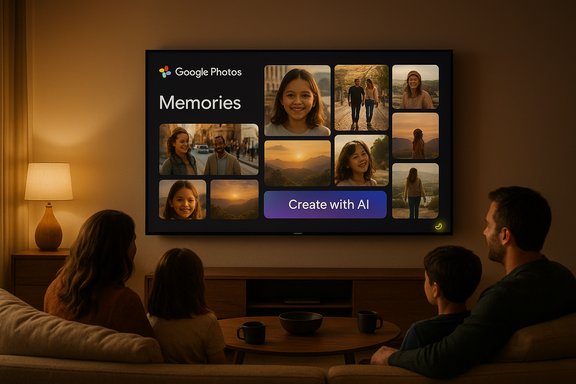
Samsung and Google are preparing to bring Google Photos to the living room at last — and Samsung’s Tizen-powered sets will be the first to get the deeper integration, starting with a curated “Memories” experience in March 2026 and broader AI-powered creation and search tools later in 2026.
Smart TVs have long supported screensaver-style access to cloud photo libraries, but a fully native, integrated Google Photos experience has been conspicuously absent from most television platforms — including Google’s own Google TV/Android TV ecosystem. That gap has left users casting from phones, sideloading apps, or using limited album screensavers rather than enjoying a TV-first gallery and creation workflow. Coverage across major outlets and Samsung’s own announcement confirm that the new effort is explicitly designed to change that by embedding Google Photos into Samsung’s TV UX and Vision AI surface.
Source: Notebookcheck Google Photos is coming to Samsung smart TVs first, while other TVs will have to wait a little longer
 Background
Smart TVs have long supported screensaver-style access to cloud photo libraries, but a fully native, integrated Google Photos experience has been conspicuously absent from most television platforms — including Google’s own Google TV/Android TV ecosystem. That gap has left users casting from phones, sideloading apps, or using limited album screensavers rather than enjoying a TV-first gallery and creation workflow. Coverage across major outlets and Samsung’s own announcement confirm that the new effort is explicitly designed to change that by embedding Google Photos into Samsung’s TV UX and Vision AI surface. Why this matters now
Televisions sit at the center of the home’s shared display experience. Turning Google Photos into a cinematic, TV-native gallery increases the utility of the big screen for families and groups who want to browse, reminisce, and create together. Samsung frames the integration as a deeper, contextual feature — not just an app port to a larger canvas — and promises to weave photos into ambient and daily experiences on the TV.What Samsung announced — three feature pillars
Samsung’s press materials and subsequent reporting lay out a three-stage plan for Google Photos on Samsung TVs:- Memories: a curated, cinematic presentation of photos and videos grouped by people, places and meaningful moments. Planned to debut in March 2026 and to be exclusive to Samsung TVs for six months.
- Create with AI: template-driven creative tools powered by Google’s image models (notably Gemini Nano Banana / Nano Banana technology) that let users apply themed templates, use Remix-style art transformations, and convert stills into short videos (“Photo to Video”). These creation tools are scheduled for the second half of 2026, with select templates or creative features marked as Samsung exclusives.
- Personalized Results (Search/Slideshows): topic- or content-based slideshows and search-driven organization (e.g., “hiking” or “Paris” groupings) to surface related memories in a TV-friendly slideshow format. This will also roll out later in 2026.
How the integration will look and feel
Deep integration with TV UX
Samsung describes the experience as “deeply woven” into the TV’s day-to-day surfaces rather than being a stand‑alone app tucked into an app drawer. Expect photos and Memories to surface inside hubs like Daily+ and Daily Board, and to be presented in large, cinematic layouts optimized for viewing across a room. The idea is to make photos feel like part of the TV’s ambient identity rather than something you must explicitly open each time.Sign-in & privacy UX
User entry is straightforward: signing into the TV with a Google Account should unlock the Google Photos library for display on that TV. That convenience raises predictable privacy and account-management questions on a communal device; Samsung’s release and industry coverage explicitly flag per-model and per-region differences in how features and sign-in flows behave. Users will need to weigh convenience against the shared nature of living-room devices.Technical and AI details
Nano Banana and generative tools
Samsung’s announcement highlights Nano Banana (a Google DeepMind image-generation/editing model) as the backbone for the TV’s Create with AI capabilities. That includes themed templates, Remix-style style transfers, and Photo to Video features that animate still images into short clips. Those capabilities reflect Google Photos’ evolution toward embedded generative tools, adapted for a TV-first interaction model.On-device vs cloud processing
While Samsung positions some features as tightly integrated with the TV’s on-device Vision AI Companion and Tizen UX, heavier generative tasks and search indexing are likely cloud-assisted. Samsung’s overall TV AI strategy — rolled out earlier with Vision AI Companion — uses a hybrid edge/cloud approach that keeps latency-sensitive tasks local while routing complex reasoning and generation to cloud agents. That hybrid architecture is a practical necessity given TV SoC limitations and the compute demands of generative models. The Vision AI Companion context and multi-agent approach are documented in Samsung’s product coverage and technical explainers.Cross-checking the claims — independent corroboration
Key timetable and exclusivity claims in Samsung’s release appear consistently across major independent outlets:- The March 2026 debut for Memories and the stated six‑month Samsung exclusivity window are explicitly called out in Samsung’s press release and reproduced by The Verge and TechCrunch.
- The later-2026 rollout for Create with AI and personalized search/slideshow features is also listed in Samsung’s materials and independently reported by Android Central, Android Authority, and TechCrunch.
What’s new vs. today’s options
Today, TV owners use several workarounds to get Google Photos on a big screen: casting from a phone, using limited screensaver features (e.g., Google Photos as a screensaver on Google TV), or sideloading apps on some platforms. Those methods don’t offer the sort of curated, editing-enabled, TV-first experience Samsung now promises. The announced plan replaces a patchwork of hacks with a prospectus for native browsing, AI editing, and contextual surfacing on the TV. Android Authority and other outlets emphasize that this is an important step because even Google’s own TV platform lacks a full native Photos app today.Product positioning and business implications
- Samsung gains a visible, consumer-friendly exclusivity window for a high-profile Google service, which can be marketed as a family-friendly differentiator for 2026 models. The six-month exclusive can help Samsung embed Photos into its Vision AI experience and measure engagement metrics.
- For Google, expanding Google Photos to TVs broadens ecosystem lock-in: users who rely on Google Photos will now have an additional reason to prefer TVs that support the feature natively.
- Other TV platforms (Android TV/Google TV, LG webOS, Roku) are likely to follow after the exclusivity period ends, but the timing and parity of those ports remain unknown. Multiple outlets assumed broader availability would follow the Samsung window, but the details will depend on partner agreements and UI adaptation work.
Strengths: What this integration gets right
- Designed for the living room. Presentations, slideshows, and AI creations tuned for couch-distance viewing and collective experience play to the TV’s strengths. Samsung’s emphasis on Daily+ and Daily Board integration means photos will be ambient, shareable, and less friction-filled than phone casting.
- Accessible creative tools. Bringing Nano Banana–powered templates and Remix-style editing to the TV reduces friction for non-expert users who want to turn images into short videos or stylized assets without exporting to a phone or PC.
- Simple setup flow. Google Account sign-in on the TV is a low barrier to entry for most users and keeps the experience consistent across devices.
- Ecosystem play. For Samsung, adding Google Photos strengthens the proposition of Vision AI Companion and One UI Tizen as an ecosystem where third-party services are surfaced as first-class household features. The multi-agent AI strategy Samsung has been promoting is a natural match for Google Photos’ cloud-based capabilities.
Risks and limitations — what to watch closely
- Privacy on a shared device. Signing a Google Account into a communal TV raises immediate privacy concerns. Memories and creation tools may surface personal content in family spaces. Users should be aware of profile, guest, and account sign‑out controls — and consider disabling certain features or creating limited, shared profiles when appropriate. Samsung notes region and model variation in how features function; consumers should verify per-model privacy controls.
- Cloud dependency and latency. Generative edits and advanced search will rely on cloud services. Households with constrained upload bandwidth or intermittent connectivity may see degraded performance for creation features that require server-side processing. Samsung’s hybrid edge/cloud strategy mitigates some latency-sensitive tasks, but heavy generation will still need back-end compute.
- Fragmented device support. Samsung’s announcement makes clear that availability depends on model year and firmware schedule. Buyers of older Samsung sets should not assume immediate parity; some 2023–2025 models may require OS updates or might not support full generative features. Independent coverage consistently warns about fragmentation and regional rollouts.
- Exclusivity doesn’t mean permanence. The six-month exclusive for Memories is a limited commercial window. After that, other TV platforms may add similar integrations — but the speed and fidelity of their implementations are uncertain.
- Regulatory and API changes. Past policy shifts around Google Photos APIs illustrate how platform-level changes can unexpectedly affect third-party displays and frames. For example, Google tightened certain APIs in 2025, disrupting automatic sync features for some digital photo frames; a TV partnership mitigates some of that by using official flows, but future API or privacy policy changes could still change how memories sync and display. Users and integrators should be alert to API policy timelines and terms.
Practical user guidance — preparing for Google Photos on your TV
- Review account sharing and profile options on your Samsung TV before signing in. Create a dedicated “family” or guest-friendly profile if the TV will display personal content.
- Check Google Photos settings on your phone: if you don’t want certain Memories to appear on a shared screen, disable Memories or sensitive content features in Google Photos settings ahead of time.
- Keep firmware updated and confirm your specific TV model’s compatibility via Samsung’s support pages; 2026 models and selected in-market models will get the feature via OS updates at different times.
- If privacy is a priority, consider network segmentation (put smart home devices and TVs on a separate VLAN) and enable two-factor authentication on Google and Samsung accounts.
- For households with limited upload bandwidth, expect creation features that generate video to take longer; test performance before planning shared viewing sessions.
Broader implications for the smart-TV ecosystem
- This move re-frames TVs as not just passive entertainment devices but as social, creative hubs integrated with a user’s broader cloud identity. The combination of curated Memories and AI generation tools could accelerate a trend toward more collaborative, shared, media-creation use cases centered on the TV.
- Manufacturers that don’t secure similar integrations risk being perceived as less friendly to family-sharing scenarios. Samsung’s timed exclusives and deep UX embedding are competitive levers other vendors will likely match or counter with their own partnerships.
- App-level and platform-level consistency will become a competitive factor — users will expect parity across phones, tablets, and TVs. The big question is how quickly Google Photos itself will become a first-class TV app on Android TV/Google TV and non‑Samsung platforms; today’s announcement hints at broader availability after Samsung’s exclusivity but does not commit to specific partners or dates.
Critical assessment — strengths and unanswered questions
Samsung and Google’s plan addresses a clear user need: a polished, living-room-friendly way to revisit and rework photos and short clips on the biggest in-home screen. The three-stage rollout is logical: launch curated viewing (Memories), then add creative tools and deeper personalization once the base UX proves stable and adoption is measured. The use of Google’s Nano Banana model suggests the edits will be competitive with current mobile-first generative tools. That said, several practical and policy questions remain:- How granular will per-profile and per-user privacy controls be on a shared television? The announcement promises simple sign-in but does not detail account separation, quick lockouts, or ephemeral guest modes.
- Which in-market models (2023–2025) will actually get the full Create with AI toolset vs only Memories? Samsung’s caveat about model and regional variation implies non-trivial differences in support.
- How will Google and Samsung handle content moderation, offensive-image generation requests, or deepfake risks on a shared TV? Public-facing guardrails for generative features on large, communal displays are not yet spelled out.
- Finally, the commercial terms (six-month exclusivity, selective template exclusives) could prompt competing platforms to push their own deals — potentially fragmenting feature parity across TVs for users who care about specific template sets or creation tools.
Conclusion
The arrival of Google Photos as a native, TV-integrated experience on Samsung’s Tizen-powered TVs is a meaningful inflection point for how families will interact with photos and short-form video on the home’s largest screen. The phased rollout — Memories first in March 2026 with a six-month Samsung exclusivity followed by Create with AI and Personalized Results later in 2026 — is well-sourced across Samsung’s press materials and independent reporting. The strengths are obvious: a more cinematic way to relive memories, accessible AI-powered creative tools, and a simpler sign-in flow. The tradeoffs are also clear: privacy on shared devices, cloud dependencies, model- and region-level fragmentation, and unanswered moderation and account-handling details. Consumers should prepare by auditing Google Photos settings, using profiles and guest modes on their TVs, and checking Samsung’s model-by-model compatibility as firmware updates roll out. In short, this is a major consumer-facing expansion for Google Photos and an immediate UX win for Samsung’s Vision AI strategy — but the real test will be how well Samsung and Google address privacy, feature parity, and performance across the broad array of in-market devices and household network conditions.Source: Notebookcheck Google Photos is coming to Samsung smart TVs first, while other TVs will have to wait a little longer
