

Erling Haaland’s visible preference for Xbox, highlighted in a July 2026 Windows Central report built around a social video of his console setup, gives Microsoft a rare kind of gaming endorsement: a global football star appearing to choose the platform without a campaign brief. That matters because Xbox’s public problem has not been awareness; it has been confidence. In a cycle where Microsoft’s gaming strategy is often defined by platform ambiguity, layoffs, Game Pass math, and PlayStation comparisons, Haaland casually sitting beside Xbox hardware says something a press release cannot. The world’s most frightening striker may not fix Xbox’s brand problem, but he shows exactly what kind of brand problem Xbox has.
The interesting part of the Haaland clip is not that a footballer plays video games. Elite athletes have been doing that publicly for years, and EA’s football series has long blurred the line between dressing room ritual and commercial ecosystem. The interesting part is that Haaland’s gaming identity, at least in this little public window, does not look focus-grouped.
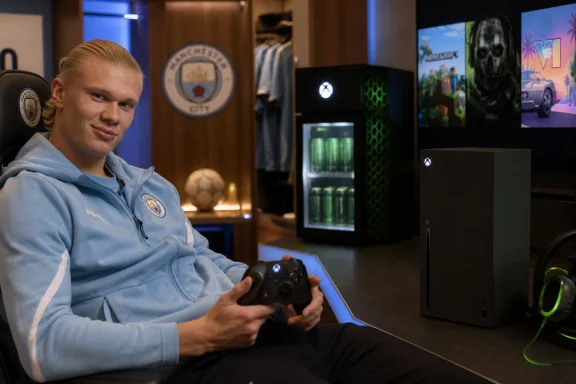
Windows Central’s Richard Devine framed the moment with the proper amount of tribal mischief: Haaland is a Manchester City and Norway star, which makes him difficult to praise for some English football fans, but he is apparently an “XBOX man.” The video circulating via yoxic on X showed Haaland’s Xbox, some of his favorite games, and even the Xbox Series X mini fridge, that strange meme-product that somehow became one of Microsoft’s most successful pieces of brand self-awareness.
That detail matters more than it should. A console on a shelf can be sponsorship inventory. A novelty mini fridge is fandom. It says the owner is at least comfortable enough with the brand’s jokes to keep the punchline in the room.
For Xbox, this is the kind of accidental authenticity that modern brand teams spend millions trying to manufacture. Haaland reportedly talking up Grand Theft Auto, the original Modern Warfare 2, Minecraft, and football games is not a polished “gaming ambassador” reel. It is closer to a locker-room inventory, and that makes it more valuable.
That is the gap Haaland accidentally fills. He is not explaining Xbox’s strategy. He is simply using it.
The console wars are less economically important than they were in the Xbox 360 era, but the emotional residue remains powerful. Players still talk about platforms as identities, not just purchase decisions. Microsoft can tell investors that reach matters more than exclusivity, but fans still respond to visible proof that people they admire choose the green box when nobody appears to be forcing them.
That is why a footballer’s game shelf becomes a miniature brand event. Haaland is not merely a celebrity. He is a shorthand for dominance, youth, athletic efficiency, and global reach. If he is waiting for GTA 6 on Xbox, then Xbox briefly stops looking like the platform that has to defend itself.
The better detail is Modern Warfare 2 — and, specifically, the apparent clarification that he meant the original Call of Duty: Modern Warfare 2 rather than the 2022 reboot. Windows Central’s piece rightly treats this as a relief, because there is a wide gulf between praising one of the defining multiplayer shooters of the Xbox 360 era and elevating a more recent reboot to all-time status.
That preference tells a story about what Xbox still owns culturally, even when it struggles commercially. The 2009 Modern Warfare 2 era was Xbox Live at its swaggering peak: party chat, prestige grinding, lobbies full of chaos, and a sense that online console gaming had found its native language. It was messy, occasionally toxic, technically imperfect, and completely era-defining.
For a player like Haaland, born in 2000, that game sits in the sweet spot between childhood mythology and adolescent habit. It is not nostalgia borrowed from older players; it is nostalgia from the last moment when Xbox felt like the obvious center of multiplayer culture. Microsoft now owns Activision Blizzard, but ownership alone does not automatically recover that emotional territory. Haaland’s offhand affection for the old Modern Warfare 2 does more to remind people of it than another brand integration ever could.
Minecraft is not an Xbox exclusive in the old sense, and that is precisely why it matters. Microsoft’s smartest gaming acquisitions have not been about locking every user to a single box. They have been about owning persistent cultural infrastructure: games people live inside, return to, mod, stream, teach, and pass down.
When a footballer with Haaland’s profile is associated with Minecraft, the brand signal is softer but wider. This is not just a shooter audience. It is a builder’s game, a hangout space, a creative tool, and for many younger players a first language of digital play.
That helps Xbox escape the narrow frame of “hardcore console preference.” Haaland’s apparent library spans blockbuster open worlds, legacy shooters, sports simulation, and sandbox creativity. It looks like the actual gaming diet of someone who plays because games are part of the week, not because a platform holder delivered talking points.
Xbox, at its best, can still do this. It can be self-deprecating without looking weak. It can turn industrial design mockery into an object fans want in their rooms. The mini fridge is dumb in exactly the way good fan culture often is: unnecessary, affectionate, and impossible to justify with a spreadsheet.
Seeing one in Haaland’s orbit is therefore a useful reminder. Xbox’s problem is not that people cannot recognize the brand. It is that the brand’s human temperature has fluctuated wildly. The mini fridge is warm precisely because it is so cold.
Microsoft should pay attention to that paradox. The company’s gaming division often talks in systems: ecosystems, entitlements, cloud libraries, cross-device access, and subscription value. But players form attachments around symbols. Sometimes the symbol is a controller. Sometimes it is a startup sound. Sometimes, apparently, it is a tiny refrigerator shaped like a console.
But there is also danger in moving too quickly. The moment is valuable because it feels unforced. Turn it into a glossy campaign too aggressively and Xbox risks sanding off exactly what made it work.
Sports endorsements are not new, of course. What has changed is the level of skepticism around influencer culture. Audiences have become fluent in the grammar of paid enthusiasm: the suspiciously framed desk setup, the too-clean product placement, the caption that sounds like it passed through three approval layers. Athletes can fall into that trap as easily as streamers.
Yet athletes still have one advantage. Their main job is visibly separate from the product. Haaland does not need Xbox to be famous. He does not need a console partnership to reach teenagers. That independence makes any genuine preference feel more credible.
That is the useful precedent for Haaland. Xbox did not have to invent Littler’s gaming identity from scratch. It amplified something that already existed. The best version of a Haaland partnership would follow the same rule.
The worst version would be a generic “Haaland joins Team Xbox” campaign with a few staged controller shots and a sweepstakes. The better version would lean into the specificity: the games he actually plays, the way footballers use gaming to decompress, the overlap between football fandom and multiplayer culture, and the simple fact that even absurdly successful people wait for the same delayed games as everyone else.
There is also a geographic layer. Haaland is Norwegian, stars for Manchester City, and has a massive following across Europe and beyond. Xbox has often had a tougher fight in many global markets than PlayStation, particularly where Sony’s brand presence has been culturally entrenched for generations. A Haaland partnership would not reverse that by itself, but it would give Xbox a football-native route into audiences that do not wake up thinking about console strategy.
Xbox has repeatedly tried to find sports-adjacent visibility, from team partnerships to celebrity tie-ins, but football remains a difficult terrain because the gaming relationship is so dominated by EA’s annual football title and by platform marketing deals that shift over time. The console itself can become secondary to where a player’s friends are, where the best Ultimate Team habits formed, or which controller someone used as a kid.
That is why organic player preference is so valuable. It cuts through the contractual fog. If Haaland is seen using Xbox, the message is not “this platform has secured rights to appear next to football.” It is “this footballer plays here.”
That distinction is small but powerful. One is inventory. The other is identity.
Microsoft’s challenge is to avoid treating football culture like a billboard. Football fans are especially sensitive to fakery because the sport is already saturated with sponsors, betting brands, crypto misadventures, sleeve patches, stadium naming deals, and global tours dressed up as tradition. If Xbox wants to turn Haaland’s preference into a relationship, it should do less selling and more listening.
A celebrity choosing Xbox should not matter much if the future is truly device-agnostic. And yet it plainly does. The reason is simple: ecosystems may be abstract, but loyalty is physical. People still point at the box under the television.
Microsoft’s expansion to PC, cloud, and rival consoles may be commercially rational. In fact, it may be necessary. The cost of blockbuster development, the limits of subscription growth, and the sheer size of the PlayStation and Nintendo audiences all push Xbox toward a broader publishing model.
But the broader Xbox becomes, the more it needs visible anchors. Hardware can be one anchor. Game Pass can be another. Cultural association is a third, and perhaps the hardest to buy directly.
That is why Haaland’s Xbox setup lands differently from a corporate statement. It reassures fans that the box is still a living object in the culture. Someone with every entertainment option available still has one.
The long wait since GTA 5 has become its own cultural joke. Windows Central noted that Haaland was only 13 when GTA 5 first launched, which is a neat way to measure the absurd span between releases. In that time, he became one of the most feared strikers in world football, while much of the gaming public remained stuck in the same Los Santos traffic.
For Xbox, the GTA 6 cycle is a stress test. If Microsoft’s console business still has mass-market pull, Rockstar’s launch window is where that pull should become visible. If consumers decide platform based on friends lists, controller preference, performance expectations, and ecosystem comfort, every public sign of high-profile Xbox enthusiasm helps.
Haaland’s preference will not decide console sales. But celebrity signals matter most around shared cultural events. GTA 6 is not just another release; it is the sort of game that reactivates casual players who may not follow showcases, subscription tiers, or hardware rumors. When those players look around to see where the action is, Xbox benefits from every authentic reminder that it remains part of the main stage.
A smarter campaign would be built around credibility rather than polish. Let him talk about the old Modern Warfare 2. Let him explain why Minecraft stays installed. Let the mini fridge remain silly. Let EA FC be obvious, because of course a footballer plays football games. Do not pretend any of this is revolutionary.
The point is not that Haaland has obscure taste. The point is that his taste is legible. Millions of players recognize that mix of comfort games, competitive games, and anticipated blockbusters. The overlap is the value.
This is where Xbox’s current uncertainty can become an advantage. Microsoft is no longer just selling a console under the television; it is selling continuity across console, PC, cloud, and owned franchises. A player like Haaland can embody that without saying the words “ecosystem strategy,” which should be legally banned from consumer advertising anyway.
Xbox is one of Microsoft’s few businesses where emotional loyalty matters as much as utility. Windows can be the default because work requires it. Azure can win because procurement, compliance, and enterprise architecture say so. Xbox has to be wanted.
That makes these cultural moments strategically relevant. They are reminders that Microsoft’s consumer credibility cannot be managed purely through bundling, account systems, and service integration. People need to feel that the platform is alive.
The Windows connection is not incidental either. Xbox’s future increasingly runs through Windows PCs, handheld-style devices, Game Pass on desktop, cross-buy entitlements, and cloud streaming. If Xbox can regain cultural confidence, that helps Microsoft’s gaming layer across Windows. If Xbox becomes merely a publisher logo, Windows loses one of its most emotionally resonant consumer bridges.
A better move would connect Haaland to a broader Xbox sports-and-gaming identity. Not just football, not just EA FC, and not just celebrity gifting. The real lane is how elite young athletes actually play: late-night decompression, competitive trash talk, shared lobbies, old favorites, new obsessions, and the comfort of games that exist away from cameras.
Microsoft has the pieces. It owns Minecraft. It owns Call of Duty. It has Game Pass. It has a console brand that still means something even when executives insist the definition is expanding. It has previous experience with Luke Littler, whose Xbox connection felt natural because it was already part of his story.
The risk is that Microsoft treats Haaland as a shortcut to cool rather than evidence of where cool already exists. Xbox does not need to borrow his personality. It needs to make room for the version of Xbox his setup already suggests: social, unpretentious, a little nostalgic, and still capable of being the default choice for people who could choose anything.
 Haaland Gives Xbox the Thing Marketing Departments Usually Fake
The interesting part of the Haaland clip is not that a footballer plays video games. Elite athletes have been doing that publicly for years, and EA’s football series has long blurred the line between dressing room ritual and commercial ecosystem. The interesting part is that Haaland’s gaming identity, at least in this little public window, does not look focus-grouped.Windows Central’s Richard Devine framed the moment with the proper amount of tribal mischief: Haaland is a Manchester City and Norway star, which makes him difficult to praise for some English football fans, but he is apparently an “XBOX man.” The video circulating via yoxic on X showed Haaland’s Xbox, some of his favorite games, and even the Xbox Series X mini fridge, that strange meme-product that somehow became one of Microsoft’s most successful pieces of brand self-awareness.
That detail matters more than it should. A console on a shelf can be sponsorship inventory. A novelty mini fridge is fandom. It says the owner is at least comfortable enough with the brand’s jokes to keep the punchline in the room.
For Xbox, this is the kind of accidental authenticity that modern brand teams spend millions trying to manufacture. Haaland reportedly talking up Grand Theft Auto, the original Modern Warfare 2, Minecraft, and football games is not a polished “gaming ambassador” reel. It is closer to a locker-room inventory, and that makes it more valuable.
Xbox Needs Cultural Proof More Than Another Strategy Memo
Microsoft has spent years explaining what Xbox is becoming. It is a console brand, a PC gaming storefront, a cloud platform, a subscription service, a publisher, a mobile gaming aspirant, and increasingly a supplier of games to rival hardware. Each of those positions is defensible on its own. Together, they make Xbox feel less like a team badge and more like a corporate org chart.That is the gap Haaland accidentally fills. He is not explaining Xbox’s strategy. He is simply using it.
The console wars are less economically important than they were in the Xbox 360 era, but the emotional residue remains powerful. Players still talk about platforms as identities, not just purchase decisions. Microsoft can tell investors that reach matters more than exclusivity, but fans still respond to visible proof that people they admire choose the green box when nobody appears to be forcing them.
That is why a footballer’s game shelf becomes a miniature brand event. Haaland is not merely a celebrity. He is a shorthand for dominance, youth, athletic efficiency, and global reach. If he is waiting for GTA 6 on Xbox, then Xbox briefly stops looking like the platform that has to defend itself.
The Modern Warfare 2 Detail Is the Tell
The most revealing game on Haaland’s list is not GTA. Everyone is waiting for GTA. Rockstar’s next release has become less a game launch than a generational timestamp, the sort of event that makes people remember where they were when the trailer dropped.The better detail is Modern Warfare 2 — and, specifically, the apparent clarification that he meant the original Call of Duty: Modern Warfare 2 rather than the 2022 reboot. Windows Central’s piece rightly treats this as a relief, because there is a wide gulf between praising one of the defining multiplayer shooters of the Xbox 360 era and elevating a more recent reboot to all-time status.
That preference tells a story about what Xbox still owns culturally, even when it struggles commercially. The 2009 Modern Warfare 2 era was Xbox Live at its swaggering peak: party chat, prestige grinding, lobbies full of chaos, and a sense that online console gaming had found its native language. It was messy, occasionally toxic, technically imperfect, and completely era-defining.
For a player like Haaland, born in 2000, that game sits in the sweet spot between childhood mythology and adolescent habit. It is not nostalgia borrowed from older players; it is nostalgia from the last moment when Xbox felt like the obvious center of multiplayer culture. Microsoft now owns Activision Blizzard, but ownership alone does not automatically recover that emotional territory. Haaland’s offhand affection for the old Modern Warfare 2 does more to remind people of it than another brand integration ever could.
Minecraft Makes the Endorsement Broader Than Console Tribalism
Minecraft’s presence on Haaland’s Xbox is equally useful, but for the opposite reason. Modern Warfare 2 evokes a specific Xbox era. Minecraft evokes Microsoft’s more durable gaming advantage: owning worlds that outgrew platforms.Minecraft is not an Xbox exclusive in the old sense, and that is precisely why it matters. Microsoft’s smartest gaming acquisitions have not been about locking every user to a single box. They have been about owning persistent cultural infrastructure: games people live inside, return to, mod, stream, teach, and pass down.
When a footballer with Haaland’s profile is associated with Minecraft, the brand signal is softer but wider. This is not just a shooter audience. It is a builder’s game, a hangout space, a creative tool, and for many younger players a first language of digital play.
That helps Xbox escape the narrow frame of “hardcore console preference.” Haaland’s apparent library spans blockbuster open worlds, legacy shooters, sports simulation, and sandbox creativity. It looks like the actual gaming diet of someone who plays because games are part of the week, not because a platform holder delivered talking points.
The Mini Fridge Still Explains Xbox Better Than the Console Does
The Xbox Series X mini fridge began as a joke about the console’s monolithic shape and became a real product because the internet would not let the joke die. That is the kind of brand elasticity Microsoft rarely gets. It is difficult to imagine Azure becoming funny on purpose, or Windows Update turning a meme into merchandise without first making half the room nervous.Xbox, at its best, can still do this. It can be self-deprecating without looking weak. It can turn industrial design mockery into an object fans want in their rooms. The mini fridge is dumb in exactly the way good fan culture often is: unnecessary, affectionate, and impossible to justify with a spreadsheet.
Seeing one in Haaland’s orbit is therefore a useful reminder. Xbox’s problem is not that people cannot recognize the brand. It is that the brand’s human temperature has fluctuated wildly. The mini fridge is warm precisely because it is so cold.
Microsoft should pay attention to that paradox. The company’s gaming division often talks in systems: ecosystems, entitlements, cloud libraries, cross-device access, and subscription value. But players form attachments around symbols. Sometimes the symbol is a controller. Sometimes it is a startup sound. Sometimes, apparently, it is a tiny refrigerator shaped like a console.
Sports Stars Are the Last Authentic Influencers Left Standing
There is a reason the Haaland moment immediately prompted calls for Xbox executives and marketers to get involved. Windows Central pointed to Xbox CEO Asha Sharma and longtime Xbox marketing figure Aaron Greenberg as obvious people for fans to tag, and the instinct is sound. If one of the world’s most recognizable footballers is giving your platform free cultural lift, the marketing department should at least be awake.But there is also danger in moving too quickly. The moment is valuable because it feels unforced. Turn it into a glossy campaign too aggressively and Xbox risks sanding off exactly what made it work.
Sports endorsements are not new, of course. What has changed is the level of skepticism around influencer culture. Audiences have become fluent in the grammar of paid enthusiasm: the suspiciously framed desk setup, the too-clean product placement, the caption that sounds like it passed through three approval layers. Athletes can fall into that trap as easily as streamers.
Yet athletes still have one advantage. Their main job is visibly separate from the product. Haaland does not need Xbox to be famous. He does not need a console partnership to reach teenagers. That independence makes any genuine preference feel more credible.
The Luke Littler Precedent Shows the Playbook
The obvious comparison is Luke Littler, the darts phenomenon whose Xbox fandom turned into an official partnership. TechRadar reported in late 2024 that Xbox had teamed up with Littler ahead of the PDC World Darts Championship, and Windows Central later covered Xbox’s collaboration with Target Darts as part of a wider push into the sport. The strategy made sense because Littler’s Xbox affinity was already part of his public image.That is the useful precedent for Haaland. Xbox did not have to invent Littler’s gaming identity from scratch. It amplified something that already existed. The best version of a Haaland partnership would follow the same rule.
The worst version would be a generic “Haaland joins Team Xbox” campaign with a few staged controller shots and a sweepstakes. The better version would lean into the specificity: the games he actually plays, the way footballers use gaming to decompress, the overlap between football fandom and multiplayer culture, and the simple fact that even absurdly successful people wait for the same delayed games as everyone else.
There is also a geographic layer. Haaland is Norwegian, stars for Manchester City, and has a massive following across Europe and beyond. Xbox has often had a tougher fight in many global markets than PlayStation, particularly where Sony’s brand presence has been culturally entrenched for generations. A Haaland partnership would not reverse that by itself, but it would give Xbox a football-native route into audiences that do not wake up thinking about console strategy.
Microsoft’s Football Problem Has Always Been Bigger Than EA FC
Football is the world’s most useful marketing language because it is both local and global. A player can be hated by rival fans on Saturday and still admired by teenagers halfway around the world on Sunday. Haaland embodies that perfectly: a club villain to some, a national hero to others, and a highlight-machine to nearly everyone.Xbox has repeatedly tried to find sports-adjacent visibility, from team partnerships to celebrity tie-ins, but football remains a difficult terrain because the gaming relationship is so dominated by EA’s annual football title and by platform marketing deals that shift over time. The console itself can become secondary to where a player’s friends are, where the best Ultimate Team habits formed, or which controller someone used as a kid.
That is why organic player preference is so valuable. It cuts through the contractual fog. If Haaland is seen using Xbox, the message is not “this platform has secured rights to appear next to football.” It is “this footballer plays here.”
That distinction is small but powerful. One is inventory. The other is identity.
Microsoft’s challenge is to avoid treating football culture like a billboard. Football fans are especially sensitive to fakery because the sport is already saturated with sponsors, betting brands, crypto misadventures, sleeve patches, stadium naming deals, and global tours dressed up as tradition. If Xbox wants to turn Haaland’s preference into a relationship, it should do less selling and more listening.
The Console War Is Over, Except When It Isn’t
The Haaland moment also exposes the contradiction at the heart of Xbox discourse in 2026. Microsoft has spent years telling the market that Xbox is not merely a console. Fans have spent the same years asking whether that means the console still matters.A celebrity choosing Xbox should not matter much if the future is truly device-agnostic. And yet it plainly does. The reason is simple: ecosystems may be abstract, but loyalty is physical. People still point at the box under the television.
Microsoft’s expansion to PC, cloud, and rival consoles may be commercially rational. In fact, it may be necessary. The cost of blockbuster development, the limits of subscription growth, and the sheer size of the PlayStation and Nintendo audiences all push Xbox toward a broader publishing model.
But the broader Xbox becomes, the more it needs visible anchors. Hardware can be one anchor. Game Pass can be another. Cultural association is a third, and perhaps the hardest to buy directly.
That is why Haaland’s Xbox setup lands differently from a corporate statement. It reassures fans that the box is still a living object in the culture. Someone with every entertainment option available still has one.
GTA 6 Turns Every Platform Preference Into a Public Statement
Haaland’s apparent excitement for GTA 6 is the least surprising part of the story, but it is also the most commercially important. Few games have the power to make dormant console owners re-evaluate their setups. GTA does.The long wait since GTA 5 has become its own cultural joke. Windows Central noted that Haaland was only 13 when GTA 5 first launched, which is a neat way to measure the absurd span between releases. In that time, he became one of the most feared strikers in world football, while much of the gaming public remained stuck in the same Los Santos traffic.
For Xbox, the GTA 6 cycle is a stress test. If Microsoft’s console business still has mass-market pull, Rockstar’s launch window is where that pull should become visible. If consumers decide platform based on friends lists, controller preference, performance expectations, and ecosystem comfort, every public sign of high-profile Xbox enthusiasm helps.
Haaland’s preference will not decide console sales. But celebrity signals matter most around shared cultural events. GTA 6 is not just another release; it is the sort of game that reactivates casual players who may not follow showcases, subscription tiers, or hardware rumors. When those players look around to see where the action is, Xbox benefits from every authentic reminder that it remains part of the main stage.
The Best Xbox Ad Is a Player Who Does Not Sound Like an Ad
The key lesson for Microsoft is restraint. The company should absolutely explore a Haaland relationship if the interest is real. It should also resist the temptation to flatten him into a standard ambassador asset.A smarter campaign would be built around credibility rather than polish. Let him talk about the old Modern Warfare 2. Let him explain why Minecraft stays installed. Let the mini fridge remain silly. Let EA FC be obvious, because of course a footballer plays football games. Do not pretend any of this is revolutionary.
The point is not that Haaland has obscure taste. The point is that his taste is legible. Millions of players recognize that mix of comfort games, competitive games, and anticipated blockbusters. The overlap is the value.
This is where Xbox’s current uncertainty can become an advantage. Microsoft is no longer just selling a console under the television; it is selling continuity across console, PC, cloud, and owned franchises. A player like Haaland can embody that without saying the words “ecosystem strategy,” which should be legally banned from consumer advertising anyway.
Where WindowsForum Readers Should See the Bigger Pattern
For Windows enthusiasts and IT pros, the Haaland story may look like entertainment fluff. It is, on the surface. But consumer brand heat has a way of feeding back into Microsoft’s broader platform story.Xbox is one of Microsoft’s few businesses where emotional loyalty matters as much as utility. Windows can be the default because work requires it. Azure can win because procurement, compliance, and enterprise architecture say so. Xbox has to be wanted.
That makes these cultural moments strategically relevant. They are reminders that Microsoft’s consumer credibility cannot be managed purely through bundling, account systems, and service integration. People need to feel that the platform is alive.
The Windows connection is not incidental either. Xbox’s future increasingly runs through Windows PCs, handheld-style devices, Game Pass on desktop, cross-buy entitlements, and cloud streaming. If Xbox can regain cultural confidence, that helps Microsoft’s gaming layer across Windows. If Xbox becomes merely a publisher logo, Windows loses one of its most emotionally resonant consumer bridges.
The Haaland Playbook Is Obvious, Which Is Why Microsoft Can Still Botch It
The simplest move would be to send Haaland some custom hardware and get a social post out of it. That would generate engagement, headlines, and probably a few jokes about Manchester City’s trophy cabinet needing another fridge. It would also be the least ambitious version of the idea.A better move would connect Haaland to a broader Xbox sports-and-gaming identity. Not just football, not just EA FC, and not just celebrity gifting. The real lane is how elite young athletes actually play: late-night decompression, competitive trash talk, shared lobbies, old favorites, new obsessions, and the comfort of games that exist away from cameras.
Microsoft has the pieces. It owns Minecraft. It owns Call of Duty. It has Game Pass. It has a console brand that still means something even when executives insist the definition is expanding. It has previous experience with Luke Littler, whose Xbox connection felt natural because it was already part of his story.
The risk is that Microsoft treats Haaland as a shortcut to cool rather than evidence of where cool already exists. Xbox does not need to borrow his personality. It needs to make room for the version of Xbox his setup already suggests: social, unpretentious, a little nostalgic, and still capable of being the default choice for people who could choose anything.
The Striker, the Mini Fridge, and the Marketing Brief Microsoft Should Not Overwrite
Haaland’s Xbox moment is small, but small cultural signals often reveal more than formal announcements. If Microsoft is smart, it will see this less as a celebrity endorsement waiting to be harvested and more as a reminder of what Xbox looks like when it escapes the boardroom.- Haaland’s apparent Xbox preference gives Microsoft a rare endorsement that feels organic rather than scripted.
- The original Modern Warfare 2 reference reconnects Xbox with one of the strongest multiplayer eras in the brand’s history.
- Minecraft broadens the signal beyond shooter nostalgia and points to Microsoft’s strength in persistent, cross-generational games.
- The Xbox Series X mini fridge matters because it shows affection for the brand’s culture, not just its hardware.
- Luke Littler’s Xbox partnership provides a useful precedent, but Haaland’s scale would require a lighter and more careful touch.
- Microsoft should amplify the moment only if it can preserve the authenticity that made people notice it in the first place.
References
- Primary source: Windows Central
Published: 2026-07-06T12:25:07.333870
Loading…
www.windowscentral.com - Related coverage: techradar.com
Loading…
www.techradar.com - Related coverage: xboxera.com
Loading…
xboxera.com - Related coverage: xbox.com
Loading…
www.xbox.com - Related coverage: news.xbox.com
DMZ - New Intel on Call of Duty’s Extraction Shooter Experience - XBOX Wire
Today at #XBOXGamesShowcase, Activision and Infinity Ward revealed the first look at DMZ, the definitive Call of Duty extraction shooter experience. Learn more: news.xbox.com
- Related coverage: windowsforum.com
Loading…
windowsforum.com
