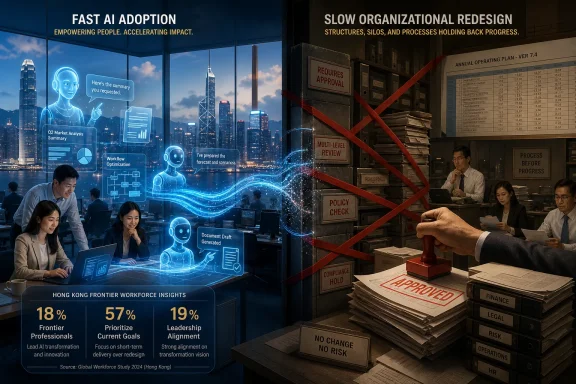
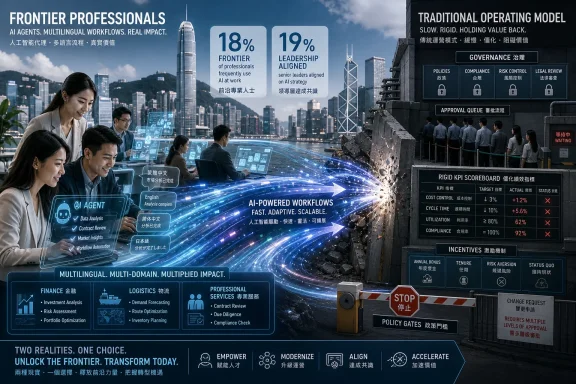
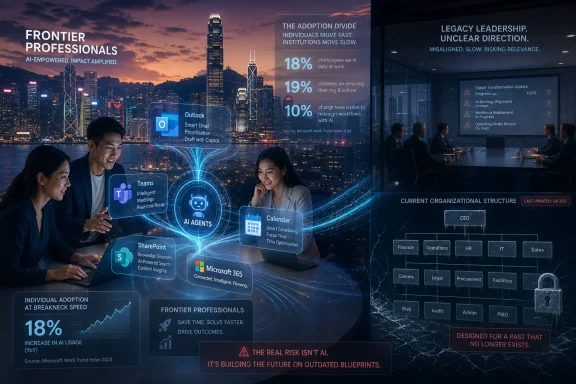
Microsoft’s 2026 Work Trend Index says Hong Kong AI users are adopting AI faster than their organizations are redesigning work around it, with 18 percent classified as “Frontier Professionals” versus 16 percent globally, even as local employees report weaker leadership alignment and fewer incentives to reinvent workflows. That is not a story about Hong Kong workers lagging behind the AI curve. It is a story about workers arriving early and finding the office still arranged for yesterday’s tools. The uncomfortable conclusion is that AI maturity is becoming less a software deployment problem than a management problem.
The headline number looks flattering at first glance. Hong Kong has a higher share of Microsoft’s most advanced AI users than the global benchmark, which suggests that the city’s professional workforce is not waiting for permission to experiment. In a market built on finance, logistics, trade, professional services, and regional headquarters work, that should not surprise anyone. Knowledge workers in Hong Kong have always had to move quickly because the city’s economy rewards speed, fluency, and cross-border coordination.
But the more interesting finding is not that 18 percent of Hong Kong AI users fall into Microsoft’s “Frontier Professional” category. It is that this group exists inside organizations that are often not behaving like frontier organizations. The worker may have learned to treat AI as a thinking partner, drafting engine, analyst, and workflow accelerator. The company around that worker may still be measuring performance, assigning tasks, and approving change as if AI were merely a faster autocomplete box.
That mismatch is the core tension in Microsoft’s local findings. Hong Kong employees are feeling more pressure than the global average to adapt to AI, yet they are also more likely than the global average to prioritize current goals over redesigning work. This is the paradox of adoption without authority. People may see the future arriving, but if their quarterly objectives, manager expectations, compliance rules, and reward systems still point toward the old playbook, the rational move is to keep the old playbook and sprinkle AI on top.
That should ring familiar to IT departments. A new platform enters the enterprise with transformative promises, then gets trapped inside legacy processes. The organization buys cloud but keeps the same approval chains. It rolls out collaboration tools but preserves meeting culture. It deploys AI assistants and then asks employees to hit the same metrics in the same workflows, only faster.
In Hong Kong, Microsoft says this group is slightly larger than the global average. That small numerical lead matters less as a league-table victory than as an early signal. Hong Kong has a cohort of workers who are already proving that AI fluency is not evenly distributed inside organizations. Some employees are operating with a new production model, while others are still using AI as a novelty or avoiding it because the rules are unclear.
The gap between these groups will not remain a soft cultural issue for long. In any workplace where one employee can produce credible analysis, polished drafts, data summaries, client materials, and process documentation at a meaningfully higher rate, the baseline expectation of work begins to shift. Managers may not formally rewrite job descriptions, but expectations migrate anyway. What was exceptional becomes normal. What was normal starts to look slow.
That is why the Frontier Professional category should make executives uneasy. It shows that AI adoption can advance from the bottom up, but organizational redesign cannot. A single employee can reinvent a personal workflow. A team can experiment with shared prompts and review patterns. But questions about accountability, quality standards, auditability, data boundaries, client disclosure, and incentive structures eventually require management to do more than applaud innovation from a town hall stage.
This is the part of the AI wave that executives often underestimate. Employees do not merely need access to a tool; they need permission structures. They need to know when AI use is expected, when it is discouraged, when it must be disclosed, what data must never enter a model, how AI-assisted work will be judged, and whether time spent redesigning a process will be treated as valuable work or as a distraction from “real” deliverables.
The report’s reward finding reinforces the point. Just 10 percent of Hong Kong AI users say they are rewarded for reinventing work with AI even when the results are not immediate, compared with 13 percent globally. Neither number suggests a corporate world ready for experimental transformation. They suggest a world that wants AI benefits without paying the short-term cost of experimentation.
That is a recipe for shallow adoption. Workers will use AI to polish emails, summarize meetings, and draft first-pass documents because those are low-risk, high-convenience uses. They will be far more cautious about redesigning a client intake process, rethinking a compliance workflow, or replacing a weekly reporting ritual with an AI-mediated dashboard if the organization still rewards visible busyness and punishes failed experiments.
The result is a familiar enterprise anti-pattern: everyone talks about transformation, but the incentive system favors optimization at the margins. AI becomes a layer on top of old work rather than a reason to ask why the old work exists.
If a worker is under pressure to deliver today’s targets, and if management has not made space for experimentation, the old process has one overwhelming advantage: it is defensible. It may be inefficient, but everyone understands it. It may waste time, but it has precedent. It may produce mediocre results, but it rarely requires an employee to explain why they trusted an AI-generated workflow that failed.
AI redesign, by contrast, introduces ambiguity. The employee must decide what can be delegated, how outputs should be checked, who owns the final decision, and whether a manager will view the experiment as initiative or recklessness. In regulated sectors, those questions become even sharper. Hong Kong’s heavy exposure to finance, insurance, legal services, and cross-border business makes governance inseparable from productivity.
That is why the “safe path” matters. In most companies, the safest path is not the most innovative one. It is the one least likely to trigger blame. Unless leaders explicitly change what safety means, employees will continue to bolt AI onto familiar workflows rather than redesign the workflow itself.
Microsoft’s own framing makes this point, even if it is naturally interested in selling the tools that sit beneath the change. The company’s broader Work Trend Index argues that AI impact depends heavily on organizational factors: culture, manager support, process redesign, and leadership alignment. That is a convenient argument for Microsoft because it shifts the conversation from “does Copilot work?” to “are you managing the transition properly?” But convenience does not make it wrong.
Quality standards are the unglamorous heart of enterprise AI. The public conversation still tends to orbit model capability, hallucinations, benchmarks, and feature announcements. Inside a workplace, however, the practical question is usually simpler: what does “good enough” look like when AI helped produce the work?
A manager who can answer that question gives employees room to move. They can say which outputs require human verification, which sources are acceptable, how uncertainty should be flagged, and when speed should yield to accuracy. Without that guidance, AI use becomes a private gamble. Some workers will overtrust the machine, others will avoid it entirely, and many will use it quietly while pretending the output came from a conventional process.
The same pattern appears in experimentation. Microsoft says 80 percent of Frontier Professionals in Hong Kong report that their manager creates space for experimentation, compared with 61 percent of Non-Frontier Professionals. Again, the point is not that every manager must become an AI researcher. It is that workers need sanctioned time and psychological cover to test new methods before those methods become reliable.
Then comes ambition. Microsoft says 81 percent of Frontier Professionals say their manager encourages more ambitious work redesign, compared with 63 percent of Non-Frontier Professionals. That is the difference between “use AI to write this faster” and “ask whether this entire reporting process should exist in this form.” The first saves minutes. The second can change the operating model.
AI is more powerful than those earlier waves because it operates closer to the substance of knowledge work. It does not merely store files, route messages, or automate forms. It drafts arguments, summarizes meetings, writes code, generates spreadsheets, proposes decisions, and turns messy human intent into executable sequences. That makes the upside larger, but it also makes unmanaged adoption more consequential.
For Windows and Microsoft 365 administrators, the Hong Kong findings should read less like a workplace-culture story and more like an implementation warning. Tenant settings, licensing, data-loss prevention policies, sensitivity labels, audit logs, and plugin controls are necessary. They are not sufficient. If the business side cannot define acceptable use and success criteria, IT will be left governing a social transformation with administrative toggles.
That is a bad place to be. IT can decide which apps are enabled, which connectors are blocked, and which data can be surfaced. It cannot decide whether a sales team should rebuild proposal generation around AI, whether legal wants AI-assisted clause comparison, or whether finance will accept AI-generated variance explanations. Those choices require business owners who understand both the work and the risk.
The practical burden will still fall heavily on IT, because it always does. When AI output is wrong, when confidential information appears in the wrong context, when an employee depends on an unapproved model, or when a department buys its own shadow AI subscription, the cleanup usually lands on technology teams. The Hong Kong data suggests that without stronger leadership alignment, that burden will grow.
But leverage is not the same as transformation. A junior analyst can use AI to produce a first draft faster. A relationship manager can summarize a client history in seconds. A compliance officer can ask for a plain-English explanation of a policy change. Those are useful improvements, but they do not automatically change how decisions are made, how handoffs work, or how accountability is assigned.
This is why Hong Kong’s higher pressure to adapt matters. Microsoft says 75 percent of Hong Kong AI users feel pressure to adapt to AI, compared with 65 percent globally. Pressure can accelerate learning, but it can also produce performative adoption. Employees may feel compelled to say they are using AI, to attend training, to add AI-assisted language to performance reviews, or to produce more output without any serious redesign of the job.
The risk is that AI becomes another productivity squeeze. If organizations use AI mainly to raise expectations while leaving old processes intact, workers will experience the technology as intensification rather than empowerment. More drafts, more meetings summarized, more dashboards generated, more follow-ups automated — but not necessarily fewer pointless rituals. That is how a tool sold as liberation becomes a faster treadmill.
For Hong Kong employers competing for talent, this distinction matters. The best AI users will not merely ask whether a company has Copilot licenses. They will ask whether the company knows what it wants people to do differently. They will look for managers who can set standards, protect experimentation, and reward redesign. If those conditions are absent, advanced users may conclude that the organization is asking them to bring frontier skills to a legacy operating model.
Yet vendor self-interest does not invalidate the diagnosis. If anything, Microsoft’s findings are notable because they highlight constraints that more software alone cannot solve. A company can license every employee for AI assistance and still fail to capture much value if managers discourage experimentation, leaders disagree on priorities, and employees are punished for work that does not generate immediate returns.
That admission matters. It means the AI market is entering a more difficult phase. The first phase was access: could employees get a capable assistant? The second phase was usage: would they actually use it? The third phase is redesign: can the organization change how work is structured so that AI is not just an accessory?
This third phase is where enterprise software projects often lose momentum. Access and usage are easy to count. Redesign is political. It threatens old roles, exposes redundant processes, changes power dynamics, and forces uncomfortable conversations about what work is valuable. It also requires leaders to tolerate temporary messiness in pursuit of longer-term productivity.
Hong Kong’s numbers suggest that many employees already understand the stakes. They feel pressure to adapt. Some are already operating at a frontier level. But they are not seeing enough alignment, recognition, or permission from above. That is not a user adoption problem. It is a governance and leadership problem wearing a user adoption costume.
Microsoft’s broader AI strategy is plainly moving in that direction. Copilot is no longer just a sidebar that answers questions. The company is pushing toward agents that can coordinate tasks, interact with business data, and participate in workflows across Microsoft 365 and third-party systems. Whether every product name sticks is less important than the direction of travel: AI is moving from conversation to action.
That shift makes the Hong Kong findings more urgent. If employees already lack leadership alignment for today’s AI use, what happens when AI systems can do more than draft and summarize? If only a small minority feel rewarded for reinventing work without immediate results, who will do the hard process redesign required before agents start acting inside operational systems?
Security teams will immediately see the problem. Agentic AI expands the importance of identity, least privilege, data classification, and monitoring. A poorly scoped human account is already dangerous. A poorly scoped agent acting at machine speed is worse. The more capable the AI becomes, the more damaging unclear governance can be.
But this is not only a security issue. It is also a labor and management issue. When an agent handles parts of a workflow, the human role shifts toward supervision, exception handling, judgment, and accountability. Organizations that do not define those roles will produce confusion. Workers will not know whether they are being augmented, measured against machines, or quietly asked to manage risk without authority.
The distinction is not academic. If employees use AI to draft client communications, who is responsible for tone, accuracy, and claims? If AI summarizes a legal or compliance document, what level of human review is required? If AI generates code, what security checks must follow? If AI recommends a decision, how should uncertainty be represented? These are management decisions before they are technical settings.
Hong Kong’s Frontier Professionals appear to be getting more of that structure from their managers than other workers do. That implies that manager behavior is not a soft variable at the edge of the AI story. It is part of the deployment architecture. A good manager becomes a control plane for judgment, standards, and experimentation.
This has implications for training budgets. Many organizations still treat AI training as a user-skills exercise: prompt better, summarize faster, learn the tool. That is necessary, but incomplete. The more valuable training may be for managers: how to define AI-ready work, how to review AI-assisted output, how to set experimentation boundaries, how to reward process improvement, and how to identify when a workflow should be redesigned rather than accelerated.
It also means that HR and IT need to stop treating AI adoption as separate domains. HR owns incentives, roles, learning, and performance management. IT owns systems, data, access, and security. AI cuts directly across both. If those functions are not aligned, employees will receive mixed signals: encouraged to innovate in one channel, constrained or ignored in another.
The practical next step is not another generic AI awareness campaign. Most knowledge workers are already aware. The harder task is to identify which workflows are worth redesigning, which teams have managers capable of supporting experimentation, and which governance gaps would become dangerous if AI use scaled from individual assistance to agentic execution.
A mature organization will not ask every worker to become a frontier user overnight. It will create patterns that make good AI use repeatable. That means approved templates, review standards, shared examples, internal communities of practice, and clear escalation routes when AI output is uncertain or risky. It also means changing performance systems so that employees are not penalized for spending time on redesign that may not pay off immediately.
There is a Windows parallel here too. Administrators learned long ago that standardization is not the enemy of productivity; bad standardization is. The goal is not to lock down AI until it becomes useless. The goal is to make the right path easier than the risky path. When approved tools are slow, policies are vague, and incentives are misaligned, shadow AI will flourish.
Hong Kong’s results show what happens when employees move faster than the institution. The talent is there. The pressure is there. The tools are increasingly there. What remains scarce is organizational courage: the willingness to change how work is assigned, evaluated, and rewarded.
That requires less theater and more operating discipline.
 Hong Kong Has the Talent Before It Has the Operating Model
The headline number looks flattering at first glance. Hong Kong has a higher share of Microsoft’s most advanced AI users than the global benchmark, which suggests that the city’s professional workforce is not waiting for permission to experiment. In a market built on finance, logistics, trade, professional services, and regional headquarters work, that should not surprise anyone. Knowledge workers in Hong Kong have always had to move quickly because the city’s economy rewards speed, fluency, and cross-border coordination.But the more interesting finding is not that 18 percent of Hong Kong AI users fall into Microsoft’s “Frontier Professional” category. It is that this group exists inside organizations that are often not behaving like frontier organizations. The worker may have learned to treat AI as a thinking partner, drafting engine, analyst, and workflow accelerator. The company around that worker may still be measuring performance, assigning tasks, and approving change as if AI were merely a faster autocomplete box.
That mismatch is the core tension in Microsoft’s local findings. Hong Kong employees are feeling more pressure than the global average to adapt to AI, yet they are also more likely than the global average to prioritize current goals over redesigning work. This is the paradox of adoption without authority. People may see the future arriving, but if their quarterly objectives, manager expectations, compliance rules, and reward systems still point toward the old playbook, the rational move is to keep the old playbook and sprinkle AI on top.
That should ring familiar to IT departments. A new platform enters the enterprise with transformative promises, then gets trapped inside legacy processes. The organization buys cloud but keeps the same approval chains. It rolls out collaboration tools but preserves meeting culture. It deploys AI assistants and then asks employees to hit the same metrics in the same workflows, only faster.
The Frontier Professional Is Not a Persona, but a Warning Light
Microsoft’s term “Frontier Professional” has the faint smell of a product-marketing coinage, but the underlying distinction matters. These are not simply people who have opened Copilot more often than their peers. They are workers who have begun to rebuild parts of their job around AI: using it to reason, test ideas, draft alternatives, summarize complexity, automate fragments of routine work, and challenge the boundaries of what one person can produce.In Hong Kong, Microsoft says this group is slightly larger than the global average. That small numerical lead matters less as a league-table victory than as an early signal. Hong Kong has a cohort of workers who are already proving that AI fluency is not evenly distributed inside organizations. Some employees are operating with a new production model, while others are still using AI as a novelty or avoiding it because the rules are unclear.
The gap between these groups will not remain a soft cultural issue for long. In any workplace where one employee can produce credible analysis, polished drafts, data summaries, client materials, and process documentation at a meaningfully higher rate, the baseline expectation of work begins to shift. Managers may not formally rewrite job descriptions, but expectations migrate anyway. What was exceptional becomes normal. What was normal starts to look slow.
That is why the Frontier Professional category should make executives uneasy. It shows that AI adoption can advance from the bottom up, but organizational redesign cannot. A single employee can reinvent a personal workflow. A team can experiment with shared prompts and review patterns. But questions about accountability, quality standards, auditability, data boundaries, client disclosure, and incentive structures eventually require management to do more than applaud innovation from a town hall stage.
Microsoft’s Numbers Expose a Leadership Gap Hiding in Plain Sight
The most damning Hong Kong finding is not about enthusiasm. It is about alignment. Only 19 percent of Hong Kong AI users say their leadership is clearly and consistently aligned on AI, compared with 26 percent globally. The global number is already low enough to suggest that many organizations are improvising. Hong Kong’s lower figure suggests an even sharper disconnect between strategic rhetoric and operational clarity.This is the part of the AI wave that executives often underestimate. Employees do not merely need access to a tool; they need permission structures. They need to know when AI use is expected, when it is discouraged, when it must be disclosed, what data must never enter a model, how AI-assisted work will be judged, and whether time spent redesigning a process will be treated as valuable work or as a distraction from “real” deliverables.
The report’s reward finding reinforces the point. Just 10 percent of Hong Kong AI users say they are rewarded for reinventing work with AI even when the results are not immediate, compared with 13 percent globally. Neither number suggests a corporate world ready for experimental transformation. They suggest a world that wants AI benefits without paying the short-term cost of experimentation.
That is a recipe for shallow adoption. Workers will use AI to polish emails, summarize meetings, and draft first-pass documents because those are low-risk, high-convenience uses. They will be far more cautious about redesigning a client intake process, rethinking a compliance workflow, or replacing a weekly reporting ritual with an AI-mediated dashboard if the organization still rewards visible busyness and punishes failed experiments.
The result is a familiar enterprise anti-pattern: everyone talks about transformation, but the incentive system favors optimization at the margins. AI becomes a layer on top of old work rather than a reason to ask why the old work exists.
The Safe Path Is Winning Because Companies Made It Safer
The Hong Kong data point that 57 percent of AI users prioritize current goals over redesigning work with AI, compared with 45 percent globally, is easy to misread as conservatism. It may be closer to realism. Employees are not irrationally resisting change; they are responding to the risk environment their organizations have created.If a worker is under pressure to deliver today’s targets, and if management has not made space for experimentation, the old process has one overwhelming advantage: it is defensible. It may be inefficient, but everyone understands it. It may waste time, but it has precedent. It may produce mediocre results, but it rarely requires an employee to explain why they trusted an AI-generated workflow that failed.
AI redesign, by contrast, introduces ambiguity. The employee must decide what can be delegated, how outputs should be checked, who owns the final decision, and whether a manager will view the experiment as initiative or recklessness. In regulated sectors, those questions become even sharper. Hong Kong’s heavy exposure to finance, insurance, legal services, and cross-border business makes governance inseparable from productivity.
That is why the “safe path” matters. In most companies, the safest path is not the most innovative one. It is the one least likely to trigger blame. Unless leaders explicitly change what safety means, employees will continue to bolt AI onto familiar workflows rather than redesign the workflow itself.
Microsoft’s own framing makes this point, even if it is naturally interested in selling the tools that sit beneath the change. The company’s broader Work Trend Index argues that AI impact depends heavily on organizational factors: culture, manager support, process redesign, and leadership alignment. That is a convenient argument for Microsoft because it shifts the conversation from “does Copilot work?” to “are you managing the transition properly?” But convenience does not make it wrong.
Middle Managers Are Becoming the Real AI Infrastructure
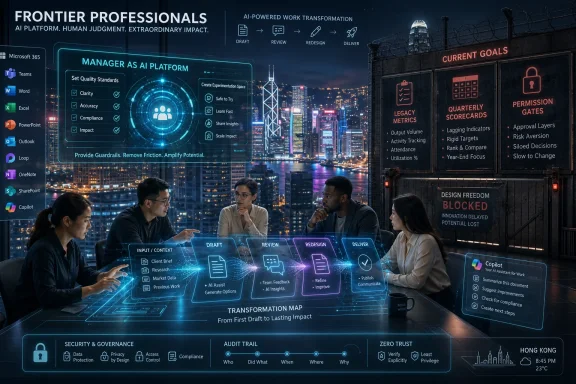
One of the most revealing parts of the Hong Kong release is the difference in manager behavior between Frontier Professionals and everyone else. Microsoft says 79 percent of Frontier Professionals report that their manager sets quality standards for AI work, compared with 59 percent of Non-Frontier Professionals. That is not a trivial gap. It suggests that advanced AI use flourishes where managers turn vague permission into concrete expectations.Quality standards are the unglamorous heart of enterprise AI. The public conversation still tends to orbit model capability, hallucinations, benchmarks, and feature announcements. Inside a workplace, however, the practical question is usually simpler: what does “good enough” look like when AI helped produce the work?
A manager who can answer that question gives employees room to move. They can say which outputs require human verification, which sources are acceptable, how uncertainty should be flagged, and when speed should yield to accuracy. Without that guidance, AI use becomes a private gamble. Some workers will overtrust the machine, others will avoid it entirely, and many will use it quietly while pretending the output came from a conventional process.
The same pattern appears in experimentation. Microsoft says 80 percent of Frontier Professionals in Hong Kong report that their manager creates space for experimentation, compared with 61 percent of Non-Frontier Professionals. Again, the point is not that every manager must become an AI researcher. It is that workers need sanctioned time and psychological cover to test new methods before those methods become reliable.
Then comes ambition. Microsoft says 81 percent of Frontier Professionals say their manager encourages more ambitious work redesign, compared with 63 percent of Non-Frontier Professionals. That is the difference between “use AI to write this faster” and “ask whether this entire reporting process should exist in this form.” The first saves minutes. The second can change the operating model.
The Copilot Era Is Forcing an Old Windows Lesson Back Into View
WindowsForum readers have seen this movie before, even if the actors are new. The history of enterprise Windows is littered with tools that promised transformation but delivered uneven outcomes because organizations underestimated change management. SharePoint was going to make knowledge management seamless. Teams was going to rationalize collaboration. Power Platform was going to democratize application development. Each succeeded in some places and devolved into sprawl in others.AI is more powerful than those earlier waves because it operates closer to the substance of knowledge work. It does not merely store files, route messages, or automate forms. It drafts arguments, summarizes meetings, writes code, generates spreadsheets, proposes decisions, and turns messy human intent into executable sequences. That makes the upside larger, but it also makes unmanaged adoption more consequential.
For Windows and Microsoft 365 administrators, the Hong Kong findings should read less like a workplace-culture story and more like an implementation warning. Tenant settings, licensing, data-loss prevention policies, sensitivity labels, audit logs, and plugin controls are necessary. They are not sufficient. If the business side cannot define acceptable use and success criteria, IT will be left governing a social transformation with administrative toggles.
That is a bad place to be. IT can decide which apps are enabled, which connectors are blocked, and which data can be surfaced. It cannot decide whether a sales team should rebuild proposal generation around AI, whether legal wants AI-assisted clause comparison, or whether finance will accept AI-generated variance explanations. Those choices require business owners who understand both the work and the risk.
The practical burden will still fall heavily on IT, because it always does. When AI output is wrong, when confidential information appears in the wrong context, when an employee depends on an unapproved model, or when a department buys its own shadow AI subscription, the cleanup usually lands on technology teams. The Hong Kong data suggests that without stronger leadership alignment, that burden will grow.
Hong Kong’s Pressure Cooker Makes the Gap More Visible
Hong Kong is a particularly revealing market for this kind of survey because its knowledge economy runs on compression. Teams are lean. Timelines are tight. Clients expect responsiveness across time zones and languages. Many firms operate at the intersection of local regulation, mainland China exposure, and global business standards. In that environment, AI’s appeal is obvious: it promises leverage.But leverage is not the same as transformation. A junior analyst can use AI to produce a first draft faster. A relationship manager can summarize a client history in seconds. A compliance officer can ask for a plain-English explanation of a policy change. Those are useful improvements, but they do not automatically change how decisions are made, how handoffs work, or how accountability is assigned.
This is why Hong Kong’s higher pressure to adapt matters. Microsoft says 75 percent of Hong Kong AI users feel pressure to adapt to AI, compared with 65 percent globally. Pressure can accelerate learning, but it can also produce performative adoption. Employees may feel compelled to say they are using AI, to attend training, to add AI-assisted language to performance reviews, or to produce more output without any serious redesign of the job.
The risk is that AI becomes another productivity squeeze. If organizations use AI mainly to raise expectations while leaving old processes intact, workers will experience the technology as intensification rather than empowerment. More drafts, more meetings summarized, more dashboards generated, more follow-ups automated — but not necessarily fewer pointless rituals. That is how a tool sold as liberation becomes a faster treadmill.
For Hong Kong employers competing for talent, this distinction matters. The best AI users will not merely ask whether a company has Copilot licenses. They will ask whether the company knows what it wants people to do differently. They will look for managers who can set standards, protect experimentation, and reward redesign. If those conditions are absent, advanced users may conclude that the organization is asking them to bring frontier skills to a legacy operating model.
Microsoft’s Sales Pitch Contains a Real Diagnosis
It is worth being clear-eyed about Microsoft’s role here. The Work Trend Index is research, but it is also part of a commercial narrative. Microsoft wants enterprises to see AI as inevitable, to standardize on Microsoft 365 Copilot and related agentic tools, and to believe that the next stage of productivity will be orchestrated inside its cloud. The company is not a neutral observer of workplace AI adoption.Yet vendor self-interest does not invalidate the diagnosis. If anything, Microsoft’s findings are notable because they highlight constraints that more software alone cannot solve. A company can license every employee for AI assistance and still fail to capture much value if managers discourage experimentation, leaders disagree on priorities, and employees are punished for work that does not generate immediate returns.
That admission matters. It means the AI market is entering a more difficult phase. The first phase was access: could employees get a capable assistant? The second phase was usage: would they actually use it? The third phase is redesign: can the organization change how work is structured so that AI is not just an accessory?
This third phase is where enterprise software projects often lose momentum. Access and usage are easy to count. Redesign is political. It threatens old roles, exposes redundant processes, changes power dynamics, and forces uncomfortable conversations about what work is valuable. It also requires leaders to tolerate temporary messiness in pursuit of longer-term productivity.
Hong Kong’s numbers suggest that many employees already understand the stakes. They feel pressure to adapt. Some are already operating at a frontier level. But they are not seeing enough alignment, recognition, or permission from above. That is not a user adoption problem. It is a governance and leadership problem wearing a user adoption costume.
The Agent Future Raises the Cost of Ambiguity
The stakes rise further as AI assistants become AI agents. A chatbot that drafts an email can be managed with review habits and data policies. An agent that performs multi-step tasks across business systems requires a much clearer operating model. It needs defined permissions, escalation paths, audit trails, and boundaries between suggestion and execution.Microsoft’s broader AI strategy is plainly moving in that direction. Copilot is no longer just a sidebar that answers questions. The company is pushing toward agents that can coordinate tasks, interact with business data, and participate in workflows across Microsoft 365 and third-party systems. Whether every product name sticks is less important than the direction of travel: AI is moving from conversation to action.
That shift makes the Hong Kong findings more urgent. If employees already lack leadership alignment for today’s AI use, what happens when AI systems can do more than draft and summarize? If only a small minority feel rewarded for reinventing work without immediate results, who will do the hard process redesign required before agents start acting inside operational systems?
Security teams will immediately see the problem. Agentic AI expands the importance of identity, least privilege, data classification, and monitoring. A poorly scoped human account is already dangerous. A poorly scoped agent acting at machine speed is worse. The more capable the AI becomes, the more damaging unclear governance can be.
But this is not only a security issue. It is also a labor and management issue. When an agent handles parts of a workflow, the human role shifts toward supervision, exception handling, judgment, and accountability. Organizations that do not define those roles will produce confusion. Workers will not know whether they are being augmented, measured against machines, or quietly asked to manage risk without authority.
The Real Divide Is Between AI Use and AI Accountability
A company can have widespread AI usage and still lack AI maturity. That is the lesson buried in the Hong Kong findings. Usage tells us that employees have discovered utility. Accountability tells us that the organization has decided how that utility should be governed, measured, and improved.The distinction is not academic. If employees use AI to draft client communications, who is responsible for tone, accuracy, and claims? If AI summarizes a legal or compliance document, what level of human review is required? If AI generates code, what security checks must follow? If AI recommends a decision, how should uncertainty be represented? These are management decisions before they are technical settings.
Hong Kong’s Frontier Professionals appear to be getting more of that structure from their managers than other workers do. That implies that manager behavior is not a soft variable at the edge of the AI story. It is part of the deployment architecture. A good manager becomes a control plane for judgment, standards, and experimentation.
This has implications for training budgets. Many organizations still treat AI training as a user-skills exercise: prompt better, summarize faster, learn the tool. That is necessary, but incomplete. The more valuable training may be for managers: how to define AI-ready work, how to review AI-assisted output, how to set experimentation boundaries, how to reward process improvement, and how to identify when a workflow should be redesigned rather than accelerated.
It also means that HR and IT need to stop treating AI adoption as separate domains. HR owns incentives, roles, learning, and performance management. IT owns systems, data, access, and security. AI cuts directly across both. If those functions are not aligned, employees will receive mixed signals: encouraged to innovate in one channel, constrained or ignored in another.
The Lesson for Windows Shops Is Written Between the Metrics
For IT pros, the Hong Kong Work Trend Index should prompt a sober inventory rather than a victory lap. The presence of advanced AI users inside an organization is good news only if the organization can learn from them. Otherwise, Frontier Professionals become isolated power users, building private productivity systems that cannot be scaled, audited, or safely shared.The practical next step is not another generic AI awareness campaign. Most knowledge workers are already aware. The harder task is to identify which workflows are worth redesigning, which teams have managers capable of supporting experimentation, and which governance gaps would become dangerous if AI use scaled from individual assistance to agentic execution.
A mature organization will not ask every worker to become a frontier user overnight. It will create patterns that make good AI use repeatable. That means approved templates, review standards, shared examples, internal communities of practice, and clear escalation routes when AI output is uncertain or risky. It also means changing performance systems so that employees are not penalized for spending time on redesign that may not pay off immediately.
There is a Windows parallel here too. Administrators learned long ago that standardization is not the enemy of productivity; bad standardization is. The goal is not to lock down AI until it becomes useless. The goal is to make the right path easier than the risky path. When approved tools are slow, policies are vague, and incentives are misaligned, shadow AI will flourish.
Hong Kong’s results show what happens when employees move faster than the institution. The talent is there. The pressure is there. The tools are increasingly there. What remains scarce is organizational courage: the willingness to change how work is assigned, evaluated, and rewarded.
The Numbers Point to a Management Reckoning, Not a Tool Rollout
The most concrete lesson from Microsoft’s Hong Kong findings is that AI adoption is becoming a test of managerial competence. The organizations that benefit most will not necessarily be those with the largest license counts or the splashiest demos. They will be the ones that turn AI from an individual productivity trick into a governed, rewarded, and continuously improved way of working.That requires less theater and more operating discipline.
- Hong Kong has a slightly larger share of advanced AI users than the global benchmark, but those users are often ahead of their organizations.
- Local employees report more pressure to adapt to AI than the global average, yet they are also more likely to stick with current goals instead of redesigning work.
- Leadership alignment is weak, with only a minority of Hong Kong AI users saying executives are clearly and consistently aligned on AI direction.
- Rewards for AI-driven reinvention remain rare, which makes experimentation rationally risky for employees under near-term performance pressure.
- Managers appear to be a major differentiator, because Frontier Professionals are much more likely to report clear standards, room to experiment, and encouragement to redesign work.
- The move from AI assistants to AI agents will make vague governance more dangerous, not less.
References
- Primary source: DagangNews
Published: 2026-06-22T02:01:07.462867
Hong Kong’s AI Adoption Outpaces Organizational Change, Microsoft Work Trend Index 2026 Finds | DagangNews - Berita Bisnes Anda
18% of Hong Kong workers using AI are the most advanced group known as Frontier Professionals, higher than the global average at 16% Just 19% Hong Kong AI users say leadership is clearly and consistently aligned on AI, and only 10% say they're rewardedwww.dagangnews.com - Official source: news.microsoft.com
- Official source: blogs.microsoft.com
How Frontier Firms are rebuilding the operating model for the age of AI - The Official Microsoft Blog
Updated May 11, 2026: The post was updated to reflect that third-party plugins will be available starting May 12, 2026. Spend time with any software engineering team right now and you’ll see something worth paying attention to. Over the last few years, the way software gets built has moved...blogs.microsoft.com - Official source: microsoft.com
2026 Work Trend Index report: Agents, human agency, and opportunity
As AI and agents take on execution, our own agency expands. The question is whether organizations are built to capture it.www.microsoft.com - Related coverage: forbes.com
Microsoft Work Trend Index 2026 Shows AI Productivity Is Not Enough
The 2026 Work Trend Index shows that marginal AI productivity gains are outpacing organizational redesign that might harness AI for durable strategic advantage.www.forbes.com - Official source: microsoftpartners.microsoft.com

- Related coverage: techradar.com
'Every business leader knows the world is changing, but far fewer have a clear picture of what to do about it': Microsoft flags the changing world of AI at work, and why "Frontier Firms" are leading the way | TechRadar
Microsoft digs deep into how businesses are using AIwww.techradar.com - Related coverage: mer.vin
Microsoft 2026 Work Trend Index: How Frontier Firms Orchestrate Human-Agent Teams - Mervin Praison
Microsoft's 2026 Work Trend Index gives engineering leaders a vocabulary for human–agent collaboration and ships Copilot Cowork mobile, plugins, and Agent...mer.vin - Related coverage: assets-c4akfrf5b4d3f4b7.z01.azurefd.net
Microsoft 2026 Work Trend Index Annual Report
Agents, human agency, and the opportunity for every organizationassets-c4akfrf5b4d3f4b7.z01.azurefd.net