

Artificial intelligence is already reshaping Nigerian education in 2026, with students using tools such as ChatGPT, Google Gemini, and Microsoft Copilot for study support while schools, exam bodies, and policymakers struggle to turn that adoption into learning rather than dependency. The real story is not that Nigerian students have discovered chatbots; students everywhere have. The sharper point is that Nigeria’s classroom crisis makes AI both more useful and more dangerous than it might be in richer, better-resourced systems. In a country where too many learners still face overcrowded classrooms, weak infrastructure, and uneven access to qualified teaching, AI is arriving less like a gadget and more like a stress test.
The first phase of AI in Nigerian education has not been designed by vice-chancellors, curriculum boards, or education ministries. It has been improvised by students. Walk into a university library, a hostel common room, or a campus cybercafé and the pattern is familiar: students are asking AI systems to explain lecture notes, summarize readings, draft essays, generate code, translate concepts, and prepare for exams.
That bottom-up adoption matters because it reverses the normal rhythm of education technology. Usually, institutions buy platforms, train staff, and eventually students are told to use them. Generative AI entered through the side door: first as a consumer tool, then as a study aid, then as an invisible co-author in assignments.
For Nigerian universities, polytechnics, and secondary schools, this creates an uncomfortable mismatch. Students are already using systems that many institutions have not formally evaluated, regulated, or integrated into teaching. Lecturers may suspect AI-assisted work, but suspicion is not a policy. A department may warn students against “plagiarism,” but generative AI does not fit neatly into the old plagiarism model because it produces new text rather than copying from a visible source.
The result is a classroom culture in which everyone knows the rules have changed, but few institutions have written new ones. Some students use AI as a patient tutor. Others use it as a shortcut. Many move between the two, sometimes within the same assignment.
That ambiguity is the defining feature of the moment. AI is not simply helping Nigerian students learn, and it is not simply helping them cheat. It is exposing how fragile many existing assessment and teaching practices already were.
The reported results were unusually strong. Students in the AI-supported programme outperformed peers on targeted English assessments and also showed gains on regular end-of-year examinations beyond the narrow scope of the intervention. World Bank researchers described the impact as outperforming most documented education interventions in comparable settings.
That finding deserves attention, but not mythology. The pilot did not prove that handing every Nigerian child a chatbot would fix education. It proved something more specific and more useful: when AI is structured, supervised, and tied to clear learning goals, it can amplify instruction in ways that matter.
The teacher role is crucial. This was not a story of machines replacing educators. It was a story of teachers using AI to extend practice time, personalize feedback, and keep students engaged beyond what a crowded classroom normally allows. In that sense, the pilot should be read less as a Silicon Valley miracle and more as a lesson in instructional design.
Nigeria’s education system has long suffered from scarcity: too few teachers, too little time, too many students, too little feedback. AI’s strongest educational use case is not replacing the teacher’s judgment. It is reducing the amount of learning time wasted while students wait for attention that never comes.
This is why the debate cannot be reduced to elite anxiety about cheating. In a country where private tutoring often determines who survives competitive exams, AI could widen access to forms of academic support that have historically been purchased by families with money. A learner who cannot afford extra lessons may still be able to ask a chatbot to explain photosynthesis, the causes of inflation, or how to structure an essay.
The same logic applies at the tertiary level. Nigerian lecturers frequently handle large classes, administrative burdens, and limited office hours. A student who is afraid to ask a question in a crowded lecture hall can ask an AI system repeatedly until a concept becomes clear. For shy students, first-generation students, and students studying in a second or third language, that private interaction can lower the emotional cost of learning.
AI also changes the rhythm of feedback. Traditional assignments often return marked weeks after submission, when the teachable moment has passed. AI tools can respond instantly, allowing students to iterate, test understanding, and correct mistakes before misconceptions harden.
The danger is that this tutoring promise can easily become a dependency trap. If students ask AI to explain a concept and then attempt the work themselves, the tool strengthens learning. If they ask AI to produce the final answer and submit it unchanged, the tool bypasses learning. The difference is not in the software. It is in the academic culture around it.
But calling this merely “cheating” understates the problem. The deeper risk is not that a student gets an undeserved grade on one assignment. The deeper risk is that repeated outsourcing turns education into credential collection without intellectual formation.
Writing is not just a way to display knowledge. It is a way to develop thought. When students struggle to frame an argument, choose evidence, revise weak sentences, and defend a conclusion, they are building the cognitive habits that higher education is supposed to cultivate. If AI performs all of that work, the student may submit something readable while learning very little.
This is especially dangerous in mass higher education systems where assessment already leans heavily on written submissions that are easy to generate and hard to authenticate. If an institution’s main test of understanding is an essay question that a chatbot can answer in seconds, the assessment is no longer measuring what the institution thinks it is measuring.
AI detection tools will not solve this. They are unreliable, easy to evade, and potentially unfair to students whose writing style is already treated with suspicion. Nigerian institutions that respond to AI with surveillance alone will spend scarce resources policing symptoms while leaving the underlying assessment model untouched.
The more durable response is to change what counts as proof of learning. Oral defenses, in-class writing, project-based work, lab demonstrations, community research, and staged drafts can make it harder for students to outsource the entire thinking process. The goal should not be to create an AI-proof classroom. It should be to create a classroom where the final grade depends on understanding that students can demonstrate under real conditions.
That may sound less dramatic than a student chatting with Copilot, but it could matter more for policy. Nigeria has a long history of education debates driven by anecdotes, political pressure, and incomplete data. If examination bodies and universities can identify performance gaps with greater precision, they can target interventions more intelligently.
The promise is obvious. Better data could reveal where students consistently fail mathematics, which regions need targeted literacy support, where enrollment trends are shifting, and how policy changes affect outcomes over time. It could help universities plan admissions, support remedial education, and detect systemic weaknesses earlier.
The risk is equally obvious. Data systems can become instruments of exclusion if they are opaque, poorly governed, or used to rank schools and students without context. A platform that identifies patterns can help policymakers; a platform that hardens inequality into dashboards can punish the same communities that need support.
For Nigeria, the lesson is that AI in education is not one technology. It is a stack of technologies: student-facing tutors, lecturer tools, grading systems, data platforms, admissions analytics, and administrative automation. Each layer has different benefits and different failure modes.
A chatbot may explain a concept clearly while still missing local context. It may produce examples that make sense in California or London but feel distant in Maiduguri, Aba, Sokoto, or Yenagoa. It may flatten Nigerian cultural diversity into generic African references, or treat locally contested issues with the confidence of a system that does not know what it does not know.
This is not a minor cosmetic problem. Education depends on relevance. Students learn better when examples connect to their environment, when language reflects their lived experience, and when knowledge is not presented as something imported from elsewhere.
There is also a disciplinary risk. If Nigerian students increasingly rely on tools whose strongest knowledge base sits outside Nigeria, local scholarship may become less visible in student work. Research topics may drift toward what AI systems can easily summarize. Indigenous knowledge, local case studies, and Nigerian academic voices could be further marginalized.
The answer is not digital nationalism or rejection of global tools. Nigeria needs access to the best AI systems available. But it also needs local datasets, local curriculum alignment, Nigerian language resources, and academic norms that require students to test AI outputs against local evidence.
In practical terms, this means universities should teach students how to interrogate AI responses. Who is missing from this answer? What Nigerian examples apply? Which claim needs verification? What would a local scholar say differently? AI literacy is not the ability to prompt a chatbot. It is the ability to doubt one intelligently.
A student in a private university with reliable Wi-Fi, a laptop, and uninterrupted power experiences AI as a daily companion. A student in an underserved rural school may experience it as a rumor. Even when smartphones are available, small screens and expensive data plans limit serious academic use.
This creates a familiar danger: technology introduced in the name of inclusion may first benefit those who are already ahead. Urban students get AI tutoring, AI writing support, AI coding help, and AI exam preparation. Poorer students get lectures about the future.
If that pattern holds, AI will not close Nigeria’s education gap. It will widen it. The students with the best teachers will also get the best digital tutors. The students with the weakest schools will be told to wait for infrastructure.
This is why public policy matters. AI adoption cannot be left entirely to market forces, because the market will serve students who can pay before it serves those most in need. If Nigeria wants AI to become an equalizer, the investment has to flow toward school connectivity, computer labs, teacher training, subsidized access, and shared community learning spaces.
The World Bank pilot matters here because it used computer labs and teacher-led sessions rather than assuming every student had a personal device. That model may be less glamorous than every child with an AI tutor in their pocket, but it is more realistic for many Nigerian communities.
AI can help teachers, but only if teachers are trained to use it. A lecturer who understands generative AI can design better assignments, explain responsible use, detect suspicious patterns through academic judgment, and show students how to move from AI-assisted brainstorming to original work. A teacher who is simply told that AI is “the future” gains nothing.
Teacher training should cover both practical and ethical use. Educators need to know how to generate lesson plans, create practice questions, adapt explanations for different levels, and use AI to support students with learning gaps. They also need to understand hallucinations, bias, data privacy, overreliance, and academic integrity.
The point is not to turn every teacher into a software engineer. It is to make AI a normal professional tool, like a calculator, projector, spreadsheet, or learning management system. The teacher remains the authority on whether learning is happening.
That distinction is especially important for younger learners. AI systems can sound confident even when wrong. They can produce age-inappropriate explanations, reinforce stereotypes, or give students answers without teaching the reasoning behind them. A trained teacher can turn the tool into a scaffold. An untrained system can become a shortcut machine.
But national strategy is not the same as campus policy. Most students do not experience AI governance as a government document. They experience it as a lecturer’s warning, a departmental rumor, or silence.
That gap is where confusion thrives. Some lecturers may ban AI entirely. Others may quietly use it themselves. Some students may believe any AI use is forbidden, while others may assume anything not detected is allowed. This inconsistency undermines trust.
Universities and schools need clear rules that distinguish between acceptable assistance and academic misconduct. Using AI to brainstorm a topic, explain a concept, or improve grammar may be acceptable in some contexts. Submitting AI-generated work as one’s own should not be. The difference must be stated plainly in course outlines, assignment instructions, and institutional policies.
The policy challenge is not to write a single rule for every subject. A computer science programming task, a literature essay, a medical case analysis, and a mass communication feature assignment require different boundaries. What institutions need is a framework flexible enough for departments to adapt and firm enough that students know where the lines are.
This should push Nigerian education toward more authentic assessment. Students should be asked to defend their work orally, apply concepts to local problems, produce staged drafts, maintain research logs, collaborate on projects, and show process as well as product. In professional programmes, they should solve problems that resemble the work they will actually do.
For mass institutions, this is not easy. Oral exams take time. Project-based learning requires supervision. Staged assessment increases marking workload. But the alternative is worse: a credential system in which polished submissions become less and less reliable as evidence of competence.
AI may also improve assessment if used carefully by educators. It can help generate varied practice questions, create rubrics, identify common errors, and support formative feedback. But high-stakes grading should remain accountable to human judgment, especially where students’ futures are at stake.
The key is to stop treating AI as an external invader and start treating it as part of the assessment environment. Students will have access to AI in workplaces. The educational question is not whether they can use it, but whether they can use it responsibly, critically, and without surrendering their own judgment.
A mass communication graduate who can prompt an AI system to draft a press release still needs news judgment, ethics, audience awareness, and the ability to verify facts. An engineering graduate using AI to troubleshoot a design still needs mathematics, safety knowledge, and professional responsibility. A law student using AI to summarize cases still needs reasoning, interpretation, and command of jurisdiction.
This is the paradox. AI raises the value of human judgment precisely because it lowers the cost of producing plausible output. When everyone can generate text, code, images, and summaries, the scarce skill becomes knowing what is true, what is useful, what is ethical, and what is original.
Nigeria’s education system should therefore resist the temptation to define AI literacy narrowly. The future graduate does not merely need to know how to use ChatGPT, Gemini, or Copilot. The future graduate needs to know when not to trust them.
That means critical thinking cannot remain a slogan in curriculum documents. It has to be built into classroom practice. Students should compare AI answers with textbooks, local data, field observations, and primary sources. They should be rewarded for identifying weak assumptions, not merely for producing fluent prose.
For Nigeria, a blanket ban would be especially counterproductive. It would deny students legitimate learning support, push usage underground, and privilege those who can access better tools privately. It would also leave teachers unprepared for the reality that AI will shape the workplaces their students enter.
A better approach is managed permission. Institutions should define where AI use is encouraged, where it is limited, and where it is prohibited. They should require disclosure when AI materially contributes to submitted work. They should teach students that disclosure is not shameful; deception is.
This cultural shift matters. If students believe any AI use is automatically misconduct, they will hide it. If they believe AI use is always acceptable, they will abuse it. The middle ground must be taught explicitly.
Nigeria also needs local research. The World Bank pilot is promising, but one programme in one setting cannot answer every question. Policymakers need evidence across regions, languages, school types, age groups, and subjects. What works in an English after-school programme may not work the same way in mathematics, civic education, engineering, medicine, or teacher training.
That means procurement decisions should be transparent. Data privacy rules should be clear. Schools should know what information students are entering into AI platforms and how that information may be stored or used. Parents and students should not have to guess whether educational data is protected.
It also means Nigerian content matters. AI systems used in schools should increasingly reflect Nigerian curricula, examples, languages, and scholarship. If global platforms are going to become classroom infrastructure, Nigeria should not be a passive market. It should negotiate, adapt, and build.
The strongest model remains the supervised one: teachers setting goals, students using AI for practice and explanation, and institutions measuring whether learning actually improves. That is slower than viral adoption, but education is not supposed to move at the speed of hype.
The worst outcome would be a two-tier system. In one tier, wealthy students use AI to deepen learning under expert guidance. In the other, poorer students either lack access entirely or use free tools unsupervised as answer machines. That is not democratization. It is inequality with a digital interface.
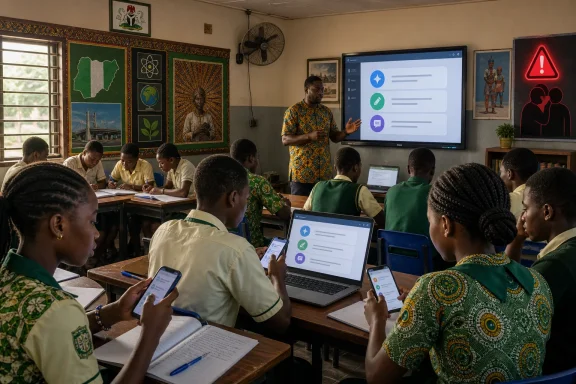 Nigeria’s AI Classroom Is Being Built from the Bottom Up
The first phase of AI in Nigerian education has not been designed by vice-chancellors, curriculum boards, or education ministries. It has been improvised by students. Walk into a university library, a hostel common room, or a campus cybercafé and the pattern is familiar: students are asking AI systems to explain lecture notes, summarize readings, draft essays, generate code, translate concepts, and prepare for exams.That bottom-up adoption matters because it reverses the normal rhythm of education technology. Usually, institutions buy platforms, train staff, and eventually students are told to use them. Generative AI entered through the side door: first as a consumer tool, then as a study aid, then as an invisible co-author in assignments.
For Nigerian universities, polytechnics, and secondary schools, this creates an uncomfortable mismatch. Students are already using systems that many institutions have not formally evaluated, regulated, or integrated into teaching. Lecturers may suspect AI-assisted work, but suspicion is not a policy. A department may warn students against “plagiarism,” but generative AI does not fit neatly into the old plagiarism model because it produces new text rather than copying from a visible source.
The result is a classroom culture in which everyone knows the rules have changed, but few institutions have written new ones. Some students use AI as a patient tutor. Others use it as a shortcut. Many move between the two, sometimes within the same assignment.
That ambiguity is the defining feature of the moment. AI is not simply helping Nigerian students learn, and it is not simply helping them cheat. It is exposing how fragile many existing assessment and teaching practices already were.
The World Bank Pilot Made the Promise Harder to Dismiss
The most striking evidence for AI’s potential in Nigerian education came from a 2024 World Bank-backed pilot in Edo State, where about 800 first-year senior secondary students attended after-school English sessions using Microsoft Copilot under teacher supervision. The programme ran for six weeks between June and July 2024, and students used the chatbot in computer labs while teachers framed the lessons and guided the work.The reported results were unusually strong. Students in the AI-supported programme outperformed peers on targeted English assessments and also showed gains on regular end-of-year examinations beyond the narrow scope of the intervention. World Bank researchers described the impact as outperforming most documented education interventions in comparable settings.
That finding deserves attention, but not mythology. The pilot did not prove that handing every Nigerian child a chatbot would fix education. It proved something more specific and more useful: when AI is structured, supervised, and tied to clear learning goals, it can amplify instruction in ways that matter.
The teacher role is crucial. This was not a story of machines replacing educators. It was a story of teachers using AI to extend practice time, personalize feedback, and keep students engaged beyond what a crowded classroom normally allows. In that sense, the pilot should be read less as a Silicon Valley miracle and more as a lesson in instructional design.
Nigeria’s education system has long suffered from scarcity: too few teachers, too little time, too many students, too little feedback. AI’s strongest educational use case is not replacing the teacher’s judgment. It is reducing the amount of learning time wasted while students wait for attention that never comes.
A Patient Tutor Is Powerful in a System Built on Scarcity
For a Nigerian student in a well-resourced urban school, AI may feel like a convenience. For a student in a rural community without access to private lessons, it can feel like a breakthrough. A chatbot that explains algebra at midnight, rewrites a difficult passage in simpler English, or offers practice questions without irritation is not a small thing.This is why the debate cannot be reduced to elite anxiety about cheating. In a country where private tutoring often determines who survives competitive exams, AI could widen access to forms of academic support that have historically been purchased by families with money. A learner who cannot afford extra lessons may still be able to ask a chatbot to explain photosynthesis, the causes of inflation, or how to structure an essay.
The same logic applies at the tertiary level. Nigerian lecturers frequently handle large classes, administrative burdens, and limited office hours. A student who is afraid to ask a question in a crowded lecture hall can ask an AI system repeatedly until a concept becomes clear. For shy students, first-generation students, and students studying in a second or third language, that private interaction can lower the emotional cost of learning.
AI also changes the rhythm of feedback. Traditional assignments often return marked weeks after submission, when the teachable moment has passed. AI tools can respond instantly, allowing students to iterate, test understanding, and correct mistakes before misconceptions harden.
The danger is that this tutoring promise can easily become a dependency trap. If students ask AI to explain a concept and then attempt the work themselves, the tool strengthens learning. If they ask AI to produce the final answer and submit it unchanged, the tool bypasses learning. The difference is not in the software. It is in the academic culture around it.
The Cheating Panic Is Real, but It Is Also Too Small
Lecturers are right to worry about AI-generated essays, lab reports, coding assignments, and research proposals. A chatbot can produce a plausible 1,500-word essay faster than a student can read the question. It can imitate academic tone, invent structure, and produce arguments that look polished enough to pass a distracted reading.But calling this merely “cheating” understates the problem. The deeper risk is not that a student gets an undeserved grade on one assignment. The deeper risk is that repeated outsourcing turns education into credential collection without intellectual formation.
Writing is not just a way to display knowledge. It is a way to develop thought. When students struggle to frame an argument, choose evidence, revise weak sentences, and defend a conclusion, they are building the cognitive habits that higher education is supposed to cultivate. If AI performs all of that work, the student may submit something readable while learning very little.
This is especially dangerous in mass higher education systems where assessment already leans heavily on written submissions that are easy to generate and hard to authenticate. If an institution’s main test of understanding is an essay question that a chatbot can answer in seconds, the assessment is no longer measuring what the institution thinks it is measuring.
AI detection tools will not solve this. They are unreliable, easy to evade, and potentially unfair to students whose writing style is already treated with suspicion. Nigerian institutions that respond to AI with surveillance alone will spend scarce resources policing symptoms while leaving the underlying assessment model untouched.
The more durable response is to change what counts as proof of learning. Oral defenses, in-class writing, project-based work, lab demonstrations, community research, and staged drafts can make it harder for students to outsource the entire thinking process. The goal should not be to create an AI-proof classroom. It should be to create a classroom where the final grade depends on understanding that students can demonstrate under real conditions.
WAEC’s Data Turn Shows AI Is Not Just a Student Tool
The AI conversation in Nigerian education often focuses on chatbots because they are visible. But some of the most consequential changes are happening at the institutional layer. WAEC’s EduStat platform, launched in 2023, points to a different kind of AI-adjacent transformation: the use of large educational datasets to understand performance, enrollment, and examination patterns at scale.That may sound less dramatic than a student chatting with Copilot, but it could matter more for policy. Nigeria has a long history of education debates driven by anecdotes, political pressure, and incomplete data. If examination bodies and universities can identify performance gaps with greater precision, they can target interventions more intelligently.
The promise is obvious. Better data could reveal where students consistently fail mathematics, which regions need targeted literacy support, where enrollment trends are shifting, and how policy changes affect outcomes over time. It could help universities plan admissions, support remedial education, and detect systemic weaknesses earlier.
The risk is equally obvious. Data systems can become instruments of exclusion if they are opaque, poorly governed, or used to rank schools and students without context. A platform that identifies patterns can help policymakers; a platform that hardens inequality into dashboards can punish the same communities that need support.
For Nigeria, the lesson is that AI in education is not one technology. It is a stack of technologies: student-facing tutors, lecturer tools, grading systems, data platforms, admissions analytics, and administrative automation. Each layer has different benefits and different failure modes.
Local Context Is the Test Global AI Keeps Failing
Most major AI tools were not built primarily for Nigerian classrooms. They were trained on global data, much of it weighted toward English-language material from wealthier countries. That matters in a country with deep linguistic diversity, distinct curricula, and local histories that are often poorly represented in global datasets.A chatbot may explain a concept clearly while still missing local context. It may produce examples that make sense in California or London but feel distant in Maiduguri, Aba, Sokoto, or Yenagoa. It may flatten Nigerian cultural diversity into generic African references, or treat locally contested issues with the confidence of a system that does not know what it does not know.
This is not a minor cosmetic problem. Education depends on relevance. Students learn better when examples connect to their environment, when language reflects their lived experience, and when knowledge is not presented as something imported from elsewhere.
There is also a disciplinary risk. If Nigerian students increasingly rely on tools whose strongest knowledge base sits outside Nigeria, local scholarship may become less visible in student work. Research topics may drift toward what AI systems can easily summarize. Indigenous knowledge, local case studies, and Nigerian academic voices could be further marginalized.
The answer is not digital nationalism or rejection of global tools. Nigeria needs access to the best AI systems available. But it also needs local datasets, local curriculum alignment, Nigerian language resources, and academic norms that require students to test AI outputs against local evidence.
In practical terms, this means universities should teach students how to interrogate AI responses. Who is missing from this answer? What Nigerian examples apply? Which claim needs verification? What would a local scholar say differently? AI literacy is not the ability to prompt a chatbot. It is the ability to doubt one intelligently.
The Digital Divide Could Turn AI into Another Private Advantage
The most seductive claim about AI in education is that it democratizes learning. There is truth in that claim, but only if students can actually reach the tools. In Nigeria, access remains uneven across device ownership, electricity, broadband availability, data costs, and school infrastructure.A student in a private university with reliable Wi-Fi, a laptop, and uninterrupted power experiences AI as a daily companion. A student in an underserved rural school may experience it as a rumor. Even when smartphones are available, small screens and expensive data plans limit serious academic use.
This creates a familiar danger: technology introduced in the name of inclusion may first benefit those who are already ahead. Urban students get AI tutoring, AI writing support, AI coding help, and AI exam preparation. Poorer students get lectures about the future.
If that pattern holds, AI will not close Nigeria’s education gap. It will widen it. The students with the best teachers will also get the best digital tutors. The students with the weakest schools will be told to wait for infrastructure.
This is why public policy matters. AI adoption cannot be left entirely to market forces, because the market will serve students who can pay before it serves those most in need. If Nigeria wants AI to become an equalizer, the investment has to flow toward school connectivity, computer labs, teacher training, subsidized access, and shared community learning spaces.
The World Bank pilot matters here because it used computer labs and teacher-led sessions rather than assuming every student had a personal device. That model may be less glamorous than every child with an AI tutor in their pocket, but it is more realistic for many Nigerian communities.
Teachers Need Training, Not Replacement Anxiety
The most damaging version of the AI education story is the one that frames teachers as obsolete. In Nigeria, that framing is not just wrong; it is politically and practically reckless. The education system does not suffer from too many teachers with too much power. It suffers from teachers who are often underpaid, overstretched, under-supported, and asked to produce miracles with limited tools.AI can help teachers, but only if teachers are trained to use it. A lecturer who understands generative AI can design better assignments, explain responsible use, detect suspicious patterns through academic judgment, and show students how to move from AI-assisted brainstorming to original work. A teacher who is simply told that AI is “the future” gains nothing.
Teacher training should cover both practical and ethical use. Educators need to know how to generate lesson plans, create practice questions, adapt explanations for different levels, and use AI to support students with learning gaps. They also need to understand hallucinations, bias, data privacy, overreliance, and academic integrity.
The point is not to turn every teacher into a software engineer. It is to make AI a normal professional tool, like a calculator, projector, spreadsheet, or learning management system. The teacher remains the authority on whether learning is happening.
That distinction is especially important for younger learners. AI systems can sound confident even when wrong. They can produce age-inappropriate explanations, reinforce stereotypes, or give students answers without teaching the reasoning behind them. A trained teacher can turn the tool into a scaffold. An untrained system can become a shortcut machine.
Policy Is Moving, but Campuses Are Still Improvising
Nigeria has not ignored AI. The establishment of the National Centre for Artificial Intelligence and Robotics in 2020 and the development of a National AI Strategy in 2024 show that policymakers understand the technology’s strategic significance. The national conversation now includes economic development, governance, skills, innovation, and inclusion.But national strategy is not the same as campus policy. Most students do not experience AI governance as a government document. They experience it as a lecturer’s warning, a departmental rumor, or silence.
That gap is where confusion thrives. Some lecturers may ban AI entirely. Others may quietly use it themselves. Some students may believe any AI use is forbidden, while others may assume anything not detected is allowed. This inconsistency undermines trust.
Universities and schools need clear rules that distinguish between acceptable assistance and academic misconduct. Using AI to brainstorm a topic, explain a concept, or improve grammar may be acceptable in some contexts. Submitting AI-generated work as one’s own should not be. The difference must be stated plainly in course outlines, assignment instructions, and institutional policies.
The policy challenge is not to write a single rule for every subject. A computer science programming task, a literature essay, a medical case analysis, and a mass communication feature assignment require different boundaries. What institutions need is a framework flexible enough for departments to adapt and firm enough that students know where the lines are.
Assessment Has to Move Closer to Reality
Generative AI is forcing schools to confront an old weakness: too many assessments reward the production of text rather than the demonstration of understanding. If a student can generate an essay without mastering the subject, the assignment was already vulnerable. AI just made the vulnerability impossible to ignore.This should push Nigerian education toward more authentic assessment. Students should be asked to defend their work orally, apply concepts to local problems, produce staged drafts, maintain research logs, collaborate on projects, and show process as well as product. In professional programmes, they should solve problems that resemble the work they will actually do.
For mass institutions, this is not easy. Oral exams take time. Project-based learning requires supervision. Staged assessment increases marking workload. But the alternative is worse: a credential system in which polished submissions become less and less reliable as evidence of competence.
AI may also improve assessment if used carefully by educators. It can help generate varied practice questions, create rubrics, identify common errors, and support formative feedback. But high-stakes grading should remain accountable to human judgment, especially where students’ futures are at stake.
The key is to stop treating AI as an external invader and start treating it as part of the assessment environment. Students will have access to AI in workplaces. The educational question is not whether they can use it, but whether they can use it responsibly, critically, and without surrendering their own judgment.
The Nigerian Graduate Will Be Judged by a New Standard
Employers will not care much whether a graduate used AI in school. They will care whether the graduate can think. In fact, the workplace may be less forgiving than the classroom because AI fluency without domain knowledge produces confident mediocrity at speed.A mass communication graduate who can prompt an AI system to draft a press release still needs news judgment, ethics, audience awareness, and the ability to verify facts. An engineering graduate using AI to troubleshoot a design still needs mathematics, safety knowledge, and professional responsibility. A law student using AI to summarize cases still needs reasoning, interpretation, and command of jurisdiction.
This is the paradox. AI raises the value of human judgment precisely because it lowers the cost of producing plausible output. When everyone can generate text, code, images, and summaries, the scarce skill becomes knowing what is true, what is useful, what is ethical, and what is original.
Nigeria’s education system should therefore resist the temptation to define AI literacy narrowly. The future graduate does not merely need to know how to use ChatGPT, Gemini, or Copilot. The future graduate needs to know when not to trust them.
That means critical thinking cannot remain a slogan in curriculum documents. It has to be built into classroom practice. Students should compare AI answers with textbooks, local data, field observations, and primary sources. They should be rewarded for identifying weak assumptions, not merely for producing fluent prose.
Nigeria Cannot Ban Its Way Out of the AI Classroom
Some institutions around the world initially responded to generative AI with bans. The impulse is understandable. Bans are simple, emotionally satisfying, and easy to announce. They are also increasingly unenforceable.For Nigeria, a blanket ban would be especially counterproductive. It would deny students legitimate learning support, push usage underground, and privilege those who can access better tools privately. It would also leave teachers unprepared for the reality that AI will shape the workplaces their students enter.
A better approach is managed permission. Institutions should define where AI use is encouraged, where it is limited, and where it is prohibited. They should require disclosure when AI materially contributes to submitted work. They should teach students that disclosure is not shameful; deception is.
This cultural shift matters. If students believe any AI use is automatically misconduct, they will hide it. If they believe AI use is always acceptable, they will abuse it. The middle ground must be taught explicitly.
Nigeria also needs local research. The World Bank pilot is promising, but one programme in one setting cannot answer every question. Policymakers need evidence across regions, languages, school types, age groups, and subjects. What works in an English after-school programme may not work the same way in mathematics, civic education, engineering, medicine, or teacher training.
The Blackboard and the Chatbot Now Share the Same Room
The practical path forward is neither techno-utopian nor defensive. Nigeria should scale AI in education where evidence supports it, but only with teacher involvement, infrastructure investment, and assessment reform. The country should treat AI as a public education tool, not merely a private consumer service.That means procurement decisions should be transparent. Data privacy rules should be clear. Schools should know what information students are entering into AI platforms and how that information may be stored or used. Parents and students should not have to guess whether educational data is protected.
It also means Nigerian content matters. AI systems used in schools should increasingly reflect Nigerian curricula, examples, languages, and scholarship. If global platforms are going to become classroom infrastructure, Nigeria should not be a passive market. It should negotiate, adapt, and build.
The strongest model remains the supervised one: teachers setting goals, students using AI for practice and explanation, and institutions measuring whether learning actually improves. That is slower than viral adoption, but education is not supposed to move at the speed of hype.
The worst outcome would be a two-tier system. In one tier, wealthy students use AI to deepen learning under expert guidance. In the other, poorer students either lack access entirely or use free tools unsupervised as answer machines. That is not democratization. It is inequality with a digital interface.
The Lesson from Nigeria’s Six-Week AI Shock
The Nigerian AI classroom is no longer theoretical, and the evidence now points in two directions at once. Used well, AI can extend scarce teaching capacity and accelerate learning. Used badly, it can weaken academic integrity and disguise shallow understanding as competence.- AI tutoring works best when teachers remain actively involved in setting tasks, guiding prompts, and checking understanding.
- Nigerian schools need AI policies that distinguish legitimate learning support from submitting machine-generated work as original student effort.
- Assessment must shift toward oral defenses, staged drafts, projects, and real-world problem-solving that reveal how students think.
- Public investment is necessary to prevent AI access from becoming another advantage reserved for urban and wealthier students.
- Local curriculum alignment, Nigerian examples, and multilingual resources will determine whether AI feels like a real classroom tool rather than an imported shortcut.
- The most important AI skill for students is not prompting fluently, but judging critically when the machine is incomplete, biased, or wrong.
References
- Primary source: Blueprint Newspapers
Published: 2026-06-12T12:50:20.687258
How AI is reshaping Nigeria's classroom - Blueprint Newspapers Limited
If you walk into any Nigerian university library today you will find students hunched over laptops, many of them not writing their assignments by hand butblueprint.ng - Related coverage: regulations.ai
National Artificial Intelligence Strategy (NAIS) - Nigeria | Regulations.AI - The Site on AI Laws and Regulations | Regulations.ai
AI law in Nigeria: The National Artificial Intelligence Strategy (NAIS) is a draft national strategy published in August 2024 that sets out Nigeria’s vision, principles and five pillars to guide national AI development, adoption and governance. The draft proposes institutional arrangements, an...regulations.ai - Related coverage: myschoolnews.ng
World Bank Launches Generative AI Education Program in Edo State, Nigeria - Myschoolnews
The World Bank has launched a pioneering educational program in Edo State, Nigeria, aimed at improving learning outcomes through generative artificial intelligence (AI) tools. Conducted under the Education for Global Development initiative, the program involved 800 first-year senior secondary...myschoolnews.ng - Related coverage: afriwise.com
Overview of Nigeria’s Draft National Artificial Intelligence Strategy 2024
Artificial intelligence (AI) is rapidly evolving, playing a crucial role in driving economic growth and addressing various societal challenges, amongst many others. www.afriwise.com
- Related coverage: pavestoneslegal.com
- Related coverage: blogs.worldbank.org
From chalkboards to chatbots in Nigeria: 7 lessons to pioneer generative AI for education
In 1984, educational psychologist Benjamin Bloom demonstrated that students receiving one-on-one tutoring vastly outperformed their peers confined to the traditional classroom setting. Despite these proven benefits, the prohibitive cost of providing individualized attention to every student has... blogs.worldbank.org

