

HP used Computex 2026 in Taipei to preview Windows PCs powered by NVIDIA’s new RTX Spark platform, with the first HP OmniBook Ultra 16 and OmniBook X 14 models expected later this year rather than immediately shipping at the show. The announcement matters less as a single product tease than as a signal: HP is preparing to sell local AI performance as the next premium-PC reason to upgrade. After two years of “AI PC” branding that often felt like a sticker on familiar hardware, RTX Spark gives OEMs a more dramatic story to tell. It also gives Windows on Arm a new protagonist, and that may be the most consequential part.
The old PC upgrade pitch was easy to understand. A new machine had a faster CPU, a brighter screen, better battery life, perhaps a thinner chassis, and enough ports to keep the dongle drawer from becoming a lifestyle. HP’s Computex preview still lives partly in that world, but the center of gravity has moved.
RTX Spark is being positioned as a platform for personal AI agents, GPU-heavy creation workflows, and serious gaming. That combination is not accidental. HP is trying to avoid the trap that swallowed the first wave of AI PCs: impressive silicon demos in search of everyday reasons to exist.
The company’s public framing leans hard on “the next wave of Windows PC experiences,” which is corporate phrasing, but the subtext is plain enough. HP wants its premium laptops and compact desktops to be judged not only by benchmarks but by what they can do locally without waiting on cloud inference.
That is a sharp turn for a market that spent much of the post-pandemic correction trying to convince households and businesses that their 2020-era notebooks were suddenly obsolete. Many were not. To make the next upgrade cycle stick, PC makers need more than a webcam tweak and a new function key.
RTX Spark combines an Arm-based CPU with Blackwell-class RTX graphics and unified memory. In practical terms, that means the machine is not a conventional x86 laptop with a discrete GPU bolted on. It is a more Apple-like architecture, where CPU, GPU, and AI acceleration are treated as parts of one compute fabric.
That comparison will make some Windows loyalists bristle, but it is unavoidable. Apple’s M-series Macs changed expectations for what unified memory, tight silicon integration, and efficient high-performance laptops could look like. Microsoft, HP, and NVIDIA are now trying to answer that model without surrendering the openness and hardware diversity that define the Windows ecosystem.
The risk is obvious. Windows on Arm has a long history of almost-there moments, from underpowered early devices to compatibility gaps that made otherwise elegant machines feel like compromises. NVIDIA’s entrance does not erase those issues by itself. It does, however, give the platform a performance story stronger than “better battery life and most of your apps probably work.”
The badge unlocks features such as Live Captions translation, image generation and editing tools, Windows Studio Effects, super resolution, and Recall where available. But Copilot+ has also exposed a problem for Microsoft: a certification can tell buyers that a PC qualifies, but it cannot make them care.
Recall is the most obvious example. Microsoft’s searchable activity timeline remains one of the most ambitious and controversial Windows features in years. It is also a reminder that local AI is not automatically a consumer benefit just because it runs on-device.
That is why HP’s RTX Spark preview matters. If the new machines are marketed only as Copilot+ PCs, they risk being absorbed into a crowded label that already includes Qualcomm, Intel, and AMD systems. If HP can show that RTX Spark materially improves creative work, game performance, developer testing, and local model use, then Copilot+ becomes a baseline rather than the main event.
Speed matters when an AI feature is part of the operating system rather than a chatbot window. A local model that can summarize a document, search screenshots, clean up audio, or generate a quick image without a round trip to a server changes the feel of the machine. It makes AI less like a website and more like a system service.
Privacy is the more delicate pitch. Running inference locally does not automatically make a feature private, secure, or trustworthy. It only changes where the computation happens. The operating system still has to collect context, manage permissions, store indexes, protect sensitive data, and explain all of this in ways normal users can understand.
For enterprise IT, that distinction is everything. A laptop capable of running AI workloads locally may reduce exposure to cloud services, but it also creates new endpoint governance questions. What data can an agent inspect? What logs are retained? Can administrators disable features cleanly? How do organizations audit AI behavior on machines that now possess workstation-class inference power?
An RTX Spark system with high-end GPU resources and unified memory could be attractive to people building AI applications, testing models, prototyping agent workflows, or running inference without provisioning cloud instances. That does not replace data center GPUs. It does narrow the gap between the laptop and the lab.
This is especially important for Windows. Much AI development has gravitated toward Linux workstations, cloud notebooks, and Apple Silicon laptops. Microsoft needs Windows to feel like a credible local AI development environment, not merely the place where finished AI features are consumed.
HP benefits if that strategy works. A premium laptop for developers, creators, and technical teams can command higher margins than a generic productivity notebook. But the machine has to prove it can handle real tools, not just scripted demos.
Creators understand GPU acceleration. They may not care about the industry’s favorite phrase, agentic AI, but they do care about faster rendering, smoother timelines, better effects previews, and local generative tools that do not interrupt a workflow. If RTX Spark improves those jobs, the sales pitch becomes tangible.
Gamers are an equally important constituency, even if the Arm transition complicates the story. NVIDIA’s RTX stack brings DLSS, ray tracing, and a familiar performance vocabulary. But Windows gaming on Arm will have to prove itself across real libraries, anti-cheat systems, launchers, drivers, and peripherals.
That is where HP has to be careful. A powerful GPU does not guarantee a frictionless gaming PC if the software layer is uneven. Enthusiasts will forgive early quirks in a developer machine; they are less forgiving when a premium gaming laptop fails to run a favorite title cleanly.
Surface devices have often served as Microsoft’s argument to the rest of the PC industry. They are not always the highest-volume Windows machines, but they show where Microsoft wants the ecosystem to go. If Surface is adopting RTX Spark, Microsoft is telling OEMs that NVIDIA-powered Arm PCs are not a side project.
That coordination also changes the competitive map. Intel and AMD remain central to Windows, and Qualcomm’s Snapdragon X chips helped establish the current Copilot+ PC category. But NVIDIA brings a different kind of leverage: developer mindshare, GPU dominance, CUDA, gaming credibility, and a powerful AI brand.
For HP, that creates both opportunity and dependency. Partnering with NVIDIA gives HP a premium story customers recognize. It also ties some of HP’s highest-end Windows ambitions to a platform whose pricing, supply, thermals, and software maturity will be controlled largely outside Palo Alto.
The late-2026 launch window gives HP time to refine the story, but it also gives competitors time to respond. Intel’s next mobile platforms, AMD’s high-performance APUs, Qualcomm’s continuing Windows on Arm push, and Apple’s MacBook line will all be part of the comparison shoppers make.
Battery life may be the most important unknown. NVIDIA can win attention with AI and graphics performance, but mobile machines live or die by how long they sustain that performance away from a wall. A laptop that behaves like a compact workstation is useful; a laptop that behaves like a compact workstation for 45 minutes is a niche product.
Price will decide how broad this category becomes. If RTX Spark systems arrive as ultra-premium machines aimed at developers, creators, and executives, they can still be successful. But they will not transform the mainstream Windows market unless the platform eventually moves down into more accessible designs.
The first question will be compatibility. Businesses still rely on x86 applications, drivers, VPN clients, security agents, device management tools, and obscure line-of-business software that nobody wants to rewrite. Windows on Arm has improved substantially, but “improved” is not the same as “risk-free.”
The second question will be control. Copilot+ features, local agents, Recall-like indexing, and developer-accessible AI APIs all require clear policy surfaces. IT departments will want to know what can be disabled, audited, sandboxed, encrypted, logged, and updated.
The third question will be lifecycle. Premium AI PCs are expensive assets. If an organization buys them in late 2026, it will expect several years of driver support, firmware updates, security patches, and platform stability. NVIDIA and HP will have to show that RTX Spark is not merely a launch event but a long-term Windows platform.
“AI PC” can mean almost anything. It can describe a machine with a modest NPU used for background blur, a workstation-class GPU used for local model inference, or a standard laptop bundled with cloud AI subscriptions. That ambiguity helps marketers in the short term and hurts trust in the long term.
RTX Spark is more concrete because it pairs the AI pitch with known performance domains. GPU acceleration, unified memory, and local inference are things that can be tested. If HP’s machines are fast, efficient, and useful, the category gains credibility. If they are expensive systems with a few impressive demos and rough edges, buyers will wait.
The lesson of the last two years is that AI features alone do not automatically refresh the PC. The upgrade case has to be grounded in work people already do and work they plausibly want to do next. HP’s best chance is to sell RTX Spark not as magic, but as a serious local compute platform that happens to make Windows AI features more capable.
The concrete readout is narrower than the branding suggests, but still important:
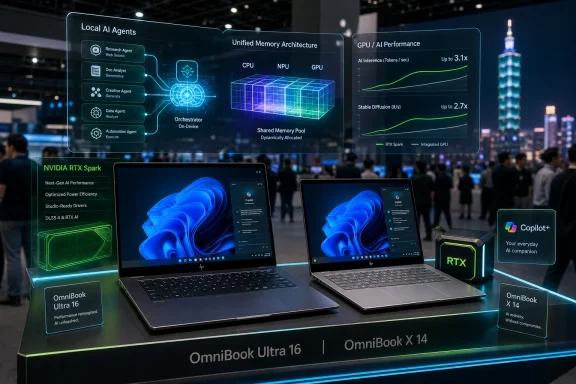 HP Is Selling a New Kind of Premium Windows Machine, Not Just Another Laptop Refresh
The old PC upgrade pitch was easy to understand. A new machine had a faster CPU, a brighter screen, better battery life, perhaps a thinner chassis, and enough ports to keep the dongle drawer from becoming a lifestyle. HP’s Computex preview still lives partly in that world, but the center of gravity has moved.RTX Spark is being positioned as a platform for personal AI agents, GPU-heavy creation workflows, and serious gaming. That combination is not accidental. HP is trying to avoid the trap that swallowed the first wave of AI PCs: impressive silicon demos in search of everyday reasons to exist.
The company’s public framing leans hard on “the next wave of Windows PC experiences,” which is corporate phrasing, but the subtext is plain enough. HP wants its premium laptops and compact desktops to be judged not only by benchmarks but by what they can do locally without waiting on cloud inference.
That is a sharp turn for a market that spent much of the post-pandemic correction trying to convince households and businesses that their 2020-era notebooks were suddenly obsolete. Many were not. To make the next upgrade cycle stick, PC makers need more than a webcam tweak and a new function key.
NVIDIA’s Spark Is a Direct Challenge to the Windows Silicon Order
The most interesting part of RTX Spark is not that it has NVIDIA graphics. Windows PCs have had NVIDIA graphics for decades. The interesting part is that NVIDIA is stepping closer to the role historically occupied by Intel and AMD: defining the whole performance envelope of the PC.RTX Spark combines an Arm-based CPU with Blackwell-class RTX graphics and unified memory. In practical terms, that means the machine is not a conventional x86 laptop with a discrete GPU bolted on. It is a more Apple-like architecture, where CPU, GPU, and AI acceleration are treated as parts of one compute fabric.
That comparison will make some Windows loyalists bristle, but it is unavoidable. Apple’s M-series Macs changed expectations for what unified memory, tight silicon integration, and efficient high-performance laptops could look like. Microsoft, HP, and NVIDIA are now trying to answer that model without surrendering the openness and hardware diversity that define the Windows ecosystem.
The risk is obvious. Windows on Arm has a long history of almost-there moments, from underpowered early devices to compatibility gaps that made otherwise elegant machines feel like compromises. NVIDIA’s entrance does not erase those issues by itself. It does, however, give the platform a performance story stronger than “better battery life and most of your apps probably work.”
The Copilot+ Badge Has Become the Price of Admission
HP says these systems will support Microsoft’s Copilot+ PC requirements, which means they must clear the now-familiar threshold of an NPU capable of at least 40 TOPS. That number has become the industry’s passport into Microsoft’s local AI feature set.The badge unlocks features such as Live Captions translation, image generation and editing tools, Windows Studio Effects, super resolution, and Recall where available. But Copilot+ has also exposed a problem for Microsoft: a certification can tell buyers that a PC qualifies, but it cannot make them care.
Recall is the most obvious example. Microsoft’s searchable activity timeline remains one of the most ambitious and controversial Windows features in years. It is also a reminder that local AI is not automatically a consumer benefit just because it runs on-device.
That is why HP’s RTX Spark preview matters. If the new machines are marketed only as Copilot+ PCs, they risk being absorbed into a crowded label that already includes Qualcomm, Intel, and AMD systems. If HP can show that RTX Spark materially improves creative work, game performance, developer testing, and local model use, then Copilot+ becomes a baseline rather than the main event.
Local AI Is the Feature, Privacy Is the Sales Pitch
The industry’s argument for local AI has hardened into a familiar refrain: faster responses, lower latency, reduced cloud cost, and better privacy. All four claims can be true, but they are not equally persuasive.Speed matters when an AI feature is part of the operating system rather than a chatbot window. A local model that can summarize a document, search screenshots, clean up audio, or generate a quick image without a round trip to a server changes the feel of the machine. It makes AI less like a website and more like a system service.
Privacy is the more delicate pitch. Running inference locally does not automatically make a feature private, secure, or trustworthy. It only changes where the computation happens. The operating system still has to collect context, manage permissions, store indexes, protect sensitive data, and explain all of this in ways normal users can understand.
For enterprise IT, that distinction is everything. A laptop capable of running AI workloads locally may reduce exposure to cloud services, but it also creates new endpoint governance questions. What data can an agent inspect? What logs are retained? Can administrators disable features cleanly? How do organizations audit AI behavior on machines that now possess workstation-class inference power?
HP’s Real Audience Includes Developers Who Are Tired of Borrowing the Cloud
The consumer story around AI PCs tends to focus on photo editing, translation, and personal assistants. The more durable market may be developers and technical professionals who want local compute for experimentation.An RTX Spark system with high-end GPU resources and unified memory could be attractive to people building AI applications, testing models, prototyping agent workflows, or running inference without provisioning cloud instances. That does not replace data center GPUs. It does narrow the gap between the laptop and the lab.
This is especially important for Windows. Much AI development has gravitated toward Linux workstations, cloud notebooks, and Apple Silicon laptops. Microsoft needs Windows to feel like a credible local AI development environment, not merely the place where finished AI features are consumed.
HP benefits if that strategy works. A premium laptop for developers, creators, and technical teams can command higher margins than a generic productivity notebook. But the machine has to prove it can handle real tools, not just scripted demos.
Creators and Gamers Are the Insurance Policy
The smartest part of HP’s positioning is that it does not rely entirely on AI. The company is also talking about content creation and gaming, two markets where NVIDIA’s brand equity is already strong.Creators understand GPU acceleration. They may not care about the industry’s favorite phrase, agentic AI, but they do care about faster rendering, smoother timelines, better effects previews, and local generative tools that do not interrupt a workflow. If RTX Spark improves those jobs, the sales pitch becomes tangible.
Gamers are an equally important constituency, even if the Arm transition complicates the story. NVIDIA’s RTX stack brings DLSS, ray tracing, and a familiar performance vocabulary. But Windows gaming on Arm will have to prove itself across real libraries, anti-cheat systems, launchers, drivers, and peripherals.
That is where HP has to be careful. A powerful GPU does not guarantee a frictionless gaming PC if the software layer is uneven. Enthusiasts will forgive early quirks in a developer machine; they are less forgiving when a premium gaming laptop fails to run a favorite title cleanly.
Microsoft’s Surface Move Makes This Bigger Than HP
The HP preview would be notable on its own, but it becomes more significant because Microsoft is also aligning around RTX Spark with the Surface Laptop Ultra. That turns the announcement from a single OEM experiment into a platform moment.Surface devices have often served as Microsoft’s argument to the rest of the PC industry. They are not always the highest-volume Windows machines, but they show where Microsoft wants the ecosystem to go. If Surface is adopting RTX Spark, Microsoft is telling OEMs that NVIDIA-powered Arm PCs are not a side project.
That coordination also changes the competitive map. Intel and AMD remain central to Windows, and Qualcomm’s Snapdragon X chips helped establish the current Copilot+ PC category. But NVIDIA brings a different kind of leverage: developer mindshare, GPU dominance, CUDA, gaming credibility, and a powerful AI brand.
For HP, that creates both opportunity and dependency. Partnering with NVIDIA gives HP a premium story customers recognize. It also ties some of HP’s highest-end Windows ambitions to a platform whose pricing, supply, thermals, and software maturity will be controlled largely outside Palo Alto.
The Missing Details Are Not Minor Details
HP has not yet given buyers everything they need. Pricing, exact configurations, battery life, thermals, ports, display options, upgradeability, and enterprise management details will matter enormously. In the premium PC market, the difference between “visionary” and “overpriced demo platform” is often found in the spec sheet.The late-2026 launch window gives HP time to refine the story, but it also gives competitors time to respond. Intel’s next mobile platforms, AMD’s high-performance APUs, Qualcomm’s continuing Windows on Arm push, and Apple’s MacBook line will all be part of the comparison shoppers make.
Battery life may be the most important unknown. NVIDIA can win attention with AI and graphics performance, but mobile machines live or die by how long they sustain that performance away from a wall. A laptop that behaves like a compact workstation is useful; a laptop that behaves like a compact workstation for 45 minutes is a niche product.
Price will decide how broad this category becomes. If RTX Spark systems arrive as ultra-premium machines aimed at developers, creators, and executives, they can still be successful. But they will not transform the mainstream Windows market unless the platform eventually moves down into more accessible designs.
Enterprise IT Will See Promise Wrapped in Governance Work
For administrators, RTX Spark PCs are both exciting and inconvenient. More local AI capacity could reduce dependence on external services, improve responsiveness, and enable sensitive workflows to stay on-device. It could also create a new class of endpoints whose capabilities outpace existing management policies.The first question will be compatibility. Businesses still rely on x86 applications, drivers, VPN clients, security agents, device management tools, and obscure line-of-business software that nobody wants to rewrite. Windows on Arm has improved substantially, but “improved” is not the same as “risk-free.”
The second question will be control. Copilot+ features, local agents, Recall-like indexing, and developer-accessible AI APIs all require clear policy surfaces. IT departments will want to know what can be disabled, audited, sandboxed, encrypted, logged, and updated.
The third question will be lifecycle. Premium AI PCs are expensive assets. If an organization buys them in late 2026, it will expect several years of driver support, firmware updates, security patches, and platform stability. NVIDIA and HP will have to show that RTX Spark is not merely a launch event but a long-term Windows platform.
The PC Recovery Needs a Better Story Than “AI Inside”
The PC market’s slow recovery has created a convenient opening for AI hardware. Vendors need a reason to push premium systems, and AI gives them a vocabulary for urgency. But consumers and businesses have already learned to be skeptical of labels.“AI PC” can mean almost anything. It can describe a machine with a modest NPU used for background blur, a workstation-class GPU used for local model inference, or a standard laptop bundled with cloud AI subscriptions. That ambiguity helps marketers in the short term and hurts trust in the long term.
RTX Spark is more concrete because it pairs the AI pitch with known performance domains. GPU acceleration, unified memory, and local inference are things that can be tested. If HP’s machines are fast, efficient, and useful, the category gains credibility. If they are expensive systems with a few impressive demos and rough edges, buyers will wait.
The lesson of the last two years is that AI features alone do not automatically refresh the PC. The upgrade case has to be grounded in work people already do and work they plausibly want to do next. HP’s best chance is to sell RTX Spark not as magic, but as a serious local compute platform that happens to make Windows AI features more capable.
The HP Spark Machines Will Be Judged by What Happens After the Demo
HP’s Computex preview puts the company near the front of a high-stakes transition for Windows hardware. The promise is a laptop or compact PC that can act as an AI workstation, creator machine, and gaming system without handing every demanding task to the cloud. The burden is proving that this combination works outside a keynote.The concrete readout is narrower than the branding suggests, but still important:
- HP is preparing RTX Spark systems under its OmniBook Ultra 16 and OmniBook X 14 lines for availability later in 2026.
- NVIDIA’s platform brings an Arm CPU, Blackwell-class RTX graphics, and unified memory into a Windows PC design that looks more integrated than traditional CPU-plus-discrete-GPU laptops.
- Copilot+ certification gives HP access to Microsoft’s local Windows AI feature set, but the badge alone will not distinguish these machines from rival AI PCs.
- Developers and creators may be the first serious audience because they can use local GPU and AI performance immediately.
- Enterprise adoption will depend as much on compatibility, manageability, and data controls as on raw TOPS.
- Pricing, battery life, thermals, and software maturity remain the unanswered questions that will determine whether this becomes a premium niche or a broader Windows shift.
References
- Primary source: iNews Zoombangla
Published: 2026-06-20T11:52:07.088958
HP Reveals New NVIDIA RTX Spark PCs at Computex 2026
HP previewed a new lineup of NVIDIA RTX Spark PCs at Computex 2026 combining AI agents, content creation and gaming in Windowsinews.zoombangla.com - Related coverage: tomshardware.com
Nvidia unveils RTX Spark Superchip for laptops and desktop PCs at Computex 2026 – new platform promises to turn Windows into an agentic AI OS with Arm CPU, Blackwell GPU, and 128GB unified memory | Tom's Hardware
Over 30 laptops and 10 desktops coming this fall with "the most efficent platform ever built"www.tomshardware.com - Related coverage: hp.com
HP Debuts PCs Built for the Next Wave of Windows PC Experiences Powered by NVIDIA RTX Spark™ | HP® Official Site
Today, HP Inc. (NYSE: HPQ) announced its latest devices and solutions, designed to enable developers of all types to create new experiences using AI.www.hp.com
- Related coverage: windowscentral.com
Surface Laptop Ultra: Microsoft and NVIDIA reveal the 128GB RAM, mini‑LED, RTX Spark powerhouse redefining Windows on Arm | Windows Central
Uncompromising raw NVIDIA N1x power meets legendary Surface craft, but can people afford it?www.windowscentral.com - Related coverage: techspot.com
Nvidia RTX Spark CPU is now official: "superchip" will power Windows laptops and desktops | TechSpot
Ryan Shrout is a longtime technology analyst and industry veteran who has spent over two decades covering PC hardware, graphics, and semiconductors. He previously led technical marketing...www.techspot.com - Related coverage: arstechnica.com
Nvidia RTX Spark comes to Windows PCs with Arm CPU, RTX GPU, and unified memory - Ars Technica
Nvidia's new chips will power laptop workstations and mini desktop PCs at first.arstechnica.com
- Related coverage: techcrunch.com
Nvidia chases $200B CPU market with AI agent PCs from Microsoft, Dell, and HP | TechCrunch
If Nvidia has cracked a way to bring AI agents easily, safely, and usefully to the masses, it could — and should — be big.techcrunch.com - Related coverage: tuttotech.net
Surface Laptop Ultra ufficiale: il laptop ultra potente di Microsoft con NVIDIA RTX Spark
Microsoft e NVIDIA hanno presentato il Surface Laptop Ultra al Computex 2026: chip RTX Spark con architettura unificata, fino a 128 GB di RAM condivisa e 1 petaflop di potenza AI in meno di 18 mm di spessore.www.tuttotech.net - Related coverage: technobezz.com
Nvidia Announces RTX Spark Processor Family for Laptops and Desktops at Computex 2026 | Technobezz
Nvidia unveils the RTX Spark processor family at Computex 2026, merging Arm CPU and Blackwell GPU cores to redefine laptops and desktops.www.technobezz.com - Related coverage: semicurrent.com
Nvidia's RTX Spark brings a Blackwell GPU and on-device AI to laptops - Semi-Current
Nvidia RTX Spark is a Windows laptop/desktop chip with a Blackwell GPU that handles 1440p gaming or on-device 120B AI, with machines from six OEMs due this fall.www.semicurrent.com - Related coverage: axios.com
Microsoft debuts Nvidia-powered Microsoft Surface Ultra laptop
Microsoft is trying again to redefine the PC for the AI era.www.axios.com
- Related coverage: true-tech.net
NVIDIA RTX Spark debuts at Computex 2026 with Grace CPU and Blackwell GPU
NVIDIA RTX Spark is official. The new Arm-based Superchip combines Grace CPU and Blackwell RTX graphics, bringing powerful AI and gaming performance to future Windows PCs.true-tech.net - Related coverage: techsearchers.com
Microsoft Surface Laptop Ultra: Mini-LED RTX Spark Powerhouse - Tech Searchers
Microsoft unveiled the Surface Laptop Ultra at Computex 2026 — a 15-inch mini-LED beast with NVIDIA's RTX Spark chip, 128GB unified memory, and 1 petaflop of AI compute.techsearchers.com - Related coverage: elpais.com
Nvidia anuncia la reinvención del ordenador personal con un chip de IA con el que reta a Intel y AMD | Economía | EL PAÍS
El gigante crea un procesador diseñado junto a Microsoft. Fabricantes como Dell, HP y Asus se unen al proyectoelpais.com - Related coverage: signal65.com
- Related coverage: nvidianews.nvidia.com
