

Huntress is positioning its Microsoft partnership as an SMB security force multiplier, using its Microsoft-verified SMB Solution status and Microsoft Intelligent Security Association membership to wrap managed EDR, identity threat detection, and 24/7 SOC response around Microsoft Defender, Entra, and Microsoft 365 environments. The message is not subtle: Microsoft supplies the platform, Huntress supplies the operational muscle many smaller organizations lack. For Windows shops and MSPs, the important part is less the co-marketing language than the shift it represents. Security value is increasingly being measured not by what a tenant is licensed to do, but by whether anyone is actually watching, tuning, and finishing the response.
Microsoft has spent years pulling enterprise-grade controls down into products that smaller organizations can actually buy. Microsoft 365 Business Premium, Defender for Business, Entra ID, Intune, and Defender for Endpoint have made capabilities that once lived in the enterprise security operations center available to companies with a few dozen or a few hundred users.
That democratization is real. A small accounting firm, manufacturer, school, or regional healthcare provider can now own tools for endpoint detection, conditional access, device management, identity protection, and automated remediation without negotiating a bespoke enterprise agreement. On paper, the gap between a small business tenant and an enterprise security stack has narrowed dramatically.
But owning the tooling is not the same thing as operating it. Defender can generate detections, Entra can surface risky sign-ins, Intune can enforce policy, and Microsoft 365 can hold the audit trail. Someone still has to decide what matters, what is noise, what needs containment, and what has to be fixed before the attacker comes back.
That is the gap Huntress is trying to occupy. Its argument is that Microsoft has built the security foundation, but many SMBs and MSPs need a managed layer that turns that foundation into outcomes. The partnership pitch works because it speaks to a familiar problem in Windows environments: the controls are there, but the staff hours are not.
That distinction is central to the pitch. Huntress is not saying Microsoft Defender is weak, nor is Microsoft saying Huntress replaces its security portfolio. The line is more pragmatic: Microsoft builds the operating system, productivity cloud, identity layer, endpoint stack, and management plane; Huntress provides managed detection, investigation, triage, and response workflows that many smaller teams cannot staff on their own.
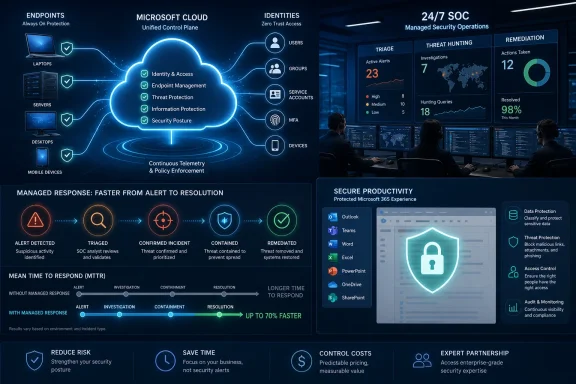
The result is a neatly complementary story. Defender and Microsoft 365 generate telemetry. Entra and identity signals show where account abuse may be happening. Huntress adds its managed EDR and ITDR services, then routes suspicious activity through a 24/7 SOC that can investigate and guide remediation.
That is a powerful message for MSPs because it avoids the awkward binary choice that has defined a lot of SMB security buying. The question stops being “Microsoft or a third-party security vendor?” and becomes “How do we get more security value out of the Microsoft licenses customers already own?”
The SMB challenge is not that Defender cannot detect threats. The problem is that detection without sustained operational attention quickly becomes another source of unread alerts. Smaller organizations routinely buy Microsoft 365 plans for email, Office apps, Teams, and identity management, then discover that the included security capabilities require expertise to configure and interpret.
That creates a strange kind of underuse. A business may technically have endpoint protection, attack surface reduction rules, conditional access policies, risky sign-in signals, and device compliance controls. Yet those features may be partially configured, inconsistently monitored, or left at defaults because the MSP is juggling dozens of tenants and the internal IT person is also responsible for printers, onboarding, line-of-business apps, and the CEO’s laptop.
Huntress’ managed Microsoft Defender pitch is aimed squarely at that reality. The company says its Managed EDR can enhance Microsoft Defender tooling by adding threat hunting, reducing noise, improving accuracy, and accelerating remediation. In plain English, it wants to be the team that makes Defender actionable.
That matters because the last mile of endpoint security is rarely glamorous. It is confirming whether a PowerShell execution chain is legitimate. It is deciding whether a suspicious persistence mechanism is malicious or merely ugly software behavior. It is knowing when to isolate a host, when to kill a process, when to reset credentials, and when to tell the customer that an incident is not over.
That is why Huntress’ emphasis on Managed ITDR is more than an add-on to the endpoint story. Business email compromise, credential theft, rogue applications, suspicious mailbox behavior, and impossible-travel-style access patterns are not edge cases for SMBs. They are the daily tradecraft of attackers who know that smaller organizations often have less monitoring but plenty of valuable access.
Microsoft Entra and Microsoft 365 contain many of the relevant signals. They can show sign-ins, app grants, mailbox activity, administrative changes, and risk indicators. The challenge is making those signals meaningful at human speed.
Huntress says its identity product integrates with Microsoft Entra and Microsoft 365 to assign identity risk, detect threats such as unwanted access and rogue apps, and monitor for misuse around the clock. The value proposition is not that Microsoft lacks identity controls. It is that identity incidents unfold quickly and often require investigation across user behavior, mailbox activity, app permissions, and endpoint context.
For MSPs, identity detection has a particular appeal because endpoint-centric security is no longer enough. A tenant can have clean devices and still suffer a costly account takeover. A mailbox rule, OAuth consent grant, or stolen refresh token may not look like traditional malware, but it can be just as damaging.
That is where the partner ecosystem becomes a product strategy, not just a sales strategy. If third-party providers can make Microsoft security easier to deploy, monitor, and remediate, Microsoft’s platform becomes stickier. Customers who might otherwise see Defender as “included but complicated” can instead see it as the foundation for a managed service.
MISA is the formal version of that idea. It is Microsoft’s ecosystem for security partners that integrate with Microsoft security technologies. For a vendor like Huntress, membership functions as both validation and distribution leverage. For Microsoft, it expands the number of partners who can help customers consume the security capabilities Microsoft has already built.
There is a defensive angle too. Microsoft faces constant scrutiny over security, from cloud incidents to identity abuse to the complexity of its licensing and portals. A healthy partner ecosystem lets Microsoft argue that customers do not have to navigate the stack alone. The tooling can be first-party; the operating model can be partner-led.
That is a brutal business model if every investigation requires manual spelunking across Microsoft portals. Multi-tenant operations magnify every source of friction. A noisy alert is not merely annoying; it becomes a margin problem. A missed account compromise is not merely embarrassing; it can become a customer-ending event.
Huntress has long understood this channel psychology. Its brand is built around the idea that smaller providers need enterprise-style security outcomes without becoming enterprise SOCs themselves. The Microsoft partnership extends that logic into the most common SMB technology footprint on the planet.
For MSPs already standardizing customers on Microsoft 365 Business Premium or E3/E5 environments, the pitch is efficient. Keep the Microsoft stack. Use Defender rather than rip it out. Add Huntress where human-led investigation and response are needed. That is far easier to sell than another platform migration.
That is not necessarily bad. Standardization can reduce chaos, improve visibility, and make it easier for MSPs to scale. A Microsoft-centered SMB environment can be far cleaner than the old pile of consumer antivirus, unmanaged local admin accounts, ad hoc VPNs, and forgotten on-prem servers.
But dependency deserves a clear-eyed reading. If a customer does not have the right Microsoft license, a promised capability may not exist. If an API changes, an integration can be affected. If Microsoft’s own alerting is delayed, downstream investigation may be delayed too. If an MSP does not understand where Microsoft ends and Huntress begins, customers may assume they have coverage they do not actually possess.
That makes documentation, scope, and tenant hygiene critical. A managed security layer is not a magic eraser for poor configuration. Conditional access still has to be designed. MFA still has to be enforced properly. Devices still need onboarding. Legacy authentication still needs to die. Admin roles still need discipline.
The strongest version of Huntress plus Microsoft is not “buy this and stop thinking.” It is “use Microsoft as the control plane, then add a managed layer that makes the control plane operational.”
Modern attacks have made that model look dated. Ransomware crews, BEC operators, and access brokers do not care whether a control technically exists. They care whether it is enforced, monitored, and connected to a response process.
That is why the Huntress-Microsoft story lands at the right moment. It reflects a broader market shift from tool ownership to security operations. Customers are beginning to understand that the useful question is not “Do we have Defender?” but “Who is watching Defender at 2 a.m., and what happens if it finds something?”
The same applies to identity. “Do we have Entra?” is not enough. The better question is whether risky behavior leads to investigation, whether malicious app consent gets revoked, whether credentials are reset, whether sessions are invalidated, and whether the MSP can explain the incident afterward.
This is where Huntress has an opening. The company is selling accountability around tools that customers may already own but underuse. If it can consistently reduce noise, accelerate triage, and drive remediation, it can make the Microsoft stack feel less like a collection of portals and more like a functioning security program.
That matters because managed security providers often build service assumptions around feature availability. One tenant may have Defender for Business. Another may have Defender for Endpoint Plan 2. Another may have Business Premium with Intune and Entra ID P1. Another may be missing a crucial SKU for the response action the MSP wants to take.
Huntress’ marketing simplifies this by emphasizing compatibility with Microsoft Defender AV, Defender for Business, Defender for Endpoint, Microsoft 365 Business Premium, E3, and E5 licensing scenarios. That breadth is commercially useful. It tells MSPs they can bring Huntress into many Microsoft environments without forcing every customer into the same enterprise plan.
But simplification can only go so far. Customers still need to know which Microsoft features they actually have, which Huntress capabilities are layered on top, and which remediation actions depend on licensing or configuration. The partnership can reduce operational burden, but it does not abolish Microsoft’s product taxonomy.
For WindowsForum readers, that is the practical warning. Before treating any “better together” bundle as solved security, inventory the tenant. Confirm endpoint onboarding, identity logging, Intune enrollment, Defender state, audit settings, and administrative roles. The managed layer is strongest when the Microsoft substrate is clean.
A SOC changes the emotional calculus for small teams. Alerts become less paralyzing when someone else is doing first-pass investigation. Defender becomes more attractive when it is not merely another console to monitor. Identity threat detection becomes more credible when a suspicious login can lead to a guided response instead of a ticket that waits until Monday.
This is particularly important for MSPs that are caught between expectation and liability. Customers increasingly assume their MSP is “handling security,” even when the contract says otherwise. Cyber insurers, regulators, and business partners are also pressuring smaller organizations to demonstrate stronger controls. A managed SOC-backed service gives MSPs something concrete to sell and operate.
Still, the word “managed” deserves scrutiny. Managed detection is not the same as full incident response. Guided remediation is not the same as legal, forensic, or crisis management support. Huntress can drive many response actions and recommendations, but customers should still understand escalation paths for serious breaches.
The healthy interpretation is partnership, not abdication. Microsoft provides signals and controls. Huntress investigates and helps act. The MSP or customer still owns governance, business decisions, and long-term security posture.
Microsoft’s success has created an ecosystem of adjacent security businesses. Some compete with Microsoft. Some complement it. The most interesting ones do both, depending on the customer segment and workload.
Huntress’ angle is sharper because of its SMB and MSP focus. Rather than trying to displace Microsoft at the platform layer, it is attaching itself to the operational layer where smaller organizations feel the pain most acutely. That is a sensible strategy in a world where many customers are already paying Microsoft and are reluctant to add another sprawling security console.
The bigger implication is that Microsoft is becoming the default substrate for SMB security. Vendors that want to win in this market increasingly need to explain how they make Microsoft better, not why customers should abandon it. That is good news for standardization, but it also raises the bar for proving incremental value.
If Huntress can show that its SOC reduces false positives, catches identity abuse, shortens mean time to respond, and improves remediation outcomes, the partnership story has teeth. If it becomes merely another badge on a partner page, it will blur into the usual security marketing fog.
A suspicious endpoint alert may require Intune policy knowledge. A compromised account may require Entra session revocation and mailbox review. A rogue app grant may require identity governance decisions. A ransomware precursor may involve Defender telemetry, PowerShell logs, local persistence, and cloud identity all at once.
That convergence makes managed services more attractive, but it also changes what internal IT needs to understand. Even if Huntress is watching the alerts, administrators must know the architecture well enough to validate coverage and execute changes. A SOC can recommend action, but someone still needs to understand the business impact of disabling an account, isolating a device, or tightening a conditional access policy.
The best admins will treat Huntress as a force multiplier, not a black box. They will use it to reduce alert fatigue while improving their own visibility into Microsoft security. They will ask what telemetry is collected, what response actions are supported, how incidents are escalated, and where logs live.
That is the right posture for the modern Microsoft shop. Trust the integration, but verify the operating model.
 Microsoft’s SMB Security Stack Has Outgrown the Typical SMB Team
Microsoft has spent years pulling enterprise-grade controls down into products that smaller organizations can actually buy. Microsoft 365 Business Premium, Defender for Business, Entra ID, Intune, and Defender for Endpoint have made capabilities that once lived in the enterprise security operations center available to companies with a few dozen or a few hundred users.That democratization is real. A small accounting firm, manufacturer, school, or regional healthcare provider can now own tools for endpoint detection, conditional access, device management, identity protection, and automated remediation without negotiating a bespoke enterprise agreement. On paper, the gap between a small business tenant and an enterprise security stack has narrowed dramatically.
But owning the tooling is not the same thing as operating it. Defender can generate detections, Entra can surface risky sign-ins, Intune can enforce policy, and Microsoft 365 can hold the audit trail. Someone still has to decide what matters, what is noise, what needs containment, and what has to be fixed before the attacker comes back.
That is the gap Huntress is trying to occupy. Its argument is that Microsoft has built the security foundation, but many SMBs and MSPs need a managed layer that turns that foundation into outcomes. The partnership pitch works because it speaks to a familiar problem in Windows environments: the controls are there, but the staff hours are not.
The Partnership Is Really About Operationalizing Microsoft
Huntress describes itself as a Microsoft-verified SMB Solution and a member of the Microsoft Intelligent Security Association. Those badges matter in the channel because they signal that Huntress is not merely scraping logs from the outside or selling itself as a Microsoft replacement. It is presenting itself as an integrated security partner for organizations already standardized on Microsoft.That distinction is central to the pitch. Huntress is not saying Microsoft Defender is weak, nor is Microsoft saying Huntress replaces its security portfolio. The line is more pragmatic: Microsoft builds the operating system, productivity cloud, identity layer, endpoint stack, and management plane; Huntress provides managed detection, investigation, triage, and response workflows that many smaller teams cannot staff on their own.
The result is a neatly complementary story. Defender and Microsoft 365 generate telemetry. Entra and identity signals show where account abuse may be happening. Huntress adds its managed EDR and ITDR services, then routes suspicious activity through a 24/7 SOC that can investigate and guide remediation.
That is a powerful message for MSPs because it avoids the awkward binary choice that has defined a lot of SMB security buying. The question stops being “Microsoft or a third-party security vendor?” and becomes “How do we get more security value out of the Microsoft licenses customers already own?”
The Defender Problem Was Never Detection Alone
Microsoft Defender’s reputation has changed substantially from the old days when “Windows antivirus” was a punchline in some IT shops. Defender for Endpoint and Defender for Business are serious security products, and the broader Microsoft Defender XDR ecosystem has become one of the central pillars of enterprise security.The SMB challenge is not that Defender cannot detect threats. The problem is that detection without sustained operational attention quickly becomes another source of unread alerts. Smaller organizations routinely buy Microsoft 365 plans for email, Office apps, Teams, and identity management, then discover that the included security capabilities require expertise to configure and interpret.
That creates a strange kind of underuse. A business may technically have endpoint protection, attack surface reduction rules, conditional access policies, risky sign-in signals, and device compliance controls. Yet those features may be partially configured, inconsistently monitored, or left at defaults because the MSP is juggling dozens of tenants and the internal IT person is also responsible for printers, onboarding, line-of-business apps, and the CEO’s laptop.
Huntress’ managed Microsoft Defender pitch is aimed squarely at that reality. The company says its Managed EDR can enhance Microsoft Defender tooling by adding threat hunting, reducing noise, improving accuracy, and accelerating remediation. In plain English, it wants to be the team that makes Defender actionable.
That matters because the last mile of endpoint security is rarely glamorous. It is confirming whether a PowerShell execution chain is legitimate. It is deciding whether a suspicious persistence mechanism is malicious or merely ugly software behavior. It is knowing when to isolate a host, when to kill a process, when to reset credentials, and when to tell the customer that an incident is not over.
Identity Is Where the Microsoft Story Gets More Urgent
The more Windows environments move into Microsoft 365, the more identity becomes the real perimeter. Attackers do not need to defeat every endpoint control if they can steal a token, trick a user into granting OAuth permissions, hijack a session, or compromise a mailbox with enough access to move money and data.That is why Huntress’ emphasis on Managed ITDR is more than an add-on to the endpoint story. Business email compromise, credential theft, rogue applications, suspicious mailbox behavior, and impossible-travel-style access patterns are not edge cases for SMBs. They are the daily tradecraft of attackers who know that smaller organizations often have less monitoring but plenty of valuable access.
Microsoft Entra and Microsoft 365 contain many of the relevant signals. They can show sign-ins, app grants, mailbox activity, administrative changes, and risk indicators. The challenge is making those signals meaningful at human speed.
Huntress says its identity product integrates with Microsoft Entra and Microsoft 365 to assign identity risk, detect threats such as unwanted access and rogue apps, and monitor for misuse around the clock. The value proposition is not that Microsoft lacks identity controls. It is that identity incidents unfold quickly and often require investigation across user behavior, mailbox activity, app permissions, and endpoint context.
For MSPs, identity detection has a particular appeal because endpoint-centric security is no longer enough. A tenant can have clean devices and still suffer a costly account takeover. A mailbox rule, OAuth consent grant, or stolen refresh token may not look like traditional malware, but it can be just as damaging.
Microsoft Gets a Channel Multiplier Without Building Every Service
From Microsoft’s perspective, partnerships like this solve a strategic problem. The company wants Microsoft 365 Business Premium, Defender for Business, Entra, Intune, and Defender XDR to become the default security stack for SMBs and midmarket organizations. But Microsoft cannot personally run every small customer’s SOC.That is where the partner ecosystem becomes a product strategy, not just a sales strategy. If third-party providers can make Microsoft security easier to deploy, monitor, and remediate, Microsoft’s platform becomes stickier. Customers who might otherwise see Defender as “included but complicated” can instead see it as the foundation for a managed service.
MISA is the formal version of that idea. It is Microsoft’s ecosystem for security partners that integrate with Microsoft security technologies. For a vendor like Huntress, membership functions as both validation and distribution leverage. For Microsoft, it expands the number of partners who can help customers consume the security capabilities Microsoft has already built.
There is a defensive angle too. Microsoft faces constant scrutiny over security, from cloud incidents to identity abuse to the complexity of its licensing and portals. A healthy partner ecosystem lets Microsoft argue that customers do not have to navigate the stack alone. The tooling can be first-party; the operating model can be partner-led.
The MSP Is the Real Audience
Although Huntress’ Microsoft page speaks to “organizations of all sizes,” the center of gravity is unmistakably the managed service provider. MSPs live in the messy middle between Microsoft’s licensing promise and the customer’s operational reality. They are expected to secure tenants, answer alerts, prevent compromise, and do it all at a price point SMBs will accept.That is a brutal business model if every investigation requires manual spelunking across Microsoft portals. Multi-tenant operations magnify every source of friction. A noisy alert is not merely annoying; it becomes a margin problem. A missed account compromise is not merely embarrassing; it can become a customer-ending event.
Huntress has long understood this channel psychology. Its brand is built around the idea that smaller providers need enterprise-style security outcomes without becoming enterprise SOCs themselves. The Microsoft partnership extends that logic into the most common SMB technology footprint on the planet.
For MSPs already standardizing customers on Microsoft 365 Business Premium or E3/E5 environments, the pitch is efficient. Keep the Microsoft stack. Use Defender rather than rip it out. Add Huntress where human-led investigation and response are needed. That is far easier to sell than another platform migration.
Better Together Also Means More Dependency
There is a risk hidden inside every “better together” story. The more tightly security operations depend on Microsoft telemetry, Microsoft licensing, Microsoft portals, and Microsoft partner integrations, the more the customer’s security architecture inherits Microsoft’s complexity.That is not necessarily bad. Standardization can reduce chaos, improve visibility, and make it easier for MSPs to scale. A Microsoft-centered SMB environment can be far cleaner than the old pile of consumer antivirus, unmanaged local admin accounts, ad hoc VPNs, and forgotten on-prem servers.
But dependency deserves a clear-eyed reading. If a customer does not have the right Microsoft license, a promised capability may not exist. If an API changes, an integration can be affected. If Microsoft’s own alerting is delayed, downstream investigation may be delayed too. If an MSP does not understand where Microsoft ends and Huntress begins, customers may assume they have coverage they do not actually possess.
That makes documentation, scope, and tenant hygiene critical. A managed security layer is not a magic eraser for poor configuration. Conditional access still has to be designed. MFA still has to be enforced properly. Devices still need onboarding. Legacy authentication still needs to die. Admin roles still need discipline.
The strongest version of Huntress plus Microsoft is not “buy this and stop thinking.” It is “use Microsoft as the control plane, then add a managed layer that makes the control plane operational.”
Security Buyers Are Learning to Ask a Better Question
For years, SMB security purchasing revolved around a simplistic checklist. Do we have antivirus? Do we have MFA? Do we back up our files? Do we have cyber insurance? Each question mattered, but the checklist model created a false sense of completion.Modern attacks have made that model look dated. Ransomware crews, BEC operators, and access brokers do not care whether a control technically exists. They care whether it is enforced, monitored, and connected to a response process.
That is why the Huntress-Microsoft story lands at the right moment. It reflects a broader market shift from tool ownership to security operations. Customers are beginning to understand that the useful question is not “Do we have Defender?” but “Who is watching Defender at 2 a.m., and what happens if it finds something?”
The same applies to identity. “Do we have Entra?” is not enough. The better question is whether risky behavior leads to investigation, whether malicious app consent gets revoked, whether credentials are reset, whether sessions are invalidated, and whether the MSP can explain the incident afterward.
This is where Huntress has an opening. The company is selling accountability around tools that customers may already own but underuse. If it can consistently reduce noise, accelerate triage, and drive remediation, it can make the Microsoft stack feel less like a collection of portals and more like a functioning security program.
The Licensing Maze Still Casts a Shadow
No discussion of Microsoft security for SMBs is complete without acknowledging licensing. Microsoft has improved the packaging story with Business Premium and Defender for Business, but the ecosystem remains full of plan boundaries, add-ons, service descriptions, and feature differences that can confuse even experienced administrators.That matters because managed security providers often build service assumptions around feature availability. One tenant may have Defender for Business. Another may have Defender for Endpoint Plan 2. Another may have Business Premium with Intune and Entra ID P1. Another may be missing a crucial SKU for the response action the MSP wants to take.
Huntress’ marketing simplifies this by emphasizing compatibility with Microsoft Defender AV, Defender for Business, Defender for Endpoint, Microsoft 365 Business Premium, E3, and E5 licensing scenarios. That breadth is commercially useful. It tells MSPs they can bring Huntress into many Microsoft environments without forcing every customer into the same enterprise plan.
But simplification can only go so far. Customers still need to know which Microsoft features they actually have, which Huntress capabilities are layered on top, and which remediation actions depend on licensing or configuration. The partnership can reduce operational burden, but it does not abolish Microsoft’s product taxonomy.
For WindowsForum readers, that is the practical warning. Before treating any “better together” bundle as solved security, inventory the tenant. Confirm endpoint onboarding, identity logging, Intune enrollment, Defender state, audit settings, and administrative roles. The managed layer is strongest when the Microsoft substrate is clean.
The Human SOC Is the Product Microsoft Cannot Bundle for Everyone
Microsoft has its own managed security offerings and a vast security business, but the broad SMB market has a different requirement: affordability, simplicity, and human escalation without enterprise consulting overhead. Huntress’ 24/7 SOC is therefore not just a support feature. It is the product.A SOC changes the emotional calculus for small teams. Alerts become less paralyzing when someone else is doing first-pass investigation. Defender becomes more attractive when it is not merely another console to monitor. Identity threat detection becomes more credible when a suspicious login can lead to a guided response instead of a ticket that waits until Monday.
This is particularly important for MSPs that are caught between expectation and liability. Customers increasingly assume their MSP is “handling security,” even when the contract says otherwise. Cyber insurers, regulators, and business partners are also pressuring smaller organizations to demonstrate stronger controls. A managed SOC-backed service gives MSPs something concrete to sell and operate.
Still, the word “managed” deserves scrutiny. Managed detection is not the same as full incident response. Guided remediation is not the same as legal, forensic, or crisis management support. Huntress can drive many response actions and recommendations, but customers should still understand escalation paths for serious breaches.
The healthy interpretation is partnership, not abdication. Microsoft provides signals and controls. Huntress investigates and helps act. The MSP or customer still owns governance, business decisions, and long-term security posture.
The Competitive Signal Is Bigger Than Huntress
Huntress is not alone in recognizing the opportunity around Microsoft security. The MDR and MSP security market is full of vendors promising to enhance Defender, ingest Microsoft 365 signals, monitor Entra, or wrap Microsoft telemetry into a managed service. That competition is a sign of where the market is going.Microsoft’s success has created an ecosystem of adjacent security businesses. Some compete with Microsoft. Some complement it. The most interesting ones do both, depending on the customer segment and workload.
Huntress’ angle is sharper because of its SMB and MSP focus. Rather than trying to displace Microsoft at the platform layer, it is attaching itself to the operational layer where smaller organizations feel the pain most acutely. That is a sensible strategy in a world where many customers are already paying Microsoft and are reluctant to add another sprawling security console.
The bigger implication is that Microsoft is becoming the default substrate for SMB security. Vendors that want to win in this market increasingly need to explain how they make Microsoft better, not why customers should abandon it. That is good news for standardization, but it also raises the bar for proving incremental value.
If Huntress can show that its SOC reduces false positives, catches identity abuse, shortens mean time to respond, and improves remediation outcomes, the partnership story has teeth. If it becomes merely another badge on a partner page, it will blur into the usual security marketing fog.
The Windows Admin’s Job Moves Up the Stack
For Windows administrators, this partnership is another reminder that endpoint management and security operations are converging. The old separation between “desktop admin,” “Microsoft 365 admin,” and “security analyst” is harder to maintain in a cloud-first Windows environment.A suspicious endpoint alert may require Intune policy knowledge. A compromised account may require Entra session revocation and mailbox review. A rogue app grant may require identity governance decisions. A ransomware precursor may involve Defender telemetry, PowerShell logs, local persistence, and cloud identity all at once.
That convergence makes managed services more attractive, but it also changes what internal IT needs to understand. Even if Huntress is watching the alerts, administrators must know the architecture well enough to validate coverage and execute changes. A SOC can recommend action, but someone still needs to understand the business impact of disabling an account, isolating a device, or tightening a conditional access policy.
The best admins will treat Huntress as a force multiplier, not a black box. They will use it to reduce alert fatigue while improving their own visibility into Microsoft security. They will ask what telemetry is collected, what response actions are supported, how incidents are escalated, and where logs live.
That is the right posture for the modern Microsoft shop. Trust the integration, but verify the operating model.
The Signal Beneath the “Better Together” Slogan
The practical lesson is not that every Microsoft tenant needs Huntress, or that Huntress is the only credible managed layer for Defender and Microsoft 365. The lesson is that Microsoft security has become too important, too capable, and too operationally demanding to be treated as a passive bundle of included features.- Huntress is presenting its Microsoft partnership as a way to turn Defender, Entra, and Microsoft 365 signals into managed security outcomes for SMBs and MSP-led environments.
- Microsoft benefits because partners can help customers consume security capabilities that might otherwise remain underconfigured, underwatched, or underused.
- The strongest use case is not replacing Microsoft security tools, but making them more manageable through 24/7 investigation, threat hunting, alert triage, and guided remediation.
- Identity protection is becoming as important as endpoint protection because Microsoft 365 account compromise, session abuse, and rogue app consent are central SMB attack paths.
- Customers still need to verify licensing, configuration, onboarding, and scope because a managed layer cannot compensate for every missing Microsoft feature or poorly designed tenant.
- MSPs should treat the partnership as an operational model, not just a product bundle, because the real value lies in repeatable response across many Microsoft environments.
References
- Primary source: Huntress
Published: 2026-06-06T12:12:15.169687
Huntress & Microsoft: Better Together | Huntress
Microsoft 365 is at the heart of your business, level up your cybersecurity with Huntress Managed EDR, ITDR, & Managed Microsoft Defender while extracting the value of your existing Microsoft investments.www.huntress.com - Official source: microsoft.com
Microsoft Intelligent Security Association (MISA) | Microsoft Security
Explore the Microsoft Intelligent Security Association (MISA), delivering cybersecurity solutions from MSSP and software development partners.www.microsoft.com
- Official source: learn.microsoft.com
Microsoft Secure Future Initiative (SFI) overview | Microsoft Learn
Get an overview of Microsoft's Secure Future Initiative (SFI) and best practices cybersecurity.learn.microsoft.com - Official source: news.microsoft.com
Microsoft announces general availability of Microsoft Defender for Business designed to boost small and medium business (SMB) security - Source
One in four small to medium-sized businesses has experienced a security breach1 in the past year and lacks the resources of large enterprises to protect themselves REDMOND, Wash. — May 2, 2022 — On Monday, Microsoft Corp. announced the general availability (GA) of the stand-alone version of... news.microsoft.com
- Official source: blogs.microsoft.com
A new world of security: Microsoft’s Secure Future Initiative - Microsoft On the Issues
In recent months, we’ve concluded within Microsoft that the increasing speed, scale, and sophistication of cyberattacks call for a new response. Therefore, we’re launching today across the company a new initiative to pursue our next generation of cybersecurity protection – what we’re calling our...blogs.microsoft.com - Official source: techcommunity.microsoft.com
Introducing Microsoft Defender for Business
Introducing Microsoft Defender for Business at Ignite 2021 techcommunity.microsoft.com
- Related coverage: sophos.com
Sophos Recognized with Microsoft Verified Small and Medium Business (SMB) Solution Status
Sophos achieves Microsoft Verified SMB Solution status, integrating Sophos MDR with Microsoft Defender for Business and Defender for Endpoint.www.sophos.com
- Official source: cdn-dynmedia-1.microsoft.com
Secure Future Initiative
Cybersecurity Strategy, Secure Engineering, AI Security, Cyber Governance, Cloud Resilience, Secure-by-Design Principlescdn-dynmedia-1.microsoft.com
- Related coverage: itpro.com
inforcer named as Microsoft partner for new AI-focused MSP initiative | ChannelPro
The vendor is one of just two software development partners selected for the initial phase of Microsoft’s #IntuneforMSPs initiativewww.itpro.com - Official source: marketingassets.microsoft.com
