
InfoComm 2026 opened Wednesday, June 17, at the Las Vegas Convention Center with Microsoft using the show’s first day to pitch AI-powered Teams collaboration, Teams Phone voice agents, smarter meeting rooms, and a broader workplace stack to the AV and IT industries. The keynote was not just another vendor turn at the microphone. It was a statement that Microsoft sees the conference room, the contact center, and the managed workplace as the next front line for Copilot-era computing. For Windows shops, that makes InfoComm less of an AV trade show on the edge of IT and more of a preview of where Microsoft wants business computing to physically live.
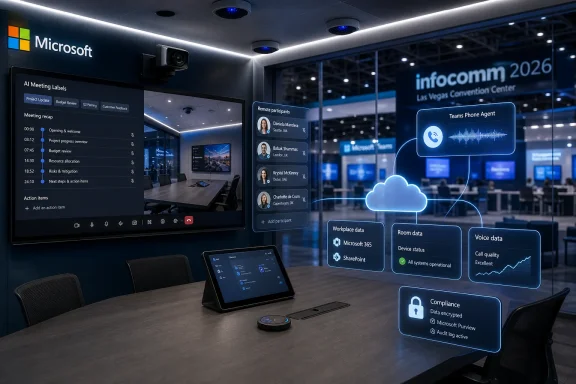
For years, Teams Rooms were easy to understand as endpoints: cameras, speakers, displays, compute modules, and management hooks that brought a conference room into the Microsoft 365 orbit. That framing is now too small. Microsoft’s InfoComm keynote suggested that the room itself is becoming a software-defined workplace node, where cameras identify participants, agents prepare or summarize meetings, and voice systems automate routine calls before a human ever enters the loop.
Ilya Bukshteyn, Microsoft’s corporate vice president for Teams Calling, Meetings and Devices, put the argument in familiar Microsoft language: AI as a productivity layer that gathers context, reduces friction, and lets people focus on higher-value work. But the concrete product direction is more revealing than the keynote rhetoric. Teams Phone Agent, custom voice agents in Copilot Studio, meeting recap experiences, chat and channel agents, IntelliFrame people labels, and new Facilitator agent skills all point to the same architecture: Microsoft wants Teams to become the operating environment for workplace interaction.
That has consequences beyond the conference room. If voice calls, hybrid meetings, room intelligence, customer interactions, and workflow automation increasingly run through Teams, then the AV stack becomes part of the enterprise application stack. The microphone is no longer just a microphone. It is an input device for identity, transcription, compliance, analytics, and automation.
This is where InfoComm becomes unusually relevant to WindowsForum readers. The show’s traditional audience includes integrators, AV specialists, broadcast engineers, facilities teams, and experience designers. Microsoft’s keynote effectively told that room that its future is tied to the same cloud, identity, device-management, and AI governance questions that sysadmins already live with every day.
On paper, the pitch is straightforward. A customer calls, an AI voice agent handles the routine request, and the human representative is freed for more complicated or valuable interactions. Organizations can also build custom agents for specialized tasks, including phone-based transaction support. In practice, that is a major expansion of what Teams Phone is supposed to be.
Teams Phone has long been Microsoft’s attempt to pull enterprise telephony into Microsoft 365. Voice agents make the product less about replacing desk phones and more about replacing chunks of business process. That is a much more ambitious claim, and it puts Microsoft in a more crowded and sensitive market.
The opportunity is obvious. Many organizations already have identity, compliance, calendaring, collaboration, and business data tied into Microsoft 365. If a voice agent can use those systems with the right permissions, it could reduce integration overhead and bring automation to places where legacy phone workflows remain stubbornly manual. For IT departments tired of maintaining parallel communications stacks, a Teams-native path has appeal.
The risk is just as obvious. Voice calls are often where customers go when self-service has failed, when a transaction is urgent, or when trust is already thin. A bad chatbot is annoying; a bad voice agent trapped in a phone tree can become a brand problem. Microsoft’s challenge is not merely to make the agent sound competent. It has to make escalation, auditability, data access, and failure handling reliable enough for real-world operations.
This is the same pattern Microsoft has used throughout the Copilot era. First, embed AI into familiar productivity surfaces. Then, give organizations a builder layer. Finally, encourage partners and customers to extend the platform until it becomes harder to separate the application from the workflow. Teams Phone voice agents fit that pattern almost perfectly.
For administrators, the governance questions should start immediately. Who can build these agents? What data can they access? How are calls logged? What retention rules apply? How does a user know whether they are speaking to an automated agent, and what happens when the agent is wrong? Microsoft’s keynote language emphasized productivity and inclusion, but enterprise adoption will hinge on policy.
That does not mean the feature is doomed to overpromise. It means the success of voice agents will be measured less by keynote applause and more by mundane operational details. The best AI phone system is not the one that sounds most human. It is the one that knows when to stop pretending and hand the call to someone accountable.
That is a useful feature, and anyone who has sat through a hybrid meeting with poor audio and a distant camera knows the problem is real. But it also marks a shift in what meeting-room equipment is expected to do. The camera is not just framing a room; it is interpreting the room. The meeting system is not just transmitting speech; it is producing structured context about who is present, what was said, and what happens next.
The new meetings recap app and Facilitator agent skills push further in that direction. Microsoft wants meetings to have a before, during, and after layer of machine assistance. Agendas, notes, action items, summaries, and follow-ups are all candidates for automation. In theory, this is the relief valve for meeting overload.
The catch is that meetings are messy because organizations are messy. The most valuable context is often political, implicit, or deliberately unstated. AI can summarize a discussion, but it may not understand why a decision was avoided, why a stakeholder went quiet, or why a seemingly minor phrasing change matters. Microsoft’s product strategy treats meeting artifacts as computable material. That is powerful, but it is not the same thing as judgment.
For Windows and Microsoft 365 admins, this raises a familiar governance tension. The business wants searchable, actionable, AI-generated meeting intelligence. Legal, compliance, HR, and security teams may see discoverability, retention, consent, and data-boundary concerns. The AV team may simply be asked to install the hardware that makes all of this possible.
A Teams Room deployment now touches Microsoft Entra identity, device enrollment, firmware updates, room calendars, Teams admin policies, network quality, security baselines, data retention, and increasingly AI feature controls. Add voice agents and Copilot Studio to the mix, and the room becomes part of a larger automation environment. That is not a side project; it is production infrastructure.
This is why Microsoft’s presence at InfoComm matters. The company is not merely courting AV integrators to sell certified devices. It is helping define a workplace model where the meeting space is managed, measured, and automated through cloud services. In that model, the integrator still matters, but so does the tenant admin.
The practical result is that AV procurement can no longer be treated as an isolated facilities decision. Camera choice, microphone coverage, room compute, signage, booking panels, and collaboration bars all have implications for security, management, and user experience. The wrong device can become a support burden. The wrong policy can turn an expensive room into a frustrating one.
That shift is understandable. AV is now tangled with collaboration software, workplace analytics, broadcast-quality production, digital signage, immersive retail, education technology, healthcare communication, and smart buildings. The buyer is not always the same person, the budget is not always in the same department, and the language of the sale increasingly sounds like IT transformation.
A Media Day gives vendors a chance to tell coherent stories instead of relying on booth traffic and spec-sheet comparisons. It also gives analysts and journalists a curated view of the industry’s preferred themes: AI adoption, workplace transformation, integrated experiences, broadcast convergence, and end-user expectations. The risk, as always, is that curation becomes consensus before the hard questions are asked.
The strongest version of InfoComm’s Media Day would not simply amplify vendor claims. It would force better comparisons between marketing language and deployable reality. Which AI features are shipping now? Which require specific licenses? Which work across mixed device estates? Which create new support obligations? Which claims are merely “AI” because that is the word every booth needs in 2026?
For IT pros, that distinction matters. Trade shows are excellent at showing what technology can look like under ideal lighting. Enterprise environments are where latency, licensing, policy, user training, accessibility, and procurement cycles decide whether the technology actually helps.
End users have been trained by consumer technology to expect smooth interfaces, high-quality video, fast search, personalization, and low tolerance for friction. At the same time, corporate environments remain full of fragmented rooms, aging displays, inconsistent audio, legacy control systems, and collaboration platforms layered on top of each other. The gap between expectation and infrastructure is where integrators make their money.
AI complicates this gap. It promises to make systems feel more adaptive, but it also depends on data, integration, and consistent inputs. A room with poor microphones will not become intelligent because a cloud model is attached to it. A meeting culture with no discipline will not become productive because recaps are generated. A workplace with unclear ownership will not become seamless because a vendor calls it an experience.
The AVIXA framing is still important because it shows the industry aligning around the same macro story Microsoft is telling. AI is not an accessory. It is becoming the justification for refreshing rooms, rethinking workflows, and connecting physical spaces to cloud platforms. Whether that produces better work or simply more expensive complexity depends on execution.
This is another reason Microsoft’s keynote fit the show. Teams is not just a meeting app anymore; it is a distribution surface for workplace video, live events, webinars, recordings, recaps, and asynchronous collaboration. AV vendors bring the cameras, capture systems, lighting, acoustics, and routing. Microsoft brings the identity, calendar, storage, compliance, and user interface. The boundary is increasingly artificial.
The phrase “broadcast-grade quality” also reflects a cultural change. People who work remotely have become less forgiving of bad rooms. A conference room that once worked for people sitting around a table may fail spectacularly for remote participants. If hybrid work is permanent, then room quality is no longer a luxury. It is part of whether remote employees can participate on equal footing.
Microsoft’s IntelliFrame people labels are a software answer to that problem, but software cannot fix everything. Good hybrid meetings still depend on room layout, lighting, acoustics, microphone placement, camera angles, network reliability, and user behavior. AI can improve the experience at the margins and sometimes more than that, but physics still gets a vote.
At first glance, residential integration might seem distant from Microsoft Teams rooms and enterprise collaboration. It is not. The same forces shaping corporate AV are reshaping high-end homes: networking, lighting control, displays, audio, video distribution, automation, wellness systems, security, and remote management. The home has become another integrated technology environment.
The commercial and residential markets are not merging into one undifferentiated industry, but they are borrowing from each other. Residential integrators increasingly deal with enterprise-grade networking and cybersecurity expectations. Commercial spaces borrow hospitality and residential design cues to make workplaces feel more adaptive and less institutional. Hybrid workers expect home offices to behave like professional collaboration spaces.
RESIDE is therefore not just an event announcement. It is AVIXA acknowledging that “integrated experience” is no longer confined to offices, classrooms, hospitals, arenas, or retail spaces. It follows people across environments. That is a powerful market story, and it also introduces a wider set of privacy, support, and interoperability questions.
For the Windows ecosystem, the home-work boundary has already been blurred by laptops, Teams, OneDrive, Microsoft 365, Windows Hello, remote management, and personal networks carrying corporate traffic. The AV industry is arriving at the same boundary from the physical-space side. RESIDE is one more sign that the professionalization of the home technology stack is accelerating.
That tension will shape the next several years of workplace technology. If Microsoft succeeds, Teams Rooms and Teams Phone become gravitational centers for collaboration infrastructure. Certified hardware ecosystems will matter, but much of the user experience will be mediated through Microsoft software, Microsoft identity, Microsoft policy, and Microsoft licensing. That is comforting for some IT departments and concerning for others.
The alternative is not a pure open ecosystem. The AV market has its own proprietary habits, compatibility matrices, firmware quirks, and control-system dependencies. Microsoft’s entry into more layers of the stack may simplify some decisions while concentrating power in another place. The question is not whether lock-in exists. The question is which lock-in customers understand, can manage, and can afford.
This is where enterprise buyers should be sober. A room standard built around Teams may be exactly right for a Microsoft 365-heavy organization. A campus with mixed collaboration platforms, specialized broadcast needs, or strict data-boundary requirements may need a more flexible design. AI features should not be evaluated as isolated magic tricks but as parts of an operating model.
The danger is that “AI-powered collaboration” becomes the phrase that ends every procurement debate. It should start the debate instead. What data does the feature use? Where is it processed? Who can administer it? What happens when licenses change? Can the room still function when the cloud service is degraded? Can users opt out? Can admins prove what happened after the fact?
Teams Rooms and AI-enabled collaboration spaces are simply the latest wave. They are more visible than many previous endpoint categories because executives use them, customers see them, and bad experiences are public. When a meeting fails, the room becomes the help desk ticket. When AI mislabels, mistranscribes, or mishandles context, the question will not be whether the AV rack was neatly installed. It will be who owns the service.
That ownership needs to be settled before deployment, not after. AV, IT, security, facilities, legal, HR, and business stakeholders all have legitimate claims. If nobody owns the whole experience, users will experience the seams. If one group owns it without the others, the deployment will likely miss critical requirements.
Microsoft’s keynote implicitly argues that the answer is platform consolidation. Put calling, meetings, devices, agents, room intelligence, and recaps into Teams, then manage it through the Microsoft cloud. That will be attractive to many organizations precisely because it reduces the number of vendors and interfaces involved. It will also make Microsoft’s roadmap more consequential to the daily functioning of physical workplaces.
For admins, the practical stance is neither reflexive enthusiasm nor reflexive suspicion. Treat AI meeting rooms as production systems. Pilot them with real users. Review logs, retention, permissions, and failure paths. Test accessibility. Test escalation. Test what happens when a room is full, a camera view is imperfect, or a participant joins from a low-bandwidth connection. The keynote demo is the beginning of the evaluation, not the end.
That positioning is not empty. Collaboration quality affects productivity. Meeting-room design affects inclusion. Voice systems affect customer experience. Digital signage affects operations. Broadcast tools affect internal communication. Residential integration affects how hybrid work actually feels outside the office. These are not decorative concerns.
But becoming core IT also means accepting core IT scrutiny. Security cannot be an afterthought. Manageability cannot be optional. Accessibility cannot be a slide near the end. AI governance cannot be deferred until after deployment. If AV systems are now intelligent, networked, identity-aware, and workflow-connected, they must be treated with the same seriousness as any other enterprise platform.
Microsoft understands that seriousness and is trying to convert it into platform advantage. Its InfoComm keynote was less about individual features than about making Teams the place where voice, meetings, rooms, agents, and workplace context converge. That is a bold play, and it arrives at a moment when organizations are still trying to determine which AI features are genuinely useful and which merely add cost and complexity.
The AV industry, meanwhile, is trying to expand its own frame. Media Day gives it a louder narrative engine. AVIXA research gives it market language. RESIDE gives it a bridge into residential integration. The result is an industry arguing that it belongs in strategic technology planning, not just in construction schedules and equipment refreshes.
That creates a near-term checklist for organizations already standardized on Microsoft 365. Not every feature needs to be adopted immediately, and not every room deserves the same level of intelligence. But the direction of travel is clear enough that planning should start before procurement cycles lock in another generation of equipment.
 Microsoft Turns the Meeting Room Into an AI Endpoint
For years, Teams Rooms were easy to understand as endpoints: cameras, speakers, displays, compute modules, and management hooks that brought a conference room into the Microsoft 365 orbit. That framing is now too small. Microsoft’s InfoComm keynote suggested that the room itself is becoming a software-defined workplace node, where cameras identify participants, agents prepare or summarize meetings, and voice systems automate routine calls before a human ever enters the loop.Ilya Bukshteyn, Microsoft’s corporate vice president for Teams Calling, Meetings and Devices, put the argument in familiar Microsoft language: AI as a productivity layer that gathers context, reduces friction, and lets people focus on higher-value work. But the concrete product direction is more revealing than the keynote rhetoric. Teams Phone Agent, custom voice agents in Copilot Studio, meeting recap experiences, chat and channel agents, IntelliFrame people labels, and new Facilitator agent skills all point to the same architecture: Microsoft wants Teams to become the operating environment for workplace interaction.
That has consequences beyond the conference room. If voice calls, hybrid meetings, room intelligence, customer interactions, and workflow automation increasingly run through Teams, then the AV stack becomes part of the enterprise application stack. The microphone is no longer just a microphone. It is an input device for identity, transcription, compliance, analytics, and automation.
This is where InfoComm becomes unusually relevant to WindowsForum readers. The show’s traditional audience includes integrators, AV specialists, broadcast engineers, facilities teams, and experience designers. Microsoft’s keynote effectively told that room that its future is tied to the same cloud, identity, device-management, and AI governance questions that sysadmins already live with every day.
The Voice Agent Is the Real Keynote Product
The most important announcement was not a prettier meeting recap or a better camera label. It was the introduction of new voice agents for Teams Phone, including a Teams Phone Agent designed to handle routine customer requests and custom voice agents built in Microsoft Copilot Studio. That move puts Microsoft directly into a category that used to be split among PBX vendors, contact-center platforms, IVR systems, CRM integrations, and bespoke automation projects.On paper, the pitch is straightforward. A customer calls, an AI voice agent handles the routine request, and the human representative is freed for more complicated or valuable interactions. Organizations can also build custom agents for specialized tasks, including phone-based transaction support. In practice, that is a major expansion of what Teams Phone is supposed to be.
Teams Phone has long been Microsoft’s attempt to pull enterprise telephony into Microsoft 365. Voice agents make the product less about replacing desk phones and more about replacing chunks of business process. That is a much more ambitious claim, and it puts Microsoft in a more crowded and sensitive market.
The opportunity is obvious. Many organizations already have identity, compliance, calendaring, collaboration, and business data tied into Microsoft 365. If a voice agent can use those systems with the right permissions, it could reduce integration overhead and bring automation to places where legacy phone workflows remain stubbornly manual. For IT departments tired of maintaining parallel communications stacks, a Teams-native path has appeal.
The risk is just as obvious. Voice calls are often where customers go when self-service has failed, when a transaction is urgent, or when trust is already thin. A bad chatbot is annoying; a bad voice agent trapped in a phone tree can become a brand problem. Microsoft’s challenge is not merely to make the agent sound competent. It has to make escalation, auditability, data access, and failure handling reliable enough for real-world operations.
Copilot Studio Moves From Demo Floor to Dial Tone
Copilot Studio matters here because it is the bridge between generic AI features and organization-specific automation. Microsoft can ship a Teams Phone Agent, but the deeper lock-in comes when companies build their own agents around internal workflows. That is where a vendor feature becomes a platform dependency.This is the same pattern Microsoft has used throughout the Copilot era. First, embed AI into familiar productivity surfaces. Then, give organizations a builder layer. Finally, encourage partners and customers to extend the platform until it becomes harder to separate the application from the workflow. Teams Phone voice agents fit that pattern almost perfectly.
For administrators, the governance questions should start immediately. Who can build these agents? What data can they access? How are calls logged? What retention rules apply? How does a user know whether they are speaking to an automated agent, and what happens when the agent is wrong? Microsoft’s keynote language emphasized productivity and inclusion, but enterprise adoption will hinge on policy.
That does not mean the feature is doomed to overpromise. It means the success of voice agents will be measured less by keynote applause and more by mundane operational details. The best AI phone system is not the one that sounds most human. It is the one that knows when to stop pretending and hand the call to someone accountable.
Hybrid Meetings Are Becoming a Data Problem
The Teams Rooms updates highlighted at InfoComm show how Microsoft is treating hybrid meetings as a data-capture and context problem. IntelliFrame people labels are a good example. They are meant to give remote participants more context by identifying people in the room, reducing the classic hybrid-meeting disadvantage where the remote attendee sees a wide shot of anonymous heads around a table.That is a useful feature, and anyone who has sat through a hybrid meeting with poor audio and a distant camera knows the problem is real. But it also marks a shift in what meeting-room equipment is expected to do. The camera is not just framing a room; it is interpreting the room. The meeting system is not just transmitting speech; it is producing structured context about who is present, what was said, and what happens next.
The new meetings recap app and Facilitator agent skills push further in that direction. Microsoft wants meetings to have a before, during, and after layer of machine assistance. Agendas, notes, action items, summaries, and follow-ups are all candidates for automation. In theory, this is the relief valve for meeting overload.
The catch is that meetings are messy because organizations are messy. The most valuable context is often political, implicit, or deliberately unstated. AI can summarize a discussion, but it may not understand why a decision was avoided, why a stakeholder went quiet, or why a seemingly minor phrasing change matters. Microsoft’s product strategy treats meeting artifacts as computable material. That is powerful, but it is not the same thing as judgment.
For Windows and Microsoft 365 admins, this raises a familiar governance tension. The business wants searchable, actionable, AI-generated meeting intelligence. Legal, compliance, HR, and security teams may see discoverability, retention, consent, and data-boundary concerns. The AV team may simply be asked to install the hardware that makes all of this possible.
The AV Department Is Being Pulled Into IT Governance
InfoComm’s importance is that it brings together the people who build physical collaboration spaces and the people who increasingly govern the software inside those spaces. That distinction used to be cleaner. AV teams handled rooms. IT handled networks, identity, endpoints, and applications. Facilities handled the workplace experience. The AI meeting room collapses those boundaries.A Teams Room deployment now touches Microsoft Entra identity, device enrollment, firmware updates, room calendars, Teams admin policies, network quality, security baselines, data retention, and increasingly AI feature controls. Add voice agents and Copilot Studio to the mix, and the room becomes part of a larger automation environment. That is not a side project; it is production infrastructure.
This is why Microsoft’s presence at InfoComm matters. The company is not merely courting AV integrators to sell certified devices. It is helping define a workplace model where the meeting space is managed, measured, and automated through cloud services. In that model, the integrator still matters, but so does the tenant admin.
The practical result is that AV procurement can no longer be treated as an isolated facilities decision. Camera choice, microphone coverage, room compute, signage, booking panels, and collaboration bars all have implications for security, management, and user experience. The wrong device can become a support burden. The wrong policy can turn an expensive room into a frustrating one.
Media Day Signals a Trade Show That Wants to Shape the Narrative
InfoComm’s first Media Day is easy to dismiss as a show-floor packaging exercise: 19 exhibitors, curated tours, journalists, analysts, creators, product announcements, partnerships, and future-of-work messaging. But the creation of a dedicated media format says something about where the AV industry thinks it is headed. It no longer wants to be seen as a hardware trade with clever installers and impressive booths. It wants to be part of the strategic technology conversation.That shift is understandable. AV is now tangled with collaboration software, workplace analytics, broadcast-quality production, digital signage, immersive retail, education technology, healthcare communication, and smart buildings. The buyer is not always the same person, the budget is not always in the same department, and the language of the sale increasingly sounds like IT transformation.
A Media Day gives vendors a chance to tell coherent stories instead of relying on booth traffic and spec-sheet comparisons. It also gives analysts and journalists a curated view of the industry’s preferred themes: AI adoption, workplace transformation, integrated experiences, broadcast convergence, and end-user expectations. The risk, as always, is that curation becomes consensus before the hard questions are asked.
The strongest version of InfoComm’s Media Day would not simply amplify vendor claims. It would force better comparisons between marketing language and deployable reality. Which AI features are shipping now? Which require specific licenses? Which work across mixed device estates? Which create new support obligations? Which claims are merely “AI” because that is the word every booth needs in 2026?
For IT pros, that distinction matters. Trade shows are excellent at showing what technology can look like under ideal lighting. Enterprise environments are where latency, licensing, policy, user training, accessibility, and procurement cycles decide whether the technology actually helps.
AVIXA’s Research Frames the Industry’s Anxiety
AVIXA’s market-intelligence briefing reportedly emphasized AI adoption, workplace transformation, integrated experiences, and evolving end-user expectations. Mike Sullivan-Trainor, AVIXA’s senior industry analyst, described demand for richer, more intelligent experiences powered by AI and broadcast-grade quality. That phrase captures both the promise and the pressure facing the industry.End users have been trained by consumer technology to expect smooth interfaces, high-quality video, fast search, personalization, and low tolerance for friction. At the same time, corporate environments remain full of fragmented rooms, aging displays, inconsistent audio, legacy control systems, and collaboration platforms layered on top of each other. The gap between expectation and infrastructure is where integrators make their money.
AI complicates this gap. It promises to make systems feel more adaptive, but it also depends on data, integration, and consistent inputs. A room with poor microphones will not become intelligent because a cloud model is attached to it. A meeting culture with no discipline will not become productive because recaps are generated. A workplace with unclear ownership will not become seamless because a vendor calls it an experience.
The AVIXA framing is still important because it shows the industry aligning around the same macro story Microsoft is telling. AI is not an accessory. It is becoming the justification for refreshing rooms, rethinking workflows, and connecting physical spaces to cloud platforms. Whether that produces better work or simply more expensive complexity depends on execution.
Broadcast Quality Has Escaped the Studio
One of the more interesting threads running through InfoComm 2026 is broadcast convergence. That phrase can sound abstract, but the underlying change is easy to see. Executives expect town halls to look professional. Universities stream lectures and events. Houses of worship, hospitals, retailers, and corporate campuses produce video for audiences that may be in the room, at home, or watching later. The studio model has leaked into everyday spaces.This is another reason Microsoft’s keynote fit the show. Teams is not just a meeting app anymore; it is a distribution surface for workplace video, live events, webinars, recordings, recaps, and asynchronous collaboration. AV vendors bring the cameras, capture systems, lighting, acoustics, and routing. Microsoft brings the identity, calendar, storage, compliance, and user interface. The boundary is increasingly artificial.
The phrase “broadcast-grade quality” also reflects a cultural change. People who work remotely have become less forgiving of bad rooms. A conference room that once worked for people sitting around a table may fail spectacularly for remote participants. If hybrid work is permanent, then room quality is no longer a luxury. It is part of whether remote employees can participate on equal footing.
Microsoft’s IntelliFrame people labels are a software answer to that problem, but software cannot fix everything. Good hybrid meetings still depend on room layout, lighting, acoustics, microphone placement, camera angles, network reliability, and user behavior. AI can improve the experience at the margins and sometimes more than that, but physics still gets a vote.
RESIDE Shows the Home Is Now Part of the Integrated Experience Economy
The launch of RESIDE, scheduled to debut alongside Lightapalooza at InfoComm 2027 in Orlando, extends the show’s argument beyond offices and commercial venues. Created through a joint venture between AVIXA, HTSA, and ProSource, the event is aimed at the residential integration market. Together, HTSA and ProSource represent more than 750 residential integration firms in North America.At first glance, residential integration might seem distant from Microsoft Teams rooms and enterprise collaboration. It is not. The same forces shaping corporate AV are reshaping high-end homes: networking, lighting control, displays, audio, video distribution, automation, wellness systems, security, and remote management. The home has become another integrated technology environment.
The commercial and residential markets are not merging into one undifferentiated industry, but they are borrowing from each other. Residential integrators increasingly deal with enterprise-grade networking and cybersecurity expectations. Commercial spaces borrow hospitality and residential design cues to make workplaces feel more adaptive and less institutional. Hybrid workers expect home offices to behave like professional collaboration spaces.
RESIDE is therefore not just an event announcement. It is AVIXA acknowledging that “integrated experience” is no longer confined to offices, classrooms, hospitals, arenas, or retail spaces. It follows people across environments. That is a powerful market story, and it also introduces a wider set of privacy, support, and interoperability questions.
For the Windows ecosystem, the home-work boundary has already been blurred by laptops, Teams, OneDrive, Microsoft 365, Windows Hello, remote management, and personal networks carrying corporate traffic. The AV industry is arriving at the same boundary from the physical-space side. RESIDE is one more sign that the professionalization of the home technology stack is accelerating.
The Platform Fight Is Moving Into the Walls
The deeper story behind InfoComm 2026 is platform control. Microsoft wants Teams and Copilot to sit at the center of work. AV manufacturers want their devices and control systems to remain differentiated. Integrators want to preserve value as systems become more cloud-managed and software-defined. Customers want fewer headaches, better experiences, and ideally less vendor lock-in than the industry usually delivers.That tension will shape the next several years of workplace technology. If Microsoft succeeds, Teams Rooms and Teams Phone become gravitational centers for collaboration infrastructure. Certified hardware ecosystems will matter, but much of the user experience will be mediated through Microsoft software, Microsoft identity, Microsoft policy, and Microsoft licensing. That is comforting for some IT departments and concerning for others.
The alternative is not a pure open ecosystem. The AV market has its own proprietary habits, compatibility matrices, firmware quirks, and control-system dependencies. Microsoft’s entry into more layers of the stack may simplify some decisions while concentrating power in another place. The question is not whether lock-in exists. The question is which lock-in customers understand, can manage, and can afford.
This is where enterprise buyers should be sober. A room standard built around Teams may be exactly right for a Microsoft 365-heavy organization. A campus with mixed collaboration platforms, specialized broadcast needs, or strict data-boundary requirements may need a more flexible design. AI features should not be evaluated as isolated magic tricks but as parts of an operating model.
The danger is that “AI-powered collaboration” becomes the phrase that ends every procurement debate. It should start the debate instead. What data does the feature use? Where is it processed? Who can administer it? What happens when licenses change? Can the room still function when the cloud service is degraded? Can users opt out? Can admins prove what happened after the fact?
Windows Admins Inherit the Room
Windows administrators have seen this movie before. A category starts as a specialized technology domain, becomes networked, gets attached to identity, moves into cloud management, and eventually lands on the IT department’s desk as a security and support responsibility. Printers, phones, mobile devices, IoT sensors, signage players, and conference-room systems have all followed versions of that path.Teams Rooms and AI-enabled collaboration spaces are simply the latest wave. They are more visible than many previous endpoint categories because executives use them, customers see them, and bad experiences are public. When a meeting fails, the room becomes the help desk ticket. When AI mislabels, mistranscribes, or mishandles context, the question will not be whether the AV rack was neatly installed. It will be who owns the service.
That ownership needs to be settled before deployment, not after. AV, IT, security, facilities, legal, HR, and business stakeholders all have legitimate claims. If nobody owns the whole experience, users will experience the seams. If one group owns it without the others, the deployment will likely miss critical requirements.
Microsoft’s keynote implicitly argues that the answer is platform consolidation. Put calling, meetings, devices, agents, room intelligence, and recaps into Teams, then manage it through the Microsoft cloud. That will be attractive to many organizations precisely because it reduces the number of vendors and interfaces involved. It will also make Microsoft’s roadmap more consequential to the daily functioning of physical workplaces.
For admins, the practical stance is neither reflexive enthusiasm nor reflexive suspicion. Treat AI meeting rooms as production systems. Pilot them with real users. Review logs, retention, permissions, and failure paths. Test accessibility. Test escalation. Test what happens when a room is full, a camera view is imperfect, or a participant joins from a low-bandwidth connection. The keynote demo is the beginning of the evaluation, not the end.
The Las Vegas Message Is That AV Is Now Core IT
InfoComm 2026’s opening day brought several threads together: Microsoft’s AI workplace pitch, the first Media Day, AVIXA’s research narrative, analyst briefings, broadcast convergence, and the RESIDE launch. The common theme is that AV no longer wants to be treated as peripheral infrastructure. It is positioning itself as the experience layer of digital work and digital life.That positioning is not empty. Collaboration quality affects productivity. Meeting-room design affects inclusion. Voice systems affect customer experience. Digital signage affects operations. Broadcast tools affect internal communication. Residential integration affects how hybrid work actually feels outside the office. These are not decorative concerns.
But becoming core IT also means accepting core IT scrutiny. Security cannot be an afterthought. Manageability cannot be optional. Accessibility cannot be a slide near the end. AI governance cannot be deferred until after deployment. If AV systems are now intelligent, networked, identity-aware, and workflow-connected, they must be treated with the same seriousness as any other enterprise platform.
Microsoft understands that seriousness and is trying to convert it into platform advantage. Its InfoComm keynote was less about individual features than about making Teams the place where voice, meetings, rooms, agents, and workplace context converge. That is a bold play, and it arrives at a moment when organizations are still trying to determine which AI features are genuinely useful and which merely add cost and complexity.
The AV industry, meanwhile, is trying to expand its own frame. Media Day gives it a louder narrative engine. AVIXA research gives it market language. RESIDE gives it a bridge into residential integration. The result is an industry arguing that it belongs in strategic technology planning, not just in construction schedules and equipment refreshes.
The Practical Reading for Microsoft Shops
The simplest reading of InfoComm’s opening day is that Microsoft announced more AI features for Teams. The better reading is that Microsoft is extending the Teams surface into every interaction that used to sit around the edges of enterprise collaboration: phone calls, room context, meeting memory, customer handoffs, and the physical experience of hybrid work.That creates a near-term checklist for organizations already standardized on Microsoft 365. Not every feature needs to be adopted immediately, and not every room deserves the same level of intelligence. But the direction of travel is clear enough that planning should start before procurement cycles lock in another generation of equipment.
- Microsoft is treating Teams Phone as a workflow automation platform, not merely a cloud PBX replacement.
- Teams Rooms deployments should now be evaluated as AI-enabled endpoints with identity, compliance, data, and lifecycle implications.
- Copilot Studio voice agents will require governance over who can build agents, what systems they can access, and how failures escalate.
- Hybrid meeting quality will depend on both software intelligence and old-fashioned room fundamentals such as audio, lighting, placement, and network reliability.
- AV and IT teams will need shared ownership models because the room, the tenant, the device, and the user experience are now inseparable.
- RESIDE’s launch alongside InfoComm 2027 shows that integrated technology environments are spreading across commercial and residential boundaries.
References
- Primary source: Sports Video Group
Published: 2026-06-18T17:42:08.618891
InfoComm 2026: Show Opens With Microsoft Keynote, Media Day, and New Industry Initiatives – Sports Video Group
InfoComm 2026 opened on Wednesday at the Las Vegas Convention Center, bringing together professionals from the AV, IT, broadcast, and integrated experience industries. Day 1 featured a keynote presentation from...www.sportsvideo.org - Related coverage: macnica.com
InfoComm 2026 | Macnica Americas
Macnica Americas will be exhibiting at InfoComm 2026, one of the largest events in North America dedicated to professional audiovisual technology and integrated experiences. Each year, InfoComm brings together engineers, system integrators, manufacturers, and technology leaders exploring...www.macnica.com
- Related coverage: commercialintegrator.com
AVIXA Acquires Lightapalooza, Plans Co-Location with InfoComm in 2027 - Commercial Integrator
AVIXA acquires Lightapalooza from HTSA, bringing the residential lighting event to InfoComm starting in 2027.www.commercialintegrator.com - Related coverage: techtimes.com
InfoComm 2026 Opens Today in Las Vegas: Agentic AI and IPMX Drive 750-Exhibitor Pro AV Show
InfoComm 2026 opened today in Las Vegas as education sessions began at the Las Vegas Convention Center, launching a seven-day pro AV trade show with 750-plus exhibitors, 46 AI sessions, free IPMXwww.techtimes.com - Related coverage: avnetwork.com
InfoComm 2026 Microsoft Keynote: Bukshteyn Talks How AI Is Impacting Teams | AVNetwork
Find out if AI is a tool or a collaborator—and how this is impacting the company's cloud-based platform.www.avnetwork.com - Related coverage: itpro.com
InfoComm 2026 Best of Show Awards entry deadline has been extended | IT Pro
Submissions will now be accepted until 23:59 PST on Friday June 12www.itpro.com
- Related coverage: cdn.asp.events
- Related coverage: infocomm.org
AVIXA - The #1 AV Association | Training & Certification | AVIXA
AVIXA is the trade association for the professional audiovisual industry worldwide, offering training, certification, job boards, conferences, and more.www.infocomm.org
