

Josh Bersin used the opening week of Irresistible 2026, held June 8–10 at USC in Los Angeles, to announce the Josh Bersin Institute, a Global HR Excellence Certification, the HR 2030 program, and new Galileo integrations for Microsoft Copilot, SAP SuccessFactors, and Workday. The announcements matter because they recast HR technology as an AI operating model rather than a collection of talent-management tools. For WindowsForum readers, the Microsoft Copilot angle is the most obvious hook, but the bigger story is that HR may become one of the first corporate functions where agentic AI moves from PowerPoint ambition to workflow architecture. The open question is whether HR leaders are buying a future of better judgment — or merely a faster version of the same enterprise sprawl.
The Josh Bersin Company did not simply announce a course, a membership program, and a few product integrations. It announced a worldview. At Irresistible 2026, the message was that HR is approaching a structural break: AI will not sit beside HR systems as a chatbot layer, but will increasingly coordinate the way HR decisions are researched, simulated, benchmarked, and executed.
That is an ambitious claim, and it is also a conveniently timed one. The HR software market has spent years promising unified employee experience, skills intelligence, workforce planning, and self-service automation. Most large employers, however, still operate a tangle of HRIS platforms, learning systems, recruiting tools, case-management portals, knowledge bases, spreadsheets, and manager workarounds. The result is an industry that talks about the employee lifecycle as if it were a clean journey map while running it through a patchwork of systems that often barely agree on the same person’s job title.
Bersin’s announcements attempt to impose a new organizing principle on that chaos. The Josh Bersin Institute and its Global HR Excellence Certification are the talent side of the bet: teach senior HR professionals how to reason through the new model. HR 2030 is the architecture side: define what an AI-enabled HR function should look like by the end of the decade. Galileo is the product layer: make Bersin’s research, models, and advisory frameworks accessible through an AI “superagent” that plugs into the enterprise systems HR already uses.
This is not subtle positioning. Bersin is trying to move from analyst and advisor to operating-system vendor for the AI-era HR profession — not in the narrow sense of replacing Workday, SAP, Microsoft, or ServiceNow, but in the broader sense of defining the mental model those platforms will be judged against. That is why the certification program is more than a credential and HR 2030 is more than a thought-leadership package. Together, they are an attempt to make “agentic HR” legible, teachable, and purchasable.
On the surface, this sounds like the familiar executive-education bundle: a prestigious university partner, a cohort experience, case-based learning, networking, and a certificate suitable for LinkedIn. But the more interesting part is the audience. Bersin is targeting HR professionals, consultants, CHROs, and technology providers — in other words, not just operators inside HR departments, but the consultants and vendors who shape what those departments buy and believe.
That is a shrewd move. Certifications create a shared vocabulary, and shared vocabulary creates market gravity. If enough HR leaders and consultants learn to describe their problems through Bersin’s maturity models, reference architectures, and Galileo-assisted workflows, then the Institute becomes more than a training provider. It becomes a standards-setting institution for how AI-era HR competence is defined.
There is precedent for this in enterprise technology. Cloud architects learned to speak in the language of AWS, Azure, Kubernetes, and DevOps certifications. Security professionals carry credentials that do not merely prove knowledge but signal membership in a profession with its own assumptions and rituals. HR has long had certifications, but Bersin is trying to graft a new AI-and-operating-model layer onto that credential economy.
The risk is that certification becomes another badge in an already crowded HR development marketplace. The opportunity is that HR genuinely needs a more rigorous way to evaluate AI systems, vendor claims, data governance, organizational design, and workforce impact. A CHRO approving an agentic HR roadmap is not merely buying software. They are making decisions about employee data, manager authority, automation boundaries, bias exposure, productivity measurement, and the future shape of the HR function itself.
That is a governance problem masquerading as a training problem. GHRE’s success will depend on whether it teaches leaders to interrogate AI systems as much as it teaches them to adopt them.
That premise is believable because the vendor market is already racing ahead. Microsoft has Copilot. Workday is building AI deeper into its platform. SAP SuccessFactors is pushing business AI across HR processes. ServiceNow wants to own workflow automation. Specialist vendors are applying AI to recruiting, skills inference, learning recommendations, pay analysis, workforce planning, and employee support. Every product roadmap now contains agents, copilots, assistants, or some synonym designed to sound less like a chatbot and more like a colleague.
The problem is that HR is especially vulnerable to bad abstractions. A finance agent that misclassifies an invoice creates a measurable operational problem. An HR agent that recommends a candidate, flags a flight risk, drafts a performance summary, nudges a manager on promotion, or interprets a policy may create a problem that is harder to see and harder to unwind. HR decisions involve law, ethics, culture, power, and personal livelihood. They also rely on data that is often incomplete, biased, outdated, or politically sensitive.
That is where a reference architecture could be useful. HR leaders need to know which systems hold authoritative data, which agents can act, which agents should only advise, which workflows require human approval, and how audit trails will survive across platforms. They need to distinguish between a knowledge assistant that answers policy questions and an agent that initiates a job requisition, recommends compensation adjustments, or triggers a restructuring workflow.
Bersin’s HR 2030 program is therefore trying to claim the planning layer before the platforms do. That is both useful and commercially convenient. If HR 2030 becomes the accepted map, then Galileo becomes a natural guide through the territory.
This is the right battleground. Microsoft has spent the last several years turning Microsoft 365, Teams, Graph, Copilot Studio, Azure AI, Entra, Purview, and the Power Platform into the default substrate for enterprise AI. The more Copilot becomes the user interface for work, the more every domain-specific knowledge provider needs a Copilot story. HR is no exception.
For IT departments, the appeal is obvious. If HR knowledge can be surfaced inside Microsoft Copilot with existing identity, permissions, compliance tooling, and user workflows, adoption friction drops. Employees already live in Teams, Outlook, SharePoint, and Office. Managers already ask questions in chat. HR shared-services teams already struggle with ticket volume, policy interpretation, and repetitive case work. A Galileo-backed Copilot deployment promises to bring specialized HR intelligence into that flow instead of forcing users into yet another portal.
But the implementation details will matter more than the demo. Microsoft Graph Connector can make external content discoverable in Microsoft 365 experiences, but discoverability is not the same as judgment. Fine-tuning or embedding a domain model can improve relevance, but it also raises questions about version control, source authority, data leakage, explainability, and update cadence. Integrating through a talent marketplace platform such as Gloat may make sense for skills and mobility use cases, but it also introduces another system of record, another permissions model, and another layer of vendor dependency.
This is where WindowsForum’s IT readership should pay attention. HR may be the business sponsor, but IT will inherit many of the architectural consequences. The moment Galileo shows up in Copilot, the project becomes an identity, data governance, compliance, endpoint, tenant configuration, and change-management problem. It is not just an HR transformation. It is another enterprise AI integration landing on the Microsoft stack.
Most large employers already have a core HR platform. They already have data pipelines, reporting processes, payroll dependencies, security roles, business rules, integrations, and years of customizations. An “agentic HR” future that ignores those systems is fantasy. The practical route is to wrap, connect, interpret, and gradually automate across them.
That makes Galileo’s positioning interesting. Bersin is not claiming to replace SAP SuccessFactors or Workday. Instead, Galileo is being positioned as an intelligence layer that can reason across research, benchmarks, maturity models, company-specific data, and workflows. In that sense, it resembles the pattern emerging across enterprise AI: keep the transaction systems, add a knowledge and orchestration layer, then use agents to reduce the distance between question and action.
The danger is that this can become yet another abstraction layer over systems that were already too complex. HR leaders may hear “agentic roadmap” and imagine a simplified future. IT leaders may hear the same phrase and see new connectors, new data mappings, new exception handling, new vendor contracts, and new security reviews. Both can be right.
The real test is whether these integrations reduce operational friction or merely relocate it. If Galileo can help a manager understand workforce options, model tradeoffs, retrieve policy guidance, and initiate the right workflow with traceable reasoning, it will feel like a breakthrough. If it produces plausible summaries that still require HR operations teams to manually verify every assumption across three systems, it will feel like another expensive assistant with a polished user interface.
Consider workforce planning. An agent could identify a skills shortage, compare internal candidates with external labor-market data, recommend reskilling options, estimate cost, and suggest redeployment scenarios. That sounds useful. It also touches promotion, mobility, pay, performance, manager discretion, and employee opportunity. If the system recommends one employee over another, the organization needs to know why — and whether the reason is lawful, fair, and aligned with company values.
Recruiting raises similar concerns. AI can accelerate sourcing, screening, outreach, interview scheduling, and candidate communication. It can also reproduce historical patterns, overweight proxy signals, or create a false sense of objectivity. HR leaders have learned to speak fluently about bias and inclusion, but agentic systems demand operational proof: documented controls, audit logs, validation, human review, and clear accountability when a recommendation goes wrong.
Employee relations may be even more sensitive. An HR agent that summarizes a complaint, recommends a response, or flags risk in manager behavior could be valuable. It could also become a surveillance mechanism if deployed carelessly. The difference will not be determined by the model alone. It will be determined by governance, data minimization, access control, retention policy, escalation design, and cultural trust.
This is why Bersin’s emphasis on education and architecture is more important than the product fireworks. Agentic HR is not a feature set. It is an authority model. Companies that fail to define that model will find themselves improvising policy around whatever their vendors make easy.
In a traditional HR portal, bad permissions may expose a policy document or case note. In a Copilot-connected environment, the blast radius can be broader because the assistant is designed to synthesize across accessible data. Microsoft has invested heavily in permission trimming, compliance, and security tooling, but enterprise reality is messy. SharePoint sites accumulate stale permissions. Teams channels blur audience boundaries. HR documents migrate from official repositories to manager desktops and shared folders. Old org charts survive long after reorganizations.
When HR intelligence is connected to that world, organizations must be ruthless about information architecture. A Copilot answer is only as trustworthy as the content it can reach and the controls that shape what it is allowed to infer. Adding Galileo may improve domain quality, but it does not magically fix tenant hygiene.
There is also a strategic dependency question. If HR’s AI experience becomes Copilot-mediated, Microsoft gains more influence over how employees encounter HR services. That may be a reasonable tradeoff for organizations already standardized on Microsoft 365. It may even be preferable to fragmented AI experiences scattered across separate HR platforms. But it means HR, IT, legal, and security teams need a shared operating model rather than a procurement-led rollout.
The best implementations will treat Copilot integration as a product program, not a plug-in. They will define use cases narrowly, validate outputs, measure resolution quality, preserve human escalation, and monitor employee trust. The worst implementations will connect everything, celebrate adoption metrics, and discover later that the assistant was confidently answering questions nobody had permission to ask.
But 2030 is not a prophecy. It is a forcing function. The value of the frame is not whether every claim about agentic HR arrives on schedule. The value is whether it pushes organizations to confront the technical debt, process fragmentation, and decision ambiguity that AI will otherwise expose in public.
Many HR departments are not ready for agentic systems because they are not ready for automation at all. Their policies are inconsistent. Their job architectures are outdated. Their skills taxonomies are incomplete. Their data quality varies by region and business unit. Their shared-services knowledge bases are written for specialists, not employees. Their managers do not trust HR systems, and employees often use HR portals only when forced.
AI does not solve that foundation problem. In some cases, it makes the problem more visible. A chatbot trained on conflicting policies will produce conflicting answers. A workforce planning agent fed incomplete skills data will recommend elegant nonsense. A career mobility assistant attached to stale job families will reinforce yesterday’s organization. Agentic HR requires boring work before it delivers magical demos.
This is why HR 2030’s reference architecture may be useful even for companies that never buy Galileo. The exercise of mapping agents, data sources, workflows, decision rights, and governance controls is itself valuable. If Bersin’s program pressures HR leaders to do that work, it will have contributed something real regardless of which vendor wins the budget.
That is exactly what the Josh Bersin Institute appears designed to do. It makes the research teachable. Galileo makes it queryable. HR 2030 makes it strategic. Corporate membership makes it recurring. Certification makes it portable for individuals and visible to employers.
This is not a criticism. It is how knowledge businesses adapt when static reports lose scarcity. Gartner, Forrester, IDC, McKinsey, Deloitte, and countless specialist research firms are all navigating versions of the same transition. The question is whether AI becomes a delivery mechanism for better expertise or a gloss over ordinary content.
Bersin has an advantage because HR is a domain where context matters. A generic model can explain performance management, but it does not necessarily know which operating model patterns have worked in global companies, how HR technology vendors differ in practice, or how organizational maturity affects implementation. If Galileo can encode that experience and keep it current, it may be more useful than a general-purpose assistant.
The risk is overconfidence. Proprietary frameworks can become self-reinforcing, especially when certification, advisory, and software all point back to the same worldview. HR leaders should welcome structure, but they should not outsource judgment. The best use of Bersin’s ecosystem will be as a disciplined lens, not an oracle.
HR data is among the most personal data in the company. It includes compensation, performance, benefits, leave, disciplinary records, demographic attributes, disability accommodations, immigration status, location, learning history, and sometimes employee relations investigations. Even when a particular AI use case seems harmless, the surrounding data environment may not be.
For Microsoft-centric shops, the practical checklist begins with Entra ID groups, conditional access, Purview labels, audit logging, Graph permissions, SharePoint governance, Teams lifecycle policies, and Copilot configuration. But it does not end there. HR and IT must agree on which sources are authoritative, which content is approved for AI retrieval, how answers are grounded, how hallucinations are reported, and how employees can challenge or escalate outcomes.
There is also a support burden. Once employees can ask HR questions through Copilot or another assistant, they will expect answers to be immediate and actionable. If the assistant points them to the wrong policy, HR gets the complaint. If access fails, IT gets the ticket. If the answer reveals too much, legal and security get involved. AI self-service does not remove support obligations; it changes their shape.
The smartest organizations will pilot narrowly. They will start with lower-risk knowledge retrieval, manager guidance, learning recommendations, or HR operations support before moving into consequential decision support. They will test with real users, not just executives in a demo room. And they will measure not only speed but accuracy, trust, escalation quality, and downstream workload.
AI promises relief by collapsing the distance between information and action. A manager could ask how to handle a leave situation. A recruiter could generate a sourcing strategy. A learning leader could map skills gaps to programs. A CHRO could simulate workforce scenarios. An employee could navigate benefits without opening a ticket. These are not trivial improvements if they work.
But HR’s chronic problem is not only information retrieval. It is organizational trust. Employees do not merely want fast answers; they want fair answers. Managers do not merely want recommendations; they want confidence that following them will not create risk. Executives do not merely want dashboards; they want decisions that survive contact with reality.
That is why the “superagent” language should be handled carefully. Superagents sound powerful, but HR needs accountable systems more than heroic metaphors. The best AI in HR will often be quiet: reducing case handling time, improving policy consistency, surfacing relevant context, documenting decisions, and helping humans reason better. The most dangerous AI will sound authoritative while obscuring uncertainty.
Bersin’s announcements sit precisely at that tension. They are exciting because they suggest HR might finally get tools equal to its complexity. They are unsettling because the same tools could harden bad processes at machine speed.
That confidence has value. HR leaders cannot simply wait for the vendor market to settle. The decisions they make now about data foundations, skills architecture, AI governance, and platform integration will shape what is possible later. A structured program can help leaders avoid paralysis.
But confidence can also become a productized emotion. Enterprise technology markets are skilled at turning uncertainty into subscription revenue. The more chaotic the AI landscape becomes, the more attractive it is to buy a blueprint from someone who claims to see the whole board.
The right stance is neither cynicism nor surrender. HR leaders should engage with GHRE, HR 2030, and Galileo as serious signals of where the market is moving. They should also test the claims against their own operating realities. Does the architecture reduce complexity? Does the certification improve decision quality? Does Galileo produce grounded, auditable, context-aware guidance? Do integrations with Copilot, SuccessFactors, and Workday make workflows better, or simply make demos smoother?
Those are not anti-AI questions. They are the questions that separate transformation from theater.
The most concrete takeaways are less about the branding and more about the architecture now coming into view.
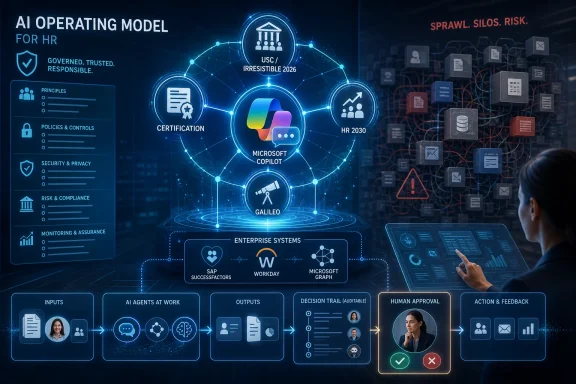 Bersin Turns a Conference Launch Into a Governance Argument
The Josh Bersin Company did not simply announce a course, a membership program, and a few product integrations. It announced a worldview. At Irresistible 2026, the message was that HR is approaching a structural break: AI will not sit beside HR systems as a chatbot layer, but will increasingly coordinate the way HR decisions are researched, simulated, benchmarked, and executed.That is an ambitious claim, and it is also a conveniently timed one. The HR software market has spent years promising unified employee experience, skills intelligence, workforce planning, and self-service automation. Most large employers, however, still operate a tangle of HRIS platforms, learning systems, recruiting tools, case-management portals, knowledge bases, spreadsheets, and manager workarounds. The result is an industry that talks about the employee lifecycle as if it were a clean journey map while running it through a patchwork of systems that often barely agree on the same person’s job title.
Bersin’s announcements attempt to impose a new organizing principle on that chaos. The Josh Bersin Institute and its Global HR Excellence Certification are the talent side of the bet: teach senior HR professionals how to reason through the new model. HR 2030 is the architecture side: define what an AI-enabled HR function should look like by the end of the decade. Galileo is the product layer: make Bersin’s research, models, and advisory frameworks accessible through an AI “superagent” that plugs into the enterprise systems HR already uses.
This is not subtle positioning. Bersin is trying to move from analyst and advisor to operating-system vendor for the AI-era HR profession — not in the narrow sense of replacing Workday, SAP, Microsoft, or ServiceNow, but in the broader sense of defining the mental model those platforms will be judged against. That is why the certification program is more than a credential and HR 2030 is more than a thought-leadership package. Together, they are an attempt to make “agentic HR” legible, teachable, and purchasable.
The Certification Is Really a Bet on HR’s New Professional Class
The Global HR Excellence Certification, or GHRE, is being pitched as a 12-week, 50-hour program developed with USC Marshall Executive Education. It uses case studies, business simulation, cohort learning, and Bersin’s existing research library to train participants in what the company calls world-class HR practices. Graduates also receive access to Galileo tools and become part of an alumni network.On the surface, this sounds like the familiar executive-education bundle: a prestigious university partner, a cohort experience, case-based learning, networking, and a certificate suitable for LinkedIn. But the more interesting part is the audience. Bersin is targeting HR professionals, consultants, CHROs, and technology providers — in other words, not just operators inside HR departments, but the consultants and vendors who shape what those departments buy and believe.
That is a shrewd move. Certifications create a shared vocabulary, and shared vocabulary creates market gravity. If enough HR leaders and consultants learn to describe their problems through Bersin’s maturity models, reference architectures, and Galileo-assisted workflows, then the Institute becomes more than a training provider. It becomes a standards-setting institution for how AI-era HR competence is defined.
There is precedent for this in enterprise technology. Cloud architects learned to speak in the language of AWS, Azure, Kubernetes, and DevOps certifications. Security professionals carry credentials that do not merely prove knowledge but signal membership in a profession with its own assumptions and rituals. HR has long had certifications, but Bersin is trying to graft a new AI-and-operating-model layer onto that credential economy.
The risk is that certification becomes another badge in an already crowded HR development marketplace. The opportunity is that HR genuinely needs a more rigorous way to evaluate AI systems, vendor claims, data governance, organizational design, and workforce impact. A CHRO approving an agentic HR roadmap is not merely buying software. They are making decisions about employee data, manager authority, automation boundaries, bias exposure, productivity measurement, and the future shape of the HR function itself.
That is a governance problem masquerading as a training problem. GHRE’s success will depend on whether it teaches leaders to interrogate AI systems as much as it teaches them to adopt them.
HR 2030 Packages the AI Future Before Vendors Define It Alone
The second announcement, HR 2030, is the more strategically important one. Bersin describes it as a global initiative to build a reference architecture, research program, case-study library, vendor analysis, technical guides, and educational curriculum for what he calls Agentic HR. The premise is simple enough: AI agents are coming to HR, and organizations need a blueprint before vendors sell them incompatible futures.That premise is believable because the vendor market is already racing ahead. Microsoft has Copilot. Workday is building AI deeper into its platform. SAP SuccessFactors is pushing business AI across HR processes. ServiceNow wants to own workflow automation. Specialist vendors are applying AI to recruiting, skills inference, learning recommendations, pay analysis, workforce planning, and employee support. Every product roadmap now contains agents, copilots, assistants, or some synonym designed to sound less like a chatbot and more like a colleague.
The problem is that HR is especially vulnerable to bad abstractions. A finance agent that misclassifies an invoice creates a measurable operational problem. An HR agent that recommends a candidate, flags a flight risk, drafts a performance summary, nudges a manager on promotion, or interprets a policy may create a problem that is harder to see and harder to unwind. HR decisions involve law, ethics, culture, power, and personal livelihood. They also rely on data that is often incomplete, biased, outdated, or politically sensitive.
That is where a reference architecture could be useful. HR leaders need to know which systems hold authoritative data, which agents can act, which agents should only advise, which workflows require human approval, and how audit trails will survive across platforms. They need to distinguish between a knowledge assistant that answers policy questions and an agent that initiates a job requisition, recommends compensation adjustments, or triggers a restructuring workflow.
Bersin’s HR 2030 program is therefore trying to claim the planning layer before the platforms do. That is both useful and commercially convenient. If HR 2030 becomes the accepted map, then Galileo becomes a natural guide through the territory.
Galileo’s Microsoft Copilot Play Puts HR AI Where Windows Shops Already Live
For Windows-heavy enterprises, the most consequential product detail is Galileo Enterprise for Microsoft Copilot. Bersin says organizations can use Galileo in Copilot through three approaches: embedded via frontier fine-tuning, connected through Microsoft Graph Connector, or integrated with Gloat. That phrasing matters because it frames Galileo not as a standalone HR chatbot but as a knowledge and advisory layer that can appear inside the Microsoft ecosystem where many corporate employees already work.This is the right battleground. Microsoft has spent the last several years turning Microsoft 365, Teams, Graph, Copilot Studio, Azure AI, Entra, Purview, and the Power Platform into the default substrate for enterprise AI. The more Copilot becomes the user interface for work, the more every domain-specific knowledge provider needs a Copilot story. HR is no exception.
For IT departments, the appeal is obvious. If HR knowledge can be surfaced inside Microsoft Copilot with existing identity, permissions, compliance tooling, and user workflows, adoption friction drops. Employees already live in Teams, Outlook, SharePoint, and Office. Managers already ask questions in chat. HR shared-services teams already struggle with ticket volume, policy interpretation, and repetitive case work. A Galileo-backed Copilot deployment promises to bring specialized HR intelligence into that flow instead of forcing users into yet another portal.
But the implementation details will matter more than the demo. Microsoft Graph Connector can make external content discoverable in Microsoft 365 experiences, but discoverability is not the same as judgment. Fine-tuning or embedding a domain model can improve relevance, but it also raises questions about version control, source authority, data leakage, explainability, and update cadence. Integrating through a talent marketplace platform such as Gloat may make sense for skills and mobility use cases, but it also introduces another system of record, another permissions model, and another layer of vendor dependency.
This is where WindowsForum’s IT readership should pay attention. HR may be the business sponsor, but IT will inherit many of the architectural consequences. The moment Galileo shows up in Copilot, the project becomes an identity, data governance, compliance, endpoint, tenant configuration, and change-management problem. It is not just an HR transformation. It is another enterprise AI integration landing on the Microsoft stack.
The SAP and Workday Integrations Reveal the Real Enterprise Constraint
Bersin also announced Galileo Enterprise for SAP SuccessFactors through a strategic partnership with Gloat, along with plans for Galileo integration into Workday through Sana Core and Sana Enterprise. These details are not mere partner-name confetti. They expose the reality of HR technology in large organizations: no one gets to start from a blank slate.Most large employers already have a core HR platform. They already have data pipelines, reporting processes, payroll dependencies, security roles, business rules, integrations, and years of customizations. An “agentic HR” future that ignores those systems is fantasy. The practical route is to wrap, connect, interpret, and gradually automate across them.
That makes Galileo’s positioning interesting. Bersin is not claiming to replace SAP SuccessFactors or Workday. Instead, Galileo is being positioned as an intelligence layer that can reason across research, benchmarks, maturity models, company-specific data, and workflows. In that sense, it resembles the pattern emerging across enterprise AI: keep the transaction systems, add a knowledge and orchestration layer, then use agents to reduce the distance between question and action.
The danger is that this can become yet another abstraction layer over systems that were already too complex. HR leaders may hear “agentic roadmap” and imagine a simplified future. IT leaders may hear the same phrase and see new connectors, new data mappings, new exception handling, new vendor contracts, and new security reviews. Both can be right.
The real test is whether these integrations reduce operational friction or merely relocate it. If Galileo can help a manager understand workforce options, model tradeoffs, retrieve policy guidance, and initiate the right workflow with traceable reasoning, it will feel like a breakthrough. If it produces plausible summaries that still require HR operations teams to manually verify every assumption across three systems, it will feel like another expensive assistant with a polished user interface.
Agentic HR Will Force Companies to Decide Who Gets to Decide
The phrase agentic HR sounds futuristic, but its hardest questions are old ones. Who has authority? Who gets overruled? Which decisions are advisory, which are automated, and which are too sensitive to delegate? AI does not eliminate those questions. It makes them harder to avoid.Consider workforce planning. An agent could identify a skills shortage, compare internal candidates with external labor-market data, recommend reskilling options, estimate cost, and suggest redeployment scenarios. That sounds useful. It also touches promotion, mobility, pay, performance, manager discretion, and employee opportunity. If the system recommends one employee over another, the organization needs to know why — and whether the reason is lawful, fair, and aligned with company values.
Recruiting raises similar concerns. AI can accelerate sourcing, screening, outreach, interview scheduling, and candidate communication. It can also reproduce historical patterns, overweight proxy signals, or create a false sense of objectivity. HR leaders have learned to speak fluently about bias and inclusion, but agentic systems demand operational proof: documented controls, audit logs, validation, human review, and clear accountability when a recommendation goes wrong.
Employee relations may be even more sensitive. An HR agent that summarizes a complaint, recommends a response, or flags risk in manager behavior could be valuable. It could also become a surveillance mechanism if deployed carelessly. The difference will not be determined by the model alone. It will be determined by governance, data minimization, access control, retention policy, escalation design, and cultural trust.
This is why Bersin’s emphasis on education and architecture is more important than the product fireworks. Agentic HR is not a feature set. It is an authority model. Companies that fail to define that model will find themselves improvising policy around whatever their vendors make easy.
The Microsoft Stack Makes Adoption Easier and Risk More Concentrated
Microsoft’s role in this story deserves special attention because Copilot is becoming the default enterprise AI doorway for many organizations. That gives HR leaders a ready-made distribution channel. It also concentrates risk in a platform that already touches email, documents, calendars, meetings, chats, files, identities, and business applications.In a traditional HR portal, bad permissions may expose a policy document or case note. In a Copilot-connected environment, the blast radius can be broader because the assistant is designed to synthesize across accessible data. Microsoft has invested heavily in permission trimming, compliance, and security tooling, but enterprise reality is messy. SharePoint sites accumulate stale permissions. Teams channels blur audience boundaries. HR documents migrate from official repositories to manager desktops and shared folders. Old org charts survive long after reorganizations.
When HR intelligence is connected to that world, organizations must be ruthless about information architecture. A Copilot answer is only as trustworthy as the content it can reach and the controls that shape what it is allowed to infer. Adding Galileo may improve domain quality, but it does not magically fix tenant hygiene.
There is also a strategic dependency question. If HR’s AI experience becomes Copilot-mediated, Microsoft gains more influence over how employees encounter HR services. That may be a reasonable tradeoff for organizations already standardized on Microsoft 365. It may even be preferable to fragmented AI experiences scattered across separate HR platforms. But it means HR, IT, legal, and security teams need a shared operating model rather than a procurement-led rollout.
The best implementations will treat Copilot integration as a product program, not a plug-in. They will define use cases narrowly, validate outputs, measure resolution quality, preserve human escalation, and monitor employee trust. The worst implementations will connect everything, celebrate adoption metrics, and discover later that the assistant was confidently answering questions nobody had permission to ask.
The 2030 Deadline Is Less Prediction Than Pressure Tactic
Bersin’s “HR 2030” framing is effective because it gives the market a deadline. Four years is close enough to create urgency and far enough to permit architectural ambition. It lets HR leaders say they are building toward a future state without pretending the future state must arrive next quarter.But 2030 is not a prophecy. It is a forcing function. The value of the frame is not whether every claim about agentic HR arrives on schedule. The value is whether it pushes organizations to confront the technical debt, process fragmentation, and decision ambiguity that AI will otherwise expose in public.
Many HR departments are not ready for agentic systems because they are not ready for automation at all. Their policies are inconsistent. Their job architectures are outdated. Their skills taxonomies are incomplete. Their data quality varies by region and business unit. Their shared-services knowledge bases are written for specialists, not employees. Their managers do not trust HR systems, and employees often use HR portals only when forced.
AI does not solve that foundation problem. In some cases, it makes the problem more visible. A chatbot trained on conflicting policies will produce conflicting answers. A workforce planning agent fed incomplete skills data will recommend elegant nonsense. A career mobility assistant attached to stale job families will reinforce yesterday’s organization. Agentic HR requires boring work before it delivers magical demos.
This is why HR 2030’s reference architecture may be useful even for companies that never buy Galileo. The exercise of mapping agents, data sources, workflows, decision rights, and governance controls is itself valuable. If Bersin’s program pressures HR leaders to do that work, it will have contributed something real regardless of which vendor wins the budget.
The New Institute Also Protects Bersin’s Own Moat
There is a business-model story here, and it should not be ignored. The Josh Bersin Company has accumulated research, case studies, maturity models, vendor intelligence, and advisory frameworks over decades. Generative AI threatens to commoditize certain kinds of analysis by making summaries, comparisons, and first-draft recommendations cheap. The obvious defense is to turn proprietary research into an interactive platform and wrap it in certification, community, and enterprise access.That is exactly what the Josh Bersin Institute appears designed to do. It makes the research teachable. Galileo makes it queryable. HR 2030 makes it strategic. Corporate membership makes it recurring. Certification makes it portable for individuals and visible to employers.
This is not a criticism. It is how knowledge businesses adapt when static reports lose scarcity. Gartner, Forrester, IDC, McKinsey, Deloitte, and countless specialist research firms are all navigating versions of the same transition. The question is whether AI becomes a delivery mechanism for better expertise or a gloss over ordinary content.
Bersin has an advantage because HR is a domain where context matters. A generic model can explain performance management, but it does not necessarily know which operating model patterns have worked in global companies, how HR technology vendors differ in practice, or how organizational maturity affects implementation. If Galileo can encode that experience and keep it current, it may be more useful than a general-purpose assistant.
The risk is overconfidence. Proprietary frameworks can become self-reinforcing, especially when certification, advisory, and software all point back to the same worldview. HR leaders should welcome structure, but they should not outsource judgment. The best use of Bersin’s ecosystem will be as a disciplined lens, not an oracle.
Enterprise IT Will Be Asked to Make HR’s AI Ambition Real
The announcements were made to HR leaders, but the work will quickly land with IT. Every agentic HR scenario depends on integration, identity, permissions, device access, data classification, monitoring, and lifecycle management. That is familiar terrain for sysadmins and enterprise architects, but HR AI adds a distinct layer of sensitivity.HR data is among the most personal data in the company. It includes compensation, performance, benefits, leave, disciplinary records, demographic attributes, disability accommodations, immigration status, location, learning history, and sometimes employee relations investigations. Even when a particular AI use case seems harmless, the surrounding data environment may not be.
For Microsoft-centric shops, the practical checklist begins with Entra ID groups, conditional access, Purview labels, audit logging, Graph permissions, SharePoint governance, Teams lifecycle policies, and Copilot configuration. But it does not end there. HR and IT must agree on which sources are authoritative, which content is approved for AI retrieval, how answers are grounded, how hallucinations are reported, and how employees can challenge or escalate outcomes.
There is also a support burden. Once employees can ask HR questions through Copilot or another assistant, they will expect answers to be immediate and actionable. If the assistant points them to the wrong policy, HR gets the complaint. If access fails, IT gets the ticket. If the answer reveals too much, legal and security get involved. AI self-service does not remove support obligations; it changes their shape.
The smartest organizations will pilot narrowly. They will start with lower-risk knowledge retrieval, manager guidance, learning recommendations, or HR operations support before moving into consequential decision support. They will test with real users, not just executives in a demo room. And they will measure not only speed but accuracy, trust, escalation quality, and downstream workload.
The AI Story Is Persuasive Because HR Is Already Under Strain
Bersin’s pitch resonates because HR is being asked to do more with systems that often make the work harder. Companies want better workforce agility, more personalized employee experiences, faster hiring, stronger leadership pipelines, more precise skills planning, tighter compliance, and credible productivity analysis. At the same time, HR teams face budget pressure, policy complexity, distributed workforces, regulatory scrutiny, and employee skepticism.AI promises relief by collapsing the distance between information and action. A manager could ask how to handle a leave situation. A recruiter could generate a sourcing strategy. A learning leader could map skills gaps to programs. A CHRO could simulate workforce scenarios. An employee could navigate benefits without opening a ticket. These are not trivial improvements if they work.
But HR’s chronic problem is not only information retrieval. It is organizational trust. Employees do not merely want fast answers; they want fair answers. Managers do not merely want recommendations; they want confidence that following them will not create risk. Executives do not merely want dashboards; they want decisions that survive contact with reality.
That is why the “superagent” language should be handled carefully. Superagents sound powerful, but HR needs accountable systems more than heroic metaphors. The best AI in HR will often be quiet: reducing case handling time, improving policy consistency, surfacing relevant context, documenting decisions, and helping humans reason better. The most dangerous AI will sound authoritative while obscuring uncertainty.
Bersin’s announcements sit precisely at that tension. They are exciting because they suggest HR might finally get tools equal to its complexity. They are unsettling because the same tools could harden bad processes at machine speed.
The Real Product Is Confidence, Not Software
The repeated word in Bersin’s announcement is not “AI” but “confidence.” The certification promises confidence to take on new HR challenges. HR 2030 promises a roadmap for an uncertain future. Galileo promises an expert system that travels with the user. Together, they sell confidence to a profession being told that AI will reinvent its operating model before the decade is out.That confidence has value. HR leaders cannot simply wait for the vendor market to settle. The decisions they make now about data foundations, skills architecture, AI governance, and platform integration will shape what is possible later. A structured program can help leaders avoid paralysis.
But confidence can also become a productized emotion. Enterprise technology markets are skilled at turning uncertainty into subscription revenue. The more chaotic the AI landscape becomes, the more attractive it is to buy a blueprint from someone who claims to see the whole board.
The right stance is neither cynicism nor surrender. HR leaders should engage with GHRE, HR 2030, and Galileo as serious signals of where the market is moving. They should also test the claims against their own operating realities. Does the architecture reduce complexity? Does the certification improve decision quality? Does Galileo produce grounded, auditable, context-aware guidance? Do integrations with Copilot, SuccessFactors, and Workday make workflows better, or simply make demos smoother?
Those are not anti-AI questions. They are the questions that separate transformation from theater.
The Week’s Announcements Put HR on IT’s AI Roadmap
Bersin’s Irresistible 2026 package is a marker of where enterprise AI is heading: away from generic assistants and toward domain-specific systems that embed themselves into existing work platforms. HR is a logical proving ground because the function is knowledge-heavy, process-heavy, and politically central. It is also a risky proving ground because mistakes affect people directly.The most concrete takeaways are less about the branding and more about the architecture now coming into view.
- The Josh Bersin Institute is designed to turn Bersin’s research and advisory frameworks into a credentialed professional development system for senior HR leaders, consultants, and HR technology providers.
- The Global HR Excellence Certification is a 12-week, 50-hour program built with USC Marshall Executive Education and tied directly to Galileo-based learning and post-program access.
- HR 2030 is an attempt to define a reference architecture for agentic HR before individual software vendors define the market through their own platforms.
- Galileo’s Microsoft Copilot integration is the most relevant development for Windows-centric enterprises because it brings HR-specific AI into the Microsoft 365 and Graph-centered workflow.
- SAP SuccessFactors and Workday integration plans show that agentic HR will be built around existing systems of record rather than replacing them in one dramatic platform shift.
- The biggest implementation risks are not model capability but data quality, permissions, governance, auditability, and the unresolved question of which HR decisions AI should influence.
References
- Primary source: Josh Bersin
Published: 2026-06-08T03:31:07.589562
The Josh Bersin Institute, HR 2030, And The Global HR Excellence Certification. – JOSH BERSIN
Introducing The Josh Bersin Institute: Defining the future of HR Excellence. Get certified as a Global HR Excellence Professional today.joshbersin.com - Related coverage: prnewswire.com
Josh Bersin Company's Irresistible 2026 HR Leadership Conference Announces Compelling Speaker Line-Up and Learning Agenda
/PRNewswire/ -- The Josh Bersin Company, the world's leading HR advisory firm, today announced the final confirmed line-up and agenda for its milestone fifth... www.prnewswire.com
- Related coverage: article.wn.com
Josh Bersin Company's Irresistible 2026 HR Leadership Conference Announces Compelling Speaker Line-Up and Learning Agenda - Worldnews.com
Executives from Etihad Airways, Keurig Dr Pepper, Microsoft, and Scentre Group will take to the stage and share AI-era HR best practices at the fifth annual Josh Bersin Company conference The event will feature Josh Bersin's keynote: "2030—what does it really mean for the American workplace?"...article.wn.com
- Related coverage: execed.marshall.usc.edu
Global HR Excellence - USC Marshall Executive Education
Build cross-domain expertise and a systemic, AI-informed view of how HR is changing. execed.marshall.usc.edu
