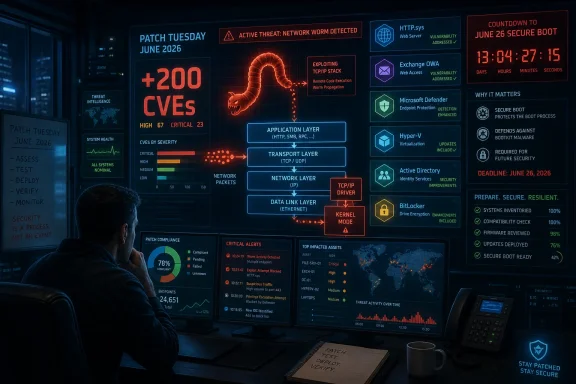
Microsoft’s June 9, 2026 Patch Tuesday delivered fixes for more than 200 vulnerabilities across Windows, Office, Exchange, Defender, Hyper-V, and server components, led by a wormable Windows kernel TCP/IP flaw that can be exploited remotely without credentials or user interaction. The raw number is historic, but the count is not the real story. This is the month Microsoft’s old patch calendar collided with AI-speed vulnerability discovery, public exploit culture, and enterprise networks that still move at change-control speed. For Windows administrators, June’s release is less a maintenance event than a stress test of whether patch management can still keep up with the threat model it was built to contain.
Patch Tuesday has always been a bargain between Microsoft and the people who have to keep Windows running. Microsoft gets a predictable disclosure and release rhythm; administrators get a regular window to test, stage, approve, and deploy fixes without turning every week into an emergency. That model has survived worms, ransomware, browser wars, Office macro abuse, Exchange compromises, and the long tail of legacy Windows estates.
June 2026 strains that bargain. Trend Micro’s Zero Day Initiative counted 208 CVEs in this release, while other researchers arrived at slightly different totals depending on whether they include already-serviced items, Chromium fixes, or third-party components bundled into Microsoft products. The exact number matters less than the consensus: this is the largest single Patch Tuesday since the program began in 2003.
The volume alone would be enough to exhaust security teams. But June’s release also includes multiple flaws with the properties defenders dread most: remote reachability, no authentication, no user interaction, kernel-level execution, public disclosure before patch availability, and confirmed exploitation in the wild. Those are not spreadsheet problems. They are prioritization problems with consequences measured in compromise windows.
The danger is that a record-breaking month encourages the wrong response. Organizations may be tempted to treat this as an outlier, a brutal but temporary spike before the patch treadmill returns to normal. The better reading is harsher: June looks like a preview of a new baseline, where AI-assisted bug discovery increases the size of each patch wave while adversaries use the same acceleration to reduce the time between fix and weaponized exploit.
A use-after-free bug is a memory safety failure in which software continues to rely on a memory region after it has been released back to the system. If an attacker can influence what later occupies that region, the old reference can become a steering wheel for malicious execution. In user-space applications, that is bad enough. In the Windows kernel’s network stack, it becomes a direct path toward SYSTEM-level compromise before many defensive layers have a meaningful chance to intervene.
Microsoft reportedly classifies the flaw as wormable under certain network configurations. That wording matters. Vendors do not use wormable lightly, because it invokes the worst moments in Windows security history: Blaster, Sasser, Conficker, WannaCry, and the era-defining lesson that a remotely exploitable Windows flaw does not need human help to become an internet-scale event.
The reference point everyone reaches for is EternalBlue, and for good reason. Microsoft patched the underlying SMB flaw in March 2017; WannaCry tore through unpatched systems in May. The postmortem was not that Microsoft failed to issue a fix. It was that too many organizations had built patch processes optimized for ordinary risk, then met an extraordinary worm with ordinary timelines.
CVE-2026-45657 is not EternalBlue unless and until a reliable exploit exists and real-world propagation begins. But defenders do not get to wait for that proof. The exploit-development clock started the moment the patch shipped, because attackers and researchers can reverse-engineer the update, compare changed binaries, and work backward toward the bug. That is the uncomfortable truth of modern patching: the fix is also a map.
That is why Dustin Childs’ warning from ZDI landed so sharply. His point was not that exploitation was already guaranteed, but that the vulnerability has exactly the sort of profile that attracts top-tier exploit developers. A CVSS 9.8 network bug in the Windows kernel is not an academic curiosity. It is an asset.
This distinction should shape enterprise response. The right question is not, “Has this been exploited in the wild yet?” The better question is, “How many days would we need to be comfortable if exploit code appeared tomorrow?” For many organizations, the honest answer is unsettling.
The common compensating controls are useful but insufficient. Firewalls, segmentation, endpoint detection, intrusion prevention, and exposure management all reduce risk. None of them should become an excuse to defer a kernel networking fix with wormable characteristics. When the vulnerable component processes traffic at a level below ordinary user-space controls, patching is not just one mitigation among many. It is the thing that removes the condition.
CVE-2026-49160, an HTTP.sys denial-of-service flaw tied to the so-called HTTP/2 Bomb technique, is a good example of why severity labels can mislead. A denial-of-service issue may sound less urgent than code execution, but exhausting tens of gigabytes of RAM on an IIS server in under a minute is not an abstract nuisance. For public-facing services, availability is part of security, and a trivial crash path can become leverage for extortion, distraction, or chained operations.
Microsoft’s mitigation through a MaxHeadersCount registry setting is useful, particularly for organizations that cannot patch internet-facing systems immediately. But mitigations are not neutral; they add configuration variance, monitoring requirements, and the possibility of uneven deployment. A registry workaround may buy time. It should not become permanent debt.
CVE-2026-50507, the BitLocker bypass associated by researchers with “YellowKey,” sits at the opposite end of the threat spectrum. It reportedly requires physical access, which makes it less likely to be exploited at scale but potentially devastating in the exact scenario BitLocker is meant to address: a lost, stolen, seized, or otherwise uncontrolled laptop. Enterprises do not deploy full-disk encryption because they expect attackers to be polite. They deploy it because devices leave buildings.
Then there is CVE-2026-45586, a Windows CTFMON privilege escalation flaw believed by researchers to overlap with the previously discussed “GreenPlasma” exploit path. Local privilege escalation bugs rarely get the same boardroom attention as remote code execution, but real intrusions are built from chains. Initial access gets an attacker onto a machine; privilege escalation decides how much of the estate that foothold can touch.
Microsoft patched the Defender elevation-of-privilege flaw out of band on May 19, and for most consumer and enterprise endpoints Defender’s update channel should have handled the fix automatically. That is the reassuring version of the story. The less reassuring version is familiar to anyone who has managed isolated networks, regulated environments, gold images, offline VDI pools, or security tools with update policies frozen by process rather than risk.
Automatic updates are a delivery mechanism, not a guarantee. Administrators still need proof of installation, reporting coverage, and exception handling for systems that do not behave like the median endpoint. The machines that miss security intelligence updates are often the same machines that are hard to see, hard to reboot, hard to manage, or hard to replace.
The same lesson applies more broadly to Microsoft’s patch ecosystem. Cloud-connected, default-configured devices may heal quickly. Enterprise reality is messier: disconnected subnets, specialized workloads, change freezes, fragile drivers, old VPN clients, vendor-certified images, and business units that treat reboot prompts as hostile acts. June punishes that messiness.
A crafted email opened in OWA can reportedly execute JavaScript in the authenticated browser session. That creates opportunities for session token theft, mailbox impersonation, and user-context abuse without necessarily exploiting the server in the way defenders are trained to imagine. It is a client-side foothold through a server-side trust channel.
Exchange has spent the last several years teaching organizations a painful lesson: perimeter software with privileged access to identity, mail, and internal workflows is not merely another application server. It is a strategic target. Whether the exploit path is ProxyShell-style server compromise, credential theft, OWA abuse, or malicious inbox rules, the practical result is often the same: attackers gain access to communications that help them move, persist, and understand the victim.
The June fix reportedly provides the first permanent patch for this issue after earlier exploitation and mitigation guidance. That makes it an immediate priority for any organization still running on-premises Exchange Server 2016, 2019, or Subscription Edition. Hybrid environments do not get a pass simply because mailboxes have moved gradually to the cloud. If OWA is reachable and users can authenticate, the risk remains real.
The DHCP client runs across ordinary Windows endpoints because ordinary Windows endpoints need network configuration. That gives the bug a potentially enormous installed base. Reports also note a contradiction in Microsoft’s write-up, with the text suggesting an authenticated-user condition while the CVSS vector indicates no authentication. In situations like that, defenders should not optimize for the gentler interpretation.
A remote code execution flaw in a ubiquitous client service changes the patching map. This is not only about servers in a DMZ or laptops that browse the web. It is about the broad endpoint fleet, including machines that may never be considered high-value until they become a bridge into something that is.
HTTP.sys brings a similar lesson from the server side. CVE-2026-47291 is a separate HTTP.sys remote code execution vulnerability, also reportedly carrying a 9.8 score, with exposure shaped in part by registry settings such as MaxRequestBytes. HTTP.sys underpins IIS and other Windows components that need kernel-mode HTTP handling, which means administrators must think beyond “Do we run a web server?” and toward “What services on this machine bind to HTTP through Windows?”
The Remote Desktop Client cluster adds a more human twist. These bugs reportedly trigger when a user connects to a malicious RDP server, which makes them less wormlike but still dangerous for administrators, support engineers, contractors, and power users who connect to systems outside tightly controlled inventories. In other words, the people most likely to use RDP are often the people whose workstations have the credentials attackers want.
Hyper-V bugs are particularly sensitive because virtualization is supposed to enforce boundaries. A guest-to-host escape, or anything in that family of risk, attacks the trust model that lets organizations consolidate workloads safely. Even when exploitation requires a specific configuration or authenticated position, the affected host may carry multiple workloads and trust relationships.
Active Directory and Kerberos vulnerabilities deserve an equally conservative posture. AD is not just a directory; it is the authority structure for Windows enterprise identity. Kerberos is not just an authentication protocol; it is the ticketing system that determines who can move where. When vulnerabilities touch those systems, the risk is less about one server and more about the integrity of the domain.
Windows Deployment Services and TFTP-based exposure may sound niche until one remembers how often deployment infrastructure is granted broad internal trust and then forgotten. Imaging, provisioning, and management services sit in the privileged backstage of enterprise IT. Attackers like backstage.
The lesson is not that every critical server bug is equally exploitable in every network. It is that June’s patch set hits too many foundational layers at once for teams to patch only the obvious perimeter systems and declare victory. Kernel networking, DHCP, HTTP.sys, Exchange, Hyper-V, AD, Kerberos, WDS, Office, Defender, BitLocker: this is not a product update. It is an estate-wide risk event.
The industry has spent years trying to make Office safer through Protected View, attachment scanning, macro restrictions, cloud detonation, application control, and better identity controls. Those layers help. But they do not erase the basic reality that documents remain an attacker’s favorite way to smuggle code-like behavior into human workflows.
Outlook vulnerabilities are especially potent because email is both delivery channel and workspace. A malicious message can arrive where users already expect urgency, context, and trust signals from colleagues or customers. Even when exploitation requires previewing, opening, or interacting with content, attackers are good at manufacturing the required interaction.
This is where patching intersects with user education but cannot be replaced by it. Training users not to open suspicious files is worthwhile. It is not a mitigation for a critical parser bug in software the business requires them to use. Office should be patched early in the endpoint cycle, particularly for users handling external attachments, finance workflows, legal documents, procurement, HR, and IT administration.
CVE-2026-49160 was reportedly identified and submitted by OpenAI’s Codex, making it one of the clearest examples yet of an AI system being publicly tied to a Microsoft Patch Tuesday vulnerability. Microsoft has also described MDASH, its Multi-Model Agentic Scanning Harness, as a system of specialized agents that found vulnerabilities across Windows networking and authentication components. This is not a researcher with a clever fuzzer and a weekend. This is security testing becoming more automated, more parallel, and more persistent.
That is good news in the narrow sense. Bugs found by defenders and patched through coordinated disclosure are better than bugs found first by ransomware crews, brokers, or state-backed operators. If AI helps Microsoft and researchers discover memory safety problems earlier, users benefit.
But there is no law that says acceleration belongs only to defenders. The same class of tools can help attackers audit patches, generate harnesses, explore variants, triage crash conditions, and lower the expertise required to move from bug to exploit. AI does not magically create working weaponized exploits on demand, but it can compress the boring labor around them. In offensive security, compressing boring labor is a strategic advantage.
This creates an uncomfortable asymmetry for enterprise IT. Discovery and exploit development can accelerate through automation, but patch deployment remains tied to business processes, reboot windows, compatibility testing, maintenance calendars, and human approval chains. The bug-finding world is becoming elastic. The patching world is still full of ticket queues.
That architecture still has value. A world of constant surprise updates would not automatically be safer, especially for enterprises running regulated systems or fragile production workloads. Predictability is not the enemy.
The problem is that predictability can become a bottleneck when vulnerability discovery speeds up and exploitation windows shrink. If AI-assisted research produces larger monthly payloads, each Patch Tuesday becomes harder to digest. If attackers reverse patches faster, each delay becomes more dangerous. If vendors respond with more out-of-band fixes, the monthly rhythm loses the very simplicity that made it useful.
Microsoft is not alone here. Every major platform vendor faces the same collision between continuous discovery and scheduled remediation. But Windows carries a unique burden because of its enterprise footprint, backward compatibility obligations, and presence across endpoints, servers, identity systems, developer machines, kiosks, industrial environments, and cloud-adjacent infrastructure.
The likely future is not the death of Patch Tuesday. It is the stratification of patching into tiers: routine monthly servicing for ordinary flaws, rapid-release channels for actively exploited or wormable vulnerabilities, and stronger policy tooling that lets organizations deploy emergency fixes without rebuilding their entire change-management culture every time the internet catches fire.
Secure Boot work is different from ordinary application patching because mistakes can produce boot problems, recovery events, or operational surprises that are hard to remediate remotely. Enterprises with diverse hardware fleets, dual-boot systems, imaging processes, specialized drivers, or older firmware need validation, not vibes.
The June update reportedly includes several Secure Boot-related fixes, including items with scope-change implications that push risk beyond the immediately vulnerable component. That should sharpen the point: boot security is no longer a set-and-forget feature from the Windows 8 era. It is a living trust chain, and trust chains age.
The deadline also complicates prioritization. Security teams already have to push kernel, DHCP, HTTP.sys, Exchange, Defender, Office, Hyper-V, AD, Kerberos, WDS, RDP client, and BitLocker fixes. Now they must also verify firmware-facing certificate state across the fleet. This is the kind of month that exposes whether asset inventory is real or merely aspirational.
CVE-2026-45657 sits at the top because it combines remote reachability, kernel execution, no authentication, no user interaction, and wormable characteristics. It should move faster than ordinary quality gates. If an organization cannot patch all affected systems immediately, it should first identify internet-exposed or broadly reachable Windows 11 and Windows Server systems, then reduce network exposure while deployment proceeds.
DHCP Client and HTTP.sys deserve similar urgency because they touch widely deployed services. A DHCP flaw can affect the endpoint fleet in places administrators do not think of as servers. HTTP.sys can expose systems that are not described in inventory as “web servers” but still process HTTP traffic through Windows components.
Exchange, Defender, and BitLocker require role-specific thinking. Exchange is urgent because exploitation has already been observed and the server is strategically valuable. Defender requires verification because automatic updating is not universal. BitLocker requires special attention for devices that may leave physical control, including laptops in travel pools, executive machines, field devices, and any endpoint scheduled for shipment, repair, or decommissioning.
RDP client, Office, Hyper-V, AD, Kerberos, and WDS then form the next ring. These are not “later” in the sense of being unimportant. They are later only if an organization must sequence work under pressure. In many environments, administrator workstations, virtualization hosts, and domain controllers should be in the first wave anyway because their compromise carries disproportionate consequences.
Asset inventory decides whether teams can even answer the first question: which systems are affected? Exposure management decides whether they know which of those systems are reachable from untrusted networks. Patch telemetry decides whether deployment succeeded. Identity hygiene decides how much damage follows if a workstation or server falls before the patch lands.
This is also where security and operations have to stop pretending they are separate tribes. Patching a wormable kernel bug is a security priority, but it is also an operations event involving uptime, compatibility, user disruption, and business risk. If those conversations happen for the first time after a crisis begins, the attacker has already gained time.
Communication matters too. Users should know why reboots are being forced. Help desks should know which symptoms may follow. Executives should understand that emergency patching is not evidence of IT panic; it is evidence that the organization still has the ability to respond before compromise rather than after.
The lesson from WannaCry was not simply “patch faster.” It was “build systems that can patch fast when speed matters.” June 2026 is another exam on that material.
June 2026 will be remembered for the number, but the number is only the surface. The deeper story is that Windows security has entered a phase where vulnerability discovery is scaling faster than enterprise remediation culture, and the winners will be the organizations that can turn patching from a monthly ritual into a risk-based response muscle. Microsoft can ship the fixes, researchers can sound the alarms, and AI can find more flaws than humans ever could; the next frontier is whether the Windows ecosystem can close the gap between knowing and doing before the next wormable bug stops being theoretical.
 The Record Patch Tuesday Is a Symptom, Not the Disease
Patch Tuesday has always been a bargain between Microsoft and the people who have to keep Windows running. Microsoft gets a predictable disclosure and release rhythm; administrators get a regular window to test, stage, approve, and deploy fixes without turning every week into an emergency. That model has survived worms, ransomware, browser wars, Office macro abuse, Exchange compromises, and the long tail of legacy Windows estates.June 2026 strains that bargain. Trend Micro’s Zero Day Initiative counted 208 CVEs in this release, while other researchers arrived at slightly different totals depending on whether they include already-serviced items, Chromium fixes, or third-party components bundled into Microsoft products. The exact number matters less than the consensus: this is the largest single Patch Tuesday since the program began in 2003.
The volume alone would be enough to exhaust security teams. But June’s release also includes multiple flaws with the properties defenders dread most: remote reachability, no authentication, no user interaction, kernel-level execution, public disclosure before patch availability, and confirmed exploitation in the wild. Those are not spreadsheet problems. They are prioritization problems with consequences measured in compromise windows.
The danger is that a record-breaking month encourages the wrong response. Organizations may be tempted to treat this as an outlier, a brutal but temporary spike before the patch treadmill returns to normal. The better reading is harsher: June looks like a preview of a new baseline, where AI-assisted bug discovery increases the size of each patch wave while adversaries use the same acceleration to reduce the time between fix and weaponized exploit.
Microsoft’s Most Urgent Bug Lives Below the Comfort Layer
The vulnerability that deserves the first change window is CVE-2026-45657, a Windows kernel use-after-free flaw in TCP/IP processing. The important phrase is not merely kernel, and it is not merely remote code execution. It is the combination: network-reachable kernel code, exploitable without credentials and without user action.A use-after-free bug is a memory safety failure in which software continues to rely on a memory region after it has been released back to the system. If an attacker can influence what later occupies that region, the old reference can become a steering wheel for malicious execution. In user-space applications, that is bad enough. In the Windows kernel’s network stack, it becomes a direct path toward SYSTEM-level compromise before many defensive layers have a meaningful chance to intervene.
Microsoft reportedly classifies the flaw as wormable under certain network configurations. That wording matters. Vendors do not use wormable lightly, because it invokes the worst moments in Windows security history: Blaster, Sasser, Conficker, WannaCry, and the era-defining lesson that a remotely exploitable Windows flaw does not need human help to become an internet-scale event.
The reference point everyone reaches for is EternalBlue, and for good reason. Microsoft patched the underlying SMB flaw in March 2017; WannaCry tore through unpatched systems in May. The postmortem was not that Microsoft failed to issue a fix. It was that too many organizations had built patch processes optimized for ordinary risk, then met an extraordinary worm with ordinary timelines.
CVE-2026-45657 is not EternalBlue unless and until a reliable exploit exists and real-world propagation begins. But defenders do not get to wait for that proof. The exploit-development clock started the moment the patch shipped, because attackers and researchers can reverse-engineer the update, compare changed binaries, and work backward toward the bug. That is the uncomfortable truth of modern patching: the fix is also a map.
The Patch Is Public, So the Race Is Now Public Too
Administrators often speak of “applying the patch” as if the main contest is internal: testing, pilot groups, outage windows, rollback plans, help desk readiness. June’s kernel bug reframes that contest as external. Once the patch is available, every unpatched system is racing not only against known attackers but against the global process of patch diffing.That is why Dustin Childs’ warning from ZDI landed so sharply. His point was not that exploitation was already guaranteed, but that the vulnerability has exactly the sort of profile that attracts top-tier exploit developers. A CVSS 9.8 network bug in the Windows kernel is not an academic curiosity. It is an asset.
This distinction should shape enterprise response. The right question is not, “Has this been exploited in the wild yet?” The better question is, “How many days would we need to be comfortable if exploit code appeared tomorrow?” For many organizations, the honest answer is unsettling.
The common compensating controls are useful but insufficient. Firewalls, segmentation, endpoint detection, intrusion prevention, and exposure management all reduce risk. None of them should become an excuse to defer a kernel networking fix with wormable characteristics. When the vulnerable component processes traffic at a level below ordinary user-space controls, patching is not just one mitigation among many. It is the thing that removes the condition.
June’s Zero-Day Stack Turns Prioritization Into Triage
The kernel flaw is the headline, but June is not a single-bug emergency. The release includes three vulnerabilities that were publicly disclosed before patches arrived, plus two that were confirmed exploited in the wild before the June cycle. That combination changes the administrator’s job from orderly sequencing to triage.CVE-2026-49160, an HTTP.sys denial-of-service flaw tied to the so-called HTTP/2 Bomb technique, is a good example of why severity labels can mislead. A denial-of-service issue may sound less urgent than code execution, but exhausting tens of gigabytes of RAM on an IIS server in under a minute is not an abstract nuisance. For public-facing services, availability is part of security, and a trivial crash path can become leverage for extortion, distraction, or chained operations.
Microsoft’s mitigation through a MaxHeadersCount registry setting is useful, particularly for organizations that cannot patch internet-facing systems immediately. But mitigations are not neutral; they add configuration variance, monitoring requirements, and the possibility of uneven deployment. A registry workaround may buy time. It should not become permanent debt.
CVE-2026-50507, the BitLocker bypass associated by researchers with “YellowKey,” sits at the opposite end of the threat spectrum. It reportedly requires physical access, which makes it less likely to be exploited at scale but potentially devastating in the exact scenario BitLocker is meant to address: a lost, stolen, seized, or otherwise uncontrolled laptop. Enterprises do not deploy full-disk encryption because they expect attackers to be polite. They deploy it because devices leave buildings.
Then there is CVE-2026-45586, a Windows CTFMON privilege escalation flaw believed by researchers to overlap with the previously discussed “GreenPlasma” exploit path. Local privilege escalation bugs rarely get the same boardroom attention as remote code execution, but real intrusions are built from chains. Initial access gets an attacker onto a machine; privilege escalation decides how much of the estate that foothold can touch.
Defender’s Awkward Week Shows Why Automatic Updates Are Not a Strategy
Two June-cycle vulnerabilities were already being exploited before the main Patch Tuesday drop: CVE-2026-41091 in Microsoft Defender and CVE-2026-42897 in Exchange Server. The Defender issue is especially awkward because it lives inside the product many organizations rely on to reduce the blast radius of everything else.Microsoft patched the Defender elevation-of-privilege flaw out of band on May 19, and for most consumer and enterprise endpoints Defender’s update channel should have handled the fix automatically. That is the reassuring version of the story. The less reassuring version is familiar to anyone who has managed isolated networks, regulated environments, gold images, offline VDI pools, or security tools with update policies frozen by process rather than risk.
Automatic updates are a delivery mechanism, not a guarantee. Administrators still need proof of installation, reporting coverage, and exception handling for systems that do not behave like the median endpoint. The machines that miss security intelligence updates are often the same machines that are hard to see, hard to reboot, hard to manage, or hard to replace.
The same lesson applies more broadly to Microsoft’s patch ecosystem. Cloud-connected, default-configured devices may heal quickly. Enterprise reality is messier: disconnected subnets, specialized workloads, change freezes, fragile drivers, old VPN clients, vendor-certified images, and business units that treat reboot prompts as hostile acts. June punishes that messiness.
Exchange Is Still the Server That Refuses to Become Boring
CVE-2026-42897, the actively exploited Exchange Server flaw in Outlook Web Access, is a reminder that Exchange remains one of the most consequential pieces of Microsoft infrastructure to leave exposed. The bug is a cross-site scripting vulnerability, not a classic unauthenticated server takeover. But that distinction should not lull anyone into treating it as minor.A crafted email opened in OWA can reportedly execute JavaScript in the authenticated browser session. That creates opportunities for session token theft, mailbox impersonation, and user-context abuse without necessarily exploiting the server in the way defenders are trained to imagine. It is a client-side foothold through a server-side trust channel.
Exchange has spent the last several years teaching organizations a painful lesson: perimeter software with privileged access to identity, mail, and internal workflows is not merely another application server. It is a strategic target. Whether the exploit path is ProxyShell-style server compromise, credential theft, OWA abuse, or malicious inbox rules, the practical result is often the same: attackers gain access to communications that help them move, persist, and understand the victim.
The June fix reportedly provides the first permanent patch for this issue after earlier exploitation and mitigation guidance. That makes it an immediate priority for any organization still running on-premises Exchange Server 2016, 2019, or Subscription Edition. Hybrid environments do not get a pass simply because mailboxes have moved gradually to the cloud. If OWA is reachable and users can authenticate, the risk remains real.
The Quietly Terrifying Bugs Are the Ones Everyone Has
CVE-2026-44815, a DHCP Client remote code execution flaw with a reported CVSS 9.8 score, deserves more attention than it may receive. DHCP is not glamorous. It is plumbing. That is precisely why a serious DHCP client flaw should make administrators uneasy.The DHCP client runs across ordinary Windows endpoints because ordinary Windows endpoints need network configuration. That gives the bug a potentially enormous installed base. Reports also note a contradiction in Microsoft’s write-up, with the text suggesting an authenticated-user condition while the CVSS vector indicates no authentication. In situations like that, defenders should not optimize for the gentler interpretation.
A remote code execution flaw in a ubiquitous client service changes the patching map. This is not only about servers in a DMZ or laptops that browse the web. It is about the broad endpoint fleet, including machines that may never be considered high-value until they become a bridge into something that is.
HTTP.sys brings a similar lesson from the server side. CVE-2026-47291 is a separate HTTP.sys remote code execution vulnerability, also reportedly carrying a 9.8 score, with exposure shaped in part by registry settings such as MaxRequestBytes. HTTP.sys underpins IIS and other Windows components that need kernel-mode HTTP handling, which means administrators must think beyond “Do we run a web server?” and toward “What services on this machine bind to HTTP through Windows?”
The Remote Desktop Client cluster adds a more human twist. These bugs reportedly trigger when a user connects to a malicious RDP server, which makes them less wormlike but still dangerous for administrators, support engineers, contractors, and power users who connect to systems outside tightly controlled inventories. In other words, the people most likely to use RDP are often the people whose workstations have the credentials attackers want.
Server Infrastructure Gets Its Own Bad News
June’s server-side set goes well beyond Exchange and HTTP.sys. Critical Hyper-V flaws, Windows Deployment Services issues, Active Directory Domain Services exposure, and a Kerberos KDC vulnerability all land in the part of the estate where compromise tends to echo.Hyper-V bugs are particularly sensitive because virtualization is supposed to enforce boundaries. A guest-to-host escape, or anything in that family of risk, attacks the trust model that lets organizations consolidate workloads safely. Even when exploitation requires a specific configuration or authenticated position, the affected host may carry multiple workloads and trust relationships.
Active Directory and Kerberos vulnerabilities deserve an equally conservative posture. AD is not just a directory; it is the authority structure for Windows enterprise identity. Kerberos is not just an authentication protocol; it is the ticketing system that determines who can move where. When vulnerabilities touch those systems, the risk is less about one server and more about the integrity of the domain.
Windows Deployment Services and TFTP-based exposure may sound niche until one remembers how often deployment infrastructure is granted broad internal trust and then forgotten. Imaging, provisioning, and management services sit in the privileged backstage of enterprise IT. Attackers like backstage.
The lesson is not that every critical server bug is equally exploitable in every network. It is that June’s patch set hits too many foundational layers at once for teams to patch only the obvious perimeter systems and declare victory. Kernel networking, DHCP, HTTP.sys, Exchange, Hyper-V, AD, Kerberos, WDS, Office, Defender, BitLocker: this is not a product update. It is an estate-wide risk event.
Office Remains the Front Door Nobody Gets to Close
The June release also includes a cluster of critical Microsoft Office vulnerabilities, including Word and Outlook remote code execution flaws. Office bugs occupy a special place in enterprise security because the attack surface is not merely installed software; it is daily work. Users open documents and email because that is their job.The industry has spent years trying to make Office safer through Protected View, attachment scanning, macro restrictions, cloud detonation, application control, and better identity controls. Those layers help. But they do not erase the basic reality that documents remain an attacker’s favorite way to smuggle code-like behavior into human workflows.
Outlook vulnerabilities are especially potent because email is both delivery channel and workspace. A malicious message can arrive where users already expect urgency, context, and trust signals from colleagues or customers. Even when exploitation requires previewing, opening, or interacting with content, attackers are good at manufacturing the required interaction.
This is where patching intersects with user education but cannot be replaced by it. Training users not to open suspicious files is worthwhile. It is not a mitigation for a critical parser bug in software the business requires them to use. Office should be patched early in the endpoint cycle, particularly for users handling external attachments, finance workflows, legal documents, procurement, HR, and IT administration.
AI Has Turned Vulnerability Discovery Into an Industrial Process
The most consequential part of June’s Patch Tuesday may be the reason there are so many vulnerabilities to patch. AI-assisted discovery is no longer a speculative future in which models might someday help find bugs. It is now appearing in CVE attribution, vendor tooling, and the shape of monthly release volume.CVE-2026-49160 was reportedly identified and submitted by OpenAI’s Codex, making it one of the clearest examples yet of an AI system being publicly tied to a Microsoft Patch Tuesday vulnerability. Microsoft has also described MDASH, its Multi-Model Agentic Scanning Harness, as a system of specialized agents that found vulnerabilities across Windows networking and authentication components. This is not a researcher with a clever fuzzer and a weekend. This is security testing becoming more automated, more parallel, and more persistent.
That is good news in the narrow sense. Bugs found by defenders and patched through coordinated disclosure are better than bugs found first by ransomware crews, brokers, or state-backed operators. If AI helps Microsoft and researchers discover memory safety problems earlier, users benefit.
But there is no law that says acceleration belongs only to defenders. The same class of tools can help attackers audit patches, generate harnesses, explore variants, triage crash conditions, and lower the expertise required to move from bug to exploit. AI does not magically create working weaponized exploits on demand, but it can compress the boring labor around them. In offensive security, compressing boring labor is a strategic advantage.
This creates an uncomfortable asymmetry for enterprise IT. Discovery and exploit development can accelerate through automation, but patch deployment remains tied to business processes, reboot windows, compatibility testing, maintenance calendars, and human approval chains. The bug-finding world is becoming elastic. The patching world is still full of ticket queues.
The Monthly Cadence Was Built for a Slower War
Patch Tuesday was born in 2003, when centralizing security updates into a predictable monthly rhythm made enormous operational sense. It reduced chaos. It gave administrators time to plan. It helped Microsoft communicate more clearly with an ecosystem that was already struggling with patch fatigue.That architecture still has value. A world of constant surprise updates would not automatically be safer, especially for enterprises running regulated systems or fragile production workloads. Predictability is not the enemy.
The problem is that predictability can become a bottleneck when vulnerability discovery speeds up and exploitation windows shrink. If AI-assisted research produces larger monthly payloads, each Patch Tuesday becomes harder to digest. If attackers reverse patches faster, each delay becomes more dangerous. If vendors respond with more out-of-band fixes, the monthly rhythm loses the very simplicity that made it useful.
Microsoft is not alone here. Every major platform vendor faces the same collision between continuous discovery and scheduled remediation. But Windows carries a unique burden because of its enterprise footprint, backward compatibility obligations, and presence across endpoints, servers, identity systems, developer machines, kiosks, industrial environments, and cloud-adjacent infrastructure.
The likely future is not the death of Patch Tuesday. It is the stratification of patching into tiers: routine monthly servicing for ordinary flaws, rapid-release channels for actively exploited or wormable vulnerabilities, and stronger policy tooling that lets organizations deploy emergency fixes without rebuilding their entire change-management culture every time the internet catches fire.
Secure Boot Adds a Deadline Administrators Cannot Patch Around
As if June’s vulnerability pile were not enough, the month also lands just before Microsoft’s June 26, 2026 Secure Boot certificate rotation deadline. That deadline concerns the transition to updated Windows UEFI CA 2023 certificates, a change with implications at the pre-OS trust layer. It is not the kind of maintenance item administrators can safely discover on June 25.Secure Boot work is different from ordinary application patching because mistakes can produce boot problems, recovery events, or operational surprises that are hard to remediate remotely. Enterprises with diverse hardware fleets, dual-boot systems, imaging processes, specialized drivers, or older firmware need validation, not vibes.
The June update reportedly includes several Secure Boot-related fixes, including items with scope-change implications that push risk beyond the immediately vulnerable component. That should sharpen the point: boot security is no longer a set-and-forget feature from the Windows 8 era. It is a living trust chain, and trust chains age.
The deadline also complicates prioritization. Security teams already have to push kernel, DHCP, HTTP.sys, Exchange, Defender, Office, Hyper-V, AD, Kerberos, WDS, RDP client, and BitLocker fixes. Now they must also verify firmware-facing certificate state across the fleet. This is the kind of month that exposes whether asset inventory is real or merely aspirational.
The Real Patch Priority Is the Blast Radius
The instinct in a month like this is to chase CVSS scores. That is understandable, and in June the highest scores do identify genuine emergencies. But mature prioritization should be driven by blast radius, exploitability, exposure, and role in the attack chain.CVE-2026-45657 sits at the top because it combines remote reachability, kernel execution, no authentication, no user interaction, and wormable characteristics. It should move faster than ordinary quality gates. If an organization cannot patch all affected systems immediately, it should first identify internet-exposed or broadly reachable Windows 11 and Windows Server systems, then reduce network exposure while deployment proceeds.
DHCP Client and HTTP.sys deserve similar urgency because they touch widely deployed services. A DHCP flaw can affect the endpoint fleet in places administrators do not think of as servers. HTTP.sys can expose systems that are not described in inventory as “web servers” but still process HTTP traffic through Windows components.
Exchange, Defender, and BitLocker require role-specific thinking. Exchange is urgent because exploitation has already been observed and the server is strategically valuable. Defender requires verification because automatic updating is not universal. BitLocker requires special attention for devices that may leave physical control, including laptops in travel pools, executive machines, field devices, and any endpoint scheduled for shipment, repair, or decommissioning.
RDP client, Office, Hyper-V, AD, Kerberos, and WDS then form the next ring. These are not “later” in the sense of being unimportant. They are later only if an organization must sequence work under pressure. In many environments, administrator workstations, virtualization hosts, and domain controllers should be in the first wave anyway because their compromise carries disproportionate consequences.
June Rewards the Boring Teams
The organizations best positioned for this Patch Tuesday are not necessarily the ones with the flashiest security products. They are the ones with accurate inventories, reliable deployment rings, tested rollback, fast exception reporting, and executive support for emergency maintenance. In other words, June rewards boring operational competence.Asset inventory decides whether teams can even answer the first question: which systems are affected? Exposure management decides whether they know which of those systems are reachable from untrusted networks. Patch telemetry decides whether deployment succeeded. Identity hygiene decides how much damage follows if a workstation or server falls before the patch lands.
This is also where security and operations have to stop pretending they are separate tribes. Patching a wormable kernel bug is a security priority, but it is also an operations event involving uptime, compatibility, user disruption, and business risk. If those conversations happen for the first time after a crisis begins, the attacker has already gained time.
Communication matters too. Users should know why reboots are being forced. Help desks should know which symptoms may follow. Executives should understand that emergency patching is not evidence of IT panic; it is evidence that the organization still has the ability to respond before compromise rather than after.
The lesson from WannaCry was not simply “patch faster.” It was “build systems that can patch fast when speed matters.” June 2026 is another exam on that material.
The June Runbook Writes Itself, If IT Is Allowed to Use It
Security teams do not need philosophical clarity so much as permission to act. This month’s runbook is unusually direct: remove the wormable condition first, contain public and exploited issues, then close the privilege-escalation and infrastructure paths attackers would use after initial access.- CVE-2026-45657 should be treated as an emergency kernel networking fix across affected Windows 11 and Windows Server systems, especially where network reachability is broad or internet exposure exists.
- CVE-2026-44815 and the HTTP.sys vulnerabilities should move into the same accelerated lane because DHCP and kernel-mode HTTP handling create unusually broad exposure.
- Exchange Server administrators should apply the CVE-2026-42897 fix immediately because exploitation had already been observed before the June release.
- Defender update status should be verified rather than assumed, particularly in isolated, update-controlled, or image-based environments.
- BitLocker-protected devices should receive the CVE-2026-50507 fix before travel, shipment, repair, reassignment, or any loss of physical control.
- Secure Boot certificate rotation should be verified before June 26, because boot-chain failures are easier to prevent than to untangle remotely.
June 2026 will be remembered for the number, but the number is only the surface. The deeper story is that Windows security has entered a phase where vulnerability discovery is scaling faster than enterprise remediation culture, and the winners will be the organizations that can turn patching from a monthly ritual into a risk-based response muscle. Microsoft can ship the fixes, researchers can sound the alarms, and AI can find more flaws than humans ever could; the next frontier is whether the Windows ecosystem can close the gap between knowing and doing before the next wormable bug stops being theoretical.
References
- Primary source: Tech Times
Published: 2026-06-10T13:40:10.089041
Microsoft Patch Tuesday June 2026: Record 208 CVEs, Wormable Kernel Flaw Demands Patching
Microsoft Patch Tuesday June 2026 set an all-time record at 208 CVEs, including a wormable CVSS 9.8 Windows Kernel flaw under active patch reversal, two vulnerabilities confirmed exploited in thewww.techtimes.com