

Microsoft Chose Speed Over the Hotpatch Calendar
Hotpatching exists to remove one of Windows administration’s most stubborn costs: the reboot. In a well-run enterprise environment, the reboot is not just a five-minute annoyance. It is a maintenance window, a user interruption, a help-desk spike, a compliance timer, and sometimes a business-process negotiation.
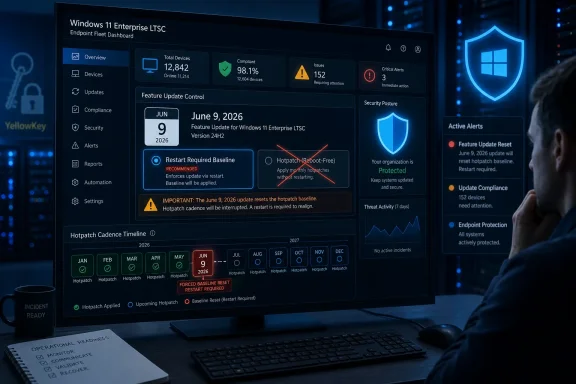
That is why the June 2026 switch matters. June would ordinarily sit in the hotpatch half of the quarterly rhythm: April as the baseline, May and June as reboot-free security servicing, then July as the next baseline. Microsoft instead made June a baseline month for affected hotpatch channels, meaning devices must restart to complete installation.
The stated reason is CVE-2026-45585, a Windows security feature bypass vulnerability publicly associated with the name YellowKey. Microsoft’s support note frames the decision carefully: the vulnerability was publicly disclosed outside typical coordinated disclosure best practices, and the baseline update is intended to protect devices as quickly as possible.
That wording is doing a lot of work. It is not merely saying that the bug is serious. It is saying the disclosure timeline changed the servicing calculus.
Hotpatching Was Always a Contract With Exceptions
The marketing version of hotpatching is simple: fewer reboots, faster compliance, less disruption. The engineering version is more conditional. Devices need to be eligible, enrolled, on the right baseline, and inside a servicing cadence where the changes can be safely applied without restarting the operating system.
Microsoft’s documented model is quarterly baselines with two hotpatch months after each baseline. Baseline updates are cumulative and restart-required. Hotpatch updates are narrower security releases that install without a reboot.
That architecture makes sense because the baseline is the anchor. It resets the device to a known-good cumulative state, after which smaller in-memory or targeted updates can be layered on top. The convenience of hotpatching depends on that foundation being predictable.
The June 2026 case breaks the rhythm but not the model. Microsoft has long reserved the right to ship additional restart-required baselines for security reasons. The important administrative detail is that an extra baseline does not necessarily cancel the next planned one. If June becomes a baseline, July can still remain a baseline under the normal quarterly schedule.
That may feel redundant to users, but it is coherent from a servicing perspective. The hotpatch promise was never “no reboots ever.” It was “fewer reboots when the update can be safely delivered that way.”
YellowKey Turned a Servicing Choice Into a Trust Problem
CVE-2026-45585 is not just another Patch Tuesday line item because it arrived with public controversy attached. The vulnerability has been described in public vulnerability databases and reporting as a Windows BitLocker security feature bypass, and Microsoft has referred to it as a publicly disclosed issue rather than a neatly coordinated private report.
That distinction matters. Coordinated vulnerability disclosure is partly a social compact and partly a risk-control mechanism. Vendors get time to investigate and produce a fix; researchers get credit; customers get a patch before attackers get a recipe.
When that compact fails, the vendor’s update pipeline becomes reactive. The issue is no longer just, “Can we produce a small hotpatch?” It becomes, “Can we confidently reduce customer exposure fast enough, across enough machines, with a servicing vehicle we trust?”
Microsoft’s answer for June was to reach for the baseline. That is the conservative move. It is disruptive, but it gives Microsoft a broader, more complete update vehicle than a narrow hotpatch month would normally imply.
This is the part Windows admins will understand instinctively. When a security problem is public, the theoretical elegance of a reboot-free patch matters less than the certainty that the installed update actually moves the machine into a protected state.
The Reboot Is Back Because the Threat Model Changed
For users, the restart requirement is the headline. For IT, it is the scheduling problem. For Microsoft, it is the tradeoff between disruption and exposure.
A hotpatch month is designed for continuity. A baseline month is designed for reset. In ordinary circumstances, June should have been a continuity month. CVE-2026-45585 made Microsoft treat it like a reset month instead.
That does not mean every device everywhere is equally exposed, or that every organization should panic. Security feature bypass vulnerabilities often depend on specific attacker access, device state, configuration, or recovery scenarios. But BitLocker-adjacent issues naturally raise the temperature because BitLocker is part of the trust boundary many organizations use to protect lost, stolen, or tampered devices.
The public disclosure element is what compresses the timeline. Once exploit concepts, technical claims, or proof-of-concept material are circulating, defenders lose the luxury of waiting for the next tidy baseline. Even if exploitation is not confirmed at scale, the knowledge asymmetry has shifted.
So the restart is not the real story. The real story is that Microsoft decided the operational pain of a forced baseline was less damaging than letting the hotpatch calendar dictate the response.
Windows 11 Enterprise LTSC Gets the Cleanest Warning
Microsoft’s support page lists Windows 11 Enterprise LTSC 2024 as the applicable client product for the June baseline note. That is a particularly interesting audience because LTSC machines are often deployed where change control matters: kiosks, specialized endpoints, manufacturing systems, healthcare environments, lab machines, and tightly managed enterprise fleets.
Those are also the places where hotpatching has obvious appeal. If the system exists to do one job all day, every reboot is friction. If the system is remote, embedded in a workflow, or shared by shifts of workers, a reboot is not just a user experience issue; it is an operations issue.
But LTSC also attracts administrators who are less tolerant of servicing surprises. They choose long-term servicing because they want predictability. June’s update is a reminder that security servicing can override product-channel temperament.
This is where Microsoft’s communication matters. The company did not bury the change in a generic cumulative update paragraph. It labeled the month as a baseline and explicitly explained why it was not delivering a hotpatch. That is the right level of bluntness for IT audiences, even if the underlying event is inconvenient.
The Calendar Still Matters, But It No Longer Wins Every Argument
There is a temptation to treat this as a failure of hotpatching. That is too simplistic. Hotpatching is not failing because one month required a baseline. In fact, a mature hotpatch program needs a defined failure mode, and the defined failure mode is exactly this: fall back to a restart-required cumulative baseline when the patch shape or risk context demands it.
The more subtle issue is expectation management. Microsoft has spent years teaching admins that reboot reduction is a measurable benefit of modern Windows servicing. That message is true, but it can easily be heard as a guarantee.
The June release shows why the guarantee cannot be absolute. A servicing model that refuses to break cadence during a public security event would be brittle. The right question is not whether hotpatching can eliminate every reboot. It is whether hotpatching can eliminate enough routine reboots while still leaving Microsoft room to respond aggressively when the situation changes.
On that measure, the June baseline is defensible. It is also a stress test of how organizations have internalized hotpatching. If a fleet has been designed around the assumption that June could not require restarts, the problem is not just Microsoft’s exception. It is the organization’s lack of exception planning.
Admins Should Treat Hotpatch as Reboot Reduction, Not Reboot Abolition
The practical lesson is straightforward: hotpatching should change maintenance planning, but it should not eliminate maintenance planning. Enterprises still need emergency restart paths, user communication templates, ring-based rollout strategies, and health monitoring after installation.
That is especially true for devices managed through Windows Autopatch and Intune quality update policies. Hotpatch can reduce the ordinary monthly burden, but devices still need to be current on baselines to remain eligible. If a machine misses a baseline, the next update experience may involve more than the tidy reboot-free path admins expected.
June 2026 also argues for clearer internal language. Calling hotpatching “rebootless patching” is emotionally satisfying and operationally dangerous. Calling it “reboot reduction with scheduled baselines and security exceptions” is less catchy, but much closer to the truth.
For sysadmins, that means the deployment plan should assume three categories of update months: planned baseline months, planned hotpatch months, and exception months. The first two are calendar-driven. The third is threat-driven.
The Security Community Feud Is Not a Patch Strategy
The YellowKey controversy has produced the predictable side debate: researcher conduct, vendor response, account actions, public proof-of-concept code, and whether Microsoft should have handled the disclosure differently. Those questions matter, particularly for a security ecosystem that depends on researchers trusting vendors enough to report flaws privately.
But administrators cannot patch a fleet with moral judgment. Whether the disclosure was reckless, justified, mishandled, or some combination of all three, the operational result is the same: a public vulnerability forced a more urgent servicing response.
That does not let Microsoft off the hook. If researchers believe reporting channels are hostile, opaque, or unrewarding, more bugs will surface through adversarial public disclosure. If vendors respond too aggressively, they may discourage exactly the researchers they need. If researchers publish exploit details without coordination, customers inherit the risk.
Still, enterprise IT has to separate cause from action. The cause may be debated. The action is not: install the June baseline, plan the restart, and verify compliance.
Restart Windows Are Now Part of Incident Response
In many organizations, patch management and incident response are still treated as separate disciplines. Patch teams operate on monthly cycles. Security teams handle alerts, vulnerabilities, and exposure management. Hotpatching has blurred that line because it makes routine security updates feel less like operational events.
June 2026 pulls the line back into view. A public vulnerability can turn an otherwise routine Patch Tuesday into a small incident-response exercise. The immediate questions are not philosophical. Which devices are eligible? Which devices received the baseline? Which devices are pending restart? Which devices are remote, offline, or outside policy? Which systems cannot restart without business approval?
The phrase “pending restart” deserves special attention. A baseline that downloads and stages but does not reboot is not fully installed. In compliance dashboards, that distinction can become messy. A device may look partially serviced while still lacking the protection Microsoft intended to deliver.
For security-minded shops, this is where endpoint inventory and update reporting earn their keep. The difference between “update offered” and “device restarted into the protected state” is the difference between paperwork and risk reduction.
The July Baseline Could Feel Like Déjà Vu
One uncomfortable consequence of Microsoft’s model is that an extra June baseline does not necessarily spare admins from July’s planned baseline. Under the standard hotpatch cadence, July is already a baseline month. Microsoft’s documentation indicates that security-driven extra baselines do not automatically rewrite the quarterly schedule.
That means some organizations may face restart planning in June and again in July. Users will not care that one baseline was exceptional and the next was scheduled. They will experience two restart-required security months in a row.
This is where IT communications need to be sharper than the update labels. “Microsoft broke hotpatching” is not a useful internal message. “A publicly disclosed vulnerability forced an extra restart-required security baseline, and the normal quarterly baseline remains expected next month” is more accurate, if less comforting.
The important thing is to prevent surprise from becoming distrust. If users were told hotpatching meant no more update interruptions, June and July will look like a broken promise. If they were told hotpatching reduces interruptions but cannot remove emergency restarts, the story holds.
Microsoft’s Best Case Is Boring Reliability
Microsoft now has to prove two things at once. First, that the June baseline actually addresses the risk that justified breaking cadence. Second, that hotpatching resumes predictably afterward for eligible devices.
The second point is easy to underestimate. Hotpatching is not merely a patch format; it is a trust relationship with operations teams. Admins need to believe the cadence enough to plan around it, but not so completely that they are unprepared for exceptions.
If June installs cleanly, restarts predictably, and leaves devices ready for the next servicing phase, the episode becomes a footnote in the maturation of Windows hotpatching. If it produces confusion, failed installs, eligibility drift, or unclear reporting, it becomes evidence for skeptics who already distrust new servicing abstractions.
The best outcome for Microsoft is boring: devices update, reboot, report healthy, and return to the cadence. In infrastructure, boring is underrated.
The June Baseline Leaves Admins With a Short Checklist and a Longer Memory
This release is not complicated in concept, but it is easy to mishandle in practice because expectations were set by the hotpatch calendar. Treat June 9, 2026 as a security exception, not a normal hotpatch month, and the operational priorities become clearer.
- The June 2026 Windows security update for affected hotpatch-capable Windows 11 Enterprise LTSC 2024 devices is a baseline update, not a hotpatch update.
- Devices must restart before installation is complete, so compliance should be measured after reboot rather than after download or staging.
- Microsoft tied the change to CVE-2026-45585, a publicly disclosed Windows security feature bypass associated with YellowKey.
- The extra June baseline should not be assumed to cancel the normal July baseline in the quarterly hotpatch cadence.
- Hotpatching remains valuable, but organizations should describe it internally as reboot reduction with security exceptions.
- Admins should verify policy targeting, baseline eligibility, installation status, and pending-restart counts across their managed fleet.
The lesson of June 2026 is not that hotpatching failed; it is that Windows servicing has become more honest about the tension between uptime and exposure. Microsoft can reduce the number of restarts, but it cannot promise that the threat landscape will respect the calendar. The organizations that benefit most from hotpatching will be the ones that embrace its convenience without forgetting how to move quickly when the old reboot reality returns.
References
- June 9, 2026—Baseline - Microsoft Support Microsoft Support · Tue, 09 Jun 2026 17:14:01 Z