

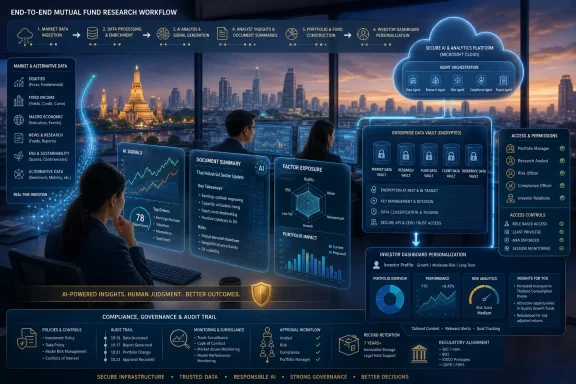
Kasikorn Asset Management, Thailand’s largest mutual fund manager, signed a memorandum of understanding with Microsoft Thailand on June 29, 2026, to expand its use of data and artificial intelligence across operations, fund management, investment research, employee workflows, and investor-facing digital services. The deal is not a product launch so much as a signal: Microsoft’s Copilot stack is being pitched as institutional infrastructure, not office decoration. For KAsset, the bet is that AI can compress research cycles, personalize investor engagement, and make fund operations less dependent on manual coordination. For Microsoft, the win is more strategic: another regulated financial player is being pulled into the company’s cloud-and-Copilot orbit.
The most important word in the announcement is not “AI.” It is “end-to-end.”
Enterprise AI announcements often arrive wrapped in safe abstractions: productivity, collaboration, employee empowerment, digital transformation. KAsset’s memorandum with Microsoft Thailand uses some of that same language, but the scope is broader than a Copilot rollout for drafting emails or summarizing Teams meetings. The company says it wants to apply data and AI across internal operations, fund management processes, and research activities that support investment decision-making.
That matters because asset management is not a generic back-office business. It is a business built on information asymmetry, risk models, regulatory discipline, customer trust, and fast interpretation of noisy signals. If AI is being inserted into that chain, the consequences extend beyond whether employees save a few minutes in Outlook.
KAsset is not positioning Microsoft 365 Copilot, Copilot Studio, and Microsoft Foundry as standalone gadgets. It is describing a stack: workplace assistance, custom agent development, and AI model or application infrastructure sitting behind governed business processes. That is the version of enterprise AI Microsoft has been trying to sell for the past two years, and financial services is one of the places where the sales pitch either becomes real or collapses under compliance pressure.
That makes the Copilot family less of an outsider and more of an extension of existing enterprise plumbing. Microsoft 365 Copilot sits close to documents, mail, meetings, and Teams collaboration. Copilot Studio gives organizations a way to build tailored agents and workflows. Microsoft Foundry — Microsoft’s branding around building, managing, and grounding AI applications and agents — gives the company a more developer- and platform-oriented story.
For a fund manager, that structure is appealing because the AI problem is not only “Can a model summarize this report?” The harder problem is whether the model can work with approved data, respect access controls, keep auditability intact, and avoid turning sensitive research or client information into a governance nightmare.
That is why the announcement’s reference to security, data governance, and compliance is not boilerplate. It is the condition that makes the rest of the announcement believable. In finance, AI that cannot be governed is not innovation; it is operational risk with a demo video.
Asset managers already use data-intensive systems to scan markets, evaluate companies, test scenarios, and monitor macroeconomic conditions. AI can accelerate parts of that work by summarizing filings, comparing research notes, extracting signals from unstructured text, drafting scenario briefs, and helping analysts interrogate large document sets. None of that requires pretending a model can “pick stocks” in some magical autonomous sense.
The near-term value is likely to be in workflow compression. A research analyst who can move faster from raw information to first-pass synthesis has more time to debate assumptions, challenge models, and test investment theses. A portfolio team that can generate scenario packs faster may be better positioned when markets move abruptly.
But speed is not the same as judgment. In investment work, a confident answer can be more dangerous than no answer at all if it masks weak assumptions or stale data. KAsset’s challenge will be to use AI as a research amplifier without letting it become a synthetic authority.
The distinction is critical. A good AI system can surface patterns, prepare summaries, and flag anomalies. A bad implementation can produce fluent consensus at scale, making everyone sound informed while narrowing the range of questions being asked.
Fund managers want to know which investors are risk-sensitive, which are retirement-oriented, which are chasing thematic growth, which respond to market volatility with panic, and which need education rather than another product brochure. AI can help segment these behaviors more finely than traditional demographic or account-based categories.
Done well, this could make investor communication more relevant. A young investor beginning a long-term savings plan does not need the same experience as a high-net-worth client evaluating global diversification or a provident fund participant trying to understand retirement glide paths. Better segmentation can mean better education, better product matching, and fewer generic nudges.
Done poorly, it becomes behavioral targeting wearing a wealth-management suit. Financial firms have to be especially careful when personalization intersects with vulnerability, suitability, and trust. The line between “helping investors understand their options” and “optimizing persuasion around anxiety or greed” is not always bright.
This is where governance again becomes more than a talking point. AI-driven investor insight must be constrained by suitability rules, explainability expectations, data minimization, and internal review. In regulated financial services, the fact that a model can infer an investor’s likely interest does not mean the firm should act on that inference without guardrails.
KAsset’s parent ecosystem matters here. Kasikornbank is one of Thailand’s most prominent financial institutions, and KAsset has long presented itself as a leading force in the Thai mutual fund market. When a player of that scale signs an AI memorandum with Microsoft Thailand, it gives Microsoft more than a customer story. It gives the company a regulated-market proof point.
This is not only about cloud consumption. Microsoft’s AI strategy depends on persuading major organizations that Copilot and agentic workflows belong inside core business operations. A bank or asset manager adopting the stack becomes a reference case for other conservative industries: if it can be governed in finance, Microsoft can argue, it can be governed almost anywhere.
That argument is powerful, but it is also fragile. Financial firms are not forgiving test beds. If AI systems mishandle data, generate unreliable content, or create compliance ambiguity, the reputational damage can outweigh the efficiency gains.
That does not make the announcement meaningless. MOUs are often how large enterprise technology relationships are framed before the harder work begins. But it does mean readers should resist treating the announcement as proof that AI has already transformed fund management at KAsset.
The real story will unfold in implementation. Which data sources are connected? Which teams get access? Which agents are approved for production? How are outputs reviewed? Who is accountable when AI-generated analysis influences a decision? How does the firm separate employee experimentation from controlled business use?
Those questions are less glamorous than a signing ceremony, but they are where enterprise AI succeeds or fails. The gap between a press release and a governed production workflow is still wide.
For KAsset, that could mean agents that help investment teams assemble research packs, operations staff reconcile procedural steps, client-service teams prepare approved responses, or compliance teams review documents against internal policy. The power of Copilot Studio is not that it makes every employee a software developer. It is that it gives business units a controlled path to build workflow-specific AI.
That path carries risk. Low-code and no-code tools can create shadow automation if governance is weak. In a financial institution, an enthusiastic team building an agent around sensitive data is not automatically a success story. It may be a compliance incident waiting for a trigger.
Microsoft’s enterprise pitch assumes centralized administration, identity-aware access, monitoring, and security controls. KAsset’s success will depend on whether those controls are treated as architecture from day one or retrofitted after experimentation spreads.
That is the agentic vision now dominating enterprise AI marketing: software that does not merely answer questions but performs tasks across systems under defined permissions. In theory, a fund-management organization could use such systems to monitor research inputs, prepare meeting materials, track regulatory updates, flag portfolio exposures, and initiate routine operational steps.
The challenge is that finance is full of edge cases. Markets behave strangely. Data vendors disagree. Client instructions carry nuance. Regulatory obligations differ by product and investor type. A system that performs well on routine cases can still fail badly when ambiguity appears.
That does not mean agents have no place in asset management. It means the first successful deployments are likely to be bounded, reviewable, and boring by design. In enterprise AI, boring is underrated. The most valuable systems may be the ones that reduce operational drag without pretending to replace fiduciary judgment.
Most organizations have already learned that giving workers access to a chatbot does not automatically produce productivity gains. Employees need training, clear policies, examples of approved use, and confidence that the tools will not expose them to disciplinary or compliance risk. They also need workflows redesigned around AI, not merely AI pasted onto old processes.
In a fund manager, that training burden is especially important. Analysts, portfolio managers, operations staff, relationship managers, and compliance professionals will use AI differently. A generic “prompt engineering” seminar will not be enough. The firm will need role-specific playbooks and a shared understanding of where AI output stops and professional accountability begins.
The cultural issue may be even harder. Investment professionals are paid for judgment. If AI is presented as a replacement for expertise, adoption may become defensive or performative. If it is presented as a tool for reducing low-value work and sharpening analysis, it has a better chance of becoming normal.
Asset managers everywhere face the same long-term challenge: younger investors are learning about markets through social platforms, influencers, short-form video, and algorithmic feeds. Traditional fund education often feels slow, formal, and disconnected from how new investors actually consume information. If KAsset and Microsoft can build credible digital learning programs, they are not just doing outreach. They are shaping the top of the investor funnel.
AI could help personalize financial education, translate complex ideas into accessible formats, and guide students through basic concepts such as risk, diversification, compounding, and time horizon. It could also create interactive learning experiences that feel less like static brochures and more like guided simulations.
But this area deserves caution too. Financial education for young investors must not become product marketing with an academic costume. The healthiest version would teach principles before products, risk before returns, and long-term discipline before trend-chasing. If Microsoft’s tools help KAsset scale that responsibly, the initiative could have value beyond customer acquisition.
The deployment pattern is familiar. First comes Microsoft 365 Copilot for productivity. Then business teams ask for custom agents. Then data owners must decide what can be grounded, indexed, connected, and exposed. Then security teams inherit the consequences of decisions made in the name of innovation.
Windows administrators and Microsoft 365 tenants should pay attention because the AI layer changes the practical meaning of access. A user who technically had permission to hundreds of documents may never have been able to read and synthesize them all. A grounded AI assistant can collapse that friction. That makes least-privilege access, sensitivity labels, retention rules, and data lifecycle hygiene more important, not less.
The same applies to endpoint and identity management. If employees are using Copilot experiences across desktop apps, Teams, browsers, and custom agents, the perimeter is not a single application. It is the user’s identity, device posture, data permissions, and the organization’s policy fabric. AI does not eliminate old Microsoft 365 administration problems. It makes them louder.
What it does not provide is a map of the trade-offs. How much AI-generated material will be allowed into investment committee workflows? Will model outputs be retained and auditable? How will KAsset prevent sensitive research from being surfaced to the wrong people? How will it measure whether Copilot improves employee work rather than simply adding another interface?
Those are not hostile questions. They are the real questions. Every enterprise AI project now lives between two risks: moving too slowly and becoming irrelevant, or moving too quickly and creating fragile systems nobody fully understands.
KAsset’s advantage is that it appears to be framing the initiative around governance from the outset. Microsoft’s advantage is that it can offer a relatively integrated stack. The unresolved issue is execution, because integration does not automatically equal discipline.
 Microsoft’s AI Pitch Moves From Productivity Theater to Portfolio Work
The most important word in the announcement is not “AI.” It is “end-to-end.”Enterprise AI announcements often arrive wrapped in safe abstractions: productivity, collaboration, employee empowerment, digital transformation. KAsset’s memorandum with Microsoft Thailand uses some of that same language, but the scope is broader than a Copilot rollout for drafting emails or summarizing Teams meetings. The company says it wants to apply data and AI across internal operations, fund management processes, and research activities that support investment decision-making.
That matters because asset management is not a generic back-office business. It is a business built on information asymmetry, risk models, regulatory discipline, customer trust, and fast interpretation of noisy signals. If AI is being inserted into that chain, the consequences extend beyond whether employees save a few minutes in Outlook.
KAsset is not positioning Microsoft 365 Copilot, Copilot Studio, and Microsoft Foundry as standalone gadgets. It is describing a stack: workplace assistance, custom agent development, and AI model or application infrastructure sitting behind governed business processes. That is the version of enterprise AI Microsoft has been trying to sell for the past two years, and financial services is one of the places where the sales pitch either becomes real or collapses under compliance pressure.
KAsset Is Buying a Platform Argument, Not Just a Copilot License
Microsoft’s advantage in deals like this is not simply that it has a capable AI assistant. Plenty of vendors can claim that. Its advantage is that many financial firms already live inside Microsoft’s identity, productivity, security, compliance, and cloud ecosystems.That makes the Copilot family less of an outsider and more of an extension of existing enterprise plumbing. Microsoft 365 Copilot sits close to documents, mail, meetings, and Teams collaboration. Copilot Studio gives organizations a way to build tailored agents and workflows. Microsoft Foundry — Microsoft’s branding around building, managing, and grounding AI applications and agents — gives the company a more developer- and platform-oriented story.
For a fund manager, that structure is appealing because the AI problem is not only “Can a model summarize this report?” The harder problem is whether the model can work with approved data, respect access controls, keep auditability intact, and avoid turning sensitive research or client information into a governance nightmare.
That is why the announcement’s reference to security, data governance, and compliance is not boilerplate. It is the condition that makes the rest of the announcement believable. In finance, AI that cannot be governed is not innovation; it is operational risk with a demo video.
The Research Desk Is Where the Real Test Begins
The most interesting use case in the KAsset announcement is investment research. That is also where expectations should be kept sober.Asset managers already use data-intensive systems to scan markets, evaluate companies, test scenarios, and monitor macroeconomic conditions. AI can accelerate parts of that work by summarizing filings, comparing research notes, extracting signals from unstructured text, drafting scenario briefs, and helping analysts interrogate large document sets. None of that requires pretending a model can “pick stocks” in some magical autonomous sense.
The near-term value is likely to be in workflow compression. A research analyst who can move faster from raw information to first-pass synthesis has more time to debate assumptions, challenge models, and test investment theses. A portfolio team that can generate scenario packs faster may be better positioned when markets move abruptly.
But speed is not the same as judgment. In investment work, a confident answer can be more dangerous than no answer at all if it masks weak assumptions or stale data. KAsset’s challenge will be to use AI as a research amplifier without letting it become a synthetic authority.
The distinction is critical. A good AI system can surface patterns, prepare summaries, and flag anomalies. A bad implementation can produce fluent consensus at scale, making everyone sound informed while narrowing the range of questions being asked.
Investor Personalization Is the Prize, and the Privacy Problem
KAsset also says the collaboration will enhance investor experience by using AI for advanced data analysis and a deeper understanding of investor behaviors and interests across different segments. That is where the business case becomes obvious.Fund managers want to know which investors are risk-sensitive, which are retirement-oriented, which are chasing thematic growth, which respond to market volatility with panic, and which need education rather than another product brochure. AI can help segment these behaviors more finely than traditional demographic or account-based categories.
Done well, this could make investor communication more relevant. A young investor beginning a long-term savings plan does not need the same experience as a high-net-worth client evaluating global diversification or a provident fund participant trying to understand retirement glide paths. Better segmentation can mean better education, better product matching, and fewer generic nudges.
Done poorly, it becomes behavioral targeting wearing a wealth-management suit. Financial firms have to be especially careful when personalization intersects with vulnerability, suitability, and trust. The line between “helping investors understand their options” and “optimizing persuasion around anxiety or greed” is not always bright.
This is where governance again becomes more than a talking point. AI-driven investor insight must be constrained by suitability rules, explainability expectations, data minimization, and internal review. In regulated financial services, the fact that a model can infer an investor’s likely interest does not mean the firm should act on that inference without guardrails.
Thailand Is Becoming a Serious AI Battleground
The KAsset-Microsoft agreement also fits a larger regional pattern. Microsoft has been pushing hard in Southeast Asia, where governments and large enterprises are trying to modernize digital infrastructure while staying competitive in AI adoption. Thailand’s financial sector is a natural target because banks, insurers, and asset managers hold large data estates and face pressure to improve digital service delivery.KAsset’s parent ecosystem matters here. Kasikornbank is one of Thailand’s most prominent financial institutions, and KAsset has long presented itself as a leading force in the Thai mutual fund market. When a player of that scale signs an AI memorandum with Microsoft Thailand, it gives Microsoft more than a customer story. It gives the company a regulated-market proof point.
This is not only about cloud consumption. Microsoft’s AI strategy depends on persuading major organizations that Copilot and agentic workflows belong inside core business operations. A bank or asset manager adopting the stack becomes a reference case for other conservative industries: if it can be governed in finance, Microsoft can argue, it can be governed almost anywhere.
That argument is powerful, but it is also fragile. Financial firms are not forgiving test beds. If AI systems mishandle data, generate unreliable content, or create compliance ambiguity, the reputational damage can outweigh the efficiency gains.
The Memorandum Is a Beginning, Not a Transformation
It is worth pausing on the legal and practical nature of the announcement. This is a memorandum of understanding, not a detailed implementation report. It establishes intent, direction, and areas of collaboration, but it does not tell us how many employees will use Copilot, which workloads will be moved first, what governance architecture will be adopted, or what measurable outcomes KAsset expects.That does not make the announcement meaningless. MOUs are often how large enterprise technology relationships are framed before the harder work begins. But it does mean readers should resist treating the announcement as proof that AI has already transformed fund management at KAsset.
The real story will unfold in implementation. Which data sources are connected? Which teams get access? Which agents are approved for production? How are outputs reviewed? Who is accountable when AI-generated analysis influences a decision? How does the firm separate employee experimentation from controlled business use?
Those questions are less glamorous than a signing ceremony, but they are where enterprise AI succeeds or fails. The gap between a press release and a governed production workflow is still wide.
Copilot Studio Is the Quietly Important Piece
Microsoft 365 Copilot gets the brand recognition, but Copilot Studio may be the more consequential tool in this kind of enterprise deal. A general assistant can help employees draft, summarize, and search. A custom agent can be built around a firm’s specific processes, data sources, approval flows, and compliance boundaries.For KAsset, that could mean agents that help investment teams assemble research packs, operations staff reconcile procedural steps, client-service teams prepare approved responses, or compliance teams review documents against internal policy. The power of Copilot Studio is not that it makes every employee a software developer. It is that it gives business units a controlled path to build workflow-specific AI.
That path carries risk. Low-code and no-code tools can create shadow automation if governance is weak. In a financial institution, an enthusiastic team building an agent around sensitive data is not automatically a success story. It may be a compliance incident waiting for a trigger.
Microsoft’s enterprise pitch assumes centralized administration, identity-aware access, monitoring, and security controls. KAsset’s success will depend on whether those controls are treated as architecture from day one or retrofitted after experimentation spreads.
Microsoft Foundry Points to the Agent Era Microsoft Wants
The inclusion of Microsoft Foundry in the announcement is another clue about the direction of travel. Microsoft does not want customers to think of AI as a chat window living beside Office. It wants them to build AI applications and agents that draw on enterprise data, operate across workflows, and become part of business systems.That is the agentic vision now dominating enterprise AI marketing: software that does not merely answer questions but performs tasks across systems under defined permissions. In theory, a fund-management organization could use such systems to monitor research inputs, prepare meeting materials, track regulatory updates, flag portfolio exposures, and initiate routine operational steps.
The challenge is that finance is full of edge cases. Markets behave strangely. Data vendors disagree. Client instructions carry nuance. Regulatory obligations differ by product and investor type. A system that performs well on routine cases can still fail badly when ambiguity appears.
That does not mean agents have no place in asset management. It means the first successful deployments are likely to be bounded, reviewable, and boring by design. In enterprise AI, boring is underrated. The most valuable systems may be the ones that reduce operational drag without pretending to replace fiduciary judgment.
Employee Adoption Will Decide Whether This Is Strategy or Shelfware
KAsset’s announcement emphasizes empowering employees to work effectively with AI-powered tools. That is wise, because AI transformation is rarely a licensing problem alone. It is a behavior-change problem.Most organizations have already learned that giving workers access to a chatbot does not automatically produce productivity gains. Employees need training, clear policies, examples of approved use, and confidence that the tools will not expose them to disciplinary or compliance risk. They also need workflows redesigned around AI, not merely AI pasted onto old processes.
In a fund manager, that training burden is especially important. Analysts, portfolio managers, operations staff, relationship managers, and compliance professionals will use AI differently. A generic “prompt engineering” seminar will not be enough. The firm will need role-specific playbooks and a shared understanding of where AI output stops and professional accountability begins.
The cultural issue may be even harder. Investment professionals are paid for judgment. If AI is presented as a replacement for expertise, adoption may become defensive or performative. If it is presented as a tool for reducing low-value work and sharpening analysis, it has a better chance of becoming normal.
The Youth Investor Angle Is More Strategic Than It Looks
The announcement’s final forward-looking element — expanding digital investment education for younger generations, particularly university students — may sound like a corporate social responsibility flourish. It is more than that.Asset managers everywhere face the same long-term challenge: younger investors are learning about markets through social platforms, influencers, short-form video, and algorithmic feeds. Traditional fund education often feels slow, formal, and disconnected from how new investors actually consume information. If KAsset and Microsoft can build credible digital learning programs, they are not just doing outreach. They are shaping the top of the investor funnel.
AI could help personalize financial education, translate complex ideas into accessible formats, and guide students through basic concepts such as risk, diversification, compounding, and time horizon. It could also create interactive learning experiences that feel less like static brochures and more like guided simulations.
But this area deserves caution too. Financial education for young investors must not become product marketing with an academic costume. The healthiest version would teach principles before products, risk before returns, and long-term discipline before trend-chasing. If Microsoft’s tools help KAsset scale that responsibly, the initiative could have value beyond customer acquisition.
Windows IT Should Watch the Governance Pattern, Not the Press Photo
For WindowsForum readers, the relevance of this story is not that a Thai asset manager signed a Microsoft partnership. It is that the Microsoft enterprise AI stack is moving deeper into regulated workflows, and the same governance questions will land on IT desks everywhere.The deployment pattern is familiar. First comes Microsoft 365 Copilot for productivity. Then business teams ask for custom agents. Then data owners must decide what can be grounded, indexed, connected, and exposed. Then security teams inherit the consequences of decisions made in the name of innovation.
Windows administrators and Microsoft 365 tenants should pay attention because the AI layer changes the practical meaning of access. A user who technically had permission to hundreds of documents may never have been able to read and synthesize them all. A grounded AI assistant can collapse that friction. That makes least-privilege access, sensitivity labels, retention rules, and data lifecycle hygiene more important, not less.
The same applies to endpoint and identity management. If employees are using Copilot experiences across desktop apps, Teams, browsers, and custom agents, the perimeter is not a single application. It is the user’s identity, device posture, data permissions, and the organization’s policy fabric. AI does not eliminate old Microsoft 365 administration problems. It makes them louder.
The Signing Ceremony Hides the Hard Part
The KAsset-Microsoft announcement is polished and optimistic, as these announcements usually are. It talks about enhancing operations, improving investor insight, supporting research, and helping younger generations learn about investing. All of that is plausible.What it does not provide is a map of the trade-offs. How much AI-generated material will be allowed into investment committee workflows? Will model outputs be retained and auditable? How will KAsset prevent sensitive research from being surfaced to the wrong people? How will it measure whether Copilot improves employee work rather than simply adding another interface?
Those are not hostile questions. They are the real questions. Every enterprise AI project now lives between two risks: moving too slowly and becoming irrelevant, or moving too quickly and creating fragile systems nobody fully understands.
KAsset’s advantage is that it appears to be framing the initiative around governance from the outset. Microsoft’s advantage is that it can offer a relatively integrated stack. The unresolved issue is execution, because integration does not automatically equal discipline.
The KAsset Deal Shows Where Microsoft Wants Copilot to Live
The practical reading of this announcement is straightforward:- KAsset is using its Microsoft Thailand agreement to push AI beyond office productivity and into fund-management operations, research, and investor engagement.
- Microsoft is positioning Copilot, Copilot Studio, and Microsoft Foundry as a governed enterprise stack for regulated industries rather than a collection of disconnected AI features.
- The most valuable near-term use cases are likely to involve research acceleration, workflow automation, investor segmentation, and employee knowledge retrieval.
- The largest risks will come from data governance, overreliance on AI-generated analysis, inappropriate personalization, and poorly controlled custom agents.
- The youth investor education component could be meaningful if it teaches financial literacy before product promotion.
- For Microsoft-focused IT teams, the lesson is that permissions, identity, endpoint security, and information governance are now AI infrastructure.
References
- Primary source: Microsoft Source
Published: 2026-06-29T05:10:17.147165
- Related coverage: kasikornasset.com
KAsset Unveils Investment Outlook for the Next Decade Through KAsset Capital Market Assumptions (KCMA) Highlighting Global and Alternative Asset Diversification as the Way Forward - KASIKORN ASSET MANAGEMENT
KAsset Unveils Investment Outlook for the Next Decade Through KAsset Capital Market Assumptions (KCMA) Highlighting Global and Alternative Asset Diversification as the Way Forwardwww.kasikornasset.com - Official source: microsoft.com
Microsoft 365 Copilot Pricing – AI Agents | Copilot Studio
Explore Copilot Studio pricing and plans for Microsoft Copilot. Build custom AI solutions across multiple channels, to assist employees and customers.www.microsoft.com
- Official source: developer.microsoft.com
Microsoft 365 Copilot | Extend and Customize Copilot
Extend, enrich, and customize Microsoft Microsoft 365 Copilot. Explore Copilot extensibility options such as agents, API plugins, and Copilot connectors to expand AI-powered productivity, skills, and creativity.developer.microsoft.com - Official source: adoption.microsoft.com
Microsoft Copilot Studio – Microsoft Adoption
Deliver value and employee satisfaction with our tools for Microsoft 365 Copilot Chat, Microsoft 365 Copilot, and agent deployment and adoption.adoption.microsoft.com - Official source: blogs.microsoft.com
Announcing Copilot leadership update - The Official Microsoft Blog
Satya Nadella, Chairman and CEO, and Mustafa Suleyman, Executive Vice President and CEO of Microsoft AI, shared the below communications with Microsoft employees this morning. SATYA NADELLA MESSAGE I want to share two org changes we’re making to our Copilot org and superintelligence effort. It’s...blogs.microsoft.com

- Related coverage: asiaasset.com
Thailand’s Kasikorn Bank Asset Management cements position as top asset manager - Asia Asset Management
Thailand’s Kasikorn Bank Asset Management saw its assets grow 23.5% to 921.6 billion baht (US$29.68 billion) in 2025, cementing its position as thewww.asiaasset.com - Related coverage: windowscentral.com
Microsoft 365 is paywalling most of Copilot in its Office apps | Windows Central
Commercial customers will soon need a Microsoft 365 Copilot license to use Copilot Chat in Word, Excel, PowerPoint, and OneNote.www.windowscentral.com - Related coverage: techradar.com
Microsoft makes Copilot Cowork open to everyone, and wants to help you tackle even the trickiest work tasks | TechRadar
Copilot Cowork gets an upgrade as it opens to all userswww.techradar.com - Related coverage: tomshardware.com
Microsoft will force install the Copilot AI app for users with desktop versions of 365 apps like Word and Excel — coming October, with no way to opt out for personal users | Tom's Hardware
More bloatware added to Windows, courtesy of Microsoft 365.www.tomshardware.com - Related coverage: pcgamer.com
In a truly galaxy-brained rebrand, Microsoft Office is now the 'Microsoft 365 Copilot app,' but Copilot is also still the name of the AI assistant | PC Gamer
Copilot is the app for launching the other apps, but it's also a chatbot inside the apps. Any questions?www.pcgamer.com - Related coverage: tomsguide.com
Biggest Microsoft Build 2026 announcements — agentic AI, RTX Spark Dev Box, GitHub Copilot app, new MAI models, and more | Tom's Guide
All the big news from Microsoft's AI-focused eventwww.tomsguide.com - Official source: cdn-dynmedia-1.microsoft.com
- Related coverage: muangthai.co.th
</rdf:Alt> </dc:title> <dc:description> <rdf:Alt> <rdf:li xml:lang="x-default"/> </rdf:Alt> </dc:description> <dc:creator> <rdf:Seq> <rdf:li>kaadmin
</rdf:Alt> </dc:description> <dc:creator> <rdf:Seq> <rdf:li>kaadminwww.muangthai.co.th
