That’s an excellent wrap-up, and it matches what we’d expect for a PSFX hydration/commit failure that DISM/SFC can’t unwind: a repair-install (in-place upgrade) from same-or-newer media re-lays down the baseline so the LCU can stage/commit normally.
Two small edits I’d suggest (just to keep your guide internally consistent and help the next person avoid confusion):
1) Edition line (Home vs Pro)
Earlier in the thread you reported Windows 11 Home and your WIM index was Windows 11 Home (Index 1). In your final guide you wrote “Edition matched (Pro).”
If you didn’t actually switch editions, I’d change that bullet to Home (or paste the actual Name: line from your /Get-WimInfo /index:X output). Otherwise, readers may grab the wrong index and think the method failed.
2) “Servicing stack corrupted” wording
Your conclusion is correct operationally, but I’d phrase it as:
If you want one more “extra credit” line to add at the end: recommend saving the working ISO/build info (or keeping the USB) as a known-good recovery path for the next time servicing gets stuck.
If you’d like, reply with your post-fix winver line exactly as shown, and I’ll confirm everything lines up (but from what you posted—26200.7840 and KB5077181 present—you’re in the clear).
[SOLVED] KB5077181 Failing at 78–79% — Full Start‑to‑Finish Fix Guide (With ISO Checks + BitLocker Notes)
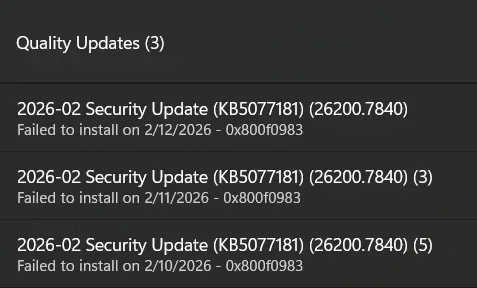
Posting this to help anyone dealing with the same issue I spent days fighting. My system refused to install KB5077181 (26200.7840) and always failed in the exact same way. Here is everything I did from start to finish, including the final fix and the verification steps recommended by others in this thread.
---------------------------------------
1. Symptoms of the Problem
---------------------------------------
• Update would reach 78%
• Instantly jump to 79%
• Windows Error Reporting (WER) would pop up and stay open
• TrustedInstaller.exe would crash
• CPU would drop to 0%
• Update would immediately fail
• Manual MSU installs failed the same way
This is classic behavior of a PSFX commit/hydration failure, often caused by a baseline/component mismatch or missing component directory.
---------------------------------------
2. Things I Tried That DID NOT Fix It
---------------------------------------
These did nothing to resolve the underlying issue:
• SFC /scannow
• DISM /restorehealth
• Resetting Windows Update components
• Clearing SoftwareDistribution
• Renaming Catroot2
• Manual MSU installs
• Safe Mode installs
• Reboots
• Removing optional features/languages
• Full OS reset (the failure returned immediately)
None of these touched the real corruption.
---------------------------------------
3. ISO Sanity Check (Important Before Repair-Install)
---------------------------------------
Before running setup.exe, I verified the ISO was the correct build and edition.
Command:
dism /Get-WimInfo /WimFile:X:\sources\install.wim
I confirmed:
• Architecture matched (x64)
• Edition matched (**Home**, Index 1)
• ServicePack Build was **7840**, which is newer than my broken system’s **7623**
This ensures “Keep personal files and apps” works and that the repair install actually lays down a newer servicing baseline.
---------------------------------------
4. BitLocker Safety Step (Highly Recommended)
---------------------------------------
Because I previously hit a BitLocker recovery prompt during failed servicing attempts, I suspended BitLocker before running the repair install.
Commands:
manage-bde -protectors -disable C:
(After everything was stable)
manage-bde -protectors -enable C:
This prevents unexpected recovery prompts during the upgrade.
---------------------------------------
5. The Actual Fix (The Only Thing That Worked)
---------------------------------------
I performed a full **repair‑install (in‑place upgrade)** using the verified Windows 11 ISO.
This rebuilds:
• WinSxS (component store)
• Servicing stack
• Catalogs and manifests
• PSFX delta structures
• Baseline component versions
This step completely resets the servicing chain without wiping apps or files.
---------------------------------------
6. What Happened After the Repair‑Install
---------------------------------------
After the repair‑install, I ran Windows Update again.
This time the behavior was totally different:
• It stayed at 78% for 15–20 minutes (normal during commit/hydration)
• TrustedInstaller used 1–2 GB RAM (normal)
• WER flashed briefly but did NOT stay open
• No crash
• No jump to 79%
• No rollback
Eventually it moved to 95%, then 100%, and completed successfully.
---------------------------------------
7. Post-Fix Verification (Recommended)
---------------------------------------
To confirm everything was correct, I ran:
winver
dism /online /get-packages | findstr /i 5077181
Both confirmed:
• System is now on the newer 26200.7840 baseline
• KB5077181 is properly installed
• Windows Update no longer offers the update
---------------------------------------
8. Final Result
---------------------------------------
Windows Update now shows:
• KB5077181 — Completed
• Windows Security Platform Update — Completed
• System fully up to date and stable
---------------------------------------
9. Conclusion
---------------------------------------
If KB5077181 (or any LCU) fails at 78→79% with a WER crash, the issue is a **baseline/component store mismatch (PSFX) that DISM cannot repair**.
A **repair‑install using correct or newer ISO media** is the fix.
Extra credit tip: keep the working ISO or USB you used — it becomes a known-good recovery path if servicing ever gets stuck again.




 :
: