

Microsoft has released KB5090933, a Phi Silica AI component update to version 1.2604.515.0 for AMD-powered Copilot+ PCs running Windows 11 version 24H2 or 25H2, delivered automatically through Windows Update after the latest cumulative update is installed. On paper, it is a small servicing notice. In practice, it is another marker in Microsoft’s larger attempt to turn Windows AI from a feature demo into serviced platform infrastructure. The interesting part is not that an on-device language model received an update; it is that Windows now treats such a model like something that must be versioned, replaced, audited, and kept current.
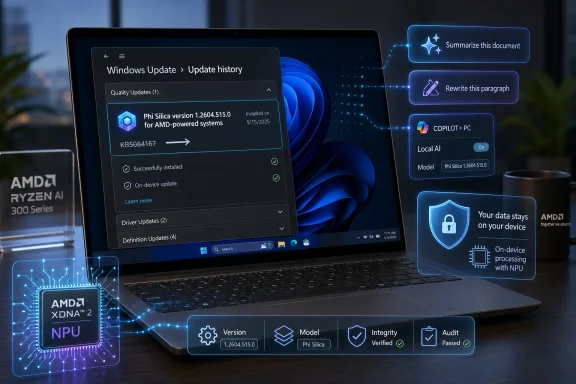
KB5090933 is a narrow update with a narrow audience: AMD-powered Copilot+ PCs, Windows 11 24H2 or 25H2, and the Phi Silica AI component. Microsoft says the update replaces KB5084167 and appears in Windows Update history as “2026-04 Phi Silica version 1.2604.515.0 for AMD-powered systems.” That phrasing matters because it is not presented as an optional app update, a Store package, or a driver tweak. It is an operating-system component update.
That is the quiet shift. Windows is no longer merely the place where AI apps run; it is increasingly the distributor of the models, runtimes, and hardware-specific plumbing those apps depend on. Phi Silica sits in that new middle layer: not quite a user-facing application, not quite a traditional driver, and not simply a developer SDK.
For administrators, this creates a new category of Windows maintenance. The familiar cadence of cumulative updates, security fixes, driver packages, and Microsoft Store app updates now has company: AI model components that may be tied to processor families and NPU capabilities. KB5090933 is AMD-specific, which reinforces the point that the Copilot+ PC promise depends heavily on per-silicon optimization rather than a one-size-fits-all Windows feature flag.
Microsoft’s wager is that users and developers will not care where the model comes from so long as the experience is fast, private, and reliable. But IT departments absolutely will care. They will want to know which devices received which model, which KB superseded which earlier package, and whether a broken AI component update can disrupt workflows that did not exist in Windows fleet planning two years ago.
That makes Phi Silica more than a bundled curiosity. It is part of the scaffolding Microsoft needs if Windows is to become a serious client-side AI platform. Developers have heard the pitch for years: build native apps, rely on platform APIs, and let Windows handle the hardware complexity. Phi Silica is the language-model version of that argument.
The model’s compactness is part of the point. It is not meant to replace frontier-scale cloud models for complex reasoning, long-context research, or enterprise-grade retrieval workflows. Instead, it is designed for the kinds of quick, repetitive, context-local jobs that make sense on a laptop: summarizing selected text, rewriting a paragraph, generating a short response, or powering accessibility-adjacent language features without the latency and privacy tradeoffs of a round trip to the cloud.
The practical benefit is obvious. If a user selects text and asks Windows to summarize it, the result can appear quickly, consume less power than a GPU-heavy local model, and avoid transmitting the selected content to a remote inference service. But the strategic benefit is larger: Microsoft can make local AI feel like part of Windows itself rather than something bolted on by each app vendor.
That does not mean every AMD laptop receives this update. The KB applies to AMD-powered Copilot+ PCs, not ordinary AMD Windows 11 systems. Copilot+ status implies specific hardware capabilities, especially an NPU powerful enough for Microsoft’s local AI requirements, alongside memory and storage baselines. A Ryzen system without the right NPU is still a Windows PC, but it is not the target for Phi Silica in this servicing lane.
This distinction is going to confuse some users. Windows Update history has become a place where normal people occasionally encounter obscure component names, and “Phi Silica” does not explain itself. A user who sees KB5090933 may reasonably wonder whether Microsoft just installed a chatbot, a telemetry module, or a driver. The answer is more precise and less dramatic: it is an updated local language-model component used by Windows AI features and apps that call the relevant APIs.
Still, Microsoft has a messaging problem. The company wants to sell Copilot+ PCs as appliances that simply gain smarter features over time. But the more these systems receive silicon-specific AI model updates, the more they resemble managed AI appliances with software stacks that administrators must track. The consumer story is magic; the enterprise story is inventory.
For Windows enthusiasts, that is welcome transparency. A component that affects local AI behavior should be identifiable. If a Phi Silica-powered feature suddenly changes tone, speed, reliability, or availability, a version number gives testers and admins a starting point. Without that, troubleshooting would collapse into vibes: “AI was working yesterday and now it is weird.”
For Microsoft, versioned AI components also provide a safer path for iteration. Models are not static libraries. Their behavior can change in ways users notice, even when the update is technically “just” a component refresh. A new version may improve latency, compatibility, content handling, or integration with Windows features; it might also introduce regressions. Treating the component as a serviced Windows asset creates a paper trail.
The risk is that Windows Update history becomes even more inscrutable. Users already see cumulative updates, .NET patches, Defender intelligence updates, firmware, drivers, Store apps, and optional previews. AI components add another line item with another naming convention. Microsoft should not assume that KB visibility alone equals clarity.
A local model does not automatically make every AI feature private. Applications still decide what they send where, and hybrid workflows may combine on-device processing with cloud services. But Phi Silica gives Windows a credible local-first substrate. At minimum, it lets Microsoft and developers build features where routine language tasks do not require remote inference.
That is especially relevant for business PCs. A lawyer summarizing a paragraph, a doctor rewriting a note, a consultant cleaning up client text, or an engineer extracting meaning from internal documentation may all face policy or regulatory constraints around cloud AI. A local SLM is not a compliance strategy by itself, but it is easier to govern than a mystery call to a hosted model outside the device boundary.
Latency is the other half of the pitch. Cloud AI can be powerful, but it depends on connectivity, service availability, queueing, and cost controls. Local AI can be immediate. When the task is small enough and the hardware is designed for it, the NPU becomes the difference between “feature” and “workflow.”
Phi Silica helps solve that problem. A local language model gives the NPU a recurring role in everyday experiences, especially if Microsoft can wire it into visible actions such as summarization, rewriting, Click to Do-style interactions, and app-level text generation. The more these capabilities show up in context menus and productivity flows, the less the NPU feels like a spec-sheet ornament.
AMD benefits from that shift because Ryzen AI systems need Windows to expose NPU value in ways that normal software can use. Hardware vendors can advertise TOPS all day, but a user does not experience TOPS. A user experiences a rewrite button that works instantly on battery without a browser tab.
The catch is that local AI value depends on consistency. If one Copilot+ PC supports a feature, another supports it later, and a third supports it only after a hidden component update, the category becomes muddy. KB5090933 is part of the necessary cleanup: keep the model current, align it with Windows builds, and ensure AMD systems remain in step with the broader Copilot+ roadmap.
The benefit is elegant. An app can ask the system for the capability, and Windows can decide how to run it on the available hardware. That is how mature operating-system platforms absorb complexity. Developers should not need to know the details of every NPU vendor stack just to summarize a paragraph.
But the moving-target problem is real. If Phi Silica updates independently of an app, app behavior can change after deployment. A summarization feature might become faster, more stable, or more capable; it might also return subtly different output. In consumer apps, that may be acceptable. In enterprise workflows, repeatability matters.
This is not unique to Microsoft. Every AI platform faces the same tension between model improvement and behavioral stability. Cloud AI vendors can swap model versions behind API names, sometimes with version pinning and sometimes without. Windows local AI now inherits that governance problem, except the updates arrive through operating-system servicing channels.
That release sequence could be driven by performance tuning, compatibility fixes, security hardening, model-quality changes, API alignment, or support for new Windows experiences. Microsoft’s support note does not enumerate a changelog, which is typical for many servicing updates but unsatisfying for an AI model. With models, “new release” is not a complete explanation.
This is where Microsoft should raise the bar. If an AI component update changes only packaging or eligibility logic, say so. If it improves inference performance on AMD NPUs, say so. If it modifies content filtering, generation behavior, or supported skills, say so carefully. Administrators do not need marketing copy; they need operationally useful deltas.
The absence of detail also makes it harder for journalists, testers, and developers to evaluate progress. Phi Silica may be improving month by month, but without meaningful release notes the public signal is mostly version arithmetic. That is not enough for a platform Microsoft wants developers to trust.
A local Windows model sounds like a compromise that IT could embrace. It keeps data on the device, reduces dependency on external services, and may enable useful productivity features without new vendor contracts. But it also creates a new surface area for policy. Organizations will want controls over availability, logging, app access, content safety settings, and whether developers inside the company can depend on Phi Silica.
There is also a software supply-chain dimension. AI models are executable logic in a practical sense, even if they are not code in the traditional way. They transform inputs into outputs, and their behavior can affect decisions, documents, and business processes. Updating them automatically through Windows Update may be convenient, but convenience is not governance.
Microsoft’s best argument is that centralized servicing is safer than letting every app ship its own opaque local model. That argument is persuasive. A Windows-managed Phi Silica component can be patched, versioned, and optimized across a fleet. The tradeoff is that Microsoft must provide enough documentation and administrative control to make that centralization acceptable.
But the Windows enthusiast community lives in the gap between consumer simplicity and platform reality. These KB articles are the breadcrumbs that show how Microsoft is assembling the AI layer underneath Windows 11. The company’s public demos may focus on magic moments, but the actual work looks like servicing packages, hardware eligibility, API contracts, and model updates.
That is why KB5090933 is more interesting than its support page suggests. It is not a flashy feature announcement. It is the maintenance machinery behind the feature story. If Microsoft is right, this kind of update will become routine enough to be boring. If Microsoft is wrong, these routine updates will become a source of compatibility complaints, policy friction, and user suspicion.
The outcome depends on execution. Local AI has to feel dependable, not experimental. It has to be visible enough to justify Copilot+ hardware, but controlled enough not to alarm administrators. And it has to improve without making every improvement feel like a behavioral surprise.
KB5090933 is part of that test. It ties a model version to AMD hardware, Windows 11 24H2 and 25H2, cumulative update prerequisites, automatic delivery, and a replacement chain. That is exactly how a platform matures: the glamorous layer gets translated into boring operations.
Boring is good, up to a point. IT departments like boring. Developers like predictable. Users like features that simply work. But AI models are not quite like printer drivers or codec packs. Their behavior is probabilistic, their outputs can be sensitive, and their usefulness depends on trust.
Microsoft therefore has to maintain two kinds of reliability. The first is traditional Windows reliability: install correctly, do not crash, do not break apps, do not drain the battery. The second is AI reliability: behave consistently enough that users and organizations understand what the model is suitable for. KB articles alone can cover the first; the second needs better transparency.
Source: Microsoft Support KB5090933: Phi Silica AI component update (version 1.2604.515.0) for AMD-powered systems - Microsoft Support
 Microsoft’s AI Platform Is Becoming Another Servicing Channel
KB5090933 is a narrow update with a narrow audience: AMD-powered Copilot+ PCs, Windows 11 24H2 or 25H2, and the Phi Silica AI component. Microsoft says the update replaces KB5084167 and appears in Windows Update history as “2026-04 Phi Silica version 1.2604.515.0 for AMD-powered systems.” That phrasing matters because it is not presented as an optional app update, a Store package, or a driver tweak. It is an operating-system component update.That is the quiet shift. Windows is no longer merely the place where AI apps run; it is increasingly the distributor of the models, runtimes, and hardware-specific plumbing those apps depend on. Phi Silica sits in that new middle layer: not quite a user-facing application, not quite a traditional driver, and not simply a developer SDK.
For administrators, this creates a new category of Windows maintenance. The familiar cadence of cumulative updates, security fixes, driver packages, and Microsoft Store app updates now has company: AI model components that may be tied to processor families and NPU capabilities. KB5090933 is AMD-specific, which reinforces the point that the Copilot+ PC promise depends heavily on per-silicon optimization rather than a one-size-fits-all Windows feature flag.
Microsoft’s wager is that users and developers will not care where the model comes from so long as the experience is fast, private, and reliable. But IT departments absolutely will care. They will want to know which devices received which model, which KB superseded which earlier package, and whether a broken AI component update can disrupt workflows that did not exist in Windows fleet planning two years ago.
Phi Silica Is Small, But Its Role in Windows Is Not
Phi Silica is Microsoft’s on-device small language model for Copilot+ PCs, designed to run on the Neural Processing Unit rather than sending every language task to the cloud. The model supports capabilities such as summarization, rewriting, text understanding, and short-form generation. It is also exposed through Windows AI APIs, giving developers a local model target without requiring them to ship their own language model or pay for a cloud endpoint.That makes Phi Silica more than a bundled curiosity. It is part of the scaffolding Microsoft needs if Windows is to become a serious client-side AI platform. Developers have heard the pitch for years: build native apps, rely on platform APIs, and let Windows handle the hardware complexity. Phi Silica is the language-model version of that argument.
The model’s compactness is part of the point. It is not meant to replace frontier-scale cloud models for complex reasoning, long-context research, or enterprise-grade retrieval workflows. Instead, it is designed for the kinds of quick, repetitive, context-local jobs that make sense on a laptop: summarizing selected text, rewriting a paragraph, generating a short response, or powering accessibility-adjacent language features without the latency and privacy tradeoffs of a round trip to the cloud.
The practical benefit is obvious. If a user selects text and asks Windows to summarize it, the result can appear quickly, consume less power than a GPU-heavy local model, and avoid transmitting the selected content to a remote inference service. But the strategic benefit is larger: Microsoft can make local AI feel like part of Windows itself rather than something bolted on by each app vendor.
AMD Copilot+ PCs Are Now Inside the First-Class AI Lane
The first wave of Copilot+ PC excitement was dominated by Qualcomm’s Snapdragon X hardware, partly because those machines arrived first and partly because Microsoft needed an Arm showcase for Windows on Arm. AMD and Intel systems followed into the Copilot+ story later, bringing the category closer to the mainstream PC buyer. KB5090933 is one of the small maintenance events that shows AMD machines are no longer waiting outside the club.That does not mean every AMD laptop receives this update. The KB applies to AMD-powered Copilot+ PCs, not ordinary AMD Windows 11 systems. Copilot+ status implies specific hardware capabilities, especially an NPU powerful enough for Microsoft’s local AI requirements, alongside memory and storage baselines. A Ryzen system without the right NPU is still a Windows PC, but it is not the target for Phi Silica in this servicing lane.
This distinction is going to confuse some users. Windows Update history has become a place where normal people occasionally encounter obscure component names, and “Phi Silica” does not explain itself. A user who sees KB5090933 may reasonably wonder whether Microsoft just installed a chatbot, a telemetry module, or a driver. The answer is more precise and less dramatic: it is an updated local language-model component used by Windows AI features and apps that call the relevant APIs.
Still, Microsoft has a messaging problem. The company wants to sell Copilot+ PCs as appliances that simply gain smarter features over time. But the more these systems receive silicon-specific AI model updates, the more they resemble managed AI appliances with software stacks that administrators must track. The consumer story is magic; the enterprise story is inventory.
The Update History Page Becomes an AI Ledger
Microsoft tells users to verify KB5090933 through Settings, Windows Update, and Update history. That is mundane advice, but it reveals how Microsoft expects these components to be governed. The AI model is not hidden entirely behind the scenes. It gets a KB number, a version, a replacement relationship, and a visible history entry.For Windows enthusiasts, that is welcome transparency. A component that affects local AI behavior should be identifiable. If a Phi Silica-powered feature suddenly changes tone, speed, reliability, or availability, a version number gives testers and admins a starting point. Without that, troubleshooting would collapse into vibes: “AI was working yesterday and now it is weird.”
For Microsoft, versioned AI components also provide a safer path for iteration. Models are not static libraries. Their behavior can change in ways users notice, even when the update is technically “just” a component refresh. A new version may improve latency, compatibility, content handling, or integration with Windows features; it might also introduce regressions. Treating the component as a serviced Windows asset creates a paper trail.
The risk is that Windows Update history becomes even more inscrutable. Users already see cumulative updates, .NET patches, Defender intelligence updates, firmware, drivers, Store apps, and optional previews. AI components add another line item with another naming convention. Microsoft should not assume that KB visibility alone equals clarity.
Local AI Is the Privacy Pitch Microsoft Needed
The case for Phi Silica rests heavily on locality. If the selected text, prompt, and response can stay on the device, Microsoft can make a much more convincing privacy argument than it can for cloud-first AI assistants. That matters because Windows users have spent the last decade becoming more suspicious of background services, account nudges, telemetry, and cloud tie-ins.A local model does not automatically make every AI feature private. Applications still decide what they send where, and hybrid workflows may combine on-device processing with cloud services. But Phi Silica gives Windows a credible local-first substrate. At minimum, it lets Microsoft and developers build features where routine language tasks do not require remote inference.
That is especially relevant for business PCs. A lawyer summarizing a paragraph, a doctor rewriting a note, a consultant cleaning up client text, or an engineer extracting meaning from internal documentation may all face policy or regulatory constraints around cloud AI. A local SLM is not a compliance strategy by itself, but it is easier to govern than a mystery call to a hosted model outside the device boundary.
Latency is the other half of the pitch. Cloud AI can be powerful, but it depends on connectivity, service availability, queueing, and cost controls. Local AI can be immediate. When the task is small enough and the hardware is designed for it, the NPU becomes the difference between “feature” and “workflow.”
The NPU Is Finally Getting a Job Users Can See
For years, PC buyers understood CPUs and GPUs because the workloads were tangible. CPUs made the system responsive. GPUs played games, accelerated creative apps, and drove displays. NPUs, by contrast, arrived with a marketing burden: they were sold as the future before most users had present-day reasons to care.Phi Silica helps solve that problem. A local language model gives the NPU a recurring role in everyday experiences, especially if Microsoft can wire it into visible actions such as summarization, rewriting, Click to Do-style interactions, and app-level text generation. The more these capabilities show up in context menus and productivity flows, the less the NPU feels like a spec-sheet ornament.
AMD benefits from that shift because Ryzen AI systems need Windows to expose NPU value in ways that normal software can use. Hardware vendors can advertise TOPS all day, but a user does not experience TOPS. A user experiences a rewrite button that works instantly on battery without a browser tab.
The catch is that local AI value depends on consistency. If one Copilot+ PC supports a feature, another supports it later, and a third supports it only after a hidden component update, the category becomes muddy. KB5090933 is part of the necessary cleanup: keep the model current, align it with Windows builds, and ensure AMD systems remain in step with the broader Copilot+ roadmap.
Developers Get a Platform, But Also a Moving Target
The developer angle is the most consequential part of Phi Silica. Microsoft is not merely shipping AI features; it is exposing Windows AI APIs so applications can call local model capabilities. That is a serious platform play. If successful, it gives Windows developers a standard way to integrate summarization, rewriting, and text generation without bundling large models or requiring cloud subscriptions.The benefit is elegant. An app can ask the system for the capability, and Windows can decide how to run it on the available hardware. That is how mature operating-system platforms absorb complexity. Developers should not need to know the details of every NPU vendor stack just to summarize a paragraph.
But the moving-target problem is real. If Phi Silica updates independently of an app, app behavior can change after deployment. A summarization feature might become faster, more stable, or more capable; it might also return subtly different output. In consumer apps, that may be acceptable. In enterprise workflows, repeatability matters.
This is not unique to Microsoft. Every AI platform faces the same tension between model improvement and behavioral stability. Cloud AI vendors can swap model versions behind API names, sometimes with version pinning and sometimes without. Windows local AI now inherits that governance problem, except the updates arrive through operating-system servicing channels.
The Replacement of KB5084167 Shows the Cadence Is Real
KB5090933 replaces KB5084167, which is the kind of detail that usually matters only to patch managers. Here, it matters more broadly because it shows that Phi Silica is not a one-and-done model dropped into Windows 11 and forgotten. Microsoft is already treating it as a component with a release sequence.That release sequence could be driven by performance tuning, compatibility fixes, security hardening, model-quality changes, API alignment, or support for new Windows experiences. Microsoft’s support note does not enumerate a changelog, which is typical for many servicing updates but unsatisfying for an AI model. With models, “new release” is not a complete explanation.
This is where Microsoft should raise the bar. If an AI component update changes only packaging or eligibility logic, say so. If it improves inference performance on AMD NPUs, say so. If it modifies content filtering, generation behavior, or supported skills, say so carefully. Administrators do not need marketing copy; they need operationally useful deltas.
The absence of detail also makes it harder for journalists, testers, and developers to evaluate progress. Phi Silica may be improving month by month, but without meaningful release notes the public signal is mostly version arithmetic. That is not enough for a platform Microsoft wants developers to trust.
The Enterprise Objection Is Not Anti-AI; It Is Anti-Surprise
Enterprise IT does not hate AI. It hates unmanaged change. KB5090933 lands in a world where many organizations are still deciding which Copilot features to allow, which cloud AI services to block, which data classes can be processed by generative systems, and how to train employees not to paste sensitive material into consumer tools.A local Windows model sounds like a compromise that IT could embrace. It keeps data on the device, reduces dependency on external services, and may enable useful productivity features without new vendor contracts. But it also creates a new surface area for policy. Organizations will want controls over availability, logging, app access, content safety settings, and whether developers inside the company can depend on Phi Silica.
There is also a software supply-chain dimension. AI models are executable logic in a practical sense, even if they are not code in the traditional way. They transform inputs into outputs, and their behavior can affect decisions, documents, and business processes. Updating them automatically through Windows Update may be convenient, but convenience is not governance.
Microsoft’s best argument is that centralized servicing is safer than letting every app ship its own opaque local model. That argument is persuasive. A Windows-managed Phi Silica component can be patched, versioned, and optimized across a fleet. The tradeoff is that Microsoft must provide enough documentation and administrative control to make that centralization acceptable.
Consumers Will Notice the Feature, Not the KB
Most people will never search for KB5090933. They will notice whether a rewrite action appears, whether it works offline, whether the laptop fans stay quiet, and whether the output is useful. That is the correct level of abstraction for consumers. Nobody bought a Copilot+ PC to become a model version archivist.But the Windows enthusiast community lives in the gap between consumer simplicity and platform reality. These KB articles are the breadcrumbs that show how Microsoft is assembling the AI layer underneath Windows 11. The company’s public demos may focus on magic moments, but the actual work looks like servicing packages, hardware eligibility, API contracts, and model updates.
That is why KB5090933 is more interesting than its support page suggests. It is not a flashy feature announcement. It is the maintenance machinery behind the feature story. If Microsoft is right, this kind of update will become routine enough to be boring. If Microsoft is wrong, these routine updates will become a source of compatibility complaints, policy friction, and user suspicion.
The outcome depends on execution. Local AI has to feel dependable, not experimental. It has to be visible enough to justify Copilot+ hardware, but controlled enough not to alarm administrators. And it has to improve without making every improvement feel like a behavioral surprise.
The Real Copilot+ Test Is Servicing, Not Silicon
The Copilot+ PC launch narrative emphasized hardware: NPUs, TOPS, Arm battery life, and eventually AMD and Intel parity. That was inevitable because a new PC category needs a spec hook. But hardware was only the first test. The harder test is whether Microsoft can service an AI-capable Windows platform with the discipline customers expect from Windows itself.KB5090933 is part of that test. It ties a model version to AMD hardware, Windows 11 24H2 and 25H2, cumulative update prerequisites, automatic delivery, and a replacement chain. That is exactly how a platform matures: the glamorous layer gets translated into boring operations.
Boring is good, up to a point. IT departments like boring. Developers like predictable. Users like features that simply work. But AI models are not quite like printer drivers or codec packs. Their behavior is probabilistic, their outputs can be sensitive, and their usefulness depends on trust.
Microsoft therefore has to maintain two kinds of reliability. The first is traditional Windows reliability: install correctly, do not crash, do not break apps, do not drain the battery. The second is AI reliability: behave consistently enough that users and organizations understand what the model is suitable for. KB articles alone can cover the first; the second needs better transparency.
The AMD Phi Silica Update Draws the Map for Windows AI
The concrete lesson from KB5090933 is that Windows AI is becoming a maintained stack rather than a collection of demos. That should shape how enthusiasts, admins, and developers read these small support notices.- KB5090933 updates Phi Silica to version 1.2604.515.0 specifically for AMD-powered Copilot+ PCs on Windows 11 24H2 and 25H2.
- The update is delivered automatically through Windows Update and requires the latest cumulative update for the supported Windows version.
- The package replaces KB5084167, confirming that Phi Silica is now on an active servicing cadence rather than remaining a static inbox model.
- Users can verify installation through Windows Update history, where the update should appear as a 2026-04 Phi Silica entry for AMD-powered systems.
- The larger significance is that Microsoft is treating local AI models as Windows components with versioning, hardware targeting, and lifecycle management.
Source: Microsoft Support KB5090933: Phi Silica AI component update (version 1.2604.515.0) for AMD-powered systems - Microsoft Support
