

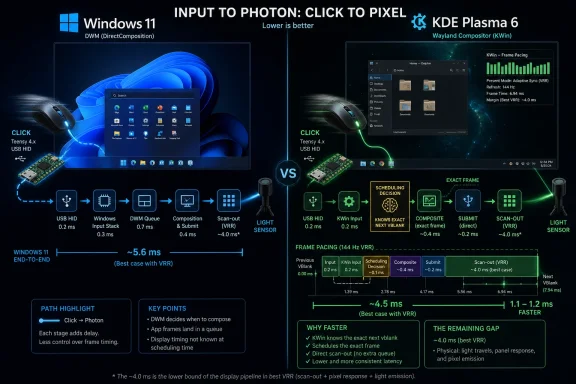
Open-source developer Jakub Okoński is preparing KDE KWin Wayland patches in June 2026 that reduce gaming latency in Plasma 6 by changing compositor timing behavior, after click-to-photon testing showed Windows 11 still leading Linux in the lowest-latency gaming scenarios. The interesting part is not that Windows remains ahead. The interesting part is that KDE’s gap is now small enough to be attacked in milliseconds rather than hand-waved away as a philosophical tax of the Linux desktop. That changes the conversation from “Wayland is not ready for games” to something more useful: which exact frame, which exact buffer, and which exact scheduling decision is costing the player time?
For years, desktop Linux gaming debates have had an oddly abstract quality. Frame rates were easy to benchmark, driver support was easy to argue about, and Proton compatibility could be counted title by title. Latency, by contrast, often lived in the realm of vibes: one user’s “buttery smooth” was another user’s “why does my mouse feel like it is dragging through syrup?”
Okoński’s work matters because it attacks that squishiness with hardware. His test setup reportedly uses a Teensy microcontroller acting as a USB HID mouse, paired with a light sensor pointed at the display, to measure click-to-photon latency. That is the right kind of crude: not synthetic in the benchmark-suite sense, but physical enough to capture the chain from input event to visible response.
The numbers Phoronix highlighted are modest and therefore believable. The patches are said to recover about 1.1 to 1.2 milliseconds in minimum latency measurements, while Windows still holds an advantage of roughly 4 milliseconds in the best VRR cases. Nobody should confuse that with a miracle patch, but nobody should dismiss it either. Once latency is already low, a millisecond is no longer noise; it is part of the last mile.
This is the stage Linux gaming has been trying to reach for a decade. The big blockers — game compatibility, GPU driver maturity, Wine and Proton plumbing, kernel scheduling, explicit sync, VRR, HDR, fractional scaling, multi-monitor sanity — have not all vanished, but enough of them have improved that the compositor is now exposed as a serious performance surface. KWin is no longer just a window manager with effects. It is part of the game pipeline.
Linux has not had that luxury. Its gaming stack has often improved through spectacular acts of translation and reconciliation. Proton maps Windows games onto Linux. Mesa drivers translate vendor hardware into open graphics APIs. Wayland compositors try to reconcile security, correctness, mixed-DPI desktops, variable refresh rate, multiple monitors, presentation timing, and legacy XWayland games without inheriting every old X11 assumption.
That makes the Windows latency gap unsurprising. The more important point is that KDE developers are now narrowing the gap without abandoning the architectural direction of the Linux desktop. The old temptation was to say that serious gamers should bypass compositors, disable effects, run exclusive fullscreen, or remain on X11 until further notice. The modern KDE argument is more ambitious: the Wayland compositor should be good enough that the normal desktop path is also the competitive path.
That ambition is not cosmetic. Wayland deliberately puts the compositor in charge of presentation in ways that can make old-school “just let the app blast frames at the screen” instincts uncomfortable. But it also gives the compositor the authority to make correct decisions about multiple displays, scaling, color management, security boundaries, and frame timing. The question is whether KWin can spend that authority cheaply enough.
That distinction is the whole story. The heroic gaming setup — fullscreen, VRR, carefully tuned, no extra desktop weirdness — is already the path where Linux can look strong. The messier, more common desktop reality is where compositors earn or lose trust. A user alt-tabs to Discord, keeps a browser open on a second monitor, records gameplay, streams to friends, uses a launcher, checks MangoHud, and expects the game not to feel worse because it is not living in a monastic fullscreen temple.
Windowed and borderless-windowed play are no longer edge cases. On Windows, they became normal because the operating system and GPU stack worked hard to make them feel nearly indistinguishable from exclusive fullscreen for most players. Linux has needed the same transition, especially because the desktop gaming experience increasingly includes overlays, launchers, chat clients, capture tools, and multiple monitors.
That is why a KWin patch aimed at compositor latency is more than an enthusiast tweak. It is an attempt to make the ordinary Linux desktop less punitive. The user should not need to understand direct scanout, mailbox presentation, atomic commits, VRR ranges, or tearing protocols to get a responsive game. If the desktop stack is doing its job, those details become implementation trivia rather than forum survival knowledge.
The latency patches suggest Plasma is moving from basic Wayland viability into the performance-tuning phase. That is a healthier and more demanding phase. Once users believe the session basically works, they stop grading on a curve. They compare it directly with Windows.
This is where KDE’s modular, fast-moving development culture becomes both an advantage and a risk. KWin can absorb targeted improvements quickly because the project is alive, public, and unusually responsive to technical feedback. But compositor changes are not like theme tweaks. Presentation timing is a minefield of regressions, and the users most likely to notice improvements are also the users most likely to notice when one game, one monitor, or one driver path gets worse.
The timing is also awkward. Plasma 6.7 is imminent, and the patches are reportedly too late for that release. In practical terms, users should not expect a magic latency switch to appear in the next stable Plasma update. The work still needs upstream submission, review, integration, and distribution packaging. For rolling-release users, that cycle may feel quick; for mainstream distributions, it may land much later.
That delay is frustrating but appropriate. A compositor should not chase benchmark wins at the expense of frame pacing, power behavior, multi-monitor correctness, or stability. WindowsForum readers know this pattern from Microsoft’s own update history: the fastest code path is not always the one you want shipped to hundreds of millions of machines on a Tuesday.
Now the comparison is harsher. If a game runs, launches, syncs saves, recognizes the controller, and produces similar frame rates, the next question is how it feels. Competitive players care about input latency because it is part of control. Casual players may not articulate it, but they feel it when a desktop seems slightly heavy or a cursor trail feels disconnected from the hand.
Microsoft understands this deeply. Windows’ gaming pitch is no longer merely “the games are here.” It is Auto HDR, DirectStorage, Game Mode, graphics settings, driver certification, Xbox integration, variable refresh rate support, and an enormous ecosystem of vendors optimizing against the same baseline. Some of those features matter more in marketing than in practice, but the total message is coherent: Windows is where PC gaming is supposed to feel native.
KDE’s counter-message cannot be that Linux is ideologically purer. It has to be that Linux is technically competitive. That is why Okoński’s measurement work is valuable even before the patches land. It gives KDE a concrete target, a reproducible complaint, and a way to tell whether a fix actually moves the needle.
There is also a governance lesson here. Open-source projects are often accused of solving the problems their developers personally have, rather than the problems mainstream users notice. In this case, the developer pain point and the mainstream pain point are aligned. Gamers want lower latency; KWin developers want better presentation timing; distributions want Plasma Wayland to be easier to recommend; Valve’s Linux ecosystem benefits when desktops stop being the weak link.
Wayland changes that psychology. The compositor is not a decorative layer on top of the display server; it is the display server. KWin’s decisions affect when frames are accepted, when they are scheduled, when they are scanned out, when they are delayed for synchronization, and how they interact with the rest of the desktop. That makes KWin performance work central to the Linux gaming experience, not adjacent to it.
This also explains why the patches do not help every scenario equally. If a game is already in a low-latency path using VRR or tearing below the refresh ceiling, there may be little compositor delay left to shave. If a game is windowed, synchronized, or mediated through a more conservative presentation path, KWin has more opportunity to reduce waiting. The win depends on where the latency is hiding.
The Windows comparison is useful precisely because it forces Linux developers to inspect those hidden waits. A four-millisecond best-case gap is not a moral failure. It is a stack trace in disguise. Somewhere between input, toolkit, compositor, kernel, driver, GPU queue, display engine, and panel response, Windows is still spending less time.
The danger is that users will overread the result. A latency benchmark is not a universal ranking of operating systems. It depends on game, API, GPU, driver, monitor, refresh rate, frame rate, input device, compositor path, and measurement method. But the presence of caveats does not make the result meaningless. It makes targeted engineering possible.
That puts KDE in a difficult but clarifying position. Plasma does not need to become Windows. It does not need to copy Windows’ UX, update model, advertising creep, Microsoft account pressure, or increasingly aggressive cloud integration. But for gaming latency, Windows is the incumbent performance contract. If Linux wants to win converts rather than merely satisfy believers, it has to meet that contract where players can feel it.
The irony is that Windows’ broader trajectory may be creating an opening. Many enthusiasts who tolerate Windows for games are increasingly irritated by the operating system around those games. They dislike forced flows, telemetry, Copilot placement, account nudges, Start menu churn, and the sense that the PC is becoming a terminal for Microsoft services. Linux does not need to be perfect to exploit that dissatisfaction, but it must avoid giving users an immediate sensory reason to retreat.
Latency is one of those sensory reasons. A user can forgive a missing settings panel or a rough-edged launcher if the game feels excellent. They are much less forgiving when every mouse movement feels fractionally late. Input response is not a feature checkbox; it is the texture of the machine.
That is why KDE’s work belongs in the same conversation as Proton, Mesa, HDR, VRR, and anti-cheat. Compatibility gets the player in the door. Latency determines whether they stay.
KDE Plasma is not SteamOS’s default handheld interface in the way most users experience the Deck, but KDE has long been part of the broader SteamOS desktop story, and Plasma’s health matters to the Linux gaming ecosystem beyond handhelds. Desktop users want the same confidence that the Deck created: the sense that Linux gaming is not a pile of exceptions but a platform with momentum.
That momentum has changed expectations. Five years ago, a Linux gamer might have been delighted simply to run a Windows title at acceptable frame rates. In 2026, the same gamer may own a high-refresh OLED monitor, a VRR-capable GPU, a low-latency mouse, and a library full of games that already work through Proton. For that user, “it launches” is not praise. It is the floor.
KWin latency work is therefore part of Linux gaming’s maturity tax. Once the stack becomes good, the remaining flaws become more visible, not less. The rough edges that enthusiasts once explained away become the exact places where mainstream users judge the platform.
This is a good problem, but it is still a problem. A platform that wants to compete with Windows has to survive comparison not only in benchmarks but in muscle memory. If the player has spent a decade aiming on Windows, the Linux desktop has to feel close enough that the difference disappears. KDE is now working in that territory.
Wayland compositors have to make those trade-offs explicitly. That can make them look worse than older systems that simply pushed complexity elsewhere. But explicit trade-offs are also debuggable trade-offs. When a developer can measure a frame path and identify a delay, the project can decide whether the delay is buying anything useful.
The reported KWin patches appear to live in exactly that space. They are not a new driver, not a kernel scheduler rewrite, not a Proton compatibility miracle. They are compositor timing improvements that reduce latency where KWin’s current behavior can be tightened. This is unglamorous work, but it is the kind of work that separates a desktop that merely functions from one that feels professionally tuned.
It also underscores why upstream review matters. Gaming communities often move faster than upstream projects, and there is always a temptation to ship special builds, custom patches, and “low latency” forks. Those experiments can be useful, but the real victory is getting the improvement into the default compositor. A latency fix that only reaches users willing to compile KWin is a demo. A latency fix that ships through KDE and then through distributions is platform progress.
The Linux desktop has too often relied on expert users to assemble the best experience from scattered parts. Gaming is forcing a different model. Defaults matter. Packaging matters. The compositor’s out-of-box behavior matters. If KDE wants Plasma Wayland to be a Windows alternative, not just a Linux enthusiast’s toolkit, it needs the low-latency path to be ordinary.
Plasma 6.7 is already arriving in a period when KDE is balancing visible features with deep infrastructure work. Users tend to notice the visible layer first: shell behavior, settings, themes, display handling, login flows, and everyday polish. But KWin’s internals are where the desktop’s credibility is increasingly decided. A beautiful shell sitting on a laggy presentation path will lose to an uglier desktop that feels immediate.
For sysadmins and IT pros, this may sound like gamer trivia. It is not. The same compositor discipline that improves games can improve remote desktops, creative applications, high-refresh workstations, simulation software, visualization tools, and general desktop responsiveness. Gaming is simply the most ruthless consumer-grade test harness for latency because players notice delays that office workflows often hide.
There is also a distribution angle. Rolling distributions will likely expose these changes first if and when they land upstream. Conservative distributions may lag by months, and enterprise desktops may lag longer still. That means the Linux gaming experience will continue to vary dramatically depending on distro cadence, GPU stack, and whether users are willing to accept newer Plasma builds.
Windows has its own fragmentation — drivers, OEM images, overlays, firmware, update channels — but it benefits from a single dominant target. Linux’s diversity remains both strength and drag. KDE can improve KWin, but the player’s final experience still depends on how quickly the rest of the ecosystem carries that work to actual machines.
KDE’s latest latency work will not make Linux the default answer for every Windows gamer overnight, and it should not be sold that way. But it shows a desktop ecosystem moving into the phase where the remaining gaps are specific, measurable, and worth fighting over. If Plasma can make the normal Wayland session feel as immediate as users expect from a gaming PC, Windows will keep its incumbent advantage — but it will no longer own the feel of PC gaming by default.
 KDE Is Finally Measuring the Thing Gamers Actually Feel
For years, desktop Linux gaming debates have had an oddly abstract quality. Frame rates were easy to benchmark, driver support was easy to argue about, and Proton compatibility could be counted title by title. Latency, by contrast, often lived in the realm of vibes: one user’s “buttery smooth” was another user’s “why does my mouse feel like it is dragging through syrup?”Okoński’s work matters because it attacks that squishiness with hardware. His test setup reportedly uses a Teensy microcontroller acting as a USB HID mouse, paired with a light sensor pointed at the display, to measure click-to-photon latency. That is the right kind of crude: not synthetic in the benchmark-suite sense, but physical enough to capture the chain from input event to visible response.
The numbers Phoronix highlighted are modest and therefore believable. The patches are said to recover about 1.1 to 1.2 milliseconds in minimum latency measurements, while Windows still holds an advantage of roughly 4 milliseconds in the best VRR cases. Nobody should confuse that with a miracle patch, but nobody should dismiss it either. Once latency is already low, a millisecond is no longer noise; it is part of the last mile.
This is the stage Linux gaming has been trying to reach for a decade. The big blockers — game compatibility, GPU driver maturity, Wine and Proton plumbing, kernel scheduling, explicit sync, VRR, HDR, fractional scaling, multi-monitor sanity — have not all vanished, but enough of them have improved that the compositor is now exposed as a serious performance surface. KWin is no longer just a window manager with effects. It is part of the game pipeline.
The Windows Advantage Is Boring, Which Is Why It Matters
Windows wins here for the least romantic reason in computing: it has been optimized around commercial gaming for a very long time. Microsoft’s desktop graphics stack, GPU vendors’ Windows drivers, game engines, anti-cheat vendors, monitor makers, and peripheral companies have all been forced into the same competitive arena. If a popular shooter feels worse on one driver branch, somebody’s support queue catches fire.Linux has not had that luxury. Its gaming stack has often improved through spectacular acts of translation and reconciliation. Proton maps Windows games onto Linux. Mesa drivers translate vendor hardware into open graphics APIs. Wayland compositors try to reconcile security, correctness, mixed-DPI desktops, variable refresh rate, multiple monitors, presentation timing, and legacy XWayland games without inheriting every old X11 assumption.
That makes the Windows latency gap unsurprising. The more important point is that KDE developers are now narrowing the gap without abandoning the architectural direction of the Linux desktop. The old temptation was to say that serious gamers should bypass compositors, disable effects, run exclusive fullscreen, or remain on X11 until further notice. The modern KDE argument is more ambitious: the Wayland compositor should be good enough that the normal desktop path is also the competitive path.
That ambition is not cosmetic. Wayland deliberately puts the compositor in charge of presentation in ways that can make old-school “just let the app blast frames at the screen” instincts uncomfortable. But it also gives the compositor the authority to make correct decisions about multiple displays, scaling, color management, security boundaries, and frame timing. The question is whether KWin can spend that authority cheaply enough.
The Big Win Is Windowed Gaming, Not the Heroic Fullscreen Case
The most revealing detail in the Phoronix report is where the gains are expected to land. Windowed games and applications should benefit substantially. V-Sync fullscreen games using direct scanout may gain around a millisecond. Games using VRR, or fullscreen games where tearing is allowed, generally will not see reduced latency from these changes as long as they remain at or below the refresh rate.That distinction is the whole story. The heroic gaming setup — fullscreen, VRR, carefully tuned, no extra desktop weirdness — is already the path where Linux can look strong. The messier, more common desktop reality is where compositors earn or lose trust. A user alt-tabs to Discord, keeps a browser open on a second monitor, records gameplay, streams to friends, uses a launcher, checks MangoHud, and expects the game not to feel worse because it is not living in a monastic fullscreen temple.
Windowed and borderless-windowed play are no longer edge cases. On Windows, they became normal because the operating system and GPU stack worked hard to make them feel nearly indistinguishable from exclusive fullscreen for most players. Linux has needed the same transition, especially because the desktop gaming experience increasingly includes overlays, launchers, chat clients, capture tools, and multiple monitors.
That is why a KWin patch aimed at compositor latency is more than an enthusiast tweak. It is an attempt to make the ordinary Linux desktop less punitive. The user should not need to understand direct scanout, mailbox presentation, atomic commits, VRR ranges, or tearing protocols to get a responsive game. If the desktop stack is doing its job, those details become implementation trivia rather than forum survival knowledge.
Plasma’s Wayland Bet Is Entering Its Performance Phase
KDE Plasma 6 made Wayland the center of gravity for the project’s future, even while X11 remains available for users and distributions that need it. That transition has been judged mostly on whether things break: do windows appear, do screens wake up, do NVIDIA systems behave, does screen sharing work, do games launch, do cursors stutter, do panels remember where they live? Those are necessary questions, but they are not sufficient anymore.The latency patches suggest Plasma is moving from basic Wayland viability into the performance-tuning phase. That is a healthier and more demanding phase. Once users believe the session basically works, they stop grading on a curve. They compare it directly with Windows.
This is where KDE’s modular, fast-moving development culture becomes both an advantage and a risk. KWin can absorb targeted improvements quickly because the project is alive, public, and unusually responsive to technical feedback. But compositor changes are not like theme tweaks. Presentation timing is a minefield of regressions, and the users most likely to notice improvements are also the users most likely to notice when one game, one monitor, or one driver path gets worse.
The timing is also awkward. Plasma 6.7 is imminent, and the patches are reportedly too late for that release. In practical terms, users should not expect a magic latency switch to appear in the next stable Plasma update. The work still needs upstream submission, review, integration, and distribution packaging. For rolling-release users, that cycle may feel quick; for mainstream distributions, it may land much later.
That delay is frustrating but appropriate. A compositor should not chase benchmark wins at the expense of frame pacing, power behavior, multi-monitor correctness, or stability. WindowsForum readers know this pattern from Microsoft’s own update history: the fastest code path is not always the one you want shipped to hundreds of millions of machines on a Tuesday.
The Millisecond Is Political Now
A 1.1-millisecond improvement sounds too small to carry much cultural weight, but Linux gaming has reached the point where small numbers have symbolic force. For years, the Linux desktop could defend itself by pointing to dramatic progress elsewhere. Proton made previously impossible games playable. Mesa delivered enormous open-driver gains. AMD’s Linux experience became credible. Steam Deck turned Linux gaming from a hobbyist argument into a shipping consumer product.Now the comparison is harsher. If a game runs, launches, syncs saves, recognizes the controller, and produces similar frame rates, the next question is how it feels. Competitive players care about input latency because it is part of control. Casual players may not articulate it, but they feel it when a desktop seems slightly heavy or a cursor trail feels disconnected from the hand.
Microsoft understands this deeply. Windows’ gaming pitch is no longer merely “the games are here.” It is Auto HDR, DirectStorage, Game Mode, graphics settings, driver certification, Xbox integration, variable refresh rate support, and an enormous ecosystem of vendors optimizing against the same baseline. Some of those features matter more in marketing than in practice, but the total message is coherent: Windows is where PC gaming is supposed to feel native.
KDE’s counter-message cannot be that Linux is ideologically purer. It has to be that Linux is technically competitive. That is why Okoński’s measurement work is valuable even before the patches land. It gives KDE a concrete target, a reproducible complaint, and a way to tell whether a fix actually moves the needle.
There is also a governance lesson here. Open-source projects are often accused of solving the problems their developers personally have, rather than the problems mainstream users notice. In this case, the developer pain point and the mainstream pain point are aligned. Gamers want lower latency; KWin developers want better presentation timing; distributions want Plasma Wayland to be easier to recommend; Valve’s Linux ecosystem benefits when desktops stop being the weak link.
The Compositor Is No Longer Optional Infrastructure
Old Linux gaming advice often treated the compositor as something to escape. Turn it off. Bypass it. Use a different session. Try X11. Try gamescope. Try a tiling compositor. Try a launch flag that somebody mentioned in a three-year-old Reddit thread. That culture made sense when the desktop stack was less mature, but it also trained users to see the compositor as overhead rather than infrastructure.Wayland changes that psychology. The compositor is not a decorative layer on top of the display server; it is the display server. KWin’s decisions affect when frames are accepted, when they are scheduled, when they are scanned out, when they are delayed for synchronization, and how they interact with the rest of the desktop. That makes KWin performance work central to the Linux gaming experience, not adjacent to it.
This also explains why the patches do not help every scenario equally. If a game is already in a low-latency path using VRR or tearing below the refresh ceiling, there may be little compositor delay left to shave. If a game is windowed, synchronized, or mediated through a more conservative presentation path, KWin has more opportunity to reduce waiting. The win depends on where the latency is hiding.
The Windows comparison is useful precisely because it forces Linux developers to inspect those hidden waits. A four-millisecond best-case gap is not a moral failure. It is a stack trace in disguise. Somewhere between input, toolkit, compositor, kernel, driver, GPU queue, display engine, and panel response, Windows is still spending less time.
The danger is that users will overread the result. A latency benchmark is not a universal ranking of operating systems. It depends on game, API, GPU, driver, monitor, refresh rate, frame rate, input device, compositor path, and measurement method. But the presence of caveats does not make the result meaningless. It makes targeted engineering possible.
Windows 11 Remains the Reference Platform KDE Cannot Ignore
There is a certain discomfort in saying this on a Linux-heavy topic, but Windows 11 is the correct reference point. Not because it is always technically elegant, and certainly not because users love every direction Microsoft has taken the OS. It is the reference point because the PC gaming industry optimizes for it first.That puts KDE in a difficult but clarifying position. Plasma does not need to become Windows. It does not need to copy Windows’ UX, update model, advertising creep, Microsoft account pressure, or increasingly aggressive cloud integration. But for gaming latency, Windows is the incumbent performance contract. If Linux wants to win converts rather than merely satisfy believers, it has to meet that contract where players can feel it.
The irony is that Windows’ broader trajectory may be creating an opening. Many enthusiasts who tolerate Windows for games are increasingly irritated by the operating system around those games. They dislike forced flows, telemetry, Copilot placement, account nudges, Start menu churn, and the sense that the PC is becoming a terminal for Microsoft services. Linux does not need to be perfect to exploit that dissatisfaction, but it must avoid giving users an immediate sensory reason to retreat.
Latency is one of those sensory reasons. A user can forgive a missing settings panel or a rough-edged launcher if the game feels excellent. They are much less forgiving when every mouse movement feels fractionally late. Input response is not a feature checkbox; it is the texture of the machine.
That is why KDE’s work belongs in the same conversation as Proton, Mesa, HDR, VRR, and anti-cheat. Compatibility gets the player in the door. Latency determines whether they stay.
The Steam Deck Effect Is Bigger Than Valve
Any modern discussion of Linux gaming has to account for Valve’s influence, even when Valve is not the named actor. Steam Deck normalized the idea that Linux can be a gaming platform for ordinary users. It also made Gamescope, Proton, Mesa, and kernel-level gaming work feel less like science projects and more like product infrastructure.KDE Plasma is not SteamOS’s default handheld interface in the way most users experience the Deck, but KDE has long been part of the broader SteamOS desktop story, and Plasma’s health matters to the Linux gaming ecosystem beyond handhelds. Desktop users want the same confidence that the Deck created: the sense that Linux gaming is not a pile of exceptions but a platform with momentum.
That momentum has changed expectations. Five years ago, a Linux gamer might have been delighted simply to run a Windows title at acceptable frame rates. In 2026, the same gamer may own a high-refresh OLED monitor, a VRR-capable GPU, a low-latency mouse, and a library full of games that already work through Proton. For that user, “it launches” is not praise. It is the floor.
KWin latency work is therefore part of Linux gaming’s maturity tax. Once the stack becomes good, the remaining flaws become more visible, not less. The rough edges that enthusiasts once explained away become the exact places where mainstream users judge the platform.
This is a good problem, but it is still a problem. A platform that wants to compete with Windows has to survive comparison not only in benchmarks but in muscle memory. If the player has spent a decade aiming on Windows, the Linux desktop has to feel close enough that the difference disappears. KDE is now working in that territory.
The Hardest Bugs Live Between Correctness and Speed
Low-latency display work is always a negotiation with correctness. Present too early, and you risk tearing or missed synchronization. Present too late, and the game feels sluggish. Optimize for the single fullscreen game, and you may hurt the mixed-monitor desktop. Optimize for the desktop, and competitive players accuse you of leaving performance on the table.Wayland compositors have to make those trade-offs explicitly. That can make them look worse than older systems that simply pushed complexity elsewhere. But explicit trade-offs are also debuggable trade-offs. When a developer can measure a frame path and identify a delay, the project can decide whether the delay is buying anything useful.
The reported KWin patches appear to live in exactly that space. They are not a new driver, not a kernel scheduler rewrite, not a Proton compatibility miracle. They are compositor timing improvements that reduce latency where KWin’s current behavior can be tightened. This is unglamorous work, but it is the kind of work that separates a desktop that merely functions from one that feels professionally tuned.
It also underscores why upstream review matters. Gaming communities often move faster than upstream projects, and there is always a temptation to ship special builds, custom patches, and “low latency” forks. Those experiments can be useful, but the real victory is getting the improvement into the default compositor. A latency fix that only reaches users willing to compile KWin is a demo. A latency fix that ships through KDE and then through distributions is platform progress.
The Linux desktop has too often relied on expert users to assemble the best experience from scattered parts. Gaming is forcing a different model. Defaults matter. Packaging matters. The compositor’s out-of-box behavior matters. If KDE wants Plasma Wayland to be a Windows alternative, not just a Linux enthusiast’s toolkit, it needs the low-latency path to be ordinary.
The Patch Misses Plasma 6.7, but the Signal Does Not
The fact that this work is likely too late for Plasma 6.7 is disappointing in the narrow sense and reassuring in the broader one. It means the release train is not being bent around an unreviewed gaming patch. It also means KDE’s latency push is not a one-off marketing bullet for the next version. It is part of a continuing performance campaign.Plasma 6.7 is already arriving in a period when KDE is balancing visible features with deep infrastructure work. Users tend to notice the visible layer first: shell behavior, settings, themes, display handling, login flows, and everyday polish. But KWin’s internals are where the desktop’s credibility is increasingly decided. A beautiful shell sitting on a laggy presentation path will lose to an uglier desktop that feels immediate.
For sysadmins and IT pros, this may sound like gamer trivia. It is not. The same compositor discipline that improves games can improve remote desktops, creative applications, high-refresh workstations, simulation software, visualization tools, and general desktop responsiveness. Gaming is simply the most ruthless consumer-grade test harness for latency because players notice delays that office workflows often hide.
There is also a distribution angle. Rolling distributions will likely expose these changes first if and when they land upstream. Conservative distributions may lag by months, and enterprise desktops may lag longer still. That means the Linux gaming experience will continue to vary dramatically depending on distro cadence, GPU stack, and whether users are willing to accept newer Plasma builds.
Windows has its own fragmentation — drivers, OEM images, overlays, firmware, update channels — but it benefits from a single dominant target. Linux’s diversity remains both strength and drag. KDE can improve KWin, but the player’s final experience still depends on how quickly the rest of the ecosystem carries that work to actual machines.
The Numbers Point to a Desktop That Is Learning to Compete
The useful lesson from Okoński’s testing is not that Linux is 1.2 milliseconds better now or 4 milliseconds worse than Windows in one best-case comparison. The useful lesson is that the KDE stack is measurable, improvable, and close enough for incremental work to matter.- KDE KWin latency patches are being prepared for upstream submission, but they are not expected to land in time for the imminent Plasma 6.7 release.
- The largest gains should be felt in windowed games and applications, where compositor behavior has more room to affect presentation timing.
- Fullscreen V-Sync games using direct scanout may see smaller gains, reportedly around a millisecond.
- VRR games and fullscreen games that allow tearing may see little or no benefit from these specific changes when they remain at or below the refresh rate.
- Windows 11 still appears to hold a best-case latency advantage in the reported measurements, but the gap is now narrow enough to guide targeted KWin engineering.
- The practical prize is not a benchmark headline; it is making Plasma Wayland feel competitive under normal gaming desktop conditions.
KDE’s latest latency work will not make Linux the default answer for every Windows gamer overnight, and it should not be sold that way. But it shows a desktop ecosystem moving into the phase where the remaining gaps are specific, measurable, and worth fighting over. If Plasma can make the normal Wayland session feel as immediate as users expect from a gaming PC, Windows will keep its incumbent advantage — but it will no longer own the feel of PC gaming by default.
References
- Primary source: Phoronix
Published: Wed, 10 Jun 2026 10:37:00 GMT
KDE KWin Patches Aiming To Optimize Gaming Latency To Better Compete With Windows - Phoronix
Open-source developer Jakub Okoński has been working on comparing the gaming latency between Linux and Windows and in turn working to drive some improvements into KDE's KWin Wayland compositor so the latency is more competitive with the gaming experience under Microsoft Windows 11.www.phoronix.com
- Related coverage: open-awesome.com
KWin-lowlatency — Low-Latency KWin for KDE Plasma | Open Awesome
KWin-lowlatency: A patched version of KWin for KDE Plasma that reduces latency and stuttering, primarily through X11 full-screen unredirection.. ⭐ 362 stars on GitHub. Open-source C++ project.open-awesome.com - Related coverage: discuss.kde.org
Very noticeable latency/input lag - Help - KDE Discuss
I experience a very noticeable latency on Plasma. No difference between X11 (both with compositing enabled and disabled) and Wayland. A very rough estimate using a reaction speed test puts the latency at around 60ms (goi… discuss.kde.org
- Related coverage: computerbase.de
Linux-Gaming: „Low Latency Layer“ bringt Anti-Lag-Funktionen für Linux - ComputerBase
Ein neues Open-Source-Projekt verspricht Reflex- und Anti-Lag-Funktionen für Linux-Spieler, selbst mit Intel-GPU.www.computerbase.de
- Related coverage: invent.kde.org
reduce latency for cursor updates (#134) · Issues · Plasma / KWin · GitLab
Right now we commit atomic commits right after rendering, and have the drm driver wait on rendering to be done. This causes two problems: invent.kde.org
- Related coverage: docs.kde.org
- Related coverage: gamingonlinux.com
KDE Plasma 6.6.1 rolls out with lots of fixes for KWin | GamingOnLinux
The KDE team have released the latest release for the Plasma desktop, with version 6.6.1 bringing quite a lot of bug fixing.www.gamingonlinux.com
