

Moonshot AI’s Kimi K3 release has turned a coding benchmark result into fresh ammunition in the U.S. debate over AI infrastructure. Bill Ackman and White House technology adviser David Sacks are arguing that restrictions on data-center growth could leave the United States short of the compute capacity needed to compete with China’s rapidly improving AI sector.
As reported by Reuters and the Associated Press, Beijing-based Moonshot unveiled Kimi K3 on July 17, describing it as a 2.8-trillion-parameter open-weight model. The model moved to the top of Arena’s Frontend Code Arena, a blind-comparison leaderboard for web-development output, ahead of Anthropic’s Claude Fable 5 and OpenAI’s GPT-5.6 Sol.
That is a notable benchmark win, especially for developers who use frontier models to generate UI components, site layouts, and application front ends. It is not, however, proof that Kimi K3 is the strongest general-purpose model or that China has overtaken U.S. labs across the board. Arena scores measure a narrow set of user-preference comparisons; they do not settle questions around reasoning, reliability, tool use, safety, enterprise support, or production cost.
Ackman used the result to revive a broader warning: China is expanding AI infrastructure without the environmental, power-grid, and permitting constraints facing projects in the United States. He has argued that a lead in compute, energy, and data could determine who reaches more capable AI systems first.
Sacks called Kimi K3’s showing “concerning,” according to Axios, and tied the issue to U.S. proposals that would slow data-center construction or add approval requirements for advanced models. The argument is less about one Chinese model than about whether American policy is creating a structural disadvantage while Chinese firms scale training and inference capacity.
The timing is awkward for that case. On July 14, New York Governor Kathy Hochul ordered a temporary, one-year pause on certain state environmental permits for new hyperscale data centers. Empire State Development said the measure is intended to give New York time to establish rules covering ratepayer costs, grid effects, water use, and community benefits. The order does not stop existing facilities or every data-center project, but it does add uncertainty for large developments in a major U.S. market.
But enterprise adoption will depend on issues beyond leaderboard placement: data handling, regional availability, identity controls, auditability, support contracts, licensing, and whether the promised open weights arrive with terms acceptable for commercial use. Moonshot says the full model weights are due July 27.
Admins should treat the release as a reason to review AI coding-tool policies, not as a reason to replace existing platforms on the strength of a single benchmark.
As reported by Reuters and the Associated Press, Beijing-based Moonshot unveiled Kimi K3 on July 17, describing it as a 2.8-trillion-parameter open-weight model. The model moved to the top of Arena’s Frontend Code Arena, a blind-comparison leaderboard for web-development output, ahead of Anthropic’s Claude Fable 5 and OpenAI’s GPT-5.6 Sol.
That is a notable benchmark win, especially for developers who use frontier models to generate UI components, site layouts, and application front ends. It is not, however, proof that Kimi K3 is the strongest general-purpose model or that China has overtaken U.S. labs across the board. Arena scores measure a narrow set of user-preference comparisons; they do not settle questions around reasoning, reliability, tool use, safety, enterprise support, or production cost.
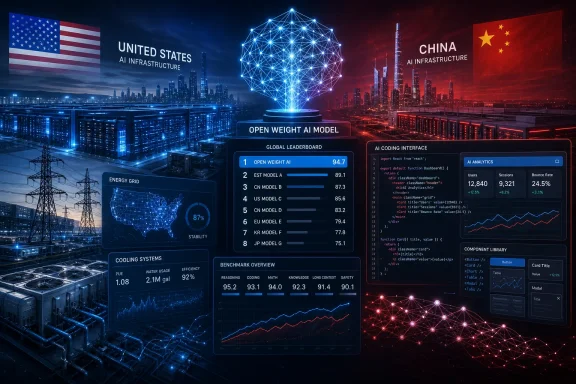 Infrastructure becomes the argument
Ackman used the result to revive a broader warning: China is expanding AI infrastructure without the environmental, power-grid, and permitting constraints facing projects in the United States. He has argued that a lead in compute, energy, and data could determine who reaches more capable AI systems first.Sacks called Kimi K3’s showing “concerning,” according to Axios, and tied the issue to U.S. proposals that would slow data-center construction or add approval requirements for advanced models. The argument is less about one Chinese model than about whether American policy is creating a structural disadvantage while Chinese firms scale training and inference capacity.
The timing is awkward for that case. On July 14, New York Governor Kathy Hochul ordered a temporary, one-year pause on certain state environmental permits for new hyperscale data centers. Empire State Development said the measure is intended to give New York time to establish rules covering ratepayer costs, grid effects, water use, and community benefits. The order does not stop existing facilities or every data-center project, but it does add uncertainty for large developments in a major U.S. market.
What Kimi K3 means for Windows shops
For Windows developers and IT teams, Kimi K3 is chiefly another option in an increasingly crowded model market. Its front-end performance could make it attractive for prototyping web interfaces, generating React or TypeScript code, and assisting with internal application work.But enterprise adoption will depend on issues beyond leaderboard placement: data handling, regional availability, identity controls, auditability, support contracts, licensing, and whether the promised open weights arrive with terms acceptable for commercial use. Moonshot says the full model weights are due July 27.
Admins should treat the release as a reason to review AI coding-tool policies, not as a reason to replace existing platforms on the strength of a single benchmark.
References
- Primary source: Blockonomi
Published: 2026-07-20T09:32:20+00:00
Ackman Sounds Alarm: China's AI Surge Could Eclipse U.S. Superintelligence Ambitions - Blockonomi
Bill Ackman warns China's AI push threatens U.S. democracy as Moonshot's Kimi K3 tops leaderboards. Nvidia slides 2% on chip concerns amid the AI race.blockonomi.com - Related coverage: benzinga.com
Bill Ackman Warns of China Super Intelligence Threat - Alibaba Gr Hldgs (NYSE:BABA) - Benzinga
Billionaire Bill Ackman warns of China's data center surge and AI arms race, citing national security risks.www.benzinga.com - Related coverage: coincentral.com
Bill Ackman China's AI Push Threatens U.S. Lead in the Race for Superintelligence - CoinCentral
Bill Ackman and David Sacks warn China's Kimi K3 AI model is closing the gap on the U.S., as Nvidia and Micron slide on fresh chip concerns.coincentral.com
