

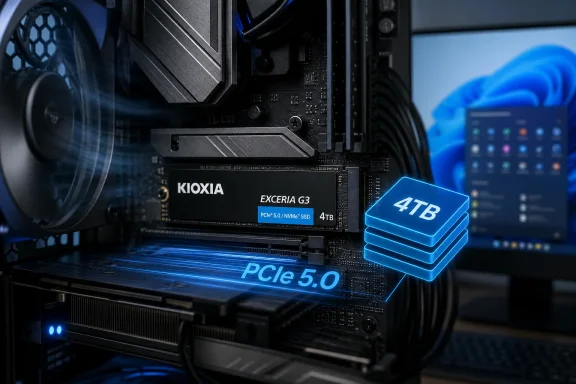
Kioxia added a 4 TB model to its Exceria G3 M.2 NVMe SSD family on June 16, 2026, expanding the PCIe 5.0 consumer drive line beyond the 1 TB and 2 TB capacities introduced in December 2025. The move is less about headline speed than about making high-capacity Gen 5 storage look normal, cheap, and cool enough for mainstream desktops. That is a bigger shift than it sounds, because the first wave of PCIe 5.0 SSDs often asked users to accept heat, cost, and overkill performance in exchange for benchmark glory. The Exceria G3’s new 4 TB option suggests the second wave of Gen 5 drives is arriving with a quieter pitch: enough speed, much more space, and fewer thermal theatrics.
For the last few years, PCIe 5.0 SSDs have occupied an awkward place in the PC market. They were technically impressive, routinely outrunning even very fast Gen 4 drives in sequential workloads, but they often came with practical caveats: heatsinks, airflow concerns, higher prices, and performance gains that most Windows users struggled to feel outside of large file transfers or synthetic benchmarks.
The Exceria G3 4 TB variant points in a different direction. It is still a Gen 5 drive, still marketed around big sequential numbers, and still intended to look modern beside newer AMD and Intel platforms. But the design choices — a DRAMless controller, QLC NAND, no bundled cooler, and a claimed peak draw of 6.4 W — frame it as a capacity-first mainstream SSD rather than a halo part.
That matters because most real PCs do not need 14 GB/s storage nearly as badly as they need room. A Windows 11 install, a few large games, local AI models, virtual machines, creative project folders, and a recovery image can make 1 TB feel cramped very quickly. A 4 TB boot or secondary NVMe drive is no longer extravagant for enthusiasts; it is increasingly the practical middle ground.
Kioxia is therefore not chasing the loudest corner of the SSD market here. It is trying to make PCIe 5.0 boring, and in storage, boring is often the point at which a technology becomes genuinely useful.
That confusion is not just pedantry. SSD branding has become a maze of “Plus,” “Pro,” “G,” “G2,” “G3,” and “G4” suffixes that do not always map cleanly to interface generation, NAND type, controller tier, or real-world performance. A buyer could easily assume that a G3 product is older or slower than a G4 product, while in Kioxia’s current consumer lineup the story is more nuanced.
The forum commenter’s instinct — that this feels like it should be folded into a higher-sounding range — reflects a broader frustration among enthusiasts. We now buy SSDs by decoding controller families, NAND generations, cache behavior, endurance ratings, and thermal profiles, while vendors sell them with product names that often hide the most important tradeoffs.
Kioxia is hardly alone here. The SSD market has trained buyers to look past the box. A name may tell you the brand family; the controller and NAND tell you the truth.
That reputation was earned in the early consumer QLC era, when some drives combined low endurance, small dynamic caches, and poor sustained write behavior. But QLC has matured, controllers have improved, and higher-capacity drives naturally get more parallelism and more total write budget. In other words, QLC at 4 TB is not the same proposition as QLC at 500 GB.
Kioxia’s claimed 2,400 TBW endurance rating for the 4 TB model is the number that will make skeptics pause. That is a strong headline figure for a QLC consumer drive and lines up with what many mainstream users would expect from good TLC products in the same capacity range. Endurance ratings are not the whole story — workload, write amplification, firmware behavior, and cooling all matter — but 2,400 TBW is not the spec of a disposable bargain-bin SSD.
The deeper point is that QLC is being repositioned. It is no longer merely the thing vendors use to make the cheapest possible drive. In drives like this, it becomes the way to deliver high-capacity NVMe storage at a performance level that is still more than sufficient for most Windows PCs.
The tradeoff is that DRAMless SSDs can be less graceful under certain heavy workloads, especially mixed random I/O, sustained writes, and scenarios where the drive is nearly full. For a gaming library, media archive, general Windows boot drive, or project storage volume, the compromise may be nearly invisible. For workstation scratch use, database-heavy development, or constant large ingest workloads, buyers still need to look more carefully.
This is where the “up to” numbers can mislead. Up to 10 GB/s sequential read and 9.6 GB/s sequential write speeds are impressive, but they describe peak behavior, not necessarily what happens after the pseudo-SLC cache is saturated. A 4 TB QLC drive can still be very fast in bursts and less impressive in long, punishing writes.
Yet that does not make the product cynical. It makes it targeted. Most PC users need burst speed, capacity, and decent thermals more than they need enterprise-grade consistency. The Exceria G3 4 TB seems built around that reality.
That is especially relevant for Windows users building compact desktops, upgrading prebuilt systems, or filling secondary motherboard slots. Many boards already include M.2 heatsinks, and many cases have enough airflow for a moderate-power NVMe drive. A bare module is easier to fit, easier to integrate, and less likely to collide with laptop or small-form-factor constraints — though actual compatibility will depend on the system.
Thermal behavior is still something reviewers will need to test. Gen 5 signaling does not magically become cool just because a drive is midrange, and sustained writes can expose weaknesses that spec sheets smooth over. But the power figure suggests Kioxia and Phison are aiming for a different class of Gen 5 experience: less “strap a radiator to it,” more “install it and move on.”
That is precisely the kind of shift PCIe 5.0 storage needs if it is going to spread beyond benchmark-focused desktops.
Boot times, app launches, and general desktop responsiveness are already excellent on good PCIe 3.0 and PCIe 4.0 NVMe drives. Moving from a competent Gen 4 SSD to a midrange Gen 5 SSD will not make Windows feel twice as fast. The operating system is often waiting on CPU work, service initialization, driver behavior, decompression, network calls, or application logic rather than raw sequential storage bandwidth.
Where the Exceria G3 4 TB becomes more compelling is in the accumulation of modern PC use. Game installs now routinely exceed 100 GB. Creator workflows generate large intermediate files. Developers run local containers, VMs, and test datasets. Enthusiasts dual-boot, image systems, and keep multiple launchers and libraries around because redownloading everything is tiresome.
A single 4 TB M.2 drive can simplify all of that. It can serve as a roomy primary drive, a fast game volume, or a local workspace for projects that used to be split across slower SATA SSDs and external drives. In that sense, the most important number in this launch may not be 10,000 MB/s. It may be 4 TB.
DirectStorage can reduce CPU overhead and improve asset decompression pipelines when games are built to use it properly. But the number of titles that transform the experience remains limited, and many games are still designed around a wide base of storage hardware. Developers cannot assume every PC has a fast Gen 5 SSD, so storage remains only one part of the performance puzzle.
That does not make a drive like this irrelevant to gaming. On the contrary, 4 TB of fast NVMe storage is extremely attractive for players who keep large libraries installed. It is just that the benefit is more likely to be convenience, load-time consistency, and room to breathe than some cinematic leap into a new era of instantaneous worlds.
The industry keeps promising that storage will reshape games. For now, capacity is doing more visible work than bandwidth.
A 4 TB QLC Gen 5 drive with a respectable endurance rating is not the right answer for every system. But it may be the right answer for many systems that need a lot of fast local capacity without paying flagship premiums. That could include developer desktops, lab machines, content review stations, gaming rigs, and power-user laptops where supported.
Sysadmins should still be cautious about consumer SSDs in managed fleets. Warranty terms, firmware tooling, power-loss behavior, telemetry visibility, and sustained performance all matter more when a drive is deployed at scale. Kioxia’s five-year warranty is reassuring for individual buyers, but it does not turn the Exceria G3 into an enterprise SSD.
Still, the direction is obvious. Consumer drives are absorbing enterprise-like density improvements, while enterprise storage ideas about tiering and workload fit are becoming more relevant to home and small-office buyers. The gap between “enthusiast” and “professional” storage use keeps narrowing.
This is the uncomfortable truth of midrange SSDs: they live or die by street price. Spec sheets can establish a product’s category, but retailers decide its fate. A drive that looks slightly compromised at launch can become a favorite after one aggressive sale; a technically balanced product can disappear if it sits too close to better-known rivals.
The 4 TB segment is particularly price-sensitive because buyers are already spending real money. At 1 TB, a small premium may be tolerable. At 4 TB, every pricing gap is magnified, and users start comparing not just speed but warranty, NAND type, sustained write reviews, controller reputation, and brand trust.
Kioxia has the advantage of being a NAND manufacturer rather than just another label on a reference design. But in the consumer SSD aisle, that advantage still has to show up as either performance confidence or a price worth noticing.
That blend may become increasingly common. The SSD market is no longer moving along a single axis where every new generation is simply faster and more expensive. Instead, vendors are slicing Gen 5 into tiers: extreme performance drives for benchmarkers and workstation users, efficient OEM drives for laptops, and midrange high-capacity drives for everyone who just wants a large, fast, modern boot volume.
In that landscape, the Exceria G3 4 TB makes sense even if the name does not. It is a bridge product. It gives buyers the platform checkbox of PCIe 5.0 without necessarily dragging in the worst costs of early Gen 5 adoption.
That may be why the forum reaction evolved from skepticism about the branding to grudging enthusiasm about the actual drive. Once you get past the name, the proposition is straightforward: 4 TB, Gen 5, strong claimed endurance, five-year warranty, and low enough power that it does not need to arrive wearing a heatsink like body armor.
Random performance claims are also worth contextualizing. Up to 1.45 million IOPS for 4K random reads and writes is a strong number, but client systems rarely reproduce peak lab conditions in everyday use. Queue depths, operating system behavior, background tasks, and drive fill level all affect what users experience.
The most useful reviews will not merely run CrystalDiskMark and declare victory. They will test large game transfers, cache recovery, mixed workloads, drive temperature under motherboard heatsinks, behavior when 80 or 90 percent full, and performance consistency over time. That is where a mainstream Gen 5 QLC drive either proves its balance or reveals the compromises hiding under the peak numbers.
For now, the launch establishes Kioxia’s intent. The verdict will depend on street pricing and real-world testing.
Kioxia’s 4 TB Exceria G3 is not the fastest possible SSD, and it may not be the cleanest piece of branding the company has ever shipped. But it is exactly the kind of product that shows where consumer storage is heading: high-capacity NVMe drives that use Gen 5 less as a luxury badge and more as a new baseline. If pricing lands well and reviewers confirm the endurance, thermals, and sustained behavior hold up, this could be one of those unglamorous upgrades that quietly matters more than the benchmark champions.
 Kioxia Moves Gen 5 From Trophy Hardware to Everyday Storage
For the last few years, PCIe 5.0 SSDs have occupied an awkward place in the PC market. They were technically impressive, routinely outrunning even very fast Gen 4 drives in sequential workloads, but they often came with practical caveats: heatsinks, airflow concerns, higher prices, and performance gains that most Windows users struggled to feel outside of large file transfers or synthetic benchmarks.The Exceria G3 4 TB variant points in a different direction. It is still a Gen 5 drive, still marketed around big sequential numbers, and still intended to look modern beside newer AMD and Intel platforms. But the design choices — a DRAMless controller, QLC NAND, no bundled cooler, and a claimed peak draw of 6.4 W — frame it as a capacity-first mainstream SSD rather than a halo part.
That matters because most real PCs do not need 14 GB/s storage nearly as badly as they need room. A Windows 11 install, a few large games, local AI models, virtual machines, creative project folders, and a recovery image can make 1 TB feel cramped very quickly. A 4 TB boot or secondary NVMe drive is no longer extravagant for enthusiasts; it is increasingly the practical middle ground.
Kioxia is therefore not chasing the loudest corner of the SSD market here. It is trying to make PCIe 5.0 boring, and in storage, boring is often the point at which a technology becomes genuinely useful.
The Naming Is Messy Because the Market Is Messy
The community reaction to the Exceria G3 expansion is telling. On paper, “G3” sounds as though it should sit below Kioxia’s faster or more premium models, and longtime buyers may associate similar naming with PCIe 4.0-era Exceria Plus G3 products. Yet this new Exceria G3 is a PCIe Gen 5 x4 drive using a Phison E31T-class DRAMless controller, which makes the name feel out of step with the hardware.That confusion is not just pedantry. SSD branding has become a maze of “Plus,” “Pro,” “G,” “G2,” “G3,” and “G4” suffixes that do not always map cleanly to interface generation, NAND type, controller tier, or real-world performance. A buyer could easily assume that a G3 product is older or slower than a G4 product, while in Kioxia’s current consumer lineup the story is more nuanced.
The forum commenter’s instinct — that this feels like it should be folded into a higher-sounding range — reflects a broader frustration among enthusiasts. We now buy SSDs by decoding controller families, NAND generations, cache behavior, endurance ratings, and thermal profiles, while vendors sell them with product names that often hide the most important tradeoffs.
Kioxia is hardly alone here. The SSD market has trained buyers to look past the box. A name may tell you the brand family; the controller and NAND tell you the truth.
QLC No Longer Means What It Used To Mean
The most important technical compromise in the 4 TB Exceria G3 is also the one that has become less frightening over time: QLC NAND. Quad-level-cell flash stores more bits per cell than TLC, lowering cost per gigabyte and enabling higher capacities, but it has historically carried a reputation for weaker endurance and slower sustained writes once cache is exhausted.That reputation was earned in the early consumer QLC era, when some drives combined low endurance, small dynamic caches, and poor sustained write behavior. But QLC has matured, controllers have improved, and higher-capacity drives naturally get more parallelism and more total write budget. In other words, QLC at 4 TB is not the same proposition as QLC at 500 GB.
Kioxia’s claimed 2,400 TBW endurance rating for the 4 TB model is the number that will make skeptics pause. That is a strong headline figure for a QLC consumer drive and lines up with what many mainstream users would expect from good TLC products in the same capacity range. Endurance ratings are not the whole story — workload, write amplification, firmware behavior, and cooling all matter — but 2,400 TBW is not the spec of a disposable bargain-bin SSD.
The deeper point is that QLC is being repositioned. It is no longer merely the thing vendors use to make the cheapest possible drive. In drives like this, it becomes the way to deliver high-capacity NVMe storage at a performance level that is still more than sufficient for most Windows PCs.
DRAMless Gen 5 Is the Real Architectural Bet
The Phison E31T angle is just as important as the NAND. A DRAMless controller reduces bill of materials cost and power consumption, while relying on modern NVMe features and host memory buffer behavior to keep performance acceptable for client workloads. That is a perfectly rational design for a mainstream SSD, especially one that wants to avoid the thermal baggage of earlier high-end Gen 5 drives.The tradeoff is that DRAMless SSDs can be less graceful under certain heavy workloads, especially mixed random I/O, sustained writes, and scenarios where the drive is nearly full. For a gaming library, media archive, general Windows boot drive, or project storage volume, the compromise may be nearly invisible. For workstation scratch use, database-heavy development, or constant large ingest workloads, buyers still need to look more carefully.
This is where the “up to” numbers can mislead. Up to 10 GB/s sequential read and 9.6 GB/s sequential write speeds are impressive, but they describe peak behavior, not necessarily what happens after the pseudo-SLC cache is saturated. A 4 TB QLC drive can still be very fast in bursts and less impressive in long, punishing writes.
Yet that does not make the product cynical. It makes it targeted. Most PC users need burst speed, capacity, and decent thermals more than they need enterprise-grade consistency. The Exceria G3 4 TB seems built around that reality.
The Missing Heatsink Is a Feature, Not an Omission
The absence of a bundled cooling solution may look underwhelming beside the oversized heatsinks and miniature heat pipes that accompanied many early PCIe 5.0 SSD launches. But for a drive claiming a peak whole-drive power draw of 6.4 W, no heatsink is part of the message. Kioxia is saying this is a Gen 5 SSD that belongs in ordinary M.2 slots, not just in showcase motherboards with elaborate armor.That is especially relevant for Windows users building compact desktops, upgrading prebuilt systems, or filling secondary motherboard slots. Many boards already include M.2 heatsinks, and many cases have enough airflow for a moderate-power NVMe drive. A bare module is easier to fit, easier to integrate, and less likely to collide with laptop or small-form-factor constraints — though actual compatibility will depend on the system.
Thermal behavior is still something reviewers will need to test. Gen 5 signaling does not magically become cool just because a drive is midrange, and sustained writes can expose weaknesses that spec sheets smooth over. But the power figure suggests Kioxia and Phison are aiming for a different class of Gen 5 experience: less “strap a radiator to it,” more “install it and move on.”
That is precisely the kind of shift PCIe 5.0 storage needs if it is going to spread beyond benchmark-focused desktops.
Windows Users Will Feel Capacity Before They Feel Gen 5
For WindowsForum readers, the most practical question is not whether 10 GB/s is impressive. It is whether a 4 TB Gen 5 drive changes the daily experience of a Windows PC. The answer is: sometimes, but not always in the way marketing implies.Boot times, app launches, and general desktop responsiveness are already excellent on good PCIe 3.0 and PCIe 4.0 NVMe drives. Moving from a competent Gen 4 SSD to a midrange Gen 5 SSD will not make Windows feel twice as fast. The operating system is often waiting on CPU work, service initialization, driver behavior, decompression, network calls, or application logic rather than raw sequential storage bandwidth.
Where the Exceria G3 4 TB becomes more compelling is in the accumulation of modern PC use. Game installs now routinely exceed 100 GB. Creator workflows generate large intermediate files. Developers run local containers, VMs, and test datasets. Enthusiasts dual-boot, image systems, and keep multiple launchers and libraries around because redownloading everything is tiresome.
A single 4 TB M.2 drive can simplify all of that. It can serve as a roomy primary drive, a fast game volume, or a local workspace for projects that used to be split across slower SATA SSDs and external drives. In that sense, the most important number in this launch may not be 10,000 MB/s. It may be 4 TB.
The DirectStorage Angle Remains More Promise Than Revolution
Every new fast NVMe drive inevitably gets pulled into the conversation about Microsoft DirectStorage, game asset streaming, and the future of Windows gaming. The Exceria G3’s speed is comfortably above the threshold needed for any current consumer gaming workload, but the software ecosystem still has to do its part.DirectStorage can reduce CPU overhead and improve asset decompression pipelines when games are built to use it properly. But the number of titles that transform the experience remains limited, and many games are still designed around a wide base of storage hardware. Developers cannot assume every PC has a fast Gen 5 SSD, so storage remains only one part of the performance puzzle.
That does not make a drive like this irrelevant to gaming. On the contrary, 4 TB of fast NVMe storage is extremely attractive for players who keep large libraries installed. It is just that the benefit is more likely to be convenience, load-time consistency, and room to breathe than some cinematic leap into a new era of instantaneous worlds.
The industry keeps promising that storage will reshape games. For now, capacity is doing more visible work than bandwidth.
Enterprise Lessons Keep Drifting Into Consumer Drives
Although Exceria is a consumer brand, the logic behind this drive reflects trends IT departments know well. Storage buyers increasingly segment workloads not by prestige tier but by behavior: hot data, cold data, bursty writes, sustained writes, endurance-sensitive volumes, and capacity-heavy repositories. The old shorthand of “TLC good, QLC bad” is too crude for that world.A 4 TB QLC Gen 5 drive with a respectable endurance rating is not the right answer for every system. But it may be the right answer for many systems that need a lot of fast local capacity without paying flagship premiums. That could include developer desktops, lab machines, content review stations, gaming rigs, and power-user laptops where supported.
Sysadmins should still be cautious about consumer SSDs in managed fleets. Warranty terms, firmware tooling, power-loss behavior, telemetry visibility, and sustained performance all matter more when a drive is deployed at scale. Kioxia’s five-year warranty is reassuring for individual buyers, but it does not turn the Exceria G3 into an enterprise SSD.
Still, the direction is obvious. Consumer drives are absorbing enterprise-like density improvements, while enterprise storage ideas about tiering and workload fit are becoming more relevant to home and small-office buyers. The gap between “enthusiast” and “professional” storage use keeps narrowing.
Pricing Will Decide Whether This Is Clever or Merely Interesting
Kioxia did not disclose pricing, and that is the missing variable. A 4 TB Gen 5 QLC drive can be a smart mainstream product if it lands at a meaningful discount to high-end TLC alternatives. If it prices too close to faster TLC Gen 5 models or proven Gen 4 high-capacity drives, the argument weakens.This is the uncomfortable truth of midrange SSDs: they live or die by street price. Spec sheets can establish a product’s category, but retailers decide its fate. A drive that looks slightly compromised at launch can become a favorite after one aggressive sale; a technically balanced product can disappear if it sits too close to better-known rivals.
The 4 TB segment is particularly price-sensitive because buyers are already spending real money. At 1 TB, a small premium may be tolerable. At 4 TB, every pricing gap is magnified, and users start comparing not just speed but warranty, NAND type, sustained write reviews, controller reputation, and brand trust.
Kioxia has the advantage of being a NAND manufacturer rather than just another label on a reference design. But in the consumer SSD aisle, that advantage still has to show up as either performance confidence or a price worth noticing.
The Spec Sheet Says Mainstream, but the Capacity Says Enthusiast
The Exceria G3 4 TB sits in an interesting psychological space. Its controller and QLC NAND point toward mainstream affordability. Its PCIe 5.0 interface and 10 GB/s-class sequential performance sound enthusiast-grade. Its 4 TB capacity appeals to power users who have outgrown 1 TB and 2 TB drives but may not want to pay for the fastest flagship models.That blend may become increasingly common. The SSD market is no longer moving along a single axis where every new generation is simply faster and more expensive. Instead, vendors are slicing Gen 5 into tiers: extreme performance drives for benchmarkers and workstation users, efficient OEM drives for laptops, and midrange high-capacity drives for everyone who just wants a large, fast, modern boot volume.
In that landscape, the Exceria G3 4 TB makes sense even if the name does not. It is a bridge product. It gives buyers the platform checkbox of PCIe 5.0 without necessarily dragging in the worst costs of early Gen 5 adoption.
That may be why the forum reaction evolved from skepticism about the branding to grudging enthusiasm about the actual drive. Once you get past the name, the proposition is straightforward: 4 TB, Gen 5, strong claimed endurance, five-year warranty, and low enough power that it does not need to arrive wearing a heatsink like body armor.
The Fine Print Is Where Reviewers Need to Go Next
The launch details leave several questions for independent testing. Sustained write performance after cache exhaustion will matter, especially because QLC drives can vary dramatically depending on firmware and free space. Thermal throttling behavior will also need scrutiny, because a no-heatsink design is only as good as its worst-case workload in a normal case.Random performance claims are also worth contextualizing. Up to 1.45 million IOPS for 4K random reads and writes is a strong number, but client systems rarely reproduce peak lab conditions in everyday use. Queue depths, operating system behavior, background tasks, and drive fill level all affect what users experience.
The most useful reviews will not merely run CrystalDiskMark and declare victory. They will test large game transfers, cache recovery, mixed workloads, drive temperature under motherboard heatsinks, behavior when 80 or 90 percent full, and performance consistency over time. That is where a mainstream Gen 5 QLC drive either proves its balance or reveals the compromises hiding under the peak numbers.
For now, the launch establishes Kioxia’s intent. The verdict will depend on street pricing and real-world testing.
The 4 TB Exceria G3 Tells Buyers to Stop Worshipping the Bus
The practical lesson from this launch is that the interface generation is only one piece of the SSD story. PCIe 5.0 gives the Exceria G3 room to post big sequential figures, but the drive’s real identity comes from its capacity, controller, NAND, endurance rating, and thermal target.- The new 4 TB model makes the Exceria G3 family more relevant to gamers, creators, and power users who have already outgrown 2 TB drives.
- The use of QLC NAND is a tradeoff, but the claimed 2,400 TBW endurance rating makes it harder to dismiss the drive on NAND type alone.
- The DRAMless Phison E31T-class design suggests Kioxia is aiming for lower power and lower cost rather than maximum sustained workstation performance.
- The lack of a bundled heatsink fits the product’s mainstream pitch, though independent thermal testing will matter.
- Pricing will determine whether the 4 TB Exceria G3 becomes a smart buy or simply another confusingly named SSD in an already crowded market.
Kioxia’s 4 TB Exceria G3 is not the fastest possible SSD, and it may not be the cleanest piece of branding the company has ever shipped. But it is exactly the kind of product that shows where consumer storage is heading: high-capacity NVMe drives that use Gen 5 less as a luxury badge and more as a new baseline. If pricing lands well and reviewers confirm the endurance, thermals, and sustained behavior hold up, this could be one of those unglamorous upgrades that quietly matters more than the benchmark champions.
References
- Primary source: TechPowerUp
Published: 2026-06-16T09:10:15.237838
KIOXIA Adds 4 TB Variant to Exceria G3 Series M.2 Gen 5 NVMe SSDs | TechPowerUp
KIOXIA today introduced a 4 TB variant to its Exceria G3 series of mid-range M.2 Gen 5 NVMe SSDs. The company had debuted this series last December, with only 1 TB and 2 TB variants at the time. It features a combination of Phison E31T series DRAMless controller, paired with Kioxia's own...www.techpowerup.com - Related coverage: kioxia.com
EXCERIA G3 - NVMe™対応 SSD | KIOXIA - Japan (日本語)
www.kioxia.com
- Related coverage: europe.kioxia.com
EXCERIA G3 - NVMe™ SSD | KIOXIA - Europe (English)
europe.kioxia.com
- Related coverage: kr.kioxia.com
EXCERIA G3 - NVMe™ SSD | KIOXIA - Republic of Korea (한국)
kr.kioxia.com
- Related coverage: apac.kioxia.com
EXCERIA G3 SSD Downloads | KIOXIA - Asia Pacific (English)
apac.kioxia.com
- Related coverage: tw.kioxia.com
EXCERIA G3 NVMe SSD | KIOXIA - Taiwan (繁體中文)
tw.kioxia.com
- Related coverage: kioxia.com.cn
- Related coverage: guru3d.com
Kioxia launches PCIe 5.0 SSDs with up to 14.9 GB/s — EXCERIA PRO G2 and G3
Kioxia has announced two new lines of consumer-oriented PCIe 5.0 NVMe M. 2 SSDs: the flagship-class EXCERIA PRO G2 and the value-oriented EXCERIA G3.Sales will begin in late January 2026.www.guru3d.com - Related coverage: techradar.com
Kioxia’s blisteringly fast PCIe 5.0 SSD could make expensive workstation upgrades suddenly look painfully outdated overnight | TechRadar
Kioxia latest SSD makes PCIe 4.0 storage suddenly feels oldwww.techradar.com - Related coverage: pcgamer.com
Kingston Fury Renegade G5 8 TB NVMe SSD review | PC Gamer
The latest Review,,,reviews, breaking news, comment, reviews and features from the experts at PC Gamerwww.pcgamer.com
