

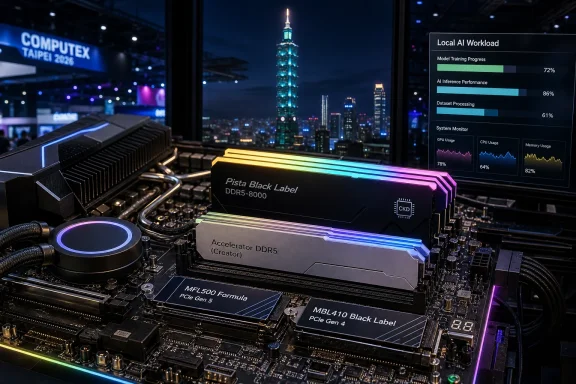
Overclockers PC used Computex 2026 in Taipei to show new OCPC Pista Black Label and Accelerator DDR5 memory families alongside MFL500 Formula PCIe Gen 5 and MBL410 Black Label PCIe Gen 4 M.2 NVMe SSDs for enthusiast, creator, and workstation-adjacent desktops. The announcement is not a platform launch in the AMD-or-Intel sense, but it is a useful snapshot of where the PC component market is drifting. The enthusiast desktop is no longer just chasing the highest number on the box; it is being pulled between RGB spectacle, denser memory configurations, PCIe Gen 5 thermals, and the sudden need to make local workloads feel more “AI-ready” without saying much about software.
The most obvious headline is the Pista Black Label DDR5 kit, advertised at DDR5-8000 speeds and dressed in the now-standard enthusiast uniform: a black or silver heat spreader, a contrasting two-tone finish, and an ARGB diffuser sitting on top like a neon crown. On paper, that puts OCPC in familiar territory. DDR5-8000 is no longer science fiction for modern desktop platforms, but it still lives in the zone where motherboard quality, CPU memory controller luck, BIOS maturity, and user patience matter.
That is why the more interesting part of OCPC’s Computex pitch is not simply the speed bin. It is the company’s hint that the Pista line may evolve toward newer standards such as CUDIMM and higher-rank configurations over the year. In other words, the module on display is both a product and a placeholder for a market transition that memory vendors know is coming.
For years, enthusiast RAM marketing was wonderfully simple: more megatransfers, tighter timings, bigger light bar. DDR5 complicated that story because the move to higher frequencies has exposed the limits of electrical signaling on conventional unbuffered DIMMs. CUDIMM, with its on-module clock driver, is one answer to that problem, and the mere mention of it in an enthusiast product context tells us where the next round of desktop memory branding is headed.
OCPC’s challenge is that this is a crowded race. The company is not alone in discovering that Computex is a good stage for high-speed DDR5, creator kits, and aggressive heatsink design. Larger memory brands have the channel presence and validation lists that conservative system builders tend to trust. Smaller or enthusiast-oriented labels need to compete with design, price, availability, and the credibility of their claimed speed bins.
That does not make products like Pista Black Label irrelevant. It makes them especially dependent on platform context. A kit that behaves well on a premium two-DIMM motherboard may be far less forgiving on a four-slot board filled to capacity. A profile that looks easy in a vendor demo may demand BIOS updates, manual voltage tuning, or a willingness to back down to a slightly lower speed for daily stability.
This is where Windows users and PC builders need to read beyond the headline number. Enthusiast memory performance has diminishing returns in many desktop applications, especially once the system has enough capacity and reasonable latency. Games can respond to memory tuning, certain creator workloads can benefit from bandwidth, and integrated graphics are famously memory-sensitive, but the practical value of DDR5-8000 depends on the full system.
The best version of OCPC’s pitch is not “buy this because 8000 is bigger than 7200.” It is that the company wants a visible place in the premium memory tier while leaving itself room to adopt the standards that could make higher-speed DDR5 less temperamental. That is a defensible strategy, provided the shipping products carry the validation and support that the branding implies.
The company says the Accelerator line will be offered in higher-density kits with mid-to-high DDR5 speeds. That positioning makes sense. A developer running containers, virtual machines, local databases, and browser tabs can punish a 32GB system long before memory bandwidth becomes the limiting factor. A video editor, 3D artist, or AI hobbyist may care more about keeping the whole project in RAM than about shaving a few nanoseconds from a benchmark.
This is also where OCPC’s memory roadmap could become more consequential than the Pista RGB showpiece. Higher-density DDR5 has become increasingly important as desktop workloads blur into workstation territory. The same home system might be used for gaming at night, compiling code in the morning, and running local inference experiments in between.
The awkward part is that “creator memory” can become marketing mush if vendors do not specify exact capacities, ranks, timings, platform validation, and thermal behavior. The phrase sounds premium, but buyers need concrete kit configurations. OCPC has the right category in mind; now it needs to make the line legible to the people who actually buy memory by QVLs, motherboard topology, and return policies.
CUDIMM changes the equation by adding a clock driver to the module. The goal is not magic performance by itself, but cleaner clock distribution and better signal integrity at high speeds. That matters because the enthusiast market is bumping up against the point where raw frequency claims become less believable without new supporting technology.
For WindowsForum readers, the practical question is not whether CUDIMM sounds exciting. It is whether future desktop platforms, motherboards, and BIOS implementations treat it as a mainstream upgrade path or a high-end niche. Early adoption will likely come with the usual caveats: platform support, firmware maturity, price premiums, and a period where compatibility matrices matter more than product photos.
OCPC’s public interest in CUDIMM suggests the company does not want to be stuck selling yesterday’s DDR5 aesthetic while the underlying standard moves forward. That is smart. The enthusiast memory market rewards brands that look current, but it punishes those that ship kits that only behave under perfect conditions.
PCIe Gen 5 SSDs are no longer just halo products chasing 14GB/s screenshots. The category is splitting into tiers. At the top are drives that require serious controllers, heavy cooling, and premium NAND configurations to push the interface hard. Below that is a more pragmatic class of Gen 5 SSDs that still beat most Gen 4 drives on sequential throughput while trying to control cost, heat, and power.
The MFL500 appears to sit in that second class. The reported use of a DRAMless controller reinforces the impression that OCPC is aiming at a more accessible Gen 5 product rather than an uncompromising flagship. DRAMless SSDs can still perform well, especially with modern controllers, host memory buffer support, and good NAND, but they generally need to be judged by more than peak sequential numbers.
That distinction matters because Windows users rarely experience storage as a single sequential read figure. Boot behavior, game loading, project imports, sustained writes, cache exhaustion, thermal throttling, random I/O, and firmware consistency shape the actual experience. A 9.5GB/s Gen 5 SSD can be excellent, but only if its real-world behavior holds up after the SLC cache is full and the drive has been sitting under a GPU in a warm case.
The risk is not that DRAMless drives are automatically bad. The risk is that the badge can conceal very different implementations. A competent DRAMless NVMe drive with a good controller, sensible firmware, and quality NAND may be perfectly fine for gaming and general desktop work. A poor one can collapse under sustained writes, run hot, or deliver erratic latency when the workload gets complicated.
For the MFL500 Formula, the advertised 512GB-to-4TB range raises another issue. Smaller-capacity SSDs often perform differently from larger ones because they have fewer NAND packages or less parallelism. A 4TB model may behave very differently from a 512GB model, even under the same product name. Buyers should wait for model-specific testing before assuming the top-line performance applies evenly across the stack.
This is especially true on Windows 11 systems where DirectStorage, game asset streaming, large creative files, and local AI datasets are all part of the marketing haze around high-speed storage. The SSD is not just a place to put Steam anymore. It is increasingly a working layer for applications that expect fast access to large files, and that makes consistency more important than a single heroic benchmark.
That specification profile lands squarely in the sweet spot of today’s desktop market. PCIe Gen 4 drives are mature, widely supported, easier to cool, and fast enough that many users will never notice the difference between a strong Gen 4 SSD and a midrange Gen 5 SSD in ordinary use. For gaming, office work, development, and most creative workflows, a good Gen 4 drive remains the rational purchase.
The inclusion of DRAM cache is also notable. While DRAM does not automatically make an SSD superior, it can help with mapping tables and performance consistency, especially in heavier workloads. In the context of a Gen 4 drive that already avoids the thermal drama of Gen 5, the MBL410 could be the more balanced product if pricing is competitive.
This is where OCPC’s storage lineup becomes more interesting than a simple “newer is better” ladder. The Gen 5 MFL500 gives the brand a forward-looking product for modern platforms and spec-sheet comparisons. The Gen 4 MBL410 may be the drive that actually fits more Windows desktops, more upgrade budgets, and more thermal envelopes.
DDR5 vendors can talk about high-speed kits for gaming, dense modules for creators, and future standards for platform stability. SSD vendors can talk about PCIe Gen 5 throughput, content pipelines, model storage, scratch disks, and local dataset access. The component itself has not changed as dramatically as the sales story around it.
That does not make the products fake or unimportant. It means buyers have to separate genuine technical direction from show-floor theater. A faster memory kit can matter. A denser kit can matter more. A Gen 5 SSD can be useful. A cooler, cheaper, DRAM-equipped Gen 4 SSD may be a better choice.
OCPC is playing the same game as everyone else at Computex, but from a position that requires sharper execution. Established brands can survive a confusing lineup because retailers, reviewers, and system integrators already know how to categorize them. OCPC needs each product family to explain itself quickly: Pista for speed and style, Accelerator for capacity and serious workloads, MFL500 for entry Gen 5, MBL410 for practical Gen 4 performance.
Memory instability is one of the least enjoyable problems a PC owner can have. It can masquerade as driver trouble, game crashes, file corruption, browser weirdness, or operating-system unreliability. High-speed DDR5 makes validation more important, not less, because a system that passes a quick boot and a few benchmarks may still stumble under long sessions, sleep-resume cycles, or memory-heavy tasks.
Storage has its own version of this problem. An SSD that looks fast in a fresh benchmark can feel very different when nearly full, thermally constrained, or hammered by simultaneous reads and writes. Windows users who run large game libraries, video editing caches, virtual machines, or development environments should care about sustained behavior and firmware quality as much as interface generation.
That is why OCPC’s new products should be judged less by whether the labels sound modern and more by whether reviewers can reproduce the claims across ordinary motherboards and cases. Enthusiasts do not need another component that only shines on an open test bench. They need parts that behave after six months of BIOS updates, driver changes, and accumulated dust.
The company’s lineup acknowledges all four realities. Pista Black Label gives the enthusiast crowd the flashy DDR5-8000 product. Accelerator gives heavier users a capacity-oriented path. MFL500 Formula offers a Gen 5 badge without pretending to be the absolute top of the category. MBL410 Black Label keeps one foot in the Gen 4 mainstream.
The unanswered questions are the ones that matter most. OCPC has not solved the buyer’s need for independent testing, detailed part numbers, controller identification, NAND disclosure, endurance ratings, warranty terms, and motherboard validation. That information will determine whether these products become credible alternatives or simply another set of attractive Computex photos.
This is not a criticism unique to OCPC. The entire component industry has become comfortable launching products with just enough detail to generate coverage and not enough to support a purchase decision. Enthusiasts should enjoy the announcement, but they should not confuse it with a review.
 OCPC Is Selling the New Enthusiast Baseline, Not Just Faster Sticks
The most obvious headline is the Pista Black Label DDR5 kit, advertised at DDR5-8000 speeds and dressed in the now-standard enthusiast uniform: a black or silver heat spreader, a contrasting two-tone finish, and an ARGB diffuser sitting on top like a neon crown. On paper, that puts OCPC in familiar territory. DDR5-8000 is no longer science fiction for modern desktop platforms, but it still lives in the zone where motherboard quality, CPU memory controller luck, BIOS maturity, and user patience matter.That is why the more interesting part of OCPC’s Computex pitch is not simply the speed bin. It is the company’s hint that the Pista line may evolve toward newer standards such as CUDIMM and higher-rank configurations over the year. In other words, the module on display is both a product and a placeholder for a market transition that memory vendors know is coming.
For years, enthusiast RAM marketing was wonderfully simple: more megatransfers, tighter timings, bigger light bar. DDR5 complicated that story because the move to higher frequencies has exposed the limits of electrical signaling on conventional unbuffered DIMMs. CUDIMM, with its on-module clock driver, is one answer to that problem, and the mere mention of it in an enthusiast product context tells us where the next round of desktop memory branding is headed.
OCPC’s challenge is that this is a crowded race. The company is not alone in discovering that Computex is a good stage for high-speed DDR5, creator kits, and aggressive heatsink design. Larger memory brands have the channel presence and validation lists that conservative system builders tend to trust. Smaller or enthusiast-oriented labels need to compete with design, price, availability, and the credibility of their claimed speed bins.
DDR5-8000 Is Impressive, but Compatibility Remains the Real Product
DDR5-8000 sounds clean in a press blurb. In a real Windows desktop, it is messier. High-frequency DDR5 is often less a plug-and-play guarantee than a negotiation between the DIMM, motherboard firmware, CPU memory controller, and user expectations.That does not make products like Pista Black Label irrelevant. It makes them especially dependent on platform context. A kit that behaves well on a premium two-DIMM motherboard may be far less forgiving on a four-slot board filled to capacity. A profile that looks easy in a vendor demo may demand BIOS updates, manual voltage tuning, or a willingness to back down to a slightly lower speed for daily stability.
This is where Windows users and PC builders need to read beyond the headline number. Enthusiast memory performance has diminishing returns in many desktop applications, especially once the system has enough capacity and reasonable latency. Games can respond to memory tuning, certain creator workloads can benefit from bandwidth, and integrated graphics are famously memory-sensitive, but the practical value of DDR5-8000 depends on the full system.
The best version of OCPC’s pitch is not “buy this because 8000 is bigger than 7200.” It is that the company wants a visible place in the premium memory tier while leaving itself room to adopt the standards that could make higher-speed DDR5 less temperamental. That is a defensible strategy, provided the shipping products carry the validation and support that the branding implies.
The Accelerator Line Tells Us Creators Are the New Safe Bet
OCPC’s second memory family, Accelerator, is aimed at creators and developers rather than the pure overclocking crowd. That sounds like a small segmentation choice, but it reflects a much bigger shift in how component companies now talk about desktop PCs. The “creator” label has become the industry’s polite way of saying that capacity, stability, and sustained throughput matter as much as benchmark bragging rights.The company says the Accelerator line will be offered in higher-density kits with mid-to-high DDR5 speeds. That positioning makes sense. A developer running containers, virtual machines, local databases, and browser tabs can punish a 32GB system long before memory bandwidth becomes the limiting factor. A video editor, 3D artist, or AI hobbyist may care more about keeping the whole project in RAM than about shaving a few nanoseconds from a benchmark.
This is also where OCPC’s memory roadmap could become more consequential than the Pista RGB showpiece. Higher-density DDR5 has become increasingly important as desktop workloads blur into workstation territory. The same home system might be used for gaming at night, compiling code in the morning, and running local inference experiments in between.
The awkward part is that “creator memory” can become marketing mush if vendors do not specify exact capacities, ranks, timings, platform validation, and thermal behavior. The phrase sounds premium, but buyers need concrete kit configurations. OCPC has the right category in mind; now it needs to make the line legible to the people who actually buy memory by QVLs, motherboard topology, and return policies.
CUDIMM Is the Quiet Signal Behind the RGB
The mention of CUDIMM may be the most important forward-looking detail in the whole Computex showcase. Conventional unbuffered DDR5 DIMMs rely on the motherboard and CPU memory controller to maintain clean signaling at very high data rates. As speeds climb, that gets harder, especially in consumer systems that must remain affordable and physically compatible with existing desktop layouts.CUDIMM changes the equation by adding a clock driver to the module. The goal is not magic performance by itself, but cleaner clock distribution and better signal integrity at high speeds. That matters because the enthusiast market is bumping up against the point where raw frequency claims become less believable without new supporting technology.
For WindowsForum readers, the practical question is not whether CUDIMM sounds exciting. It is whether future desktop platforms, motherboards, and BIOS implementations treat it as a mainstream upgrade path or a high-end niche. Early adoption will likely come with the usual caveats: platform support, firmware maturity, price premiums, and a period where compatibility matrices matter more than product photos.
OCPC’s public interest in CUDIMM suggests the company does not want to be stuck selling yesterday’s DDR5 aesthetic while the underlying standard moves forward. That is smart. The enthusiast memory market rewards brands that look current, but it punishes those that ship kits that only behave under perfect conditions.
PCIe Gen 5 Storage Is Moving Down the Performance Stack
The MFL500 Formula is OCPC’s new PCIe Gen 5 M.2 NVMe SSD, offered in capacities from 512GB to 4TB with claimed sequential reads up to 9.5GB/s and sequential writes up to 8.5GB/s. Those are fast numbers in absolute terms, but they are not the most aggressive Gen 5 figures the market has seen. That is the point.PCIe Gen 5 SSDs are no longer just halo products chasing 14GB/s screenshots. The category is splitting into tiers. At the top are drives that require serious controllers, heavy cooling, and premium NAND configurations to push the interface hard. Below that is a more pragmatic class of Gen 5 SSDs that still beat most Gen 4 drives on sequential throughput while trying to control cost, heat, and power.
The MFL500 appears to sit in that second class. The reported use of a DRAMless controller reinforces the impression that OCPC is aiming at a more accessible Gen 5 product rather than an uncompromising flagship. DRAMless SSDs can still perform well, especially with modern controllers, host memory buffer support, and good NAND, but they generally need to be judged by more than peak sequential numbers.
That distinction matters because Windows users rarely experience storage as a single sequential read figure. Boot behavior, game loading, project imports, sustained writes, cache exhaustion, thermal throttling, random I/O, and firmware consistency shape the actual experience. A 9.5GB/s Gen 5 SSD can be excellent, but only if its real-world behavior holds up after the SLC cache is full and the drive has been sitting under a GPU in a warm case.
DRAMless Gen 5 Is a Compromise, Not an Insult
There is a tendency in enthusiast circles to treat “DRAMless” as a dirty word. That is too simplistic. DRAMless SSDs exist because controller design, NAND management, and operating-system support have improved enough to make them viable for many users. They also exist because the market wants cheaper drives with big numbers on the front of the box.The risk is not that DRAMless drives are automatically bad. The risk is that the badge can conceal very different implementations. A competent DRAMless NVMe drive with a good controller, sensible firmware, and quality NAND may be perfectly fine for gaming and general desktop work. A poor one can collapse under sustained writes, run hot, or deliver erratic latency when the workload gets complicated.
For the MFL500 Formula, the advertised 512GB-to-4TB range raises another issue. Smaller-capacity SSDs often perform differently from larger ones because they have fewer NAND packages or less parallelism. A 4TB model may behave very differently from a 512GB model, even under the same product name. Buyers should wait for model-specific testing before assuming the top-line performance applies evenly across the stack.
This is especially true on Windows 11 systems where DirectStorage, game asset streaming, large creative files, and local AI datasets are all part of the marketing haze around high-speed storage. The SSD is not just a place to put Steam anymore. It is increasingly a working layer for applications that expect fast access to large files, and that makes consistency more important than a single heroic benchmark.
Gen 4 Still Owns the Sensible Middle
The MBL410 Black Label line may be the more important SSD for most buyers. It is a PCIe Gen 4 M.2 NVMe family offered in 1TB, 2TB, and 4TB capacities, with claimed sequential reads up to 7GB/s and sequential writes up to 6GB/s. Unlike the MFL500, it reportedly uses a controller with DRAM cache.That specification profile lands squarely in the sweet spot of today’s desktop market. PCIe Gen 4 drives are mature, widely supported, easier to cool, and fast enough that many users will never notice the difference between a strong Gen 4 SSD and a midrange Gen 5 SSD in ordinary use. For gaming, office work, development, and most creative workflows, a good Gen 4 drive remains the rational purchase.
The inclusion of DRAM cache is also notable. While DRAM does not automatically make an SSD superior, it can help with mapping tables and performance consistency, especially in heavier workloads. In the context of a Gen 4 drive that already avoids the thermal drama of Gen 5, the MBL410 could be the more balanced product if pricing is competitive.
This is where OCPC’s storage lineup becomes more interesting than a simple “newer is better” ladder. The Gen 5 MFL500 gives the brand a forward-looking product for modern platforms and spec-sheet comparisons. The Gen 4 MBL410 may be the drive that actually fits more Windows desktops, more upgrade budgets, and more thermal envelopes.
Computex Is Now a Memory-and-Storage Arms Bazaar
OCPC’s announcement sits inside a broader Computex pattern: memory and storage vendors are trying to reframe familiar components for a market obsessed with AI PCs, creator workloads, and high-bandwidth local computing. The irony is that RAM and SSDs were already central to system responsiveness long before anyone put “AI” on a keynote slide. What has changed is the industry’s need to make every component sound strategically relevant again.DDR5 vendors can talk about high-speed kits for gaming, dense modules for creators, and future standards for platform stability. SSD vendors can talk about PCIe Gen 5 throughput, content pipelines, model storage, scratch disks, and local dataset access. The component itself has not changed as dramatically as the sales story around it.
That does not make the products fake or unimportant. It means buyers have to separate genuine technical direction from show-floor theater. A faster memory kit can matter. A denser kit can matter more. A Gen 5 SSD can be useful. A cooler, cheaper, DRAM-equipped Gen 4 SSD may be a better choice.
OCPC is playing the same game as everyone else at Computex, but from a position that requires sharper execution. Established brands can survive a confusing lineup because retailers, reviewers, and system integrators already know how to categorize them. OCPC needs each product family to explain itself quickly: Pista for speed and style, Accelerator for capacity and serious workloads, MFL500 for entry Gen 5, MBL410 for practical Gen 4 performance.
The Windows Angle Is Stability, Not Spectacle
For Windows enthusiasts, the obvious temptation is to treat this as another round of component candy. More RGB, more DDR5 speed, more SSD bandwidth. But the Windows experience is usually governed less by peak specs than by stability under mixed workloads.Memory instability is one of the least enjoyable problems a PC owner can have. It can masquerade as driver trouble, game crashes, file corruption, browser weirdness, or operating-system unreliability. High-speed DDR5 makes validation more important, not less, because a system that passes a quick boot and a few benchmarks may still stumble under long sessions, sleep-resume cycles, or memory-heavy tasks.
Storage has its own version of this problem. An SSD that looks fast in a fresh benchmark can feel very different when nearly full, thermally constrained, or hammered by simultaneous reads and writes. Windows users who run large game libraries, video editing caches, virtual machines, or development environments should care about sustained behavior and firmware quality as much as interface generation.
That is why OCPC’s new products should be judged less by whether the labels sound modern and more by whether reviewers can reproduce the claims across ordinary motherboards and cases. Enthusiasts do not need another component that only shines on an open test bench. They need parts that behave after six months of BIOS updates, driver changes, and accumulated dust.
The Smart Buyer Reads the Roadmap and Waits for Receipts
OCPC’s Computex showcase is promising because it maps neatly onto the actual pressures in the desktop market. Memory needs to get faster without becoming a compatibility lottery. Creator systems need more capacity without workstation pricing. PCIe Gen 5 storage needs to become less hot, less expensive, and less exotic. PCIe Gen 4 still needs to serve the enormous installed base that is not rebuilding every year.The company’s lineup acknowledges all four realities. Pista Black Label gives the enthusiast crowd the flashy DDR5-8000 product. Accelerator gives heavier users a capacity-oriented path. MFL500 Formula offers a Gen 5 badge without pretending to be the absolute top of the category. MBL410 Black Label keeps one foot in the Gen 4 mainstream.
The unanswered questions are the ones that matter most. OCPC has not solved the buyer’s need for independent testing, detailed part numbers, controller identification, NAND disclosure, endurance ratings, warranty terms, and motherboard validation. That information will determine whether these products become credible alternatives or simply another set of attractive Computex photos.
This is not a criticism unique to OCPC. The entire component industry has become comfortable launching products with just enough detail to generate coverage and not enough to support a purchase decision. Enthusiasts should enjoy the announcement, but they should not confuse it with a review.
OCPC’s Computex Bet Comes Down to Four Buying Decisions
The useful way to read OCPC’s showcase is not as a single announcement, but as a menu of upgrade paths aimed at different kinds of Windows PCs. Each product family points toward a real need, but each also carries a caveat that buyers should keep in mind.- Pista Black Label is the showpiece for users who want high-speed DDR5 and visible styling, but DDR5-8000 should be treated as platform-dependent until independent validation proves otherwise.
- Accelerator memory is the more practical signal for developers and creators, because higher-capacity DDR5 kits can matter more than chasing the highest frequency.
- The MFL500 Formula brings PCIe Gen 5 storage into a more moderate performance tier, but its apparent DRAMless design makes real-world testing especially important.
- The MBL410 Black Label may be the better fit for many systems, because a strong PCIe Gen 4 SSD with DRAM cache remains fast, mature, and easier to cool.
- OCPC’s interest in CUDIMM suggests that today’s DDR5 products are part of a transition, not the end state of enthusiast memory.
References
- Primary source: TechPowerUp
Published: 2026-06-02T11:10:16.163551
OCPC Showcases Pista and Accelerator DDR5 Memory, New Gen 5 and Gen 4 M.2 NVMe SSDs | TechPowerUp
Overclockers PC (OCPC), showcased its latest enthusiast-segment memory and storage products at Computex 2026. The star of the show is the new Pista Black Label line of enthusiast-segment DDR5 PC memory, which comes in speeds of DDR5-8000 and features a 2-tone silver or black heat-spreader design...www.techpowerup.com - Related coverage: tomshardware.com
Intel details long-awaited Crescent Island AI GPU at Computex, boasts up to 480 GB of LPDDR5X to combat memory shortages — company shares more details of its Xe3P inference accelerator at Computex | Tom's Hardware
Unusual memory choice brings lots of AI data closer to the chip for efficiencywww.tomshardware.com - Related coverage: marketscreener.com
Micron Technology Showcases Full Portfolio of AI-Optimized Memory and Storage Solutions At COMPUTEX 2026
Micron Technology showcased its full portfolio of AI-optimized memory and storage solutions during COMPUTEX 2026, empowering next-generation AI data center and intelligent edge applications. Micron's...www.marketscreener.com
