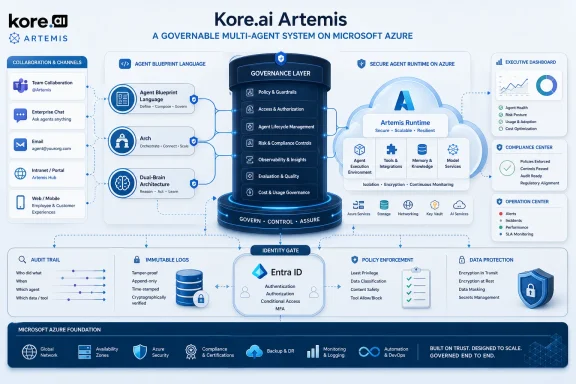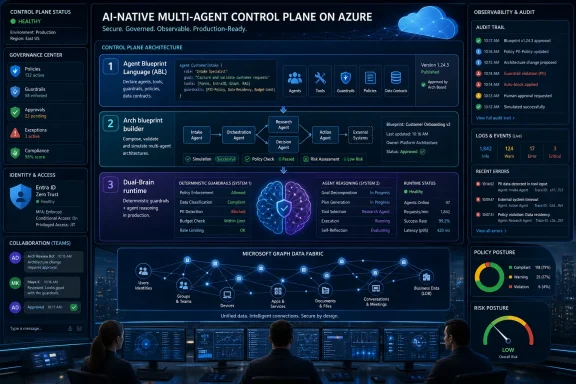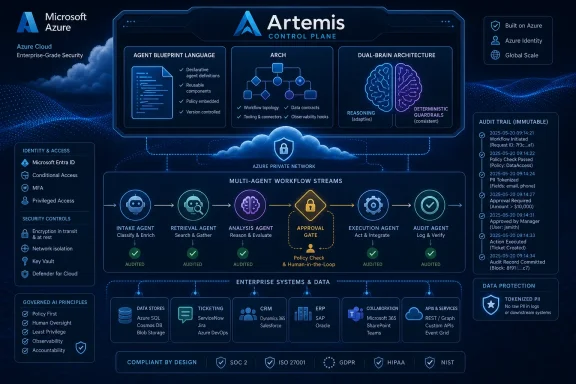
Kore.ai launched the Artemis edition of its Agent Platform on May 21, 2026, initially on Microsoft Azure, positioning it as an enterprise system for building, governing, and optimizing multi-agent AI workflows before they enter production. The announcement is not just another vendor adding “agentic” to the product sheet. Kore.ai is arguing that the next phase of enterprise AI will be won less by the cleverest chatbot and more by the platform that can make agents boring, inspectable, repeatable, and accountable. That is a useful provocation for CIOs and Windows-centric IT shops now being asked to turn experiments into systems of record.
The most important word in the Artemis announcement is not “agent.” It is compiled.
That choice matters because the enterprise AI market has spent the last eighteen months behaving as if prompt engineering, connector catalogs, and a few policy dashboards would somehow become an operating model. Kore.ai’s pitch is that this is insufficient. If agents are going to touch regulated workflows, customer records, money movement, HR decisions, support escalations, or production systems, they need something closer to software engineering discipline than a conversational interface with permissions.
Artemis tries to formalize that discipline around three ideas: Agent Blueprint Language, Arch, and a dual-brain architecture. Together, they form Kore.ai’s answer to the question many enterprise buyers are quietly asking after the first wave of AI pilots: how do we make these systems manageable after the demo ends?
That is the right question. The first enterprise AI wave was about access to foundation models. The second was about embedding those models into existing products. The third is about operating AI systems that can act, coordinate, recover, and explain themselves without turning every business process into a compliance gamble.
Kore.ai is hardly alone in seeing that shift. Microsoft, Salesforce, ServiceNow, Google, Workday, and a long list of startups are all racing to define the control plane for agents. Artemis is Kore.ai’s claim that agent governance has to be architectural rather than decorative.
This is a notable correction to the prompt-first culture that has surrounded generative AI. Prompts are easy to write and hard to govern. They mix intent, policy, examples, fallbacks, and hidden assumptions in ways that are often opaque even to the teams that authored them. A compiled blueprint, by contrast, promises a stable representation of what the agent is supposed to do before the model starts improvising.
The point is not that ABL magically eliminates unpredictability. No language can turn probabilistic model behavior into deterministic software by declaration alone. The more credible claim is that a language layer can narrow the blast radius by separating the shape of the system from the model calls inside it.
That distinction will resonate with IT administrators who have lived through every previous platform abstraction. Group Policy did not make Windows fleets simple, but it made them governable. Infrastructure as code did not eliminate cloud misconfiguration, but it gave teams reviewable state. ABL is Kore.ai’s attempt to bring a similar concept to multi-agent AI.
The six orchestration patterns Kore.ai names — supervisor, delegation, handoff, fan-out, escalation, and agent-to-agent federation — also suggest a pragmatic view of enterprise automation. Real business processes are not single-turn chats. They are messy chains of routing, retries, approvals, exception handling, and cross-system context. If ABL can make those patterns explicit, it gives architects something more durable than a whiteboard diagram and a pile of prompts.
This is the most ambitious part of Artemis, and also the one that deserves the most skepticism. “AI building AI” is a seductive phrase because it compresses cost, speed, and scale into one promise. It is also where enterprise buyers should slow down and ask what counts as production-ready, who approves generated blueprints, how regressions are detected, and whether optimization recommendations can be traced back to measurable business outcomes.
Still, the strategic logic is clear. If every department wants agents, no central engineering group can handcraft each one from scratch. The shortage is not only model expertise; it is process translation. Enterprises have endless business requirements trapped in documents, workshops, tickets, call recordings, SOPs, compliance manuals, and tribal knowledge. A tool that can turn those requirements into reviewable agent blueprints would be valuable even if it still requires human approval.
Arch also fits a broader vendor movement away from low-code toward AI-programmable systems. Low-code platforms asked business users to assemble workflows through visual components. AI-programmable platforms promise to infer the workflow from the business goal, then generate the implementation. That is a different bargain. It reduces the cost of creation, but it raises the importance of inspection.
For CIOs, the operational question is whether Arch becomes a productivity multiplier or a source of uncontrolled agent sprawl. Kore.ai’s answer is that ABL and runtime governance prevent the latter. The market will decide whether that claim holds under the weight of real enterprise complexity.
Large language models are useful because they can interpret ambiguous instructions, summarize context, generate plans, and interact naturally with users. They are risky for the same reason. They may generalize beyond approved procedure, over-trust context, or produce plausible but wrong steps. Deterministic workflows are less flexible, but they are predictable, auditable, and easier to certify.
Kore.ai’s architecture effectively says both are needed. Let the model reason, but do not let reasoning become the only control surface. Keep deterministic constraints and flow controls outside the model’s discretion. Maintain shared memory, but govern execution through a runtime that can log, enforce, and trace.
That framing is more mature than the common fantasy of fully autonomous digital workers roaming across enterprise systems. In regulated environments, the winning AI architecture is unlikely to be the one that maximizes autonomy. It will be the one that can prove when autonomy was permitted, when it was blocked, and why.
The risk, of course, is complexity. Two engines, shared memory, compiled blueprints, orchestration patterns, governance layers, and model independence are a lot for customers to understand and validate. Enterprise platforms often begin by promising simplification and end by creating a new priesthood. Kore.ai will need tooling, documentation, and operational clarity to keep Artemis from becoming yet another sophisticated system only specialists can safely run.
The Microsoft integrations named in the announcement are not incidental. Entra ID supplies identity. Microsoft Graph connects to the fabric of work. Teams provides a familiar channel. Azure Bot Framework supports conversational delivery. Microsoft Foundry and Agent 365 place Artemis near Microsoft’s own agent-building and agent-management ambitions.
That proximity is both an opportunity and a strategic tension. Kore.ai benefits from Microsoft’s enterprise credibility, procurement reach, and security posture. But Microsoft is not merely a cloud landlord in this market. It is building its own agent stack, its own development frameworks, its own management layers, and its own Copilot-centered user experience.
For WindowsForum readers, this is the part worth watching closely. The Microsoft ecosystem is becoming the default theater for enterprise agents, especially in organizations standardized on Microsoft 365, Teams, Entra, and Azure. Third-party platforms like Kore.ai can succeed there, but only if they complement Microsoft’s control plane rather than collide with it.
The mention of Agent 365 is especially telling. Microsoft has been moving toward a world where agents are not just apps but managed identities and governed participants in the workplace. Kore.ai’s Artemis pitch lines up with that direction: agents need lifecycle management, observability, identity, permissions, and auditability. The unresolved question is who owns the final pane of glass.
But the initial Azure launch complicates the neutrality story. An Azure-first platform can still be model-independent, but its first audience will naturally be Microsoft-standardized enterprises. Its early integrations, reference architectures, sales motions, and operational assumptions will likely reflect that world.
That is not necessarily a flaw. In fact, it may be the only realistic way to enter the enterprise agent market at scale. Buyers do not want abstract neutrality if it arrives as integration burden. They want a platform that works with the identity systems, collaboration tools, logging pipelines, and security controls they already use.
The deeper issue is whether Kore.ai can preserve portability while taking advantage of Microsoft-native services. If ABL blueprints remain stable across models and deployment environments, Azure-first becomes a go-to-market sequence rather than a lock-in trap. If core operational value depends heavily on Microsoft-specific primitives, then Artemis becomes part of the Azure gravity well no matter how model-independent the language appears.
This is not a criticism unique to Kore.ai. Every enterprise AI vendor is wrestling with the same tradeoff. The closer a product sits to a hyperscaler’s identity, compute, data, and security stack, the easier it is to adopt and the harder it may be to leave.
Enterprise IT needs more than documentation. It needs runtime enforcement. It needs policy controls that are not optional suggestions to a model. It needs the ability to prevent an agent from taking certain actions, to escalate exceptions, to require human approval, and to tie each decision to a policy or regulatory control.
Kore.ai’s language about deterministic constraints living outside the model is therefore important. It recognizes that a model should not be the final authority on its own permissions. That aligns with a basic security principle administrators already understand: do not let the workload define its own trust boundary.
The challenge is implementation depth. Logging every action is useful, but only if the logs are structured, searchable, and mapped to the questions auditors actually ask. Traceability is valuable, but only if it survives complex multi-agent handoffs. Policy enforcement is credible only if customers can test it, version it, and prove that a change in one agent does not silently alter behavior elsewhere.
This is where Kore.ai’s long history in conversational AI may help. The company has spent years selling into regulated service environments where call flows, escalation paths, records, and compliance constraints matter. Artemis is an attempt to generalize that experience from conversational automation into enterprise-wide agent orchestration.
If Artemis works as advertised, it changes the operating model for enterprise AI development. Teams would not simply build agents; they would define objectives, generate blueprints, review compiled artifacts, enforce policies, observe traces, and iterate based on production signals. That is closer to a platform engineering model than a chatbot-building exercise.
This matters because AI demand inside large organizations is becoming horizontal. HR wants agents. Finance wants agents. Contact centers want agents. Software teams want agents. Legal, procurement, facilities, sales operations, and security teams all have their own automation wish lists. Without a shared foundation, each group will pick its own framework, model, connector set, and governance workaround.
Kore.ai is pitching Artemis as that shared foundation. For a CIO, the appeal is consolidation: fewer one-off bots, fewer unmanaged integrations, and fewer bespoke engineering efforts. For business units, the appeal is faster delivery. The tension between those two goals will define adoption.
Central platforms can become bottlenecks if governance turns into bureaucracy. They can also become dangerous if they prioritize speed over review. Artemis will need to prove it can support federated development without surrendering central control.
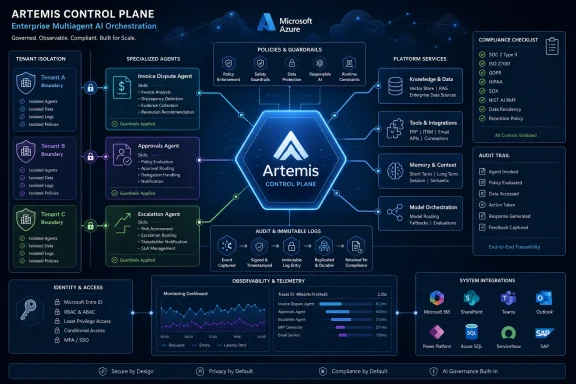
Kore.ai’s security and compliance claims are extensive: SOC 2 Type II, ISO 27001, PCI DSS, FedRAMP Moderate authorization, HIPAA alignment, HITRUST and GDPR compliance, along with real-time PII tokenization, tenant isolation, immutable audit trails, and deployment options that include public cloud, sovereign regions, private cloud, and on-premises. That checklist is designed for regulated buyers, and it is necessary table stakes.
But certifications and deployment options do not answer every security question raised by agentic systems. Agents differ from conventional SaaS workflows because they can interpret instructions, select tools, chain actions, and operate across systems. That creates new failure modes around prompt injection, excessive privileges, compromised context, unsafe delegation, and confused-deputy behavior between agents.
The dual-brain architecture and runtime governance are clearly meant to address these risks. If deterministic controls truly constrain what agents can do, the platform has a stronger security story than tools that rely primarily on model alignment and post-hoc monitoring. But CISOs will want evidence under adversarial conditions, not just architectural diagrams.
They will also want to understand how Artemis handles identity at the agent level. In a Microsoft environment, that means mapping agent actions to Entra identities, service principals, delegated permissions, user context, and audit logs in a way that security operations teams can actually investigate. “The agent did it” cannot become an acceptable explanation.
That is the right financial story for a platform vendor. Enterprises do not want hundreds of disconnected AI projects with separate maintenance costs and unclear ROI. They want reusable infrastructure, measurable outcomes, and marginal economics that improve with scale.
Still, CFOs should distinguish between lower build cost and lower total cost. Agent platforms introduce new expenses: licensing, integration work, data preparation, governance staffing, security review, observability tooling, change management, and ongoing optimization. Compressing initial development from months to days is valuable, but production systems spend most of their lives in maintenance.
The more interesting financial question is whether Artemis can make agent performance measurable enough to survive budget scrutiny. If production traces can connect agent behavior to resolution time, deflection rate, employee productivity, error reduction, revenue protection, or compliance cost avoidance, the platform becomes easier to defend. If the metrics remain vague, agent sprawl will look like cloud sprawl with a better demo.
CFOs should also care about model independence. If a platform allows the enterprise to move workloads across models based on cost, latency, quality, and risk, it gives procurement leverage. If the platform’s practical value is tied to a narrow model or cloud dependency, the economics may look different after the first contract cycle.
Kore.ai’s differentiation is not that it has agents. Everyone has agents. Its differentiation is the assertion that agents require a compiled blueprint language, an AI architect, and a runtime that separates reasoning from deterministic control.
That is a sharper claim than generic productivity marketing. It also gives buyers a way to evaluate the company. If ABL becomes a practical standard inside customer environments, Kore.ai has a defensible wedge. If customers see it as proprietary overhead, the platform risks being compared feature-for-feature against larger vendors with deeper installed bases.
The company’s existing footprint matters here. Kore.ai says it supports more than 500 Global 2000 organizations and has long experience in banking, healthcare, insurance, retail, and service operations. That is not the same as owning the next generation of agent infrastructure, but it gives the company credibility in environments where reliability and compliance are not optional.
The enterprise AI market will not be decided by who coins the best term for agents. It will be decided by who survives procurement, security review, integration complexity, business-unit impatience, and the second year of operations. Kore.ai is positioning Artemis for that less glamorous contest.
Most Windows-heavy organizations are also Microsoft 365, Entra ID, Teams, Intune, Defender, Purview, and Azure customers to varying degrees. Agents that operate in those environments will need to respect identity boundaries, data classifications, conditional access rules, audit expectations, and collaboration workflows. An Azure-first agent platform is therefore part of the same administrative universe, even if end users encounter it as a Teams bot or business-process assistant.
The practical impact could show up in mundane places. A support agent might triage tickets across Teams, Jira, and Microsoft 365. A finance agent might gather approvals while respecting access rules. An HR agent might answer employee questions while redacting sensitive information. An IT operations agent might coordinate incident response without being allowed to make unauthorized production changes.
Those examples are less flashy than autonomous AI demos, but they are where enterprise value usually lives. The question is whether Artemis can make such agents reliable enough that administrators stop treating them as experiments and start treating them as managed services.
If that happens, Windows and Microsoft administrators will inherit new responsibilities. They will need to understand agent identities, agent permissions, agent logs, agent lifecycle policies, and agent incident response. The agent platform may sit above the OS, but its consequences will land squarely in the admin stack.
But the proof will be in deployment. Production-ready means agents can be tested before launch, monitored after launch, rolled back after failure, patched after model changes, and audited after an incident. It means administrators can answer not just what the agent said, but what it did, which systems it touched, which policy allowed the action, and which human approved the exception.
It also means the platform can handle organizational mess. Enterprises have inconsistent data, legacy applications, undocumented workflows, conflicting policies, and political boundaries between teams. A clean agent blueprint is only as useful as its ability to survive dirty reality.
Kore.ai’s emphasis on production traces is promising because it acknowledges that agents will need continuous improvement. But optimization is a governance problem too. If AI recommends changes to an agent based on observed behavior, those recommendations need review, testing, versioning, and accountability. Otherwise, “AI optimizing AI” becomes a polite phrase for systems drifting in production.
The strongest version of Artemis is a platform where AI accelerates design and improvement while humans retain meaningful control over policy and release. The weakest version is a platform where AI-generated blueprints create a false sense of rigor. Enterprise buyers should evaluate which version they are getting.
Kore.ai Is Selling Discipline, Not Just Agents
The most important word in the Artemis announcement is not “agent.” It is compiled.That choice matters because the enterprise AI market has spent the last eighteen months behaving as if prompt engineering, connector catalogs, and a few policy dashboards would somehow become an operating model. Kore.ai’s pitch is that this is insufficient. If agents are going to touch regulated workflows, customer records, money movement, HR decisions, support escalations, or production systems, they need something closer to software engineering discipline than a conversational interface with permissions.
Artemis tries to formalize that discipline around three ideas: Agent Blueprint Language, Arch, and a dual-brain architecture. Together, they form Kore.ai’s answer to the question many enterprise buyers are quietly asking after the first wave of AI pilots: how do we make these systems manageable after the demo ends?
That is the right question. The first enterprise AI wave was about access to foundation models. The second was about embedding those models into existing products. The third is about operating AI systems that can act, coordinate, recover, and explain themselves without turning every business process into a compliance gamble.
Kore.ai is hardly alone in seeing that shift. Microsoft, Salesforce, ServiceNow, Google, Workday, and a long list of startups are all racing to define the control plane for agents. Artemis is Kore.ai’s claim that agent governance has to be architectural rather than decorative.
Agent Blueprint Language Is a Bet That AI Needs Source Code Again
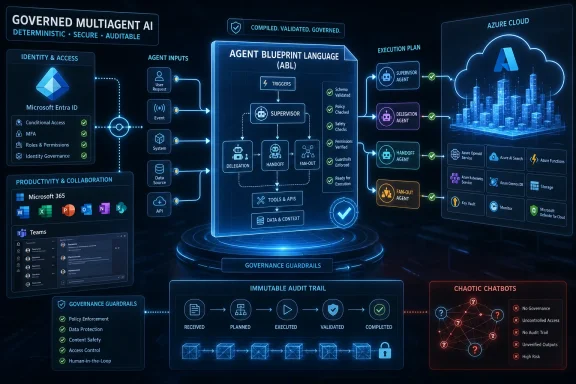
Agent Blueprint Language, or ABL, is the center of gravity in the Artemis launch. Kore.ai describes it as a compiled, declarative language for defining, validating, and governing agents, systems, and workflows. That may sound like vendor abstraction, but the idea underneath is straightforward: if an AI system is going to be deployed like enterprise software, it needs an artifact that can be reviewed like enterprise software.This is a notable correction to the prompt-first culture that has surrounded generative AI. Prompts are easy to write and hard to govern. They mix intent, policy, examples, fallbacks, and hidden assumptions in ways that are often opaque even to the teams that authored them. A compiled blueprint, by contrast, promises a stable representation of what the agent is supposed to do before the model starts improvising.
The point is not that ABL magically eliminates unpredictability. No language can turn probabilistic model behavior into deterministic software by declaration alone. The more credible claim is that a language layer can narrow the blast radius by separating the shape of the system from the model calls inside it.
That distinction will resonate with IT administrators who have lived through every previous platform abstraction. Group Policy did not make Windows fleets simple, but it made them governable. Infrastructure as code did not eliminate cloud misconfiguration, but it gave teams reviewable state. ABL is Kore.ai’s attempt to bring a similar concept to multi-agent AI.
The six orchestration patterns Kore.ai names — supervisor, delegation, handoff, fan-out, escalation, and agent-to-agent federation — also suggest a pragmatic view of enterprise automation. Real business processes are not single-turn chats. They are messy chains of routing, retries, approvals, exception handling, and cross-system context. If ABL can make those patterns explicit, it gives architects something more durable than a whiteboard diagram and a pile of prompts.
Arch Makes the Platform Its Own Developer
The second pillar, Arch, is Kore.ai’s AI agent architect. It is supposed to translate business objectives into production-ready ABL, design the underlying agent topology, support the agent lifecycle, and continuously refine agents using production traces.This is the most ambitious part of Artemis, and also the one that deserves the most skepticism. “AI building AI” is a seductive phrase because it compresses cost, speed, and scale into one promise. It is also where enterprise buyers should slow down and ask what counts as production-ready, who approves generated blueprints, how regressions are detected, and whether optimization recommendations can be traced back to measurable business outcomes.
Still, the strategic logic is clear. If every department wants agents, no central engineering group can handcraft each one from scratch. The shortage is not only model expertise; it is process translation. Enterprises have endless business requirements trapped in documents, workshops, tickets, call recordings, SOPs, compliance manuals, and tribal knowledge. A tool that can turn those requirements into reviewable agent blueprints would be valuable even if it still requires human approval.
Arch also fits a broader vendor movement away from low-code toward AI-programmable systems. Low-code platforms asked business users to assemble workflows through visual components. AI-programmable platforms promise to infer the workflow from the business goal, then generate the implementation. That is a different bargain. It reduces the cost of creation, but it raises the importance of inspection.
For CIOs, the operational question is whether Arch becomes a productivity multiplier or a source of uncontrolled agent sprawl. Kore.ai’s answer is that ABL and runtime governance prevent the latter. The market will decide whether that claim holds under the weight of real enterprise complexity.
The Dual-Brain Design Admits That Reasoning Is Not Control
The third major architectural claim is Kore.ai’s dual-brain model: one cognitive engine for agentic reasoning, another for deterministic flows, operating in parallel through shared memory and governed by a single runtime. This is the part of the announcement that most directly addresses the anxiety behind enterprise agent adoption.Large language models are useful because they can interpret ambiguous instructions, summarize context, generate plans, and interact naturally with users. They are risky for the same reason. They may generalize beyond approved procedure, over-trust context, or produce plausible but wrong steps. Deterministic workflows are less flexible, but they are predictable, auditable, and easier to certify.
Kore.ai’s architecture effectively says both are needed. Let the model reason, but do not let reasoning become the only control surface. Keep deterministic constraints and flow controls outside the model’s discretion. Maintain shared memory, but govern execution through a runtime that can log, enforce, and trace.
That framing is more mature than the common fantasy of fully autonomous digital workers roaming across enterprise systems. In regulated environments, the winning AI architecture is unlikely to be the one that maximizes autonomy. It will be the one that can prove when autonomy was permitted, when it was blocked, and why.
The risk, of course, is complexity. Two engines, shared memory, compiled blueprints, orchestration patterns, governance layers, and model independence are a lot for customers to understand and validate. Enterprise platforms often begin by promising simplification and end by creating a new priesthood. Kore.ai will need tooling, documentation, and operational clarity to keep Artemis from becoming yet another sophisticated system only specialists can safely run.
Azure Gives Artemis a Familiar Door Into the Enterprise
Kore.ai’s decision to launch Artemis first on Microsoft Azure is commercially obvious and technically consequential. For many Global 2000 customers, Azure is already where identity, security policy, data governance, collaboration, and application modernization efforts converge. If agent platforms are going to be accepted by enterprise IT, they need to show up where enterprise IT already governs.The Microsoft integrations named in the announcement are not incidental. Entra ID supplies identity. Microsoft Graph connects to the fabric of work. Teams provides a familiar channel. Azure Bot Framework supports conversational delivery. Microsoft Foundry and Agent 365 place Artemis near Microsoft’s own agent-building and agent-management ambitions.
That proximity is both an opportunity and a strategic tension. Kore.ai benefits from Microsoft’s enterprise credibility, procurement reach, and security posture. But Microsoft is not merely a cloud landlord in this market. It is building its own agent stack, its own development frameworks, its own management layers, and its own Copilot-centered user experience.
For WindowsForum readers, this is the part worth watching closely. The Microsoft ecosystem is becoming the default theater for enterprise agents, especially in organizations standardized on Microsoft 365, Teams, Entra, and Azure. Third-party platforms like Kore.ai can succeed there, but only if they complement Microsoft’s control plane rather than collide with it.
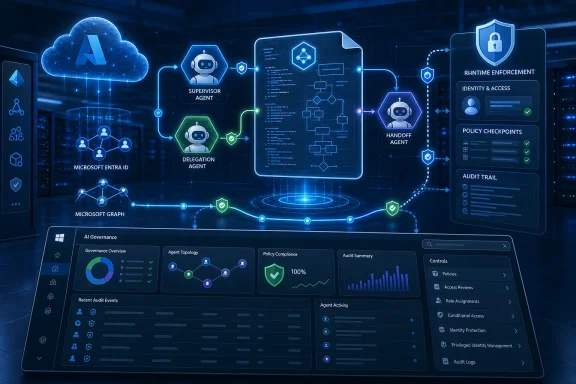
The mention of Agent 365 is especially telling. Microsoft has been moving toward a world where agents are not just apps but managed identities and governed participants in the workplace. Kore.ai’s Artemis pitch lines up with that direction: agents need lifecycle management, observability, identity, permissions, and auditability. The unresolved question is who owns the final pane of glass.
The Platform-Neutral Claim Will Be Tested by the Azure-First Reality
Kore.ai says Artemis is model-independent, which is a critical claim in an enterprise market wary of lock-in. Model independence means customers should be able to switch or combine models without rebuilding the entire agent estate. In theory, this protects investments as foundation models improve, pricing changes, and regulatory requirements evolve.But the initial Azure launch complicates the neutrality story. An Azure-first platform can still be model-independent, but its first audience will naturally be Microsoft-standardized enterprises. Its early integrations, reference architectures, sales motions, and operational assumptions will likely reflect that world.
That is not necessarily a flaw. In fact, it may be the only realistic way to enter the enterprise agent market at scale. Buyers do not want abstract neutrality if it arrives as integration burden. They want a platform that works with the identity systems, collaboration tools, logging pipelines, and security controls they already use.
The deeper issue is whether Kore.ai can preserve portability while taking advantage of Microsoft-native services. If ABL blueprints remain stable across models and deployment environments, Azure-first becomes a go-to-market sequence rather than a lock-in trap. If core operational value depends heavily on Microsoft-specific primitives, then Artemis becomes part of the Azure gravity well no matter how model-independent the language appears.
This is not a criticism unique to Kore.ai. Every enterprise AI vendor is wrestling with the same tradeoff. The closer a product sits to a hyperscaler’s identity, compute, data, and security stack, the easier it is to adopt and the harder it may be to leave.
Governance Moves From Dashboard Theater to Runtime Enforcement
The most persuasive part of the Artemis announcement is Kore.ai’s insistence that governance must be enforced before agents go live. That sounds mundane, but it cuts against a lot of AI product behavior. Too many tools treat governance as reporting after the fact: logs, dashboards, risk scores, and review queues that document what already happened.Enterprise IT needs more than documentation. It needs runtime enforcement. It needs policy controls that are not optional suggestions to a model. It needs the ability to prevent an agent from taking certain actions, to escalate exceptions, to require human approval, and to tie each decision to a policy or regulatory control.
Kore.ai’s language about deterministic constraints living outside the model is therefore important. It recognizes that a model should not be the final authority on its own permissions. That aligns with a basic security principle administrators already understand: do not let the workload define its own trust boundary.
The challenge is implementation depth. Logging every action is useful, but only if the logs are structured, searchable, and mapped to the questions auditors actually ask. Traceability is valuable, but only if it survives complex multi-agent handoffs. Policy enforcement is credible only if customers can test it, version it, and prove that a change in one agent does not silently alter behavior elsewhere.
This is where Kore.ai’s long history in conversational AI may help. The company has spent years selling into regulated service environments where call flows, escalation paths, records, and compliance constraints matter. Artemis is an attempt to generalize that experience from conversational automation into enterprise-wide agent orchestration.
CIOs Get Speed, But They Also Inherit a New Operating Model
Kore.ai frames Artemis as a way to deploy production-ready multi-agent systems in days instead of months. That promise will get the attention of CIOs under pressure to show AI results without creating a shadow-IT disaster. The speed claim, however, is only half the story.If Artemis works as advertised, it changes the operating model for enterprise AI development. Teams would not simply build agents; they would define objectives, generate blueprints, review compiled artifacts, enforce policies, observe traces, and iterate based on production signals. That is closer to a platform engineering model than a chatbot-building exercise.
This matters because AI demand inside large organizations is becoming horizontal. HR wants agents. Finance wants agents. Contact centers want agents. Software teams want agents. Legal, procurement, facilities, sales operations, and security teams all have their own automation wish lists. Without a shared foundation, each group will pick its own framework, model, connector set, and governance workaround.
Kore.ai is pitching Artemis as that shared foundation. For a CIO, the appeal is consolidation: fewer one-off bots, fewer unmanaged integrations, and fewer bespoke engineering efforts. For business units, the appeal is faster delivery. The tension between those two goals will define adoption.
Central platforms can become bottlenecks if governance turns into bureaucracy. They can also become dangerous if they prioritize speed over review. Artemis will need to prove it can support federated development without surrendering central control.
CISOs Will Care Less About the Demo Than the Failure Modes
The CISO audience will read the Artemis announcement differently. They will not start with “AI building AI.” They will start with identity, permissions, data exposure, audit trails, policy enforcement, and incident response.Kore.ai’s security and compliance claims are extensive: SOC 2 Type II, ISO 27001, PCI DSS, FedRAMP Moderate authorization, HIPAA alignment, HITRUST and GDPR compliance, along with real-time PII tokenization, tenant isolation, immutable audit trails, and deployment options that include public cloud, sovereign regions, private cloud, and on-premises. That checklist is designed for regulated buyers, and it is necessary table stakes.
But certifications and deployment options do not answer every security question raised by agentic systems. Agents differ from conventional SaaS workflows because they can interpret instructions, select tools, chain actions, and operate across systems. That creates new failure modes around prompt injection, excessive privileges, compromised context, unsafe delegation, and confused-deputy behavior between agents.
The dual-brain architecture and runtime governance are clearly meant to address these risks. If deterministic controls truly constrain what agents can do, the platform has a stronger security story than tools that rely primarily on model alignment and post-hoc monitoring. But CISOs will want evidence under adversarial conditions, not just architectural diagrams.
They will also want to understand how Artemis handles identity at the agent level. In a Microsoft environment, that means mapping agent actions to Entra identities, service principals, delegated permissions, user context, and audit logs in a way that security operations teams can actually investigate. “The agent did it” cannot become an acceptable explanation.
CFOs Are Being Sold Compounding Returns, Not Cheaper Chatbots
Kore.ai’s CFO argument is that shared infrastructure changes the economics of enterprise AI. Once Arch, ABL, and the runtime are in place, each additional agent should cost less to author, govern, and improve. Model upgrades should benefit the existing agent estate rather than require separate redevelopment.That is the right financial story for a platform vendor. Enterprises do not want hundreds of disconnected AI projects with separate maintenance costs and unclear ROI. They want reusable infrastructure, measurable outcomes, and marginal economics that improve with scale.
Still, CFOs should distinguish between lower build cost and lower total cost. Agent platforms introduce new expenses: licensing, integration work, data preparation, governance staffing, security review, observability tooling, change management, and ongoing optimization. Compressing initial development from months to days is valuable, but production systems spend most of their lives in maintenance.
The more interesting financial question is whether Artemis can make agent performance measurable enough to survive budget scrutiny. If production traces can connect agent behavior to resolution time, deflection rate, employee productivity, error reduction, revenue protection, or compliance cost avoidance, the platform becomes easier to defend. If the metrics remain vague, agent sprawl will look like cloud sprawl with a better demo.
CFOs should also care about model independence. If a platform allows the enterprise to move workloads across models based on cost, latency, quality, and risk, it gives procurement leverage. If the platform’s practical value is tied to a narrow model or cloud dependency, the economics may look different after the first contract cycle.
The Competitive Field Is Already Crowded and Getting Meaner
Artemis arrives in a market where nearly every major enterprise software company is trying to own the agent layer. Salesforce has Agentforce. ServiceNow is embedding agents into workflow automation. Microsoft is threading agents through Copilot, Foundry, Teams, and Microsoft 365. Google, AWS, Workday, Oracle, and others are making their own claims on the enterprise agent stack.Kore.ai’s differentiation is not that it has agents. Everyone has agents. Its differentiation is the assertion that agents require a compiled blueprint language, an AI architect, and a runtime that separates reasoning from deterministic control.
That is a sharper claim than generic productivity marketing. It also gives buyers a way to evaluate the company. If ABL becomes a practical standard inside customer environments, Kore.ai has a defensible wedge. If customers see it as proprietary overhead, the platform risks being compared feature-for-feature against larger vendors with deeper installed bases.
The company’s existing footprint matters here. Kore.ai says it supports more than 500 Global 2000 organizations and has long experience in banking, healthcare, insurance, retail, and service operations. That is not the same as owning the next generation of agent infrastructure, but it gives the company credibility in environments where reliability and compliance are not optional.
The enterprise AI market will not be decided by who coins the best term for agents. It will be decided by who survives procurement, security review, integration complexity, business-unit impatience, and the second year of operations. Kore.ai is positioning Artemis for that less glamorous contest.
The Windows Angle Is Really an Identity and Workflow Story
For WindowsForum readers, Artemis is not a Windows feature in the traditional sense. It will not change the desktop shell, patch cadence, or endpoint management console. Its relevance is in the Microsoft enterprise stack that surrounds modern Windows environments.Most Windows-heavy organizations are also Microsoft 365, Entra ID, Teams, Intune, Defender, Purview, and Azure customers to varying degrees. Agents that operate in those environments will need to respect identity boundaries, data classifications, conditional access rules, audit expectations, and collaboration workflows. An Azure-first agent platform is therefore part of the same administrative universe, even if end users encounter it as a Teams bot or business-process assistant.
The practical impact could show up in mundane places. A support agent might triage tickets across Teams, Jira, and Microsoft 365. A finance agent might gather approvals while respecting access rules. An HR agent might answer employee questions while redacting sensitive information. An IT operations agent might coordinate incident response without being allowed to make unauthorized production changes.
Those examples are less flashy than autonomous AI demos, but they are where enterprise value usually lives. The question is whether Artemis can make such agents reliable enough that administrators stop treating them as experiments and start treating them as managed services.
If that happens, Windows and Microsoft administrators will inherit new responsibilities. They will need to understand agent identities, agent permissions, agent logs, agent lifecycle policies, and agent incident response. The agent platform may sit above the OS, but its consequences will land squarely in the admin stack.
The Hard Part Is Proving “Production-Ready” Means Something
Every enterprise AI vendor now says “production-ready.” The phrase has become so common that it risks meaning little more than “available for purchase.” Kore.ai’s Artemis announcement is stronger than most because it ties production readiness to specific architectural claims: compiled blueprints, runtime governance, observability, deterministic controls, orchestration patterns, and model independence.But the proof will be in deployment. Production-ready means agents can be tested before launch, monitored after launch, rolled back after failure, patched after model changes, and audited after an incident. It means administrators can answer not just what the agent said, but what it did, which systems it touched, which policy allowed the action, and which human approved the exception.
It also means the platform can handle organizational mess. Enterprises have inconsistent data, legacy applications, undocumented workflows, conflicting policies, and political boundaries between teams. A clean agent blueprint is only as useful as its ability to survive dirty reality.
Kore.ai’s emphasis on production traces is promising because it acknowledges that agents will need continuous improvement. But optimization is a governance problem too. If AI recommends changes to an agent based on observed behavior, those recommendations need review, testing, versioning, and accountability. Otherwise, “AI optimizing AI” becomes a polite phrase for systems drifting in production.
The strongest version of Artemis is a platform where AI accelerates design and improvement while humans retain meaningful control over policy and release. The weakest version is a platform where AI-generated blueprints create a false sense of rigor. Enterprise buyers should evaluate which version they are getting.
Artemis Turns the Agent Race Into a Governance Race
The big lesson from Kore.ai’s launch is that the agent market is maturing from capability theater to control-plane competition. Buyers should pay less attention to whether a vendor can show an impressive autonomous workflow and more attention to whether it can operate that workflow under enterprise constraints.- Kore.ai launched Artemis on May 21, 2026, with Microsoft Azure as the initial cloud platform and broader cloud availability planned later.
- The platform’s core architectural bet is that agents should be defined through compiled, reviewable blueprints rather than governed only through prompts and dashboards.
- Arch is designed to turn business objectives into ABL-based agent systems, but its value will depend on the quality of human review, testing, and lifecycle controls.
- The dual-brain architecture reflects a realistic enterprise compromise: use models for reasoning, but keep deterministic enforcement outside the model’s control.
- Azure integration gives Kore.ai a strong route into Microsoft-standardized enterprises, while also placing it in strategic proximity to Microsoft’s own agent ambitions.
- The real test will be whether Artemis can make agents auditable, secure, and cost-effective after the first production wave, not whether it can generate a compelling demo.
References
- Primary source: Express Computer
Published: 2026-05-25T04:30:08.694719
Loading…
www.expresscomputer.in - Related coverage: kore.ai
- Related coverage: venturebeat.com
Loading…
venturebeat.com - Related coverage: helpnetsecurity.com
Kore.ai unveils AI-native platform for enterprise multiagent systems - Help Net Security
Kore.ai launched the Artemis Agent Platform, a native system for building and managing enterprise agents on Azure first at launch.www.helpnetsecurity.com
- Related coverage: docs.kore.ai
Get Started - Kore.ai Docs
docs.kore.ai
- Related coverage: thenewstack.io
Kore counts down to Artemis, its moonshot for governable AI agents
Kore launches Artemis, an AI-native agent platform with compiled blueprints, dual-brain architecture, and governance tools for enterprise multi-agent systems.
thenewstack.io
- Related coverage: itbrief.news
Loading…
itbrief.news - Related coverage: vktr.com
Kore.ai Launches Artemis, the New Generation of the Kore.ai Agent Platform
Agent Blueprint Language (ABL) compounds returns and compresses agent delivery from months to days.www.vktr.com
- Related coverage: itbrief.co.uk
Loading…
itbrief.co.uk - Related coverage: newsroom.workday.com
Loading…
newsroom.workday.com