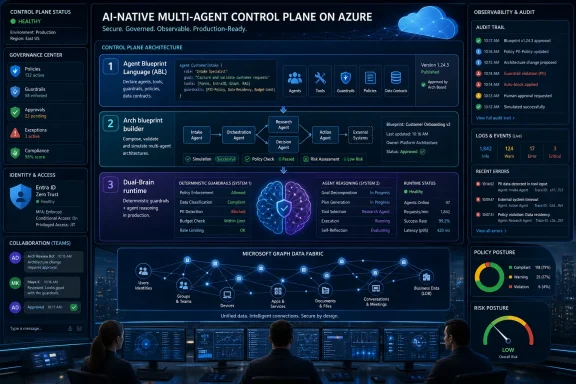
Kore.ai launched the Artemis edition of its Agent Platform on May 21, 2026, initially on Microsoft Azure, positioning it as a governed enterprise system for building, deploying, and operating multi-agent AI workflows across large organisations. The announcement is less about another chatbot builder and more about a fight over who owns the control plane for agentic AI. Kore.ai is betting that enterprises will not scale autonomous software through prompt libraries and enthusiasm alone. Microsoft, meanwhile, gets another partner reinforcing Azure as the place where agents become managed infrastructure rather than experimental side projects.

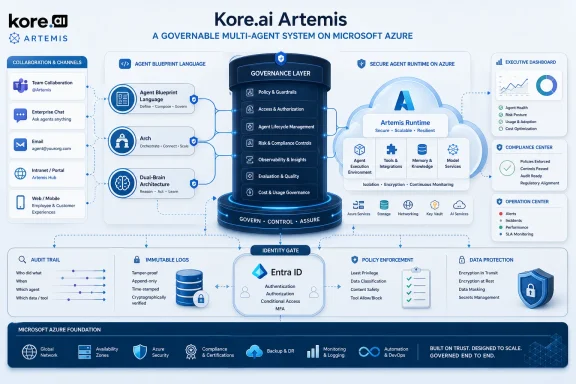
Microsoft Azure Artemis Control Plane diagram showing multi-agent workflow, security, audit trail, and data protection.Kore.ai Wants the Agent Boom to Grow Up​

The enterprise AI market has spent the past two years selling possibility. Agents would answer tickets, triage invoices, query databases, draft responses, and orchestrate work across departments. What has been harder to sell is the boring part: who approves what the agent can do, how its decisions are audited, and how a regulated company proves that a software worker did not quietly improvise its way into a compliance problem.
That is the opening Kore.ai is aiming at with Artemis. The company is not presenting the new platform as a single-purpose assistant or a departmental automation tool. It is pitching a layer where agents are defined, governed, observed, refined, and connected to enterprise systems before they are allowed near production work.
The timing matters. The first wave of generative AI in business was about access to models. The second was about adding copilots to existing software. The third, if vendors are right, is about agents that perform chains of work across systems. That third wave is where the risk profile changes, because a bad answer is one thing; a bad action taken through authenticated enterprise systems is another.
Kore.ai’s argument is that agentic AI needs more than model choice. It needs architecture. Artemis wraps that argument in three branded components: Agent Blueprint Language, Arch, and a Dual-Brain Architecture. Strip away the naming, and the core pitch is straightforward: enterprises need a repeatable way to describe agent behavior, convert business goals into governed workflows, and combine flexible reasoning with deterministic guardrails.

The Most Important Feature Is Not the Model​

Kore.ai describes Artemis as model-independent, and that detail is more than a procurement footnote. In enterprise AI, the model is often the star of the demo, but it is rarely the whole system. A production agent also needs identity, permissions, memory, connectors, monitoring, escalation rules, data controls, and a rollback story when something behaves badly.
That is why the platform’s emphasis on a standard agent definition language is significant. Agent Blueprint Language, or ABL, is presented as a compiled, declarative way to define and validate agents, workflows, and multi-agent systems. In ordinary IT terms, Kore.ai is trying to move agent design closer to infrastructure-as-code discipline: describe the desired system, validate it, govern it, deploy it, and keep a record of what changed.
This is the correct direction for enterprise buyers, even if the product still has to prove itself in real deployments. One of the great weaknesses of the agent boom is that too much of it has treated behavior as something emerging from prompts, tool calls, and vibes. That may be tolerable for a prototype. It is a poor foundation for a bank, insurer, hospital, or multinational support operation that must explain why a system made a decision.
Kore.ai’s “Dual-Brain Architecture” is also a response to that tension. Agentic reasoning is useful precisely because it can interpret context and adapt. Deterministic flows are useful precisely because they constrain behavior and make outcomes more predictable. The platform’s promise is to let those modes operate together through shared memory and a single runtime, rather than forcing enterprises to choose between brittle workflow automation and unconstrained AI autonomy.

Azure Gives Artemis a Door Into the Enterprise Estate​

Launching first on Microsoft Azure is the commercially obvious move. Many of the customers Kore.ai wants already use Microsoft identity, collaboration, security, development, and productivity tools. If an agent platform can plug into Entra ID, Microsoft Graph, Microsoft Teams, Microsoft Foundry, and Agent 365, it has a much easier story to tell a CIO than a standalone AI product asking to be trusted from scratch.
That Microsoft integration also reflects the emerging shape of the market. AI agents are not being treated as isolated apps. They are being pulled into the same management logic that governs users, devices, data access, and SaaS permissions. The enterprise does not want a thousand clever agents running in parallel; it wants accountable digital workers with policy, observability, and lifecycle management.
For Microsoft, the partnership helps reinforce Azure’s role as the operating environment for enterprise AI. Microsoft has spent the last several product cycles turning AI into a platform story: Copilot for users, Foundry for builders, Agent 365 for management, and Graph as the connective tissue across workplace data. Kore.ai’s Azure-first launch fits neatly into that narrative.
For Kore.ai, the benefit is distribution and credibility. The company can say it is meeting enterprises where they already are, rather than asking them to build a parallel AI governance stack. That is especially important for buyers that have already consolidated identity, compliance, and endpoint management around Microsoft’s ecosystem.

Governance Moves From Slideware to Product Architecture​

Every AI vendor now talks about governance. The more interesting question is where governance lives. If it is a dashboard bolted onto a model after deployment, it is mostly a reporting feature. If it is embedded in how agents are defined, validated, executed, and audited, it becomes part of the system’s operating model.
Kore.ai is clearly trying to claim the latter. The company says Artemis includes governance before agents go live, immutable audit trails for agent actions, tenant isolation, real-time personally identifiable information tokenisation, and deployment choices spanning public cloud, sovereign regions, private cloud, and on-premises environments. It also lists enterprise certifications and compliance alignments including SOC 2 Type II, ISO 27001, PCI DSS, FedRAMP Moderate authorisation, HIPAA alignment, HiTrust, and GDPR compliance.
Those claims will matter most in sectors where AI has been stuck between executive enthusiasm and risk-office skepticism. Customer service, workplace support, claims processing, onboarding, and IT operations all look attractive for agentic automation. They also involve sensitive data, regulated workflows, and reputational downside when automation fails in public.
The more consequential claim is that governance is “architectural, not an afterthought,” as one early customer put it. That phrasing captures the market’s mood. Enterprises are no longer asking whether AI can produce an impressive answer in a controlled demo. They are asking whether it can survive procurement, legal review, security review, data residency constraints, and the operational messiness of real business systems.

Agent Blueprint Language Is a Bet on Standardisation​

The most intriguing part of Artemis may be ABL, because it points to a broader industry problem: enterprises do not yet have a mature grammar for agentic systems. Traditional software has source code, tests, build pipelines, deployment manifests, logging conventions, and change-control processes. Robotic process automation has workflows and runbooks. AI agents often have prompts, tools, memory settings, and a loose promise that observability will catch the rest.
A standard agent language could help close that gap. If an organisation can define an agent’s role, tools, escalation paths, orchestration pattern, policy boundaries, and expected behavior in a consistent format, it becomes easier to review, reuse, test, and govern agent designs. It also becomes easier to move from artisanal agent-building to portfolio management.
Kore.ai says ABL supports built-in orchestration patterns including supervisor, delegation, handoff, fan-out, escalation, and agent-to-agent federation. That list is revealing because it treats multi-agent systems less like magic and more like distributed operations. Agents need supervisors. They need handoff rules. They need escalation points. They need ways to delegate without losing accountability.
The challenge, of course, is adoption. A language only matters if enough builders use it, enough tools understand it, and enough organisations trust it as a durable abstraction rather than a vendor-specific configuration format. Kore.ai does not have the standards-setting power of Microsoft, Google, Amazon, or OpenAI. Its opportunity is to make ABL useful enough inside its own platform that enterprises stop caring whether it becomes universal.

Arch Sells the Dream of AI Building AI, With a Human Still in the Loop​

Arch, Kore.ai’s agent architect, is the platform’s most fashionable component. It promises to translate business objectives into production-ready blueprints and then refine agents using production traces. That is the sort of claim that will attract both interest and skepticism from experienced IT teams.
The attraction is obvious. Business units rarely describe automation needs in clean technical specifications. They describe outcomes: reduce call handling time, speed up claims intake, route internal support requests, reconcile exceptions, or improve onboarding. If Arch can convert those goals into structured agent designs that IT can review, modify, and deploy, it could reduce one of the biggest bottlenecks in enterprise AI adoption.
The skepticism is equally obvious. “AI builds the agent” sounds elegant until the agent touches a legacy CRM, a custom claims system, a regional data store, and a policy exception process known only to three people in operations. Enterprise workflows are full of edge cases that do not show up in strategy decks. Any platform claiming to generate production-ready systems must still confront the lived reality of business process archaeology.
Kore.ai appears to understand this by positioning Arch as part of a lifecycle rather than a one-shot generator. The more credible promise is not that AI will instantly replace solution architects. It is that AI can accelerate the drafting, refinement, and optimisation of agent designs while keeping human review and governance in the loop. That may sound less revolutionary, but it is much closer to how large organisations actually buy and operate software.

Microsoft’s Agent Stack Gets Another Tenant​

The Azure-first launch also shows how Microsoft’s agent strategy is becoming gravitational. Microsoft does not need to build every agent platform itself if it can make Azure, Foundry, Entra ID, Graph, Teams, and Agent 365 the environment where third-party agents live. That is a familiar platform play: own the identity, control plane, data fabric, and developer surface, then let partners fill in specialised layers.
For WindowsForum readers, the Teams and Microsoft 365 connection is particularly important. Many enterprise agents will not appear to users as exotic new applications. They will appear inside the collaboration tools workers already use. They will answer in Teams, pull context from Microsoft Graph, authenticate through Entra ID, and be monitored through Microsoft-aligned governance tooling.
That creates convenience, but it also raises the stakes. Once agents are embedded into the Microsoft workplace estate, they inherit both the power and the risk of that estate. A well-governed agent can become a useful front door into business systems. A poorly governed one can become a confused but authenticated actor with access to sensitive data and operational workflows.
This is why Agent 365 matters in the background of the Kore.ai announcement. Microsoft has been framing it as a way to manage agents across the enterprise, including agents built with Microsoft tools and third-party frameworks. Kore.ai integrating with that strategy is not just a checkbox. It is a signal that the market expects agent governance to become a first-class administrative discipline.

The Security Claims Are Necessary, Not Sufficient​

Kore.ai’s security and compliance list is substantial, and it will help the company in enterprise evaluations. Certifications, audit trails, tenant isolation, PII tokenisation, and data residency controls are table stakes for the regulated customers the company wants. Without them, Artemis would be excluded before the first serious architecture meeting.
But security-minded buyers should still separate platform controls from application outcomes. A platform can provide identity integration, logs, policy enforcement, and deployment isolation. It cannot automatically guarantee that every agent built on top of it is safe, useful, or compliant in its specific business context. The hardest risks often live in the gap between technical capability and process design.
For example, immutable audit trails are valuable only if someone knows what to review and how to respond. PII tokenisation reduces exposure but does not eliminate the need for data classification and access policy. Model independence protects against supplier lock-in, but it also means organisations must test behavior across models and versions. Deterministic flows can constrain actions, but they still need to be designed around the messy exceptions that define real operations.
That does not weaken Kore.ai’s pitch; it clarifies it. Artemis should be judged not as a magic safety wrapper for AI, but as an attempt to give enterprises the machinery they need to impose discipline. The success or failure will depend on how well customers use that machinery, and how honestly the vendor handles the inevitable cases where agents do not behave as expected.

The Customer Quotes Reveal the Real Buyer Anxiety​

The early customer comments from Vanguard and Blue Cross Blue Shield of Massachusetts are notable for what they emphasize. They do not gush about creativity, personality, or a futuristic user experience. They talk about architectural rigor, compiled blueprints, deterministic governance, and the ability to move from pilot to production without creating compliance exposure.
That is the voice of enterprise AI in 2026. The excitement is still there, but the buyer has changed. The first proof-of-concept could be sponsored by innovation teams. Production deployment requires security, architecture, legal, compliance, procurement, operations, and business owners to agree that the system is controllable enough to matter.
This is where Kore.ai’s decade in conversational AI and enterprise automation may help. The company has long sold into environments where contact center workflows, support operations, and regulated customer interactions demand reliability. Artemis extends that heritage into the agent era, where the unit of automation is no longer just a conversation but a sequence of actions across systems.
The danger is that every vendor now wants to frame itself as the adult in the room. “Governed AI” has become the new “enterprise-grade.” The market will need evidence beyond launch language: deployment metrics, failure modes, customer retention, integration depth, administrative usability, and proof that non-trivial agents can be maintained over time without collapsing into bespoke consulting projects.

The Agent Platform Market Is Becoming a Control-Plane War​

Kore.ai is not launching Artemis into an empty field. Microsoft, Salesforce, ServiceNow, Google, Amazon, OpenAI, Anthropic, UiPath, and a swarm of startups are all circling the same enterprise budget. They may use different labels, but the strategic ambition is similar: become the layer where AI workers are created, connected, monitored, and governed.
This is why the cloud partnership matters. Agent platforms will be sticky if they sit near identity, data, applications, and security operations. A vendor that controls only the model endpoint is vulnerable to substitution. A vendor that controls the agent lifecycle, approvals, permissions, observability, and integrations becomes much harder to dislodge.
Kore.ai’s challenge is to occupy that layer without being swallowed by the larger platforms around it. Azure gives Artemis reach, but it also places the product inside Microsoft’s orbit. If Microsoft’s own tools become good enough for a large portion of enterprise use cases, Kore.ai will need to prove that its specialised architecture, multi-agent orchestration, and governance model justify an additional platform commitment.
The same tension applies to model independence. Enterprises like flexibility, but they also like consolidation when budgets tighten. Kore.ai must persuade buyers that abstraction is worth paying for because it protects them from model churn and lets them standardise agent operations across changing AI infrastructure. That is a plausible argument, but not an automatic one.

Windows and Microsoft 365 Admins Should Watch the Operational Layer​

For Windows administrators and Microsoft 365 teams, the Kore.ai launch is another sign that AI management is moving into familiar territory. The relevant skills will not be limited to prompt engineering. Identity design, conditional access, data governance, audit review, endpoint policy, Teams administration, API permissions, and incident response will all become part of the agent operations picture.
That shift could be uncomfortable. Many IT departments are still cleaning up SaaS sprawl, shadow automation, and unmanaged data access. Agents add a new class of actor: software entities that can reason, call tools, retrieve information, and potentially initiate changes. Treating them like ordinary apps will be too loose. Treating them like ordinary users will be too crude.
The likely answer is a new administrative category with its own lifecycle. Agents will need owners, permissions, environments, versioning, test histories, approval gates, logging, and retirement processes. They will also need monitoring for behavior, not just uptime. A healthy agent is not merely one that responds quickly; it is one that acts within policy and produces outcomes the business can defend.
Kore.ai’s Artemis announcement should therefore be read as part of a larger operational transition. AI is leaving the sandbox and entering the estate. Once that happens, the center of gravity moves from demos to controls.
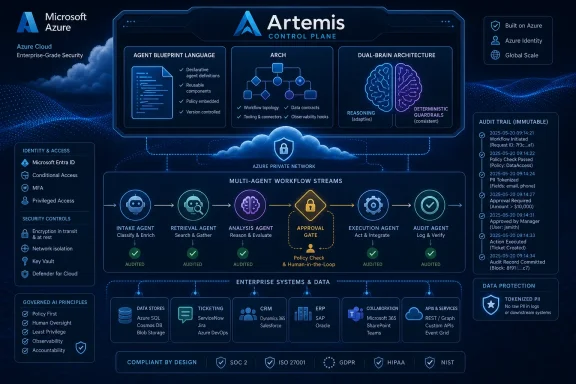
The Azure Launch Tells Enterprises Where the Battle Lines Are​

Kore.ai’s Artemis debut does not settle the agent platform race, but it does sharpen the terms of competition.
  • Enterprises are moving from AI pilots toward production systems that need identity, auditability, policy enforcement, and operational ownership.
  • Kore.ai’s Agent Blueprint Language is an attempt to make agent behavior more standardized, reviewable, and governable than prompt-centric development allows.
  • The Azure-first launch gives Kore.ai access to Microsoft-standardized enterprises and aligns the platform with Entra ID, Microsoft Graph, Teams, Foundry, and Agent 365.
  • The Dual-Brain Architecture reflects a practical compromise between flexible agentic reasoning and deterministic workflow controls.
  • Security certifications and deployment options will help with procurement, but customers still need strong internal governance and process design.
  • The bigger market fight is over the agent control plane, not merely over which model produces the best answer.
The strongest version of Kore.ai’s argument is also the least flashy: enterprises do not need more autonomous agents so much as they need operable ones. Artemis is a bet that the next phase of AI adoption will reward the vendors that make agents boring enough to approve, trace, secure, and maintain. If that bet is right, the winners in enterprise AI will not be the companies with the loudest demos, but the ones that make digital labor legible to the people who have to run it on Monday morning.

References​

  1. Primary source: IT Brief UK
    Published: Fri, 22 May 2026 11:34:00 GMT
  2. Related coverage: kore.ai
  3. Related coverage: docs.kore.ai
  4. Related coverage: vktr.com
  5. Related coverage: businesstoday.in
  6. Related coverage: windowscentral.com
 

Kore.ai launched the Artemis edition of its Agent Platform on May 21, 2026, initially on Microsoft Azure, positioning the release as an enterprise system for building, governing, deploying, and optimizing multi-agent AI workflows across large organizations with Microsoft identity, security, and collaboration integrations. The announcement is not merely another vendor attaching “agentic” to a product line. It is a sign that the AI-agent market is moving out of the demo theater and into the dull, expensive, unforgiving world of enterprise operations. That is where Microsoft wants Azure to sit, and where Kore.ai is betting its decade of conversational AI experience gives it credibility.

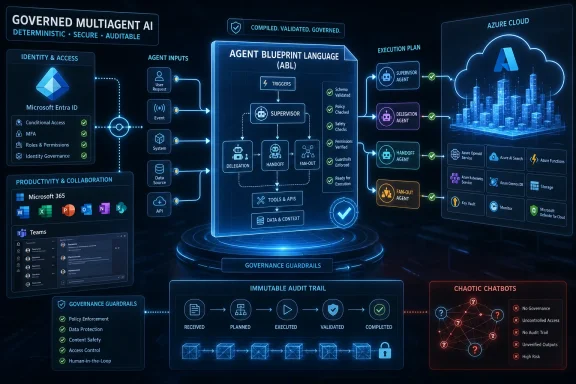
Kore.ai Artemis architecture diagram for a governed multi-agent system on Microsoft Azure.Kore.ai Is Selling the Plumbing, Not the Magic Trick​

The most revealing part of the Artemis launch is not the promise that enterprises can deploy multi-agent systems “in days instead of months.” That is the kind of claim every automation vendor makes when a market category is hot. The more interesting claim is that Kore.ai can make those agents governable before they go live.
That framing matters because the enterprise AI conversation has changed. In 2023 and 2024, the default question was whether generative AI could answer questions, summarize documents, write code, and produce enough productivity theater to justify the licensing uplift. By 2026, the harder question is whether AI systems can be trusted to act inside business processes where mistakes produce audit findings, compliance exposure, customer harm, or operational mess.
Artemis is Kore.ai’s answer to that second question. It is presented as an AI-programmable foundation for defining agents, validating their behavior, enforcing deterministic controls, and observing them in production. In other words, Kore.ai is not trying to win by promising that agents will become smarter on their own. It is trying to win by promising that enterprises can contain them.
That is a sober pitch in a noisy market. The industry has spent the last two years treating agents as if giving a language model a tool belt and a vague goal somehow created a digital employee. Large organizations know better. They have spent decades learning that workflows are brittle, identities are political, integrations are messy, and audit trails are not optional. The novelty of Artemis is not that it imagines AI agents doing work. The novelty is that it treats the boundaries around that work as the product.

Azure Gives Artemis the Enterprise Doorway It Needs​

Launching first on Microsoft Azure is the commercial logic hiding in plain sight. Kore.ai needs access to the estates where enterprise work already happens, and Microsoft owns a disproportionate amount of that terrain through Azure, Microsoft 365, Teams, Entra ID, Graph, and the broader security stack. For a vendor selling production AI agents, the shortest path into the enterprise is not a standalone portal. It is integration with the platform administrators already trust.
Kore.ai says Artemis is built on the Azure stack across compute, identity, AI, and security. It also says the platform integrates with Microsoft Foundry, Microsoft Agent 365, Entra ID, Microsoft Graph API, and a Microsoft Teams channel through Azure Bot Framework. The message is straightforward: this is not an agent platform that lives beside Microsoft’s world; it is an agent platform that wants to be wired into it.
That has consequences for WindowsForum readers because Microsoft’s AI strategy is increasingly about control planes. Copilot is the user-facing brand, but the real enterprise battle is over where agents are registered, governed, authenticated, monitored, and allowed to touch data. If agents become another class of workload, then identity, endpoint management, data loss prevention, logging, and policy enforcement become the new battleground.
Microsoft benefits when third-party AI platforms make Azure the default place for that work. Kore.ai benefits because Azure gives it a procurement and trust story that a pure-play agent vendor would otherwise need years to build alone. The partnership is therefore less about brand halo and more about distribution architecture: put agents where the customers’ users, data, identities, and compliance controls already live.

Agent Blueprint Language Is a Bet That Agents Need Source Code​

The first of Artemis’ three headline components is Agent Blueprint Language, or ABL. Kore.ai describes it as a compiled, declarative language for defining, validating, and governing agents, systems, and workflows. That may sound like vendor jargon, but the underlying idea is important: if agents are going to run business processes, enterprises need something more inspectable than prompts and vibes.
In early agent deployments, a surprising amount of behavior has been encoded in natural-language instructions, fragile prompt chains, tool descriptions, and framework glue. That approach works well enough for prototypes. It breaks down when auditors, security teams, and operations leaders ask what the system is allowed to do, why it did something, and whether the same process will behave consistently tomorrow.
ABL is Kore.ai’s attempt to make agent design more like software architecture. A compiled blueprint can be reviewed, validated, versioned, and governed. It can express orchestration patterns such as supervision, delegation, handoff, escalation, fan-out, and agent-to-agent federation. The emphasis on patterns is notable because multi-agent systems are not just collections of chatbots. They are distributed systems with failure modes.
The risk, of course, is that every vendor now wants its own language, schema, or orchestration abstraction. Enterprise IT has seen this movie before. A standard way to define agents is valuable only if it reduces complexity rather than creating another island of proprietary expertise. Kore.ai will need to prove that ABL is not simply a new DSL for customers to learn, but a practical control surface for teams that must move agents from pilot to production without losing visibility.

Arch Turns the Architect Into an AI Role​

The second piece, Arch, is Kore.ai’s AI agent architect. Its job is to translate business objectives into production-ready ABL, design the underlying agent topology, support the agent lifecycle, and refine systems using production traces. This is the most ambitious part of the Artemis story because it pushes AI into the design and maintenance of AI systems themselves.
There is an obvious appeal here. Most enterprises do not have enough AI engineers, workflow architects, security reviewers, and integration specialists to handcraft every departmental agent. If every claims-processing assistant, HR service bot, IT support agent, sales workflow assistant, and customer-service automation needs bespoke engineering, the agent economy stalls before it leaves the innovation lab. Arch promises to compress that cycle by turning business intent into deployable blueprints.
But this also raises the central tension of the whole product category. If AI is helping to build AI systems, the governance layer cannot be ornamental. It must be the thing that prevents automation from compounding mistakes at machine speed. Kore.ai’s argument is that generated blueprints remain reviewable, constrained, and subject to a deterministic governance layer. That is the right argument to make. The market will judge whether the implementation is strong enough.
The production-trace element may prove especially important. Enterprise software improves when vendors can observe how systems actually behave in the field, not merely how they were designed to behave in a demo. If Arch can use real operational traces to recommend improvements while keeping humans in the approval loop, it could turn agent maintenance into an iterative engineering discipline rather than a prompt-tuning guessing game.

The Dual-Brain Pitch Is Really About Trust Boundaries​

Kore.ai’s third major claim is its Dual-Brain Architecture, which combines agentic reasoning with deterministic flows operating in parallel through shared memory and a single runtime. Put less poetically, the platform tries to separate the part of the system that can reason flexibly from the part that must obey rules predictably. That distinction is central to making AI agents acceptable in regulated or high-stakes settings.
Language models are useful because they are flexible. They can interpret messy user intent, summarize ambiguous information, and adapt to conversational context. They are risky for exactly the same reason. They may infer too much, skip a step, choose the wrong tool, or produce a plausible answer that does not match policy. Deterministic flows are boring by comparison, but boring is often what enterprises need.
The dual-brain framing attempts to preserve both strengths. Let the agentic side handle interpretation, planning, and interaction, but keep execution paths, policy gates, escalations, and compliance controls in a deterministic layer. The shared-memory and single-runtime claims matter because split architectures can become operationally incoherent if reasoning and execution drift apart.
This architecture also reflects a broader market correction. The first wave of generative AI in the enterprise often implied that models could replace workflows. The emerging view is that models are more useful when embedded inside workflows, supervised by policy, and limited by identity and data controls. Kore.ai is not rejecting agentic AI. It is arguing that agentic AI must be domesticated before enterprises let it near consequential work.

Microsoft’s Agent Stack Needs Partners That Look Governable​

Microsoft’s role in this launch should be read in the context of its larger agent strategy. The company has been building toward a world where agents are not isolated applications but managed participants in the Microsoft 365 and Azure ecosystem. Agent 365, Foundry, Teams, Entra, Graph, Copilot Studio, and Azure Bot Framework all point toward the same premise: agents need identities, permissions, channels, telemetry, and administrative controls.
That strategy creates an opening for vendors like Kore.ai. Microsoft can supply the platform primitives, but enterprises will still need industry-specific workflows, packaged agent systems, orchestration layers, and consulting-heavy implementation paths. Kore.ai’s pitch is that it has the domain experience and platform maturity to sit on top of Microsoft’s infrastructure without disappearing into it.
There is a delicate balance here. Too little Microsoft integration and Kore.ai looks like another external AI island that IT must secure separately. Too much dependence and Kore.ai risks becoming a feature-shaped partner inside Microsoft’s gravity well. The Artemis launch tries to thread the needle by emphasizing model independence and deployment flexibility while leading with Azure availability.
For Microsoft, this is a useful partnership because it supports the narrative that Azure is becoming the operating environment for enterprise AI agents. For Kore.ai, it is useful because it turns Microsoft’s identity and productivity footprint into a go-to-market accelerator. For customers, the real question is whether the combination reduces operational burden or simply adds another control plane to an already crowded estate.

The Customer Quotes Reveal the Market Anxiety​

The early customer comments from Vanguard and Blue Cross Blue Shield of Massachusetts are worth reading less as endorsements and more as signals. Both emphasize architecture and governance. Neither says the most important thing is that the agents are dazzlingly creative.
That is telling. Vanguard’s comment points to compiled blueprints, a deterministic governance layer, and one language for every agent. Blue Cross Blue Shield of Massachusetts focuses on moving from pilot to production without creating compliance exposure. These are not the concerns of a market still intoxicated by novelty. They are the concerns of executives who have seen shadow automation spread faster than approval processes can manage.
In heavily regulated industries, AI failure is not only a technical problem. It is a documentation problem, a supervision problem, a customer-impact problem, and a board-level risk problem. A model hallucination in a demo is embarrassing. A model-driven workflow that exposes protected health information, misroutes a financial request, or creates an inconsistent customer outcome is a different class of event.
Kore.ai is leaning directly into that anxiety. The company is effectively saying that governance is not something a customer should bolt on after buying an agent framework. It should be part of the system’s anatomy. That is a strong position, and it aligns with where enterprise demand appears to be heading. But it also raises the burden of proof: if governance is the differentiator, customers will expect it to work under ugly real-world conditions, not just in architecture diagrams.

Security Claims Are Necessary, But Not Sufficient​

Kore.ai lists the certifications and compliance alignments one would expect from a platform targeting Global 2000 deployments: SOC 2 Type II, ISO 27001, PCI DSS, FedRAMP Moderate authorization, HIPAA alignment, HiTrust, and GDPR compliance. It also points to real-time personally identifiable information tokenization, tenant isolation, immutable audit trails, regional data residency controls, and deployment options spanning public cloud, sovereign regions, private cloud, and on-premises environments.
Those claims are not decorative. They are table stakes for selling into banking, healthcare, insurance, telecoms, and government-adjacent markets. If an AI-agent platform cannot explain where data goes, how actions are logged, how tenants are isolated, how identities are handled, and how regional residency is enforced, it will not survive serious procurement scrutiny.
Still, certifications do not answer every operational question. AI agents introduce a new layer of behavioral risk. They may combine data from different systems, call tools in unexpected sequences, escalate incorrectly, or act on ambiguous instructions. Traditional compliance controls were not designed for autonomous or semi-autonomous software that can reason across systems.
That is why the immutable audit trail claim matters more than it might seem. In agentic systems, the ability to reconstruct what happened is not optional. Administrators will need to know which agent acted, what data it saw, which policy permitted the action, which model or deterministic flow influenced the decision, and whether a human approved the step. Without that level of traceability, governance becomes a slide in a sales deck rather than a defensible operating model.

The Model-Independent Claim Is a Hedge Against Platform Lock-In​

Kore.ai describes Artemis as model-independent, which is both a technical position and a procurement message. Enterprises do not want their entire AI operating model tied to one foundation model provider, especially when model performance, pricing, latency, data-handling terms, and regulatory scrutiny remain moving targets. A platform that can shift among models while preserving governance and workflow structure is easier to defend.
This is especially relevant for organizations standardized on Microsoft but not necessarily willing to make every AI decision through a single model family. Azure gives access to a wide model ecosystem, and many enterprises will use different models for different workloads. Customer-service summarization, code assistance, compliance review, voice automation, and back-office process execution do not all require the same model characteristics.
The harder part is making model independence real. A workflow may be portable in theory while still depending on model-specific behavior in practice. Different models handle tool use, long context, retrieval, structured output, multilingual support, safety refusal, and latency differently. If an agent blueprint assumes one model’s strengths, swapping models can change the user experience or break hidden assumptions.
That is where a deterministic control layer could become valuable. If the business rules, audit controls, and orchestration patterns are kept outside the model, then model changes become less destabilizing. They still require testing, but they do not necessarily require rethinking the whole agent system. Kore.ai’s challenge is to turn that architectural promise into a repeatable operational advantage.

The Agent Platform Market Is Becoming an Operations Market​

The Artemis launch lands in a market where nearly every major software supplier is trying to become the place where enterprises build, manage, or consume AI agents. Microsoft has its agent ecosystem, Salesforce has Agentforce, ServiceNow has AI agents inside workflows, Workday is moving agents into HR and finance processes, and cloud providers are racing to make their AI platforms the default runtime. At the same time, open-source frameworks and developer-first tools have made it easy for teams to spin up agents outside central IT.
That is how sprawl begins. One team builds a support agent. Another builds a sales assistant. A third wires a model to Jira, GitHub, SharePoint, or ServiceNow. Before long, the enterprise has dozens or hundreds of AI-enabled workflows with inconsistent logging, unclear ownership, uneven data controls, and no shared lifecycle management.
Kore.ai’s strategic bet is that agent sprawl will create demand for a more standardized platform. The company’s March 2026 Agent Management Platform announcement already pointed in that direction, positioning governance and monitoring as a response to fragmented AI deployments. Artemis now goes further by putting the build layer, governance language, runtime architecture, and Azure launch together under one platform story.
This is the predictable maturation of a technology category. First, teams experiment. Then they standardize. Then they centralize some parts while allowing controlled decentralization elsewhere. The winners are rarely the tools that made prototyping easiest. They are the systems that make production boring enough to survive procurement, security review, disaster recovery planning, and the first serious incident.

For Windows Shops, Teams Is the Front Door and Entra Is the Gatekeeper​

For Windows-heavy organizations, the Teams and Entra integrations may matter more than the abstract agent architecture. Users do not want another portal. Administrators do not want another identity island. If an AI agent is going to participate in daily work, it needs to appear inside the collaboration tools users already open and obey the identity and access boundaries administrators already maintain.
Teams has become one of Microsoft’s favored surfaces for AI because it is where messages, meetings, files, approvals, and workflows converge. An agent that can operate through Teams is easier to introduce into an organization than one that requires users to change context. But Teams integration alone is not enough. Without Entra-backed identity, Graph-aware context, and policy enforcement, a Teams agent can become a convenient front end to a governance headache.
That is why Kore.ai’s Azure-first posture is more than a hosting choice. It tells IT departments that Artemis is intended to respect the Microsoft control fabric rather than bypass it. In a world of shadow AI tools, that distinction matters. If agents are going to access enterprise data, trigger workflow actions, or communicate with employees, administrators will insist on identity-aware controls.
The practical implication is that agent rollouts will increasingly look like enterprise application rollouts. They will require role definitions, least-privilege permissions, data classification review, logging integration, lifecycle policies, and incident response plans. The agent may speak natural language, but the deployment process will look familiar to anyone who has shipped serious software into a Microsoft estate.

“Days Instead of Months” Will Be Tested by Integration Reality​

Kore.ai’s promise of deploying production-ready multi-agent systems in days rather than months is the kind of claim that invites skepticism. Not because it is impossible to accelerate agent creation, but because enterprise deployment time is rarely consumed only by building the thing. It is consumed by access approvals, integration mapping, data-quality surprises, compliance review, change management, testing, user training, and internal politics.
Arch and ABL may shorten the design and engineering phase. Prebuilt integrations may reduce wiring time. Azure alignment may simplify procurement for Microsoft-standardized customers. But an AI agent that touches banking systems, healthcare workflows, retail operations, or telecom support processes cannot be treated like a weekend script.
The more realistic promise is that Artemis may reduce the amount of bespoke engineering required to make agents production-ready. That is still valuable. If a platform can standardize design patterns, generate reviewable blueprints, enforce policy, and produce audit trails automatically, it can compress the cycle from idea to controlled rollout. But “days” will likely apply first to narrower workflows, well-understood processes, or organizations already mature in Microsoft cloud operations.
The danger for Kore.ai, and for the broader agent market, is overpromising speed while underestimating institutional friction. Enterprises do not merely buy platforms; they absorb them. A platform that speeds up engineering but fails to fit governance committees, risk models, and support processes will still feel slow. Artemis’ success will depend on whether it accelerates the whole organizational path to production, not just the technical act of generating an agent.

The Real Competition Is the Enterprise Control Layer​

It is tempting to frame Artemis as a fight among AI-agent platforms. That is only partly true. The deeper competition is over who owns the enterprise control layer for AI work. Whoever owns that layer influences how agents are built, where they run, how they authenticate, what they can access, how they are monitored, and how value is measured.
Microsoft wants that control layer anchored in Azure and Microsoft 365. Salesforce wants it anchored in customer data and CRM workflows. ServiceNow wants it anchored in IT and enterprise service management. Workday wants it anchored in HR and finance. Kore.ai is trying to position itself as a horizontal agent platform that can span industries and workflows while taking advantage of Microsoft’s infrastructure gravity.
The horizontal strategy has advantages. Kore.ai can argue that enterprises need a consistent agent-building and governance system across departments, not a patchwork of agents embedded in every SaaS application. It can also appeal to organizations that need voice, digital channels, customer service, internal support, and process automation under one umbrella.
The disadvantage is that horizontal platforms must integrate deeply with everything. Kore.ai claims support for more than 40 voice and digital channels and more than 300 integrations, including Microsoft A365, Salesforce, HubSpot, Jira, GitHub, and industry systems in banking, healthcare, retail, and telecoms. That breadth is useful, but breadth brings maintenance burden. In enterprise software, the integration list is only as good as the reliability of the integrations under version churn, policy changes, and real production load.

Governance Is Becoming the New Feature War​

The most important shift signaled by Artemis is that governance is no longer a postscript in enterprise AI announcements. It is the headline. Vendors used to lead with model quality, productivity gains, and magical user experiences. Now the more serious ones lead with observability, auditability, deterministic controls, identity, and compliance.
That may sound dull, but it is how technology becomes infrastructure. Databases became enterprise infrastructure because they could be secured, backed up, queried, replicated, audited, and recovered. Virtualization became infrastructure because it could be managed at scale. Cloud became infrastructure because identity, policy, monitoring, and billing matured around it. AI agents will follow the same path or remain trapped in pilots.
Kore.ai’s language about governance being enforced before agents go live is therefore more than marketing. It reflects the market’s realization that deployment gates matter. Enterprises do not need a thousand clever agents if nobody can prove what they are allowed to do. They need a smaller number of reliable agents that can survive scrutiny.
The irony is that the AI industry is rediscovering old enterprise truths. Production systems need schemas, controls, logs, environments, permissions, testing, and rollback. The agent era does not abolish those requirements. It makes them more important because the software now appears to exercise judgment.

The Artemis Bet Comes Down to Operational Proof​

Kore.ai has the ingredients of a credible enterprise story: Azure launch, Microsoft integrations, model independence, a declarative agent language, an AI-assisted architecture layer, deterministic governance, audit trails, compliance posture, and named early enterprise visibility. That is a strong launch package. It is not the same as proof at scale.
The proof will come from production deployments that show agents handling real workflows without becoming unmanageable. It will come from administrators reporting that ABL made systems easier to review, not harder to understand. It will come from security teams accepting that the deterministic layer actually constrains agent behavior. It will come from business units deciding that Arch accelerates delivery without producing opaque automation they cannot own.
Kore.ai also has to navigate a market where Microsoft itself is expanding rapidly. Foundry, Agent 365, Copilot Studio, Teams, and Entra are not static platforms. If Microsoft absorbs more agent-building and governance capabilities into its native stack, partners will need to keep proving why customers should buy an additional layer. Kore.ai’s answer appears to be depth, cross-channel reach, industry workflow experience, and a governance-first architecture.
That answer may resonate, especially with large organizations that have already discovered that building one impressive AI demo is easy and operating hundreds of compliant agents is hard. The more enterprises move from experimentation to operations, the more they will care about repeatability. Artemis is designed for that moment.

The Azure Launch Narrows the Questions IT Should Ask​

Artemis is not just another AI-agent announcement to admire from a distance. For organizations already invested in Microsoft infrastructure, it raises practical evaluation questions that should be asked early, before agent enthusiasm outruns governance discipline.
  • Enterprises should determine whether ABL makes agent behavior easier for security, compliance, and operations teams to inspect than existing prompt-and-framework approaches.
  • Administrators should test how Artemis agents inherit, respect, and log Microsoft identity and access controls through Entra ID and related Microsoft services.
  • Security teams should validate whether deterministic governance actually prevents risky actions, rather than merely recording them after the fact.
  • IT leaders should compare Kore.ai’s control layer with native Microsoft tooling to avoid duplicating policy, monitoring, and lifecycle management functions.
  • Business owners should start with constrained workflows where the value of faster agent deployment can be measured against real operational risk.
  • Procurement teams should treat model independence as a testable requirement, not a slide-deck promise.
Kore.ai’s Artemis launch is best understood as a bet that enterprise AI’s next phase will be won by the vendors that make agents manageable, not merely impressive. Azure gives the platform a credible enterprise runway, and Microsoft gets another partner reinforcing its claim to be the operating layer for agentic work. The coming test is whether governance-first architecture can survive contact with production complexity; if it can, the agent market will start to look less like a gold rush and more like the next chapter of enterprise middleware.

References​

  1. Primary source: IT Brief Australia
    Published: 2026-05-22T12:30:08.451584
  2. Related coverage: kore.ai
  3. Related coverage: vktr.com
  4. Related coverage: itbrief.co.uk
  5. Related coverage: businesswire.com
  6. Related coverage: docs.kore.ai
 

Kore.ai launched the Artemis edition of its Agent Platform on May 21, 2026, making Microsoft Azure the first cloud home for a new enterprise system designed to build, govern, and operate multiagent AI workflows. The announcement is less about another chatbot builder than about the next control layer in enterprise software. Kore.ai is arguing that the agent era will not be won by the smartest model alone, but by the platform that can make fleets of agents auditable, repeatable, and safe enough for regulated work.

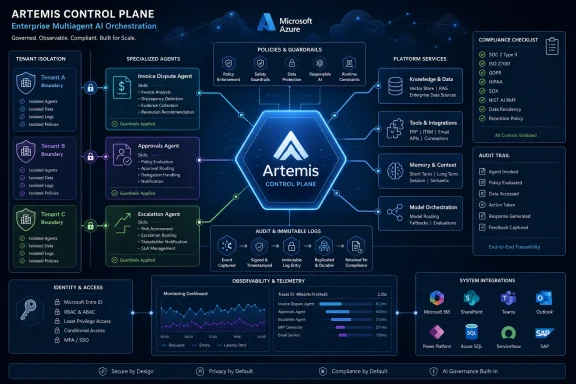
Futuristic diagram shows governed multi-agent AI workflow with Azure cloud tools and immutable audit trail.Kore.ai Is Selling Discipline, Not Magic​

The most important word in the Artemis announcement is not “agentic.” It is “compiled.”
That may sound like a developer’s detail, but it points to the deeper wager behind Kore.ai’s new platform. The company is trying to turn agent construction from a messy mix of prompts, glue code, API calls, and hope into something closer to software engineering. Artemis introduces Agent Blueprint Language, or ABL, as a declarative way to define agents, workflows, orchestration patterns, and governance rules before anything reaches production.
That framing matters because enterprise AI has been stuck between two uncomfortable poles. On one side are demos that look astonishing in conference keynotes. On the other are security reviews, audit trails, exception handling, data residency requirements, identity boundaries, and angry business owners when an automation makes the wrong decision at scale.
Artemis is Kore.ai’s answer to that gap. It promises to let enterprises describe what they want in business language, have an AI architect generate the underlying agent design, and then govern the result through a deterministic platform layer. The sales pitch is speed, but the strategic pitch is control.

The Agent Boom Has Reached Its Middleware Moment​

Every software cycle eventually discovers middleware. The PC had drivers and management tools. The web had application servers and identity layers. Cloud computing had orchestration, observability, and policy engines. AI agents are now arriving at the same inflection point.
For the last two years, the agent conversation has been dominated by capability: whether models can plan, call tools, execute multistep tasks, and coordinate with other agents. That was a necessary phase, but it was never sufficient for enterprises. A bank, insurer, hospital, retailer, or government contractor does not merely ask whether an AI agent can complete a task. It asks who authorized it, what data it touched, what policy constrained it, what happened when the first tool call failed, and whether the whole episode can be reconstructed six months later.
Kore.ai is positioning Artemis as the layer where those questions are answered before deployment rather than after an incident. The platform’s six orchestration patterns — supervisor, delegation, handoff, fan-out, escalation, and agent-to-agent federation — read like a catalog of the failure modes enterprises already fear. Someone must be in charge. Work must be delegated cleanly. Control must pass between systems without vanishing. Parallel actions must be reconciled. Risky events must escalate. Agents must talk to one another without becoming an ungoverned swarm.
That is the real market Kore.ai is chasing. Not “AI that can do things,” but AI that can be allowed to do things.

Azure Gets the First Cut Because the Enterprise Runs on Identity​

Kore.ai’s decision to launch Artemis first on Microsoft Azure is not incidental. It is a recognition of where enterprise AI will be operationalized. If agents are going to act inside organizations, they need to live near identity, messaging, documents, workflow systems, security logs, and administrative controls.
Microsoft has spent the past year turning that adjacency into a platform argument. Foundry Agent Service gives developers a managed environment for building and deploying agents. Microsoft 365 Copilot and Teams provide the daily user interface for knowledge workers. Entra ID supplies identity and access control. Microsoft Graph provides the connective tissue into mail, calendars, files, chats, users, and organizational context. Agent 365 is Microsoft’s attempt to make agents discoverable, manageable, and governed across that estate.
Kore.ai is plugging Artemis into precisely that stack. The company says the platform integrates with Microsoft Foundry, Microsoft Agent 365, Entra ID, Microsoft Graph API, and Teams through Azure Bot Framework. That makes the Azure-first launch less a cloud hosting choice than a distribution and governance strategy.
For WindowsForum readers, the Microsoft angle is the practical one. The future of enterprise AI may be model-agnostic in theory, but the first serious deployments will often be Microsoft-adjacent in practice. Agents will surface in Teams, act on Microsoft 365 data, authenticate through Entra, and be reviewed by administrators already living in Microsoft’s security and compliance portals.
This is also why the partnership is a double-edged sword. Kore.ai wants to present Artemis as model-independent and ultimately cloud-flexible. But the first launch partner shapes the early center of gravity. The tighter Artemis becomes with Microsoft’s agent ecosystem, the more attractive it becomes to Microsoft-standardized enterprises — and the more carefully customers will need to evaluate how portable their agent designs really are.

ABL Is a Bet That Prompts Are Not Enough​

The most technically interesting part of Artemis is Agent Blueprint Language. Kore.ai describes ABL as a compiled, declarative language for defining, validating, and governing agents, systems, and workflows. In plain English, Kore.ai wants the agent’s intended behavior to be expressed as a reviewable artifact, not scattered across prompts, plugins, custom scripts, and undocumented runtime decisions.
That is a meaningful distinction. Prompt-driven development has been useful because it is fast, flexible, and accessible to people who do not think of themselves as programmers. It has also been fragile. Prompts drift, tool behavior changes, model upgrades alter response patterns, and one team’s clever workaround becomes another team’s compliance problem.
A compiled blueprint suggests a different discipline. The organization can inspect what an agent is supposed to do. The platform can validate whether the design conforms to policy. Governance can be applied to the structure of the workflow, not merely to the model’s answer. Operations teams can observe production traces against a known design rather than reverse-engineering behavior from logs.
This does not eliminate uncertainty. Large language models remain probabilistic systems, and no declarative layer magically turns open-ended reasoning into traditional deterministic software. But it does move the boundary. Instead of asking a model to improvise every part of a process, Artemis appears designed to constrain where improvisation happens and where fixed flow control takes over.
That is why Kore.ai’s “dual-brain” architecture is more than marketing garnish. The company says Artemis combines agentic reasoning with deterministic flows, operating in parallel through shared memory and governed by one runtime. If that works as advertised, it gives enterprises a way to use generative AI where judgment and language matter, while preserving conventional workflow controls where predictability matters more.

The AI Architect Is the Most Ambitious — and Riskiest — Claim​

Arch, Kore.ai’s AI agent architect, is the feature that will attract the most attention and probably the most skepticism. The company says Arch can translate business objectives into production-ready ABL, design agent topologies, support the full lifecycle, and continuously refine agents using real-world production traces.
In other words, Kore.ai is not merely offering a platform for building agents. It is offering AI that helps build the agents, govern them, and optimize them over time. The company’s own formulation is blunt: AI building AI, AI governing AI, AI optimizing AI.
There is a powerful business case here. Enterprise software backlogs are full of workflow automations that never get built because bespoke engineering is too expensive. If Arch can take a plain-language objective, generate a reviewable blueprint, validate it against policy, and produce something close to production-ready, the economics of automation change. The marginal cost of the next agent falls because the shared runtime, patterns, governance controls, and integration fabric are already in place.
But this is also where customers should slow down. “AI-generated” does not mean “risk-free,” and “reviewable” does not mean “reviewed.” The strongest version of the Artemis story depends on human oversight remaining meaningful rather than ceremonial. If Arch proposes changes from production traces, someone still needs to understand whether those optimizations improve the business process, degrade compliance posture, or simply overfit to yesterday’s workload.
The long-term question is whether enterprises can build a reliable approval pipeline around AI-generated agent designs. That pipeline will need product owners, security teams, compliance officers, platform engineers, and business process experts. If Artemis reduces hand-coding but increases governance complexity, the productivity gain will depend on whether organizations redesign their operating model, not just whether they buy the platform.

Governance Becomes the Product Feature Buyers Actually Understand​

Kore.ai’s announcement is packed with capability claims, but the clearest buyer-facing message is governance. That is not an accident. The enterprise AI market has learned that the easiest pilot to fund is not always the easiest system to approve.
CIOs want consolidation because many organizations already have agent sprawl: experiments in business units, vendor-provided assistants in SaaS tools, custom bots built by innovation teams, and shadow automations wired into internal data. CISOs want enforceable controls because an agent that can read documents, call APIs, and send messages is not just a productivity tool. It is a new actor inside the enterprise. CFOs want reuse because the economics of AI become ugly if every use case requires separate infrastructure, security review, model tuning, and support.
Artemis speaks to all three constituencies. It promises one foundation for multiple agents, governance outside the model’s control, traceability for decisions and policy enforcement, and shared infrastructure that makes later agents cheaper to create than the first. The argument is elegant: if enterprises are going to deploy hundreds or thousands of agents, they need an agent platform, not a collection of disconnected assistants.
The danger is that governance language can become a comfort blanket. Certifications, audit trails, and policy engines are necessary, but they do not automatically prove that a given agent is safe for a given business process. Real governance is contextual. A workflow that is acceptable for triaging HR requests may be unacceptable for approving credit exceptions, changing patient records, or modifying production infrastructure.
That is where Artemis will need to prove itself in customer deployments. The platform can provide the scaffolding, but enterprises still have to define the rules, assign accountability, test edge cases, and decide which decisions remain human-owned.

Microsoft’s Agent Strategy Gives Kore.ai Reach — and Competition​

The Microsoft partnership gives Kore.ai immediate credibility and reach, but it also places Artemis inside one of the most competitive zones in enterprise technology. Microsoft is not merely a channel partner in the agent market. It is a platform vendor with its own agent-building tools, its own developer frameworks, its own Copilot strategy, and its own ambitions to manage agent identity and lifecycle.
That creates an interesting tension. Kore.ai benefits from Azure’s infrastructure, Microsoft 365’s surface area, and the familiarity of Entra-backed administration. At the same time, Microsoft’s own agent stack will keep expanding. Customers will ask when to use Kore.ai, when to use Microsoft-native tools, when to use Salesforce or ServiceNow agents, and when to build directly on model-provider APIs.
Kore.ai’s answer appears to be specialization and neutrality. Artemis is pitched as model-independent, architected for multiagent orchestration, and designed from a decade of enterprise conversational AI deployments. That history matters. Kore.ai was not born in the current agent gold rush; it has long sold automation and AI systems into customer service, employee support, banking, healthcare, retail, and other regulated environments.
Still, neutrality is difficult to maintain when go-to-market motion flows through a dominant ecosystem. If Artemis is best on Azure, most visible through Microsoft 365, and deeply integrated with Microsoft’s agent management layer, customers will reasonably treat it as part of a Microsoft-centric architecture. That is not necessarily bad. For many Global 2000 organizations, that is exactly the point.

The Compliance Pitch Is Aimed Squarely at Regulated Buyers​

Kore.ai’s compliance checklist is deliberately extensive. The company says Artemis meets requirements including SOC 2 Type II, ISO 27001, PCI DSS certification, FedRAMP Moderate authorization, HIPAA alignment, HITRUST and GDPR compliance, plus real-time PII tokenization, tenant isolation, immutable audit trails, data residency options, and deployment across public cloud, sovereign regions, private cloud, and on-premises environments.
That list is not decorative. It tells us who Kore.ai thinks will buy first: organizations that already know why ungoverned AI is a problem. In banking, healthcare, insurance, telecom, retail, and public-sector-adjacent industries, the path from AI demo to production often dies in risk review. A platform that arrives with compliance primitives baked in has a better chance of surviving procurement.
The FedRAMP claim is particularly relevant for U.S. public sector and government-adjacent buyers, while PCI DSS and HIPAA alignment speak to industries where AI agents will inevitably touch sensitive financial or health-related workflows. The promise of immutable audit trails is similarly important because it acknowledges a simple reality: if an agent takes action, the organization must be able to reconstruct that action later.
But compliance claims also require careful reading. A platform’s certification does not automatically certify every agent a customer builds on top of it. Data flows, integrations, retention policies, access controls, prompt content, and downstream systems can all change the compliance picture. Artemis may lower the barrier, but it does not remove the responsibility.

The Real Test Is Production Drift​

Kore.ai’s emphasis on production traces is one of the more grounded parts of the Artemis story. Enterprise AI systems do not fail only at launch. They drift. Business policies change, APIs evolve, user behavior shifts, models are upgraded, and edge cases accumulate.
Traditional software teams have learned to manage this with testing, monitoring, versioning, rollback, change control, and incident response. Agentic AI needs the same discipline, with the added complication that the system may reason differently across contexts. Observability is therefore not a luxury feature. It is the difference between a controllable automation and an expensive black box.
Artemis claims to log, trace, and analyze every decision, path, and outcome in real time. If that is implemented well, it gives enterprises a fighting chance at operational AI management. Security teams can investigate anomalous behavior. Developers can see where workflows break. Business owners can compare outcomes against intent. Compliance teams can map actions to policy controls.
The harder question is how much of that observability will be intelligible to non-specialists. Logs are only useful when someone can interpret them. Traces are only valuable when they connect technical behavior to business consequence. If Artemis can make agent behavior legible to CIOs, CISOs, auditors, and process owners, it will have something more durable than another builder interface.

The Platform War Is Moving Above the Model Layer​

The Artemis launch reinforces a larger shift in AI strategy. The model is no longer the whole story. In 2023 and 2024, many organizations treated model choice as the main event. Which model was smartest? Which one had the best context window? Which one reasoned better, wrote better, coded better, or cost less?
Those questions still matter, but the enterprise platform battle is moving upward. Customers want model flexibility because today’s best model may not be tomorrow’s best model. They want policy enforcement that survives model swaps. They want integrations that do not need to be rebuilt every quarter. They want agent definitions that can be reviewed, versioned, and governed independently of the latest benchmark race.
Kore.ai’s model-independent claim should be read in that light. If Artemis can let enterprises define agent behavior once and run it across multiple model providers, that becomes a hedge against vendor lock-in at the model layer. It also gives Kore.ai a way to compete with hyperscalers without pretending to outspend them on frontier model training.
The irony is that model independence may become most valuable inside a cloud-dependent deployment. A company standardized on Azure may still want freedom to use OpenAI, Azure OpenAI, Anthropic, Gemini, or future models depending on cost, latency, region, capability, and regulatory constraints. The agent platform becomes the abstraction layer where those decisions can change without rewriting the business process.

Windows Shops Should Watch the Teams and Graph Surface​

For IT pros in Microsoft-heavy environments, Artemis is worth watching less as a standalone AI product and more as a possible new workload class inside the Microsoft estate. If agents become accessible through Teams, grounded in Microsoft 365 data, governed through Entra-linked identity, and published through Microsoft’s agent ecosystem, they will quickly become part of the same operational world as endpoints, apps, identities, and collaboration policies.
That means administrators will need to ask familiar questions in unfamiliar form. Which agents can act on behalf of which users? What scopes do they have in Microsoft Graph? Can they send messages, create tickets, update records, retrieve sensitive files, or trigger external workflows? How are agent permissions reviewed when employees change roles or leave the company?
The Teams channel is especially important because user experience often determines adoption. Employees do not want to learn a separate portal for every AI tool. If Artemis-backed agents appear inside Teams and Microsoft 365 workflows, they inherit the convenience — and the risk — of being close to where work already happens.
This is where agent governance will intersect with everyday Windows and Microsoft 365 administration. The next wave of IT tickets may not be about installing software or resetting passwords. They may be about why an agent cannot access a SharePoint library, why it escalated a request to the wrong team, why it used stale CRM data, or why its policy prevented an action the business expected it to take.

The Fine Print Behind the “Days Instead of Months” Promise​

Kore.ai says Artemis can compress delivery of production-ready multiagent AI systems from months to days. That is the kind of claim that gets executives interested and practitioners cautious.
There are good reasons to believe time-to-value can improve. Reusable orchestration patterns, prebuilt integrations, declarative blueprints, AI-assisted architecture, and shared governance controls should reduce repetitive engineering. If an organization has common workflows across departments — intake, triage, routing, escalation, summarization, data lookup, case creation — a platform approach can compound quickly.
But “days instead of months” is not the same as “no work required.” The difficult parts of enterprise automation often live outside the tool. Data quality must be assessed. Integration permissions must be granted. Business exceptions must be documented. Compliance teams must agree on acceptable automation boundaries. Users must be trained. Support teams must know what to do when the agent is wrong.
The more consequential the workflow, the more these non-coding tasks matter. An agent that summarizes public product documentation can move fast. An agent that touches claims adjudication, employee records, clinical workflows, payment processes, or production infrastructure should not.
The better reading of Kore.ai’s promise is that Artemis may reduce the engineering bottleneck. It does not eliminate organizational bottlenecks, and responsible customers should not want it to.

The Enterprise Agent Market Is Starting to Look Like ERP in Fast Motion​

There is a familiar pattern emerging. First, individual teams adopt tools. Then organizations realize those tools touch shared data and business-critical processes. Then governance, integration, reporting, and lifecycle management become more important than the original feature set. Eventually, the market consolidates around platforms.
Enterprise agents are moving through that arc at uncomfortable speed. Salesforce wants agents tied to CRM and customer workflows. ServiceNow wants agents around IT and business service management. Microsoft wants agents embedded in work and governed through its cloud. Google, AWS, OpenAI, Anthropic, and others are all building their own layers of agent infrastructure. Kore.ai is trying to occupy the cross-enterprise orchestration and governance lane.
That lane is plausible because many organizations do not live inside one application vendor’s universe. A customer support process may touch Microsoft 365, Salesforce, ServiceNow, custom internal systems, payments, identity, document repositories, and industry-specific platforms. An agent platform that can orchestrate across those systems has a credible role, particularly if it can satisfy security and compliance requirements.
The challenge is differentiation. Every vendor now claims governance, observability, integrations, and enterprise readiness. Kore.ai will need to show not just that Artemis has the right vocabulary, but that its blueprint language, AI architect, dual-brain runtime, and production trace loop produce better outcomes than stitching together native tools from Microsoft and other platform vendors.

The Buyer’s Checklist Is Already Taking Shape​

Artemis is not a consumer AI story, and it should not be judged like one. The relevant question is not whether it can impress a user in a five-minute demo. The relevant question is whether it can survive the ugly middle of enterprise adoption: procurement, security review, integration, pilot expansion, audit, user training, incident response, and cost management.
The concrete signals to watch are not hard to identify.
  • Enterprises should test whether ABL blueprints are genuinely understandable and reviewable by both technical teams and process owners.
  • Security teams should verify that governance is enforced outside the model and cannot be bypassed by prompt behavior or tool-calling shortcuts.
  • Microsoft 365 administrators should examine how Artemis-backed agents interact with Entra ID, Graph permissions, Teams, Copilot, and Agent 365 discovery.
  • Compliance teams should distinguish between Kore.ai’s platform certifications and the compliance status of each customer-built agent workflow.
  • Finance leaders should measure whether reuse actually lowers the cost of later agents, rather than merely shifting cost into platform licensing and governance labor.
  • Operations teams should demand clear evidence that production traces, rollback, versioning, and optimization recommendations are usable during real incidents.
Kore.ai’s Artemis launch is a sign that the agent market is maturing from experimentation into infrastructure. That is good news for enterprises that have been waiting for governance to catch up with capability, and a warning to anyone who still thinks AI agents can be managed like clever chatbots. The winners in this phase will not be the vendors that promise the most autonomy, but the ones that make autonomy administrable — and in the Microsoft ecosystem, that battle has now moved directly onto Azure.

References​

  1. Primary source: SMEStreet
    Published: Sat, 23 May 2026 12:17:37 GMT
  2. Related coverage: businesswire.com
  3. Related coverage: kore.ai
  4. Related coverage: venturebeat.com
  5. Official source: learn.microsoft.com
  6. Related coverage: docs.kore.ai
 

Kore.ai launched the Artemis edition of its Agent Platform on May 21, 2026, in San Mateo, California, debuting first on Microsoft Azure as a new enterprise platform for building, governing, and operating multiagent AI systems. The announcement is less interesting as another “agentic AI” launch than as a sign of where the market is being forced to go. After two years of demos, copilots, and workflow prototypes, enterprise AI is entering its control-plane era. Artemis is Kore.ai’s argument that agents will not scale because they are clever; they will scale only if they are standardized, observable, and boring enough for regulated companies to trust.

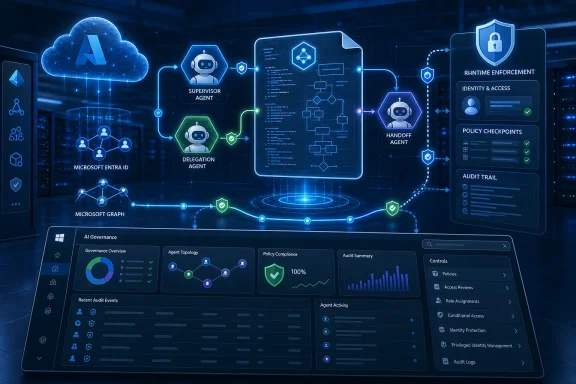
Infographic showing the “Artemis Control Plane” for Azure multi-agent AI orchestration with security and compliance features.Kore.ai Is Selling the Discipline That Agent Hype Has Avoided​

The early enterprise AI pitch was speed. Give workers a chatbot, connect it to documents, and let the model reason its way through the messy middle of work. That was a useful first act, but it also exposed the limits of treating AI as a conversational veneer over business systems.
Artemis lands with a different premise: enterprises do not merely need agents, they need an architecture for agents. Kore.ai says the platform can deploy production-ready multiagent systems in days rather than months, with governance and observability enforced before anything goes live. That “before” matters. In enterprise software, controls bolted on after deployment are usually controls that fail when the system gets popular.
The company’s vocabulary is intentionally infrastructural. Agent Blueprint Language, Arch, dual-brain architecture, deterministic runtime, production traces, immutable audit trails: this is not the language of a consumer assistant. It is the language of change management, compliance review, and operations teams who will be blamed when a model-driven workflow does something expensive, irreversible, or legally awkward.
Kore.ai is also making a broader industry claim. The future of enterprise agents, it argues, will not be won by the model alone. It will be won by the layer that defines what an agent is allowed to do, how it hands off work, how it is monitored, and how its behavior is revised when the business changes.

Azure Gives Artemis a Shortcut Into the Enterprise Stack​

The Azure-first launch is not a small distribution detail. For Global 2000 companies, Microsoft is often less a vendor than an operating environment. Identity lives in Entra ID, collaboration happens in Teams, documents and workflows sprawl across Microsoft 365, and developers increasingly meet AI through Azure AI Foundry and adjacent services.
By launching initially on Azure, Kore.ai is choosing the shortest path to enterprise plausibility. The company says Artemis is built natively across Azure compute, identity, AI, and security services, with integrations into Microsoft Foundry, Microsoft Agent 365, Entra ID, Microsoft Graph, and Teams through the Azure Bot Framework. That is a mouthful, but the strategy is straightforward: meet the enterprise where its permissions, policies, and workflows already live.
This matters because agents are only as useful as their access. A model that cannot read the right data, trigger the right workflow, or respect the right identity boundary is a demo. A model that can do all those things without creating a governance nightmare is a platform.
The Microsoft relationship also places Kore.ai in the middle of a larger race. Microsoft has been positioning Agent 365 and Foundry as governance and development layers for AI agents. Salesforce, ServiceNow, Google, AWS, and others are all trying to define the system of record for agentic work. Kore.ai is not trying to out-Microsoft Microsoft inside the Microsoft estate; it is trying to become the governed agent factory that can plug into that estate.

Agent Blueprint Language Is the Real Product Bet​

The flashiest part of Artemis may be Arch, the AI architect that translates business objectives into production-ready agents. But the more consequential piece is Agent Blueprint Language, or ABL. Kore.ai describes it as a compiled, declarative language for defining, validating, and governing agents, systems, and workflows.
That framing is important. ABL is not just another prompt wrapper if it works as advertised. It is an attempt to turn agent behavior into something reviewable, portable, testable, and enforceable. In other words, Kore.ai wants to move agents from the world of bespoke runtime behavior into something closer to software engineering.
The compiled-language metaphor is doing heavy work here. Enterprises understand artifacts that can be inspected before deployment. They understand policy checks, versioning, approvals, and rollback. They are far less comfortable with autonomous behavior that emerges from a long prompt, a tool list, and a hope that the model will choose wisely.
ABL also gives Kore.ai a way to claim neutrality. If the platform can define agents independently of the underlying model, then customers can swap or upgrade models without rebuilding every workflow. That is a powerful promise in a market where foundation-model pricing, performance, safety behavior, and procurement risk remain moving targets.
The risk is that proprietary abstraction layers can become their own lock-in. Enterprises have seen this movie before: a vendor creates a higher-level language to simplify complexity, and that language becomes the moat. Kore.ai’s challenge will be proving that ABL standardizes agent behavior without trapping customers inside a syntax that only one platform truly understands.

Arch Turns Prompting Into a Systems-Design Problem​

Arch is Kore.ai’s name for the AI agent architect inside Artemis. Its job, according to the company, is to translate plain-language business goals into production-ready ABL, design the agent topology, support the agent lifecycle, and refine agents using real-world production traces.
That is a more ambitious claim than “generate a workflow.” It suggests that Kore.ai wants AI to participate not just in task execution, but in system design. If a business says it wants an invoice-dispute agent, Arch should determine which specialized agents are needed, how they should coordinate, which escalation paths are required, and which deterministic controls must govern the process.
This is where the “AI building AI” pitch becomes both compelling and uncomfortable. It is compelling because enterprise automation has long been bottlenecked by scarce engineering capacity and slow requirements translation. If Arch can produce a validated blueprint from a business objective, the economics of automation change.
It is uncomfortable because system design is where bad assumptions become expensive. An agent that summarizes a document poorly creates annoyance. An agent architecture that routes approvals incorrectly, mishandles regulated data, or optimizes for the wrong business outcome creates operational risk. Kore.ai’s answer is that Arch produces reviewable blueprints rather than opaque magic. That distinction will matter in procurement conversations.
The more realistic near-term value may not be fully autonomous agent creation. It may be acceleration: generating a credible first draft, surfacing orchestration patterns, instrumenting governance, and giving developers and business analysts a common artifact to debate. In enterprise IT, shaving weeks from design and review can be more valuable than pretending humans are no longer involved.

The Dual-Brain Pitch Is Really About Distrusting the Model​

Kore.ai’s “dual-brain architecture” pairs agentic reasoning with deterministic flows through shared memory, authored in a unified language and governed by a single runtime. Stripped of branding, the idea is that the model should reason where reasoning is useful, while rules and flows should retain control where predictability matters.
That is the right instinct. The most mature enterprise AI systems will not be pure model autonomy. They will be hybrids that let models interpret, summarize, classify, draft, and plan, while deterministic systems handle entitlement checks, transaction boundaries, escalation rules, and compliance controls.
The phrase “governance outside the model’s control” is doing some of the most important work in Kore.ai’s launch materials. It acknowledges a truth that many AI demos obscure: you cannot reliably govern a system by asking the same system to behave. Guardrails that depend entirely on model self-discipline are fragile. Platform-enforced constraints are the more enterprise-friendly answer.
Shared memory is the tricky part. Memory is useful because multiagent systems need context across steps, sessions, and handoffs. Memory is dangerous because context can leak, persist beyond its intended scope, or create subtle policy failures when one agent inherits information another should not have exposed. Kore.ai’s claims around tenant isolation, PII tokenization, and auditability are therefore not garnish. They are prerequisites.
If Artemis succeeds, the dual-brain design will fade into the background. Users will not care whether a workflow step was model-driven or deterministic. Administrators will care very much, because that boundary is where trust is either engineered or hand-waved.

Multiagent Systems Need Orchestration More Than They Need Personality​

Kore.ai says ABL includes six built-in orchestration patterns: supervisor, delegation, handoff, fan-out, escalation, and agent-to-agent federation. That list sounds technical, but it points to a basic reality of enterprise work. Most business processes are not single-turn conversations. They are chains of responsibility.
A customer-service issue may begin with identity verification, move through account lookup, trigger fraud analysis, require policy interpretation, escalate to a human, and end with a documented resolution. A procurement workflow may involve budget validation, vendor checks, legal review, and ERP updates. Calling all of that “an agent” is too vague to be operationally useful.
The orchestration layer is where agentic AI either becomes enterprise software or remains theater. Multiagent systems need rules for who acts, who waits, who escalates, and who owns the final outcome. They need to prevent loops, duplicate work, conflicting decisions, and silent failure.
Kore.ai’s federation pattern is especially worth watching. Enterprises will not standardize on one vendor’s agent universe, no matter how much vendors would like them to. Departments will buy different tools, developers will build internal agents, and SaaS platforms will ship their own embedded assistants. A credible enterprise agent platform must assume heterogeneity rather than wish it away.
That is also where Microsoft’s ecosystem becomes strategically useful. If Agent 365 becomes a common governance and discovery surface for Microsoft customers, Kore.ai can position Artemis-built agents as well-behaved citizens inside a broader agent economy. The prize is not only building agents; it is making them legible to enterprise control planes.

The CIO Gets Speed, But Also Another Platform to Rationalize​

For CIOs, Artemis is pitched as a way to consolidate fragmented third-party and home-grown agents into one foundation. That is a familiar enterprise software story, and it will resonate with leaders who already see agent sprawl forming inside their organizations.
The uncomfortable truth is that many companies are now repeating the early cloud era at AI speed. Teams are experimenting with different tools, vendors are embedding agents into every product, and business units are not waiting for central IT to design a perfect architecture. The result is predictable: duplicated effort, inconsistent controls, uncertain data access, and unclear ownership.
Artemis gives CIOs a vocabulary for rationalization. Instead of asking whether each department should use AI, the better question becomes which agent patterns, runtimes, and governance layers should be sanctioned. That shifts the conversation from prohibition to architecture.
But consolidation is never free. A platform that promises to govern everything must integrate with almost everything, and it must do so without becoming the slowest part of delivery. If Artemis is perceived as another review gate that delays teams already moving fast, shadow AI will continue elsewhere. If it becomes the fastest approved path to production, the CIO’s consolidation argument becomes much stronger.

The CISO Will Care Less About Agents Than Evidence​

The CISO pitch is the most credible part of the Artemis story because it maps to a real blocker. Security leaders are not generally opposed to automation. They are opposed to automation that cannot explain what it did, why it did it, what data it touched, and which control approved the action.
Kore.ai says Artemis logs every decision, path, and outcome, with traceability to regulatory controls and immutable audit trails for agent actions. That is the language CISOs need before they can approve agents for high-value workflows. Without evidence, “trustworthy AI” is just a vendor adjective.
The platform’s model-independent approach also has security implications. If controls live above or beside the model rather than inside a single model provider’s behavior, enterprises can evaluate models for performance and cost without re-arguing the entire governance framework. That does not eliminate model risk, but it changes where some of the risk is managed.
Still, auditability is not the same as safety. Logs tell you what happened. Policy enforcement, testing, and runtime controls determine whether the wrong thing happens less often. The most important Artemis deployments will be judged not by how elegant the traces look in a dashboard, but by how well the platform prevents unauthorized action under messy real-world conditions.

The CFO Pitch Depends on Reuse Becoming Real​

For CFOs, Kore.ai argues that AI investment compounds because Arch, ABL, and the runtime become shared infrastructure. Once the organization has a common agent foundation, the marginal cost of each additional agent should fall toward the cost of authoring its blueprint.
That is the dream of every platform sale. Build once, reuse everywhere, and turn what looked like project spending into durable operating leverage. It is also a dream that enterprise software often struggles to fulfill because business processes are more idiosyncratic than vendors admit.
The CFO will want proof that reuse beats customization. If every new agent requires weeks of integration, policy exceptions, departmental negotiation, and remediation, the economics revert to ordinary enterprise automation. If ABL blueprints, orchestration patterns, and shared runtime controls can genuinely be reused across functions, the cost curve changes.
Model upgrades are another part of the financial story. Kore.ai says every model upgrade can improve agents already running on the platform. That is plausible if the abstraction holds. It is also a reason for caution, because changing model behavior underneath production workflows can create regressions. The strongest version of this pitch requires not just model independence, but disciplined testing against production traces before and after upgrades.

The Compliance Claims Are Table Stakes for the Customers Kore.ai Wants​

Kore.ai says the platform supports enterprise security and compliance requirements including SOC 2 Type II, ISO 27001, PCI DSS, FedRAMP Moderate authorization, HIPAA alignment, HITRUST and GDPR compliance, along with real-time PII tokenization, tenant isolation, immutable audit trails, data residency controls, and deployment options across public cloud, sovereign regions, private cloud, and on-premises environments.
That list is long because the target customer list is serious. Banking, healthcare, insurance, retail, telecom, and global service operations are exactly the sectors where AI agents could produce enormous productivity gains and exactly the sectors where unsupervised automation can trigger regulatory consequences.
The compliance posture also reveals the difference between enterprise agent platforms and consumer AI tools. A consumer assistant can apologize. An enterprise agent may need to produce an audit trail, prove policy compliance, preserve evidence, and show that a human approval occurred before a regulated action.
FedRAMP Moderate authorization is particularly relevant for public-sector and government-adjacent buyers, while PCI DSS and HIPAA alignment speak to payment and healthcare workflows where data handling is tightly constrained. The practical question is not whether these badges exist in marketing material. It is how consistently the controls apply across every agent, connector, channel, and deployment mode.
Kore.ai says Artemis supports more than 40 voice and digital channels and more than 300 integrations, including Microsoft 365, Salesforce, HubSpot, Jira, GitHub, and vertical systems. That breadth is necessary, but it also expands the attack surface and operational complexity. Every connector is a productivity path and a potential control boundary.

The Market Is Moving From Copilots to Governed Labor​

The word “agent” has become so overused that it now obscures more than it explains. Sometimes it means a chatbot with tools. Sometimes it means a workflow automation with a language-model interface. Sometimes it means a semi-autonomous software worker with memory, identity, and permission to act.
Artemis is best understood as part of a market correction. The first wave of generative AI in the enterprise was about access to models. The second was about copilots embedded into applications. The third is about governed labor: AI systems that can perform multistep work across enterprise systems under policy control.
That shift changes the competitive landscape. The winners may not be the vendors with the most charismatic assistants. They may be the vendors that define identity, permissioning, lifecycle management, observability, and interoperability for agents. This is why Microsoft, Salesforce, ServiceNow, Google, AWS, and specialist vendors are converging on similar language around control planes, governance, and agent operations.
Kore.ai’s advantage is focus. The company has spent years in conversational AI and enterprise automation, particularly in customer service and regulated environments. Its disadvantage is scale. The largest platform vendors own the applications, clouds, and identity systems where agents will live. Artemis is therefore a bet that specialized agent infrastructure can matter even when the hyperscalers and SaaS incumbents are building their own stacks.

Vendor Neutrality Is Both a Feature and a Negotiation​

Kore.ai emphasizes that Artemis operates independently of the underlying model. In 2026, that is not a philosophical nicety; it is a procurement strategy. Enterprises do not want to hard-code their automation futures to a single model vendor whose pricing, safety behavior, regional availability, or legal posture may change.
Model neutrality also gives companies leverage. If an agent platform can run across multiple models, enterprises can choose cheaper models for routine tasks, stronger models for complex reasoning, domain-specific models for regulated workflows, and private deployments for sensitive data. The platform becomes the governance layer above a shifting model market.
But neutrality has limits. Every abstraction hides differences until those differences matter. Models vary in tool use, latency, context handling, reasoning reliability, multilingual performance, and refusal behavior. A workflow that performs well on one model may degrade on another even if the blueprint remains unchanged.
That is why production traces may become one of Artemis’s most important assets. If the platform can use real-world traces to test, compare, and optimize agent behavior across models, it can turn neutrality from a marketing claim into an operational capability. Without that discipline, model independence risks becoming another version of “write once, debug everywhere.”

The Hard Part Starts After the Launch Demo​

The most difficult problems for Artemis will not be solved in a press release. They will emerge in the first large deployments, when business units try to encode ambiguous processes, security teams challenge data flows, and users discover that AI agents are only as good as the organizational rules they inherit.
Enterprise workflows are full of exceptions. The official process often differs from the process that keeps the business running. Human workers rely on judgment, relationships, and tacit knowledge that rarely appear in documentation. Turning that into an agent blueprint is not merely a technical act; it is organizational archaeology.
There is also the question of accountability. If Arch designs an agent topology, a developer approves the blueprint, a model reasons through a case, and a deterministic flow executes the action, who owns the outcome? Enterprises will need governance models that assign responsibility clearly enough for audit, remediation, and legal review.
User trust will be another constraint. Workers may resist agents that appear to monitor, replace, or second-guess them. Customers may not care whether an agent is multiagent, dual-brained, or declaratively compiled; they will care whether it solves the problem quickly and fairly. The enterprise buyer cares about architecture, but adoption depends on experience.
Kore.ai’s strongest argument is that these are exactly the reasons a platform is needed. The counterargument is that platforms can add ceremony without eliminating complexity. Artemis will have to prove that its structure reduces operational drag rather than merely renaming it.

Artemis Gives Windows Shops a Familiar Control-Plane Story​

For WindowsForum readers, the Microsoft angle is more than ecosystem trivia. Many IT shops already manage identity, access, devices, collaboration, and security posture through Microsoft-administered surfaces. An agent platform that plugs into Entra ID, Microsoft Graph, Teams, Azure Bot Framework, Foundry, and Agent 365 fits a governance pattern administrators already understand.
That does not mean deployment will be simple. Agentic systems touch data classification, conditional access, retention, DLP, logging, secrets management, API permissions, and human approval flows. The fact that Artemis launches on Azure may reduce friction, but it does not remove the need for architecture.
The practical opportunity is that agent governance can become part of existing enterprise administration rather than a separate AI island. If agents appear in the same operational universe as users, apps, devices, and data policies, IT has a fighting chance to manage them. If they proliferate as disconnected SaaS features, administrators will spend the next several years discovering automation after it has already acted.
Microsoft’s own agent strategy makes this more urgent. As Agent 365 and Foundry mature, organizations will need to decide which agents are built in Microsoft-native tooling, which are built in third-party platforms like Kore.ai, and how all of them are inventoried, secured, and observed. Artemis is entering that debate early enough to shape it.

The Artemis Bet Comes Down to Control Before Autonomy​

The most concrete lesson from Kore.ai’s Artemis launch is that the enterprise AI conversation is turning away from raw autonomy and toward controlled autonomy. That is a healthier place for the industry to be. The question is no longer whether agents can act. It is whether they can act inside boundaries that the enterprise can understand, audit, and change.
A few points should stay in view as the platform moves from announcement to adoption:
  • Kore.ai launched Artemis on May 21, 2026, with Microsoft Azure as the initial cloud platform and broader cloud availability promised later.
  • The platform’s central technical bet is Agent Blueprint Language, a compiled declarative layer meant to make agent behavior reviewable and governable before deployment.
  • Arch is designed to turn business objectives into production-ready agent blueprints, but its real value will depend on how well humans can inspect, test, and revise what it generates.
  • The dual-brain architecture reflects a necessary enterprise compromise: models can reason, but deterministic systems must still enforce rules, approvals, and transaction boundaries.
  • The Azure and Microsoft Agent 365 integrations make Artemis especially relevant for organizations already standardizing identity, collaboration, and governance around Microsoft’s stack.
  • The platform’s success will be measured less by how quickly it creates agents than by how reliably those agents behave under audit, exception handling, security constraints, and model upgrades.
Kore.ai has framed Artemis as a new generation of its agent platform, but the larger story is that enterprise AI is being pulled back into the old disciplines of software: languages, runtimes, policies, logs, testing, identity, and operations. That may sound less exciting than autonomous digital workers transforming the enterprise overnight. It is also the only version of the agent future that large organizations are likely to approve, fund, and keep running.

References​

  1. Primary source: cxotoday.com
    Published: 2026-05-24T06:22:12.364090
  2. Related coverage: kore.ai
  3. Related coverage: venturebeat.com
  4. Related coverage: morningstar.com
  5. Related coverage: thenewstack.io
  6. Related coverage: helpnetsecurity.com
 

Kore.ai launched the Artemis edition of its Agent Platform on May 21, 2026, initially on Microsoft Azure, positioning it as an enterprise system for building, governing, and optimizing multi-agent AI workflows before they enter production. The announcement is not just another vendor adding “agentic” to the product sheet. Kore.ai is arguing that the next phase of enterprise AI will be won less by the cleverest chatbot and more by the platform that can make agents boring, inspectable, repeatable, and accountable. That is a useful provocation for CIOs and Windows-centric IT shops now being asked to turn experiments into systems of record.

Blue AI cybersecurity dashboard with cloud, agents, and identity access runtime enforcement visuals.Kore.ai Is Selling Discipline, Not Just Agents​

The most important word in the Artemis announcement is not “agent.” It is compiled.
That choice matters because the enterprise AI market has spent the last eighteen months behaving as if prompt engineering, connector catalogs, and a few policy dashboards would somehow become an operating model. Kore.ai’s pitch is that this is insufficient. If agents are going to touch regulated workflows, customer records, money movement, HR decisions, support escalations, or production systems, they need something closer to software engineering discipline than a conversational interface with permissions.
Artemis tries to formalize that discipline around three ideas: Agent Blueprint Language, Arch, and a dual-brain architecture. Together, they form Kore.ai’s answer to the question many enterprise buyers are quietly asking after the first wave of AI pilots: how do we make these systems manageable after the demo ends?
That is the right question. The first enterprise AI wave was about access to foundation models. The second was about embedding those models into existing products. The third is about operating AI systems that can act, coordinate, recover, and explain themselves without turning every business process into a compliance gamble.
Kore.ai is hardly alone in seeing that shift. Microsoft, Salesforce, ServiceNow, Google, Workday, and a long list of startups are all racing to define the control plane for agents. Artemis is Kore.ai’s claim that agent governance has to be architectural rather than decorative.

Agent Blueprint Language Is a Bet That AI Needs Source Code Again​

Agent Blueprint Language, or ABL, is the center of gravity in the Artemis launch. Kore.ai describes it as a compiled, declarative language for defining, validating, and governing agents, systems, and workflows. That may sound like vendor abstraction, but the idea underneath is straightforward: if an AI system is going to be deployed like enterprise software, it needs an artifact that can be reviewed like enterprise software.
This is a notable correction to the prompt-first culture that has surrounded generative AI. Prompts are easy to write and hard to govern. They mix intent, policy, examples, fallbacks, and hidden assumptions in ways that are often opaque even to the teams that authored them. A compiled blueprint, by contrast, promises a stable representation of what the agent is supposed to do before the model starts improvising.
The point is not that ABL magically eliminates unpredictability. No language can turn probabilistic model behavior into deterministic software by declaration alone. The more credible claim is that a language layer can narrow the blast radius by separating the shape of the system from the model calls inside it.
That distinction will resonate with IT administrators who have lived through every previous platform abstraction. Group Policy did not make Windows fleets simple, but it made them governable. Infrastructure as code did not eliminate cloud misconfiguration, but it gave teams reviewable state. ABL is Kore.ai’s attempt to bring a similar concept to multi-agent AI.
The six orchestration patterns Kore.ai names — supervisor, delegation, handoff, fan-out, escalation, and agent-to-agent federation — also suggest a pragmatic view of enterprise automation. Real business processes are not single-turn chats. They are messy chains of routing, retries, approvals, exception handling, and cross-system context. If ABL can make those patterns explicit, it gives architects something more durable than a whiteboard diagram and a pile of prompts.

Arch Makes the Platform Its Own Developer​

The second pillar, Arch, is Kore.ai’s AI agent architect. It is supposed to translate business objectives into production-ready ABL, design the underlying agent topology, support the agent lifecycle, and continuously refine agents using production traces.
This is the most ambitious part of Artemis, and also the one that deserves the most skepticism. “AI building AI” is a seductive phrase because it compresses cost, speed, and scale into one promise. It is also where enterprise buyers should slow down and ask what counts as production-ready, who approves generated blueprints, how regressions are detected, and whether optimization recommendations can be traced back to measurable business outcomes.
Still, the strategic logic is clear. If every department wants agents, no central engineering group can handcraft each one from scratch. The shortage is not only model expertise; it is process translation. Enterprises have endless business requirements trapped in documents, workshops, tickets, call recordings, SOPs, compliance manuals, and tribal knowledge. A tool that can turn those requirements into reviewable agent blueprints would be valuable even if it still requires human approval.
Arch also fits a broader vendor movement away from low-code toward AI-programmable systems. Low-code platforms asked business users to assemble workflows through visual components. AI-programmable platforms promise to infer the workflow from the business goal, then generate the implementation. That is a different bargain. It reduces the cost of creation, but it raises the importance of inspection.
For CIOs, the operational question is whether Arch becomes a productivity multiplier or a source of uncontrolled agent sprawl. Kore.ai’s answer is that ABL and runtime governance prevent the latter. The market will decide whether that claim holds under the weight of real enterprise complexity.

The Dual-Brain Design Admits That Reasoning Is Not Control​

The third major architectural claim is Kore.ai’s dual-brain model: one cognitive engine for agentic reasoning, another for deterministic flows, operating in parallel through shared memory and governed by a single runtime. This is the part of the announcement that most directly addresses the anxiety behind enterprise agent adoption.
Large language models are useful because they can interpret ambiguous instructions, summarize context, generate plans, and interact naturally with users. They are risky for the same reason. They may generalize beyond approved procedure, over-trust context, or produce plausible but wrong steps. Deterministic workflows are less flexible, but they are predictable, auditable, and easier to certify.
Kore.ai’s architecture effectively says both are needed. Let the model reason, but do not let reasoning become the only control surface. Keep deterministic constraints and flow controls outside the model’s discretion. Maintain shared memory, but govern execution through a runtime that can log, enforce, and trace.
That framing is more mature than the common fantasy of fully autonomous digital workers roaming across enterprise systems. In regulated environments, the winning AI architecture is unlikely to be the one that maximizes autonomy. It will be the one that can prove when autonomy was permitted, when it was blocked, and why.
The risk, of course, is complexity. Two engines, shared memory, compiled blueprints, orchestration patterns, governance layers, and model independence are a lot for customers to understand and validate. Enterprise platforms often begin by promising simplification and end by creating a new priesthood. Kore.ai will need tooling, documentation, and operational clarity to keep Artemis from becoming yet another sophisticated system only specialists can safely run.

Azure Gives Artemis a Familiar Door Into the Enterprise​

Kore.ai’s decision to launch Artemis first on Microsoft Azure is commercially obvious and technically consequential. For many Global 2000 customers, Azure is already where identity, security policy, data governance, collaboration, and application modernization efforts converge. If agent platforms are going to be accepted by enterprise IT, they need to show up where enterprise IT already governs.
The Microsoft integrations named in the announcement are not incidental. Entra ID supplies identity. Microsoft Graph connects to the fabric of work. Teams provides a familiar channel. Azure Bot Framework supports conversational delivery. Microsoft Foundry and Agent 365 place Artemis near Microsoft’s own agent-building and agent-management ambitions.
That proximity is both an opportunity and a strategic tension. Kore.ai benefits from Microsoft’s enterprise credibility, procurement reach, and security posture. But Microsoft is not merely a cloud landlord in this market. It is building its own agent stack, its own development frameworks, its own management layers, and its own Copilot-centered user experience.
For WindowsForum readers, this is the part worth watching closely. The Microsoft ecosystem is becoming the default theater for enterprise agents, especially in organizations standardized on Microsoft 365, Teams, Entra, and Azure. Third-party platforms like Kore.ai can succeed there, but only if they complement Microsoft’s control plane rather than collide with it.
The mention of Agent 365 is especially telling. Microsoft has been moving toward a world where agents are not just apps but managed identities and governed participants in the workplace. Kore.ai’s Artemis pitch lines up with that direction: agents need lifecycle management, observability, identity, permissions, and auditability. The unresolved question is who owns the final pane of glass.

The Platform-Neutral Claim Will Be Tested by the Azure-First Reality​

Kore.ai says Artemis is model-independent, which is a critical claim in an enterprise market wary of lock-in. Model independence means customers should be able to switch or combine models without rebuilding the entire agent estate. In theory, this protects investments as foundation models improve, pricing changes, and regulatory requirements evolve.
But the initial Azure launch complicates the neutrality story. An Azure-first platform can still be model-independent, but its first audience will naturally be Microsoft-standardized enterprises. Its early integrations, reference architectures, sales motions, and operational assumptions will likely reflect that world.
That is not necessarily a flaw. In fact, it may be the only realistic way to enter the enterprise agent market at scale. Buyers do not want abstract neutrality if it arrives as integration burden. They want a platform that works with the identity systems, collaboration tools, logging pipelines, and security controls they already use.
The deeper issue is whether Kore.ai can preserve portability while taking advantage of Microsoft-native services. If ABL blueprints remain stable across models and deployment environments, Azure-first becomes a go-to-market sequence rather than a lock-in trap. If core operational value depends heavily on Microsoft-specific primitives, then Artemis becomes part of the Azure gravity well no matter how model-independent the language appears.
This is not a criticism unique to Kore.ai. Every enterprise AI vendor is wrestling with the same tradeoff. The closer a product sits to a hyperscaler’s identity, compute, data, and security stack, the easier it is to adopt and the harder it may be to leave.

Governance Moves From Dashboard Theater to Runtime Enforcement​

The most persuasive part of the Artemis announcement is Kore.ai’s insistence that governance must be enforced before agents go live. That sounds mundane, but it cuts against a lot of AI product behavior. Too many tools treat governance as reporting after the fact: logs, dashboards, risk scores, and review queues that document what already happened.
Enterprise IT needs more than documentation. It needs runtime enforcement. It needs policy controls that are not optional suggestions to a model. It needs the ability to prevent an agent from taking certain actions, to escalate exceptions, to require human approval, and to tie each decision to a policy or regulatory control.
Kore.ai’s language about deterministic constraints living outside the model is therefore important. It recognizes that a model should not be the final authority on its own permissions. That aligns with a basic security principle administrators already understand: do not let the workload define its own trust boundary.
The challenge is implementation depth. Logging every action is useful, but only if the logs are structured, searchable, and mapped to the questions auditors actually ask. Traceability is valuable, but only if it survives complex multi-agent handoffs. Policy enforcement is credible only if customers can test it, version it, and prove that a change in one agent does not silently alter behavior elsewhere.
This is where Kore.ai’s long history in conversational AI may help. The company has spent years selling into regulated service environments where call flows, escalation paths, records, and compliance constraints matter. Artemis is an attempt to generalize that experience from conversational automation into enterprise-wide agent orchestration.

CIOs Get Speed, But They Also Inherit a New Operating Model​

Kore.ai frames Artemis as a way to deploy production-ready multi-agent systems in days instead of months. That promise will get the attention of CIOs under pressure to show AI results without creating a shadow-IT disaster. The speed claim, however, is only half the story.
If Artemis works as advertised, it changes the operating model for enterprise AI development. Teams would not simply build agents; they would define objectives, generate blueprints, review compiled artifacts, enforce policies, observe traces, and iterate based on production signals. That is closer to a platform engineering model than a chatbot-building exercise.
This matters because AI demand inside large organizations is becoming horizontal. HR wants agents. Finance wants agents. Contact centers want agents. Software teams want agents. Legal, procurement, facilities, sales operations, and security teams all have their own automation wish lists. Without a shared foundation, each group will pick its own framework, model, connector set, and governance workaround.
Kore.ai is pitching Artemis as that shared foundation. For a CIO, the appeal is consolidation: fewer one-off bots, fewer unmanaged integrations, and fewer bespoke engineering efforts. For business units, the appeal is faster delivery. The tension between those two goals will define adoption.
Central platforms can become bottlenecks if governance turns into bureaucracy. They can also become dangerous if they prioritize speed over review. Artemis will need to prove it can support federated development without surrendering central control.

CISOs Will Care Less About the Demo Than the Failure Modes​

The CISO audience will read the Artemis announcement differently. They will not start with “AI building AI.” They will start with identity, permissions, data exposure, audit trails, policy enforcement, and incident response.
Kore.ai’s security and compliance claims are extensive: SOC 2 Type II, ISO 27001, PCI DSS, FedRAMP Moderate authorization, HIPAA alignment, HITRUST and GDPR compliance, along with real-time PII tokenization, tenant isolation, immutable audit trails, and deployment options that include public cloud, sovereign regions, private cloud, and on-premises. That checklist is designed for regulated buyers, and it is necessary table stakes.
But certifications and deployment options do not answer every security question raised by agentic systems. Agents differ from conventional SaaS workflows because they can interpret instructions, select tools, chain actions, and operate across systems. That creates new failure modes around prompt injection, excessive privileges, compromised context, unsafe delegation, and confused-deputy behavior between agents.
The dual-brain architecture and runtime governance are clearly meant to address these risks. If deterministic controls truly constrain what agents can do, the platform has a stronger security story than tools that rely primarily on model alignment and post-hoc monitoring. But CISOs will want evidence under adversarial conditions, not just architectural diagrams.
They will also want to understand how Artemis handles identity at the agent level. In a Microsoft environment, that means mapping agent actions to Entra identities, service principals, delegated permissions, user context, and audit logs in a way that security operations teams can actually investigate. “The agent did it” cannot become an acceptable explanation.

CFOs Are Being Sold Compounding Returns, Not Cheaper Chatbots​

Kore.ai’s CFO argument is that shared infrastructure changes the economics of enterprise AI. Once Arch, ABL, and the runtime are in place, each additional agent should cost less to author, govern, and improve. Model upgrades should benefit the existing agent estate rather than require separate redevelopment.
That is the right financial story for a platform vendor. Enterprises do not want hundreds of disconnected AI projects with separate maintenance costs and unclear ROI. They want reusable infrastructure, measurable outcomes, and marginal economics that improve with scale.
Still, CFOs should distinguish between lower build cost and lower total cost. Agent platforms introduce new expenses: licensing, integration work, data preparation, governance staffing, security review, observability tooling, change management, and ongoing optimization. Compressing initial development from months to days is valuable, but production systems spend most of their lives in maintenance.
The more interesting financial question is whether Artemis can make agent performance measurable enough to survive budget scrutiny. If production traces can connect agent behavior to resolution time, deflection rate, employee productivity, error reduction, revenue protection, or compliance cost avoidance, the platform becomes easier to defend. If the metrics remain vague, agent sprawl will look like cloud sprawl with a better demo.
CFOs should also care about model independence. If a platform allows the enterprise to move workloads across models based on cost, latency, quality, and risk, it gives procurement leverage. If the platform’s practical value is tied to a narrow model or cloud dependency, the economics may look different after the first contract cycle.

The Competitive Field Is Already Crowded and Getting Meaner​

Artemis arrives in a market where nearly every major enterprise software company is trying to own the agent layer. Salesforce has Agentforce. ServiceNow is embedding agents into workflow automation. Microsoft is threading agents through Copilot, Foundry, Teams, and Microsoft 365. Google, AWS, Workday, Oracle, and others are making their own claims on the enterprise agent stack.
Kore.ai’s differentiation is not that it has agents. Everyone has agents. Its differentiation is the assertion that agents require a compiled blueprint language, an AI architect, and a runtime that separates reasoning from deterministic control.
That is a sharper claim than generic productivity marketing. It also gives buyers a way to evaluate the company. If ABL becomes a practical standard inside customer environments, Kore.ai has a defensible wedge. If customers see it as proprietary overhead, the platform risks being compared feature-for-feature against larger vendors with deeper installed bases.
The company’s existing footprint matters here. Kore.ai says it supports more than 500 Global 2000 organizations and has long experience in banking, healthcare, insurance, retail, and service operations. That is not the same as owning the next generation of agent infrastructure, but it gives the company credibility in environments where reliability and compliance are not optional.
The enterprise AI market will not be decided by who coins the best term for agents. It will be decided by who survives procurement, security review, integration complexity, business-unit impatience, and the second year of operations. Kore.ai is positioning Artemis for that less glamorous contest.

The Windows Angle Is Really an Identity and Workflow Story​

For WindowsForum readers, Artemis is not a Windows feature in the traditional sense. It will not change the desktop shell, patch cadence, or endpoint management console. Its relevance is in the Microsoft enterprise stack that surrounds modern Windows environments.
Most Windows-heavy organizations are also Microsoft 365, Entra ID, Teams, Intune, Defender, Purview, and Azure customers to varying degrees. Agents that operate in those environments will need to respect identity boundaries, data classifications, conditional access rules, audit expectations, and collaboration workflows. An Azure-first agent platform is therefore part of the same administrative universe, even if end users encounter it as a Teams bot or business-process assistant.
The practical impact could show up in mundane places. A support agent might triage tickets across Teams, Jira, and Microsoft 365. A finance agent might gather approvals while respecting access rules. An HR agent might answer employee questions while redacting sensitive information. An IT operations agent might coordinate incident response without being allowed to make unauthorized production changes.
Those examples are less flashy than autonomous AI demos, but they are where enterprise value usually lives. The question is whether Artemis can make such agents reliable enough that administrators stop treating them as experiments and start treating them as managed services.
If that happens, Windows and Microsoft administrators will inherit new responsibilities. They will need to understand agent identities, agent permissions, agent logs, agent lifecycle policies, and agent incident response. The agent platform may sit above the OS, but its consequences will land squarely in the admin stack.

The Hard Part Is Proving “Production-Ready” Means Something​

Every enterprise AI vendor now says “production-ready.” The phrase has become so common that it risks meaning little more than “available for purchase.” Kore.ai’s Artemis announcement is stronger than most because it ties production readiness to specific architectural claims: compiled blueprints, runtime governance, observability, deterministic controls, orchestration patterns, and model independence.
But the proof will be in deployment. Production-ready means agents can be tested before launch, monitored after launch, rolled back after failure, patched after model changes, and audited after an incident. It means administrators can answer not just what the agent said, but what it did, which systems it touched, which policy allowed the action, and which human approved the exception.
It also means the platform can handle organizational mess. Enterprises have inconsistent data, legacy applications, undocumented workflows, conflicting policies, and political boundaries between teams. A clean agent blueprint is only as useful as its ability to survive dirty reality.
Kore.ai’s emphasis on production traces is promising because it acknowledges that agents will need continuous improvement. But optimization is a governance problem too. If AI recommends changes to an agent based on observed behavior, those recommendations need review, testing, versioning, and accountability. Otherwise, “AI optimizing AI” becomes a polite phrase for systems drifting in production.
The strongest version of Artemis is a platform where AI accelerates design and improvement while humans retain meaningful control over policy and release. The weakest version is a platform where AI-generated blueprints create a false sense of rigor. Enterprise buyers should evaluate which version they are getting.

Artemis Turns the Agent Race Into a Governance Race​

The big lesson from Kore.ai’s launch is that the agent market is maturing from capability theater to control-plane competition. Buyers should pay less attention to whether a vendor can show an impressive autonomous workflow and more attention to whether it can operate that workflow under enterprise constraints.
  • Kore.ai launched Artemis on May 21, 2026, with Microsoft Azure as the initial cloud platform and broader cloud availability planned later.
  • The platform’s core architectural bet is that agents should be defined through compiled, reviewable blueprints rather than governed only through prompts and dashboards.
  • Arch is designed to turn business objectives into ABL-based agent systems, but its value will depend on the quality of human review, testing, and lifecycle controls.
  • The dual-brain architecture reflects a realistic enterprise compromise: use models for reasoning, but keep deterministic enforcement outside the model’s control.
  • Azure integration gives Kore.ai a strong route into Microsoft-standardized enterprises, while also placing it in strategic proximity to Microsoft’s own agent ambitions.
  • The real test will be whether Artemis can make agents auditable, secure, and cost-effective after the first production wave, not whether it can generate a compelling demo.
Kore.ai’s Artemis launch is best understood as a wager that enterprise AI will become more like enterprise software, not less. The companies that win will not be the ones that simply let agents do more; they will be the ones that can prove what agents are allowed to do, what they actually did, and how quickly the organization can correct them when reality intrudes. For Microsoft-centric IT shops, Artemis is another sign that the next administrative frontier is not only devices, identities, and apps, but fleets of semi-autonomous workers that must be governed with the same seriousness as any other production system.

References​

  1. Primary source: Express Computer
    Published: 2026-05-25T04:30:08.694719
  2. Related coverage: kore.ai
  3. Related coverage: venturebeat.com
  4. Related coverage: helpnetsecurity.com
  5. Related coverage: docs.kore.ai
  6. Related coverage: thenewstack.io
 

Kore.ai launched the Artemis edition of its Agent Platform on May 21, 2026, initially on Microsoft Azure, pitching it as an AI-native system for building, governing, and optimizing enterprise multi-agent workflows across business applications, identity systems, and collaboration channels. The launch is not just another “agent builder” announcement; it is Kore.ai’s attempt to turn agentic AI from a collection of clever demos into something IT can actually operate. The bet is that enterprises do not need more autonomous software so much as they need a control plane for autonomy. For WindowsForum readers, the Microsoft angle matters because Artemis lands first in the Azure, Entra, Teams, Graph, Foundry, and Agent 365 orbit where many enterprise Windows environments already live.

AI-native multi-agent control plane dashboard on Azure with governance, audit, and risk analytics.Kore.ai Is Selling Governance Before Magic​

The most revealing thing about Artemis is not that it promises agents that can reason, delegate, escalate, and hand work to other agents. Everyone in enterprise software now promises some version of that. The interesting part is that Kore.ai leads with governance, observability, and compiled blueprints before it talks about productivity miracles.
That is a sign of where the agent market has moved. In 2023 and 2024, the industry sold chatbots as interfaces and copilots as productivity layers. By 2026, the pitch has hardened into something more operational: agents that can touch systems of record, act on behalf of employees, and move work across departments without waiting for a human at every step.
That makes the risk profile fundamentally different. A chatbot that hallucinates an answer is embarrassing. An agent that updates a customer account, files a support ticket, grants access, or triggers a payment workflow is a change-management event with audit implications.
Kore.ai’s Artemis edition is therefore trying to answer the question enterprise buyers keep asking after the proof of concept succeeds: who is allowed to trust this thing? The company’s answer is architecture. Agent behavior is supposed to be described in a formal language, validated before deployment, observed in production, and improved through reviewable recommendations rather than improvised prompt tinkering.
That is the right question to ask. Whether Artemis becomes the answer depends on how well its abstractions survive real enterprise messiness.

The Blueprint Is the Product​

Kore.ai’s centerpiece is Agent Blueprint Language, or ABL, a compiled, declarative language for defining agents, workflows, tools, policies, orchestration paths, and governance rules. That matters because most enterprise AI systems today are still an uneasy mixture of prompts, glue code, API calls, orchestration frameworks, and tribal knowledge. They work until a model changes, a workflow edge case appears, or the developer who understood the prompt stack leaves.
ABL is Kore.ai’s attempt to make agent design more like infrastructure design. Instead of treating an agent as a floating conversational personality, Artemis treats it as a defined system with components, constraints, handoffs, and runtime behavior. The company says ABL supports orchestration patterns including supervisor, delegation, handoff, fan-out, escalation, and agent-to-agent federation.
Those words will sound familiar to anyone who has watched the multi-agent world mature from whiteboard concept to production headache. A supervisor pattern gives one agent oversight over others. Delegation lets specialized agents take on specific work. Handoff moves a task from one actor to another. Fan-out allows parallel work. Escalation brings in a higher-authority process or human. Federation is the dream — or nightmare — of agents talking across organizational and system boundaries.
By standardizing these patterns, Kore.ai is doing something pragmatic. It is admitting that the value of multi-agent systems is not in letting arbitrary agents chatter with each other. The value is in constraining that chatter into repeatable paths that can be reviewed, tested, and audited.
That is also where Artemis becomes a direct challenge to the “just use a framework” school of agent development. Open-source orchestration tools and cloud-native AI services can absolutely build agent workflows. The enterprise question is whether they give CIOs and CISOs a common artifact to govern across departments. Kore.ai wants ABL to be that artifact.

Arch Turns the Platform Into Its Own Developer​

The second pillar is Arch, Kore.ai’s built-in AI agent architect. The company says Arch translates plain-language business objectives into production-ready ABL, designs the underlying agent topology, supports the full lifecycle, and refines agents using production traces.
This is the most ambitious part of the announcement and the part that deserves the most skepticism. “AI builds AI” is a seductive phrase because it promises to collapse the distance between business intent and working software. It is also the kind of phrase that can hide a lot of implementation detail.
In a best-case scenario, Arch becomes a productivity layer over a disciplined engineering process. A business team describes a claims-intake workflow, a procurement approval sequence, or a customer-service escalation path. Arch proposes agents, tools, policies, handoffs, and monitoring. Technical teams review the generated ABL, security teams inspect permissions, and operations teams watch the traces once the system is live.
In a worse scenario, Arch becomes another generator of plausible artifacts that still require specialists to debug. The danger is not that AI-generated blueprints are useless. The danger is that they look complete enough to create false confidence.
Kore.ai’s strongest defense against that risk is compilation and reviewability. If Arch generates a structured blueprint rather than an opaque prompt blob, the organization has something to inspect. That does not eliminate mistakes, but it changes their shape. Enterprise IT can reason about a blueprint in a way it cannot reason about a thousand-line prompt held together by comments and hope.
That is why the ABL-and-Arch pairing is more important than either feature alone. A language without a builder is too slow for business teams. A builder without a formal target is too mushy for regulated operations. Kore.ai is trying to make the two reinforce each other.

Dual-Brain Architecture Is a Quiet Rejection of Pure Autonomy​

The third major idea is what Kore.ai calls Dual-Brain Architecture. In plain English, Artemis combines agentic reasoning with deterministic flows, running through shared memory, authored in a unified language, and governed by a single runtime.
That is a mouthful, but the strategic meaning is simple: Kore.ai does not believe enterprises should hand everything to a reasoning model. The platform keeps a deterministic layer beside the agentic layer, which is exactly where many production AI systems are heading. Let the model interpret, summarize, plan, and adapt. Let deterministic logic enforce policy, state transitions, approvals, and business rules.
This is not as glamorous as the fully autonomous agent narrative, but it is more credible. Enterprise work is full of procedures that should not be probabilistic. A refund threshold, a data-retention rule, a privileged-access approval, or a regulatory disclosure requirement is not something an agent should reinterpret creatively because the prompt sounded persuasive.
The dual-brain model also reflects an uncomfortable truth about large language models: they are powerful but not inherently accountable. Accountability has to be engineered around them. That means identity, logging, policy, permissions, state management, observability, and rollback. It means the model is part of the system, not the system itself.
For Windows and Microsoft-heavy shops, this design philosophy should feel familiar. Enterprise administration has always been about layers of control: group policy, role-based access control, identity boundaries, logging, endpoint management, and change windows. Artemis is trying to bring that sensibility to AI agents.
The phrase governance outside the model’s control is the crucial one. If the guardrails are merely instructions in the same prompt the model is interpreting, they are softer than many buyers want to admit. If the guardrails are enforced by the runtime, identity layer, and workflow engine, the enterprise has a better story to tell auditors.

Azure Is the Launchpad, Not a Footnote​

Artemis launches first on Microsoft Azure, and that is not incidental. Kore.ai says the platform is built natively on the Microsoft Azure stack across compute, identity, AI, and security, with integrations including Microsoft Foundry, Microsoft Agent 365, Entra ID, Microsoft Graph API, Microsoft Teams, and Azure Bot Framework.
That lineup reads like a map of modern Microsoft enterprise strategy. Foundry is where Microsoft wants developers and AI teams building agentic applications. Agent 365 is Microsoft’s control plane story for discovering, governing, and managing agents. Entra is the identity backbone. Graph is the connective tissue into Microsoft 365 data. Teams is the collaboration surface where many enterprise workflows already happen.
For Microsoft customers, Kore.ai is effectively saying: you do not have to choose between a third-party agent platform and your existing Microsoft governance stack. Artemis will live inside the environment your admins already trust. That is a commercially powerful message, especially for Global 2000 companies that have standardized on Microsoft security, productivity, and identity tooling.
It also constrains the initial story. “Azure first” is not the same as “cloud agnostic today.” Kore.ai says broader cloud availability will follow, and the company has historically emphasized model, data, and cloud flexibility. But at launch, the deepest integration story is clearly Microsoft-shaped.
That is not necessarily a weakness. In enterprise software, depth often beats theoretical portability. A platform that works cleanly with Entra identities, Teams channels, Microsoft 365 data, and Agent 365 governance may be more useful to a Microsoft-standardized enterprise than a nominally neutral product that integrates shallowly everywhere.
Still, CIOs should read the sequencing carefully. If the organization’s agent strategy spans Azure, AWS, Google Cloud, Salesforce, ServiceNow, custom applications, and on-prem systems, Artemis will need to prove that its control model travels well beyond the Microsoft comfort zone.

Microsoft’s Agent Push Gives Kore.ai a Bigger Stage​

The timing of Artemis reflects a broader shift in Microsoft’s own AI strategy. Microsoft is no longer only selling Copilot as a user-facing assistant. It is building administrative layers for AI agents: identities, registries, lifecycle controls, policy enforcement, and visibility.
That matters because enterprise agents create a new version of an old problem: shadow IT. If every department can spin up agents that read data, call APIs, and act inside business systems, then IT needs a way to know what exists, who owns it, what it can access, and whether it is behaving oddly. The old pattern of unmanaged SaaS sprawl now has an autonomous twist.
Microsoft’s Entra Agent ID and Agent 365 direction shows that Redmond sees agents as identities that need governance, not just apps that need configuration. Agents need owners, permissions, expiration, audit logs, conditional access, and risk signals. That is the world Kore.ai is entering with Artemis.
This creates an interesting relationship between Kore.ai and Microsoft. Kore.ai is a partner, not merely a passenger. It brings a specialized agent platform, an enterprise customer base, and domain experience in conversational and workflow automation. Microsoft brings the substrate: cloud, identity, productivity data, security tooling, and administrative reach.
But there is also tension. Microsoft, Salesforce, ServiceNow, Google, AWS, and others all want to own the enterprise agent layer. Kore.ai’s pitch depends on being sufficiently integrated with Microsoft while still sufficiently independent to serve as a cross-enterprise agent platform. That is a delicate line to walk.
The best version of this partnership gives customers choice. Microsoft provides the governance and identity fabric; Kore.ai provides agent design, orchestration, and operational tooling. The worst version creates overlapping control planes that force admins to ask which system is the source of truth.

The CIO Gets Speed, But Also a New Platform to Rationalize​

Kore.ai’s message to CIOs is straightforward: Artemis can consolidate fragmented agents and accelerate delivery from quarters to days. That is exactly the promise CIOs want to hear after two years of scattered AI pilots.
The fragmentation problem is real. Many enterprises now have departmental copilots, vendor-specific agents, internal prototypes, support bots, workflow automations, and experimental LLM tools. Some are useful. Some are abandoned. Some are connected to sensitive data with unclear ownership. Few are governed as a coherent estate.
A platform like Artemis offers a way to impose shape on that sprawl. If agents can be represented as blueprints, governed through common policies, and monitored through a shared runtime, the CIO gets something resembling portfolio management. Instead of asking “Which team built this bot?” IT can ask “Which blueprint is deployed, what tools does it call, what policy applies, and what trace explains its last action?”
The speed claim is more complicated. Shipping in days instead of months is plausible for some classes of workflow, especially when a platform supplies prebuilt integrations, orchestration patterns, and AI-assisted design. But speed in enterprise IT is rarely blocked only by coding. It is blocked by data access, compliance review, stakeholder alignment, testing, change management, integration quirks, and production support.
Artemis can compress some of that work. It cannot repeal it. The practical question for CIOs is not whether Arch can generate a blueprint quickly. It is whether the organization can approve, test, deploy, monitor, and improve that blueprint without recreating the old bottlenecks under a new brand.
That is where Kore.ai’s governance-first pitch helps. If the platform can make approval artifacts clearer, logs richer, and policy enforcement more consistent, it may reduce the review burden. If it simply generates more agent proposals faster than IT can validate them, the bottleneck moves but does not disappear.

The CISO Gets Auditability, But Not Automatic Trust​

For security leaders, Artemis is aimed at the anxiety that agents will become invisible actors inside the enterprise. Kore.ai says every decision, path, and outcome can be logged, traced, and analyzed in real time, with deterministic constraints enforced by the platform rather than left to the agent.
That is the correct security posture. Agents need to be treated as active principals with bounded authority. They should have identities, owners, scoped permissions, monitored behavior, and revocation paths. They should not be generic service accounts with a conversational front end.
The Microsoft integration is especially relevant here. Entra-based identity and Agent 365-style inventory fit the security model enterprises already understand. If an agent can be discovered, assigned an identity, governed by policy, monitored for risk, and tied to a human sponsor, it becomes administrable. That does not make it safe by default, but it makes it visible enough to manage.
The hard part is semantic risk. Traditional security tooling is good at detecting unusual access, suspicious sign-ins, privilege misuse, data exfiltration, and policy violations. Agent risk also includes bad reasoning, tool misuse, prompt injection, inappropriate delegation, flawed assumptions, and automation of a business process that should have required judgment.
Artemis’s deterministic layer can reduce that risk by limiting what an agent is allowed to do. It can force approvals, constrain workflows, and make certain paths impossible. But the more flexible the agent, the harder the boundary problem becomes. A platform can log that an agent called an API; it may be harder to prove that the agent’s interpretation of the business context was correct.
That means CISOs should welcome Artemis’s auditability without confusing it for absolution. The right deployment model is staged, measured, and adversarially tested. Agents that touch low-risk knowledge workflows are not the same as agents that change entitlements, handle regulated data, or initiate financial actions.

The CFO Hears Compounding Returns, But Should Ask About Unit Economics​

Kore.ai’s CFO pitch is that shared infrastructure compounds. Arch, ABL, and the runtime are reused across agents, so the marginal cost of the next agent trends toward the cost of authoring its blueprint. Model upgrades then improve the estate beneath already-running agents.
That is a sophisticated argument and a familiar one. It resembles the platform economics that made cloud, identity, and SaaS ecosystems attractive in the first place. Build the foundation once, reuse it many times, and avoid bespoke engineering for every new use case.
There is truth in it. If a company has to hand-code every agent, every integration, every escalation path, and every monitoring scheme, agentic AI will remain a boutique activity. If a platform supplies reusable patterns and governance, the organization can attempt more use cases with less reinvention.
But CFOs should also remember that AI costs do not vanish because the architecture is elegant. Model inference, data movement, integration maintenance, security review, user training, exception handling, and vendor licensing all matter. Multi-agent systems can be particularly cost-sensitive because one user request may trigger multiple model calls, tool calls, retries, and validations behind the scenes.
The economic test is therefore not the cost of creating the Nth agent in isolation. It is the cost of running the Nth agent at production scale with acceptable accuracy, latency, support, and risk. A blueprint may be cheap to author and expensive to operate if it fans out too aggressively or requires constant human correction.
Kore.ai’s observability claims become important here. If Artemis can show which agents are resolving work, which are escalating, which are burning tokens, which are failing policy checks, and which are producing measurable business outcomes, CFOs get a basis for rational investment. Without that, agent portfolios risk becoming another layer of AI enthusiasm funded by anecdotes.

The Competitive Field Is Getting Crowded and Less Forgiving​

Artemis arrives in a market where every major enterprise platform vendor is trying to define the operating model for agents. Salesforce has its agent story. ServiceNow has workflow-native AI ambitions. Microsoft has Copilot, Foundry, Agent 365, and Entra. Google and AWS are pushing their own AI development and cloud platforms. Smaller specialists are selling orchestration, observability, evaluation, and security layers.
Kore.ai’s differentiation is its combination of agent lifecycle tooling, formal blueprint language, AI-assisted design, and enterprise governance. The company also has credibility from years in conversational AI and customer-service automation, markets where production reliability matters more than demo theatrics.
But differentiation in this market is fragile. Platform vendors can absorb features quickly. What looks novel in May can become a checkbox by November. A compiled agent definition language, governed runtime, and AI-assisted builder are strong concepts, but Kore.ai will need ecosystem adoption, customer proof, and operational maturity to keep them from being dismissed as packaging.
The question is whether ABL becomes a real enterprise artifact or remains a proprietary implementation detail. If customers treat ABL as something their architects, security teams, and auditors can understand, it becomes powerful. If only Kore.ai tooling can meaningfully interpret it, buyers may worry about lock-in.
That is the paradox of enterprise abstraction. A proprietary language can create consistency and control. It can also create dependency. Kore.ai will need to convince buyers that the productivity and governance benefits outweigh the risk of anchoring agent definitions to one vendor’s runtime.
The Azure-first launch helps because it gives Artemis an enterprise-grade distribution path. It also places Kore.ai directly in the gravitational field of Microsoft’s own agent ambitions. That can accelerate adoption, but it also raises the bar. Products living near Microsoft’s core enterprise stack are judged by enterprise expectations.

The Real Test Is Not the Demo, It Is the Exception​

The biggest challenge for Artemis will be exceptions. Enterprise workflows are rarely clean. Customer records are incomplete. Policies conflict. Legacy systems behave unpredictably. Human employees route around formal processes. Compliance requirements vary by region. The weird case is not an edge case; it is Tuesday.
Multi-agent systems can either help with this complexity or amplify it. A well-designed agent network can route work to the right specialist, gather missing context, escalate when confidence drops, and produce a trace of what happened. A poorly designed one can create a maze of automated decisions nobody understands.
Kore.ai’s six orchestration patterns are useful because they acknowledge that not all agent collaboration is the same. Some work needs a supervisor. Some needs delegation. Some needs human escalation. Some needs parallel research. Some needs federation across boundaries. A platform that forces architects to choose these patterns explicitly is more likely to produce systems that can be debugged.
The production-trace feedback loop is equally important. Systems improve when they learn from what actually happened, not from what designers imagined would happen. If Arch can inspect real traces and recommend specific blueprint improvements, Artemis could become a living operations platform rather than a build-once tool.
But human oversight remains essential. The company says optimizations are reviewable, which is the right design choice. In regulated and high-impact workflows, automatic self-improvement should be treated with caution. The agent platform should recommend; accountable humans should approve.
The useful mental model is not “AI replaces the process team.” It is “AI gives the process team a faster design, simulation, monitoring, and refinement loop.” That is less flashy, but it is closer to how enterprises actually change.

Windows Shops Should Watch the Teams and Graph Surface Carefully​

For WindowsForum’s audience, the Teams, Microsoft Graph, Entra, and Azure Bot Framework integrations may matter more than the agent architecture vocabulary. In many organizations, Teams is already the place where employees ask for help, approve requests, coordinate incidents, and interact with internal services. Graph is the API layer into calendars, files, users, groups, messages, and organizational context.
That makes Teams a natural front door for agents. It also makes it a risky one. An agent operating in Teams can feel informal while still touching formal systems. Users may treat it like chat even when it is invoking workflows with compliance consequences.
The integration opportunity is obvious. Employees could request HR help, IT support, procurement updates, sales information, or customer-service actions without leaving the collaboration surface. Agents could use Graph context to personalize responses and route work. Admins could govern access through Entra and monitor agent presence through Microsoft’s emerging agent controls.
The governance challenge is equally obvious. Once agents appear in everyday collaboration tools, user trust becomes a security boundary. Employees need to understand when they are chatting with an informational assistant, when they are triggering a workflow, and when a human is being brought into the loop. The interface must not blur those distinctions for convenience.
Artemis’s success in Microsoft environments will therefore depend partly on user experience discipline. A powerful governed backend is not enough if the front-end interaction encourages casual approval of serious actions. Enterprise agents need clear affordances, confirmations, escalation signals, and audit trails that ordinary employees can understand.
This is where Windows administrators and Microsoft 365 teams will become central. Agent rollout will not be only an AI project. It will be an identity project, a Teams governance project, a data-access project, and a change-management project.

The Artemis Bet Comes Down to Control at Scale​

The most concrete reading of Kore.ai’s announcement is that the company wants to be the system of record for enterprise agent design and operation, while leaning on Microsoft Azure as the first large-scale deployment and governance environment. The promise is compelling, but buyers should separate what is available now from what depends on broader cloud expansion, ecosystem maturity, and production proof.
  • Artemis launched first on Microsoft Azure, with Kore.ai saying broader cloud availability will follow.
  • Agent Blueprint Language is the core abstraction, intended to make agents, workflows, tools, guardrails, and orchestration patterns reviewable before deployment.
  • Arch is positioned as an AI architect that converts business objectives into production-ready blueprints and later recommends improvements from production traces.
  • The dual-brain design pairs agentic reasoning with deterministic flows, reflecting the enterprise need for autonomy bounded by policy.
  • Microsoft integrations give Artemis a strong opening in Entra-, Teams-, Graph-, Foundry-, and Agent 365-centered environments.
  • The hardest questions for customers will be operational cost, exception handling, cross-cloud portability, and whether ABL becomes a trusted enterprise artifact rather than another proprietary layer.
The agent market is entering its less romantic phase, which is usually when enterprise technology becomes interesting. Kore.ai’s Artemis edition is not important because it promises smarter agents; smarter agents are now table stakes. It is important because it argues that the future of enterprise AI belongs to whoever can make autonomous systems legible, governable, and boring enough to run in production. If Kore.ai can deliver that inside the Microsoft ecosystem and then extend it cleanly beyond Azure, Artemis may look less like another AI launch and more like an early draft of the agent operations stack enterprises will spend the next decade standardizing.

References​

  1. Primary source: The Fast Mode
    Published: 2026-06-01T02:30:12.133046
  2. Related coverage: businesswire.com
  3. Related coverage: venturebeat.com
  4. Related coverage: kore.ai
  5. Related coverage: itbrief.news
  6. Related coverage: vktr.com
  1. Related coverage: helpnetsecurity.com
  2. Related coverage: awesomeagents.ai
  3. Related coverage: docs.kore.ai
 

Back
Top