

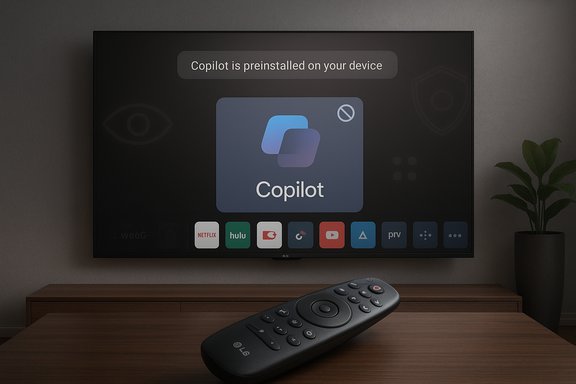
LG owners woke up to a routine webOS update this month and found Microsoft’s Copilot pinned to their home screens — an assistant they didn’t ask for and, in many reported cases, cannot delete.
Background / Overview
LG and Microsoft publicly signalled plans to bring Copilot to living-room screens at CES 2025, pitching the assistant as an on-screen companion for content discovery, voice-first search, and contextual recommendations. LG framed the feature as part of an “AI-forward” webOS roadmap and an upgraded webOS Hub that surfaces AI features through a rebranded AI Remote and a dedicated AI section in the interface. What changed in the field was delivery and control. After a recent webOS firmware-over-the-air (FOTA) push, multiple owners reported a new Copilot tile appearing on their TV home screens. Unlike ordinary apps such as Netflix or YouTube, community reports and screenshots show that the Copilot tile often lacks an uninstall option in the TV’s Edit/App Manager flows and can only be hidden — and in several documented cases a factory reset restored the tile. Those on-the-ground accounts are the core evidence driving consumer anger. The backlash has been loud on social media. A single Reddit post showing the unwanted tile drew tens of thousands of upvotes and hundreds of comments, crystallizing a broader frustration with smart‑TV vendors pushing AI and data-driven features onto already‑sold devices.What actually appeared on TVs
- The visible change: a Copilot tile or shortcut pinned to the webOS home ribbon or the AI/Assistant section after an automatic/required firmware update. The tile typically launches a Copilot experience; on many affected sets that experience appears to be a web-based Copilot page rendered inside the TV’s browser shell rather than a heavily integrated native app.
- Management behavior: in many reports the TV’s app-management UI exposes only hide or disable, not uninstall, for the Copilot entry. Multiple owners report that a factory reset reintroduces the tile — the classic symptom of a system-level or firmware‑baked package.
- User-visible functionality: the initial Copilot experience on affected LG sets is reported as lightweight — a conversational shortcut capable of accepting voice input via the remote — rather than the deeply integrated, visually rich assistant vendors demoed at trade shows.
Why this matters: ownership, privacy, and trust
The uproar isn’t just about a new app on the screen. It touches three overlapping issues that make this more than a UI annoyance.- Loss of device autonomy. Consumers reasonably expect software on purchased hardware to be optional, or at least removable. A system-level tile that cannot be uninstalled feels like forced software — effectively vendor-controlled features being pushed onto devices that customers already paid for. Community reporting shows that this is perceived as a loss of ownership.
- Expanded telemetry surface. Modern smart TVs already contain multiple telemetry channels — Automatic Content Recognition (ACR, marketed by LG as Live Plus), ad personalization controls, voice-recognition services, and more. Introducing a conversational assistant that benefits from contextual signals (what you’re watching, when, and possibly audio cues) raises plausible concerns about increased profiling and data flows. The specific telemetry changes Copilot introduces on top of existing signals remain unconfirmed without vendor disclosure or forensic audit. That uncertainty amplifies user fears.
- Opaque update mechanics. Firmware updates are generally expected to patch security or fix bugs; updates that add persistent, prominent third-party services without a clear consent step or a supported removal path erode trust. Reports indicate that users did not receive clear, model-specific notice or opt-in flows before Copilot appeared.
Technical mechanics: why the tile can be “undeletable”
Two well-known packaging choices explain why users experience Copilot as effectively permanent:- Privileged system package — the OEM installs the component outside the standard user app sandbox and marks it as a system app. In that model, the UI often exposes only hide/disable, not uninstall, because removing a system package could break platform features. This choice is standard for DRM and other platform services.
- Firmware-baked component — the Copilot entry is included in the firmware image written by the FOTA update. A factory reset restores that firmware image and therefore restores the baked-in component. Removing the component would usually require an official firmware rollback or a vendor-supported tool that most consumers don’t have.
What LG and Microsoft have said (and what they haven’t)
- The public, marketing record: LG documented a broader webOS AI push and the webOS Hub upgrades that promised integration with Copilot and other AI features; Microsoft and OEMs showcased Copilot’s TV ambitions at CES 2025. Those vendor-level statements established the intended feature set and partnership but stopped short of specifying deployment mechanics for in-field devices.
- The missing detail: neither LG nor Microsoft, in the initial wave of public-facing notices tied to the update, published a detailed consumer-facing technical bulletin explaining why Copilot was delivered as a system-level component on some firmware builds, or which models/batches would receive the change when, and whether customer-controlled uninstall paths would be provided. That gap is a core complaint from owners.
- On telemetry and audio capture: there is no vendor-confirmed indication that Copilot starts any novel always-on audio capture beyond existing voice-activation functionality, nor any public, technical whitepaper from LG detailing new data flows attributable to Copilot specifically. Treat claims about expanded, secretive microphone use or additional profiling as plausible concerns but unverified without technical disclosure or forensic analysis.
Practical mitigations for owners today
If Copilot has appeared on your webOS TV and you want to reduce its presence or the associated privacy footprint, these are the practical steps owners have reported as effective (or partially effective):- Edit the home screen / hide the tile. The UI typically allows hide; this removes the visible tile but does not uninstall the component. It’s a cosmetic mitigation only.
- Disable AI personalization settings such as Live Plus (Automatic Content Recognition) and limit ad tracking inside webOS settings. This reduces some data flows but does not remove Copilot.
- Disconnect the TV from the internet. Without network access the Copilot shortcut is inert. This protects privacy but disables all smart features, future updates, and streaming apps.
- Block the Copilot web host at the router or network level (Pi-hole, DNS blocking, firewall rules). This prevents the web-based Copilot pages from loading while keeping the TV online for local network use, but some services may degrade.
- Use an external streaming device (Apple TV, Roku, Fire TV, Nvidia Shield). Run third‑party streaming hardware through your TV’s HDMI input and treat the TV primarily as a display; this reduces reliance on webOS and hides the native home screen for daily use.
- File a support request or complaint with LG customer service requesting a permanent uninstall option or a firmware rollback if available.
Business motivations — follow the incentives
Why would LG and Microsoft push Copilot this way? There are several rational incentives:- Product differentiation: AI and on‑screen assistants are headline features for 2025 TVs; OEMs want to market AI-enabled experiences to justify premium pricing.
- Ecosystem reach: Microsoft gains presence on large, shared screens, which supports cross-device continuity and ecosystem lock-in.
- Monetization: improved personalization increases the value of ad inventory and platform engagement metrics, which is attractive to OEMs operating CTV/ad businesses.
Legal and regulatory angle
The incident sits at the intersection of consumer-protection expectations and digital-services regulation. Regulators have begun to scrutinize opaque data collection and forced software in many device classes. If a preinstalled or post-purchase firmware update installs persistent, non-removable software that alters device behavior and collects data, that could attract the attention of consumer-protection agencies in some jurisdictions.From a compliance viewpoint, transparent notice, opt-in mechanisms for new telemetry features, and clear uninstall paths are safer practices than surprise installs. Companies that make firmware-level choices to force partner software onto sold hardware risk consumer complaints, increased returns, and potential regulatory scrutiny — particularly when privacy or data collection are implicated.
Strengths and benefits of Copilot on TVs (the upside)
It’s worth acknowledging the legitimate use-cases and potential benefits that motivate bringing Copilot to large screens:- Faster content discovery: a conversational assistant can search across streaming apps and present unified results, which can be genuinely convenient on a couch-and-remote UX.
- Accessibility gains: voice-driven summaries, audio descriptions, and conversational navigation can help users with limited mobility or vision.
- Contextual value: Copilot can provide show recaps, cast information, and trivia during playback that some viewers will find useful.
Key risks and shortcomings (the downside)
- Delivery without consent: forcing a system-level tile onto existing hardware without a clear consent or removal mechanism is a UX and trust failure.
- Unclear telemetry: absent a vendor technical disclosure, the privacy implications of adding a conversational assistant are unclear and therefore worrying to many users.
- Incomplete implementation: early field reports suggest the Copilot entry behaves like a web shortcut in many cases rather than a polished native TV experience, increasing the perception of a rushed or half-baked rollout.
- Platform creep: the episode is another example of the slow creep of platform-level advertising and data collection into appliances that were once primarily hardware purchases.
What vendors should do now (a pragmatic checklist)
- Publish a clear, model-by-model rollout plan that lists which TVs will receive Copilot and when.
- Release a technical note describing what data Copilot collects, how audio input is handled, where data is sent, and how to opt out.
- Ship a user-facing uninstall option or a supported rollback for affected firmware builds — giving owners the control they were promised when buying the hardware.
- Default to privacy-minimal settings for newly added features and require explicit opt-in for personalization and ACR-based features.
- Improve communication channels so that firmware updates that change user-facing behavior require explicit user consent or at least a prominent pre-install notice.
What this episode means for smart‑TV owners and the industry
The Copilot-on-LG controversy is a bellwether moment. Hardware makers increasingly differentiate on software and services rather than raw panel specs. That shift creates pressure to ship new, attention-grabbing features to incumbent devices. Without clear rules of engagement — opt-in consent, easy removal, transparent data flows — consumers will push back, and regulators will follow.For owners, the practical takeaway is that smart‑TV software is now a living platform: post‑purchase changes can alter the ownership experience. If you value control and privacy, take steps now (disable ACR/Live Plus, hide the tile, consider network blocks or external streamers) and push vendors for policy changes that restore true choice.
Conclusion
Copilot on TVs is not inherently a bad idea: conversational discovery and contextual help can add real value on a large, shared screen. The problem in this latest episode is not the concept but the execution. Dropping a preinstalled Copilot tile onto paid-for hardware through a firmware update, without a clear uninstall path or an explicit opt-in, turned a potential convenience into a trust failure.Short-term mitigations exist — hiding the tile, disabling personalization, or isolating the TV from the network — but they are stopgap measures. The long-term path back to consumer trust requires vendors to prioritize transparency, meaningful opt-outs, and technical routes that preserve user agency over devices they own. Until then, many owners will treat branded AI on their TVs as an unwanted feature rather than a welcome upgrade.
Source: Fudzilla.com LG stuffs Copilot onto smart TVs
