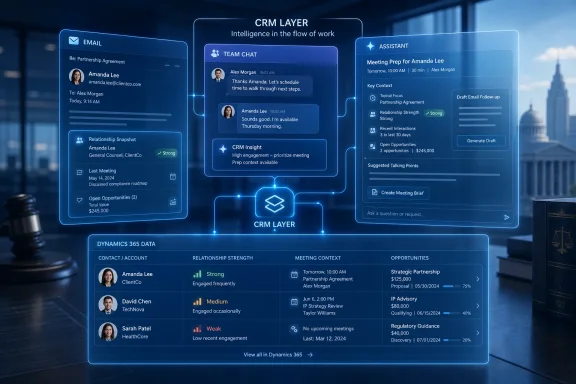
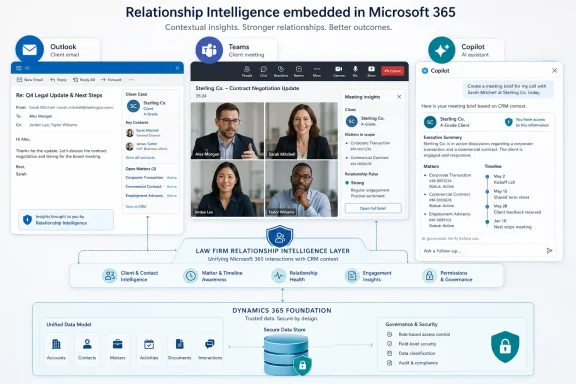
Foundation 365, Litera’s AI-powered client relationship platform for law firms, became available within Microsoft 365 on June 3, 2026, extending legal CRM data into Outlook, Teams, and Microsoft 365 Copilot through a product built on Microsoft Dynamics 365. That sentence sounds like a routine integration announcement, but it is really a map of where legal software is going. The legal tech fight is no longer about whether firms will buy AI; it is about which vendor gets to sit inside the workflow lawyers already refuse to leave. For Microsoft-heavy firms, Litera is making a blunt wager: the next legal CRM will not look like a CRM at all.
The least surprising thing about Foundation 365 is that it lives in Microsoft 365. The most important thing about it is that Litera is treating that location as the product. Outlook, Teams, Word, and Copilot are not just distribution channels here; they are the new user interface for law firm growth.
That matters because CRM has always been a slightly awkward category in legal. Firms know relationship intelligence is valuable, but lawyers are famously poor CRM clerks. They do not want to log interactions, update contacts, classify opportunities, or spend non-billable time feeding a system whose benefits often accrue to someone else.
Litera’s announcement is aimed directly at that adoption problem. If client, contact, and relationship data can appear while a lawyer is preparing for a meeting, reading an email, joining a Teams call, or asking Copilot for help, the CRM stops being a destination and becomes background infrastructure. That is the promise, at least.
The company’s pitch also reflects a wider change in enterprise software. AI has made the “system of record” less glamorous than the “system of action.” The database still matters, but the competitive edge is now in surfacing the right signal at the right moment, preferably before the professional has to go looking for it.
For law firms, that is an especially sharp proposition. The most valuable relationship data often lives in fragments: an old pitch, a billing history, a contact tucked away in Outlook, a partner’s memory, a Teams chat, a matter record, a marketing list, a spreadsheet maintained by business development. Foundation 365’s job is to turn that mess into a usable institutional asset without forcing lawyers to behave like sales reps.
Peppermint’s heritage matters because many legal vendors have spent years integrating with Microsoft from the outside. Peppermint’s proposition was different. Its CX365 platform was designed around Microsoft’s cloud stack, with Dynamics 365 as a foundation and Microsoft 365 as the place where users worked.
That gave Litera something it could not easily bolt on after the fact. A credible legal CRM inside Microsoft’s ecosystem requires more than a plug-in. It requires permissions models, data mappings, contact synchronization, legal-specific workflows, and enough familiarity with law firm operations to avoid becoming a generic sales automation tool in a tailored suit.
The acquisition also filled a strategic gap. Litera has long had a strong footprint in drafting, document comparison, transaction work, knowledge, and experience management. But client development is where the business of law meets the work of law, and it is where many firms still struggle to connect institutional knowledge to revenue opportunities.
By rebranding and relaunching Peppermint’s client engagement capabilities as Foundation 365, Litera is not merely adding another product tile. It is trying to assemble a broader legal operating layer around Microsoft 365: drafting, knowledge, relationship intelligence, and now AI-assisted business development, all close to the tools lawyers already use.
That distinction is not cosmetic. A law firm relationship is rarely owned by a single person in the neat way a sales account might be owned inside a conventional company. One partner may have the historical relationship, another may be doing the active matter work, a third may know the general counsel socially, and a fourth may be best positioned to introduce a new practice area.
That is why legal CRM has always been harder than importing a corporate sales model into a partnership. Law firms need to know not only who knows whom, but how strong that connection is, when it was last active, which matters or pitches connect to it, and whether outreach would feel useful or opportunistic. The best answer is often political as much as mathematical.
Foundation 365’s value proposition is built around that reality. Litera says the platform is designed to show which relationships are strong, which need attention, and who inside the firm is best positioned to make contact. In plain English, it is trying to make relationship capital visible before a client meeting, not after a lost opportunity.
There is a reason this language will resonate with managing partners and chief marketing and business development officers. Law firms have spent years telling themselves they are relationship businesses while keeping much of their relationship data trapped in inboxes and individual memories. AI does not solve that cultural problem by itself, but it makes the cost of inaction harder to defend.
That is a big deal because Copilot changes the user’s expectation of where information should appear. In the old model, a lawyer searched a document management system, opened a CRM record, checked a billing dashboard, and asked an assistant or business development colleague for context. In the Copilot model, the user asks a question and expects the relevant systems to assemble an answer.
For law firms, that raises the stakes on data quality. A bad CRM record is annoying when it sits quietly in a database. It is more dangerous when an AI assistant confidently brings it into a meeting brief, relationship summary, or client call preparation workflow. Foundation 365’s promise depends not only on integration, but on governance, hygiene, and trust.
This is where Litera’s Microsoft alignment cuts both ways. On the positive side, many firms have already standardized on Microsoft 365 for identity, collaboration, email, calendaring, and increasingly AI. Bringing legal CRM into that environment reduces friction and may simplify adoption.
On the risk side, Microsoft 365 is also where oversharing, permission sprawl, and data classification weaknesses can become brutally visible. If Copilot is only as good as the content and access controls beneath it, legal CRM data needs to be curated with unusual care. A partner should be able to discover that a colleague has a strong client relationship; that does not mean every sensitive note, pitch strategy, or internal assessment should surface casually in a prompt response.
That tension will define the next phase of legal AI adoption. The firms that benefit most will not be the ones that merely switch on Copilot-connected tools. They will be the ones that have done the unglamorous work of cleaning data, defining access, mapping client teams, and deciding which knowledge is safe to operationalize.
That is a sensible direction. Legal work is not one workflow. Drafting a merger agreement, preparing for a client meeting, triaging a relationship risk, and building a pitch are different jobs with different data sources and risk profiles. A generic chatbot can impress in a demo and disappoint in practice because it has no deep connection to the firm’s systems or habits.
The question is whether Lito becomes a genuinely useful agent or simply a branded layer over functions Microsoft is already trying to commoditize. Every vendor building on Microsoft 365 faces this dilemma. Microsoft controls the operating surface; specialist vendors must prove that their domain knowledge, data models, and workflows add enough value to justify another subscription and another dependency.
Litera’s argument is that legal specificity matters. Foundation 365 is not a generic CRM with “law firm” added to the sales deck. It is supposed to understand relationship strength, firmwide contacts, client development, matter context, and the peculiar way lawyers collaborate and compete inside partnerships.
That argument is stronger in legal than it would be in many other verticals. Law firms have conflicts rules, confidentiality duties, client team structures, partner compensation dynamics, and matter histories that generic CRM platforms do not naturally understand. The opportunity for Litera is to make Microsoft 365 feel legally literate.
The danger is that every legal vendor is now telling some version of that story. “Meet lawyers where they work” has become the industry’s favorite sentence. The winners will be the companies that make the sentence boringly true: fewer clicks, fewer duplicate records, better meeting prep, cleaner contacts, more timely outreach, and less administrative theater.
This is a notable reversal from an earlier era of legal tech. For years, the center of gravity was often the document management system, the practice management suite, or a specialist legal platform. Microsoft Office was indispensable, but it was treated as the place where work happened after other systems had done their part.
Copilot changes that. Microsoft is trying to make Microsoft 365 not only the place where documents, emails, meetings, and chats live, but the interface through which employees query organizational knowledge. If that strategy works, vendors that do not integrate deeply into Microsoft’s AI layer risk being pushed to the edge of daily work.
Litera clearly understands this. Its recent positioning around Microsoft 365 is not a casual partnership story; it is a platform bet. Foundation 365, Lito, and Litera’s broader Microsoft integrations all point toward a future in which legal professionals interact with firm systems through the same surfaces they use for communication and drafting.
That should make IT leaders both interested and cautious. On one hand, consolidating workflows inside Microsoft 365 can reduce training burden, improve security consistency, and make AI adoption feel less like a separate transformation program. On the other, it deepens dependence on Microsoft’s roadmap, licensing model, identity architecture, and AI governance capabilities.
There is also a subtle power shift. If Microsoft 365 becomes the universal workbench, then legal tech vendors compete less on owning the screen and more on owning the data, workflow logic, and domain intelligence that surface inside that screen. The user may think they are “using Copilot,” even when the valuable answer comes from Litera, iManage, NetDocuments, a finance system, or a custom firm knowledge base.
That is not necessarily bad for users. In fact, it may be exactly what professionals want. But it changes how buyers should evaluate software. The old question was whether a product had a good interface. The new question is whether it contributes reliable, permission-aware intelligence to the firm’s shared AI fabric.
A platform that infers relationship strength from emails, meetings, contacts, and collaboration patterns can help a firm avoid embarrassing gaps. It can identify dormant relationships, suggest the right partner for an introduction, and prevent a pitch team from missing an internal connection that could change the outcome. Those are real advantages.
But firms will have to draw lines. Lawyers may resist systems that appear to mine their communications for business development intelligence without clear rules. Clients may have expectations about confidentiality that go beyond what a permissions model technically allows. Business development teams may want broader visibility than partners are comfortable granting.
Litera’s integration with Microsoft 365 makes these issues more urgent because the data sources are so close to daily work. Outlook and Teams contain the living record of a firm’s relationships, but they also contain privileged, sensitive, and politically delicate material. The difference between useful relationship intelligence and creepy overreach will come down to design and governance.
That means administrators should not treat Foundation 365 as a simple application rollout. It belongs in the same conversation as data loss prevention, retention, sensitivity labels, ethical walls, client confidentiality, and Copilot readiness. The CRM may be sold to business development, but its consequences land in IT, risk, and firm management.
The best firms will make the bargain explicit. They will tell lawyers what data is used, what is not used, who can see relationship insights, how sensitive matters are excluded, and how corrections are made. AI-powered CRM cannot run on trust if the humans using it do not understand the bargain.
Still, installed base is not the same as active transformation. Many enterprise CRM deployments have impressive license counts and disappointing daily usage. The hard question is not whether firms bought the system, but whether lawyers change behavior because of it.
That is why the Microsoft 365 integration matters so much. If Foundation 365 can reduce the gap between availability and use, it could solve one of legal CRM’s chronic problems. Lawyers who will not open a standalone CRM may accept context that appears in Outlook or a Copilot-generated meeting brief.
But adoption will depend on whether the insights are good enough to become habit-forming. If Foundation 365 surfaces stale contacts, weak suggestions, or generic summaries, lawyers will dismiss it quickly. Legal professionals have a high tolerance for ugly tools they must use and a low tolerance for optional tools that waste time.
The system’s success will also depend on whether business development teams can turn AI-assisted insight into disciplined follow-through. Knowing that a relationship needs attention is not the same as deciding who calls, what they say, how the action is recorded, and whether the client experiences the outreach as valuable. Software can expose the opportunity; management still has to run the play.
The firms most likely to benefit are those that already treat client development as an institutional function rather than a collection of heroic individual efforts. Foundation 365 can amplify a coordinated strategy. It cannot magically create one.
That matters in enterprise procurement. Law firm CIOs and innovation leaders are far more comfortable with vendors that align with existing Microsoft investments. A product built on Dynamics 365, surfaced through Microsoft 365, and recognized by Microsoft’s partner ecosystem has an easier path through security and architecture discussions than a tool that asks the firm to embrace a separate stack.
But partner recognition should not be mistaken for product proof. Microsoft’s ecosystem is full of well-positioned vendors whose success depends on implementation quality, data readiness, and user adoption. A badge can help a vendor enter the room; it does not make the software valuable by itself.
The same caveat applies to the phrase “built on Microsoft.” For some buyers, that phrase means security, scalability, identity integration, and administrative familiarity. For others, it raises questions about licensing complexity, tenant configuration, API dependencies, and how much flexibility remains once the vendor’s roadmap is tied to Microsoft’s.
For IT teams, the practical evaluation should be concrete. How does Foundation 365 handle permissions? How does it interact with Copilot? What data does it index or summarize? How are conflicts, ethical walls, and confidential client teams respected? What happens when a user leaves the firm, changes practice groups, or moves from one client team to another?
Those are not objections to the product. They are the questions that determine whether an AI-powered CRM becomes a trusted layer of firm intelligence or another well-intentioned system that administrators spend years untangling.
The status quo is a partner’s inbox, an assistant’s memory, a half-updated contact list, a spreadsheet of targets, a pitch folder, and a business development professional who knows which partner actually has the relationship. It is inefficient, but it is familiar. It also preserves individual control, which matters in law firm politics.
Litera’s challenge is therefore cultural as much as technical. Foundation 365 has to persuade firms that relationship data becomes more valuable when it is shared appropriately. That is easy to say and hard to implement in organizations where origination credit, client ownership, and internal influence are often tied to who knows what.
AI may help by making the benefits more immediate. A lawyer preparing for a client call may care less about “CRM hygiene” than about a concise summary of recent interactions, open opportunities, known risks, and the colleague best positioned to help. If the tool delivers that in the moment, it can make data sharing feel less like compliance and more like self-interest.
But the same AI layer can also expose the weakness of the underlying culture. If lawyers do not trust the system, do not correct records, or do not believe they will be treated fairly when relationships are surfaced, the technology will disappoint. The machine can infer patterns, but the firm has to decide what those patterns mean.
This is why Foundation 365’s arrival inside Microsoft 365 is important but not sufficient. It lowers friction. It does not abolish incentives.
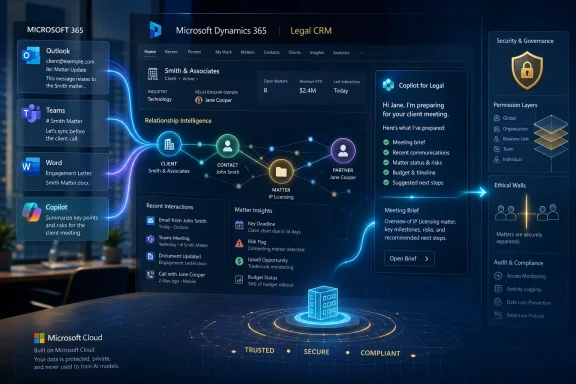 Litera Moves the CRM Into the Lawyer’s Line of Sight
The least surprising thing about Foundation 365 is that it lives in Microsoft 365. The most important thing about it is that Litera is treating that location as the product. Outlook, Teams, Word, and Copilot are not just distribution channels here; they are the new user interface for law firm growth.That matters because CRM has always been a slightly awkward category in legal. Firms know relationship intelligence is valuable, but lawyers are famously poor CRM clerks. They do not want to log interactions, update contacts, classify opportunities, or spend non-billable time feeding a system whose benefits often accrue to someone else.
Litera’s announcement is aimed directly at that adoption problem. If client, contact, and relationship data can appear while a lawyer is preparing for a meeting, reading an email, joining a Teams call, or asking Copilot for help, the CRM stops being a destination and becomes background infrastructure. That is the promise, at least.
The company’s pitch also reflects a wider change in enterprise software. AI has made the “system of record” less glamorous than the “system of action.” The database still matters, but the competitive edge is now in surfacing the right signal at the right moment, preferably before the professional has to go looking for it.
For law firms, that is an especially sharp proposition. The most valuable relationship data often lives in fragments: an old pitch, a billing history, a contact tucked away in Outlook, a partner’s memory, a Teams chat, a matter record, a marketing list, a spreadsheet maintained by business development. Foundation 365’s job is to turn that mess into a usable institutional asset without forcing lawyers to behave like sales reps.
The Peppermint Deal Now Looks Like a Microsoft Strategy
Foundation 365 did not appear from nowhere. It is the renamed and repositioned descendant of Peppermint Client Engagement, which came to Litera through its February 2025 acquisition of Peppermint Technology, a U.K. legal software company known for applications built on Microsoft technology. At the time, the deal looked like another consolidation move in a crowded legal tech market. In hindsight, it looks more specific: Litera was buying a Microsoft-native path into the business development layer of law firms.Peppermint’s heritage matters because many legal vendors have spent years integrating with Microsoft from the outside. Peppermint’s proposition was different. Its CX365 platform was designed around Microsoft’s cloud stack, with Dynamics 365 as a foundation and Microsoft 365 as the place where users worked.
That gave Litera something it could not easily bolt on after the fact. A credible legal CRM inside Microsoft’s ecosystem requires more than a plug-in. It requires permissions models, data mappings, contact synchronization, legal-specific workflows, and enough familiarity with law firm operations to avoid becoming a generic sales automation tool in a tailored suit.
The acquisition also filled a strategic gap. Litera has long had a strong footprint in drafting, document comparison, transaction work, knowledge, and experience management. But client development is where the business of law meets the work of law, and it is where many firms still struggle to connect institutional knowledge to revenue opportunities.
By rebranding and relaunching Peppermint’s client engagement capabilities as Foundation 365, Litera is not merely adding another product tile. It is trying to assemble a broader legal operating layer around Microsoft 365: drafting, knowledge, relationship intelligence, and now AI-assisted business development, all close to the tools lawyers already use.
“GrowthTech” Is Marketing, but the Pain Point Is Real
Litera calls this category “GrowthTech,” a term that deserves some skepticism because enterprise software vendors have an inexhaustible gift for naming old problems as new markets. Still, the underlying distinction is useful. Traditional CRM often asks firms to track relationships. Litera wants to help firms act on them.That distinction is not cosmetic. A law firm relationship is rarely owned by a single person in the neat way a sales account might be owned inside a conventional company. One partner may have the historical relationship, another may be doing the active matter work, a third may know the general counsel socially, and a fourth may be best positioned to introduce a new practice area.
That is why legal CRM has always been harder than importing a corporate sales model into a partnership. Law firms need to know not only who knows whom, but how strong that connection is, when it was last active, which matters or pitches connect to it, and whether outreach would feel useful or opportunistic. The best answer is often political as much as mathematical.
Foundation 365’s value proposition is built around that reality. Litera says the platform is designed to show which relationships are strong, which need attention, and who inside the firm is best positioned to make contact. In plain English, it is trying to make relationship capital visible before a client meeting, not after a lost opportunity.
There is a reason this language will resonate with managing partners and chief marketing and business development officers. Law firms have spent years telling themselves they are relationship businesses while keeping much of their relationship data trapped in inboxes and individual memories. AI does not solve that cultural problem by itself, but it makes the cost of inaction harder to defend.
Copilot Becomes the Front Door for Firm Intelligence
The most strategically important part of the announcement is not Outlook or Teams integration. It is Microsoft 365 Copilot. Litera is placing Foundation 365 data into the same conversational and contextual layer Microsoft is trying to make central to office work.That is a big deal because Copilot changes the user’s expectation of where information should appear. In the old model, a lawyer searched a document management system, opened a CRM record, checked a billing dashboard, and asked an assistant or business development colleague for context. In the Copilot model, the user asks a question and expects the relevant systems to assemble an answer.
For law firms, that raises the stakes on data quality. A bad CRM record is annoying when it sits quietly in a database. It is more dangerous when an AI assistant confidently brings it into a meeting brief, relationship summary, or client call preparation workflow. Foundation 365’s promise depends not only on integration, but on governance, hygiene, and trust.
This is where Litera’s Microsoft alignment cuts both ways. On the positive side, many firms have already standardized on Microsoft 365 for identity, collaboration, email, calendaring, and increasingly AI. Bringing legal CRM into that environment reduces friction and may simplify adoption.
On the risk side, Microsoft 365 is also where oversharing, permission sprawl, and data classification weaknesses can become brutally visible. If Copilot is only as good as the content and access controls beneath it, legal CRM data needs to be curated with unusual care. A partner should be able to discover that a colleague has a strong client relationship; that does not mean every sensitive note, pitch strategy, or internal assessment should surface casually in a prompt response.
That tension will define the next phase of legal AI adoption. The firms that benefit most will not be the ones that merely switch on Copilot-connected tools. They will be the ones that have done the unglamorous work of cleaning data, defining access, mapping client teams, and deciding which knowledge is safe to operationalize.
Lito Gives Litera a Legal AI Personality, but Microsoft Gives It Reach
Litera has already been pushing Lito, its legal AI agent, across Outlook, Word, the web, and iOS. Foundation 365 extends that story into client development. The move suggests Litera does not see legal AI as a single assistant for drafting or research, but as a set of agents embedded in different moments of legal work.That is a sensible direction. Legal work is not one workflow. Drafting a merger agreement, preparing for a client meeting, triaging a relationship risk, and building a pitch are different jobs with different data sources and risk profiles. A generic chatbot can impress in a demo and disappoint in practice because it has no deep connection to the firm’s systems or habits.
The question is whether Lito becomes a genuinely useful agent or simply a branded layer over functions Microsoft is already trying to commoditize. Every vendor building on Microsoft 365 faces this dilemma. Microsoft controls the operating surface; specialist vendors must prove that their domain knowledge, data models, and workflows add enough value to justify another subscription and another dependency.
Litera’s argument is that legal specificity matters. Foundation 365 is not a generic CRM with “law firm” added to the sales deck. It is supposed to understand relationship strength, firmwide contacts, client development, matter context, and the peculiar way lawyers collaborate and compete inside partnerships.
That argument is stronger in legal than it would be in many other verticals. Law firms have conflicts rules, confidentiality duties, client team structures, partner compensation dynamics, and matter histories that generic CRM platforms do not naturally understand. The opportunity for Litera is to make Microsoft 365 feel legally literate.
The danger is that every legal vendor is now telling some version of that story. “Meet lawyers where they work” has become the industry’s favorite sentence. The winners will be the companies that make the sentence boringly true: fewer clicks, fewer duplicate records, better meeting prep, cleaner contacts, more timely outreach, and less administrative theater.
The Microsoft Stack Is Becoming the New Legal Tech Battleground
For WindowsForum readers, the significance of Foundation 365 is not just that another legal tool has arrived in Microsoft 365. It is that Microsoft’s productivity suite is becoming the gravitational center around which vertical software vendors now organize themselves.This is a notable reversal from an earlier era of legal tech. For years, the center of gravity was often the document management system, the practice management suite, or a specialist legal platform. Microsoft Office was indispensable, but it was treated as the place where work happened after other systems had done their part.
Copilot changes that. Microsoft is trying to make Microsoft 365 not only the place where documents, emails, meetings, and chats live, but the interface through which employees query organizational knowledge. If that strategy works, vendors that do not integrate deeply into Microsoft’s AI layer risk being pushed to the edge of daily work.
Litera clearly understands this. Its recent positioning around Microsoft 365 is not a casual partnership story; it is a platform bet. Foundation 365, Lito, and Litera’s broader Microsoft integrations all point toward a future in which legal professionals interact with firm systems through the same surfaces they use for communication and drafting.
That should make IT leaders both interested and cautious. On one hand, consolidating workflows inside Microsoft 365 can reduce training burden, improve security consistency, and make AI adoption feel less like a separate transformation program. On the other, it deepens dependence on Microsoft’s roadmap, licensing model, identity architecture, and AI governance capabilities.
There is also a subtle power shift. If Microsoft 365 becomes the universal workbench, then legal tech vendors compete less on owning the screen and more on owning the data, workflow logic, and domain intelligence that surface inside that screen. The user may think they are “using Copilot,” even when the valuable answer comes from Litera, iManage, NetDocuments, a finance system, or a custom firm knowledge base.
That is not necessarily bad for users. In fact, it may be exactly what professionals want. But it changes how buyers should evaluate software. The old question was whether a product had a good interface. The new question is whether it contributes reliable, permission-aware intelligence to the firm’s shared AI fabric.
Law Firms Want Relationship Intelligence Without Surveillance Theater
Relationship analytics is powerful because it can reveal hidden connections. It is also sensitive because it can feel like surveillance. That tension is especially acute inside law firms, where personal networks are part of professional identity and often part of partner economics.A platform that infers relationship strength from emails, meetings, contacts, and collaboration patterns can help a firm avoid embarrassing gaps. It can identify dormant relationships, suggest the right partner for an introduction, and prevent a pitch team from missing an internal connection that could change the outcome. Those are real advantages.
But firms will have to draw lines. Lawyers may resist systems that appear to mine their communications for business development intelligence without clear rules. Clients may have expectations about confidentiality that go beyond what a permissions model technically allows. Business development teams may want broader visibility than partners are comfortable granting.
Litera’s integration with Microsoft 365 makes these issues more urgent because the data sources are so close to daily work. Outlook and Teams contain the living record of a firm’s relationships, but they also contain privileged, sensitive, and politically delicate material. The difference between useful relationship intelligence and creepy overreach will come down to design and governance.
That means administrators should not treat Foundation 365 as a simple application rollout. It belongs in the same conversation as data loss prevention, retention, sensitivity labels, ethical walls, client confidentiality, and Copilot readiness. The CRM may be sold to business development, but its consequences land in IT, risk, and firm management.
The best firms will make the bargain explicit. They will tell lawyers what data is used, what is not used, who can see relationship insights, how sensitive matters are excluded, and how corrections are made. AI-powered CRM cannot run on trust if the humans using it do not understand the bargain.
The Numbers Are Impressive, but Adoption Is the Real Test
Litera says Foundation 365 is used by five of the Global Top 10 law firms and more than 4,000 firms worldwide. Those numbers give the announcement credibility, particularly in a market where legal buyers often look sideways at peer adoption before moving. Nobody wants to be first with a risky system, but nobody wants to be last with a useful one.Still, installed base is not the same as active transformation. Many enterprise CRM deployments have impressive license counts and disappointing daily usage. The hard question is not whether firms bought the system, but whether lawyers change behavior because of it.
That is why the Microsoft 365 integration matters so much. If Foundation 365 can reduce the gap between availability and use, it could solve one of legal CRM’s chronic problems. Lawyers who will not open a standalone CRM may accept context that appears in Outlook or a Copilot-generated meeting brief.
But adoption will depend on whether the insights are good enough to become habit-forming. If Foundation 365 surfaces stale contacts, weak suggestions, or generic summaries, lawyers will dismiss it quickly. Legal professionals have a high tolerance for ugly tools they must use and a low tolerance for optional tools that waste time.
The system’s success will also depend on whether business development teams can turn AI-assisted insight into disciplined follow-through. Knowing that a relationship needs attention is not the same as deciding who calls, what they say, how the action is recorded, and whether the client experiences the outreach as valuable. Software can expose the opportunity; management still has to run the play.
The firms most likely to benefit are those that already treat client development as an institutional function rather than a collection of heroic individual efforts. Foundation 365 can amplify a coordinated strategy. It cannot magically create one.
Microsoft’s Partner Awards Signal Momentum, Not Immunity
Litera’s receipt of Microsoft’s 2025–2026 AI Business Solutions Inner Circle Award gives the announcement an additional sheen. Microsoft gives that recognition to a small slice of its partner network, and for buyers it signals that Litera is not merely building adjacent to Microsoft but operating within a favored partner orbit.That matters in enterprise procurement. Law firm CIOs and innovation leaders are far more comfortable with vendors that align with existing Microsoft investments. A product built on Dynamics 365, surfaced through Microsoft 365, and recognized by Microsoft’s partner ecosystem has an easier path through security and architecture discussions than a tool that asks the firm to embrace a separate stack.
But partner recognition should not be mistaken for product proof. Microsoft’s ecosystem is full of well-positioned vendors whose success depends on implementation quality, data readiness, and user adoption. A badge can help a vendor enter the room; it does not make the software valuable by itself.
The same caveat applies to the phrase “built on Microsoft.” For some buyers, that phrase means security, scalability, identity integration, and administrative familiarity. For others, it raises questions about licensing complexity, tenant configuration, API dependencies, and how much flexibility remains once the vendor’s roadmap is tied to Microsoft’s.
For IT teams, the practical evaluation should be concrete. How does Foundation 365 handle permissions? How does it interact with Copilot? What data does it index or summarize? How are conflicts, ethical walls, and confidential client teams respected? What happens when a user leaves the firm, changes practice groups, or moves from one client team to another?
Those are not objections to the product. They are the questions that determine whether an AI-powered CRM becomes a trusted layer of firm intelligence or another well-intentioned system that administrators spend years untangling.
The Real Competition Is the Status Quo
It is tempting to frame Foundation 365 against other legal CRM vendors or broader platforms such as Salesforce and Dynamics-based competitors. That is part of the story, but not the whole story. The most formidable competitor in law firm relationship management remains the status quo.The status quo is a partner’s inbox, an assistant’s memory, a half-updated contact list, a spreadsheet of targets, a pitch folder, and a business development professional who knows which partner actually has the relationship. It is inefficient, but it is familiar. It also preserves individual control, which matters in law firm politics.
Litera’s challenge is therefore cultural as much as technical. Foundation 365 has to persuade firms that relationship data becomes more valuable when it is shared appropriately. That is easy to say and hard to implement in organizations where origination credit, client ownership, and internal influence are often tied to who knows what.
AI may help by making the benefits more immediate. A lawyer preparing for a client call may care less about “CRM hygiene” than about a concise summary of recent interactions, open opportunities, known risks, and the colleague best positioned to help. If the tool delivers that in the moment, it can make data sharing feel less like compliance and more like self-interest.
But the same AI layer can also expose the weakness of the underlying culture. If lawyers do not trust the system, do not correct records, or do not believe they will be treated fairly when relationships are surfaced, the technology will disappoint. The machine can infer patterns, but the firm has to decide what those patterns mean.
This is why Foundation 365’s arrival inside Microsoft 365 is important but not sufficient. It lowers friction. It does not abolish incentives.
The Foundation 365 Bet Comes Down to Five Practical Tests
The announcement is best read not as a finished victory lap, but as a signpost for where legal AI is moving. Foundation 365 puts Litera deeper into Microsoft’s productivity environment and gives law firms a more plausible way to make CRM data visible in daily work. The practical judgment will come from what happens after deployment.- Foundation 365 is now positioned as a Microsoft 365-native legal CRM and relationship intelligence platform rather than a standalone database lawyers must remember to visit.
- Litera’s 2025 acquisition of Peppermint Technology now looks central to its Microsoft strategy, not merely an expansion of its product catalog.
- The integration with Microsoft 365 Copilot raises the value of clean, permission-aware client data because AI summaries are only as trustworthy as the systems beneath them.
- Law firm IT and risk teams should treat AI-powered CRM as a governance project involving identity, confidentiality, ethical walls, retention, and data quality.
- The product’s success will depend less on whether firms buy it than on whether lawyers find its relationship insights accurate enough to use without being forced.
- Microsoft’s role as the legal workbench is growing, and specialist vendors such as Litera will increasingly compete on the quality of the domain intelligence they bring into that workbench.
References
- Primary source: LawSites | by Robert Ambrogi
Published: Wed, 03 Jun 2026 12:03:16 GMT
Foundation 365, Litera's AI-Powered CRM Platform for Law Firms, Is Now Available within Microsoft 365 | LawSites
Foundation 365, Litera's AI-powered CRM platform for law firms, is now available across Microsoft 365, including Outlook, Teams and Microsoft 365 Copilot, the company said today. Built on Microsoft Dy...www.lawnext.com - Related coverage: litera.com
- Related coverage: cbinsights.com
Litera Stock Price, Funding, Valuation, Revenue & Financial Statements
See Litera funding rounds, investors, investments, exits and more. Evaluate their financials based on Litera's post-money valuation and revenue.www.cbinsights.com
- Related coverage: owler.com
Litera Acquisitions - Owler
Litera acquisitions and mergers include Peppermint Technology, Office & Dragons and FileTrail. Learn more about these acquired companies and mergers on Owler, the world’s largest community-based business insights platform. www.owler.com
- Related coverage: jdjournal.com
Litera’s Strategic Acquisition of Peppermint Technology: A Game-Changer in Legal Tech - JDJournal Blog
Introduction: The Evolution of Legal Technology The legal tech industry is undergoing a seismic shift as firms embrace AI, automation, and cloud-based solutions to drive efficiency. One of the most significant moves in this space is Litera’s recent acquisition of Peppermint Technology, a... www.jdjournal.com
- Related coverage: legaltechnology.com
Litera’s acquisition of Peppermint: The inside view - Legal IT Insider
Avaneesh Marwaha & Gary Young, CEOs of Litera & Peppermint, tell us what the driving forces were behind the acquisition & what happens nowlegaltechnology.com
- Related coverage: ilta.legaltechnologyhub.com
Peppermint CX365 by Litera | Legaltech Hub
Peppermint CX365 delivers a cloud-based legal platform and modular applications suite, bringing the best of Microsoft Cloud into the context of the modern law firm’s operating environment. ilta.legaltechnologyhub.com
- Related coverage: app.dealroom.co
Litera Acquires Peppermint Technology Platform | Dealroom.co
Litera has acquired Peppermint Technology, a Microsoft partner known for its CX365 platform, marking its largest acquisition since Kira. This move aims to enhance Litera's integration with Microsoft applications, focusing on data-driven insights for law firms. CEO Avaneesh Marwaha...app.dealroom.co - Related coverage: legaltechnologyhub.com
Litera Acquires Peppermint Technology, Enhancing Ability to Serve Firms in the Microsoft Cloud | Legaltech Hub
Peppermint Technology’s fully integrated suite of legal-specific apps built on Microsoft will bolster Litera’s ability to offer firms its experience management capabilities directly via the Microsoft Cloud. www.legaltechnologyhub.com
- Related coverage: theedgeroom.com
INTRODUCING LITERA ONE: THE FIRST PLATFORM CONNECTING THE FULL SPECTRUM OF LEGAL WORK, SEAMLESSLY INTEGRATING WITH MICROSOFT 365
PDF documentwww.theedgeroom.com