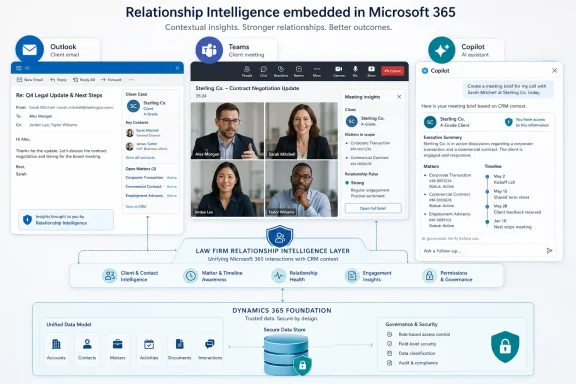
Litera Foundation 365: Legal CRM Meets Microsoft 365 Copilot for Relationship Intelligence

Foundation 365, Litera’s AI-powered client relationship platform for law firms, became available within Microsoft 365 on June 3, 2026, extending legal CRM data into Outlook, Teams, and Microsoft 365 Copilot through a product built on Microsoft Dynamics 365. That sentence sounds like a routine integration announcement, but it is really a map of where legal software is going. The legal tech fight is no longer about whether firms will buy AI; it is about which vendor gets to sit inside the workflow lawyers already refuse to leave. For Microsoft-heavy firms, Litera is making a blunt wager: the next legal CRM will not look like a CRM at all.

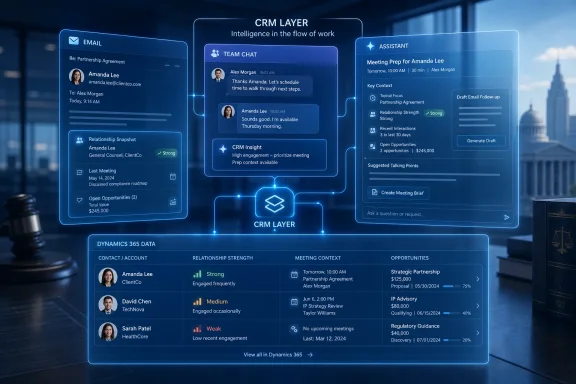
Microsoft Dynamics 365 Legal CRM dashboard with Copilot for Legal and security governance panels.Litera Moves the CRM Into the Lawyer’s Line of Sight​

The least surprising thing about Foundation 365 is that it lives in Microsoft 365. The most important thing about it is that Litera is treating that location as the product. Outlook, Teams, Word, and Copilot are not just distribution channels here; they are the new user interface for law firm growth.
That matters because CRM has always been a slightly awkward category in legal. Firms know relationship intelligence is valuable, but lawyers are famously poor CRM clerks. They do not want to log interactions, update contacts, classify opportunities, or spend non-billable time feeding a system whose benefits often accrue to someone else.
Litera’s announcement is aimed directly at that adoption problem. If client, contact, and relationship data can appear while a lawyer is preparing for a meeting, reading an email, joining a Teams call, or asking Copilot for help, the CRM stops being a destination and becomes background infrastructure. That is the promise, at least.
The company’s pitch also reflects a wider change in enterprise software. AI has made the “system of record” less glamorous than the “system of action.” The database still matters, but the competitive edge is now in surfacing the right signal at the right moment, preferably before the professional has to go looking for it.
For law firms, that is an especially sharp proposition. The most valuable relationship data often lives in fragments: an old pitch, a billing history, a contact tucked away in Outlook, a partner’s memory, a Teams chat, a matter record, a marketing list, a spreadsheet maintained by business development. Foundation 365’s job is to turn that mess into a usable institutional asset without forcing lawyers to behave like sales reps.

The Peppermint Deal Now Looks Like a Microsoft Strategy​

Foundation 365 did not appear from nowhere. It is the renamed and repositioned descendant of Peppermint Client Engagement, which came to Litera through its February 2025 acquisition of Peppermint Technology, a U.K. legal software company known for applications built on Microsoft technology. At the time, the deal looked like another consolidation move in a crowded legal tech market. In hindsight, it looks more specific: Litera was buying a Microsoft-native path into the business development layer of law firms.
Peppermint’s heritage matters because many legal vendors have spent years integrating with Microsoft from the outside. Peppermint’s proposition was different. Its CX365 platform was designed around Microsoft’s cloud stack, with Dynamics 365 as a foundation and Microsoft 365 as the place where users worked.
That gave Litera something it could not easily bolt on after the fact. A credible legal CRM inside Microsoft’s ecosystem requires more than a plug-in. It requires permissions models, data mappings, contact synchronization, legal-specific workflows, and enough familiarity with law firm operations to avoid becoming a generic sales automation tool in a tailored suit.
The acquisition also filled a strategic gap. Litera has long had a strong footprint in drafting, document comparison, transaction work, knowledge, and experience management. But client development is where the business of law meets the work of law, and it is where many firms still struggle to connect institutional knowledge to revenue opportunities.
By rebranding and relaunching Peppermint’s client engagement capabilities as Foundation 365, Litera is not merely adding another product tile. It is trying to assemble a broader legal operating layer around Microsoft 365: drafting, knowledge, relationship intelligence, and now AI-assisted business development, all close to the tools lawyers already use.

“GrowthTech” Is Marketing, but the Pain Point Is Real​

Litera calls this category “GrowthTech,” a term that deserves some skepticism because enterprise software vendors have an inexhaustible gift for naming old problems as new markets. Still, the underlying distinction is useful. Traditional CRM often asks firms to track relationships. Litera wants to help firms act on them.
That distinction is not cosmetic. A law firm relationship is rarely owned by a single person in the neat way a sales account might be owned inside a conventional company. One partner may have the historical relationship, another may be doing the active matter work, a third may know the general counsel socially, and a fourth may be best positioned to introduce a new practice area.
That is why legal CRM has always been harder than importing a corporate sales model into a partnership. Law firms need to know not only who knows whom, but how strong that connection is, when it was last active, which matters or pitches connect to it, and whether outreach would feel useful or opportunistic. The best answer is often political as much as mathematical.
Foundation 365’s value proposition is built around that reality. Litera says the platform is designed to show which relationships are strong, which need attention, and who inside the firm is best positioned to make contact. In plain English, it is trying to make relationship capital visible before a client meeting, not after a lost opportunity.
There is a reason this language will resonate with managing partners and chief marketing and business development officers. Law firms have spent years telling themselves they are relationship businesses while keeping much of their relationship data trapped in inboxes and individual memories. AI does not solve that cultural problem by itself, but it makes the cost of inaction harder to defend.

Copilot Becomes the Front Door for Firm Intelligence​

The most strategically important part of the announcement is not Outlook or Teams integration. It is Microsoft 365 Copilot. Litera is placing Foundation 365 data into the same conversational and contextual layer Microsoft is trying to make central to office work.
That is a big deal because Copilot changes the user’s expectation of where information should appear. In the old model, a lawyer searched a document management system, opened a CRM record, checked a billing dashboard, and asked an assistant or business development colleague for context. In the Copilot model, the user asks a question and expects the relevant systems to assemble an answer.
For law firms, that raises the stakes on data quality. A bad CRM record is annoying when it sits quietly in a database. It is more dangerous when an AI assistant confidently brings it into a meeting brief, relationship summary, or client call preparation workflow. Foundation 365’s promise depends not only on integration, but on governance, hygiene, and trust.
This is where Litera’s Microsoft alignment cuts both ways. On the positive side, many firms have already standardized on Microsoft 365 for identity, collaboration, email, calendaring, and increasingly AI. Bringing legal CRM into that environment reduces friction and may simplify adoption.
On the risk side, Microsoft 365 is also where oversharing, permission sprawl, and data classification weaknesses can become brutally visible. If Copilot is only as good as the content and access controls beneath it, legal CRM data needs to be curated with unusual care. A partner should be able to discover that a colleague has a strong client relationship; that does not mean every sensitive note, pitch strategy, or internal assessment should surface casually in a prompt response.
That tension will define the next phase of legal AI adoption. The firms that benefit most will not be the ones that merely switch on Copilot-connected tools. They will be the ones that have done the unglamorous work of cleaning data, defining access, mapping client teams, and deciding which knowledge is safe to operationalize.

Lito Gives Litera a Legal AI Personality, but Microsoft Gives It Reach​

Litera has already been pushing Lito, its legal AI agent, across Outlook, Word, the web, and iOS. Foundation 365 extends that story into client development. The move suggests Litera does not see legal AI as a single assistant for drafting or research, but as a set of agents embedded in different moments of legal work.
That is a sensible direction. Legal work is not one workflow. Drafting a merger agreement, preparing for a client meeting, triaging a relationship risk, and building a pitch are different jobs with different data sources and risk profiles. A generic chatbot can impress in a demo and disappoint in practice because it has no deep connection to the firm’s systems or habits.
The question is whether Lito becomes a genuinely useful agent or simply a branded layer over functions Microsoft is already trying to commoditize. Every vendor building on Microsoft 365 faces this dilemma. Microsoft controls the operating surface; specialist vendors must prove that their domain knowledge, data models, and workflows add enough value to justify another subscription and another dependency.
Litera’s argument is that legal specificity matters. Foundation 365 is not a generic CRM with “law firm” added to the sales deck. It is supposed to understand relationship strength, firmwide contacts, client development, matter context, and the peculiar way lawyers collaborate and compete inside partnerships.
That argument is stronger in legal than it would be in many other verticals. Law firms have conflicts rules, confidentiality duties, client team structures, partner compensation dynamics, and matter histories that generic CRM platforms do not naturally understand. The opportunity for Litera is to make Microsoft 365 feel legally literate.
The danger is that every legal vendor is now telling some version of that story. “Meet lawyers where they work” has become the industry’s favorite sentence. The winners will be the companies that make the sentence boringly true: fewer clicks, fewer duplicate records, better meeting prep, cleaner contacts, more timely outreach, and less administrative theater.

The Microsoft Stack Is Becoming the New Legal Tech Battleground​

For WindowsForum readers, the significance of Foundation 365 is not just that another legal tool has arrived in Microsoft 365. It is that Microsoft’s productivity suite is becoming the gravitational center around which vertical software vendors now organize themselves.
This is a notable reversal from an earlier era of legal tech. For years, the center of gravity was often the document management system, the practice management suite, or a specialist legal platform. Microsoft Office was indispensable, but it was treated as the place where work happened after other systems had done their part.
Copilot changes that. Microsoft is trying to make Microsoft 365 not only the place where documents, emails, meetings, and chats live, but the interface through which employees query organizational knowledge. If that strategy works, vendors that do not integrate deeply into Microsoft’s AI layer risk being pushed to the edge of daily work.
Litera clearly understands this. Its recent positioning around Microsoft 365 is not a casual partnership story; it is a platform bet. Foundation 365, Lito, and Litera’s broader Microsoft integrations all point toward a future in which legal professionals interact with firm systems through the same surfaces they use for communication and drafting.
That should make IT leaders both interested and cautious. On one hand, consolidating workflows inside Microsoft 365 can reduce training burden, improve security consistency, and make AI adoption feel less like a separate transformation program. On the other, it deepens dependence on Microsoft’s roadmap, licensing model, identity architecture, and AI governance capabilities.
There is also a subtle power shift. If Microsoft 365 becomes the universal workbench, then legal tech vendors compete less on owning the screen and more on owning the data, workflow logic, and domain intelligence that surface inside that screen. The user may think they are “using Copilot,” even when the valuable answer comes from Litera, iManage, NetDocuments, a finance system, or a custom firm knowledge base.
That is not necessarily bad for users. In fact, it may be exactly what professionals want. But it changes how buyers should evaluate software. The old question was whether a product had a good interface. The new question is whether it contributes reliable, permission-aware intelligence to the firm’s shared AI fabric.

Law Firms Want Relationship Intelligence Without Surveillance Theater​

Relationship analytics is powerful because it can reveal hidden connections. It is also sensitive because it can feel like surveillance. That tension is especially acute inside law firms, where personal networks are part of professional identity and often part of partner economics.
A platform that infers relationship strength from emails, meetings, contacts, and collaboration patterns can help a firm avoid embarrassing gaps. It can identify dormant relationships, suggest the right partner for an introduction, and prevent a pitch team from missing an internal connection that could change the outcome. Those are real advantages.
But firms will have to draw lines. Lawyers may resist systems that appear to mine their communications for business development intelligence without clear rules. Clients may have expectations about confidentiality that go beyond what a permissions model technically allows. Business development teams may want broader visibility than partners are comfortable granting.
Litera’s integration with Microsoft 365 makes these issues more urgent because the data sources are so close to daily work. Outlook and Teams contain the living record of a firm’s relationships, but they also contain privileged, sensitive, and politically delicate material. The difference between useful relationship intelligence and creepy overreach will come down to design and governance.
That means administrators should not treat Foundation 365 as a simple application rollout. It belongs in the same conversation as data loss prevention, retention, sensitivity labels, ethical walls, client confidentiality, and Copilot readiness. The CRM may be sold to business development, but its consequences land in IT, risk, and firm management.
The best firms will make the bargain explicit. They will tell lawyers what data is used, what is not used, who can see relationship insights, how sensitive matters are excluded, and how corrections are made. AI-powered CRM cannot run on trust if the humans using it do not understand the bargain.

The Numbers Are Impressive, but Adoption Is the Real Test​

Litera says Foundation 365 is used by five of the Global Top 10 law firms and more than 4,000 firms worldwide. Those numbers give the announcement credibility, particularly in a market where legal buyers often look sideways at peer adoption before moving. Nobody wants to be first with a risky system, but nobody wants to be last with a useful one.
Still, installed base is not the same as active transformation. Many enterprise CRM deployments have impressive license counts and disappointing daily usage. The hard question is not whether firms bought the system, but whether lawyers change behavior because of it.
That is why the Microsoft 365 integration matters so much. If Foundation 365 can reduce the gap between availability and use, it could solve one of legal CRM’s chronic problems. Lawyers who will not open a standalone CRM may accept context that appears in Outlook or a Copilot-generated meeting brief.
But adoption will depend on whether the insights are good enough to become habit-forming. If Foundation 365 surfaces stale contacts, weak suggestions, or generic summaries, lawyers will dismiss it quickly. Legal professionals have a high tolerance for ugly tools they must use and a low tolerance for optional tools that waste time.
The system’s success will also depend on whether business development teams can turn AI-assisted insight into disciplined follow-through. Knowing that a relationship needs attention is not the same as deciding who calls, what they say, how the action is recorded, and whether the client experiences the outreach as valuable. Software can expose the opportunity; management still has to run the play.
The firms most likely to benefit are those that already treat client development as an institutional function rather than a collection of heroic individual efforts. Foundation 365 can amplify a coordinated strategy. It cannot magically create one.

Microsoft’s Partner Awards Signal Momentum, Not Immunity​

Litera’s receipt of Microsoft’s 2025–2026 AI Business Solutions Inner Circle Award gives the announcement an additional sheen. Microsoft gives that recognition to a small slice of its partner network, and for buyers it signals that Litera is not merely building adjacent to Microsoft but operating within a favored partner orbit.
That matters in enterprise procurement. Law firm CIOs and innovation leaders are far more comfortable with vendors that align with existing Microsoft investments. A product built on Dynamics 365, surfaced through Microsoft 365, and recognized by Microsoft’s partner ecosystem has an easier path through security and architecture discussions than a tool that asks the firm to embrace a separate stack.
But partner recognition should not be mistaken for product proof. Microsoft’s ecosystem is full of well-positioned vendors whose success depends on implementation quality, data readiness, and user adoption. A badge can help a vendor enter the room; it does not make the software valuable by itself.
The same caveat applies to the phrase “built on Microsoft.” For some buyers, that phrase means security, scalability, identity integration, and administrative familiarity. For others, it raises questions about licensing complexity, tenant configuration, API dependencies, and how much flexibility remains once the vendor’s roadmap is tied to Microsoft’s.
For IT teams, the practical evaluation should be concrete. How does Foundation 365 handle permissions? How does it interact with Copilot? What data does it index or summarize? How are conflicts, ethical walls, and confidential client teams respected? What happens when a user leaves the firm, changes practice groups, or moves from one client team to another?
Those are not objections to the product. They are the questions that determine whether an AI-powered CRM becomes a trusted layer of firm intelligence or another well-intentioned system that administrators spend years untangling.

The Real Competition Is the Status Quo​

It is tempting to frame Foundation 365 against other legal CRM vendors or broader platforms such as Salesforce and Dynamics-based competitors. That is part of the story, but not the whole story. The most formidable competitor in law firm relationship management remains the status quo.
The status quo is a partner’s inbox, an assistant’s memory, a half-updated contact list, a spreadsheet of targets, a pitch folder, and a business development professional who knows which partner actually has the relationship. It is inefficient, but it is familiar. It also preserves individual control, which matters in law firm politics.
Litera’s challenge is therefore cultural as much as technical. Foundation 365 has to persuade firms that relationship data becomes more valuable when it is shared appropriately. That is easy to say and hard to implement in organizations where origination credit, client ownership, and internal influence are often tied to who knows what.
AI may help by making the benefits more immediate. A lawyer preparing for a client call may care less about “CRM hygiene” than about a concise summary of recent interactions, open opportunities, known risks, and the colleague best positioned to help. If the tool delivers that in the moment, it can make data sharing feel less like compliance and more like self-interest.
But the same AI layer can also expose the weakness of the underlying culture. If lawyers do not trust the system, do not correct records, or do not believe they will be treated fairly when relationships are surfaced, the technology will disappoint. The machine can infer patterns, but the firm has to decide what those patterns mean.
This is why Foundation 365’s arrival inside Microsoft 365 is important but not sufficient. It lowers friction. It does not abolish incentives.
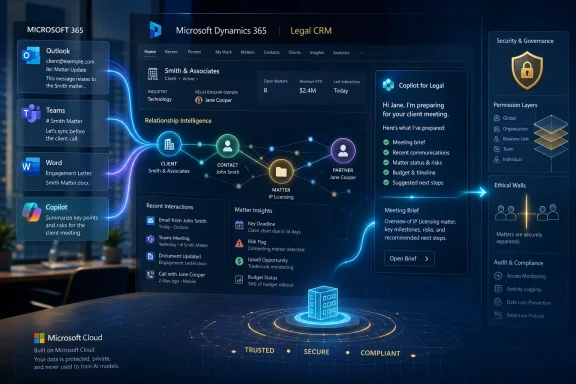
The Foundation 365 Bet Comes Down to Five Practical Tests​

The announcement is best read not as a finished victory lap, but as a signpost for where legal AI is moving. Foundation 365 puts Litera deeper into Microsoft’s productivity environment and gives law firms a more plausible way to make CRM data visible in daily work. The practical judgment will come from what happens after deployment.
  • Foundation 365 is now positioned as a Microsoft 365-native legal CRM and relationship intelligence platform rather than a standalone database lawyers must remember to visit.
  • Litera’s 2025 acquisition of Peppermint Technology now looks central to its Microsoft strategy, not merely an expansion of its product catalog.
  • The integration with Microsoft 365 Copilot raises the value of clean, permission-aware client data because AI summaries are only as trustworthy as the systems beneath them.
  • Law firm IT and risk teams should treat AI-powered CRM as a governance project involving identity, confidentiality, ethical walls, retention, and data quality.
  • The product’s success will depend less on whether firms buy it than on whether lawyers find its relationship insights accurate enough to use without being forced.
  • Microsoft’s role as the legal workbench is growing, and specialist vendors such as Litera will increasingly compete on the quality of the domain intelligence they bring into that workbench.
The larger story is that legal software is being pulled toward the place lawyers already live: Microsoft 365. Foundation 365 is Litera’s bid to make client intelligence part of that environment before someone else does, and it arrives at a moment when firms are deciding whether AI will be a novelty layered over old habits or a forcing function for cleaner data and better coordination. If Litera is right, the future legal CRM will not announce itself with a login screen; it will appear quietly in the email, meeting, and Copilot prompt where the next client relationship is won or lost.

References​

  1. Primary source: LawSites | by Robert Ambrogi
    Published: Wed, 03 Jun 2026 12:03:16 GMT
  2. Related coverage: litera.com
  3. Related coverage: cbinsights.com
  4. Related coverage: owler.com
  5. Related coverage: jdjournal.com
  6. Related coverage: legaltechnology.com
  1. Related coverage: ilta.legaltechnologyhub.com
  2. Related coverage: app.dealroom.co
  3. Related coverage: legaltechnologyhub.com
  4. Related coverage: theedgeroom.com
 

Litera announced on Wednesday, June 3, 2026, that Foundation 365, its AI-powered client relationship platform for law firms, is now available across Microsoft 365, bringing CRM, relationship intelligence, and client data into Copilot, Outlook, and Teams. The announcement is not just another legal-tech integration story. It is a bet that the next fight over enterprise software will be won inside the inbox, the meeting window, and the AI assistant — not inside the standalone application. For law firms, that makes Foundation 365 less a CRM relaunch than a test of whether Microsoft 365 can finally become the operating layer for legal business development.

Office scene with holographic cybersecurity dashboard, email icon, and video meeting feeds on large screens.Litera Is Moving CRM to Where Lawyers Already Live​

The oldest joke in legal CRM is that the system would be brilliant if lawyers used it. Firms buy platforms to track relationships, matters, pitches, referrals, opportunities, and client history, then discover that the people with the most valuable information are also the least likely to enter it. The lawyer who just had lunch with a general counsel, spotted a new litigation risk, or heard about a boardroom reshuffle is usually moving to the next call, not updating a database.
Foundation 365 is aimed squarely at that failure mode. Litera is not promising that attorneys will suddenly become disciplined CRM users because the interface is prettier. It is arguing something more pragmatic: if relationship intelligence is surfaced inside Outlook, Teams, and Microsoft 365 Copilot, the firm can lower the cost of participation until CRM stops feeling like a separate administrative chore.
That is the real importance of the announcement. Foundation 365 takes the familiar legal-industry ambition — a single view of the client — and embeds it inside the Microsoft productivity stack that already dominates law-firm work. Outlook remains the relationship record of first resort for many lawyers. Teams is where internal coordination increasingly happens. Copilot is where Microsoft wants work to become conversational, contextual, and increasingly automated.
Litera’s thesis is that legal CRM should ride that current rather than fight it. The company acquired UK-based Peppermint Technology in February 2025, inheriting a Microsoft Dynamics 365-based legal platform that already treated Microsoft’s cloud as the center of gravity. Now the combined product has been rebranded as Foundation 365, which is a name with a marketing department’s fingerprints but also a clear strategic message: this is Foundation, pulled fully into the Microsoft orbit.

The Peppermint Deal Now Looks Less Like Consolidation and More Like Positioning​

When Litera bought Peppermint Technology, the deal could be read as another chapter in legal tech’s long-running consolidation story. Litera already had a broad portfolio across drafting, knowledge management, transaction management, firm intelligence, and business development. Peppermint brought a Microsoft-native CRM, matter, and workflow platform with a strong UK legal footprint. Combining the two looked sensible, if not especially radical.
Foundation 365 makes the acquisition look more strategic. Peppermint’s value was not merely that it gave Litera another CRM product. It gave Litera a platform already designed around Microsoft Dynamics 365, Microsoft 365, and the workflows of law firms that had standardized heavily on Microsoft infrastructure. In an era when Microsoft is pushing Copilot and agentic workflows into every corner of the enterprise, that architecture matters.
The timing also helps explain the move. Since 2024, Litera has been talking publicly about deeper Microsoft collaboration and Copilot integration. The company’s December 2025 SharePoint integration and its broader Microsoft go-to-market alignment suggested a direction of travel. Foundation 365 is the moment where those threads become a product narrative: legal relationship intelligence, delivered through Microsoft 365.
There is an important distinction here. Plenty of vendors claim to “integrate with Microsoft” because they synchronize calendars, expose a Teams tab, or authenticate through Entra ID. Litera is pitching something more central: the CRM itself as a Microsoft 365-native experience, built on Dynamics 365 and exposed through the tools where legal professionals already spend their day. That is a stronger claim, and it raises stronger expectations.

The CRM Problem Was Never Just Bad Data​

Legal CRM failures are often blamed on bad data hygiene, but that diagnosis is too narrow. The deeper problem is that traditional CRM systems often ask lawyers to think like salespeople while working in an environment that is not structured like a sales floor. A partner’s relationship with a client may span decades, multiple matters, overlapping practice groups, lateral moves, conflicts checks, referral networks, and informal trust that never fits cleanly into a pipeline stage.
That makes law-firm CRM unusually hard. The data is valuable precisely because it is messy. Relationship strength may be inferred from emails, meetings, billing history, prior matters, alumni connections, industry focus, and who actually knows whom. Firms want that intelligence to help with pitches, cross-selling, succession planning, client retention, and lateral integration. But if every useful signal requires manual entry, the system decays.
Foundation 365’s promise is to move CRM from a destination to a layer. If a lawyer is writing to a client in Outlook, preparing for a Teams meeting, or asking Copilot for background before a call, the relevant relationship context can appear in the moment of need. That does not eliminate the governance challenge, but it changes the adoption equation. A system that gives lawyers useful intelligence inside their existing workflow has a better chance of earning reciprocal attention.
That is why the Womble Bond Dickinson quote in Litera’s announcement matters. The firm’s CRM manager framed the tool as giving teams flexibility to track relationships and opportunities in a way that suits them. In CRM-speak, that sounds modest. In law-firm politics, it is central. Central marketing and business development teams need structure; lawyers need convenience; practice groups need local nuance. The winning system is the one that can satisfy all three without becoming a bureaucratic punishment device.

Microsoft 365 Is Becoming the Legal-Tech Battleground​

For WindowsForum readers, the most interesting part of Foundation 365 may not be legal CRM at all. It is the continued transformation of Microsoft 365 from a productivity suite into an enterprise application platform. Microsoft has spent years turning Teams, Outlook, SharePoint, Dynamics, Power Platform, Graph, and now Copilot into a substrate on which third-party workflows can be built. Legal tech is simply one of the more demanding test cases.
Law firms are conservative buyers, but they are not technologically simple organizations. They need strict confidentiality, ethical walls, document security, matter-centric collaboration, auditability, records controls, and integrations with finance, document management, time capture, e-discovery, and knowledge systems. They also tend to live in Microsoft Office all day. That makes Microsoft 365 both attractive and dangerous: attractive because the users are already there, dangerous because every new integration widens the blast radius of misconfiguration.
Foundation 365 sits at the intersection of those pressures. Bringing relationship intelligence into Copilot, Outlook, and Teams could reduce friction dramatically. It could also expose firms to familiar Microsoft 365 governance questions in a more sensitive context. Which client data can Copilot access? Which Teams users can see which relationship histories? What happens when a lateral partner joins with restricted client information? How are conflicts, ethical walls, and matter confidentiality respected when AI assistants summarize context?
These are not reasons to reject the model. They are reasons to take it seriously. The legal industry’s Microsoft 365 adoption has often run ahead of its information governance maturity, particularly around Teams sprawl and SharePoint permissions. Adding AI-mediated CRM intelligence to that environment makes the payoff bigger, but it also makes sloppy governance harder to excuse.

Copilot Changes the Integration From Search to Action​

Before Copilot, the practical goal of a CRM integration was usually retrieval. A lawyer could open a panel in Outlook, search for a company, view recent matters, or identify colleagues with relevant relationships. Useful, certainly, but still recognizably a lookup experience. The user asked for a record, and the system returned one.
Copilot changes the product expectation. Once relationship data is accessible through an AI assistant, the lawyer does not merely want a record. The lawyer wants a briefing. “Prepare me for this client meeting.” “Who knows this general counsel?” “What matters have we handled for this company in the last three years?” “Which partners should be included in this pitch?” “Draft a follow-up email that reflects the client’s industry concerns and our recent work.”
That is where Foundation 365 becomes more than a CRM skin inside Microsoft 365. If implemented well, it can turn client intelligence into a conversational resource, grounded in firm data and available at the point of action. Frost Brown Todd’s reported use of Foundation data to build Co360 — generating company research reports in minutes and surfacing matter and relationship intelligence before meetings — shows the kind of direction firms want to travel. The same underlying data has reportedly supported client-matching algorithms that alert clients to newly filed litigation and relevant government contract reviews.
The shift is subtle but significant. Traditional CRM tells a firm what it knows. AI-infused CRM tries to decide what knowledge matters right now. That can be powerful in business development, where timing and context often matter more than raw data volume. But it also raises the old AI question in a more expensive suit: when the system produces a confident answer about a client relationship, who verifies it before a partner acts on it?

Litera’s Installed Base Gives the Pitch Weight — and Raises the Bar​

Litera says its technology serves 99 percent of the Am Law 100 and more than 2.3 million daily users, with more than 4,000 global firms using Foundation 365, including five of the world’s ten largest law firms. Vendor numbers should always be read as part evidence, part positioning. But even with that caveat, Litera is not a fringe startup trying to wedge its way into legal IT through a clever Teams app.
That matters because CRM succeeds or fails through institutional reach. A small tool can delight a practice group and still fail to become the firm’s client intelligence system. A platform with existing relationships across large law firms has a better shot at becoming the connective tissue between marketing, business development, knowledge management, and matter teams.
It also means Litera will be judged by enterprise standards. Large firms will not evaluate Foundation 365 only on whether it has a smart Copilot prompt or a clean Outlook pane. They will ask how it handles permissions, data residency, API extensibility, survivability during Microsoft service changes, migration from legacy CRM systems, and integration with the rest of the firm’s architecture. They will want administrative control, audit trails, and a roadmap that does not leave them trapped between Litera’s product strategy and Microsoft’s platform churn.
That last point is not theoretical. Microsoft 365 is an extraordinary platform, but it is also a moving target. Admin centers change, licensing changes, Copilot capabilities evolve, Teams architecture shifts, and Power Platform governance remains a recurring headache for enterprises. A vendor building deeply inside that ecosystem inherits Microsoft’s velocity. For buyers, that is both a feature and a risk.

The “Flow of Work” Argument Is Winning Enterprise Software​

Karan Nigam, Microsoft’s head of product marketing for agentic customer experience, framed the collaboration around professionals expecting critical business data to be available “in the flow of work.” That phrase has become one of the dominant clichés of enterprise software, but clichés become clichés because they capture something real. Users do not want another dashboard. They want the right context where the decision is already happening.
The reason this matters in legal is that the profession’s core work products are still documents, emails, meetings, and advice. Lawyers do not spend their day inside a CRM. They spend it in Word, Outlook, Teams, PDF tools, document management systems, research platforms, and billing systems. Any client intelligence platform that demands a separate behavioral routine is fighting the profession’s muscle memory.
Microsoft has understood this better than most. Its Copilot strategy is less about creating a single chatbot than about placing AI interfaces across the work surface. In Outlook, Copilot can help with messages and inbox context. In Teams, it can summarize meetings and discussions. In Word and PowerPoint, it can help draft and reshape artifacts. The more third-party business data can be grounded into that experience, the more Microsoft 365 becomes the place where enterprise work is interpreted, not merely produced.
Foundation 365 is Litera’s attempt to put legal relationship data into that interpretive layer. If the system works, a client meeting is no longer prepared by opening five applications and reconciling contradictory notes. It is prepared by asking for a synthesized view, then drilling into the evidence. That is precisely the sort of workflow that makes AI useful — and precisely the sort that makes information governance non-negotiable.

The Risk Is That Convenience Becomes a New Kind of Lock-In​

There is an obvious upside to building around Microsoft 365: firms already own the substrate. They have identity, email, calendars, files, collaboration, compliance tooling, and increasingly AI licensing tied to Microsoft. A legal CRM that uses those investments can look cheaper, faster, and easier to adopt than a standalone platform that asks users to live elsewhere.
But convenience has a shadow. Once client intelligence, CRM workflows, AI prompts, Teams collaboration, Dynamics records, and SharePoint content are braided together, switching costs rise. A firm may find that its business development architecture is no longer a discrete application but a mesh of Microsoft and Litera services. That can be efficient, but it can also make future procurement choices more constrained.
This is not unique to Litera. It is the direction of enterprise software generally. Salesforce wants business processes inside Salesforce. ServiceNow wants workflows inside ServiceNow. Microsoft wants work inside Microsoft 365 and Azure. The vendor that controls the context layer increasingly controls the user’s path to action.
For law firms, the practical answer is not to avoid integrated platforms. The answer is to negotiate and architect with exit paths in mind. Data portability, API access, permission transparency, and clear ownership of enriched relationship data should be treated as first-order procurement issues. A CRM that finally gets lawyers to participate is valuable. A CRM that traps the firm’s institutional memory in a brittle ecosystem is a future problem wearing a productivity badge.

AI Will Not Magically Fix Relationship Intelligence​

The phrase “AI-powered” deserves scrutiny. In legal tech, as in every other enterprise category, AI has become both a capability and a sales tax on attention. Foundation 365 may use AI to surface insights, summarize relationships, improve data capture, or support Copilot-driven interaction. That can be useful. But AI does not solve the underlying data problem by declaration.
Relationship intelligence depends on data quality, data boundaries, and institutional trust. If a firm’s contact records are stale, matter metadata is inconsistent, email histories are incomplete, and practice groups use different definitions for opportunity stages, AI can only do so much. It may make the mess easier to query. It may also make the mess look more authoritative than it is.
That is especially risky in client development. A hallucinated case citation is embarrassing and potentially dangerous; a hallucinated relationship can be politically damaging inside a firm and commercially damaging outside it. If an AI assistant suggests that a partner has a strong relationship with a prospective client based on weak signals, the resulting outreach may be awkward at best. If it misses a conflict-sensitive relationship, the consequences can be worse.
The best use of AI in this context is not to replace human judgment but to reduce the time spent assembling context. A well-designed Foundation 365 workflow should show its work, expose source records, respect permissions, and make it easy for professionals to correct or enrich the system. The firms that benefit most will be those that treat AI as a layer on top of disciplined data stewardship, not a substitute for it.

The Windows Admin’s Problem Moves Up the Stack​

For IT administrators, Foundation 365 is another reminder that the center of gravity in Microsoft environments has moved beyond device management and patching. The hard problems now sit in identity, permissions, data lifecycle, SaaS integration, and AI governance. Windows endpoints still matter, but the strategic risk increasingly lives in cloud policy and cross-application data flow.
A law firm deploying Foundation 365 across Microsoft 365 will need more than enthusiasm from marketing and business development. It will need administrators who understand Dynamics 365, Microsoft 365 permissions, Teams governance, SharePoint architecture, Entra ID, conditional access, auditing, retention policies, and Copilot controls. It will also need legal and compliance stakeholders who can define which data should be visible to whom, under what circumstances, and for what purpose.
That is a lot of institutional coordination for something sold as workflow simplification. But this is the pattern of modern enterprise IT. The user experience becomes simpler only because the administrative model becomes more sophisticated. The button in Outlook looks easy; the policy design behind it is not.
The firms that get this right will likely see real benefits. Lawyers will spend less time hunting for context. Business development teams will have more current signals. CRM managers will spend less energy begging for updates and more time improving process design. The firms that get it wrong may simply create a faster way to spread stale, over-permissioned, or misunderstood client intelligence.

Foundation 365 Turns Legal CRM Into a Microsoft 365 Governance Test​

The most useful way to read Litera’s announcement is not as a product launch in isolation, but as a case study in where enterprise software is headed. Business applications are being pulled into collaboration suites, AI assistants are becoming the front door to institutional data, and specialized vendors are learning to survive by becoming deeply native to hyperscale platforms.
Legal is an unusually revealing market because the stakes are high and the workflows are stubborn. If Foundation 365 can make CRM participation feel natural to lawyers, it will validate a model that many other professional-services tools will follow. If it struggles, the reason will probably not be lack of demand. It will be the old collision between elegant demos and messy institutional reality.
The concrete lessons are already visible:
  • Foundation 365’s main bet is that law-firm CRM adoption improves when relationship intelligence appears inside Outlook, Teams, and Copilot rather than in a separate destination app.
  • Litera’s 2025 acquisition of Peppermint Technology now looks like a Microsoft-platform strategy, not merely a portfolio expansion.
  • Copilot integration changes CRM from a lookup tool into a briefing and action layer, which makes accuracy, provenance, and permissions more important.
  • Law firms evaluating the platform should treat data governance, ethical walls, auditability, and portability as core buying criteria rather than post-deployment details.
  • Microsoft 365 administrators will carry much of the operational burden, because the success of embedded legal AI depends on identity, access, retention, and collaboration controls.
  • The firms most likely to benefit are those that already have disciplined client data practices and want AI to accelerate them, not those hoping AI will clean up years of CRM neglect.
The broader story is that Microsoft 365 is becoming the place where enterprise knowledge is assembled, interpreted, and acted upon, and Litera wants legal client intelligence to be part of that layer. Foundation 365 may or may not become the definitive answer to law firms’ CRM problem, but it points in the direction the market is moving: fewer standalone systems of record on the edge of professional life, more intelligence embedded directly into the tools where work already happens. For law firms and their IT teams, the opportunity is real — and so is the obligation to make sure the AI-powered shortcut does not become another unmanaged corridor through the firm’s most sensitive data.

References​

  1. Primary source: Legal IT Insider
    Published: Wed, 03 Jun 2026 11:55:16 GMT
  2. Related coverage: litera.com
  3. Official source: adoption.microsoft.com
  4. Official source: blogs.microsoft.com
  5. Related coverage: cbinsights.com
  6. Official source: support.microsoft.com
  1. Related coverage: ilta.legaltechnologyhub.com
  2. Related coverage: windowscentral.com
  3. Related coverage: jdjournal.com
  4. Related coverage: its.fsu.edu
  5. Related coverage: theedgeroom.com
  6. Related coverage: realfoundations.net
 

Litera released Foundation 365 on June 3, 2026, positioning the AI-powered legal CRM as a Microsoft 365-native client intelligence platform that brings relationship data, business development prompts, and firm knowledge into Outlook, Teams, Word, Dynamics 365, and Microsoft 365 Copilot. The launch matters less because it adds another CRM to a crowded legal tech market than because it accepts a truth many firms have spent years avoiding: lawyers do not want another place to work. Litera is trying to make relationship management disappear into the Windows-and-Microsoft productivity layer where legal work already happens. If it succeeds, the future of legal CRM may look less like Salesforce with a legal skin and more like an ambient operating system for firm growth.

Collage of futuristic office screens showing client intelligence, documents, security, and relationship graphs.Litera Is Selling the End of the Separate Legal App​

The legal technology industry has spent two decades asking lawyers to become better software users. That has usually meant portals, dashboards, matter systems, knowledge banks, document tools, billing tools, and CRM databases, each promising efficiency while also demanding attention. The result is a contradiction familiar to every IT department supporting professional services: the tool that is supposed to reduce friction becomes another tab, another login, another source of incomplete data.
Foundation 365 is Litera’s attempt to attack that problem at the point of daily behavior. The platform is built around the idea that business development information should not live in a separate system that lawyers visit when prompted by marketing. It should surface inside Outlook when an email arrives, inside Teams when a client discussion is happening, and inside Word or Copilot when a lawyer is preparing for a meeting, pitch, or matter review.
That is why the product is more interesting than the usual CRM announcement. Litera is not merely claiming that Foundation 365 integrates with Microsoft 365. It is arguing that CRM adoption in law firms has failed because the category was designed around database discipline rather than lawyer workflow. The company’s “GrowthTech” framing is marketing language, certainly, but it also names a real shift: the move from recording relationships after the fact to prompting action while the relationship is still alive.
For WindowsForum readers, the Microsoft angle is not incidental. Law firms are among the most Microsoft-saturated professional environments on earth, and many of their security, compliance, document management, and identity decisions already orbit Microsoft 365, Entra ID, Teams, SharePoint, Exchange, and increasingly Copilot. Litera’s bet is that the next layer of legal productivity will be won not by asking firms to leave that estate, but by becoming more deeply embedded in it.

The CRM Problem Was Always a Human-Factors Problem​

CRM in law firms has long suffered from a brutal adoption paradox. Firm leadership wants a shared view of clients, opportunities, referrals, alumni, prospects, and cross-selling potential. Individual lawyers, especially partners, often see CRM as a chore that takes time away from billable work and offers benefits that accrue to someone else.
That is not because lawyers are uniquely resistant to technology. It is because many CRM systems ask for manual input at the worst possible moment: after the meeting, after the email, after the call, after the opportunity has moved on. The system of record becomes a system of guilt, populated unevenly by assistants, marketing teams, and the small subset of lawyers who are naturally disciplined about data hygiene.
Foundation 365’s pitch is that this model has it backward. If the firm already knows who emailed whom, who attended which meeting, what matters were opened, what clients are expanding, and which relationships are active or stale, the platform should infer useful signals rather than wait for lawyers to type them in. AI does not eliminate the need for judgment, but it can reduce the clerical tax that made legal CRM so brittle in the first place.
This is where the product’s Microsoft-native strategy becomes more than a deployment preference. Outlook is not merely another email client inside a law firm; it is often the most complete living map of the firm’s commercial nervous system. Teams is where internal coordination increasingly happens. Word remains the center of legal drafting. Embedding intelligence there means Foundation 365 is not asking lawyers to remember to use CRM. It is trying to make CRM use a byproduct of normal work.
The risk, of course, is that “ambient” can become “invisible” in the wrong way. If lawyers do not trust what the system surfaces, or if they cannot understand why it recommends a particular contact, opportunity, or relationship score, the technology will be dismissed as another AI layer trying too hard. Legal professionals are trained to care about provenance, context, and privilege; a black-box prompt inside Outlook is not enough.

Microsoft 365 Has Become the New Legal Platform War​

Litera’s move lands in a market where the Microsoft stack has become both infrastructure and battleground. Microsoft has been pushing Copilot, agentic workflows, and Dynamics 365 deeper into enterprise operations, while software vendors in every vertical are racing to prove they can bring domain-specific intelligence into that environment. Legal tech is no exception.
That changes the competitive question. Historically, a legal software vendor could win by building the best standalone application for document comparison, transaction management, knowledge retrieval, CRM, or experience management. Now, the question is increasingly whether a vendor can deliver specialized capability inside the daily workspace without compromising governance or forcing another adoption campaign.
Litera already had a strong position in legal workflows through drafting, document comparison, transaction, knowledge, and firm intelligence tools. Its acquisition of Peppermint Technology gave it a Microsoft-based legal CRM and matter management foundation, now folded into the Foundation 365 story. The company’s broader Litera One strategy also points in the same direction: connect drafting, review, knowledge, and client intelligence inside the tools lawyers already use.
Microsoft benefits from this as much as Litera does. Every credible vertical integration gives Microsoft 365 Copilot and Dynamics 365 a stronger claim to being not just productivity software, but an enterprise operating layer. For firms already committed to Microsoft licensing, security review, device management, and data residency controls, that is an attractive path compared with deploying yet another independent system with its own identity, storage, permissions, and compliance story.
But this also raises the stakes. Once Microsoft 365 becomes the place where legal CRM lives, the quality of tenant governance becomes business-critical in a new way. Permissions sprawl, mailbox access, Teams retention settings, SharePoint chaos, and poorly governed Copilot deployments are no longer just IT hygiene issues. They become determinants of whether relationship intelligence is accurate, safe, and usable.

“GrowthTech” Is a New Label for an Old Law Firm Anxiety​

Litera’s “GrowthTech” phrase is clearly designed to move the conversation beyond CRM, a term that carries decades of baggage in law firms. The company wants to describe a system that helps firms identify opportunities, monitor relationships, prepare for client interactions, and coordinate business development without forcing lawyers into a separate sales culture. That distinction matters because most law firms do not think of themselves as sales organizations, even when they are competing ruthlessly for work.
The anxiety underneath the branding is real. Corporate legal departments have become more sophisticated buyers. Alternative legal service providers, accounting firms, boutiques, and AI-enabled service models are pressuring traditional firms. Clients expect industry knowledge, pricing discipline, responsiveness, and evidence that a firm understands the business, not just the legal issue.
In that environment, relationship data is not administrative trivia. It is strategic infrastructure. A firm that knows which partners have active ties to a target company, which client contacts have gone quiet, which alumni have moved into decision-making roles, and which matters suggest adjacent opportunities has an advantage over a firm relying on hallway memory.
The problem is that law firm knowledge has traditionally been trapped in personal inboxes, partner recollections, billing narratives, and fragmented marketing systems. Foundation 365 is attempting to turn that scattered institutional memory into timely prompts. The difference between “we have a CRM” and “we know who should call this client today” is the difference between a database and a growth engine.
Still, the phrase GrowthTech should not be accepted uncritically. Vendors often rename categories when the old one becomes unfashionable, and CRM has certainly had a rough reputation in law. The meaningful test is not whether the label sticks, but whether the platform can measurably improve business development behavior without making lawyers feel managed by an algorithm.

AI Turns Relationship Management Into a Prediction Problem​

The most ambitious part of Foundation 365 is not that it displays client data in Microsoft 365. It is that Litera wants AI to interpret that data: relationship strength, communication patterns, meeting history, sentiment, client feedback, and possible opportunities. That moves legal CRM from retrospective tracking toward prediction.
This is where the upside is obvious. A lawyer preparing for a client call could ask Copilot for a briefing that draws on matter history, recent interactions, known stakeholders, open opportunities, and internal expertise. A business development team could identify accounts where communication has slowed or where multiple practice groups have disconnected relationships with the same company. A firm leader could see whether strategic clients are receiving coordinated attention or fragmented outreach.
The same capability could also expose uncomfortable truths. Relationship intelligence may reveal that a supposedly “owned” client relationship is actually maintained by associates, alumni, or another office. It may show that a rainmaker’s network is thinner than assumed, or that important contacts have not heard from the firm in months. Better data can improve strategy, but it can also unsettle internal politics.
AI intensifies that tension because it turns patterns into recommendations. Once a system starts saying which client is cooling, which partner has the strongest connection, or which opportunity should be pursued, it enters a zone where firm culture, compensation, and client ownership collide. In law firms, data governance is never just technical governance; it is governance over power.
That does not make the approach wrong. It makes transparency essential. Firms will need to decide which signals are visible, who can act on them, whether lawyers can challenge relationship scores, and how recommendations are audited. The firms that treat Foundation 365 as a plug-in may get dashboards. The firms that treat it as an organizational change project may get value.

The Windows Desktop Is Still Where Legal AI Has to Prove Itself​

Despite years of cloud transformation, legal work remains stubbornly desktop-centric. Lawyers may use SaaS platforms, mobile devices, virtual desktops, and web apps, but the lived experience of legal productivity still revolves around Windows, Outlook, Word, PDF tools, document management integrations, secure browsers, and matter-centric file access. Any AI tool that ignores that reality is asking for failure.
That is why Foundation 365’s promise is practical rather than flashy. It does not ask a lawyer to learn an entirely new interface before seeing value. It tries to surface context inside the applications that already define the lawyer’s day. In enterprise software, that kind of design often matters more than model sophistication.
The Microsoft 365 Copilot connection is especially significant because it gives Litera a conversational layer that many firms are already evaluating. Instead of training lawyers to query a legal CRM directly, the platform can support natural-language requests through an assistant that is already part of Microsoft’s productivity narrative. If the system can reliably answer, “What should I know before this client meeting?” or “Who at the firm knows this prospect best?” it becomes a daily tool rather than a quarterly reporting obligation.
But the desktop is also where AI disappointment becomes visible. If suggestions are generic, if client summaries omit crucial context, if Copilot permissions expose data too broadly, or if the experience slows Outlook, lawyers will notice immediately. There is no softer landing inside the flow of work; being embedded means being judged in real time.
For IT administrators, that means rollout discipline matters. Pilot groups, permission reviews, data classification, retention policies, and training are not optional accessories. They are the difference between a useful intelligence layer and a compliance incident dressed up as innovation.

The Competitive Field Will Not Stand Still​

Litera is not alone in seeing legal business development as an AI problem. Thomson Reuters, Intapp, iManage, NetDocuments, Salesforce partners, and a wide field of specialist vendors are all pursuing pieces of the same market. Some have deeper experience in deal intelligence, some in document management, some in knowledge retrieval, and some in enterprise CRM customization.
Litera’s differentiator is its claim to be deeply aligned with Microsoft’s stack and legal workflow at the same time. That is a strong position, but not an unbeatable one. In large firms, platform decisions are rarely based on elegance alone; they are shaped by existing contracts, integration debt, data quality, practice group politics, client security requirements, and the preferences of influential partners.
Intapp, for example, has long sold into the business-of-law layer, including relationships, risk, time, and deal management. Thomson Reuters brings enormous legal content and research gravity. Document management vendors own another critical piece of daily workflow. Microsoft itself can also shift the market by absorbing more domain-like capability into Copilot, Teams, Outlook, and Dynamics.
That last point should keep every legal tech vendor alert. Building on Microsoft gives Litera reach, security credibility, and adoption leverage. It also means the company is operating close to a platform owner with its own ambitions. The more Microsoft generalizes agentic workflows, structured business data access, and enterprise relationship graphs, the more vertical vendors must prove that their legal-specific models, taxonomies, and workflows add durable value.
For now, legal remains specialized enough to reward domain expertise. Law firm data is not just contacts and activities; it is matters, conflicts, confidentiality walls, jurisdictions, client teams, billing relationships, lateral movement, referral networks, and experience histories. A generic CRM can store some of that. A legal growth platform has to understand it.

The Security Conversation Is the Adoption Conversation​

Every legal AI launch eventually arrives at the same checkpoint: trust. Law firms handle privileged communications, confidential client data, regulated industries, M&A activity, litigation strategy, trade secrets, and sensitive personal information. A system that mines relationship data must be evaluated not only for productivity, but for exposure.
Foundation 365’s Microsoft foundation gives Litera an advantage here, because many firms already have security models, audit practices, identity controls, and compliance workflows around Microsoft 365 and Dynamics 365. That does not eliminate risk, but it makes the conversation more familiar. Security teams would rather extend a governed environment than bless a tool that creates yet another shadow repository of client intelligence.
The hardest risks are not always the dramatic ones. They are mundane: stale permissions, overbroad Teams membership, poorly classified documents, personal contact imports, assistants with delegated mailbox access, and lateral hires whose prior relationship data may be sensitive. AI does not create all of these problems, but it can make them more consequential by making hidden data easier to retrieve and summarize.
Firms will also need to think carefully about ethical duties. If an AI system recommends outreach based on communication analysis, who verifies that the outreach is appropriate? If sentiment analysis flags dissatisfaction, who sees that signal? If relationship scoring draws from emails, calendars, and matter data, what consent or notice obligations apply inside the firm and across jurisdictions?
The lesson from early enterprise AI deployments is that governance must precede enthusiasm. Lawyers may be skeptical of AI outputs, but they are often even more skeptical of systems that appear to monitor their relationships. Litera and its customers will need to frame Foundation 365 as assistance, not surveillance. That line will determine whether the product feels empowering or managerial.

The Real Test Is Whether Lawyers Change Their Behavior​

The history of legal CRM is full of technically successful deployments that failed to change behavior. Data was migrated, forms were customized, integrations were built, training sessions were held, and dashboards were delivered. Then the system became the marketing department’s problem.
Foundation 365’s embedded design is meant to avoid that fate. If the platform can help a lawyer prepare faster, avoid embarrassment in front of a client, spot a warm introduction, or follow up at the right time, adoption becomes self-reinforcing. Lawyers are pragmatic; they will use tools that save time or help win work.
The first wave of value will probably be preparation. Meeting briefs, client histories, relationship maps, and opportunity context are immediate, concrete, and easy to understand. The second wave will be coordination: helping practice groups avoid duplicative outreach and align around client teams. The third, harder wave will be prediction: determining which relationships need attention before revenue is at risk.
That third wave is where Litera’s ambitions will either mature or stall. Predictive relationship intelligence requires clean data, thoughtful models, and firm willingness to act on uncomfortable signals. It also requires patience. A system that promises overnight rainmaking will lose credibility quickly; a system that steadily reduces missed opportunities may become indispensable.
CRM adoption in law firms has never been about whether partners appreciate revenue. It has been about whether the system respects their time, judgment, and incentives. Foundation 365’s thesis is that the best way to respect those constraints is not to persuade lawyers to live in CRM, but to bring CRM to where they already live.

The Microsoft-Native Bet Cuts Both Ways​

The strongest argument for Foundation 365 is also the source of its strategic constraint. By aligning tightly with Microsoft 365, Dynamics 365, and Copilot, Litera lowers friction for firms that already trust Microsoft. It can ride existing identity, productivity, collaboration, and administrative patterns rather than inventing them from scratch.
That makes deployment easier to justify in Microsoft-centric firms. It also gives business development teams a more persuasive story: this is not another silo; this is an extension of the platform the firm already uses. In budget conversations, that matters. In change-management conversations, it matters even more.
But Microsoft-native does not mean universally simple. Law firms often run complex document management systems, specialized finance platforms, conflicts tools, experience databases, HR systems, data warehouses, and regional compliance controls. Foundation 365 will have to coexist with that messy reality. A clean Microsoft story can become less clean once it touches twenty years of law firm infrastructure.
There is also a cultural dependency. If lawyers dislike Copilot, distrust Teams, or experience Microsoft 365 as an overloaded environment full of notifications and half-adopted features, Foundation 365 inherits some of that baggage. Embedding in the flow of work only helps if the flow itself is healthy.
That is the paradox of modern enterprise software. The best place to put a new tool is inside the platform users already inhabit. The worst place to put a new tool is inside a platform already burdened with too much noise. Litera’s challenge is to make Foundation 365 feel like signal, not one more pane of enterprise software asking for attention.

The Firms That Win Will Treat Data as a Practice Asset​

The deeper implication of Foundation 365 is that relationship data is becoming a practice asset rather than a marketing asset. That is a major cultural change. In many firms, the most valuable commercial information is still treated as personal capital: who knows whom, who originated what, who controls the client, who gets credit.
AI-enabled relationship intelligence pushes against that model. It asks firms to pool signals for collective advantage. It implies that client development is not solely an individual rainmaker’s art, but a firm capability that can be measured, improved, and coordinated.
That will be easier for some firms than others. Firms with strong client team structures, disciplined matter data, and collaborative compensation models will have a head start. Firms built around guarded books of business may find the technology politically awkward. The software can surface opportunities, but it cannot by itself resolve incentives that reward hoarding.
For IT and knowledge teams, this creates an opening. Data quality projects that once sounded administrative can now be tied directly to growth. Contact cleansing, matter taxonomy, experience capture, email governance, and client hierarchy mapping become inputs to AI performance. The better the firm’s operational data, the more useful the intelligence layer becomes.
That is perhaps the most important practical lesson. Foundation 365 is not magic sprinkled over messy information. Like every enterprise AI system, it will amplify the quality of the underlying data environment. Firms that have postponed data governance may discover that AI has not made the work obsolete; it has made the work urgent.

The Day-One Read for Firms Running on Microsoft​

The launch of Foundation 365 should not send every firm racing into procurement, but it should force a more serious conversation about where client intelligence belongs. If the firm’s lawyers live in Microsoft 365, then a CRM strategy that remains outside that environment is increasingly hard to defend. The key is not whether Litera has coined the perfect category name. The key is whether the firm is ready to make relationship intelligence operational.
  • Foundation 365 is best understood as an embedded client intelligence layer for Microsoft-centric law firms, not simply as another CRM database.
  • Litera’s “GrowthTech” framing reflects a real shift from passive contact tracking toward AI-assisted business development prompts inside daily workflow.
  • The Microsoft 365 and Dynamics 365 architecture may reduce adoption friction, but it also makes tenant governance, permissions, and data hygiene central to success.
  • Lawyers are most likely to adopt the system if it delivers immediate value in meeting preparation, client context, and warm-introduction discovery.
  • Firms should treat rollout as an organizational change project involving IT, marketing, knowledge management, risk, and practice leadership.
  • The long-term value will depend less on AI novelty than on whether firms are willing to share, clean, and act on relationship data.
Litera’s Foundation 365 is not the final form of legal CRM, but it is a clear signal of where the category is heading: away from isolated databases and toward AI-assisted intelligence embedded in the productivity stack. For law firms, the strategic question is no longer whether relationship data should be digitized; that argument is over. The question now is whether firms can govern that data well enough, and collaborate around it honestly enough, for AI to turn it into growth rather than just another pane in Outlook.

References​

  1. Primary source: BriefGlance
    Published: Wed, 03 Jun 2026 12:01:00 GMT
  2. Related coverage: litera.com
  3. Related coverage: ainvest.com
 

Litera announced on June 3, 2026, that Foundation 365, its AI-powered customer relationship management platform for law firms, is now available across Microsoft 365 through integrations with Microsoft Dynamics 365, Microsoft 365 Copilot, Outlook, and Teams. The announcement is not just another legal-tech vendor promising that AI will “meet users where they work.” It is a sign that Microsoft 365 is becoming the gravitational center for professional-services intelligence, with third-party vendors competing to turn Outlook, Teams, Word, and Copilot into the front end for industry-specific business systems. For law firms, that could make client development more useful, more measurable, and more dangerous if the underlying relationship data is not governed with care.

Office professional views a digital network of connected people and documents on transparent screens.Litera Is Selling Less CRM and More Context​

Traditional legal CRM has always had a participation problem. Lawyers live in email, documents, meetings, billing systems, matter files, and client calls; business-development staff live in pipeline tools, contact records, campaigns, and reports. The gap between those worlds is where many CRM projects in law firms go to die.
Foundation 365 is Litera’s answer to that old failure mode. Instead of asking attorneys to leave their normal workflow and update a separate database, Litera is trying to surface relationship intelligence inside Microsoft 365, where many lawyers already spend the day. The pitch is simple: if a partner is preparing for a client meeting, joining a Teams call, or checking Outlook, the system should already know which relationships matter, which opportunities are active, and who inside the firm is best positioned to make the next move.
That is why the Microsoft angle matters. Built on Dynamics 365 and connected to Microsoft 365 Copilot, Foundation 365 is not merely a legal CRM with a prettier interface. It is an attempt to make CRM data conversational, contextual, and ambient inside the productivity layer.
The phrase Litera uses for this is “GrowthTech,” a vendor term that deserves skepticism but also captures the broader shift. The goal is no longer to record business-development activity after the fact. The goal is to predict where growth may come from, push relevant context to lawyers at the moment of action, and make client intelligence feel like part of the work rather than administrative residue left over after the work is done.

Microsoft 365 Has Become the New Legal-Tech Desktop​

For years, legal software vendors talked about “integration with Office” as if it meant a Word ribbon, an Outlook add-in, or a document-management connector. That was useful, but mostly tactical. The arrival of Microsoft 365 Copilot changes the ambition.
Copilot turns Microsoft 365 from a bundle of applications into a reasoning layer that can summarize, retrieve, draft, and act across data a user is permitted to access. For vendors like Litera, that creates a new route to the user: not just a sidebar in Outlook, but an AI-mediated experience that can bring firm-specific intelligence into the conversation.
This is especially important in law, where the operating system of daily work is still overwhelmingly Microsoft-centric. Even firms that run specialized document-management, timekeeping, finance, and knowledge systems often conduct their most visible client interactions through Outlook, Teams, Word, and PowerPoint. The practical question for legal AI is therefore not whether a model can answer a question in isolation. It is whether the answer can appear in the workflow where a lawyer is already trying to make a decision.
Foundation 365’s claimed footprint across Copilot, Outlook, and Teams is aimed squarely at that reality. A business-development professional may care about dashboards, pipeline hygiene, and campaign analytics. A partner may care only whether the system can answer: Who knows this client? What did we last do for them? What should I know before I get on this call?
If the answer appears without forcing that partner into a separate CRM screen, Litera has a better chance of solving the adoption problem that has haunted legal CRM for decades.

The Real Product Is the Relationship Graph​

The most important asset in this story is not the chat interface. It is the relationship graph underneath it.
Law firms are unusually dependent on informal networks. A major client relationship may involve a rainmaker, several matter partners, associates who know the operational contacts, alumni at the client, and a marketing team that sees industry activity before the lawyers do. Those connections are often scattered across inboxes, calendar histories, matter records, event attendance, pitch documents, and personal memory.
A legal CRM that merely stores names and opportunities is not enough. The valuable system is one that can infer strength of relationship, spot neglected accounts, identify who should make contact, and connect market activity to firm capability. That is the kind of intelligence Litera is promising when it talks about helping firms understand which relationships are strong, which need attention, and who is best positioned to engage.
This is where AI can be useful without pretending to replace the lawyer. A model does not need to “practice law” to improve business development. It needs to help assemble fragmented context, rank likely relevance, summarize history, and reduce the time between signal and action.
The obvious catch is that relationship intelligence is only as good as the data estate beneath it. If contacts are duplicated, permissions are sloppy, matter metadata is inconsistent, and attorneys avoid logging important interactions, the AI layer will confidently summarize a mess. In professional services, the danger is not just a wrong answer; it is a wrong answer delivered with the smooth authority of institutional memory.

Copilot Makes Vendor Data More Useful—and More Exposed​

Microsoft’s Copilot strategy gives third-party vendors a compelling distribution channel, but it also raises the stakes for governance. When external systems are connected to Microsoft 365 Copilot through agents, connectors, or app integrations, users expect the result to behave like part of Microsoft 365. That expectation is convenient for adoption and uncomfortable for risk management.
Legal relationship data is sensitive in ways that ordinary sales data is not. It may reveal potential conflicts, confidential client relationships, lateral-hire strategies, pitch activity, private equity networks, or a firm’s internal assessment of where revenue is vulnerable. If surfaced too broadly, even accurate intelligence can become a compliance problem.
Microsoft’s own Copilot model is built around existing permissions, tenant controls, and administrative governance. But that does not absolve firms from doing the hard work of deciding who should see what. A partner’s client notes, a business-development team’s opportunity data, and a firmwide relationship score may all live in overlapping systems, but they should not necessarily be exposed to every user in the same way.
This is where CIOs and knowledge-management leaders will need to be less dazzled by “AI-powered” language and more demanding about architecture. They should ask how Foundation 365 handles role-based access, data residency, auditability, retention, and integration with Microsoft Entra ID and Microsoft 365 administrative controls. They should also ask what happens when Copilot generates a response from relationship data that is incomplete, stale, or politically sensitive inside the firm.
The core issue is not whether Litera can technically bring client intelligence into Microsoft 365. The issue is whether firms can govern that intelligence at the same speed that lawyers begin to rely on it.

The Legal AI Market Is Moving from Drafting to Revenue​

Much of the legal AI conversation has focused on drafting, summarization, research, contract review, and document comparison. That made sense because those were the most obvious places to apply large language models to lawyer workflows. Litera itself has been active in that category with AI-assisted drafting and document tools.
Foundation 365 points to a different frontier: AI for the business of law. That may prove just as consequential.
Law firms are under pressure to become more disciplined commercial organizations without losing the relationship-driven culture that still defines high-end legal work. Clients are consolidating panels, procurement teams are scrutinizing spend, and alternative providers keep nibbling at work that firms once considered secure. In that environment, knowing which relationship to cultivate and when to act is not a soft marketing function. It is revenue defense.
The business-development problem is also better suited to near-term AI than some more legally complex use cases. Predicting a litigation outcome or interpreting unsettled law requires deep legal judgment and carries obvious professional-risk implications. Summarizing relationship history, identifying dormant contacts, or preparing a briefing for a client meeting is still sensitive, but it is easier to keep a human in the loop.
That may be why Microsoft 365 is such a useful stage for this category. The most valuable interventions are small and timely: a prompt before a call, a summary before a meeting, an alert that another partner has an active relationship, a reminder that a client’s industry is moving. AI does not need to replace rainmaking. It needs to make institutional knowledge less dependent on hallway conversations and heroic memory.

Dynamics 365 Gives the Pitch Enterprise Weight​

The decision to build Foundation 365 on Microsoft Dynamics 365 is not incidental. Dynamics gives Litera a familiar enterprise substrate for CRM, data models, identity integration, reporting, and business-process automation. That matters for larger firms that do not want a boutique system floating outside the rest of their Microsoft estate.
It also gives Microsoft another industry-specific proof point for its broader business-applications strategy. Dynamics 365 has often lived in the shadow of Salesforce in the CRM imagination, but Microsoft has an advantage in organizations where the productivity layer, identity layer, collaboration layer, and increasingly the AI layer are already Microsoft. If the CRM can appear inside Outlook, Teams, and Copilot, the old distinction between “productivity app” and “business app” starts to blur.
That blurring is the strategic point. Microsoft does not need every lawyer to open Dynamics every day. It needs Dynamics-backed data and workflows to show up through the tools lawyers already open hundreds of times a week. Litera’s legal-specific layer makes that proposition more credible for law firms than a generic sales CRM ever could.
For IT leaders, the appeal is obvious: fewer disconnected systems, more use of existing Microsoft controls, and a stronger chance that expensive CRM data will actually be consumed. The risk is equally obvious: deeper dependence on Microsoft’s ecosystem, more complex licensing and vendor relationships, and a growing need to understand how third-party AI experiences behave inside the tenant.

The Adoption Problem Now Moves Upstairs​

The dirty secret of many CRM rollouts is that failure is rarely technical. The software can be deployed, the data migrated, the fields configured, and the dashboards built. The problem comes when partners do not use it, assistants update it inconsistently, and business-development teams spend their time policing inputs rather than enabling growth.
Embedding Foundation 365 in Microsoft 365 is a direct attack on that problem. If the CRM becomes less of a destination and more of a service that appears inside daily work, the burden on users changes. They do not need to remember to visit the system as often; the system needs to be helpful enough that they notice when it is absent.
But this also raises expectations. Lawyers are impatient software users. If the AI produces generic summaries, misses obvious relationship context, or interrupts with low-value suggestions, it will quickly be treated as another layer of noise. In a law firm, bad relevance is not a minor user-experience issue. It is the difference between a system that becomes trusted institutional infrastructure and one that gets tolerated by marketing because the firm already paid for it.
Litera’s advantage is domain focus. A legal-specific relationship platform can understand concepts that generic CRM tools may flatten: matters, clients versus contacts, referrals, conflicts, practice groups, panels, pitches, laterals, alumni, and the difference between a billing relationship and an influence relationship. That domain specificity is the reason this announcement deserves attention beyond the usual AI-in-everything cycle.
Still, the hardest part will be change management. AI may reduce friction, but it does not eliminate the need for clean processes, executive sponsorship, data stewardship, and careful rollout. The firms that benefit most will likely be those that already treat client intelligence as an institutional asset, not those hoping a Copilot integration will magically create discipline where none existed.

The Microsoft Build Timing Was Not an Accident​

Litera’s announcement landed during Microsoft Build 2026, held June 2–3 in San Francisco and online, a conference cycle heavily shaped by AI agents, Copilot extensibility, and the idea that Microsoft’s ecosystem is becoming a platform for specialized work assistants. Even though Foundation 365 is a legal-industry product rather than a Windows feature, it fits neatly into that Build-era message.
Microsoft wants developers and partners to build agents and integrations that make Copilot more valuable inside specific business contexts. A generic assistant can summarize a meeting. A domain-aware assistant connected to CRM, relationship intelligence, and business-development history can tell a lawyer why that meeting matters.
That distinction is the next phase of the Copilot economy. The first wave was about productivity: draft this, summarize that, find this document. The next wave is about judgment support inside vertical workflows. Legal, healthcare, finance, manufacturing, and public-sector vendors will all try to turn their proprietary data models into Copilot-native experiences.
For WindowsForum readers, the point is broader than legal tech. Microsoft’s AI strategy is increasingly less about a single chatbot and more about making Windows, Microsoft 365, Azure, Dynamics, and identity services the connective tissue for third-party intelligence. If that works, the value of the Microsoft stack grows not because every Microsoft app is best-in-class, but because the stack becomes the place where specialized systems become usable.

Firms Should Read the Fine Print Before They Read the Prompt​

Foundation 365 may be promising, but law firms should approach it like infrastructure, not like a novelty feature. Once client intelligence starts appearing in Copilot, Outlook, and Teams, it becomes part of the firm’s operational memory. That makes implementation choices consequential.
The procurement conversation should begin with data boundaries. Which systems feed Foundation 365? Which records are visible to which roles? How are ethical walls, confidentiality screens, and client-specific restrictions respected? Can administrators audit what data was used to generate a recommendation or summary?
The next question is accuracy. Relationship intelligence often depends on inference: email frequency, meeting history, matter involvement, contact ownership, and user-entered notes. Firms need to know when the system is presenting verified facts and when it is ranking probabilities. A confident suggestion that the wrong partner “owns” a relationship can create internal tension; a confident summary that omits a key conflict can create a worse problem.
Finally, firms should think about human incentives. If lawyers perceive the system as surveillance of their relationships, they will resist it. If they perceive it as a way for the firm to extract personal networks without giving value back, they will underfeed it. The best implementations will make the benefit immediate and reciprocal: better meeting preparation, less duplicative outreach, stronger pitch teams, and fewer missed opportunities.

The Signal Inside the Microsoft 365 Noise​

The Foundation 365 announcement is easy to dismiss as another AI partnership press release. It is more useful to read it as a marker of where enterprise software is heading: away from standalone systems of record and toward AI-mediated systems of action embedded in daily work.
For law firms and Microsoft-focused IT teams, the concrete lessons are clear.
  • Foundation 365 brings Litera’s legal CRM and relationship-intelligence platform into Microsoft 365 through Dynamics 365, Copilot, Outlook, and Teams.
  • The strategic promise is not merely better contact management, but timely client intelligence inside the applications lawyers already use.
  • The value of the product will depend heavily on data quality, permission design, and whether firms can distinguish verified relationship facts from AI-assisted inference.
  • Microsoft benefits because specialized vertical systems make Copilot and Dynamics more valuable without requiring users to live inside traditional CRM screens.
  • Law firms should treat Copilot-connected relationship intelligence as governed enterprise infrastructure, not as a lightweight productivity add-on.
  • The larger trend is that legal AI is expanding from document work into revenue, client development, and firm strategy.
The most interesting thing about Foundation 365 is not that it uses AI, or that it plugs into Microsoft 365, or even that it is aimed at law firms. It is that it treats client intelligence as something that should arrive at the point of decision, not sit in a database waiting for someone to go looking. If Litera and Microsoft can make that work without overwhelming users or weakening governance, the legal CRM may finally stop being a system lawyers avoid and start becoming a layer of context they quietly depend on.

References​

  1. Primary source: New Castle News
    Published: 2026-06-03T12:12:11.175287
  2. Related coverage: techradar.com
  3. Related coverage: tomsguide.com
  4. Related coverage: windowscentral.com
  5. Related coverage: litera.com
  6. Related coverage: nvidia.com
  1. Related coverage: redhat.com
  2. Related coverage: endorlabs.com
  3. Official source: build.microsoft.com
  4. Official source: microsoft.com
  5. Official source: devblogs.microsoft.com
  6. Related coverage: chatforest.com
  7. Related coverage: reworked.co
  8. Related coverage: info.litera.com
  9. Official source: techcommunity.microsoft.com
 

Back
Top