

The City of Raisio in Finland has completed an early Microsoft 365 Copilot adoption program built around staff training, role-specific use cases and AI governance rather than a broad, technology-led deployment. According to a Capgemini client case study published in June, nearly 100 municipal employees took part as Raisio prepared to make data and generative AI a larger part of daily work under its 2026 strategy.
Raisio already had Microsoft 365 Copilot licenses, but chose a phased program with Sogeti, Capgemini’s technology unit, before expanding use. The city’s stated aim was not simply to speed up drafting and searching, but to give employees across different public-sector functions a way to use the service safely and confidently.
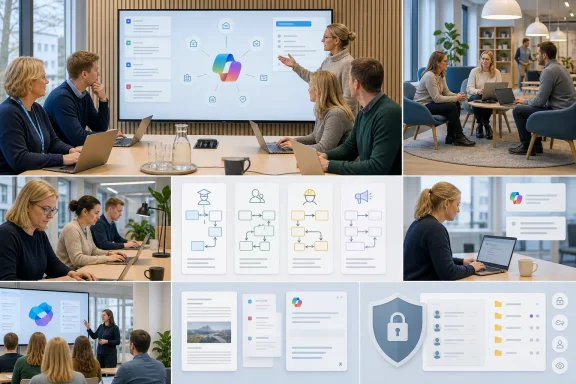
The program began in autumn 2025 and covered a notably broad range of city functions, including education, infrastructure, HR and communications. Rather than use one generic Copilot course, Raisio and Sogeti assessed the needs of individual groups and structured the rollout around three elements:
Pre- and post-project surveys reportedly found reduced employee hesitation and a better understanding of both generative AI’s potential and its limitations. The case study does not publish task-time savings, adoption rates after training, licensing costs, or independently measured productivity results, so the outcome should be read as an early adoption account rather than a quantified ROI study.
That approach matters in a Microsoft 365 tenant because Copilot can surface information already accessible through Microsoft Graph-backed services such as SharePoint, OneDrive, Teams and Exchange. The AI does not create a permissions problem by itself, but a conversational interface can make old oversharing and weak data hygiene much easier for employees to discover. A training-first deployment gives admins time to examine access controls, content ownership, retention policies and sensitivity labeling before usage expands.
Raisio’s experience also underscores that the barrier to Copilot adoption is often organizational rather than technical. Staff were allowed to move through the material at their own pace, use examples from their actual jobs and discuss limits as well as benefits. That is less dramatic than an enterprise-wide license assignment, but more useful for a municipality where teams handle different types of resident, financial, educational and operational data.
For Windows and Microsoft 365 administrators, the practical lesson is straightforward: pair Copilot licensing with permissions cleanup, clear acceptable-use rules and training tied to real workflows, then measure whether users continue to use it.
Raisio is continuing its AI work as its 2026 strategy takes effect.
Raisio already had Microsoft 365 Copilot licenses, but chose a phased program with Sogeti, Capgemini’s technology unit, before expanding use. The city’s stated aim was not simply to speed up drafting and searching, but to give employees across different public-sector functions a way to use the service safely and confidently.
 Training before scale
The program began in autumn 2025 and covered a notably broad range of city functions, including education, infrastructure, HR and communications. Rather than use one generic Copilot course, Raisio and Sogeti assessed the needs of individual groups and structured the rollout around three elements:- Introductory Copilot training for the organization
- Hands-on workshops based on role-specific tasks
- An overview of process automation and its potential impact on knowledge work
Pre- and post-project surveys reportedly found reduced employee hesitation and a better understanding of both generative AI’s potential and its limitations. The case study does not publish task-time savings, adoption rates after training, licensing costs, or independently measured productivity results, so the outcome should be read as an early adoption account rather than a quantified ROI study.
Governance is the real deployment work
The more relevant detail for IT teams is that Raisio treated AI usage guidance, security and privacy as part of the rollout itself. The city and Sogeti jointly created AI-use guidelines, while materials were made available for continuing self-study after the live sessions ended.That approach matters in a Microsoft 365 tenant because Copilot can surface information already accessible through Microsoft Graph-backed services such as SharePoint, OneDrive, Teams and Exchange. The AI does not create a permissions problem by itself, but a conversational interface can make old oversharing and weak data hygiene much easier for employees to discover. A training-first deployment gives admins time to examine access controls, content ownership, retention policies and sensitivity labeling before usage expands.
Raisio’s experience also underscores that the barrier to Copilot adoption is often organizational rather than technical. Staff were allowed to move through the material at their own pace, use examples from their actual jobs and discuss limits as well as benefits. That is less dramatic than an enterprise-wide license assignment, but more useful for a municipality where teams handle different types of resident, financial, educational and operational data.
For Windows and Microsoft 365 administrators, the practical lesson is straightforward: pair Copilot licensing with permissions cleanup, clear acceptable-use rules and training tied to real workflows, then measure whether users continue to use it.
Raisio is continuing its AI work as its 2026 strategy takes effect.
References
- Primary source: Capgemini
Published: 2026-07-13T13:12:08.708032
The City of Raisio launches a people-first path to AI with Microsoft 365 Copilot
The City of Raisio partnered with Sogeti to launch a new strategy, setting in motion a people-first AI journey supported by a safe learning environment and shared learningwww.capgemini.com - Related coverage: windowsforum.com
Raisio’s Microsoft 365 Copilot Rollout: Workforce-First AI for Finland City Hall | Windows Forum
The City of Raisio in Finland began a Microsoft 365 Copilot adoption program in autumn 2025 with Sogeti, part of Capgemini, training nearly 100 municipal...windowsforum.com - Official source: news.microsoft.com

