

Huntress says a standard Microsoft 365 user was escalated to Global Administrator in five and a half minutes during a live product-launch demonstration, using no zero-day exploit, only permissive identity settings, an overpowered enterprise application, a service account, and AI-generated scripting. The stunt matters because it reframes Microsoft 365 compromise as a posture problem rather than a tooling problem. The uncomfortable lesson for Windows shops is that attackers do not need to outsmart Entra ID when tenants are already full of permissions, exceptions, and stale configuration choices waiting to be chained together.
The account in Huntress’ demonstration was deliberately ordinary. “Standard Steve” was not a privileged admin, not a domain wizard, and not a synthetic red-team superuser with hidden powers. He represented the kind of Microsoft 365 identity that gets harvested every day through phishing, token theft, password reuse, adversary-in-the-middle kits, or a tired employee clicking through a convincing prompt.
That is what made the escalation useful as a story. Security demos often collapse under their own theatricality because the attacker is assumed to have an unrealistic level of knowledge, tooling, or access. Huntress’ version was more mundane: a regular user found an enterprise application with too much power, created a credential for a service account, had an AI assistant generate the script needed to move up the privilege ladder, and executed it.
The claim is not that Microsoft 365 is uniquely broken or that every tenant is five minutes away from disaster. The claim is sharper and more useful: identity environments accumulate paths that turn low-value accounts into high-value compromise. If an attacker can find the path quickly, the distinction between “standard user” and “global admin” becomes less reassuring than administrators like to believe.
The AI angle is almost the least interesting part, even though it makes the story more alarming. AI did not discover a new class of vulnerability. It compressed the time between “I found something abusable” and “I have working code,” which is exactly the kind of acceleration defenders should assume is now available to mediocre attackers, not just elite crews.
That is why identity posture management has become a crowded and increasingly important category. It is not glamorous in the way endpoint detection once was, and it does not have the immediate drama of ransomware recovery. But it addresses the obvious fact that Microsoft 365 has become the operating system of work, and its identity plane is where attackers try to turn one compromised account into persistence, data access, and administrative control.
Huntress says its three-month Early Access program for Managed Identity Security Posture Management covered more than 12,000 Microsoft 365 tenants. According to the company, more than 60 percent of those tenants were missing at least half of Huntress-recommended security controls. The headline number is not a scientific census of the whole Microsoft 365 ecosystem, but it is a large enough operational sample to match what many MSPs and sysadmins already know from experience: the average tenant is less hardened than its owners think.
The individual gaps Huntress reported are familiar enough to be depressing. Sixty-six percent of assessed tenants reportedly lacked recommended MFA configurations. Fifty-five percent allowed standard users to perform admin-level functions. Fifty-nine percent had admin accounts with insufficient restrictions. These are not exotic edge cases buried in obscure cloud APIs; they are the everyday failure modes of identity administration at scale.
The security industry often talks about “misconfiguration” as though it were a typo. In Microsoft 365, misconfiguration is more like urban planning. One permissive setting may not be fatal, but the city of exceptions, delegated rights, app permissions, and unmanaged service identities can create a route that nobody intended to build.
Conditional Access is a perfect example. On paper, enforcing MFA, location-aware access, device compliance, or risky sign-in controls sounds obvious. In production, a policy can lock out executives, break line-of-business workflows, strand field workers, trigger emergency exceptions, or generate a helpdesk spike at exactly the moment the IT team is already underwater.
So administrators do what sensible operators often do: they stage, defer, exempt, monitor, and promise to come back later. The policy remains in report-only mode. A VIP gets a bypass. A break-glass account is created but not properly governed. A service account is left alone because nobody is completely sure what it touches. Each decision is defensible in isolation; together, they become an attack path.
MSPs face a harsher version of the same math. They inherit tenants through new clients, mergers, acquisitions, and rescue engagements. A provider may take responsibility for a Microsoft 365 environment whose Secure Score is low, whose global admins are numerous, whose applications were consented to years ago, and whose exceptions encode business logic nobody has documented.
Internal teams are not spared. A two-person IT department supporting a company that grows from 40 people to 150 in a year is not failing because it lacks seriousness. It is failing because the operational model assumes human beings can continuously reconcile a fast-moving cloud identity platform while also handling endpoints, onboarding, offboarding, printers, tickets, vendors, compliance asks, and the CEO’s phone.
This is where Huntress’ pitch becomes more than vendor packaging. A dashboard that says “you have 47 identity risks” may be accurate, but accuracy is not the same as capacity. The hard part is deciding which controls to deploy first, how to avoid breaking work, how to clean up exceptions, and how to keep the environment from drifting back into danger next month.
Huntress frames this as an exposure problem, and that is the right framing. If a standard user can regain access to something they should not have, if an admin loses a required restriction, if MFA enforcement weakens, or if an enterprise application gains excessive reach, the question is not merely whether the next compliance scan will catch it. The question is whether an attacker gets there first.
Microsoft and the broader security industry have repeatedly warned that the time between initial access and meaningful attacker movement has compressed. Huntress cites a 48-minute average from initial intrusion to lateral movement. Whether that number is treated as a precise benchmark or a directional warning, it cuts against the comfortable rhythm of daily or weekly posture reviews.
A 24-hour scan cycle may be useful for governance, but it is not the same thing as protection. If a control fails at 9:05 a.m., an attacker finds the gap at 9:40 a.m., and the posture tool reports it the next morning, the tool has produced a record of exposure, not a defense. That may still help auditors and incident responders, but it does not change the outcome for the compromised tenant.
The operational gap is even larger when remediation is manual. Detection that creates a ticket, which waits for triage, which waits for a maintenance window, which waits for approval, which waits for someone who understands the tenant, is not continuous hardening. It is a queue. Attackers love queues because queues are predictable places where risk waits.
Huntress says Managed ISPM detects and remediates drift in minutes. That is the claim to watch, because it is the difference between posture management as reporting and posture management as enforcement. The former tells teams what they failed to keep fixed. The latter tries to make “fixed” a state that persists.
That is a subtle but meaningful distinction. Microsoft already provides a large amount of security capability inside Microsoft 365, Entra ID, Defender, Purview, and related licensing bundles. Many third-party products can also enumerate weaknesses, score configurations, and flag risky permissions. The bottleneck is not always visibility. The bottleneck is translating visibility into safe, prioritized, continuously enforced change.
Huntress’ model is to define a Microsoft 365 identity-hardening framework, keep that framework current, deploy recommended controls, monitor for drift, and remediate or escalate when reality diverges from the desired state. In plain English: Huntress wants to be the operator of the identity security baseline, not merely the vendor that points to the broken glass.
That makes sense for the company’s customer base. Huntress has long aimed at SMBs, mid-market organizations, and MSPs that want security expertise packaged as an outcome rather than a do-it-yourself platform. Managed EDR and managed Microsoft 365 detection both fit that same thesis: the customer gets a service that absorbs some of the operational burden, while Huntress turns its SOC visibility into repeatable product logic.
The risk, of course, is that “managed” can become a comforting word that hides complexity. Identity hardening is full of business-specific exceptions. Some organizations have legacy applications, unusual vendor requirements, fragile workflows, or politically sensitive admin habits. A managed baseline has to be opinionated enough to reduce risk, but flexible enough not to become another source of downtime.
Huntress appears to understand that tension, at least in product language. Its Learning Mode is designed to let Conditional Access policies run temporarily in a report-only state while surfacing likely user impacts before enforcement. Its Managed Deployments sequence policy rollouts in waves, prioritizing importance and user impact rather than dumping every recommendation into the same urgent pile.
Those features matter because they address the real reason controls stay unenforced. Teams do not avoid hardening because they love risk. They avoid hardening because they fear the business disruption of a poorly staged rollout. Any product that wants to change that behavior must make safe enforcement easier than indefinite deferral.
That distinction is important for defenders. AI lowers the execution barrier for tasks that previously required more scripting fluency, cloud API familiarity, or patience. It does not eliminate the need for access, permissions, and exploitable relationships. It makes the exploitation of those relationships faster and more accessible.
In the Microsoft 365 world, that means old posture problems become newly urgent. Overpowered enterprise applications are not new. Service principals and app credentials have been abused for years. Weak MFA policy, excessive user consent, and sloppy admin scoping are established problems. What changes is the speed with which an attacker can stitch them together after landing inside a tenant.
The uncomfortable implication is that defenders can no longer rely on attacker incompetence as a compensating control. A low-skill intruder with stolen credentials can now ask for help navigating Microsoft Graph, writing PowerShell, interpreting permission scopes, or automating escalation steps. The same AI assistance that helps administrators write scripts also helps attackers operationalize gaps administrators did not close.
This is why posture matters more, not less, in the AI era. Detection remains essential, but detection assumes the attacker is already doing something observable. Hardening tries to remove the cheap paths before they become activity. In an environment where scripting and procedural knowledge are easier to obtain, removing cheap paths becomes the more durable defense.
It is also why Microsoft 365 compromise feels different from an old-fashioned single-system breach. A stolen mailbox is rarely just a stolen mailbox. It may become invoice fraud, internal phishing, data theft, OAuth abuse, lateral movement into cloud applications, or privilege escalation through roles and service accounts the victim never knew existed.
Administrators have heard for years that identity is the new perimeter. The phrase has become a cliché because it is true but incomplete. Identity is not a wall; it is a routing fabric. Every application permission, delegated role, conditional policy, exception, stale guest, and service account helps define where a compromised user can go next.
Microsoft has improved the native tooling around this fabric, but the tooling still requires judgment. Secure Score can point teams in the right direction, but it cannot know every business trade-off. Entra admin centers expose settings, but the settings are numerous and distributed. Conditional Access is powerful, but power increases the cost of mistakes.
That is the gap where managed posture vendors want to live. They are not replacing Microsoft’s security model; they are trying to make it operable for organizations that do not have a dedicated identity team. For WindowsForum readers who manage real tenants rather than ideal architecture diagrams, that difference is not academic.
The best version of this market will complement Microsoft’s platform by turning security recommendations into safe operational routines. The worst version will add another abstraction layer that customers trust without understanding. The burden is on vendors like Huntress to prove that managed hardening produces measurable reduction in incidents, not merely cleaner dashboards.
Those are vendor numbers, and they deserve the usual caution. They come from Huntress’ customer base, Huntress’ classification of incidents, and Huntress’ view of which policies would have prevented which events. They are still useful because they are operationally specific. The claim is not that Managed ISPM stops all compromise; the claim is that a meaningful share of incidents begin with weaknesses that hardening can remove.
That distinction matters. Security marketing often drifts into the fantasy of prevention, where the right platform makes attackers disappear. Identity hardening does not do that. Users will still be phished. Tokens will still be stolen. Attackers will still find creative ways into organizations. Vendors will still have bugs, and administrators will still make mistakes.
What hardening can do is reduce the payoff from initial access. If a compromised standard user cannot access admin portals, cannot register dangerous credentials, cannot abuse an over-permissioned app, cannot bypass MFA, and cannot reach sensitive resources without device or risk conditions, the attacker’s job becomes harder. Harder does not mean impossible. It means noisier, slower, more expensive, and more likely to collide with detection.
This is where ISPM and ITDR are naturally linked. ITDR watches for active identity threats and responds when accounts behave maliciously or suspiciously. ISPM tries to close the configuration gaps that make those threats easier to execute. Huntress’ stated feedback loop between SOC findings and posture controls is sensible: incidents should teach the baseline what to harden next.
The security industry has spent years separating prevention, detection, response, and posture into neat product boxes. Attackers do not experience environments that way. They experience the tenant as a set of paths. If the defender’s products do not talk to each other about those paths, the attacker gets the more coherent view of the system.
That scale turns best practices into logistics. It is one thing to know that standard users should not be able to perform admin-adjacent actions. It is another to identify where that is true across a client base, stage changes, communicate impacts, handle exceptions, prove progress, and keep the posture from drifting again after a vendor or technician changes something.
MSPs also carry reputational risk when client tenants are compromised. A business email compromise incident may begin with a client user, but the client often looks to the MSP for an explanation. If the answer is “we knew the setting was risky but had not gotten to it yet,” the distinction between advisory responsibility and operational responsibility will not be comforting.
A managed posture product gives MSPs a way to convert vague hardening promises into a repeatable service. That is valuable, but it also raises expectations. Once a provider sells managed hardening, customers will reasonably assume that obvious gaps are being closed continuously. The product must therefore be reliable not only as technology, but as a delegation of professional responsibility.
For smaller organizations, the appeal is similar. They may not want to become Microsoft identity experts. They may not be able to hire one. But they still depend on Microsoft 365 as the hub of their operations. In that world, buying managed posture is less about outsourcing security judgment entirely and more about acknowledging that identity hardening has become too important to be handled only when someone has spare time.
Huntress’ Managed ISPM launch is an argument that “later” has become the attacker’s favorite window. The company is not alone in seeing identity posture as the next battleground, but its data and demo land because they match the lived reality of Windows administrators: the platform is powerful, the controls exist, and the work of keeping them correctly deployed never ends.
The healthiest response is neither panic nor product worship. It is to accept that Microsoft 365 hardening has moved from recommendation to routine operations. Whether organizations use Huntress, Microsoft-native tooling, another ISPM or SSPM platform, or a disciplined internal program, the standard has changed. A tenant that is secure only on the day someone audits it is not secure enough for attackers who need minutes, not months, to turn a neglected identity gap into control.
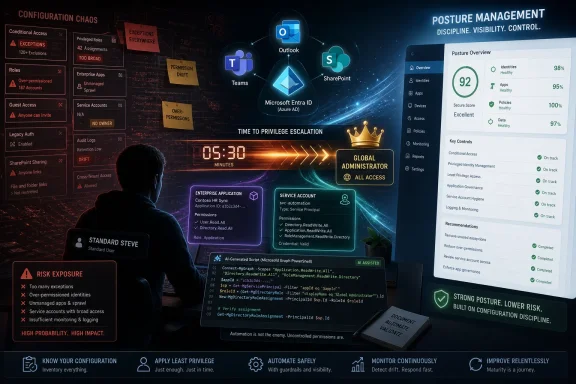 The Five-Minute Admin Was a Product Demo With a Real-World Punchline
The account in Huntress’ demonstration was deliberately ordinary. “Standard Steve” was not a privileged admin, not a domain wizard, and not a synthetic red-team superuser with hidden powers. He represented the kind of Microsoft 365 identity that gets harvested every day through phishing, token theft, password reuse, adversary-in-the-middle kits, or a tired employee clicking through a convincing prompt.That is what made the escalation useful as a story. Security demos often collapse under their own theatricality because the attacker is assumed to have an unrealistic level of knowledge, tooling, or access. Huntress’ version was more mundane: a regular user found an enterprise application with too much power, created a credential for a service account, had an AI assistant generate the script needed to move up the privilege ladder, and executed it.
The claim is not that Microsoft 365 is uniquely broken or that every tenant is five minutes away from disaster. The claim is sharper and more useful: identity environments accumulate paths that turn low-value accounts into high-value compromise. If an attacker can find the path quickly, the distinction between “standard user” and “global admin” becomes less reassuring than administrators like to believe.
The AI angle is almost the least interesting part, even though it makes the story more alarming. AI did not discover a new class of vulnerability. It compressed the time between “I found something abusable” and “I have working code,” which is exactly the kind of acceleration defenders should assume is now available to mediocre attackers, not just elite crews.
Microsoft 365 Security Is Now a Configuration Discipline
For years, Microsoft 365 hardening has lived in an awkward middle ground. It is too important to be treated as back-office hygiene, but too sprawling to be managed like a single product toggle. Entra ID, Exchange Online, enterprise applications, Conditional Access, MFA registration, admin roles, guest access, legacy authentication remnants, OAuth consent, and service principals all sit in the same blast radius, but not in the same clean mental model.That is why identity posture management has become a crowded and increasingly important category. It is not glamorous in the way endpoint detection once was, and it does not have the immediate drama of ransomware recovery. But it addresses the obvious fact that Microsoft 365 has become the operating system of work, and its identity plane is where attackers try to turn one compromised account into persistence, data access, and administrative control.
Huntress says its three-month Early Access program for Managed Identity Security Posture Management covered more than 12,000 Microsoft 365 tenants. According to the company, more than 60 percent of those tenants were missing at least half of Huntress-recommended security controls. The headline number is not a scientific census of the whole Microsoft 365 ecosystem, but it is a large enough operational sample to match what many MSPs and sysadmins already know from experience: the average tenant is less hardened than its owners think.
The individual gaps Huntress reported are familiar enough to be depressing. Sixty-six percent of assessed tenants reportedly lacked recommended MFA configurations. Fifty-five percent allowed standard users to perform admin-level functions. Fifty-nine percent had admin accounts with insufficient restrictions. These are not exotic edge cases buried in obscure cloud APIs; they are the everyday failure modes of identity administration at scale.
The security industry often talks about “misconfiguration” as though it were a typo. In Microsoft 365, misconfiguration is more like urban planning. One permissive setting may not be fatal, but the city of exceptions, delegated rights, app permissions, and unmanaged service identities can create a route that nobody intended to build.
The Real Enemy Is Not Ignorance, But Operating Load
The most generous reading of the Huntress data is also the most damning. The problem is usually not that IT teams have never heard of MFA, least privilege, Conditional Access, admin separation, or application governance. The problem is that they understand the principles and still struggle to make them survive contact with real users, real licensing, real helpdesks, and real inherited environments.Conditional Access is a perfect example. On paper, enforcing MFA, location-aware access, device compliance, or risky sign-in controls sounds obvious. In production, a policy can lock out executives, break line-of-business workflows, strand field workers, trigger emergency exceptions, or generate a helpdesk spike at exactly the moment the IT team is already underwater.
So administrators do what sensible operators often do: they stage, defer, exempt, monitor, and promise to come back later. The policy remains in report-only mode. A VIP gets a bypass. A break-glass account is created but not properly governed. A service account is left alone because nobody is completely sure what it touches. Each decision is defensible in isolation; together, they become an attack path.
MSPs face a harsher version of the same math. They inherit tenants through new clients, mergers, acquisitions, and rescue engagements. A provider may take responsibility for a Microsoft 365 environment whose Secure Score is low, whose global admins are numerous, whose applications were consented to years ago, and whose exceptions encode business logic nobody has documented.
Internal teams are not spared. A two-person IT department supporting a company that grows from 40 people to 150 in a year is not failing because it lacks seriousness. It is failing because the operational model assumes human beings can continuously reconcile a fast-moving cloud identity platform while also handling endpoints, onboarding, offboarding, printers, tickets, vendors, compliance asks, and the CEO’s phone.
This is where Huntress’ pitch becomes more than vendor packaging. A dashboard that says “you have 47 identity risks” may be accurate, but accuracy is not the same as capacity. The hard part is deciding which controls to deploy first, how to avoid breaking work, how to clean up exceptions, and how to keep the environment from drifting back into danger next month.
Drift Turns Good Intentions Into Open Doors
Configuration drift is one of those phrases that sounds harmless until you map it against attacker timing. In traditional IT operations, drift often means entropy: a server setting changes, a policy falls out of compliance, a workstation misses a baseline, and someone eventually notices. In identity security, drift can be the moment a dormant path to privilege becomes available again.Huntress frames this as an exposure problem, and that is the right framing. If a standard user can regain access to something they should not have, if an admin loses a required restriction, if MFA enforcement weakens, or if an enterprise application gains excessive reach, the question is not merely whether the next compliance scan will catch it. The question is whether an attacker gets there first.
Microsoft and the broader security industry have repeatedly warned that the time between initial access and meaningful attacker movement has compressed. Huntress cites a 48-minute average from initial intrusion to lateral movement. Whether that number is treated as a precise benchmark or a directional warning, it cuts against the comfortable rhythm of daily or weekly posture reviews.
A 24-hour scan cycle may be useful for governance, but it is not the same thing as protection. If a control fails at 9:05 a.m., an attacker finds the gap at 9:40 a.m., and the posture tool reports it the next morning, the tool has produced a record of exposure, not a defense. That may still help auditors and incident responders, but it does not change the outcome for the compromised tenant.
The operational gap is even larger when remediation is manual. Detection that creates a ticket, which waits for triage, which waits for a maintenance window, which waits for approval, which waits for someone who understands the tenant, is not continuous hardening. It is a queue. Attackers love queues because queues are predictable places where risk waits.
Huntress says Managed ISPM detects and remediates drift in minutes. That is the claim to watch, because it is the difference between posture management as reporting and posture management as enforcement. The former tells teams what they failed to keep fixed. The latter tries to make “fixed” a state that persists.
The Managed Part Is the Product
The most important word in “Managed ISPM” is not identity or posture. It is managed. Huntress is betting that the market, especially MSPs and small-to-mid-sized organizations, does not need another console as much as it needs someone to own the baseline and the remediation workflow.That is a subtle but meaningful distinction. Microsoft already provides a large amount of security capability inside Microsoft 365, Entra ID, Defender, Purview, and related licensing bundles. Many third-party products can also enumerate weaknesses, score configurations, and flag risky permissions. The bottleneck is not always visibility. The bottleneck is translating visibility into safe, prioritized, continuously enforced change.
Huntress’ model is to define a Microsoft 365 identity-hardening framework, keep that framework current, deploy recommended controls, monitor for drift, and remediate or escalate when reality diverges from the desired state. In plain English: Huntress wants to be the operator of the identity security baseline, not merely the vendor that points to the broken glass.
That makes sense for the company’s customer base. Huntress has long aimed at SMBs, mid-market organizations, and MSPs that want security expertise packaged as an outcome rather than a do-it-yourself platform. Managed EDR and managed Microsoft 365 detection both fit that same thesis: the customer gets a service that absorbs some of the operational burden, while Huntress turns its SOC visibility into repeatable product logic.
The risk, of course, is that “managed” can become a comforting word that hides complexity. Identity hardening is full of business-specific exceptions. Some organizations have legacy applications, unusual vendor requirements, fragile workflows, or politically sensitive admin habits. A managed baseline has to be opinionated enough to reduce risk, but flexible enough not to become another source of downtime.
Huntress appears to understand that tension, at least in product language. Its Learning Mode is designed to let Conditional Access policies run temporarily in a report-only state while surfacing likely user impacts before enforcement. Its Managed Deployments sequence policy rollouts in waves, prioritizing importance and user impact rather than dumping every recommendation into the same urgent pile.
Those features matter because they address the real reason controls stay unenforced. Teams do not avoid hardening because they love risk. They avoid hardening because they fear the business disruption of a poorly staged rollout. Any product that wants to change that behavior must make safe enforcement easier than indefinite deferral.
AI Makes the Weakest Admin Path Easier to Walk
The Standard Steve demonstration is likely to be remembered because of the AI assistant. That is understandable, but it should not be misunderstood. The assistant was not a magic hacking machine; it was a force multiplier for a user who could describe what he wanted in plain language and receive a workable script.That distinction is important for defenders. AI lowers the execution barrier for tasks that previously required more scripting fluency, cloud API familiarity, or patience. It does not eliminate the need for access, permissions, and exploitable relationships. It makes the exploitation of those relationships faster and more accessible.
In the Microsoft 365 world, that means old posture problems become newly urgent. Overpowered enterprise applications are not new. Service principals and app credentials have been abused for years. Weak MFA policy, excessive user consent, and sloppy admin scoping are established problems. What changes is the speed with which an attacker can stitch them together after landing inside a tenant.
The uncomfortable implication is that defenders can no longer rely on attacker incompetence as a compensating control. A low-skill intruder with stolen credentials can now ask for help navigating Microsoft Graph, writing PowerShell, interpreting permission scopes, or automating escalation steps. The same AI assistance that helps administrators write scripts also helps attackers operationalize gaps administrators did not close.
This is why posture matters more, not less, in the AI era. Detection remains essential, but detection assumes the attacker is already doing something observable. Hardening tries to remove the cheap paths before they become activity. In an environment where scripting and procedural knowledge are easier to obtain, removing cheap paths becomes the more durable defense.
Microsoft’s Platform Strength Also Creates Microsoft’s Blast Radius
Microsoft 365’s centrality is its strength. One identity can unlock mail, files, Teams, SharePoint, line-of-business apps, administrative portals, device management, security tooling, and third-party SaaS. That integration is why organizations standardize on the platform.It is also why Microsoft 365 compromise feels different from an old-fashioned single-system breach. A stolen mailbox is rarely just a stolen mailbox. It may become invoice fraud, internal phishing, data theft, OAuth abuse, lateral movement into cloud applications, or privilege escalation through roles and service accounts the victim never knew existed.
Administrators have heard for years that identity is the new perimeter. The phrase has become a cliché because it is true but incomplete. Identity is not a wall; it is a routing fabric. Every application permission, delegated role, conditional policy, exception, stale guest, and service account helps define where a compromised user can go next.
Microsoft has improved the native tooling around this fabric, but the tooling still requires judgment. Secure Score can point teams in the right direction, but it cannot know every business trade-off. Entra admin centers expose settings, but the settings are numerous and distributed. Conditional Access is powerful, but power increases the cost of mistakes.
That is the gap where managed posture vendors want to live. They are not replacing Microsoft’s security model; they are trying to make it operable for organizations that do not have a dedicated identity team. For WindowsForum readers who manage real tenants rather than ideal architecture diagrams, that difference is not academic.
The best version of this market will complement Microsoft’s platform by turning security recommendations into safe operational routines. The worst version will add another abstraction layer that customers trust without understanding. The burden is on vendors like Huntress to prove that managed hardening produces measurable reduction in incidents, not merely cleaner dashboards.
The Numbers Point to Preventable Incidents, Not Perfect Security
Huntress says 79 percent of its critical and high-severity incidents last year were identity-based. It also says roughly 35 percent of identity-based incidents its ITDR SOC handled over the past six months could have been prevented by fully deployed ISPM policies, with an expectation that the figure could rise to 80 percent as more controls are added.Those are vendor numbers, and they deserve the usual caution. They come from Huntress’ customer base, Huntress’ classification of incidents, and Huntress’ view of which policies would have prevented which events. They are still useful because they are operationally specific. The claim is not that Managed ISPM stops all compromise; the claim is that a meaningful share of incidents begin with weaknesses that hardening can remove.
That distinction matters. Security marketing often drifts into the fantasy of prevention, where the right platform makes attackers disappear. Identity hardening does not do that. Users will still be phished. Tokens will still be stolen. Attackers will still find creative ways into organizations. Vendors will still have bugs, and administrators will still make mistakes.
What hardening can do is reduce the payoff from initial access. If a compromised standard user cannot access admin portals, cannot register dangerous credentials, cannot abuse an over-permissioned app, cannot bypass MFA, and cannot reach sensitive resources without device or risk conditions, the attacker’s job becomes harder. Harder does not mean impossible. It means noisier, slower, more expensive, and more likely to collide with detection.
This is where ISPM and ITDR are naturally linked. ITDR watches for active identity threats and responds when accounts behave maliciously or suspiciously. ISPM tries to close the configuration gaps that make those threats easier to execute. Huntress’ stated feedback loop between SOC findings and posture controls is sensible: incidents should teach the baseline what to harden next.
The security industry has spent years separating prevention, detection, response, and posture into neat product boxes. Attackers do not experience environments that way. They experience the tenant as a set of paths. If the defender’s products do not talk to each other about those paths, the attacker gets the more coherent view of the system.
MSPs Are the Natural Test Case for Managed Hardening
Managed service providers are the obvious audience for Huntress’ ISPM pitch because they live with the arithmetic of scale. A single internal IT department may struggle to harden one tenant. An MSP may be responsible for dozens or hundreds, each with different licensing, business needs, inherited choices, and executive tolerance for disruption.That scale turns best practices into logistics. It is one thing to know that standard users should not be able to perform admin-adjacent actions. It is another to identify where that is true across a client base, stage changes, communicate impacts, handle exceptions, prove progress, and keep the posture from drifting again after a vendor or technician changes something.
MSPs also carry reputational risk when client tenants are compromised. A business email compromise incident may begin with a client user, but the client often looks to the MSP for an explanation. If the answer is “we knew the setting was risky but had not gotten to it yet,” the distinction between advisory responsibility and operational responsibility will not be comforting.
A managed posture product gives MSPs a way to convert vague hardening promises into a repeatable service. That is valuable, but it also raises expectations. Once a provider sells managed hardening, customers will reasonably assume that obvious gaps are being closed continuously. The product must therefore be reliable not only as technology, but as a delegation of professional responsibility.
For smaller organizations, the appeal is similar. They may not want to become Microsoft identity experts. They may not be able to hire one. But they still depend on Microsoft 365 as the hub of their operations. In that world, buying managed posture is less about outsourcing security judgment entirely and more about acknowledging that identity hardening has become too important to be handled only when someone has spare time.
The Hardening Story Windows Admins Should Actually Hear
The Standard Steve demo is dramatic, but the useful lesson is practical. Microsoft 365 compromise often starts with ordinary accounts and ordinary administrative debt. The organizations that improve will be the ones that treat identity posture as a continuously operated control plane, not an annual cleanup project.- A standard Microsoft 365 account can become dangerous when enterprise applications, service accounts, and delegated permissions are allowed to accumulate unchecked.
- MFA is necessary but insufficient if the surrounding tenant still permits weak exceptions, over-privileged identities, risky admin access, or uncontrolled application permissions.
- Configuration drift should be treated as live exposure because attackers can move faster than daily scan cycles and ticket-based remediation queues.
- Managed posture tools are most valuable when they safely enforce change, not merely when they produce longer lists of recommendations.
- AI raises the urgency of basic hardening because it helps less-skilled attackers turn known gaps into working scripts faster than before.
- MSPs and small IT teams should evaluate identity-hardening products by their ability to reduce operational burden without hiding business-impact decisions.
The Next Microsoft 365 Breach Will Look Boring Until It Is Expensive
The great frustration of Microsoft 365 identity security is that many of the worst incidents begin with settings that look ordinary until they are chained together. A service account owns too much. A user can reach a portal they do not need. An application has excessive permissions. MFA enforcement is inconsistent. An admin account is under-restricted because tightening it was always scheduled for later.Huntress’ Managed ISPM launch is an argument that “later” has become the attacker’s favorite window. The company is not alone in seeing identity posture as the next battleground, but its data and demo land because they match the lived reality of Windows administrators: the platform is powerful, the controls exist, and the work of keeping them correctly deployed never ends.
The healthiest response is neither panic nor product worship. It is to accept that Microsoft 365 hardening has moved from recommendation to routine operations. Whether organizations use Huntress, Microsoft-native tooling, another ISPM or SSPM platform, or a disciplined internal program, the standard has changed. A tenant that is secure only on the day someone audits it is not secure enough for attackers who need minutes, not months, to turn a neglected identity gap into control.
References
- Primary source: Huntress
Published: Tue, 30 Jun 2026 14:26:37 GMT
- Related coverage: feedback.huntress.com
Lock down Microsoft 365 identities with Managed ISPM, now in free Early Access for ITDR tenants | Huntress Changelog
Huntress Managed Identity Security Posture Management (ISPM) is now in free Early Access for qualifying Huntress partners and customers using Managed ITDR infeedback.huntress.com - Official source: marketplace.microsoft.com
Microsoft Marketplace | cloud solutions, AI apps, and agents
marketplace.microsoft.com
- Related coverage: msspalert.com
Huntress Brings Managed Identity and Endpoint Posture to MSSPs, MSPs | news | MSSP Alert
New ESPM and ISPM offerings aim to reduce common security gaps by continuously enforcing controls across Microsoft 365 and endpoint environments.www.msspalert.com - Related coverage: businessof.tech
Huntress Expands Into Identity Security as N-able Adds CMMC Controls, Signaling New Expectations for MSP Discipline – Business of Tech
Huntress has officially acquired Inside Agent , a London-based firm focused on enhancing Microsoft 365 security against various threats. The new Identity Securibusinessof.tech - Related coverage: support.huntress.io
Historical Huntress Agent and Platform Release Notes – Huntress Support
Summary: Huntress updates detailed with features and bug fixes. For recent release notes, see Huntress Release Notes and Agent...support.huntress.io
- Official source: microsoft.com
Inside Microsoft 365 Defender: Attack modeling for finding and stopping lateral movement | Microsoft Security Blog
Microsoft Threat Protection uses a data-driven approach for identifying lateral movement, combining industry-leading optics, expertise, and data science to deliver automated discovery of some of the most critical threats today.www.microsoft.com - Related coverage: secur-serv.com
