

Windows Central reports that another Microsoft customer says a compromised Microsoft account was permanently suspended after recovery failed, cutting off access to an Xbox game library and OneDrive data tied to the same identity.
The customer, Joshua Khane, posted screenshots and an account of the case on social media on July 14. He said Microsoft had acknowledged the compromise but deemed the account unrecoverable after its security details were changed. Khane claims the loss included purchased Xbox games, personal files, and family photos. Microsoft has not publicly commented on the individual case.
This follows a separate report from Windows Central a day earlier involving Brazilian Xbox user Ordo_Liberal, who said a court ordered Microsoft to restore a hacked account and pay damages. The publication reported the user’s account had also been marked unrecoverable after an attacker changed its security information. The reported court outcome has not been independently substantiated with public filings.
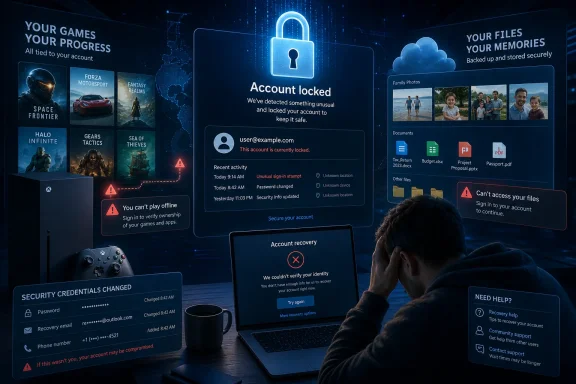
Microsoft’s account model puts Xbox purchases, OneDrive storage, Outlook mail, Windows sign-in, subscriptions, and security credentials behind one Microsoft account. That integration is convenient until recovery fails: losing control of the account can mean losing access to several unrelated services at once.
Microsoft’s own support documentation says agents cannot manually reset passwords or change account details. When all security information is replaced, Microsoft normally places the account into a 30-day restricted state and sends alerts to the previous contact methods. Users who did not authorize the change are directed to report it through the pending-security-change screen or the account recovery process.
But Microsoft also says that where its automated recovery process cannot establish ownership, support cannot override it. That leaves a difficult gap for customers who can show purchase records, console ownership, old credentials, or other evidence but cannot satisfy the recovery system’s required checks.
The company’s Digital Goods rules make the legal position plain, if unwelcome: Xbox games and other Microsoft Store content are licensed, not sold. Access remains tied to the Microsoft account and its compliance with the service terms. That does not make a failed recovery acceptable to affected customers, but it explains why a lost account can also mean inaccessible purchases.
If Microsoft’s recovery process rejects an account after a takeover, the practical outcome may still be a permanent loss of access to the content and services attached to it.
The customer, Joshua Khane, posted screenshots and an account of the case on social media on July 14. He said Microsoft had acknowledged the compromise but deemed the account unrecoverable after its security details were changed. Khane claims the loss included purchased Xbox games, personal files, and family photos. Microsoft has not publicly commented on the individual case.
This follows a separate report from Windows Central a day earlier involving Brazilian Xbox user Ordo_Liberal, who said a court ordered Microsoft to restore a hacked account and pay damages. The publication reported the user’s account had also been marked unrecoverable after an attacker changed its security information. The reported court outcome has not been independently substantiated with public filings.
 An Account Problem With Wider Consequences
Microsoft’s account model puts Xbox purchases, OneDrive storage, Outlook mail, Windows sign-in, subscriptions, and security credentials behind one Microsoft account. That integration is convenient until recovery fails: losing control of the account can mean losing access to several unrelated services at once.Microsoft’s own support documentation says agents cannot manually reset passwords or change account details. When all security information is replaced, Microsoft normally places the account into a 30-day restricted state and sends alerts to the previous contact methods. Users who did not authorize the change are directed to report it through the pending-security-change screen or the account recovery process.
But Microsoft also says that where its automated recovery process cannot establish ownership, support cannot override it. That leaves a difficult gap for customers who can show purchase records, console ownership, old credentials, or other evidence but cannot satisfy the recovery system’s required checks.
The company’s Digital Goods rules make the legal position plain, if unwelcome: Xbox games and other Microsoft Store content are licensed, not sold. Access remains tied to the Microsoft account and its compliance with the service terms. That does not make a failed recovery acceptable to affected customers, but it explains why a lost account can also mean inaccessible purchases.
What Users Should Do
The immediate lesson is not to abandon digital purchases, but to avoid treating a consumer account as the only copy or proof of anything important.- Keep at least two current recovery methods, including an authenticator app.
- Review security alerts promptly and retain access to the recovery email and phone number.
- Save purchase receipts, subscription confirmations, and Xbox account details offline.
- Back up OneDrive content separately to local storage or another cloud provider.
- Do not remove all account security methods at once; Microsoft says doing so triggers a 30-day restriction.
If Microsoft’s recovery process rejects an account after a takeover, the practical outcome may still be a permanent loss of access to the content and services attached to it.
References
- Primary source: Windows Central
Published: 2026-07-14T17:01:45+00:00
Microsoft keeps proving you own NOTHING with them — it blocks another user's entire Xbox game library, including his OneDrive | Windows Central
Gamer Joshua Khane is yet another victim of Microsoft's apathy towards its customers, in yet another example of it banning a user for the crime of ... being hacked?www.windowscentral.com
