

Microsoft’s purchase of Osmos represents a fast-moving bet that agentic AI—software agents that act autonomously to complete multistep tasks—will become a foundational layer of enterprise data platforms rather than a niche add‑on. The deal folds Osmos’s agentic data‑engineering technology directly into Microsoft Fabric and its unified storage layer, OneLake, promising to accelerate the conversion of raw, messy data into analytics‑ and AI‑ready assets while raising fresh questions about governance, reliability, and vendor lock‑in for cloud data teams.
Microsoft announced it has acquired Osmos, a Seattle‑area startup founded in 2019 by Kirat Pandya and Naresh Venkat, that built agentic systems for data ingestion, cleaning, transformation, and automated code generation inside data platforms. Osmos’s product portfolio—covering Uploaders, Pipelines, Datasets, and agentic “AI Data Engineer” and “AI Data Wrangler” offerings—was already integrated with Microsoft Fabric through Fabric’s extensibility model prior to the acquisition. Microsoft framed the purchase as a step toward embedding autonomous AI agents into Fabric to reduce operational overhead for data teams. Osmos’s own site and communications make the transition explicit: the company now redirects visitors to Microsoft’s announcement and posts a Frequently Asked Questions page noting that Osmos’s standalone products will sunset starting in January 2026 as its technology is integrated into Fabric. Financial terms were not disclosed; public reporting shows Osmos raised venture capital (a Series A led by Lightspeed in 2021) though sources differ slightly on aggregated totals.
Conclusion: Microsoft’s acquisition of Osmos accelerates the convergence of agentic AI and cloud data platforms, delivering meaningful operational benefits for Fabric customers while amplifying governance and portability risks that demand active mitigation. Organizations should use the announced sunset timeline to inventory Osmos dependencies, engage Microsoft for migration and SLAs, harden validation and lineage practices for any agent‑generated assets, and weigh the strategic tradeoffs of deeper platform integration against long‑term multi‑cloud flexibility.
Source: SDxCentral Microsoft ingests Osmos to boost Fabric agentic AI abilities
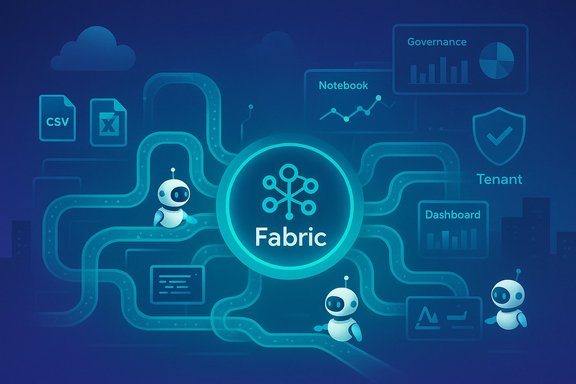 Background / Overview
Microsoft announced it has acquired Osmos, a Seattle‑area startup founded in 2019 by Kirat Pandya and Naresh Venkat, that built agentic systems for data ingestion, cleaning, transformation, and automated code generation inside data platforms. Osmos’s product portfolio—covering Uploaders, Pipelines, Datasets, and agentic “AI Data Engineer” and “AI Data Wrangler” offerings—was already integrated with Microsoft Fabric through Fabric’s extensibility model prior to the acquisition. Microsoft framed the purchase as a step toward embedding autonomous AI agents into Fabric to reduce operational overhead for data teams. Osmos’s own site and communications make the transition explicit: the company now redirects visitors to Microsoft’s announcement and posts a Frequently Asked Questions page noting that Osmos’s standalone products will sunset starting in January 2026 as its technology is integrated into Fabric. Financial terms were not disclosed; public reporting shows Osmos raised venture capital (a Series A led by Lightspeed in 2021) though sources differ slightly on aggregated totals. Why this matters for Fabric and OneLake
Microsoft Fabric is a unified analytics platform that brings together data integration, engineering, science, warehousing, real‑time intelligence, and business analytics on top of the OneLake storage layer. Fabric’s design goal is “one copy, many engines” so that the same guarded dataset can be used across Spark, T‑SQL, KQL, and Power BI without unnecessary duplication. Osmos’s agentic tech plugs directly into that model by automating the painful, repetitive, and error‑prone steps of data ingestion and transformation—particularly for external and messy data sources such as vendor spreadsheets, partner feeds, or PDF attachments. OneLake already supports virtualization and near‑real‑time integration with external systems via features such as Shortcuts and Mirroring, enabling connections to Databricks Unity Catalog and Iceberg tables (Snowflake) among others. Agentic data agents running natively inside Fabric could accelerate onboarding of those external datasets into consistent Delta or Iceberg tables, generate production‑grade PySpark notebooks automatically, and keep transformation logic versioned and auditable within the Fabric workspace. That combination is the crux of Microsoft’s stated rationale for the acquisition.What Osmos brings: technology and productized capabilities
Osmos’s recent product set focused on two complementary approaches: agentic, autonomous assistants that generate and manage pipeline code (the AI Data Engineer, AI Data Wrangler), and embedded uploader and pipeline services that automate ingestion and mapping workflows without code. Key technical capabilities the startup emphasized include:- Fabric‑native PySpark notebook generation with structure for exploration, transforms, validations, and logging. These notebooks are designed to run within a customer’s Fabric tenant and execute on Spark pools, keeping data in‑tenant.
- Autonomous code generation and validation: agents can produce code, run tests, detect and remediate some failures, and produce audit trails and metrics for human review.
- Broad data format support and connectors for CSV, Excel, JSON, Parquet, and text files together with prebuilt logic to handle messy structures like multi‑table PDFs or variant column encodings.
- Integration with Fabric’s Workload Hub extensibility model—Osmos had already shipped Fabric workloads and agents that customers could run in their own Fabric workspaces before the acquisition.
Verified facts and cross‑checks
Several claims in early coverage and the companies’ own announcements were verified across independent sources:- The acquisition and Microsoft’s framing (agentic AI to accelerate autonomous data engineering inside Fabric) appear in Microsoft’s official announcement and Osmos’s site.
- Osmos was founded in 2019 by Kirat Pandya and Naresh Venkat; both founders previously worked in ML and partnerships roles at Google and have public bios and earlier posts describing that background. Lightspeed Venture Partners publicly lists Osmos as a portfolio company, and prior press describes a Series A led by Lightspeed in 2021.
- Osmos’s public FAQ and multiple coverage items confirm the company’s standalone products will be sunset starting January 2026 as the team and technology move into Microsoft Fabric. This is a firm customer‑facing timeline from Osmos.
- Publicly available documentation shows Fabric/OneLake already supports Shortcuts, Mirroring, and connections to Databricks and Snowflake via Iceberg/Unity Catalog integrations—making the Osmos integration technically complementary to Fabric’s existing ingestion and virtualization primitives.
Immediate customer impact and migration timeline
Osmos has been explicit in telling current customers that standalone offerings will be sunset beginning January 2026 and that active customers should have received transition emails with account‑specific details. Osmos also says it will not accept new users during the transition period and invites customers to follow Microsoft Fabric Blog updates for integration timelines. Practically, this means:- Active Osmos customers must plan migration paths for any production workloads the company currently manages or hosts.
- Customers using Osmos agents for non‑Fabric targets—Databricks or third‑party warehouses—need contingency planning because the Databricks and other agents are listed among the items being sunset.
Benefits: what organizations stand to gain
Embedding Osmos’s agentic data engineering into Fabric offers several concrete advantages when implemented well:- Faster onboarding of messy data: Agentic agents accelerate the conversion of ad‑hoc external data into normalized tables—reducing months‑long ETL projects to days or weeks in some cases.
- Operational efficiency: Automating repetitive pipeline authoring, validation, and monitoring can reduce dev and maintenance effort for routine ingestion jobs. Public vendor posts claim significant percentage reductions in toil during pilot phases. These vendor metrics are promising but should be validated in each customer environment.
- Tenant‑local execution and governance: Osmos emphasized that generated notebooks execute inside a user’s Fabric tenant and work with OneLake security and governance, which is critical for regulated industries that cannot allow external data flows.
- Consistency and auditability: Versioned, auditable notebooks and agent‑driven change logs can improve traceability for data transformations and make debugging and compliance easier when compared with ad‑hoc scripts spread across teams.
Risks, technical caveats, and governance challenges
Agentic AI for data engineering is powerful but not without material risks. Integrating Osmos into Fabric raises a set of technical, organizational, and compliance‑oriented questions:- Hallucination and correctness: Agentic systems that generate code can make logical errors, misinterpret ambiguous schemas, or silently produce transformations that appear plausible but are incorrect. This risk demands robust validation tooling, test harnesses, and human‑in‑the‑loop checkpoints before generated pipelines are promoted to production. Osmos’s product emphasized validation and metrics, but these must be adopted and audited by customer teams to avoid silent data corruption.
- Explainability and audit trails: While Osmos claims audit trails and version control, real enterprise compliance regimes (financial reporting, healthcare, regulated data) require rigorous artifact lineage, approvals, and reproducible runs. Microsoft and customers must ensure agentic outputs map cleanly to required audit artifacts and controls inside Fabric’s governance model.
- Security and data residency: Osmos’s model of executing within the tenant is important, but integrating a third party’s intellectual property and agent logic into a hyperscaler raises questions about who controls model updates, where model weights or telemetry may be stored, and whether external calls (for LLM inference, telemetry, or model updates) occur. Customers will want clear attestations about data residency, telemetry, and offline operation. Osmos and Microsoft have stated compliance alignment, but specifics will matter for regulated customers.
- Support surface and SLAs: Customers on Osmos’s hosted services must prepare for the end of those services and for Microsoft's support model for any converted Osmos features inside Fabric. Microsoft’s enterprise SLAs, billing, and support constructs may differ materially from Osmos’s, requiring contractual attention during migration. Osmos’s FAQ directs customers to Microsoft Fabric updates but does not publish a full migration playbook at announcement time.
- Vendor lock‑in and portability: Osmos’s value proposition is coupling agentic engineering tightly with the data platform. While that increases convenience for Fabric customers, it increases dependence on Microsoft’s stack. Organizations that value multi‑cloud or vendor neutrality should weigh the convenience gains versus the strategic risk of tighter coupling. Existing Databricks or Snowflake customers will need to evaluate tradeoffs carefully, especially since Osmos had previously supported Databricks and those agents are being sunset.
- Operational transparency and debugging: Automatically generated code can accelerate work, but it can also make root‑cause analysis harder if engineers lose familiarity with auto‑generated pipelines. Best practice requires toolchains that produce human‑readable artifacts, extensive test coverage, and the ability for teams to iterate on and own generated code. Osmos advertises structured notebooks with test flags and logs, which mitigates but does not eliminate this concern.
Competitive and market implications
This acquisition nudges the market toward integrated agentic data tooling inside hyperscaler platforms. Several competitive dynamics to watch:- Databricks and Snowflake: Databricks has been expanding automated ETL and pipeline generation features (Unity Catalog integrations, automated data quality features). Snowflake’s ecosystem likewise pushes integration with external data ingestion tools. By embedding Osmos into Fabric, Microsoft strengthens its direct platform offering and raises the bar for third parties that previously differentiated through Fabric‑native integrations. The result will be accelerated productization of agentic assistants across major platforms or new partnerships to preserve multi‑platform portability.
- Hyperscaler strategy: Hyperscalers increasingly view agentic AI as infrastructure rather than application-level add‑ons. Microsoft is betting that agentic agents tightly integrated with storage, governance, and compute provide a superior enterprise story versus bolt‑on SaaS offerings. Expect other cloud vendors to make similar moves or tighten their partner ecosystems.
- Startups and incumbents: Smaller vendors offering agentic ingestion tools now face the prospect of having their value captured inside hyperscaler platforms or being forced into integration partnerships. The tradeoff for customers is convenience versus strategic independence.
Practical advice for IT and data leaders
Given the acquisition, organizations using Osmos or evaluating agentic ingestion should consider this practical checklist:- Inventory: Immediately catalog any current Osmos assets—Uploaders, Pipelines, Datasets, and Data Agents—and map them to production owners, SLAs, and data sensitivity. Osmos’s FAQ states the product suite will be sunset starting January 2026.
- Engage Microsoft: Open direct migration discussions with Microsoft Fabric account teams and technical specialists. Ask for a documented migration plan, timelines for feature parity inside Fabric, and details about telemetry or model inference.
- Validate artifacts: Require that any agent‑generated notebooks include test harnesses, unit checks, row‑count comparisons, and reproducible runs. Accept no “black box” deployments without human review gates.
- Governance & compliance: Map Osmos‑managed workflows to existing governance controls in OneLake (row/column level security, catalog policies) and ensure lineage and audit logs are accessible for compliance reviews.
- Exit and portability planning: For workloads that must remain platform portable, ensure there are exportable artifacts (standardized SQL, PySpark notebooks) and that orchestration and scheduling are not trapped in a vendor‑specific workflow without fallback.
Unanswered questions and areas to watch
Several key items remain undetailed and will determine whether the acquisition is a net positive for enterprise data teams:- What exactly will change inside Fabric and when? Microsoft pledged integration updates on the Fabric Blog but has not published a detailed roadmap for which Osmos features will become first‑class Fabric capabilities versus phased integrations.
- How will inference be handled for agentic models—locally in tenant, through Microsoft models, or via third‑party LLMs? The security posture and compliance implications hinge on this answer.
- What migration assistance and SLAs will Microsoft provide to Osmos customers whose hosted services are being sunset? Osmos’s FAQ directs customers to support contacts but does not yet publish a formal migration SLA.
- Are there material differences in reported Osmos funding totals and what do they imply about deal structure? Public trackers list a 2021 Lightspeed‑led round (commonly $13M reported) with some aggregators listing higher totals; the acquisition price was undisclosed. Treat funding totals as approximate.
Final analysis: pragmatic optimism with vigilant governance
Microsoft’s acquisition of Osmos is strategically coherent: it embeds agentic data‑engineering capabilities where a large portion of enterprise data workloads already live—the cloud data platform—and it promises to simplify the traditional bottleneck of data preparation. For organizations already invested in Fabric and OneLake, the integration could materially shorten the path from raw data to insights and AI projects while improving governance if Microsoft preserves tenant‑local execution and robust audit controls. At the same time, agentic AI is not a silver bullet. Data correctness, explainability, traceable lineage, and reproducibility remain engineering priorities that cannot be outsourced to opaque agents. Organizations should treat Osmos‑driven automation as a productivity multiplier that still requires human‑centered controls, testing disciplines, and strategic decisions about portability and vendor dependence. The announced product sunset gives customers a firm migration milestone—January 2026—that should be respected as the baseline for migration planning. As agentic capabilities proliferate across the major clouds, the balance for IT leaders will be between adopting powerful, platform‑native automation that reduces operational cost and maintaining the guardrails needed for accuracy, compliance, and long‑term platform independence. The Osmos acquisition is an important bellwether in that evolution—one that will reward careful implementation and governance as much as clever automation.Conclusion: Microsoft’s acquisition of Osmos accelerates the convergence of agentic AI and cloud data platforms, delivering meaningful operational benefits for Fabric customers while amplifying governance and portability risks that demand active mitigation. Organizations should use the announced sunset timeline to inventory Osmos dependencies, engage Microsoft for migration and SLAs, harden validation and lineage practices for any agent‑generated assets, and weigh the strategic tradeoffs of deeper platform integration against long‑term multi‑cloud flexibility.
Source: SDxCentral Microsoft ingests Osmos to boost Fabric agentic AI abilities
