

Microsoft and MIT Technology Review Insights published the 2026 Agent Confidence Index on June 29, 2026, surveying 300 technical experts across AI, data, and cloud work in 12 industries and four regions about confidence in agents across 101 enterprise tasks. The result is less a victory lap than a map of where delegation has actually begun. It shows a market that is confident in agents for repetitive, observable, low-regret work, and still cautious where systems are tangled, failures are expensive, and human judgment remains the last control plane.
For the last two years, “agents” have been the most overloaded word in enterprise technology. They have meant chatbots with plugins, workflow automations with better marketing, coding assistants with shell access, and ambitious software co-workers that promise to plan, act, and correct themselves. Microsoft’s new index matters because it tries to pin that fog to actual tasks.
The company says the average confidence score across the 101 measured tasks is 64 out of 100, with 30 tasks clearing 70. That is not a declaration that agents are ready to run the enterprise. It is a more interesting claim: builders already trust agents in specific pockets of work, and those pockets are not random.
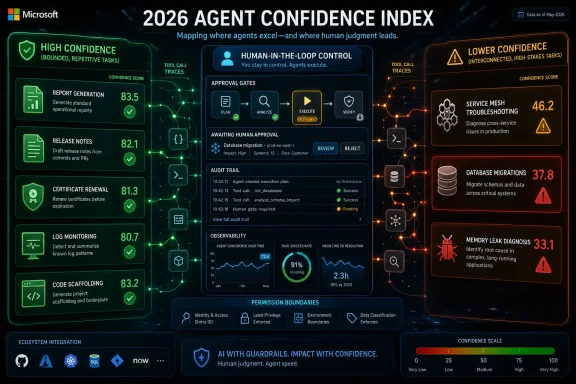
The highest confidence scores cluster around work that sysadmins, developers, data engineers, and SREs already know too well. Automated report generation leads the index at 83.5. Boilerplate code generation for new features follows at 82.5. Certificate expiration monitoring and renewal lands at 81.5, real-time data stream monitoring at 80.5, and release note generation from commit history at 79.5.
That list tells us more than the aggregate number does. Agents are gaining confidence first where the work is structured, repetitive, auditable, and irritating. The enterprise is not handing over its architecture board. It is handing over the chores.
That is exactly where automation has always entered the workplace: not by replacing expertise wholesale, but by eating the work experts least want to defend. A developer who lets Copilot generate familiar boilerplate is not surrendering authorship of the product. A cloud engineer who lets an agent monitor certificate expiration is not outsourcing operational judgment. They are shifting attention away from preventable toil.
For WindowsForum readers, this distinction matters. The people most likely to benefit from agents are not necessarily the ones dazzled by futuristic interfaces. They are the admins who have watched preventable outages begin with an expired cert, the developers who have written the same API wrapper a dozen times, and the operations teams that spend too much of their week turning noisy signals into tickets.
Microsoft’s framing is predictably optimistic, but the data behind this part of the story is plausible because it matches how IT departments actually behave. Teams do not begin with blind trust. They begin with tasks where mistakes are detectable, reversals are possible, and humans can compare the agent’s output against known patterns.
That boundedness is what separates useful agent work from magical thinking. Agents are not merely “better” at some tasks because they are fast; they are more deployable where the surrounding system makes their failures survivable. The boring workflow is doing as much work as the model.
This is why automated report generation scoring 83.5 is less surprising than it first appears. Reports often have templates, recurring data sources, known audiences, and visible errors. An agent can draft, aggregate, summarize, and format while leaving final interpretation to a human or dashboard owner.
Certificate monitoring is similar. It is tedious, high-value, and unforgiving when ignored, but the expected behavior is clear. Watch expiration dates, surface risk, renew or route according to policy, and make the evidence visible. That is a natural habitat for an agent because the job is not to invent policy; it is to enforce a known one.
Service mesh work is difficult because it is distributed by design. A change can touch identity, routing, retries, observability, latency, and policy enforcement at once. An agent that “helps” without understanding the topology can make a bad situation worse with impressive speed.
Database migration is another useful reality check. Generating a migration script is not the same as understanding production data, application assumptions, rollback paths, lock behavior, replication lag, and the social cost of getting it wrong. The script is the artifact; the migration is the system.
Memory leak detection sits in the same category. An agent can summarize heap dumps, correlate telemetry, suggest suspicious allocations, and point engineers toward likely causes. But diagnosing memory behavior under real load still requires context that is often scattered across code, infrastructure, recent deployments, and institutional memory.
This is where observability becomes more than a dashboard discipline. If an agent is going to touch cloud operations, deployment workflows, code generation, data pipelines, or business documents, the organization needs to know what it did, why it did it, what data it used, what tools it invoked, and where a human approved or rejected the result.
The index reports that 59 percent of surveyed technical experts named “keeping humans in the loop” as their top priority for navigating agent adoption. Better observability, monitoring, and tracing followed close behind at 53 percent. That ordering is important because it suggests builders are not confusing autonomy with maturity.
A serious agent deployment has to make human oversight operational rather than ceremonial. A manager rubber-stamping outputs after the fact is not governance. A system that routes high-risk actions through approvals, records reasoning and tool calls, evaluates outputs against intent, and limits access by policy is closer to what the enterprise actually needs.
The index usefully pushes this issue into the foreground. Agents are most compelling when they can act, not merely advise. But the moment software can act across systems, human judgment has to be designed into the workflow, not appended as a compliance slogan.
For reversible tasks, the human loop may be lightweight. Let the agent draft release notes, generate a report, classify tickets, or propose code changes, then let normal review processes absorb the risk. For higher-stakes tasks, the loop becomes more formal: approvals, staged rollouts, canary testing, access boundaries, policy enforcement, and full traceability.
This is the practical meaning of trust. It is not a feeling that the model is smart. It is confidence that the system will behave within limits, expose uncertainty, fail safely, and stop before a decision becomes too costly to undo.
Strip away the branding and the strategic claim is straightforward. Microsoft wants to make organizational context the moat. If agents need to understand files, meetings, calendars, chats, code, data, permissions, business processes, and collaboration patterns, then the company that already hosts much of that material has a powerful distribution advantage.
That is both compelling and uncomfortable. Compelling because enterprise AI really does need context, identity, governance, and workflow integration. Uncomfortable because the most capable agent is also the one closest to the most sensitive data.
For Windows and Microsoft 365 shops, the appeal is obvious. The dream is an agent that understands the business without requiring every team to rebuild context from scratch. The risk is equally obvious: if context becomes the fuel for action, permissions, data hygiene, retention policies, and oversharing problems become agent problems too.
The old model rewarded people who could remember every switch, script around every gap, and manually reconcile conflicting signals from logs, tickets, dashboards, and user complaints. The new model will increasingly reward people who can define safe workflows, constrain agent permissions, validate outputs, and know when automation is quietly drifting away from reality.
This is not a small shift. Many IT careers have been built on being the person who can make the system behave at 2 a.m. Agents may reduce the number of 2 a.m. tasks that require hand-crafted heroics. But they will also create new failure modes, especially when multiple automated systems interpret, escalate, and remediate based on partial information.
The admin who thrives in that environment will not be the one who simply “uses AI.” It will be the one who understands identity, logging, policy, rollback, endpoint state, data boundaries, and human escalation paths well enough to make agentic automation boring.
But every generated line of code creates an obligation. Someone has to understand it, test it, maintain it, and explain it when it breaks. The productivity gain is real only if the review and maintenance burden does not quietly swallow the time saved at generation.
This is where the index’s lower-confidence tasks should temper executive enthusiasm. Database migrations, memory diagnosis, distributed-system configuration, and performance troubleshooting are not just “harder coding.” They are areas where correctness depends on context, timing, state, and consequences outside the code editor.
The likely near-term pattern is not autonomous software engineering. It is accelerated software work with more emphasis on review, test generation, evaluation harnesses, and architectural judgment. In that world, senior engineers may become even more important, not less, because they are the ones who can tell when plausible output is dangerously incomplete.
There is a self-selection caveat here. A survey of technical experts building or adopting frontier systems will naturally lean more optimistic than a survey of workers being told to use whatever tool procurement just bought. Still, the result should not be dismissed. The people closest to the tools often see both the capabilities and the limitations with unusual clarity.
The career opportunity is not evenly distributed, however. Roles that evolve toward evaluation, orchestration, governance, data quality, security, and system design may gain leverage. Roles defined mainly by repetitive task execution may feel the squeeze faster.
That is the uncomfortable bargain at the heart of agent adoption. The technology may free people from toil, but only if organizations invest in moving people toward higher-judgment work. If companies simply automate the boring parts and overload workers with more systems to supervise, the promised liberation becomes another productivity trap.
That does not make the findings useless. Vendor-backed research can still surface real patterns, especially when it asks practitioners about specific tasks rather than abstract sentiment. But readers should separate the survey’s useful signal from Microsoft’s platform conclusion.
The useful signal is that confidence is highest in bounded, repetitive, observable work and lower in interconnected, high-stakes engineering tasks. The platform conclusion is that Microsoft is uniquely positioned to unify data, models, agents, and human judgment through its stack. The first claim is broadly instructive. The second is a competitive argument.
IT leaders should treat the report as a planning input, not a procurement recommendation. The smart move is not to ask, “Which Microsoft agent should we deploy?” It is to ask which tasks in the organization resemble the high-confidence categories, which controls are missing, and which workflows are too risky for anything beyond assisted analysis.
Most organizations already have messy permissions. Files are overshared. Teams sprawl. Old SharePoint sites linger. Service accounts accumulate privileges. Data labels are inconsistent. Business processes live partly in tickets, partly in email, partly in someone’s head.
An agent dropped into that environment does not magically create order. It may reveal the disorder faster. Worse, it may act on it.
This is why Microsoft’s emphasis on governance and identity should be taken seriously, even by skeptics of the broader AI push. The future of enterprise agents will be shaped less by demo intelligence than by access control, auditability, data classification, retention, prompt and tool isolation, and the ability to prove what happened after the fact.
A developer’s job may include boilerplate generation, design discussion, debugging, code review, incident response, mentoring, and product judgment. An agent may be useful for some of those and dangerous for others. Treating the whole job as automatable obscures the operational truth.
The same is true in IT operations. Ticket classification is not the same as root-cause analysis. Certificate monitoring is not the same as production incident command. Cost optimization suggestions are not the same as deciding which service-level tradeoffs the business can tolerate.
This task-level view is how organizations should build their agent roadmaps. Start where confidence is high, the work is painful, the blast radius is limited, and success can be measured. Expand only when the system has earned it.
This is the mature position. There is no contradiction between wanting agents to do more and insisting that humans remain accountable for consequential decisions. In fact, those two ideas depend on each other. The more useful agents become, the more important boundaries become.
The next phase of enterprise AI will not be won by the companies that remove people from every workflow fastest. It will be won by the companies that learn which workflows deserve automation, which deserve augmentation, and which still require human deliberation at the center.
That is a less dramatic story than the one told on conference stages. It is also the one most likely to survive contact with production.
 Microsoft’s Agent Story Finally Gets a Scorecard
For the last two years, “agents” have been the most overloaded word in enterprise technology. They have meant chatbots with plugins, workflow automations with better marketing, coding assistants with shell access, and ambitious software co-workers that promise to plan, act, and correct themselves. Microsoft’s new index matters because it tries to pin that fog to actual tasks.The company says the average confidence score across the 101 measured tasks is 64 out of 100, with 30 tasks clearing 70. That is not a declaration that agents are ready to run the enterprise. It is a more interesting claim: builders already trust agents in specific pockets of work, and those pockets are not random.
The highest confidence scores cluster around work that sysadmins, developers, data engineers, and SREs already know too well. Automated report generation leads the index at 83.5. Boilerplate code generation for new features follows at 82.5. Certificate expiration monitoring and renewal lands at 81.5, real-time data stream monitoring at 80.5, and release note generation from commit history at 79.5.
That list tells us more than the aggregate number does. Agents are gaining confidence first where the work is structured, repetitive, auditable, and irritating. The enterprise is not handing over its architecture board. It is handing over the chores.
The First Wave of Delegation Is Boring, Which Is Why It Matters
The most persuasive part of the index is also the least glamorous. Nobody needs another keynote demo in which an agent books travel, spins up a prototype, drafts a quarterly plan, and politely explains itself in a synthetic voice. The real adoption story is certificate renewal, ticket routing, report generation, release notes, monitoring, anomaly detection, and code scaffolding.That is exactly where automation has always entered the workplace: not by replacing expertise wholesale, but by eating the work experts least want to defend. A developer who lets Copilot generate familiar boilerplate is not surrendering authorship of the product. A cloud engineer who lets an agent monitor certificate expiration is not outsourcing operational judgment. They are shifting attention away from preventable toil.
For WindowsForum readers, this distinction matters. The people most likely to benefit from agents are not necessarily the ones dazzled by futuristic interfaces. They are the admins who have watched preventable outages begin with an expired cert, the developers who have written the same API wrapper a dozen times, and the operations teams that spend too much of their week turning noisy signals into tickets.
Microsoft’s framing is predictably optimistic, but the data behind this part of the story is plausible because it matches how IT departments actually behave. Teams do not begin with blind trust. They begin with tasks where mistakes are detectable, reversals are possible, and humans can compare the agent’s output against known patterns.
Confidence Is Highest Where Failure Has a Short Blast Radius
The index’s top tasks share a quiet architectural trait: they are usually bounded. A report can be checked. A generated release note can be edited. A certificate monitor can alert before action is taken. Boilerplate code can be reviewed and tested against existing patterns.That boundedness is what separates useful agent work from magical thinking. Agents are not merely “better” at some tasks because they are fast; they are more deployable where the surrounding system makes their failures survivable. The boring workflow is doing as much work as the model.
This is why automated report generation scoring 83.5 is less surprising than it first appears. Reports often have templates, recurring data sources, known audiences, and visible errors. An agent can draft, aggregate, summarize, and format while leaving final interpretation to a human or dashboard owner.
Certificate monitoring is similar. It is tedious, high-value, and unforgiving when ignored, but the expected behavior is clear. Watch expiration dates, surface risk, renew or route according to policy, and make the evidence visible. That is a natural habitat for an agent because the job is not to invent policy; it is to enforce a known one.
The Low Scores Are the More Honest Part of the Report
Microsoft makes a point of noting that the bottom-ranked tasks still show nonzero confidence. Service mesh configuration and troubleshooting sits at 37.5. Database schema migration scripting is at 46.5. Memory leak detection is at 48.5. In marketing language, those are frontier opportunities. In engineering language, they are the places where mistakes become archaeology.Service mesh work is difficult because it is distributed by design. A change can touch identity, routing, retries, observability, latency, and policy enforcement at once. An agent that “helps” without understanding the topology can make a bad situation worse with impressive speed.
Database migration is another useful reality check. Generating a migration script is not the same as understanding production data, application assumptions, rollback paths, lock behavior, replication lag, and the social cost of getting it wrong. The script is the artifact; the migration is the system.
Memory leak detection sits in the same category. An agent can summarize heap dumps, correlate telemetry, suggest suspicious allocations, and point engineers toward likely causes. But diagnosing memory behavior under real load still requires context that is often scattered across code, infrastructure, recent deployments, and institutional memory.
The Enterprise Agent Is Really an Observability Problem
Microsoft’s strongest implicit argument is that agents are not standalone products. They are only as good as the environment they can perceive, the tools they can call, the permissions they carry, and the feedback loops that correct them. That makes enterprise agent adoption less like installing an app and more like extending the nervous system of the organization.This is where observability becomes more than a dashboard discipline. If an agent is going to touch cloud operations, deployment workflows, code generation, data pipelines, or business documents, the organization needs to know what it did, why it did it, what data it used, what tools it invoked, and where a human approved or rejected the result.
The index reports that 59 percent of surveyed technical experts named “keeping humans in the loop” as their top priority for navigating agent adoption. Better observability, monitoring, and tracing followed close behind at 53 percent. That ordering is important because it suggests builders are not confusing autonomy with maturity.
A serious agent deployment has to make human oversight operational rather than ceremonial. A manager rubber-stamping outputs after the fact is not governance. A system that routes high-risk actions through approvals, records reasoning and tool calls, evaluates outputs against intent, and limits access by policy is closer to what the enterprise actually needs.
Human-in-the-Loop Is Not a Vibe, It Is an Architecture
“Keep a human in the loop” is one of those phrases that sounds reassuring until someone asks where the loop is. Is the human approving every action? Reviewing exceptions? Auditing samples? Defining policy? Handling rollbacks? Training evaluations? Owning the final business outcome?The index usefully pushes this issue into the foreground. Agents are most compelling when they can act, not merely advise. But the moment software can act across systems, human judgment has to be designed into the workflow, not appended as a compliance slogan.
For reversible tasks, the human loop may be lightweight. Let the agent draft release notes, generate a report, classify tickets, or propose code changes, then let normal review processes absorb the risk. For higher-stakes tasks, the loop becomes more formal: approvals, staged rollouts, canary testing, access boundaries, policy enforcement, and full traceability.
This is the practical meaning of trust. It is not a feeling that the model is smart. It is confidence that the system will behave within limits, expose uncertainty, fail safely, and stop before a decision becomes too costly to undo.
Microsoft IQ Is the Strategic Center of Gravity
Microsoft’s blog uses the index to advance a broader platform argument. Agents, the company says, work best in well-integrated environments where the whole stack draws from a single source of truth. That leads directly to Microsoft IQ, Work IQ, Fabric IQ, Foundry, GitHub, Agent 365, and the rest of Microsoft’s increasingly sprawling agent platform story.Strip away the branding and the strategic claim is straightforward. Microsoft wants to make organizational context the moat. If agents need to understand files, meetings, calendars, chats, code, data, permissions, business processes, and collaboration patterns, then the company that already hosts much of that material has a powerful distribution advantage.
That is both compelling and uncomfortable. Compelling because enterprise AI really does need context, identity, governance, and workflow integration. Uncomfortable because the most capable agent is also the one closest to the most sensitive data.
For Windows and Microsoft 365 shops, the appeal is obvious. The dream is an agent that understands the business without requiring every team to rebuild context from scratch. The risk is equally obvious: if context becomes the fuel for action, permissions, data hygiene, retention policies, and oversharing problems become agent problems too.
The Windows Admin’s Future Looks Less Like Scripting and More Like Supervision
For sysadmins, the index reads like a preview of a changing job description. The work that agents appear best positioned to absorb is familiar operational glue: monitoring, routing, reporting, remediation suggestions, cost optimization, documentation, and repetitive configuration support. That does not erase the admin role. It changes where the leverage sits.The old model rewarded people who could remember every switch, script around every gap, and manually reconcile conflicting signals from logs, tickets, dashboards, and user complaints. The new model will increasingly reward people who can define safe workflows, constrain agent permissions, validate outputs, and know when automation is quietly drifting away from reality.
This is not a small shift. Many IT careers have been built on being the person who can make the system behave at 2 a.m. Agents may reduce the number of 2 a.m. tasks that require hand-crafted heroics. But they will also create new failure modes, especially when multiple automated systems interpret, escalate, and remediate based on partial information.
The admin who thrives in that environment will not be the one who simply “uses AI.” It will be the one who understands identity, logging, policy, rollback, endpoint state, data boundaries, and human escalation paths well enough to make agentic automation boring.
Developers Get More Help, and More Review Debt
The coding implications are equally mixed. Confidence is high for boilerplate generation, API client maintenance, code identification, and release note generation. That matches what many developers already experience: AI assistants are useful when the target is conventional, the surrounding codebase provides examples, and the output is reviewable.But every generated line of code creates an obligation. Someone has to understand it, test it, maintain it, and explain it when it breaks. The productivity gain is real only if the review and maintenance burden does not quietly swallow the time saved at generation.
This is where the index’s lower-confidence tasks should temper executive enthusiasm. Database migrations, memory diagnosis, distributed-system configuration, and performance troubleshooting are not just “harder coding.” They are areas where correctness depends on context, timing, state, and consequences outside the code editor.
The likely near-term pattern is not autonomous software engineering. It is accelerated software work with more emphasis on review, test generation, evaluation harnesses, and architectural judgment. In that world, senior engineers may become even more important, not less, because they are the ones who can tell when plausible output is dangerously incomplete.
The Career Story Is Brighter Than the Replacement Story
Microsoft says 80 percent or more of respondents see meaningful career opportunity ahead across system reliability and site operations, evaluations and quality assurance, and data pipeline management. That is a striking counterpoint to the broader anxiety around AI and technical jobs. The builders surveyed do not appear to see agents only as a labor-replacement machine.There is a self-selection caveat here. A survey of technical experts building or adopting frontier systems will naturally lean more optimistic than a survey of workers being told to use whatever tool procurement just bought. Still, the result should not be dismissed. The people closest to the tools often see both the capabilities and the limitations with unusual clarity.
The career opportunity is not evenly distributed, however. Roles that evolve toward evaluation, orchestration, governance, data quality, security, and system design may gain leverage. Roles defined mainly by repetitive task execution may feel the squeeze faster.
That is the uncomfortable bargain at the heart of agent adoption. The technology may free people from toil, but only if organizations invest in moving people toward higher-judgment work. If companies simply automate the boring parts and overload workers with more systems to supervise, the promised liberation becomes another productivity trap.
The Index Is Also a Microsoft Sales Document
The Agent Confidence Index should be read seriously, but not naively. Microsoft partnered with MIT Technology Review Insights, but the company is not a neutral observer of the agent market. It is one of the largest vendors attempting to sell the infrastructure, tools, governance layers, and productivity suites that agent adoption requires.That does not make the findings useless. Vendor-backed research can still surface real patterns, especially when it asks practitioners about specific tasks rather than abstract sentiment. But readers should separate the survey’s useful signal from Microsoft’s platform conclusion.
The useful signal is that confidence is highest in bounded, repetitive, observable work and lower in interconnected, high-stakes engineering tasks. The platform conclusion is that Microsoft is uniquely positioned to unify data, models, agents, and human judgment through its stack. The first claim is broadly instructive. The second is a competitive argument.
IT leaders should treat the report as a planning input, not a procurement recommendation. The smart move is not to ask, “Which Microsoft agent should we deploy?” It is to ask which tasks in the organization resemble the high-confidence categories, which controls are missing, and which workflows are too risky for anything beyond assisted analysis.
The Hard Part Is Not Building Agents, It Is Deciding What They Are Allowed to Know
The more integrated an agent becomes, the more valuable it gets. It can answer with context, act across systems, and reduce the friction that makes ordinary enterprise work so slow. But integration also turns every old governance weakness into a new automation risk.Most organizations already have messy permissions. Files are overshared. Teams sprawl. Old SharePoint sites linger. Service accounts accumulate privileges. Data labels are inconsistent. Business processes live partly in tickets, partly in email, partly in someone’s head.
An agent dropped into that environment does not magically create order. It may reveal the disorder faster. Worse, it may act on it.
This is why Microsoft’s emphasis on governance and identity should be taken seriously, even by skeptics of the broader AI push. The future of enterprise agents will be shaped less by demo intelligence than by access control, auditability, data classification, retention, prompt and tool isolation, and the ability to prove what happened after the fact.
The Real Unit of Adoption Is the Task, Not the Job
One of the index’s best features is that it measures confidence by task. That framing is more useful than the usual debate over whether agents will replace developers, admins, analysts, or support engineers. Jobs are bundles of tasks, responsibilities, relationships, and accountability. Agents enter through the bundle one thread at a time.A developer’s job may include boilerplate generation, design discussion, debugging, code review, incident response, mentoring, and product judgment. An agent may be useful for some of those and dangerous for others. Treating the whole job as automatable obscures the operational truth.
The same is true in IT operations. Ticket classification is not the same as root-cause analysis. Certificate monitoring is not the same as production incident command. Cost optimization suggestions are not the same as deciding which service-level tradeoffs the business can tolerate.
This task-level view is how organizations should build their agent roadmaps. Start where confidence is high, the work is painful, the blast radius is limited, and success can be measured. Expand only when the system has earned it.
The Builders Are Telling Us to Slow Down in the Right Places
The most encouraging number in the report may be the 59 percent prioritizing humans in the loop. That suggests the people building and deploying agents are not simply asking for more autonomy. They are asking for safer autonomy.This is the mature position. There is no contradiction between wanting agents to do more and insisting that humans remain accountable for consequential decisions. In fact, those two ideas depend on each other. The more useful agents become, the more important boundaries become.
The next phase of enterprise AI will not be won by the companies that remove people from every workflow fastest. It will be won by the companies that learn which workflows deserve automation, which deserve augmentation, and which still require human deliberation at the center.
That is a less dramatic story than the one told on conference stages. It is also the one most likely to survive contact with production.
The Agent Confidence Index Rewards the Shops That Already Know Their Workflows
The practical lesson for WindowsForum’s audience is not that agents have arrived everywhere. It is that confidence is becoming measurable enough for disciplined teams to act. The organizations most likely to benefit are the ones that can describe their tasks clearly, instrument their systems well, and decide in advance where human judgment must interrupt automation.- Agents are earning the most trust in repetitive, structured, observable tasks such as report generation, boilerplate code, certificate monitoring, stream monitoring, and release note generation.
- The hardest engineering tasks remain hard because they span systems, state, timing, and business risk that cannot be reduced to a single generated artifact.
- Human oversight is not a temporary crutch but a design requirement for any agent workflow that can affect production systems, sensitive data, or irreversible decisions.
- Microsoft’s platform argument is strongest where identity, context, governance, and productivity data already live inside its ecosystem.
- IT teams should adopt agents task by task, beginning with workflows where errors are detectable, rollback is possible, and success can be measured.
- The most valuable technical careers will move toward evaluation, supervision, architecture, governance, and judgment rather than raw repetition.
References
- Primary source: Microsoft
Published: 2026-06-29T15:12:11.003966
The 2026 Agent Confidence Index: Where 300 builders see real momentum | The Microsoft Cloud Blog
Explore the 2026 Agent Confidence Index from MIT Technology Review Insights and Microsoft. New global research shows and how AI agents are transforming enterprise workflows, building trust, and enabling teams to delegate with confidence.www.microsoft.com - Official source: news.microsoft.com
AI, human agency, and the opportunity for every Canadian organization
 news.microsoft.com
- Related coverage: agentmarketcap.ai
Every 4 Months, AI Agents Double Their Task Horizon. Here's What That Means for Enterprise Architecture | AgentMarketCap
METR's six-year dataset shows AI agent task horizons doubling every 4 months since 2024 — faster than enterprise SLA review cycles. Here's what the trendline implies for 2027 and why your agent contracts are already obsolete.agentmarketcap.ai - Related coverage: metaintro.com
Microsoft 2026 Work Trend Index: 67% Say... | Metaintro
Microsoft's 2026 Work Trend Index of 20,000 workers finds 67% rank organizational readiness — not tools — as the biggest factor in AI pilot success globally.www.metaintro.com - Related coverage: telset.id
Laporan Microsoft: AI Agent Siap Optimalkan Infrastruktur IT 2026 | Telset.id
Laporan MIT-Microsoft 2026: AI agent siap optimalkan infrastruktur IT. Biaya IT naik 2-3x lipat, kepercayaan pada agen otonom melonjak.telset.id - Related coverage: forbes.com
Microsoft Work Trend Index 2026 Shows AI Productivity Is Not Enough
The 2026 Work Trend Index shows that marginal AI productivity gains are outpacing organizational redesign that might harness AI for durable strategic advantage.www.forbes.com
- Related coverage: aiagentindex.mit.edu
The 2025 AI Agent Index: Documenting Technical and Safety Features of Deployed Agentic AI Systems
PDF documentaiagentindex.mit.edu
