

At Microsoft Build 2026, Microsoft Digital, the company’s internal IT organization, said it is expanding its “Customer Zero” agentic AI program to help Microsoft employees and developers build governed AI agents across Copilot Studio, Work IQ, Agent 365, Azure DevOps, and Model Context Protocol. The announcement is less a product launch than a field report from inside Microsoft’s own transformation factory. Its real message is that agentic AI is no longer being sold as a clever assistant bolted onto office work; it is being framed as an enterprise operating model. That should interest WindowsForum readers because the same governance, identity, tooling, and support questions now facing Microsoft’s internal developers are the questions every IT department will inherit next.
Microsoft has always had a particular advantage when selling enterprise software: it can point to itself. The phrase “Customer Zero” is corporate shorthand, but in this case it matters. Microsoft Digital is not merely evaluating agentic AI from the outside; it is serving as the early production environment for the stack Microsoft wants customers to trust.
That gives the Build 2026 message a useful tension. On one hand, this is Microsoft marketing a future in which every business process has an agent, every employee can automate a workflow, and every developer can wire intelligence into the systems they already maintain. On the other hand, Microsoft is implicitly admitting that the hard part is not the model demo. The hard part is turning a thousand experiments into something an enterprise can govern without strangling.
The supplied Microsoft material leans heavily on the evolution from individual productivity to organizational impact. That distinction is important. The first Copilot wave was about helping a person draft, summarize, search, and write code faster. The agentic wave is about letting software act across systems, carry context, invoke tools, and complete sequences of work that used to require human coordination.
For IT pros, that is where the story gets interesting and uncomfortable. A chatbot that drafts an email is a productivity tool. An agent that updates a ticket, queries HR data, opens a pull request, posts to Teams, and triggers an approval flow is infrastructure.
Agentic AI changes the implied contract. Instead of asking “What can the assistant tell me?” the enterprise starts asking “What work can this system safely do?” The difference sounds subtle until you map it onto real business systems. The moment an agent can take action, organizations need identity, permissions, audit trails, lifecycle management, observability, rollback plans, and ownership.
That is why Microsoft’s Build 2026 positioning emphasizes a “secure, governed, and extensible platform.” The phrase is easy to dismiss as vendor boilerplate, but it points to a real constraint. Large organizations do not lack enthusiastic employees willing to automate annoying tasks. They lack a reliable way to separate safe local automation from risky shadow IT.
Microsoft Digital’s internal journey seems designed to answer that problem with a tiered model. Some agents can be personal, lightweight, and task-specific. Others must be enterprise-grade applications with formal review, managed deployment, and broad availability. The challenge is building a platform that lets both categories exist without pretending they are the same thing.
In the agent era, adoption without governance becomes a liability. A poorly governed agent is not just an inaccurate answer machine. It may have access to documents, calendars, code repositories, CRM records, support queues, financial data, or privileged operational systems. The more useful an agent becomes, the more consequential its mistakes become.
Microsoft is trying to turn that risk into a platform argument. Agent 365, Work IQ, Copilot Studio, Azure DevOps integrations, and support for Model Context Protocol all appear in the same strategic frame: developers need places to build, users need places to discover, admins need places to govern, and security teams need places to observe. The agent is only the visible tip of a management stack.
That framing is also a quiet rebuttal to the “everyone will build agents” enthusiasm that often surrounds this market. Yes, Microsoft wants citizen developers and professional developers both participating. But the company’s own language makes clear that empowerment is supposed to come with guardrails. The new bottleneck will not be whether someone can prompt an agent into existence; it will be whether the organization can understand what that agent can touch, what it is doing, and who is accountable when it fails.
Microsoft’s pitch is that Work IQ can expose Microsoft 365 data and organizational context to agents while respecting permissions and compliance boundaries. If that works as advertised, it gives developers a way to build agents that are useful because they understand the workplace, not because they have been manually fed every relevant detail. That is the difference between a demo bot and a production assistant.
But this is also where the stakes rise. The same context that makes an agent useful also makes it sensitive. Mail, calendars, Teams conversations, SharePoint files, OneDrive documents, and business records are not neutral data pools. They contain internal strategy, customer information, employee details, legal discussions, and the everyday residue of corporate life.
For admins, the practical question is not whether Microsoft can make Work IQ powerful. It is whether Microsoft can make that power legible. Enterprises will need clear answers about data boundaries, permission inheritance, logging, retention, eDiscovery, tenant controls, and how agent actions differ from user actions. If agentic AI is going to become part of the Windows and Microsoft 365 workplace, “it respects existing permissions” is the beginning of the conversation, not the end.
That matters because agentic AI will fail if every agent is a bespoke integration project. Developers need reusable connectors, predictable interfaces, and a way to expose capabilities without rebuilding the same bridge repeatedly. MCP promises a more standard way to let agents discover and use tools.
For Windows developers and sysadmins, this could become a familiar story: what starts as developer plumbing becomes operational surface area. If agents can call MCP servers, then organizations need to know which servers exist, who owns them, what they expose, how they authenticate, and how they are monitored. A protocol that makes integration easier also makes governance more urgent.
Microsoft’s embrace of MCP fits its broader platform instincts. The company does not want agents to remain isolated features inside individual apps. It wants an ecosystem in which agents can move across Microsoft 365, Azure, developer tools, Windows endpoints, and line-of-business systems. That creates opportunity, but it also creates the kind of sprawl that IT departments spend years trying to rationalize.
That is a significant cultural change. Traditional enterprise development often begins with requirements and ends with an application. Agentic development is more iterative and more ambiguous. The agent may need to reason through cases, call tools dynamically, and behave differently depending on the context it retrieves.
That makes engineering discipline more important, not less. Testing, observability, review, versioning, and deployment controls cannot disappear because the interface is conversational. If anything, they become harder. A conventional application exposes a defined set of screens and buttons. An agent exposes a range of possible behaviors.
This is why Microsoft Digital’s internal experience may be valuable beyond the branding. If Microsoft can show how it trains developers, classifies agents, measures impact, supports users, and handles risk, the market will learn more from the operational playbook than from another AI feature reel.
The risk is that citizen development at enterprise scale has always been a double-edged sword. Power Platform, macros, scripts, SharePoint workflows, and unmanaged SaaS automations have all delivered value while also creating governance headaches. Agentic AI raises the ceiling on what these tools can do, which means it also raises the ceiling on what they can break.
Microsoft appears to understand this, at least in its framing. The company’s Build 2026 material does not present agent creation as a free-for-all. It talks about governance, implementation practices, measurement, and support. That suggests Microsoft knows the agent explosion must be managed before it becomes another layer of digital clutter.
Still, customers should be skeptical in the productive sense. They should ask how agents are approved, how stale agents are retired, how ownership transfers when an employee changes roles, and how low-code agents are distinguished from enterprise-grade automations. “Everyone can build” is a compelling adoption slogan. “Someone remains accountable” is the enterprise requirement.
Microsoft’s broader Build 2026 security messaging emphasizes securing code, agents, and models across the development lifecycle. That is the right frame. Agents are not just outputs of AI systems; they are software artifacts with dependencies, privileges, and operational behavior. Treating them as casual productivity helpers will not survive contact with enterprise reality.
Security teams will need inventories of agents just as they need inventories of devices, applications, identities, and APIs. They will need to understand which agents can act on behalf of users, which have delegated permissions, which connect to sensitive repositories, and which can trigger downstream changes. They will also need incident response patterns for cases where an agent behaves incorrectly or is manipulated.
This is one area where Microsoft has an advantage and a burden. Its identity, endpoint, productivity, cloud, and security products already sit inside many enterprises. If it can connect agent governance into that fabric, it may reduce fragmentation. If it cannot, customers may find themselves with yet another admin plane to monitor.
Agentic AI may make measurement easier in some ways. If an agent handles support triage, updates records, processes approvals, or assists developers in a CI/CD workflow, there are observable events to count. Time saved, tickets resolved, defects reduced, cycle times shortened, and handoffs eliminated are more concrete than “employees feel more productive.”
But measurement can also become misleading. An agent that completes a task quickly is not necessarily creating value if humans must spend time checking its work. A coding agent that opens more pull requests is not necessarily improving software quality. A support agent that closes tickets faster may be deflecting unresolved problems into another channel.
The better metric is not agent activity. It is net operational improvement. Microsoft Digital’s own experience will be most useful if it shares not just adoption numbers, but the uncomfortable details: where agents failed, where governance slowed progress for good reasons, where employees resisted, and where productivity gains proved hard to verify.
That is attractive because developers already live inside these workflows. An agent that understands a backlog item, reads the relevant repository, drafts a change, opens a pull request, checks policy, and responds to review comments is far more useful than an assistant that merely explains syntax. But it also moves AI from advice into execution.
This is where Microsoft’s internal IT organization becomes a particularly relevant proving ground. Microsoft Digital has to maintain real systems for real employees inside one of the world’s most scrutinized technology companies. If agentic development practices can improve internal engineering without undermining reliability, that is a stronger signal than a keynote demo.
The danger is over-automation. Software teams already struggle with alert fatigue, dependency noise, flaky tests, and generated work that looks productive but dilutes attention. Agents can reduce toil, but they can also create new toil if their output requires constant human cleanup. The winning organizations will not be those that generate the most AI activity; they will be those that design the cleanest human-machine handoffs.
For WindowsForum readers, that means endpoint management is likely to become part of the agent governance conversation. If agents can interact with local apps, files, settings, or enterprise resources from a Windows device, admins will need policies for what is allowed on managed machines. The boundary between Microsoft 365 administration, endpoint management, and AI governance will continue to blur.
This could be beneficial if Microsoft gets the architecture right. A managed Windows environment with Entra identity, Intune policy, Defender telemetry, Microsoft 365 data controls, and agent governance could give organizations a coherent stack for AI-enabled work. It could also reinforce Microsoft lock-in by making the safest agentic path the one that stays inside the Microsoft estate.
That tradeoff will not bother every customer. Many enterprises already prefer integration over theoretical openness. But IT leaders should recognize the strategic direction: agentic AI is becoming another reason for Microsoft to pull identity, productivity, development, security, and endpoint management into a single control plane.
That is a more radical claim than “AI will help employees save time.” It suggests companies should revisit processes, org charts, support models, and development practices. If agents can automate routine coordination, then some middle layers of work may shrink while new roles around orchestration, governance, and review expand.
Microsoft is careful to frame this as empowerment rather than replacement. That is politically and commercially sensible. Enterprises do not want a vendor telling employees they are obsolete. But the operational reality is that automation changes labor. Some tasks will disappear, some will be compressed, and some will become supervisory.
The more honest way to read Microsoft’s Build 2026 message is this: the company believes agentic AI will become a normal part of enterprise operations, and it wants to sell the platform, governance model, and developer tooling that make that transition palatable. The future of work rhetoric is the wrapper. The management system is the product.
Microsoft Digital’s story is valuable precisely because it points back to those layers. The company is saying that agentic AI required a foundation, not just enthusiasm. It had to rethink how development is fostered, how innovation is governed, and how systems operate at scale.
That should be the practical lesson for IT departments. Do not start by asking how many agents you can build. Start by asking what kinds of agents your organization is willing to trust, what data they can access, who approves them, how users find them, how incidents are handled, and how success is measured.
The organizations that skip that work may still get impressive demos. They may even get short-term productivity wins. But they will also accumulate unmanaged automation that behaves like every previous generation of shadow IT, only with more autonomy and better marketing.
Microsoft’s own platform pieces are lining up around that model. Copilot Studio gives more people a creation surface. Work IQ gives agents organizational context. Agent 365 promises management and governance. Azure DevOps and GitHub bring agents closer to engineering work. MCP points toward broader connectivity. The strategy is to make agent creation easier while making agent sprawl governable.
That combination is ambitious, and it is not guaranteed to work. Microsoft must prove that its governance tools are understandable, that its agent inventory is complete, that permissions remain enforceable, and that customers can avoid creating a maze of overlapping assistants. The company must also show that agentic AI delivers measurable value after the novelty fades.
For customers, the smart posture is neither blind adoption nor reflexive cynicism. The technology is moving too quickly to ignore, and the risks are too real to wave away. Microsoft’s “Customer Zero” story is useful because it presents agentic AI as an enterprise discipline rather than a magic layer sprinkled over existing work.
 Microsoft Turns Its Own IT Shop Into the Demonstration Floor
Microsoft has always had a particular advantage when selling enterprise software: it can point to itself. The phrase “Customer Zero” is corporate shorthand, but in this case it matters. Microsoft Digital is not merely evaluating agentic AI from the outside; it is serving as the early production environment for the stack Microsoft wants customers to trust.That gives the Build 2026 message a useful tension. On one hand, this is Microsoft marketing a future in which every business process has an agent, every employee can automate a workflow, and every developer can wire intelligence into the systems they already maintain. On the other hand, Microsoft is implicitly admitting that the hard part is not the model demo. The hard part is turning a thousand experiments into something an enterprise can govern without strangling.
The supplied Microsoft material leans heavily on the evolution from individual productivity to organizational impact. That distinction is important. The first Copilot wave was about helping a person draft, summarize, search, and write code faster. The agentic wave is about letting software act across systems, carry context, invoke tools, and complete sequences of work that used to require human coordination.
For IT pros, that is where the story gets interesting and uncomfortable. A chatbot that drafts an email is a productivity tool. An agent that updates a ticket, queries HR data, opens a pull request, posts to Teams, and triggers an approval flow is infrastructure.
The Copilot Era Was the On-Ramp, Not the Destination
The last few years of Microsoft’s AI strategy have trained users to think of Copilot as the interface for generative AI. In Windows, Microsoft 365, GitHub, Azure, Dynamics, and security products, the company has pushed the same pattern: put natural language beside existing workflows, then let the model retrieve, summarize, and suggest. That was useful, but it was still largely assistive.Agentic AI changes the implied contract. Instead of asking “What can the assistant tell me?” the enterprise starts asking “What work can this system safely do?” The difference sounds subtle until you map it onto real business systems. The moment an agent can take action, organizations need identity, permissions, audit trails, lifecycle management, observability, rollback plans, and ownership.
That is why Microsoft’s Build 2026 positioning emphasizes a “secure, governed, and extensible platform.” The phrase is easy to dismiss as vendor boilerplate, but it points to a real constraint. Large organizations do not lack enthusiastic employees willing to automate annoying tasks. They lack a reliable way to separate safe local automation from risky shadow IT.
Microsoft Digital’s internal journey seems designed to answer that problem with a tiered model. Some agents can be personal, lightweight, and task-specific. Others must be enterprise-grade applications with formal review, managed deployment, and broad availability. The challenge is building a platform that lets both categories exist without pretending they are the same thing.
Governance Becomes the Product
The most revealing part of Microsoft’s agentic AI pitch is not the promise that developers can build more agents. It is the insistence that they must be built inside a governed system. That is a meaningful shift from the early generative AI boom, when the industry behaved as though adoption itself was the metric.In the agent era, adoption without governance becomes a liability. A poorly governed agent is not just an inaccurate answer machine. It may have access to documents, calendars, code repositories, CRM records, support queues, financial data, or privileged operational systems. The more useful an agent becomes, the more consequential its mistakes become.
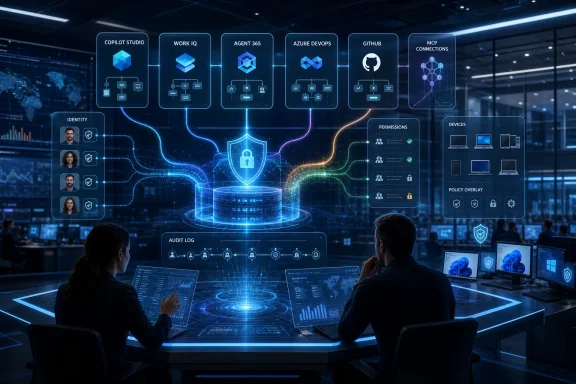
Microsoft is trying to turn that risk into a platform argument. Agent 365, Work IQ, Copilot Studio, Azure DevOps integrations, and support for Model Context Protocol all appear in the same strategic frame: developers need places to build, users need places to discover, admins need places to govern, and security teams need places to observe. The agent is only the visible tip of a management stack.
That framing is also a quiet rebuttal to the “everyone will build agents” enthusiasm that often surrounds this market. Yes, Microsoft wants citizen developers and professional developers both participating. But the company’s own language makes clear that empowerment is supposed to come with guardrails. The new bottleneck will not be whether someone can prompt an agent into existence; it will be whether the organization can understand what that agent can touch, what it is doing, and who is accountable when it fails.
Work IQ Is Microsoft’s Attempt to Bottle Institutional Context
The Work IQ concept is central to Microsoft’s enterprise AI strategy because it addresses a problem every assistant eventually hits: models are only as useful as the context they can safely access. Generic intelligence can draft a plan. Workplace intelligence can know which project, which document, which customer, which policy, and which approval chain the plan depends on.Microsoft’s pitch is that Work IQ can expose Microsoft 365 data and organizational context to agents while respecting permissions and compliance boundaries. If that works as advertised, it gives developers a way to build agents that are useful because they understand the workplace, not because they have been manually fed every relevant detail. That is the difference between a demo bot and a production assistant.
But this is also where the stakes rise. The same context that makes an agent useful also makes it sensitive. Mail, calendars, Teams conversations, SharePoint files, OneDrive documents, and business records are not neutral data pools. They contain internal strategy, customer information, employee details, legal discussions, and the everyday residue of corporate life.
For admins, the practical question is not whether Microsoft can make Work IQ powerful. It is whether Microsoft can make that power legible. Enterprises will need clear answers about data boundaries, permission inheritance, logging, retention, eDiscovery, tenant controls, and how agent actions differ from user actions. If agentic AI is going to become part of the Windows and Microsoft 365 workplace, “it respects existing permissions” is the beginning of the conversation, not the end.
Model Context Protocol Moves From Developer Curiosity to Enterprise Plumbing
The inclusion of Model Context Protocol in Microsoft’s Build-era agent story is another signal that the market is maturing. MCP began as a way to standardize how AI systems connect to tools and data sources. In enterprise terms, it is a potential integration layer for agents that need to reach beyond a single application.That matters because agentic AI will fail if every agent is a bespoke integration project. Developers need reusable connectors, predictable interfaces, and a way to expose capabilities without rebuilding the same bridge repeatedly. MCP promises a more standard way to let agents discover and use tools.
For Windows developers and sysadmins, this could become a familiar story: what starts as developer plumbing becomes operational surface area. If agents can call MCP servers, then organizations need to know which servers exist, who owns them, what they expose, how they authenticate, and how they are monitored. A protocol that makes integration easier also makes governance more urgent.
Microsoft’s embrace of MCP fits its broader platform instincts. The company does not want agents to remain isolated features inside individual apps. It wants an ecosystem in which agents can move across Microsoft 365, Azure, developer tools, Windows endpoints, and line-of-business systems. That creates opportunity, but it also creates the kind of sprawl that IT departments spend years trying to rationalize.
Developers Are Being Asked to Become Process Designers
The supplied Microsoft post frames developers as the engine of agentic transformation, and that is mostly right. But the role it describes is broader than writing code. Developers building agents must understand workflows, permissions, data quality, human escalation paths, and failure modes. They are being asked to translate business process into semi-autonomous software.That is a significant cultural change. Traditional enterprise development often begins with requirements and ends with an application. Agentic development is more iterative and more ambiguous. The agent may need to reason through cases, call tools dynamically, and behave differently depending on the context it retrieves.
That makes engineering discipline more important, not less. Testing, observability, review, versioning, and deployment controls cannot disappear because the interface is conversational. If anything, they become harder. A conventional application exposes a defined set of screens and buttons. An agent exposes a range of possible behaviors.
This is why Microsoft Digital’s internal experience may be valuable beyond the branding. If Microsoft can show how it trains developers, classifies agents, measures impact, supports users, and handles risk, the market will learn more from the operational playbook than from another AI feature reel.
The Citizen Developer Promise Still Carries a Shadow IT Warning
Microsoft’s vision clearly includes employees beyond professional engineering teams. Copilot Studio and similar tools are designed to let business users build task-focused agents without waiting for a central development queue. In theory, that is exactly where agentic AI should shine: automating local friction that is too small for a formal software project but too repetitive to ignore.The risk is that citizen development at enterprise scale has always been a double-edged sword. Power Platform, macros, scripts, SharePoint workflows, and unmanaged SaaS automations have all delivered value while also creating governance headaches. Agentic AI raises the ceiling on what these tools can do, which means it also raises the ceiling on what they can break.
Microsoft appears to understand this, at least in its framing. The company’s Build 2026 material does not present agent creation as a free-for-all. It talks about governance, implementation practices, measurement, and support. That suggests Microsoft knows the agent explosion must be managed before it becomes another layer of digital clutter.
Still, customers should be skeptical in the productive sense. They should ask how agents are approved, how stale agents are retired, how ownership transfers when an employee changes roles, and how low-code agents are distinguished from enterprise-grade automations. “Everyone can build” is a compelling adoption slogan. “Someone remains accountable” is the enterprise requirement.
Security Teams Will Inherit the Agent Lifecycle
The security implications of agentic AI are not limited to prompt injection or hallucination, though both matter. The deeper issue is lifecycle control. Agents will be created, modified, shared, connected to data sources, granted permissions, embedded in workflows, and eventually forgotten. Every stage is a potential security event.Microsoft’s broader Build 2026 security messaging emphasizes securing code, agents, and models across the development lifecycle. That is the right frame. Agents are not just outputs of AI systems; they are software artifacts with dependencies, privileges, and operational behavior. Treating them as casual productivity helpers will not survive contact with enterprise reality.
Security teams will need inventories of agents just as they need inventories of devices, applications, identities, and APIs. They will need to understand which agents can act on behalf of users, which have delegated permissions, which connect to sensitive repositories, and which can trigger downstream changes. They will also need incident response patterns for cases where an agent behaves incorrectly or is manipulated.
This is one area where Microsoft has an advantage and a burden. Its identity, endpoint, productivity, cloud, and security products already sit inside many enterprises. If it can connect agent governance into that fabric, it may reduce fragmentation. If it cannot, customers may find themselves with yet another admin plane to monitor.
Measurement Is the Missing Discipline in Most AI Rollouts
Microsoft’s source material repeatedly gestures at moving from experimentation to impact. That phrase matters because many organizations are stuck in the experiment phase. They have pilots, demos, hackathons, and enthusiastic internal champions, but they struggle to measure whether AI is changing business outcomes.Agentic AI may make measurement easier in some ways. If an agent handles support triage, updates records, processes approvals, or assists developers in a CI/CD workflow, there are observable events to count. Time saved, tickets resolved, defects reduced, cycle times shortened, and handoffs eliminated are more concrete than “employees feel more productive.”
But measurement can also become misleading. An agent that completes a task quickly is not necessarily creating value if humans must spend time checking its work. A coding agent that opens more pull requests is not necessarily improving software quality. A support agent that closes tickets faster may be deflecting unresolved problems into another channel.
The better metric is not agent activity. It is net operational improvement. Microsoft Digital’s own experience will be most useful if it shares not just adoption numbers, but the uncomfortable details: where agents failed, where governance slowed progress for good reasons, where employees resisted, and where productivity gains proved hard to verify.
Azure DevOps and GitHub Put Agents Where Work Already Happens
For developers, the most practical agentic AI story is not a standalone chatbot. It is intelligence embedded into the development lifecycle. Azure DevOps, GitHub, code security tooling, and model-assisted scanning all point toward a future where agents participate in planning, coding, testing, reviewing, securing, and deploying software.That is attractive because developers already live inside these workflows. An agent that understands a backlog item, reads the relevant repository, drafts a change, opens a pull request, checks policy, and responds to review comments is far more useful than an assistant that merely explains syntax. But it also moves AI from advice into execution.
This is where Microsoft’s internal IT organization becomes a particularly relevant proving ground. Microsoft Digital has to maintain real systems for real employees inside one of the world’s most scrutinized technology companies. If agentic development practices can improve internal engineering without undermining reliability, that is a stronger signal than a keynote demo.
The danger is over-automation. Software teams already struggle with alert fatigue, dependency noise, flaky tests, and generated work that looks productive but dilutes attention. Agents can reduce toil, but they can also create new toil if their output requires constant human cleanup. The winning organizations will not be those that generate the most AI activity; they will be those that design the cleanest human-machine handoffs.
Windows Becomes a Surface for Agents, Not Just an Endpoint
Although the supplied Microsoft text focuses on Microsoft Digital and enterprise IT, the implications extend to Windows. Microsoft has been steadily positioning Windows as an AI-capable platform, not merely a client operating system that runs AI applications. Agentic experiences on Windows will depend on local context, cloud services, identity, device management, and secure connectors.For WindowsForum readers, that means endpoint management is likely to become part of the agent governance conversation. If agents can interact with local apps, files, settings, or enterprise resources from a Windows device, admins will need policies for what is allowed on managed machines. The boundary between Microsoft 365 administration, endpoint management, and AI governance will continue to blur.
This could be beneficial if Microsoft gets the architecture right. A managed Windows environment with Entra identity, Intune policy, Defender telemetry, Microsoft 365 data controls, and agent governance could give organizations a coherent stack for AI-enabled work. It could also reinforce Microsoft lock-in by making the safest agentic path the one that stays inside the Microsoft estate.
That tradeoff will not bother every customer. Many enterprises already prefer integration over theoretical openness. But IT leaders should recognize the strategic direction: agentic AI is becoming another reason for Microsoft to pull identity, productivity, development, security, and endpoint management into a single control plane.
The “Frontier Firm” Pitch Is Really a Management Doctrine
Microsoft’s “Frontier Firm” language is the kind of phrase that can trigger eye-rolls in technical audiences. It sounds like keynote vocabulary, and to some extent it is. But underneath the branding is a recognizable management doctrine: organizations should redesign work around human judgment plus machine execution.That is a more radical claim than “AI will help employees save time.” It suggests companies should revisit processes, org charts, support models, and development practices. If agents can automate routine coordination, then some middle layers of work may shrink while new roles around orchestration, governance, and review expand.
Microsoft is careful to frame this as empowerment rather than replacement. That is politically and commercially sensible. Enterprises do not want a vendor telling employees they are obsolete. But the operational reality is that automation changes labor. Some tasks will disappear, some will be compressed, and some will become supervisory.
The more honest way to read Microsoft’s Build 2026 message is this: the company believes agentic AI will become a normal part of enterprise operations, and it wants to sell the platform, governance model, and developer tooling that make that transition palatable. The future of work rhetoric is the wrapper. The management system is the product.
The Hardest Part Is Trusting the Boring Layers
AI coverage tends to focus on model capability because models are easy to dramatize. They pass benchmarks, generate code, summarize documents, and produce moments that feel magical. Enterprise transformation, however, tends to succeed or fail in the boring layers: identity, permissions, policy, documentation, training, support, cost controls, and audit logs.Microsoft Digital’s story is valuable precisely because it points back to those layers. The company is saying that agentic AI required a foundation, not just enthusiasm. It had to rethink how development is fostered, how innovation is governed, and how systems operate at scale.
That should be the practical lesson for IT departments. Do not start by asking how many agents you can build. Start by asking what kinds of agents your organization is willing to trust, what data they can access, who approves them, how users find them, how incidents are handled, and how success is measured.
The organizations that skip that work may still get impressive demos. They may even get short-term productivity wins. But they will also accumulate unmanaged automation that behaves like every previous generation of shadow IT, only with more autonomy and better marketing.
The Real Build 2026 Message Is That Agents Need a Supply Chain
The most concrete lesson from Microsoft’s internal story is that agentic AI needs a supply chain. Ideas have to become prototypes, prototypes have to become managed agents, managed agents have to become supported services, and supported services have to be measured against business outcomes. That is not a feature; it is an operating model.Microsoft’s own platform pieces are lining up around that model. Copilot Studio gives more people a creation surface. Work IQ gives agents organizational context. Agent 365 promises management and governance. Azure DevOps and GitHub bring agents closer to engineering work. MCP points toward broader connectivity. The strategy is to make agent creation easier while making agent sprawl governable.
That combination is ambitious, and it is not guaranteed to work. Microsoft must prove that its governance tools are understandable, that its agent inventory is complete, that permissions remain enforceable, and that customers can avoid creating a maze of overlapping assistants. The company must also show that agentic AI delivers measurable value after the novelty fades.
For customers, the smart posture is neither blind adoption nor reflexive cynicism. The technology is moving too quickly to ignore, and the risks are too real to wave away. Microsoft’s “Customer Zero” story is useful because it presents agentic AI as an enterprise discipline rather than a magic layer sprinkled over existing work.
The Admin’s Checklist Is Hiding Inside Microsoft’s Showcase
Microsoft wants Build 2026 attendees to see momentum. IT departments should see homework. The agentic future being described here will reward organizations that prepare their governance and punish those that treat agents as just another optional productivity add-on.- Microsoft is positioning agentic AI as a managed enterprise platform, not merely a collection of smarter Copilot features.
- Microsoft Digital’s “Customer Zero” role gives the company a credible internal test bed, but customers should still demand evidence of measurable outcomes.
- Work IQ and Microsoft 365 context can make agents far more useful, but they also increase the importance of permissions, auditing, and data governance.
- Model Context Protocol may reduce integration friction, but it also creates new inventory, ownership, and monitoring responsibilities.
- Developers will need to think like workflow architects, because useful agents must understand business processes as well as code.
- IT and security teams should start defining agent lifecycle policies before employee-built automation becomes impossible to untangle.
References
- Primary source: Microsoft
Published: 2026-06-02T20:12:13.328942
Microsoft Build 2026: Empowering our developers to adopt agentic AI at Microsoft - Inside Track Blog
Learn how we’re empowering our developers with intelligent agentic tools and platforms to accelerate our journey to becoming a Frontier Firm.www.microsoft.com - Official source: blogs.microsoft.com
How Microsoft is empowering Frontier Transformation with Intelligence + Trust - The Official Microsoft Blog
At Microsoft Ignite in November, we introduced Frontier Transformation — a holistic reimagining of business aligning AI with human ambition to help organizations achieve their highest aspirations and growth potential. While AI Transformation centered on efficiency and productivity, Frontier...blogs.microsoft.com - Official source: learn.microsoft.com
Microsoft Work IQ API (preview) | Microsoft Learn
Learn about the Work IQ API for building AI applications that securely reason over workplace intelligence data using REST, A2A, and MCP protocols.learn.microsoft.com - Official source: developer.microsoft.com
Windows Agentic | Microsoft Developer
The secure, open platform for AI & agents. Native support for MCP and Agent workspace on Windows.developer.microsoft.com - Related coverage: windowscentral.com
Microsoft doubles down on agentic AI — Agent 365 prepares for a future with over 1 billion agents | Windows Central
Microsoft kicked off Ignite with a major push into agentic AI, unveiling Agent 365 as its newest tool for automating workflows.www.windowscentral.com - Related coverage: techradar.com
Microsoft reveals Agent 365 - the new and (hopefully) easy way to get a handle on all these new AI agents at work | TechRadar
Say hello to Agent 365www.techradar.com
- Official source: cdn-dynmedia-1.microsoft.com
- Official source: adoption.microsoft.com
