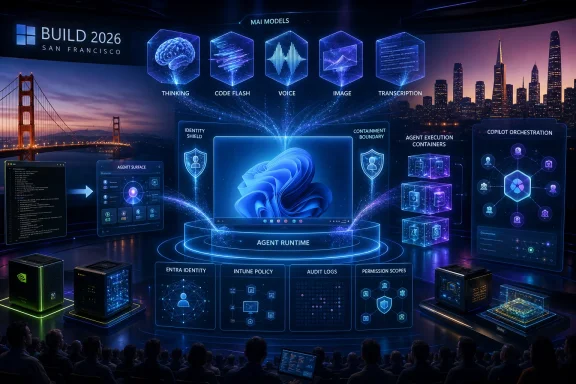
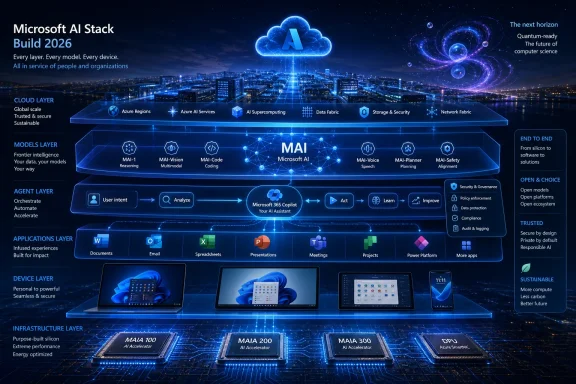
Microsoft is expected to unveil a suite of homegrown AI models at its Build developer conference in San Francisco on June 2–3, 2026, including a coding model aimed at strengthening GitHub Copilot, according to reporting attributed to The Information and Reuters. The announcement, if it lands as reported, is not just another AI keynote flourish. It is Microsoft telling developers, customers, investors, and perhaps OpenAI itself that the company wants more control over the models underneath its most important products. Build has become the place where Microsoft turns strategy into platform gravity, and this year the gravity is shifting toward a Microsoft-owned AI stack.
For the past three years, Microsoft has enjoyed the best of both worlds: it could market itself as the enterprise face of generative AI while leaning heavily on OpenAI’s technical lead. Azure supplied infrastructure, Microsoft 365 supplied distribution, GitHub supplied developers, and OpenAI supplied the magic. That arrangement helped Microsoft move faster than nearly every enterprise software rival.
But the model layer is too strategic to rent forever. The company can keep partnering with OpenAI, and almost certainly will, while still deciding that its own products need Microsoft-controlled models for cost, latency, specialization, compliance, and bargaining power. A coding model for GitHub Copilot is the cleanest example: Microsoft owns GitHub, sells Copilot subscriptions, runs the cloud, and controls the developer platform. Leaving the core economics of that product entirely in someone else’s hands would be a strange long-term bet.
That is why the reported Build announcement matters more than the usual “new model” headline. Microsoft is not merely chasing benchmark points or trying to win a chatbot leaderboard. It is filling in a missing layer of its own platform, one that could decide how profitable Copilot becomes and how deeply AI features can be woven into Windows, Azure, Microsoft 365, and developer tools.
The phrase homegrown AI models is doing a lot of work here. It signals independence without quite declaring a divorce. Microsoft does not need to abandon OpenAI to reduce dependency on OpenAI; it only needs credible alternatives good enough for specific workloads.
The problem is that AI coding has moved beyond autocomplete. Tools such as Cursor, Claude Code, and agentic coding workflows have pushed the category toward multi-file edits, terminal operations, test execution, code review, and pull-request generation. In that world, the model is not just suggesting text. It is acting inside the software development lifecycle.
That shift changes the cost structure. A lightweight code-completion model can be sold like a productivity add-on; an agent that reads repositories, reasons through failures, and retries commands can burn through tokens at a rate that makes finance departments flinch. If Copilot becomes more autonomous, Microsoft needs models that are not only capable but economically tuned for its own usage patterns.
A dedicated Microsoft coding model would therefore serve two masters. It would be a product feature, giving Copilot another answer to specialist rivals. It would also be a margin instrument, letting Microsoft route coding workloads to a model it can optimize, price, and deploy on its own infrastructure.
This is the less glamorous side of AI competition, but it may be the more important one. The winning coding assistant will not simply be the one that writes the cleverest function in a demo. It will be the one that can handle millions of routine enterprise tasks at predictable cost, with enough governance to satisfy the organizations that still decide what software their employees are allowed to use.
The company has already spent multiple cycles telling the market that Copilot is the interface of the future. Now it has to persuade developers that the underlying platform is stable, extensible, and not overly dependent on a single outside model provider. Model choice, routing, fine-tuning, local inference, governance, and agent orchestration are not keynote decoration for this audience. They are purchasing criteria.
The reported model announcements also fit the broader shape of Build 2026. Microsoft’s public conference material points heavily toward AI-powered developer tools and platforms, while the session catalog has been expected to emphasize agentic AI, Windows AI APIs, local model execution, Foundry tooling, and responsible AI. That is not a random collection of buzzwords. It is the architecture of a platform company trying to make AI development feel as normal as cloud development eventually became.
The strategic ambition is obvious: Microsoft wants developers to treat AI models the way they treat databases, identity systems, observability tools, and compute targets. Choose them, route between them, govern them, deploy them locally or in the cloud, and pay Microsoft somewhere along the way.
Microsoft’s OpenAI partnership remains one of the most consequential alliances in modern tech. It gave Microsoft early access to frontier models, turned Azure into the default enterprise AI backend, and helped Copilot become a recognizable brand across the company’s portfolio. But dependency and partnership are different things. Microsoft can value OpenAI deeply while still wanting leverage.
Enterprise customers understand this instinct because they practice it themselves. No serious CIO wants a critical system with only one supplier, one region, one identity path, or one pricing lever. Microsoft is now applying the same logic to AI models. It wants redundancy, specialization, and control.
This is also where Microsoft’s multi-model messaging becomes practical rather than philosophical. A Copilot experience may use one model for cheap summarization, another for deep reasoning, another for code generation, another for transcription, and another for image generation. The user may never know, and ideally should not need to know. The orchestration layer becomes the product.
That is good for Microsoft because orchestration is where platform owners thrive. If the future is a marketplace of models, Microsoft wants to own the switchboard.
New Microsoft models could help close that gap if they are designed in multiple sizes and deployment profiles. A cloud-scale reasoning model is one thing; a small local model that can summarize files, classify content, assist with settings, or help an app reason over user data without shipping everything to a remote server is another. Windows needs the latter as much as the former.
That matters because the next phase of Windows AI cannot just be another Copilot button. Users have already shown fatigue with AI features that feel bolted on, intrusive, or vaguely duplicative of a web chatbot. The better version is quieter: APIs that let developers add local inference, accessibility features that work instantly, search that understands context, and productivity workflows that respect privacy boundaries.
If Microsoft brings new models to Build, Windows developers will be looking for details that go beyond branding. They will want to know which models run locally, which require Azure, how memory and NPU constraints are handled, what licensing terms apply, and whether the APIs will survive long enough to justify investment.
Windows has always depended on developer confidence. AI does not change that rule; it intensifies it.
Homegrown models make that hardware story more coherent. If Microsoft controls more of the model design, it can optimize more aggressively for the hardware it deploys. That can mean lower serving costs in Azure, better performance on specific accelerators, and smaller models tuned for local devices. In AI, software architecture and hardware economics are now the same conversation.
This is why the “AI-driven cloud flywheel” language from Wall Street analysts is more than stock-market poetry. If Microsoft can build useful models, deploy them efficiently on Azure, expose them through Foundry and Copilot, and feed demand back into cloud consumption, it has one of the most complete AI monetization loops in the industry. The risk is that every major cloud rival is trying to do the same.
Amazon has its own model strategy, Google has Gemini and TPUs, Meta is pushing open models, Anthropic has become a developer favorite, and OpenAI remains a frontier force. Microsoft’s advantage is distribution. Its disadvantage is that distribution alone does not guarantee developer affection.
Build is where it has to prove the stack is not merely broad, but compelling.
Developers will judge the same news differently. They will ask whether Copilot gets better, whether pricing gets more complicated, whether GitHub’s data policies become more aggressive, and whether Microsoft is building tools for developers or extracting more value from developer workflows. Those are not anti-Microsoft questions. They are rational questions in a market where AI coding tools are becoming both indispensable and expensive.
Trust is especially delicate because coding assistants sit close to proprietary source code. Enterprises want productivity, but they also want guarantees around data retention, training, compliance, security review, and auditability. A Microsoft-owned model could help if it gives customers clearer contractual and technical boundaries. It could hurt if customers see it as another reason their development activity is being absorbed into a closed platform loop.
The best version of this announcement would therefore include more than model names. It would include deployment options, admin controls, transparent data-use settings, and clear separation between consumer experimentation and enterprise governance. Microsoft knows how to sell trust to IT departments. The question is whether its AI product teams can move as carefully as its enterprise sales teams promise.
GitHub gives Microsoft an enormous structural advantage. Copilot lives where code already lives. GitHub Actions, pull requests, code review, security scanning, Codespaces, and enterprise identity all give Microsoft surfaces where an AI agent can act with context. A rival coding tool may have a better model on a given day, but Microsoft can surround the workflow.
That is also why Microsoft cannot afford for Copilot to feel second-rate. Developers are unusually willing to switch tools when productivity is on the line. If Cursor or Claude Code becomes the place where serious AI-assisted programming happens, GitHub risks owning the repository while someone else owns the developer’s attention. That would be strategically intolerable.
A Microsoft coding model is a defensive move as much as an offensive one. It says Copilot will not be limited to whatever Microsoft can license from partners. It also suggests Microsoft wants its own feedback loop from code interactions to model improvement, though the company will need to manage that loop carefully in enterprise environments.
The broader point is that coding has become the proving ground for agentic AI. If an AI system can navigate a codebase, make a plan, modify files, run tests, interpret errors, and iterate, then the same pattern can be applied to finance workflows, legal review, IT operations, and customer support. Microsoft’s coding model is not just about developers. It is a rehearsal for agents everywhere else.
That matters operationally. Someone has to decide which AI services are allowed, which data they can access, how logs are retained, what compliance policies apply, and how costs are monitored. AI products are often marketed as magic interfaces; in enterprise IT, they become permissions, invoices, incident reports, and governance meetings.
Microsoft’s challenge is to avoid turning model abundance into administrative fog. If every Copilot uses a different model family with different capabilities and data rules, customers will struggle to reason about risk. If Microsoft abstracts everything too aggressively, customers may worry they cannot see enough. The middle path is hard: simple defaults with inspectable controls.
This is where Microsoft’s enterprise DNA could become an advantage. The company has decades of experience turning complicated technology into policy surfaces for administrators. Group Policy, Intune, Entra ID, Defender, Purview, and Azure management tooling all exist because businesses do not merely buy software; they govern it. AI needs the same treatment, and quickly.
Build should therefore be judged not only by demos, but by admin affordances. A flashy Copilot coding agent can win applause. A well-designed control plane can win deployment.
That framing cuts through the hype. If a coding model helps a developer complete a task faster but costs more than the time saved, it is a novelty. If a transcription model improves Teams notes but creates compliance headaches, it is a liability. If an image model is impressive but disconnected from Microsoft’s actual enterprise workflows, it is a side show.
Microsoft’s advantage is that it can embed models where work already happens. A small improvement in Outlook triage, Teams meeting summaries, Excel analysis, Visual Studio debugging, GitHub code review, or Windows accessibility can have huge aggregate value. The trick is matching the right model to the right job at the right cost.
This is why smaller, specialized models may matter more than giant frontier models in Microsoft’s product universe. A model that is cheap, fast, governable, and good enough for a specific workflow can be more valuable than a more impressive general model that is expensive to run. Enterprise AI is not a talent show. It is logistics.
If Microsoft’s Build announcements emphasize model families in multiple sizes, local and cloud deployment, and workload-specific tuning, that will be the signal to watch. It would mean the company is optimizing for production, not just applause.
Near the close of the Build keynote cycle, the most important details may be the least theatrical ones. Model names will trend for a day. Pricing, routing, governance, and developer adoption will decide whether the announcement matters in six months.
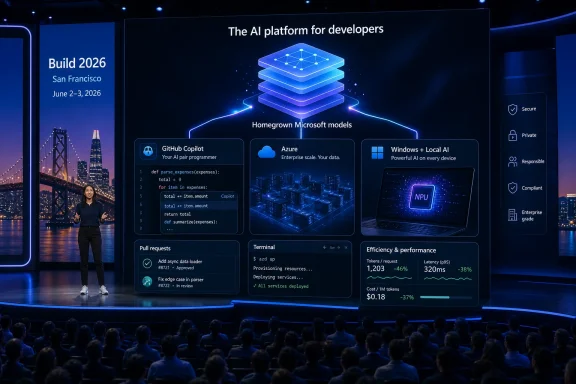 Microsoft Wants the Model Layer Back
For the past three years, Microsoft has enjoyed the best of both worlds: it could market itself as the enterprise face of generative AI while leaning heavily on OpenAI’s technical lead. Azure supplied infrastructure, Microsoft 365 supplied distribution, GitHub supplied developers, and OpenAI supplied the magic. That arrangement helped Microsoft move faster than nearly every enterprise software rival.But the model layer is too strategic to rent forever. The company can keep partnering with OpenAI, and almost certainly will, while still deciding that its own products need Microsoft-controlled models for cost, latency, specialization, compliance, and bargaining power. A coding model for GitHub Copilot is the cleanest example: Microsoft owns GitHub, sells Copilot subscriptions, runs the cloud, and controls the developer platform. Leaving the core economics of that product entirely in someone else’s hands would be a strange long-term bet.
That is why the reported Build announcement matters more than the usual “new model” headline. Microsoft is not merely chasing benchmark points or trying to win a chatbot leaderboard. It is filling in a missing layer of its own platform, one that could decide how profitable Copilot becomes and how deeply AI features can be woven into Windows, Azure, Microsoft 365, and developer tools.
The phrase homegrown AI models is doing a lot of work here. It signals independence without quite declaring a divorce. Microsoft does not need to abandon OpenAI to reduce dependency on OpenAI; it only needs credible alternatives good enough for specific workloads.
GitHub Copilot Has Become Too Important to Be Just a Wrapper
GitHub Copilot began as a startling autocomplete demo and became one of Microsoft’s most credible AI businesses. Developers were among the first knowledge workers to pay for generative AI because the value proposition was unusually concrete: write boilerplate faster, explain unfamiliar code, suggest tests, and stay inside the editor. Copilot also gave Microsoft something that Windows itself no longer guarantees — daily relevance among the people building the next generation of software.The problem is that AI coding has moved beyond autocomplete. Tools such as Cursor, Claude Code, and agentic coding workflows have pushed the category toward multi-file edits, terminal operations, test execution, code review, and pull-request generation. In that world, the model is not just suggesting text. It is acting inside the software development lifecycle.
That shift changes the cost structure. A lightweight code-completion model can be sold like a productivity add-on; an agent that reads repositories, reasons through failures, and retries commands can burn through tokens at a rate that makes finance departments flinch. If Copilot becomes more autonomous, Microsoft needs models that are not only capable but economically tuned for its own usage patterns.
A dedicated Microsoft coding model would therefore serve two masters. It would be a product feature, giving Copilot another answer to specialist rivals. It would also be a margin instrument, letting Microsoft route coding workloads to a model it can optimize, price, and deploy on its own infrastructure.
This is the less glamorous side of AI competition, but it may be the more important one. The winning coding assistant will not simply be the one that writes the cleverest function in a demo. It will be the one that can handle millions of routine enterprise tasks at predictable cost, with enough governance to satisfy the organizations that still decide what software their employees are allowed to use.
Build Is Where Microsoft Turns AI From Spectacle Into Plumbing
Microsoft Build is not CES, and it is not a consumer hardware launch. Its real audience is the developer who has to decide which APIs, frameworks, cloud services, and deployment assumptions are worth building around. That makes Build the natural venue for Microsoft’s next AI turn.The company has already spent multiple cycles telling the market that Copilot is the interface of the future. Now it has to persuade developers that the underlying platform is stable, extensible, and not overly dependent on a single outside model provider. Model choice, routing, fine-tuning, local inference, governance, and agent orchestration are not keynote decoration for this audience. They are purchasing criteria.
The reported model announcements also fit the broader shape of Build 2026. Microsoft’s public conference material points heavily toward AI-powered developer tools and platforms, while the session catalog has been expected to emphasize agentic AI, Windows AI APIs, local model execution, Foundry tooling, and responsible AI. That is not a random collection of buzzwords. It is the architecture of a platform company trying to make AI development feel as normal as cloud development eventually became.
The strategic ambition is obvious: Microsoft wants developers to treat AI models the way they treat databases, identity systems, observability tools, and compute targets. Choose them, route between them, govern them, deploy them locally or in the cloud, and pay Microsoft somewhere along the way.
The OpenAI Partnership Is Becoming Less Simple, Not Less Important
The lazy interpretation is that Microsoft is preparing to dump OpenAI. The more accurate reading is that Microsoft is preparing for a world in which no single model supplier is enough. That world is already here.Microsoft’s OpenAI partnership remains one of the most consequential alliances in modern tech. It gave Microsoft early access to frontier models, turned Azure into the default enterprise AI backend, and helped Copilot become a recognizable brand across the company’s portfolio. But dependency and partnership are different things. Microsoft can value OpenAI deeply while still wanting leverage.
Enterprise customers understand this instinct because they practice it themselves. No serious CIO wants a critical system with only one supplier, one region, one identity path, or one pricing lever. Microsoft is now applying the same logic to AI models. It wants redundancy, specialization, and control.
This is also where Microsoft’s multi-model messaging becomes practical rather than philosophical. A Copilot experience may use one model for cheap summarization, another for deep reasoning, another for code generation, another for transcription, and another for image generation. The user may never know, and ideally should not need to know. The orchestration layer becomes the product.
That is good for Microsoft because orchestration is where platform owners thrive. If the future is a marketplace of models, Microsoft wants to own the switchboard.
Windows Is Waiting for AI That Does Not Need a Data Center Every Time
For Windows users, the Build model story intersects with a second Microsoft obsession: local AI. Copilot+ PCs were introduced with the promise that a neural processing unit could make AI feel immediate, private, and battery-conscious. The reality has been uneven, partly because software support and genuinely useful local workloads have lagged behind the hardware branding.New Microsoft models could help close that gap if they are designed in multiple sizes and deployment profiles. A cloud-scale reasoning model is one thing; a small local model that can summarize files, classify content, assist with settings, or help an app reason over user data without shipping everything to a remote server is another. Windows needs the latter as much as the former.
That matters because the next phase of Windows AI cannot just be another Copilot button. Users have already shown fatigue with AI features that feel bolted on, intrusive, or vaguely duplicative of a web chatbot. The better version is quieter: APIs that let developers add local inference, accessibility features that work instantly, search that understands context, and productivity workflows that respect privacy boundaries.
If Microsoft brings new models to Build, Windows developers will be looking for details that go beyond branding. They will want to know which models run locally, which require Azure, how memory and NPU constraints are handled, what licensing terms apply, and whether the APIs will survive long enough to justify investment.
Windows has always depended on developer confidence. AI does not change that rule; it intensifies it.
Nvidia, Azure, and the Hardware Politics Beneath the Keynote
The reported Build news also lands in a week where Microsoft’s AI story is inseparable from hardware. Microsoft and Nvidia are expected to show joint work around PCs powered by Nvidia chips, while Azure remains one of the world’s most important buyers and deployers of AI compute. That gives Microsoft a dual identity: it is a software platform company and a capacity broker in a market where GPUs have become strategic infrastructure.Homegrown models make that hardware story more coherent. If Microsoft controls more of the model design, it can optimize more aggressively for the hardware it deploys. That can mean lower serving costs in Azure, better performance on specific accelerators, and smaller models tuned for local devices. In AI, software architecture and hardware economics are now the same conversation.
This is why the “AI-driven cloud flywheel” language from Wall Street analysts is more than stock-market poetry. If Microsoft can build useful models, deploy them efficiently on Azure, expose them through Foundry and Copilot, and feed demand back into cloud consumption, it has one of the most complete AI monetization loops in the industry. The risk is that every major cloud rival is trying to do the same.
Amazon has its own model strategy, Google has Gemini and TPUs, Meta is pushing open models, Anthropic has become a developer favorite, and OpenAI remains a frontier force. Microsoft’s advantage is distribution. Its disadvantage is that distribution alone does not guarantee developer affection.
Build is where it has to prove the stack is not merely broad, but compelling.
The Stock Market Sees Margin; Developers See Trust
The market’s reaction to reports of new Microsoft AI models is easy to understand. If Microsoft can reduce reliance on third-party models, improve Copilot economics, and attach more AI consumption to Azure, the long-term revenue story gets stronger. Analysts already frame Microsoft’s AI business as a high-margin cloud accelerator, and new in-house models fit neatly into that thesis.Developers will judge the same news differently. They will ask whether Copilot gets better, whether pricing gets more complicated, whether GitHub’s data policies become more aggressive, and whether Microsoft is building tools for developers or extracting more value from developer workflows. Those are not anti-Microsoft questions. They are rational questions in a market where AI coding tools are becoming both indispensable and expensive.
Trust is especially delicate because coding assistants sit close to proprietary source code. Enterprises want productivity, but they also want guarantees around data retention, training, compliance, security review, and auditability. A Microsoft-owned model could help if it gives customers clearer contractual and technical boundaries. It could hurt if customers see it as another reason their development activity is being absorbed into a closed platform loop.
The best version of this announcement would therefore include more than model names. It would include deployment options, admin controls, transparent data-use settings, and clear separation between consumer experimentation and enterprise governance. Microsoft knows how to sell trust to IT departments. The question is whether its AI product teams can move as carefully as its enterprise sales teams promise.
AI Coding Is Becoming the New Office Suite War
The battle over coding assistants increasingly resembles the productivity-suite wars, except the users are developers and the switching costs may become even higher. Once an AI assistant understands a repository, integrates with issue trackers, writes tests, proposes pull requests, and learns team conventions, it becomes part of the workflow rather than a replaceable text box.GitHub gives Microsoft an enormous structural advantage. Copilot lives where code already lives. GitHub Actions, pull requests, code review, security scanning, Codespaces, and enterprise identity all give Microsoft surfaces where an AI agent can act with context. A rival coding tool may have a better model on a given day, but Microsoft can surround the workflow.
That is also why Microsoft cannot afford for Copilot to feel second-rate. Developers are unusually willing to switch tools when productivity is on the line. If Cursor or Claude Code becomes the place where serious AI-assisted programming happens, GitHub risks owning the repository while someone else owns the developer’s attention. That would be strategically intolerable.
A Microsoft coding model is a defensive move as much as an offensive one. It says Copilot will not be limited to whatever Microsoft can license from partners. It also suggests Microsoft wants its own feedback loop from code interactions to model improvement, though the company will need to manage that loop carefully in enterprise environments.
The broader point is that coding has become the proving ground for agentic AI. If an AI system can navigate a codebase, make a plan, modify files, run tests, interpret errors, and iterate, then the same pattern can be applied to finance workflows, legal review, IT operations, and customer support. Microsoft’s coding model is not just about developers. It is a rehearsal for agents everywhere else.
The Risk Is Another Layer of AI Sprawl
For sysadmins and IT pros, the announcement may produce as much anxiety as excitement. Microsoft’s AI portfolio is already sprawling: Copilot in Windows, Copilot in Microsoft 365, Copilot Studio, Azure AI Foundry, GitHub Copilot, security copilots, local AI tools, and a growing menu of model options. New in-house models may improve the stack, but they also add another naming layer to an already dense product map.That matters operationally. Someone has to decide which AI services are allowed, which data they can access, how logs are retained, what compliance policies apply, and how costs are monitored. AI products are often marketed as magic interfaces; in enterprise IT, they become permissions, invoices, incident reports, and governance meetings.
Microsoft’s challenge is to avoid turning model abundance into administrative fog. If every Copilot uses a different model family with different capabilities and data rules, customers will struggle to reason about risk. If Microsoft abstracts everything too aggressively, customers may worry they cannot see enough. The middle path is hard: simple defaults with inspectable controls.
This is where Microsoft’s enterprise DNA could become an advantage. The company has decades of experience turning complicated technology into policy surfaces for administrators. Group Policy, Intune, Entra ID, Defender, Purview, and Azure management tooling all exist because businesses do not merely buy software; they govern it. AI needs the same treatment, and quickly.
Build should therefore be judged not only by demos, but by admin affordances. A flashy Copilot coding agent can win applause. A well-designed control plane can win deployment.
The Real Contest Is Cost Per Useful Action
AI companies like to talk about tokens, parameters, context windows, and benchmark scores. Businesses care about useful work. The economic question for Microsoft is whether its models can reduce the cost per useful action across Copilot and Azure.That framing cuts through the hype. If a coding model helps a developer complete a task faster but costs more than the time saved, it is a novelty. If a transcription model improves Teams notes but creates compliance headaches, it is a liability. If an image model is impressive but disconnected from Microsoft’s actual enterprise workflows, it is a side show.
Microsoft’s advantage is that it can embed models where work already happens. A small improvement in Outlook triage, Teams meeting summaries, Excel analysis, Visual Studio debugging, GitHub code review, or Windows accessibility can have huge aggregate value. The trick is matching the right model to the right job at the right cost.
This is why smaller, specialized models may matter more than giant frontier models in Microsoft’s product universe. A model that is cheap, fast, governable, and good enough for a specific workflow can be more valuable than a more impressive general model that is expensive to run. Enterprise AI is not a talent show. It is logistics.
If Microsoft’s Build announcements emphasize model families in multiple sizes, local and cloud deployment, and workload-specific tuning, that will be the signal to watch. It would mean the company is optimizing for production, not just applause.
The Build Bet Comes Down to Control, Cost, and Confidence
The reported model unveiling is best understood as a platform correction. Microsoft rode the first generative AI wave through a landmark partnership; now it is building more of the machinery itself. That does not weaken the original strategy. It makes the strategy more durable.Near the close of the Build keynote cycle, the most important details may be the least theatrical ones. Model names will trend for a day. Pricing, routing, governance, and developer adoption will decide whether the announcement matters in six months.
- Microsoft is expected to use Build 2026 in San Francisco to present new in-house AI models, including a coding-focused model for GitHub Copilot.
- The move would reduce Microsoft’s dependence on outside model providers without requiring it to walk away from OpenAI.
- GitHub Copilot is the most obvious beneficiary because AI coding tools are becoming more agentic, more expensive to run, and more strategically important.
- Windows developers should watch for local AI details, especially model sizes, NPU support, and APIs that make on-device inference practical.
- Enterprise IT should focus less on keynote demos and more on governance, data-use controls, deployment options, and cost management.
- The central business test is whether Microsoft can lower the cost per useful AI action across Azure, GitHub, Windows, and Microsoft 365.
References
- Primary source: intellectia.ai
Published: 2026-05-30T00:40:32.190627
- Related coverage: axios.com
Microsoft, Dell to debut Nvidia-powered laptops
The chips will appear in Microsoft Surface computers and PCs from other manufacturers.www.axios.com
- Related coverage: techradar.com
Windows 12 at Build 2026: What to expect | TechRadar
What Build 2026 signals about the future of the Windowswww.techradar.com - Related coverage: techcrunch.com
Microsoft takes on AI rivals with three new foundational models | TechCrunch
MAI released models that can transcribe voice into text as well as generate audio and images after the group's formation six months ago.techcrunch.com - Official source: developer.microsoft.com
Before You Build: A Microsoft Build Preview | Microsoft Reactor
Learn new skills, meet new peers, and find career mentorship. Virtual events are running around the clock so join us anytime, anywhere!developer.microsoft.com - Related coverage: informertech.com
Microsoft to Unveil New AI Models at Build 2026
Microsoft is set to reveal new proprietary AI models at Build 2026, including a coding model for GitHub Copilot, as it expands its in-house MAI lineup.www.informertech.com
- Official source: news.microsoft.com
Microsoft Build 2026
 news.microsoft.com
- Related coverage: ebisuda.net
Microsoft Build 2026がサンフランシスコに移転——AIエージェント・信頼性・開発者プラットフォーム刷新を6月2〜3日に発表 | ebisuda.net
Build 2026は10年ぶりにSF開催。AIエージェント自律実行・Responsible AI・AI Foundry for Windows SDKが主軸に。www.ebisuda.net
- Related coverage: resultsense.com
Microsoft to unveil homegrown coding model at Build
Microsoft will reportedly debut its own AI coding model and in-house models at Build next week, reducing dependence on OpenAI as Claude Code leads.www.resultsense.com
- Official source: microsoft.com
Microsoft Build 2026 sessions every startup should attend
Explore the Microsoft Build 2026 sessions every startup should attend, from AI prototyping and agentic workflows to cost optimization, production readiness, and go-to-market growth.www.microsoft.com - Related coverage: tomsguide.com
Microsoft Build 2026 preview — all the big announcements to expect | Tom's Guide
Microsoft Build 2026 should be a showcase for the company's latest and upcoming AI efforts. Here are some of the big announcements we expect to see.www.tomsguide.com - Related coverage: windowscentral.com
Microsoft says its MAI-Image-2-Efficient AI model slashes costs by 41% while boosting speed by 22% (and maintaining quality) | Windows Central
Microsoft’s latest AI model makes photorealistic image generation faster, cheaper, and more efficient than ever before.www.windowscentral.com - Related coverage: tomshardware.com
Microsoft announces 'world's most powerful' AI data center — 315-acre site to house 'hundreds of thousands' of Nvidia GPUs and enough fiber to circle the Earth 4.5 times | Tom's Hardware
The Wisconsin-based data center is set to go online in 2026www.tomshardware.com - Related coverage: geekwire.com
Microsoft releases new AI models to expand further beyond OpenAI – GeekWire
Microsoft announced MAI-Transcribe-1, a new speech-to-text model, and made its in-house MAI-Voice-1 and MAI-Image-2 models broadly available to developers for commercial use for the first time, expanding its proprietary AI capabilities beyond its OpenAI partnership.www.geekwire.com - Related coverage: techgig.com
Microsoft to unveil new AI models, coding tool at Build conference, TechGig
Microsoft is launching new artificial intelligence (AI) models at its upcoming Build conference. These include a coding model designed to enhance GitHub Copilot, alongside capabilities for transcription, reasoning, speech, and images. The move suggests Microsoft's strategic intent to lessen its...techgig.com
- Related coverage: livescience.com
Microsoft says its newest AI chip Maia 200 is 3 times more powerful than Google's TPU and Amazon's Trainium processor | Live Science
The Maia 200 AI chip is described as an inference powerhouse — meaning it could lead AI models to apply their knowledge to real-world situations much faster and more efficiently. www.livescience.com
- Related coverage: itpro.com
Satya Nadella talks up Microsoft's sovereign cloud credentials as firm announces general availability for Azure Local Disconnected, new capabilities for Foundry Local | IT Pro
Microsoft has expanded its Sovereign Cloud for AI and regulated environments, as CEO Satya Nadella hypes up the full extent of AI support the firm now offers.www.itpro.com - Related coverage: news.cognizant.com
Cognizant and Microsoft Expand Partnership to Advance AI Transformation and Frontier Firm Experiences - Dec 18, 2025
PDF documentnews.cognizant.com
- Related coverage: newsroom.ibm.com
IBM Introduces New Microsoft Copilot Capabilities to Fuel AI-Powered Business Transformation
PDF documentnewsroom.ibm.com
- Related coverage: its.fsu.edu
- Related coverage: download.intel.com
- Official source: cdn-dynmedia-1.microsoft.com
The Next Wave of AI Innovation: Microsoft Introduces Azure AI Foundry, A New Unified AI, and GenAI Platform at Ignite 2024
PDF documentcdn-dynmedia-1.microsoft.com
- Related coverage: investing.com
Microsoft to release new coding model next week, the Information reports By Reuters
Microsoft to release new coding model next week, the Information reportswww.investing.com - Related coverage: cybernews.com

Microsoft unveils new AI coding model next week | Cybernews
Microsoft will unveil new homegrown AI models next week including a coding model to boost GitHub Copilot
cybernews.com