Microsoft is expected to unveil a suite of homegrown AI models at its Build developer conference in San Francisco on June 2–3, 2026, including a coding model aimed at strengthening GitHub Copilot, according to reporting attributed to The Information and Reuters. The announcement, if it lands as reported, is not just another AI keynote flourish. It is Microsoft telling developers, customers, investors, and perhaps OpenAI itself that the company wants more control over the models underneath its most important products. Build has become the place where Microsoft turns strategy into platform gravity, and this year the gravity is shifting toward a Microsoft-owned AI stack.

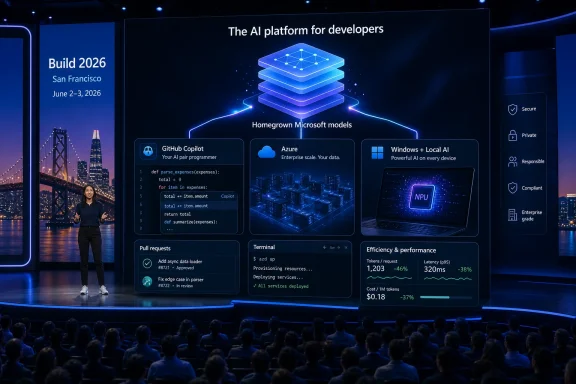
A speaker presents Microsoft’s AI platform for developers at Build 2026 in a futuristic, blue-lit stage display.Microsoft Wants the Model Layer Back​

For the past three years, Microsoft has enjoyed the best of both worlds: it could market itself as the enterprise face of generative AI while leaning heavily on OpenAI’s technical lead. Azure supplied infrastructure, Microsoft 365 supplied distribution, GitHub supplied developers, and OpenAI supplied the magic. That arrangement helped Microsoft move faster than nearly every enterprise software rival.
But the model layer is too strategic to rent forever. The company can keep partnering with OpenAI, and almost certainly will, while still deciding that its own products need Microsoft-controlled models for cost, latency, specialization, compliance, and bargaining power. A coding model for GitHub Copilot is the cleanest example: Microsoft owns GitHub, sells Copilot subscriptions, runs the cloud, and controls the developer platform. Leaving the core economics of that product entirely in someone else’s hands would be a strange long-term bet.
That is why the reported Build announcement matters more than the usual “new model” headline. Microsoft is not merely chasing benchmark points or trying to win a chatbot leaderboard. It is filling in a missing layer of its own platform, one that could decide how profitable Copilot becomes and how deeply AI features can be woven into Windows, Azure, Microsoft 365, and developer tools.
The phrase homegrown AI models is doing a lot of work here. It signals independence without quite declaring a divorce. Microsoft does not need to abandon OpenAI to reduce dependency on OpenAI; it only needs credible alternatives good enough for specific workloads.

GitHub Copilot Has Become Too Important to Be Just a Wrapper​

GitHub Copilot began as a startling autocomplete demo and became one of Microsoft’s most credible AI businesses. Developers were among the first knowledge workers to pay for generative AI because the value proposition was unusually concrete: write boilerplate faster, explain unfamiliar code, suggest tests, and stay inside the editor. Copilot also gave Microsoft something that Windows itself no longer guarantees — daily relevance among the people building the next generation of software.
The problem is that AI coding has moved beyond autocomplete. Tools such as Cursor, Claude Code, and agentic coding workflows have pushed the category toward multi-file edits, terminal operations, test execution, code review, and pull-request generation. In that world, the model is not just suggesting text. It is acting inside the software development lifecycle.
That shift changes the cost structure. A lightweight code-completion model can be sold like a productivity add-on; an agent that reads repositories, reasons through failures, and retries commands can burn through tokens at a rate that makes finance departments flinch. If Copilot becomes more autonomous, Microsoft needs models that are not only capable but economically tuned for its own usage patterns.
A dedicated Microsoft coding model would therefore serve two masters. It would be a product feature, giving Copilot another answer to specialist rivals. It would also be a margin instrument, letting Microsoft route coding workloads to a model it can optimize, price, and deploy on its own infrastructure.
This is the less glamorous side of AI competition, but it may be the more important one. The winning coding assistant will not simply be the one that writes the cleverest function in a demo. It will be the one that can handle millions of routine enterprise tasks at predictable cost, with enough governance to satisfy the organizations that still decide what software their employees are allowed to use.

Build Is Where Microsoft Turns AI From Spectacle Into Plumbing​

Microsoft Build is not CES, and it is not a consumer hardware launch. Its real audience is the developer who has to decide which APIs, frameworks, cloud services, and deployment assumptions are worth building around. That makes Build the natural venue for Microsoft’s next AI turn.
The company has already spent multiple cycles telling the market that Copilot is the interface of the future. Now it has to persuade developers that the underlying platform is stable, extensible, and not overly dependent on a single outside model provider. Model choice, routing, fine-tuning, local inference, governance, and agent orchestration are not keynote decoration for this audience. They are purchasing criteria.
The reported model announcements also fit the broader shape of Build 2026. Microsoft’s public conference material points heavily toward AI-powered developer tools and platforms, while the session catalog has been expected to emphasize agentic AI, Windows AI APIs, local model execution, Foundry tooling, and responsible AI. That is not a random collection of buzzwords. It is the architecture of a platform company trying to make AI development feel as normal as cloud development eventually became.
The strategic ambition is obvious: Microsoft wants developers to treat AI models the way they treat databases, identity systems, observability tools, and compute targets. Choose them, route between them, govern them, deploy them locally or in the cloud, and pay Microsoft somewhere along the way.

The OpenAI Partnership Is Becoming Less Simple, Not Less Important​

The lazy interpretation is that Microsoft is preparing to dump OpenAI. The more accurate reading is that Microsoft is preparing for a world in which no single model supplier is enough. That world is already here.
Microsoft’s OpenAI partnership remains one of the most consequential alliances in modern tech. It gave Microsoft early access to frontier models, turned Azure into the default enterprise AI backend, and helped Copilot become a recognizable brand across the company’s portfolio. But dependency and partnership are different things. Microsoft can value OpenAI deeply while still wanting leverage.
Enterprise customers understand this instinct because they practice it themselves. No serious CIO wants a critical system with only one supplier, one region, one identity path, or one pricing lever. Microsoft is now applying the same logic to AI models. It wants redundancy, specialization, and control.
This is also where Microsoft’s multi-model messaging becomes practical rather than philosophical. A Copilot experience may use one model for cheap summarization, another for deep reasoning, another for code generation, another for transcription, and another for image generation. The user may never know, and ideally should not need to know. The orchestration layer becomes the product.
That is good for Microsoft because orchestration is where platform owners thrive. If the future is a marketplace of models, Microsoft wants to own the switchboard.

Windows Is Waiting for AI That Does Not Need a Data Center Every Time​

For Windows users, the Build model story intersects with a second Microsoft obsession: local AI. Copilot+ PCs were introduced with the promise that a neural processing unit could make AI feel immediate, private, and battery-conscious. The reality has been uneven, partly because software support and genuinely useful local workloads have lagged behind the hardware branding.
New Microsoft models could help close that gap if they are designed in multiple sizes and deployment profiles. A cloud-scale reasoning model is one thing; a small local model that can summarize files, classify content, assist with settings, or help an app reason over user data without shipping everything to a remote server is another. Windows needs the latter as much as the former.
That matters because the next phase of Windows AI cannot just be another Copilot button. Users have already shown fatigue with AI features that feel bolted on, intrusive, or vaguely duplicative of a web chatbot. The better version is quieter: APIs that let developers add local inference, accessibility features that work instantly, search that understands context, and productivity workflows that respect privacy boundaries.
If Microsoft brings new models to Build, Windows developers will be looking for details that go beyond branding. They will want to know which models run locally, which require Azure, how memory and NPU constraints are handled, what licensing terms apply, and whether the APIs will survive long enough to justify investment.
Windows has always depended on developer confidence. AI does not change that rule; it intensifies it.

Nvidia, Azure, and the Hardware Politics Beneath the Keynote​

The reported Build news also lands in a week where Microsoft’s AI story is inseparable from hardware. Microsoft and Nvidia are expected to show joint work around PCs powered by Nvidia chips, while Azure remains one of the world’s most important buyers and deployers of AI compute. That gives Microsoft a dual identity: it is a software platform company and a capacity broker in a market where GPUs have become strategic infrastructure.
Homegrown models make that hardware story more coherent. If Microsoft controls more of the model design, it can optimize more aggressively for the hardware it deploys. That can mean lower serving costs in Azure, better performance on specific accelerators, and smaller models tuned for local devices. In AI, software architecture and hardware economics are now the same conversation.
This is why the “AI-driven cloud flywheel” language from Wall Street analysts is more than stock-market poetry. If Microsoft can build useful models, deploy them efficiently on Azure, expose them through Foundry and Copilot, and feed demand back into cloud consumption, it has one of the most complete AI monetization loops in the industry. The risk is that every major cloud rival is trying to do the same.
Amazon has its own model strategy, Google has Gemini and TPUs, Meta is pushing open models, Anthropic has become a developer favorite, and OpenAI remains a frontier force. Microsoft’s advantage is distribution. Its disadvantage is that distribution alone does not guarantee developer affection.
Build is where it has to prove the stack is not merely broad, but compelling.

The Stock Market Sees Margin; Developers See Trust​

The market’s reaction to reports of new Microsoft AI models is easy to understand. If Microsoft can reduce reliance on third-party models, improve Copilot economics, and attach more AI consumption to Azure, the long-term revenue story gets stronger. Analysts already frame Microsoft’s AI business as a high-margin cloud accelerator, and new in-house models fit neatly into that thesis.
Developers will judge the same news differently. They will ask whether Copilot gets better, whether pricing gets more complicated, whether GitHub’s data policies become more aggressive, and whether Microsoft is building tools for developers or extracting more value from developer workflows. Those are not anti-Microsoft questions. They are rational questions in a market where AI coding tools are becoming both indispensable and expensive.
Trust is especially delicate because coding assistants sit close to proprietary source code. Enterprises want productivity, but they also want guarantees around data retention, training, compliance, security review, and auditability. A Microsoft-owned model could help if it gives customers clearer contractual and technical boundaries. It could hurt if customers see it as another reason their development activity is being absorbed into a closed platform loop.
The best version of this announcement would therefore include more than model names. It would include deployment options, admin controls, transparent data-use settings, and clear separation between consumer experimentation and enterprise governance. Microsoft knows how to sell trust to IT departments. The question is whether its AI product teams can move as carefully as its enterprise sales teams promise.

AI Coding Is Becoming the New Office Suite War​

The battle over coding assistants increasingly resembles the productivity-suite wars, except the users are developers and the switching costs may become even higher. Once an AI assistant understands a repository, integrates with issue trackers, writes tests, proposes pull requests, and learns team conventions, it becomes part of the workflow rather than a replaceable text box.
GitHub gives Microsoft an enormous structural advantage. Copilot lives where code already lives. GitHub Actions, pull requests, code review, security scanning, Codespaces, and enterprise identity all give Microsoft surfaces where an AI agent can act with context. A rival coding tool may have a better model on a given day, but Microsoft can surround the workflow.
That is also why Microsoft cannot afford for Copilot to feel second-rate. Developers are unusually willing to switch tools when productivity is on the line. If Cursor or Claude Code becomes the place where serious AI-assisted programming happens, GitHub risks owning the repository while someone else owns the developer’s attention. That would be strategically intolerable.
A Microsoft coding model is a defensive move as much as an offensive one. It says Copilot will not be limited to whatever Microsoft can license from partners. It also suggests Microsoft wants its own feedback loop from code interactions to model improvement, though the company will need to manage that loop carefully in enterprise environments.
The broader point is that coding has become the proving ground for agentic AI. If an AI system can navigate a codebase, make a plan, modify files, run tests, interpret errors, and iterate, then the same pattern can be applied to finance workflows, legal review, IT operations, and customer support. Microsoft’s coding model is not just about developers. It is a rehearsal for agents everywhere else.

The Risk Is Another Layer of AI Sprawl​

For sysadmins and IT pros, the announcement may produce as much anxiety as excitement. Microsoft’s AI portfolio is already sprawling: Copilot in Windows, Copilot in Microsoft 365, Copilot Studio, Azure AI Foundry, GitHub Copilot, security copilots, local AI tools, and a growing menu of model options. New in-house models may improve the stack, but they also add another naming layer to an already dense product map.
That matters operationally. Someone has to decide which AI services are allowed, which data they can access, how logs are retained, what compliance policies apply, and how costs are monitored. AI products are often marketed as magic interfaces; in enterprise IT, they become permissions, invoices, incident reports, and governance meetings.
Microsoft’s challenge is to avoid turning model abundance into administrative fog. If every Copilot uses a different model family with different capabilities and data rules, customers will struggle to reason about risk. If Microsoft abstracts everything too aggressively, customers may worry they cannot see enough. The middle path is hard: simple defaults with inspectable controls.
This is where Microsoft’s enterprise DNA could become an advantage. The company has decades of experience turning complicated technology into policy surfaces for administrators. Group Policy, Intune, Entra ID, Defender, Purview, and Azure management tooling all exist because businesses do not merely buy software; they govern it. AI needs the same treatment, and quickly.
Build should therefore be judged not only by demos, but by admin affordances. A flashy Copilot coding agent can win applause. A well-designed control plane can win deployment.

The Real Contest Is Cost Per Useful Action​

AI companies like to talk about tokens, parameters, context windows, and benchmark scores. Businesses care about useful work. The economic question for Microsoft is whether its models can reduce the cost per useful action across Copilot and Azure.
That framing cuts through the hype. If a coding model helps a developer complete a task faster but costs more than the time saved, it is a novelty. If a transcription model improves Teams notes but creates compliance headaches, it is a liability. If an image model is impressive but disconnected from Microsoft’s actual enterprise workflows, it is a side show.
Microsoft’s advantage is that it can embed models where work already happens. A small improvement in Outlook triage, Teams meeting summaries, Excel analysis, Visual Studio debugging, GitHub code review, or Windows accessibility can have huge aggregate value. The trick is matching the right model to the right job at the right cost.
This is why smaller, specialized models may matter more than giant frontier models in Microsoft’s product universe. A model that is cheap, fast, governable, and good enough for a specific workflow can be more valuable than a more impressive general model that is expensive to run. Enterprise AI is not a talent show. It is logistics.
If Microsoft’s Build announcements emphasize model families in multiple sizes, local and cloud deployment, and workload-specific tuning, that will be the signal to watch. It would mean the company is optimizing for production, not just applause.

The Build Bet Comes Down to Control, Cost, and Confidence​

The reported model unveiling is best understood as a platform correction. Microsoft rode the first generative AI wave through a landmark partnership; now it is building more of the machinery itself. That does not weaken the original strategy. It makes the strategy more durable.
Near the close of the Build keynote cycle, the most important details may be the least theatrical ones. Model names will trend for a day. Pricing, routing, governance, and developer adoption will decide whether the announcement matters in six months.
  • Microsoft is expected to use Build 2026 in San Francisco to present new in-house AI models, including a coding-focused model for GitHub Copilot.
  • The move would reduce Microsoft’s dependence on outside model providers without requiring it to walk away from OpenAI.
  • GitHub Copilot is the most obvious beneficiary because AI coding tools are becoming more agentic, more expensive to run, and more strategically important.
  • Windows developers should watch for local AI details, especially model sizes, NPU support, and APIs that make on-device inference practical.
  • Enterprise IT should focus less on keynote demos and more on governance, data-use controls, deployment options, and cost management.
  • The central business test is whether Microsoft can lower the cost per useful AI action across Azure, GitHub, Windows, and Microsoft 365.
Microsoft’s reported Build plans suggest a company moving from AI distribution to AI ownership, not because partnerships have failed, but because the next phase of the market rewards those who control more of the stack. For Windows users, developers, and administrators, the promise is a more capable and coherent AI platform; the danger is another wave of branded complexity pushed into products before the controls are fully mature. Build 2026 will not settle the AI race, but it may show whether Microsoft can turn Copilot from a collection of features into an operating layer for work — and whether it can do so on its own terms.

References​

  1. Primary source: intellectia.ai
    Published: 2026-05-30T00:40:32.190627
  2. Related coverage: axios.com
  3. Related coverage: techradar.com
  4. Related coverage: techcrunch.com
  5. Official source: developer.microsoft.com
  6. Related coverage: informertech.com
 

Microsoft used Build 2026 in San Francisco on June 2 and 3 to unveil seven in-house MAI models, new Windows agent infrastructure, Copilot updates, OpenClaw integration, local AI tooling, and purpose-built developer hardware for an AI-first Microsoft stack. The keynote’s message was not subtle: Microsoft no longer wants to be merely the best distributor of other people’s models. It wants the operating system, the cloud, the productivity suite, the developer tools, and increasingly the model layer itself. That makes Build 2026 less a product dump than a declaration of vertical ambition.

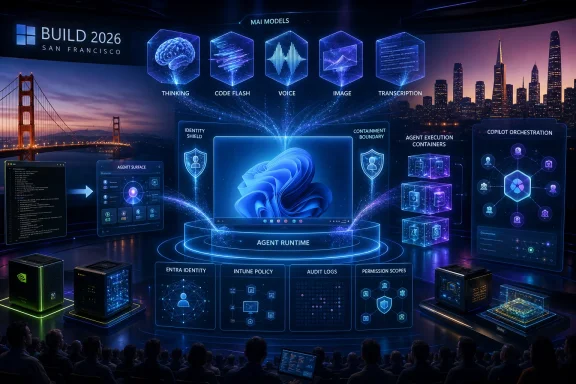
Tech conference stage showing AI agent runtime system diagrams at Build 2026 San Francisco.Microsoft’s AI Stack Stops Pretending It Is Just a Partnership Story​

For years, Microsoft’s AI strategy was easy to summarize and hard to overstate: take OpenAI’s most capable models, wire them into Microsoft 365, Azure, GitHub, Bing, Windows, and security products, then sell the enterprise version with the kind of procurement muscle only Microsoft can bring. Build 2026 complicates that story. The company is still tied to OpenAI, but the center of gravity has shifted toward a Microsoft-owned model portfolio.
The seven new MAI models are the clearest evidence yet. MAI-Thinking-1 is positioned as Microsoft AI’s flagship reasoning model, a mid-sized system aimed at complex problem solving and software engineering rather than broad consumer spectacle. MAI-Code-1-Flash brings a faster, lower-cost coding model into GitHub Copilot and VS Code. MAI-Image-2.5, MAI-Voice-2, and MAI-Transcribe-1.5 fill out the multimodal surface area Microsoft needs if Copilot is to become less of a chatbot and more of a persistent interface layer.
The important part is not that every benchmark claim should be taken as gospel. Vendor benchmarks are marketing until independent users have months of bruises and bug reports behind them. The important part is that Microsoft is now making a public case for its own model economics, its own training discipline, and its own product-specific optimization.
That matters because the next phase of AI competition is not simply about who has the smartest general-purpose model on a leaderboard. It is about who can make models cheap enough, governable enough, and context-aware enough to run inside daily workflows without turning every prompt into a billing event or every automation into a compliance exception.

MAI-Thinking-1 Is a Reasoning Model With a Procurement Department in Mind​

MAI-Thinking-1 is the showpiece because reasoning models are where the industry has decided the frontier now lives. Microsoft describes it as a medium-sized 35-billion-parameter model with a large context window and training that did not rely on distillation from third-party models. The company says blind raters preferred it to Anthropic’s Sonnet 4.6 and that it matches Opus 4.6 on SWE-Bench Pro.
Those claims will draw attention, but the more revealing detail is access. MAI-Thinking-1 is not being thrown over the wall as a mass-market toy. It is in private preview through Microsoft Foundry, gated behind an access request and aimed first at enterprise use cases.
That is classic Microsoft. The company does not need to win the Saturday-night chatbot popularity contest to make MAI-Thinking-1 matter. It needs a model that can be tuned, governed, audited, and embedded into workflows where the buyer cares less about viral demos and more about repeatability, latency, cost, data handling, and support contracts.
The phrase Microsoft wants customers to hear is trained from the ground up. That is a strategic answer to two anxieties at once. Customers want to know whether their models are contaminated by murky training pipelines, and Microsoft wants investors and regulators to know it can build durable AI capability without functioning only as OpenAI’s enterprise channel.
Still, the model’s biggest test will not be whether it can win a curated coding benchmark. It will be whether it can sit inside a Microsoft tenant, reason over messy work artifacts, respect policy boundaries, and avoid the kind of confident nonsense that turns automation into cleanup work. Enterprise AI does not fail only when it is wrong. It fails when it is wrong in a way no one can attribute, reproduce, or safely constrain.

Copilot’s Coding Future Gets Cheaper Before It Gets Smarter​

MAI-Code-1-Flash is less glamorous than the reasoning model, but it may show up in more users’ hands sooner. It is rolling into VS Code through the GitHub Copilot model picker and is pitched as a fast, inference-efficient agentic coding model. Microsoft says it has 5 billion active parameters and is comparable to Anthropic’s Haiku class while being cheaper.
That framing is revealing. Microsoft is not claiming that MAI-Code-1-Flash is the new best coding model in the world. It is claiming that a smaller, tuned model can do a large amount of everyday coding work at better cost and speed when it is deeply integrated into the Microsoft developer stack.
This is where Copilot’s next stage becomes less about autocomplete and more about routing. A developer may ask one thing, but the system can choose among cloud models, local small language models, specialized coding models, and heavier reasoning systems depending on the task. The model picker is the visible UI; the real product is orchestration.
For Windows developers, this could be genuinely useful. A fast model that understands VS Code, GitHub, terminal context, repository structure, and Microsoft’s own SDKs may beat a larger general model on practical throughput. The caveat is that “agentic coding” has become an industry term of art that often hides a mess of brittle file edits, hallucinated dependencies, and half-finished refactors.
Microsoft knows that. Build’s Windows announcements repeatedly paired agentic capability with containment, identity, and policy. The company is implicitly admitting that coding agents are powerful enough to be useful and dangerous enough to require operating-system support.

Windows Is Being Recast as the Agent Runtime​

The Windows portion of Build 2026 was not about a shiny Start menu redesign or another pass at Copilot key placement. It was about turning Windows into a trusted runtime for agents. That is a much bigger bet than a sidebar.
Microsoft introduced or expanded a cluster of developer features around agent execution: Microsoft Execution Containers, Agent 365 integration, Windows 365 for Agents, OpenClaw on Windows, Windows AI APIs, on-device SLMs, and an experimental Intelligent Terminal. The common thread is that agents are moving from browser tabs into the operating system’s trust boundary.
That is both logical and risky. If an agent is going to read files, run commands, browse internal apps, manipulate a desktop session, or coordinate tasks across Outlook, Teams, OneDrive, SharePoint, GitHub, and local folders, the OS has to know what that agent is allowed to do. Browser permissions and SaaS app scopes are not enough.
Microsoft Execution Containers are the most important piece of that puzzle. The promise is a policy-driven execution layer where developers declare what an agent can access and Windows enforces boundaries at runtime. In plainer terms: the agent should not be able to rummage through your machine just because it can operate your apps.
That will appeal to admins who watched the first wave of AI agents with a mixture of fascination and dread. The industry spent decades teaching users not to run random scripts from the internet. Now software vendors are asking enterprises to authorize semi-autonomous systems that can generate scripts, run commands, click interfaces, and interpret documents. Containment is not a nice-to-have; it is the price of admission.

OpenClaw Gives Microsoft a Wild Interface It Can Tame​

OpenClaw’s arrival on Windows is one of the more intriguing Build developments because it represents Microsoft doing something it historically prefers to avoid: embracing a messy, fast-moving outside interface idea and trying to domesticate it for enterprise use. OpenClaw’s appeal is autonomy. Microsoft’s appeal is governance. The tension is the product.
The new Windows companion app, sidebar widget, and native node and gateway support are designed to let users set up claws or connect to existing ones while keeping execution inside Microsoft’s containment model. Microsoft even demoed guardrails that prevented OpenClaw from touching restricted folders. That is exactly the kind of demo admins need to see, though demos are not production reality.
The strategic benefit for Microsoft is obvious. If OpenClaw becomes one of the dominant patterns for agentic desktop work, Microsoft would rather make Windows the safest and most capable place to run it than watch developers drift toward Linux workstations, browser sandboxes, or cloud desktops. Windows does not need to invent every agent interface if it can become the place where they are governed.
The risk is also obvious. OpenClaw-style agents are attractive precisely because they can be broad, persistent, and flexible. Those are the same traits that make them difficult to secure. The more an agent behaves like a tireless junior operator with hands on the keyboard, the more identity, logging, rollback, data loss prevention, and least privilege become unavoidable.
This is where Windows may actually have an advantage. Microsoft controls the desktop OS, the enterprise directory, the management plane, the productivity apps, the endpoint security stack, and the developer tools. If it can make all of those layers speak the same governance language, it can offer something hobbyist agent frameworks cannot: a path from cool demo to auditable deployment.

Scout Is Copilot After It Stops Waiting for You​

Microsoft Scout may be the most important Copilot announcement because it changes the interaction model. Copilot began as something users invoked. Scout is described as an always-on personal agent for work, built on OpenClaw and grounded in Work IQ, operating across Teams, Outlook, OneDrive, SharePoint, and local device actions.
That is a major conceptual shift. The old Copilot model was prompt-response: summarize this, draft that, find the answer, rewrite the paragraph. Scout is closer to delegation. It watches for work, reasons across systems, and takes action under a governed identity.
The governed identity part is not corporate boilerplate. It is the difference between an agent that can exist in a regulated enterprise and an agent that lives forever in experimental preview. Microsoft says Scout operates under its own Entra identity, giving admins and users a way to attribute what it does. That is essential if an agent is creating calendar entries, opening Teams conversations, moving files, or touching code.
Scout also reveals why Microsoft is so obsessed with Work IQ. General intelligence is less useful at work than organizational memory: who owns what, which files matter, what a team calls a project, where decisions were made, and which workflows are normal for a given company. The model matters, but the context engine may matter more.
There is a danger here of Microsoft turning every workplace into an ambient automation experiment. Always-on agents can help, but they can also create invisible work, noisy interventions, and a new category of “AI did something” tickets. The product succeeds only if users can see what Scout is doing, stop it easily, and trust that administrators can set meaningful boundaries.

Project Solara Shows Microsoft Still Wants New Hardware Rituals​

Build 2026 was not only about software. Microsoft also showed Project Solara, a platform for agent-driven experiences, including concept devices meant to make agents feel less like apps and more like companions in the workspace. The idea is familiar: a home or desk display, voice interaction, persistent context, and an agent that can operate alongside you.
This is where Microsoft’s ambitions become culturally interesting. The company has spent decades trying to decide whether Windows is a workspace, a device ecosystem, a cloud endpoint, or a services delivery vehicle. Agentic AI lets it argue that Windows is all of those things again, provided the interface is no longer just a screen full of windows.
The hardware story includes more practical developer boxes, too. The Surface RTX Spark Dev Box is pitched as a local AI development machine with NVIDIA RTX Spark silicon, up to 1 petaflop of AI compute, and 128 GB of unified memory. DGX Station for Windows goes even higher, bringing NVIDIA’s deskside AI supercomputer concept into the Windows ecosystem for frontier-scale local development.
The point is not that every developer will buy a Windows AI workstation. Most will not. The point is that Microsoft is trying to make local AI compute a first-class Windows story instead of a niche for Linux users with CUDA scars and a tolerance for dependency pain.
Local compute also changes the economics. If agents become continuous background workers, per-token cloud billing becomes a tax on ambition. Microsoft’s “unmetered intelligence” language is marketing, but the underlying problem is real. Enterprises will want a hybrid model where routine inference runs locally, sensitive work stays on managed devices or Cloud PCs, and frontier calls are reserved for tasks that justify the cost.

The Terminal Becomes an Agent Surface, Not Just a Shell​

The Intelligent Terminal announcement is easy to miss among larger AI claims, but it may land hard with developers. The terminal is where intent, tools, errors, logs, package managers, build systems, and deployment commands already converge. Putting context-aware agent assistance there is more natural than forcing every workflow through a chat pane.
Microsoft’s advantage is that Windows Terminal, PowerShell, WSL, VS Code, GitHub Copilot, and Windows developer configurations can be treated as one surface. A coding agent that understands a failing command, sees the repository, edits the file, reruns the test, and respects OS-enforced boundaries is more useful than a chatbot that merely suggests what to type.
The challenge is trust. Developers are unusually willing to automate themselves into trouble, but they also notice when tools are sloppy. A terminal agent that runs the wrong command, modifies the wrong environment, or hides the reasoning behind a fix will be disabled quickly.
This is why Build’s repeated emphasis on containers, isolation, and policy is more than security theater. The more powerful the terminal agent becomes, the more important it is that the agent’s blast radius can be limited. Nobody wants an AI assistant with root energy and intern judgment.

Aion and On-Device AI Are Microsoft’s Answer to Cloud Fatigue​

Microsoft’s new Aion models point at another pressure building under the AI boom: cloud fatigue. Aion 1.0 Instruct and Aion 1.0 Plan are meant to bring small language model capabilities to Windows devices, with the latter focused on reasoning and tool calling for local agentic workloads.
This is a necessary correction. The first Copilot wave over-rotated toward cloud intelligence. That made sense when models were large, NPUs were just arriving, and Microsoft wanted the service revenue. But users and developers increasingly want AI features that are fast, private, offline-capable, and not obviously tied to a meter in the sky.
On-device models will not replace frontier models. They do not need to. They can summarize, rewrite, classify, extract intent, handle accessibility scenarios, power local agents, and triage which tasks deserve a cloud call. That kind of tiering is how AI becomes infrastructure rather than a novelty.
The Windows AI API expansion matters here because developers need stable abstractions. If every app has to detect hardware, choose runtimes, bundle models, manage updates, and optimize for each silicon vendor, local AI will remain fragmented. Microsoft wants Windows to hide enough of that complexity to make local intelligence boring.
Boring is good. Boring is how features become platforms.

The Copilot Super App Is Microsoft’s Attempt to End AI Sprawl​

The reported Copilot “super app” direction makes sense in this context. Microsoft has scattered Copilot entry points across Windows, Edge, Office, Teams, GitHub, security products, and mobile apps. Some of those entry points have been useful. Others felt like branding sprayed over existing software.
A unified Copilot shell would be an admission that AI sprawl has become a usability problem. If users have to remember which Copilot does what, where a conversation lives, which model is behind it, and whether it can act or only answer, the system is already too complicated. A super app can centralize chat, Cowork-style collaboration, coding, agent status, and long-running tasks.
But centralization cuts both ways. A single shell can simplify workflows, or it can become yet another Microsoft dashboard that grows until nobody knows where anything is. The success of a Copilot super app will depend on whether it reduces cognitive overhead rather than merely aggregating Microsoft’s AI ambitions in one window.
The better vision is not “one app to rule them all.” It is one control plane for human and agent work. Users should be able to see which agents are running, what they are doing, what they have access to, what they changed, and what needs approval. Admins should be able to apply policy without chasing every new agent surface across the tenant.
If Microsoft gets that right, Copilot becomes less of a chatbot brand and more of an operating layer. If it gets it wrong, Copilot becomes Clippy with a budget line.

Enterprise IT Gets the Best Story and the Hardest Job​

For sysadmins, Build 2026 is both reassuring and exhausting. The reassuring part is that Microsoft understands the enterprise objection to agentic AI: it is not just accuracy, it is control. The company is talking about Entra identities, Intune policy, Defender integration, Purview protections, Cloud PCs for agents, containment boundaries, and attributable activity.
The exhausting part is that every one of those controls becomes another thing to learn, configure, monitor, and explain. AI agents will not arrive as a single neatly packaged workload. They will show up through Copilot, GitHub, Windows, Teams, Outlook, third-party apps, browser extensions, developer tools, and open-source frameworks.
The old software governance model already struggled with SaaS sprawl. Agentic AI adds action. It is one thing for an unauthorized app to store files in the wrong place. It is another for an authorized agent to make a plausible but damaging decision across multiple systems at machine speed.
Microsoft’s answer is to make agents first-class security principals. That is the right direction. An agent should not borrow a user’s identity invisibly, and it should not act as a vague service account with godlike reach. It needs scoped permissions, logs, policy, and revocation.
The practical challenge is culture. Organizations will need to decide which tasks can be delegated, which require approval, which data is off-limits, and who is accountable when an agent follows instructions that were technically allowed but operationally foolish. Technology can enforce boundaries. It cannot define judgment for every business process.

Microsoft’s Model Independence Is Real, but Not Absolute​

It would be tempting to frame Build 2026 as Microsoft breaking away from OpenAI. That is too simple. Microsoft still has deep ties to OpenAI, and OpenAI remains a major force across the developer ecosystem. Build itself included OpenAI in the broader Windows agent containment story.
What has changed is leverage. By building MAI models for reasoning, coding, image, voice, and transcription, Microsoft gives itself options. It can tune models for its products, optimize cost, reduce dependency risk, and negotiate from a stronger position. It can also route tasks to the model that makes the most economic and technical sense.
This is not ideological independence. It is supply-chain discipline. In cloud computing, Microsoft would never want Azure to depend entirely on a single outside provider for a core capability. In AI, models are becoming a core capability.
The “no distillation” and licensed-data messaging should be read in that light. Microsoft is trying to make its model stack palatable to enterprises, regulators, and partners who worry about provenance. Whether the market rewards that discipline remains to be seen, but it is a sensible bet for a company whose customers ask procurement questions before they ask leaderboard questions.
The harder question is whether Microsoft can attract developers to MAI models outside its own products. Foundry distribution, OpenRouter, Fireworks, Baseten, and tuning options suggest it wants a broader ecosystem. But developers are fickle, and model loyalty is thin. They will use whatever is best, cheapest, fastest, easiest, or already integrated into the tool in front of them.

The Build 2026 Message Sysadmins Should Tape to the Monitor​

Build 2026 was too sprawling to reduce to one announcement, but its practical meaning is unusually clear. Microsoft is building an AI stack that starts with models, runs through developer tools and Windows, and ends in governed agents acting across real work systems.
  • Microsoft’s seven new MAI models mark a serious move toward owning more of the AI layer beneath Copilot, GitHub, Windows, and Microsoft 365.
  • MAI-Thinking-1 is important less because of benchmark claims than because it gives Microsoft an enterprise-oriented reasoning model it can tune and govern through Foundry.
  • Windows is being repositioned as an agent runtime, with Microsoft Execution Containers, Agent 365, Entra identity, Intune policy, and Windows 365 for Agents forming the control plane.
  • OpenClaw on Windows is a bet that Microsoft can embrace autonomous agent workflows while making them acceptable to security teams.
  • Local AI through Aion models, Windows AI APIs, and NVIDIA-powered developer hardware is Microsoft’s answer to the cost, privacy, and latency limits of cloud-only inference.
  • Scout points to Copilot’s next phase: agents that do not wait for prompts but operate continuously, visibly, and under policy.
The big question after Build 2026 is not whether Microsoft has enough AI announcements. It plainly has more than enough. The question is whether it can turn this thicket of models, agents, containers, identities, terminals, Cloud PCs, and devices into something coherent enough that users trust it and administrators can govern it without drowning. If Microsoft succeeds, Windows becomes the place where AI agents stop being demos and start becoming infrastructure; if it fails, Build 2026 will be remembered as the moment the company correctly saw the future and then buried it under too many moving parts.

References​

  1. Primary source: TestingCatalog AI News
    Published: 2026-06-03T20:17:11.517375
  2. Related coverage: axios.com
  3. Related coverage: windowscentral.com
  4. Related coverage: tomsguide.com
  5. Related coverage: techradar.com
  6. Related coverage: techtimes.com
  1. Related coverage: ai-tldr.dev
  2. Official source: microsoft.ai
  3. Related coverage: techcrunch.com
  4. Related coverage: windowslatest.com
  5. Related coverage: kursol.io
  6. Related coverage: singularity.kiwi
  7. Official source: news.microsoft.com
  8. Related coverage: resultsense.com
  9. Official source: blogs.windows.com
  10. Related coverage: financialexpress.com
  11. Related coverage: omni.se
  12. Related coverage: ashgabattimes.com
 

Microsoft used its Build 2026 developer conference in San Francisco this week to expand its AI strategy across models, devices, cloud infrastructure, developer tools, and speculative quantum hardware, while analysts continued to frame the company’s AI spending as a long-term growth engine for Azure and Microsoft 365. The pitch was not merely that Microsoft has more AI features. It was that Microsoft wants to own more of the stack beneath them. For Windows users, developers, and IT departments, that is both the opportunity and the warning.

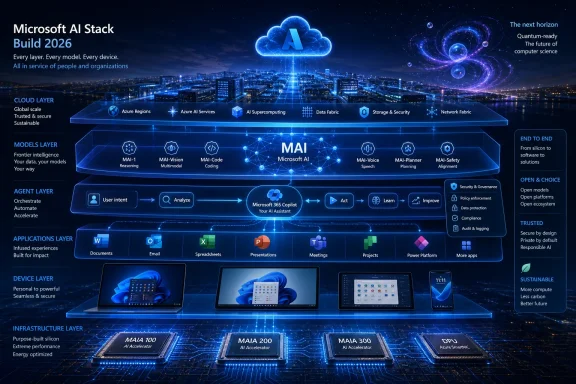
Microsoft AI Stack Build 2026 graphic with glowing cloud, layered tech architecture, and city skyline backdrop.Microsoft Is No Longer Just Packaging Someone Else’s AI​

For the past three years, Microsoft’s AI story has often been described through the OpenAI lens: Microsoft funded the frontier lab, hosted its models on Azure, and poured Copilot branding across Windows, Office, GitHub, Security, Dynamics, and Bing. That story was true, but it was never going to be enough. Build 2026 made the next phase explicit: Microsoft wants to be less of an AI distributor and more of an AI manufacturer.
The most direct evidence is the company’s new MAI model lineup. Microsoft announced seven new in-house AI models spanning reasoning, coding, transcription, voice, and image work, with MAI-Thinking-1 positioned as the flagship reasoning model. The important phrase here is not “reasoning model,” because every major AI vendor is now selling some version of that claim. The important phrase is in-house.
That distinction matters because model choice is becoming a cost-control lever. Microsoft has spent enormous sums building out Azure capacity for AI workloads, and every Copilot prompt that depends on an expensive third-party frontier model carries margin implications. A Microsoft-owned model that is good enough for many enterprise tasks gives the company something more valuable than bragging rights: pricing flexibility.
It also gives Microsoft strategic cover. The company can keep using OpenAI where it needs maximum capability, offer smaller or cheaper MAI models where latency and cost matter more, and present the whole thing to developers as choice rather than substitution. That is the classic Microsoft playbook: bundle the ecosystem, abstract the complexity, and make the platform look inevitable.

Build’s Real Product Was the Stack​

The individual announcements at Build were numerous, but the pattern was simple. Microsoft is trying to make AI run through every layer it controls: silicon, datacenter, model, agent runtime, operating system surface, productivity application, and developer workflow. This is not a feature launch strategy. It is an infrastructure strategy wearing a keynote badge.
That is why Maia 200 matters even to people who will never touch a server rack. Microsoft says its AI accelerators will help power products such as Microsoft 365 Copilot while improving performance efficiency. In plain English, the company is trying to reduce dependence on scarce and expensive third-party GPUs, especially as AI usage becomes a normal part of enterprise software rather than a novelty line item.
This is also why Azure remains the center of the financial story. Wall Street’s bullish case for Microsoft is not that Word gets a better chatbot. It is that AI demand keeps Azure growth elevated, that Copilot becomes a durable add-on to Microsoft 365, and that developers building agentic applications choose Microsoft’s cloud because the tooling, identity layer, governance model, and deployment path are already there.
KeyBanc’s Overweight rating and $600 price target fit that narrative. Analyst notes can be wrong, and price targets are not prophecy, but the reasoning is easy to understand. If Microsoft can turn its existing enterprise footprint into recurring AI consumption, the company does not need to win every consumer AI popularity contest. It only needs to make AI another metered utility inside the Microsoft estate.

Project Solara Shows the Windows Question Microsoft Would Rather Not Say Too Loudly​

Project Solara may be the most interesting announcement for WindowsForum readers because it exposes the tension inside Microsoft’s platform strategy. Microsoft described Solara as a chip-to-cloud platform for agent-first computing, a way to support AI agents across devices and services. Reporting around the announcement indicates that the underlying device work involves Microsoft’s Device Ecosystem Platform and an agent shell designed around Android-derived foundations rather than traditional Windows.
That is not a small detail. For decades, Microsoft’s answer to new computing categories was some version of Windows: Windows CE, Windows Mobile, Windows Phone, Windows RT, Windows IoT, Windows on Arm, Windows 365, and so on. Solara suggests a more pragmatic Microsoft, one that may be willing to build AI-first device experiences beside Windows rather than forcing every new form factor through the Win32 inheritance machine.
For Windows loyalists, that can feel like heresy. But from Microsoft’s perspective, the operating system is no longer the only choke point. Identity, cloud state, agent orchestration, policy control, app connectors, and model routing may be more strategically important than whether the local shell is Windows in the familiar desktop sense.
That does not mean Windows is suddenly irrelevant. It means Windows is being repositioned as one node in a broader agentic fabric. The PC remains where much knowledge work happens, but the agent Microsoft imagines is not confined to the PC; it follows the user across cloud services, enterprise data, mobile surfaces, and specialized devices. The Windows desktop becomes a command center, not the whole kingdom.

The Agent Dream Still Has an Enterprise Hangover​

Microsoft’s Build language leaned heavily into agents: agents that understand work, agents that retrieve information, agents that act across systems, agents that coordinate tasks. The promise is seductive because enterprise software is still full of repetitive glue work. If an AI agent can reliably draft a document, update a CRM record, summarize a Teams thread, file a ticket, and prepare a spreadsheet without breaking policy, there is real productivity there.
The hard part is that “reliably” is doing most of the work in that sentence. Enterprise IT does not merely ask whether an agent can complete a task in a demo. It asks who approved the action, what data was accessed, which identity was used, what audit trail exists, how the result can be reversed, and whether the system behaves differently after a model update.
That is where Microsoft has an advantage over many AI startups. It already owns Entra ID, Purview, Defender, Intune, Microsoft 365 admin controls, GitHub enterprise workflows, and a large share of the corporate productivity surface. If agents are going to be governed, logged, permissioned, and deployed at scale, Microsoft has the plumbing.
But that same advantage creates concentration risk. The more Microsoft ties together identity, productivity data, endpoint management, AI agents, and Azure runtime services, the more customers must think carefully about lock-in. Convenience is valuable; dependency is expensive. The enterprise buyer’s job is to know the difference before procurement turns a pilot into a platform commitment.

The MAI Models Are a Margin Story Disguised as a Capability Story​

MAI-Thinking-1 is being presented as Microsoft’s first reasoning model, with the company emphasizing efficiency and lower computing costs. That positioning is telling. Microsoft does not have to claim that every MAI model beats every frontier competitor on every benchmark. It only has to show that many business tasks can be handled well enough at lower cost and with tighter integration.
That is the Copilot economics problem in miniature. If a company pays for Microsoft 365 Copilot, it expects useful output inside Word, Excel, Outlook, Teams, and SharePoint. It does not particularly care whether a given response came from OpenAI, MAI, a smaller domain model, or a routed combination. Microsoft cares very much, because the cost of inference determines how profitable Copilot can become at scale.
This is why the model announcements should be read alongside the hardware announcements. Maia chips, model routing, smaller specialized models, and Azure capacity planning are all parts of the same equation. Microsoft wants to make AI cheaper to serve, easier to govern, and harder for customers to unbundle.
There is also a developer angle. If Microsoft can offer a menu of models inside Foundry, GitHub Copilot, and Azure tooling, it can meet developers where they already build. The developer does not need to become a procurement expert for every AI lab. Microsoft’s platform can offer “good, better, best” options and collect the cloud spend either way.

Windows Developers Get Courted, But Not Necessarily Centered​

Build has always been Microsoft’s developer love letter, even when the relationship was strained. In 2026, the company’s message to developers is that AI agents are the new application layer and Microsoft wants to provide the scaffolding. That includes model lifecycle tooling, agent governance, retrieval systems, coding assistants, and new hardware for local or hybrid AI development.
For Windows developers, the message is more complicated. Microsoft continues to invest in Windows as a development platform, and GitHub Copilot remains one of the most important AI coding tools in the market. But the center of gravity is cloud-first and agent-first, not desktop-first. The Windows PC is valuable because it is part of a larger Microsoft-controlled workflow, not because Microsoft believes every future app begins with a Start menu tile.
That shift has been underway for years. Windows Subsystem for Linux, Dev Home, Windows 365, cloud dev boxes, GitHub Codespaces, and Azure-hosted build pipelines all point in the same direction. The developer’s machine is still important, but the platform is increasingly the identity, repository, model, and deployment graph around that machine.
This is not necessarily bad for Windows. A Windows PC that works seamlessly with cloud agents, local NPUs, secure enclaves, and enterprise policy could be more useful than a purely local workstation. But it does mean the old dream of Windows as the primary application monopoly is gone. Microsoft’s new dream is subtler: Windows as the trusted enterprise endpoint in an AI system that extends far beyond Windows.

Quantum Is the Moonshot That Helps the AI Story Look Bigger​

Microsoft also used Build to introduce Majorana 2, its next-generation quantum computing chip, tied to the company’s goal of building a scalable quantum computer by 2029. Quantum announcements should always be handled carefully, because the distance between a promising chip and a practical, fault-tolerant quantum computer is enormous. Microsoft’s topological qubit approach has long attracted both interest and skepticism.
Still, the announcement serves a purpose in the broader Build narrative. AI is the near-term business. Quantum is the long-term frontier. By putting both on the same stage, Microsoft gets to frame itself not merely as a software company adding AI buttons, but as a deep infrastructure company working from physics to productivity apps.
For investors, that matters less than Azure growth over the next several quarters. For researchers and developers, it matters because Microsoft is trying to keep itself in the conversation about post-classical computing. For IT departments, it is mostly a reminder that vendor roadmaps are now mixing practical procurement issues with decade-scale research bets.
The danger is hype compression. AI agents that may be deployed this year, custom AI chips that may affect cloud margins over the next few years, and quantum processors that may or may not become practically useful by 2029 are not the same kind of announcement. Microsoft benefits when they sit together under one innovation umbrella. Customers benefit when they separate the timelines.

The Investor Case Is Plausible Because Microsoft Already Owns the Workday​

The bullish Microsoft thesis is not difficult to articulate. The company owns the operating system on many corporate PCs, the productivity suite where office work happens, the collaboration layer where employees communicate, the identity system that governs access, the cloud platform where workloads run, and the developer platform where code is written. AI can be attached to each of those surfaces.
That is a very different starting point from a pure-play AI company trying to sell into the enterprise from the outside. Microsoft does not need to convince customers to create a new workflow from scratch. It can insert AI into existing workflows and charge incrementally for the privilege. That is how enterprise software empires compound.
The risk is that customers eventually ask whether the incremental value matches the incremental bill. Microsoft 365 Copilot has improved, but many organizations are still working through adoption challenges, data readiness issues, training requirements, and governance concerns. AI is not magic dust sprinkled over a messy SharePoint estate. If permissions are chaotic, documents are stale, and business processes are poorly defined, an agent may simply automate confusion.
This is where analysts and IT practitioners often diverge. Analysts see attach rates, cloud consumption, and operating leverage. IT teams see rollout plans, help desk tickets, compliance reviews, and executives asking why a costly pilot did not instantly transform productivity. Both views are valid. The market rewards the aggregate story, but the deployment reality is local and uneven.

The Security Argument Is Now the Product Argument​

Microsoft cannot sell enterprise agents without selling trust. An AI agent that reads email, manipulates files, queries business systems, and takes actions on behalf of a user is not just another assistant. It is a delegated actor inside the corporate environment. That makes security and governance core product features, not afterthoughts.
The company knows this, which is why its agent strategy increasingly emphasizes runtime governance, identity controls, policy enforcement, and auditability. Microsoft’s advantage is that it can connect those capabilities to tools customers already use. The same admin who manages conditional access, device compliance, data loss prevention, and endpoint security can plausibly be asked to manage agent permissions too.
But trust in Microsoft is not unlimited. The company’s security record has faced intense scrutiny in recent years, and many administrators remain wary of fast-moving cloud features that appear before governance documentation feels mature. AI raises the stakes because the system’s behavior can be probabilistic, context-dependent, and difficult to explain after the fact.
That means Microsoft’s AI success will depend not only on model quality, but on administrative clarity. IT pros need to know what an agent can access, what it did, why it did it, how to stop it, and how to prove compliance later. If Microsoft makes that boring and dependable, it wins. If it makes it flashy and opaque, it creates resistance inside the very organizations it wants to monetize.

The Windows Community Should Watch the Defaults​

For enthusiasts, the most visible AI debates often revolve around whether Copilot belongs in the taskbar, whether Recall-style features are safe, and whether Windows is becoming too cloud-dependent. Those debates are not trivial, but Build 2026 suggests the bigger fight is over defaults. Which model is selected by default? Which data sources are connected by default? Which agents are enabled by default? Which admin controls are opt-out rather than opt-in?
Defaults shape behavior at Microsoft scale. A feature that appears as an optional developer preview in June can become a standard enterprise control surface two release cycles later. A model that begins as a lower-cost alternative can become the silent engine behind a premium product. A device strategy that starts outside Windows can influence what Windows itself becomes.
Windows users should also pay attention to local versus cloud execution. As NPUs improve and Microsoft talks more about hybrid inference, the practical question will be which AI features run locally, which require Azure, and which expose sensitive user or enterprise data to cloud processing. Microsoft will likely present this as a continuum. Administrators will need to turn it into policy.
The strongest version of Microsoft’s strategy gives users capable local assistance, gives enterprises strong governance, gives developers flexible model choices, and gives Microsoft a profitable AI business. The weaker version gives users more prompts, enterprises more licensing complexity, developers more lock-in, and Microsoft another reason to blur product boundaries. Build did not settle which version we will get.

The Build 2026 Signal Hidden Beneath the Keynote Noise​

Microsoft’s Build announcements are best read as a coordinated attempt to turn AI from a feature wave into a platform dependency. The company is not merely adding models; it is building the economic and technical machinery to make those models cheaper, more governable, and more deeply embedded in work.
  • Microsoft is moving beyond reliance on partner models by expanding its own MAI family, including MAI-Thinking-1 for reasoning workloads.
  • Project Solara signals that Microsoft’s agent-first device strategy may develop alongside Windows rather than always inside traditional Windows.
  • Maia 200 and related infrastructure work show that AI margins, not just AI features, are now central to Microsoft’s strategy.
  • The enterprise opportunity depends on whether Copilot and agentic tools produce measurable productivity gains beyond pilot-stage enthusiasm.
  • Security, identity, governance, and auditability will determine whether AI agents become trusted enterprise tools or another shadow-IT headache.
  • Quantum announcements such as Majorana 2 broaden Microsoft’s innovation story, but they should not be confused with the near-term business impact of Azure and Copilot.
Microsoft’s wager is that the next computing platform will not arrive as a single device, operating system, or app store, but as an agentic layer stretched across everything people already use; if it is right, Build 2026 will look less like a product showcase and more like the moment Microsoft began turning AI into the new enterprise default.

References​

  1. Primary source: TradingView
    Published: 2026-06-03T17:12:11.405292
  2. Related coverage: windowscentral.com
  3. Related coverage: techradar.com
  4. Related coverage: axios.com
  5. Official source: news.microsoft.com
  6. Related coverage: tomshardware.com
  1. Related coverage: techcrunch.com
  2. Related coverage: elsolitario.org
  3. Related coverage: enterprisedna.co
  4. Related coverage: techiexpert.com
  5. Related coverage: moneycontrol.com
  6. Related coverage: gihyo.jp
  7. Related coverage: constellationr.com
  8. Related coverage: thelettertwo.com
  9. Related coverage: omni.se
  10. Official source: microsoft.com
  11. Related coverage: its.fsu.edu
  12. Official source: info.microsoft.com
  13. Related coverage: investing.com
  14. Related coverage: za.investing.com
  15. Related coverage: ca.investing.com
  16. Related coverage: insidermonkey.com
  17. Related coverage: it.investing.com
  18. Related coverage: coincentral.com
 

At Microsoft Build 2026 in San Francisco on June 2, Microsoft announced new AI agents, developer tooling, Azure and Foundry capabilities, security controls, Windows agent infrastructure, and a slate of in-house MAI models meant to give developers and enterprises more control over AI systems. The headline is not simply that Microsoft has more AI features; the headline is that Microsoft is trying to own more of the stack beneath them. After years of being defined by its OpenAI partnership, Redmond is now making the case that enterprise AI needs Microsoft-shaped plumbing, Microsoft-shaped governance, and increasingly Microsoft-made models. For Windows users, developers, and IT departments, that shift matters because it turns AI from a cloud add-on into a platform assumption.

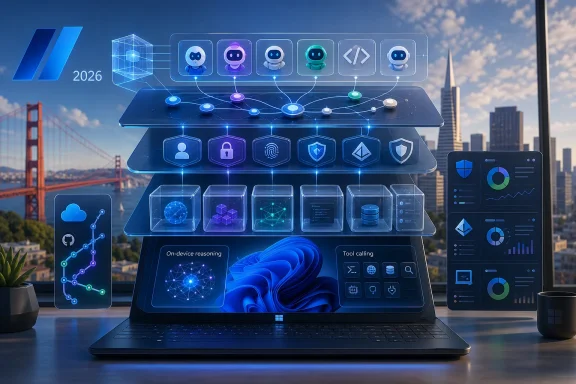
AI cloud assistant shown as futuristic UI icons on a laptop screen above a city skyline.Microsoft Is No Longer Content to Be the Best Reseller of Someone Else’s Intelligence​

Microsoft’s early AI advantage came from a bargain that looked almost unfairly good at the time. OpenAI supplied frontier-model credibility, Microsoft supplied capital, Azure infrastructure, enterprise distribution, and the Copilot brand umbrella. That combination gave Microsoft a head start inside productivity software, developer tools, cloud services, and Windows itself.
Build 2026 showed a company that still values that partnership but does not want to be strategically trapped inside it. The unveiling of Microsoft AI’s in-house model family, including MAI-Thinking-1 and MAI-Code-1, was the clearest signal yet that Microsoft wants its own answers to the model-layer question. That does not mean Microsoft is walking away from OpenAI; it means Microsoft wants leverage, optionality, and cost control.
The distinction matters. In the cloud business, margins are shaped not just by what customers pay but by how much compute is burned to answer every prompt, run every agent, and generate every line of code. A company that can route workloads among OpenAI models, partner models, open-weight models, and its own models has a very different business from one that is merely packaging another firm’s intelligence.
This is why the phrase proprietary models carries more weight than it might appear to at first glance. Microsoft is not trying to win a benchmark beauty contest for its own sake. It is building a portfolio of models with specific economics, deployment patterns, licensing claims, and integration hooks that make sense inside GitHub, Microsoft 365, Azure, Windows, and enterprise compliance regimes.

Build’s Real Product Was Control​

The Build keynote framing leaned heavily on agents, as every major AI conference now does. But the underlying product was control: control over what agents can access, how they execute code, which models they use, where data lives, and how administrators observe and constrain them. Microsoft knows that enterprises are not short of demos; they are short of reasons to trust demos at scale.
That is where Microsoft Foundry, Azure AI infrastructure, GitHub tooling, Defender, Entra, Intune, and Windows developer features begin to look less like separate announcements and more like a single campaign. Microsoft is trying to make the agent era feel governable. It wants the buyer to believe that the same company that already manages identity, endpoint policy, source code, cloud workloads, and office documents can now manage semi-autonomous software actors too.
This is a shrewd enterprise pitch because most organizations are not waiting for a slightly more magical chatbot. They are waiting for a way to let AI touch business systems without creating a security incident, a compliance problem, or an untraceable automation chain. Microsoft’s answer is not purity; it is bureaucracy with APIs.
That will sound dull to consumer AI enthusiasts. It will sound much more interesting to the people who get paged when an overprivileged automation token starts deleting records or leaking files. In business software, the winning AI agent may be less the one that sounds most human and more the one that can be audited, revoked, sandboxed, and billed predictably.

The Agent Boom Has Reached Its Enterprise Phase​

For the last two years, the word agent has been stretched almost beyond usefulness. Sometimes it means a chatbot with a tool call. Sometimes it means a workflow runner. Sometimes it means a coding assistant that can modify a repository. Sometimes it means an operating model in which software takes a goal, decomposes it into steps, acts across systems, and reports back.
Microsoft is deliberately using the broader meaning. Its Build announcements positioned agents as the connective tissue between applications, cloud services, documents, databases, code repositories, and devices. That is an ambitious vision, and it is also one that benefits Microsoft more than almost anyone else because Microsoft already owns so many of the surfaces where work happens.
The company’s enterprise story is that agents should not live off to the side as novelty tools. They should sit inside the workflow: in Microsoft 365 Copilot, in GitHub, in Azure, in developer environments, in Windows, and in business applications. Instead of asking users to move work into a chatbot, Microsoft wants agents to move through the systems users already depend on.
There is an obvious upside here. Customer service agents can summarize cases, fetch policy documents, and draft responses. Developer agents can triage bugs, generate patches, run tests, and prepare pull requests. Operations agents can watch logs, correlate alerts, and propose remediations. Data agents can turn business questions into analysis without requiring every employee to become a SQL expert.
There is also an obvious risk. The more useful an agent becomes, the more dangerous it becomes when misconfigured. A toy chatbot can hallucinate an answer; an enterprise agent can hallucinate an action. Microsoft’s Build message was that this new class of software needs identity, permissions, containment, monitoring, and lifecycle management from the start.

Windows Is Being Recast as an Agent Workbench​

For WindowsForum readers, the most interesting part of Build may be what Microsoft is doing to Windows itself. The company is not just adding another Copilot button or sprinkling AI into Settings. It is trying to make Windows a credible development and runtime environment for local and hybrid AI workloads.
That includes new Windows developer features aimed at running agent workloads locally, reducing setup friction, and giving developers safer execution boundaries. Microsoft Execution Containers, for example, point to a future where developers can declare what an AI agent is allowed to access and have those boundaries enforced at runtime. That is not glamorous, but it is exactly the kind of capability agents need if they are going to write code, inspect files, call tools, and execute commands on real machines.
The company also highlighted local reasoning and tool-calling models designed for capable devices. The broad idea is simple: not every AI action should require a round trip to the cloud. Some tasks are cheaper, faster, more private, or more resilient when handled on-device, while others still belong in Azure-scale infrastructure.
This hybrid approach is likely to define the Windows AI story for the next several years. Microsoft cannot credibly claim that all intelligence will live on the PC, because frontier models and enterprise data services still need cloud capacity. It also cannot credibly claim that Windows is merely a thin client, because privacy, latency, cost, and developer workflows all push some inference and orchestration back to the endpoint.
That tension may be healthy. The PC has spent years being treated as either a legacy productivity box or a portal to cloud services. Agentic computing gives Microsoft a reason to argue that the endpoint matters again, not as a nostalgic return to local-first computing, but as a governed execution surface for AI.

Project Solara Shows Microsoft Looking Past the App Icon​

One of the more revealing Build threads was Project Solara, Microsoft’s chip-to-cloud concept for agent-first devices. The striking detail is not just that Microsoft is imagining new device categories. It is that the company is openly exploring a model where the device becomes an interface to persistent, cloud-connected agents rather than a traditional app launcher.
That is a profound shift if Microsoft can make it work. The conventional operating-system model assumes users choose an app, manipulate its interface, and store or transmit data through that app’s boundaries. The agent-first model assumes users express intent and a software intermediary assembles the necessary tools, data, and interface on demand.
This vision is seductive and dangerous in equal measure. It promises less friction, fewer context switches, and software that adapts to the task instead of forcing the user through static menus. It also threatens to blur accountability: if an agent spans cloud services, device contexts, organizational data, and third-party tools, who owns the mistake when it acts badly?
The fact that Microsoft is experimenting with lightweight device software, cloud state, and agent shells suggests that Windows is no longer the only canvas for Microsoft’s client ambitions. That does not mean Windows is being abandoned. It means Microsoft is hedging against a future in which the operating system’s most important job is not to host apps but to mediate agents.
For Windows loyalists, that is both exciting and uncomfortable. Microsoft has spent decades teaching users that the desktop is the center of personal computing. Now it is suggesting that the center may be a persistent AI actor that follows the user across devices, with Windows as one important surface among several.

GitHub Remains the Place Microsoft Tests the Future First​

If Microsoft wants to know whether agents can do useful work, GitHub is the natural laboratory. Developers already work in structured environments with repositories, issues, tests, pull requests, dependency graphs, and review workflows. Code also provides a harsh feedback loop: either the build passes, the test succeeds, the vulnerability is fixed, or it does not.
That is why MAI-Code-1 and the broader GitHub Copilot ecosystem matter beyond developers. Coding agents are Microsoft’s most plausible proof point for enterprise agents generally. They operate in a domain where tasks can be decomposed, results can be inspected, and productivity gains can be measured more concretely than in many knowledge-work scenarios.
The challenge is that developer trust is hard to win and easy to lose. A coding agent that produces a useful draft is helpful; one that confidently introduces a security bug is expensive. A tool that saves an hour on boilerplate is welcome; one that floods maintainers with mediocre pull requests becomes a tax on the team.
Microsoft’s strategy appears to be moving from autocomplete to delegated work, while wrapping that delegation in stronger security and governance. That means code scanning, model scanning, repository-aware context, sandboxed execution, and integration with the workflows teams already use. The goal is not merely to make Copilot chat better. The goal is to make Copilot and related agents participants in the software delivery pipeline.
This is where the enterprise logic comes into focus again. Microsoft does not need every developer to believe an AI agent is a genius colleague. It needs organizations to believe that agent-assisted development can be controlled, measured, secured, and improved over time. That is a lower bar philosophically, but a higher bar operationally.

Security Is Moving From Afterthought to Sales Pitch​

The most important AI security announcements are rarely the flashiest ones. Build 2026 included the expected responsible-AI language, but the more substantive story was Microsoft’s push to secure code, agents, and models across the development lifecycle. That framing recognizes that AI risk is not confined to prompt injection or offensive deepfakes; it is embedded in how models are sourced, deployed, connected, and allowed to act.
Model scanning is a good example. As organizations pull models from registries, fine-tune them, ship them into applications, and run them across cloud and endpoint environments, the model itself becomes part of the supply chain. A compromised or vulnerable model is not just a bad file; it can become a behavioral risk inside software that users trust.
Agent runtime governance is another necessary layer. If agents can call tools, access files, query databases, make network requests, and execute code, then the runtime becomes a security boundary. Identity systems need to distinguish between the user, the agent, the application, and the delegated action. Administrators need to know not only that something happened, but which actor made it happen under which authority.
Microsoft’s advantage is that it already sells many of the control planes needed for this world. Entra governs identity. Intune manages devices. Defender observes threats. GitHub secures code. Azure manages cloud workloads. The Build story ties those pieces together around AI agents, essentially arguing that enterprise AI should inherit the security architecture of enterprise IT.
There is a self-serving quality to that argument, of course. Microsoft benefits if every AI deployment becomes another reason to buy deeper into the Microsoft stack. But the argument is not wrong simply because it is convenient. Agentic systems really do need controls that consumer AI products were never designed to provide.

The Open Ecosystem Pitch Comes With a Microsoft Accent​

Microsoft is careful to talk about openness. It supports multiple models, agent protocols, developer frameworks, and deployment targets. It talks about interoperability because customers do not want to be locked into a single model vendor or a single interface for every automation problem.
At the same time, Microsoft’s definition of openness tends to run through Microsoft infrastructure. Azure AI Foundry, GitHub, Copilot Studio, Windows, Microsoft 365, and Defender create a highly attractive path of least resistance. The door may be open, but the hallway is painted Microsoft blue.
This is not new. Microsoft has long succeeded by embracing standards and then making its implementation the most convenient choice for customers already inside its ecosystem. The difference is that AI agents raise the stakes because the integration surface is broader than an office document or a virtual machine. Agents need memory, identity, data access, orchestration, logging, runtime policy, model routing, tool catalogs, and user experience.
The risk for customers is not old-fashioned lock-in alone. It is architectural gravity. Once an organization builds agents around Microsoft identity, Microsoft data connectors, Microsoft security telemetry, Microsoft model routing, and Microsoft productivity surfaces, switching costs become operational rather than contractual. The platform becomes the workflow.
That does not make the strategy bad. In fact, for many enterprises, a coherent stack is preferable to an improvised collection of AI startups and model APIs. But IT leaders should be clear-eyed about the bargain. Microsoft is offering order in exchange for deeper dependency.

Proprietary Models Are About Margins, Not Just Prestige​

The emergence of Microsoft’s own MAI models should be read through business logic as much as technical ambition. Frontier AI is expensive to train, expensive to serve, and expensive to integrate into products that customers expect to use all day. If Microsoft is going to put AI into every surface, it needs models that are good enough for specific jobs and cheap enough to run at massive scale.
That is where specialized models can be more important than general-purpose bragging rights. A coding model tuned for GitHub and Visual Studio Code does not need to be the best model on Earth at every task. A reasoning model designed for enterprise workflows does not need to win every consumer benchmark. It needs to be reliable, controllable, efficient, and deployable in contexts Microsoft can monetize.
There is also a legal and procurement angle. Microsoft has emphasized commercially licensed training data for some model work, reflecting the growing anxiety around copyright, data provenance, and enterprise indemnity. Customers in regulated sectors may care less about whether a model tops a leaderboard than whether their legal department can approve its use.
This puts Microsoft in a different position from pure AI labs. It can package model capability with cloud commitments, enterprise agreements, compliance documentation, support contracts, and familiar admin tooling. That bundle may not thrill AI researchers, but it is exactly how large organizations buy technology.
The result is that Microsoft’s in-house models are not merely an OpenAI hedge. They are a way to segment workloads. Some tasks will justify premium frontier models. Some will run on cheaper internal models. Some will run locally. Some will run on partner models through Azure. The winner is not one model; the winner is the routing layer.

The Competition Is Pushing Microsoft to Move Faster Than Its Customers​

Microsoft is not making these moves in isolation. Google is pushing Gemini deeper into developer tools, cloud workflows, and productivity software. Anthropic is competing aggressively for enterprise and coding workloads. Meta continues to shape the open-model conversation. OpenAI remains both Microsoft’s most important AI partner and one of the companies most capable of defining the market without it.
That competitive pressure creates a strange mismatch. Vendors are racing to announce agents, model families, toolchains, and platform visions at a speed that many customers cannot absorb. Enterprises are still trying to answer basic questions about data boundaries, employee training, return on investment, and software procurement. The industry is sprinting; IT governance is walking briskly with a clipboard.
Microsoft’s advantage is that it can translate hype into line items customers already understand. Azure consumption. GitHub seats. Microsoft 365 Copilot licenses. Security add-ons. Developer workstations. Managed identity. Endpoint controls. This is how a speculative technology becomes an enterprise budget category.
But that translation can also hide complexity. Buying the Microsoft version of agentic AI does not automatically solve change management, process redesign, or employee trust. A customer service agent plugged into a broken knowledge base will still produce broken answers faster. A coding agent dropped into a poorly tested repository will still generate uncertainty. An analytics agent connected to inconsistent data will still make the organization argue about whose numbers are real.
The winners in the next phase will not be the companies that merely deploy agents. They will be the ones that redesign workflows around where agents are actually reliable and constrain them where they are not.

The Windows Community Should Watch the Boring Plumbing​

For enthusiasts, the temptation is to focus on the visible AI features: the Copilot experiences, the new device concepts, the chat interfaces, the demos where an agent performs a complex task with a single prompt. Those are useful signals, but they are not the whole story. The more durable changes are happening in the layers most users rarely see.
Runtime containment, local model execution, model routing, identity delegation, endpoint policy, and developer sandboxing will determine whether AI on Windows becomes trusted infrastructure or another round of half-finished assistantware. Microsoft has been here before. Cortana promised ambient productivity and ended up as a cautionary tale. The difference now is that the company is building into an ecosystem where the models are far more capable and the enterprise demand is far more concrete.
Still, Windows users should be skeptical of any claim that agents will simply replace apps. Apps are not just icons; they are accountability structures. They define permissions, interfaces, data models, update channels, and user expectations. If agents are going to abstract apps away, they must replace those accountability structures with something equally legible.
That is why the Build announcements around security and governance may matter more than the agent demos. If Microsoft can make agent behavior observable, permissioned, revocable, and testable, it has a chance to make AI feel native to Windows and enterprise computing. If it cannot, users will treat agents as impressive but unsafe interns.

The Build 2026 Message Fits Inside One Enterprise Bargain​

Microsoft’s pitch is broad, but the practical implications are concrete. The company wants customers to see AI not as a single product, but as a managed layer running across devices, clouds, code, documents, and business processes. That is a big promise, and it comes with a big dependency.
  • Microsoft is moving from an OpenAI-led perception of its AI strategy toward a multi-model stack that includes more in-house MAI models.
  • Developers are the first serious test market for agentic workflows because code provides structure, review, and measurable outcomes.
  • Windows is being prepared as a hybrid AI platform where local execution, cloud agents, and runtime containment all matter.
  • Enterprise adoption will depend less on dazzling demos than on identity, policy, logging, model governance, and cost predictability.
  • Microsoft’s openness pitch is real but bounded by the gravitational pull of Azure, GitHub, Microsoft 365, Defender, Entra, Intune, and Windows.
  • The most important AI buying decision for many organizations will be whether they want Microsoft to become the control plane for agentic work.
Microsoft’s Build 2026 announcements show a company trying to turn the AI boom into a platform transition on its own terms: less chatbot novelty, more managed infrastructure; less dependence on one model partner, more routing across a portfolio; less app-by-app experimentation, more agentic workflow design. The opportunity is enormous, but so is the burden Microsoft is placing on itself. If agents are to become the next layer of computing, they will need the unglamorous qualities enterprise technology has always demanded: reliability, accountability, security, and cost discipline. Build made clear that Microsoft understands the assignment; the next year will show whether customers believe it can grade its own work.

References​

  1. Primary source: boldnewsonline.com
    Published: 2026-06-04T07:30:25.863553
  2. Related coverage: tomshardware.com
  3. Related coverage: windowscentral.com
  4. Related coverage: axios.com
  5. Related coverage: techradar.com
  6. Official source: news.microsoft.com
  1. Official source: microsoft.com
  2. Related coverage: tomsguide.com
  3. Official source: blogs.microsoft.com
  4. Official source: azure.microsoft.com
  5. Related coverage: indianexpress.com
  6. Official source: devblogs.microsoft.com
 

Back
Top