Microsoft CEO Satya Nadella said at a live taping of The New York Times’ “Hard Fork” podcast in June 2026 that “a lot” of tokenmaxxing is happening inside Microsoft, while urging employees not to use frontier AI models for ordinary work. The quip landed because it said aloud what the AI industry has spent months trying to make sound strategic: much of the current boom is not just about productivity, but consumption. Microsoft has sold the world on Copilot as a new operating layer for work; now its own CEO is warning that not every task deserves the most expensive brain in the rack. The AI era’s next phase may be less about who can summon the biggest model and more about who can stop doing so reflexively.
Nadella’s comments are not a retreat from AI. They are a correction inside the faith.
For the past two years, Microsoft has pushed artificial intelligence into nearly every visible surface of its empire: Windows, Office, Teams, GitHub, Azure, Security, Dynamics, and the developer tooling around them. Copilot became less a product than a house style, a branding answer to the question of what Microsoft wants computing to feel like after the browser, the search box, and the command line.
That strategy was always going to collide with a less glamorous constraint. Generative AI is not software in the old marginal-cost sense. Every prompt has weight. Every long context window, every reasoning loop, every agentic workflow, every “just try that again with more detail” request eventually becomes compute, electricity, datacenter capacity, GPU depreciation, and somebody’s bill.
That is what makes Nadella’s “tokenmaxxer” answer unusually revealing. It translates a boardroom concern into internet-native slang. Microsoft does not want to sound like it is scolding workers for using the very tools it spent billions embedding into their workflows. But it also cannot run a serious AI business on the premise that the most advanced model should be the default for every email rewrite, meeting summary, spreadsheet explanation, and half-formed hunch.
The irony is sharp because Microsoft helped create the conditions for the habit it now wants to moderate. If AI is framed as the new measure of modern work, employees will use it performatively as well as practically. If internal culture celebrates prompt volume, agent adoption, and token throughput, then tokenmaxxing is not a bug. It is the incentive system doing exactly what it was trained to do.
Nadella admitted the temptation. “I’m a tokenmaxxer too, it’s addictive,” he said, before pivoting to the more sober question: what are we trying to create? That second sentence is the important one. It reframes AI usage from volume to outcome, which is exactly where enterprise buyers are trying to drag the conversation.
The first wave of corporate AI adoption rewarded visible enthusiasm. Executives wanted employees to experiment. Teams created internal showcases. Vendors promised that assistants would dissolve drudgery, agents would coordinate work, and frontier models would give every employee access to something like elite cognitive labor on demand.
But enterprises eventually ask less romantic questions. Did the support queue shrink? Did engineering throughput improve after accounting for review time? Did analysts produce better work, or just longer summaries? Did meetings become shorter, or did AI simply generate more artifacts around the same indecision?
Tokenmaxxing became the cultural symptom of that unresolved accounting. A token is not a result. It is a unit of processing. Treating it as a badge of seriousness is like treating CPU usage as a measure of business value. Sometimes the machine is working hard because the workload is important; sometimes it is working hard because the job was badly designed.
Frontier models are the expensive, high-capability systems at the edge of the industry’s current performance curve. They are the models you reach for when the task requires deep reasoning, complex synthesis, code generation across a large project, ambiguous planning, or multi-step work where mistakes are costly. They are also slower, costlier, and more resource-intensive than smaller models that can handle routine tasks perfectly well.
The industry’s public demo culture has trained users to equate “best” with “biggest.” That made sense when the goal was wonder. It makes less sense when the task is extracting three action items from a meeting transcript or drafting a polite reply to a scheduling email. A frontier model can do that work, but so can a cheaper model, a smaller local model, or sometimes a traditional rules-based system.
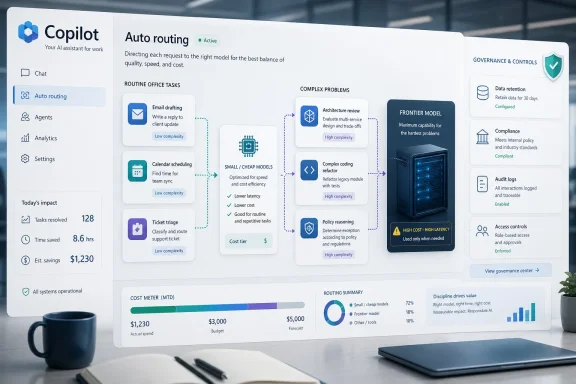
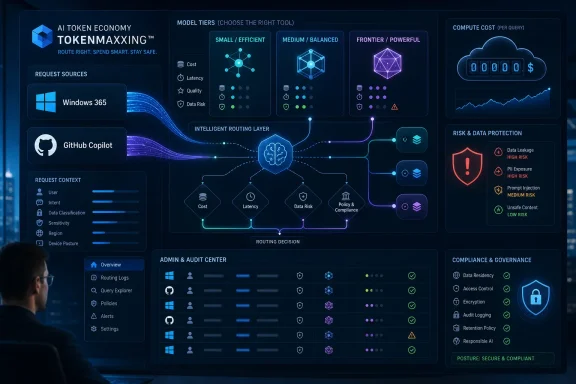
This is why model routing is becoming the hidden battleground of AI products. Microsoft’s Copilot Chat documentation already describes an Auto mode that uses a real-time router to adjust the underlying model based on a prompt, with faster models for routine questions and deeper reasoning models for more complex requests. GitHub Copilot’s documentation similarly frames Auto model selection around choosing a model that can solve a task efficiently.
That sounds like plumbing, but it is actually product strategy. If Microsoft can make model choice invisible and economically rational, it can preserve the magic of Copilot while reducing the waste of manual over-selection. The user gets an answer; Microsoft gets a shot at sustainable margins.
When Nadella points to Copilot’s Auto mode, he is not merely praising a feature. He is describing how Microsoft wants to govern AI demand at planetary scale. The user should not need to know whether a task belongs on a frontier model, a smaller fast model, a tuned enterprise model, or a specialized agent. The system should decide.
That promise has obvious appeal. Most workers do not want to become model procurement specialists. Most IT departments do not want every employee picking models based on vibes, Reddit lore, or a leaderboard inside the company Slack. Model choice needs to become a policy-governed layer, not a personality test.
But Auto mode also shifts power. If the platform chooses the model, the platform shapes the economics, latency, capabilities, and sometimes the quality ceiling of the work. Users may not know when they have been routed to a cheaper model, when a deeper reasoning model was withheld, or when cost controls quietly changed the experience.
For Microsoft, this is familiar territory. Windows has long mediated hardware complexity for users. Microsoft 365 has long abstracted infrastructure, identity, storage, compliance, and collaboration behind admin settings and licensing tiers. Copilot extends that tradition into cognition itself: the user asks, the system routes, the tenant governs, and the bill arrives somewhere upstream.
The risk is that “right model for the job” becomes a euphemism for “right model for the margin.” That does not make the routing wrong. It means customers will eventually demand observability, auditability, and policy controls around model selection, just as they demanded them around cloud spend, endpoint security, and identity access.
That transition is unavoidable. AI assistants are moving from executive keynote demos into procurement reviews, security assessments, budget committees, and admin consoles. A CIO does not buy a miracle; a CIO buys a controlled service with predictable cost, measurable benefit, and defensible risk.
The language around Microsoft 365 Copilot already reflects this shift. The company talks about security, compliance, privacy boundaries, model selection, tenant controls, and agent governance. GitHub Copilot now has cost indicators, model choices, and guidance about using Auto for most prompts while reserving more capable models for complex tasks. This is not the vocabulary of science fiction. It is the vocabulary of enterprise software growing up.
That maturity will feel deflating to some users. The early AI moment was defined by abundance: unlimited chat, giant context windows, tools that felt underpriced because venture capital and hyperscaler capex were absorbing the difference. The next phase is defined by allocation. Who gets the powerful model? For which tasks? Under which policy? At what price?
Nadella’s comment is therefore less a throwaway joke than a signal from the center of the AI economy. The experiment-everywhere era is not ending, but the blank-check era is. Microsoft wants enthusiasm without waste, adoption without runaway costs, and automation without every workflow becoming a frontier-model bonfire.
As described, the tool monitors discussions that might affect a project, creates a plan when relevant changes appear, makes the update, and keeps the code working without Nadella needing to be present in the meeting or thread. That is not just a chatbot helping with a task. It is an agent watching the organization, interpreting intent, and acting on software.
This is where Microsoft’s AI strategy becomes more consequential for WindowsForum readers than another round of “AI button in the sidebar” jokes. The goal is not merely to draft text faster. The goal is to wire AI into the nervous system of work: meetings, documents, repos, tickets, calendars, permissions, identity, and deployment pipelines.
If that works, it changes the shape of enterprise IT. Administrators will not just manage users and devices; they will manage agents. Developers will not just review pull requests from colleagues; they will review machine-generated plans derived from conversations they may not have attended. Security teams will not just ask whether a user had access; they will ask whether an agent acting on that user’s behalf had the right scope, sandbox, logging, and revocation path.
That is why Nadella’s cost discipline matters. Agentic workflows can burn far more tokens than a simple chat exchange because they reason, retrieve, plan, call tools, evaluate results, and loop. A company that cannot distinguish a frontier-worthy problem from a routine one will struggle even more when the model is not just answering but acting.
A smaller AI-native startup can standardize on a few workflows, move quickly, and accept chaos as the price of speed. Microsoft has roughly 220,000 employees, a vast partner channel, heavily regulated customers, legacy products with decades of compatibility expectations, and enterprise buyers who punish surprises. The company is expected to innovate like a startup while governing like a utility.
Recent leadership moves fit that pressure. Nadella appointed a new CEO for Microsoft’s commercial business in October, reportedly freeing himself to spend more time on technical work. In November, he tapped a new AI advisor to help rethink the company’s business model for the AI era. These are not cosmetic changes. They suggest a CEO trying to get closer to the technical substrate while forcing a sprawling organization to behave more like an AI platform company.
But Microsoft’s scale also makes internal behavior symbolically important. If Microsoft’s own employees are tokenmaxxing, customers can reasonably wonder what efficient AI adoption is supposed to look like in their own tenants. If Microsoft needs model routing, governance, and cultural restraint internally, then so does every Fortune 500 company being sold the Copilot future.
There is nothing hypocritical about that. It is actually useful. Microsoft’s internal messiness is a preview of everyone else’s. The difference is that Microsoft has the incentive to turn its own cost-control problem into a feature, a licensing model, an admin policy, and eventually a best-practice whitepaper.
Nadella laughed and accepted the shirt, but the gag worked because the alternate history remains plausible. For a few chaotic days in November 2023, Microsoft looked ready to absorb much of OpenAI’s talent and build a parallel AI research operation under its own roof. The fact that this did not happen does not make the episode irrelevant. It showed how tightly Microsoft’s AI future had become linked to a partner it did not fully control.
That tension is still present, even as Microsoft diversifies its model strategy. Microsoft 365 Copilot uses models from Azure OpenAI Service and, in some contexts, Anthropic models as well. Copilot Studio and enterprise agent features increasingly emphasize model choice, tuning, governance, and the ability to match capabilities to tasks.
In other words, the joke T-shirt points to the strategic destination Microsoft is still traveling toward: not dependence on one frontier lab, but control over an AI application platform that can route across models, enforce enterprise policy, and monetize the work layer above them. Microsoft does not need every model to be born in Redmond if every model reaches enterprise users through Microsoft’s identity, productivity, developer, and cloud stack.
That is why tokenmaxxing is more than a usage habit. It is a pressure test for the whole platform. If Microsoft can turn model sprawl into governed choice, it strengthens its position. If users experience routing as opacity, throttling, or degraded quality, the platform story gets shakier.
Microsoft has been clear that it wants Windows to become a foundation for AI running from local devices to cloud infrastructure. That vision includes NPUs in PCs, local models, cloud models, and hybrid workflows that decide where work should happen. The same “right model for the job” logic applies to the device: some tasks should run locally, some in the cloud, and some through enterprise services governed by tenant policy.
This has practical implications. If Microsoft can push more routine inference onto capable local hardware, it can reduce cloud costs and improve latency. If it can reserve cloud frontier models for genuinely hard problems, it can make Copilot feel faster and more economical. If it cannot, users may encounter more limits, more confusing model switches, more premium tiers, and more admin-controlled access gates.
The Windows PC may therefore become part of the AI cost-control architecture. That helps explain the industry’s intense focus on AI PCs, NPUs, and local inference. Some of the marketing is overcooked, but the economic logic is real. A local model that handles routine summarization, search, classification, or light drafting can be strategically valuable even if it is not dazzling in a keynote.
For sysadmins, this creates a new category of planning. Hardware refresh cycles, endpoint policy, data governance, and AI capability will increasingly overlap. The old question was whether a PC could run the company’s applications. The new question is whether it can participate efficiently in the company’s AI fabric without leaking data, wasting cloud spend, or frustrating users with inconsistent behavior.
Early cloud adoption often began with speed and ended with FinOps. Developers could provision resources quickly, which was wonderful until idle instances, overprovisioned services, and poorly tagged workloads turned into budget shock. The answer was not to abandon cloud computing. It was to create governance: budgets, alerts, chargebacks, tagging, reserved capacity, policy enforcement, and architectural review.
AI is heading toward a similar reckoning. Tokens are not identical to compute instances, but they behave like a meter that can escape managerial intuition. A thousand employees using AI casually may be affordable. A thousand employees using long-context frontier reasoning agents for routine tasks may not be. A handful of automated workflows can consume more than a whole department of occasional chat users if they loop carelessly.
This is where Microsoft’s enterprise instincts could become an advantage. The company knows how to sell administrators the tools to manage complexity it helped introduce. Expect more dashboards, more usage analytics, more policy knobs, more role-based controls, and more language about aligning AI consumption to business value.
The hard part will be cultural. Workers have been told that using AI is modern, efficient, and expected. Now they will need to learn that using too much AI, or the wrong kind of AI, is wasteful. That is a subtle message, and subtle messages are not Silicon Valley’s strength.
For developers, that means measuring more than generated lines of code. It means defect rates, review burden, onboarding time, incident frequency, maintainability, and whether AI-generated changes actually survive contact with production. For office workers, it means asking whether Copilot reduces time-to-decision or merely produces better-formatted ambiguity.
This is where tokenmaxxing becomes actively harmful. It can create the illusion of transformation while obscuring whether the underlying process improved. A team that generates more summaries, drafts, plans, and synthetic meeting notes may feel more productive even if it has added another layer of review work.
Microsoft’s own product direction implicitly acknowledges this. The push toward agents, Cowork-style delegation, Copilot Tuning, model routing, and integration with Microsoft Graph is an attempt to move AI from isolated text generation into repeatable business workflows. The value proposition improves when AI is grounded in organizational context, constrained by permissions, and evaluated against known tasks.
But that also raises the bar. Once AI is embedded in workflows, mistakes are not just weird answers in a chat window. They are bad updates, wrong plans, misrouted approvals, privacy incidents, and automated busywork at scale. The right model for the job is not only a cost question. It is a reliability question.
That will be a difficult adjustment because the frontier model has become a status object. Users like knowing they are talking to the best available system. Developers like having the most capable coding model in the loop. Executives like telling investors and employees that the company is all-in on AI.
But disciplined AI use will require a less glamorous hierarchy. Routine tasks should go to routine models. Sensitive enterprise workflows should go through governed systems with appropriate audit trails. Complex reasoning should be reserved for situations where it changes the outcome. Local inference should be used when it is good enough and safer or cheaper. Frontier models should be treated like specialists, not office lighting.
That is not anti-AI. It is the only way AI becomes durable enterprise infrastructure rather than an expensive novelty. Nadella’s warning matters because Microsoft is both a vendor and a test case. If the company that put Copilot everywhere now says the biggest model is not always the right model, customers should hear that as permission to be more demanding, not less ambitious.
 Microsoft’s AI Gospel Meets Its Cloud Bill
Nadella’s comments are not a retreat from AI. They are a correction inside the faith.For the past two years, Microsoft has pushed artificial intelligence into nearly every visible surface of its empire: Windows, Office, Teams, GitHub, Azure, Security, Dynamics, and the developer tooling around them. Copilot became less a product than a house style, a branding answer to the question of what Microsoft wants computing to feel like after the browser, the search box, and the command line.
That strategy was always going to collide with a less glamorous constraint. Generative AI is not software in the old marginal-cost sense. Every prompt has weight. Every long context window, every reasoning loop, every agentic workflow, every “just try that again with more detail” request eventually becomes compute, electricity, datacenter capacity, GPU depreciation, and somebody’s bill.
That is what makes Nadella’s “tokenmaxxer” answer unusually revealing. It translates a boardroom concern into internet-native slang. Microsoft does not want to sound like it is scolding workers for using the very tools it spent billions embedding into their workflows. But it also cannot run a serious AI business on the premise that the most advanced model should be the default for every email rewrite, meeting summary, spreadsheet explanation, and half-formed hunch.
The irony is sharp because Microsoft helped create the conditions for the habit it now wants to moderate. If AI is framed as the new measure of modern work, employees will use it performatively as well as practically. If internal culture celebrates prompt volume, agent adoption, and token throughput, then tokenmaxxing is not a bug. It is the incentive system doing exactly what it was trained to do.
Tokenmaxxing Was Always a Management Problem Wearing Developer Slang
The term tokenmaxxing sounds unserious, which is part of its usefulness. It captures the absurdity of turning AI consumption into a proxy for ambition. In its most charitable form, it means pushing models hard enough to discover new workflows. In its worst form, it means confusing meter-spinning with invention.Nadella admitted the temptation. “I’m a tokenmaxxer too, it’s addictive,” he said, before pivoting to the more sober question: what are we trying to create? That second sentence is the important one. It reframes AI usage from volume to outcome, which is exactly where enterprise buyers are trying to drag the conversation.
The first wave of corporate AI adoption rewarded visible enthusiasm. Executives wanted employees to experiment. Teams created internal showcases. Vendors promised that assistants would dissolve drudgery, agents would coordinate work, and frontier models would give every employee access to something like elite cognitive labor on demand.
But enterprises eventually ask less romantic questions. Did the support queue shrink? Did engineering throughput improve after accounting for review time? Did analysts produce better work, or just longer summaries? Did meetings become shorter, or did AI simply generate more artifacts around the same indecision?
Tokenmaxxing became the cultural symptom of that unresolved accounting. A token is not a result. It is a unit of processing. Treating it as a badge of seriousness is like treating CPU usage as a measure of business value. Sometimes the machine is working hard because the workload is important; sometimes it is working hard because the job was badly designed.
Frontier Models Are Becoming the New Luxury Default
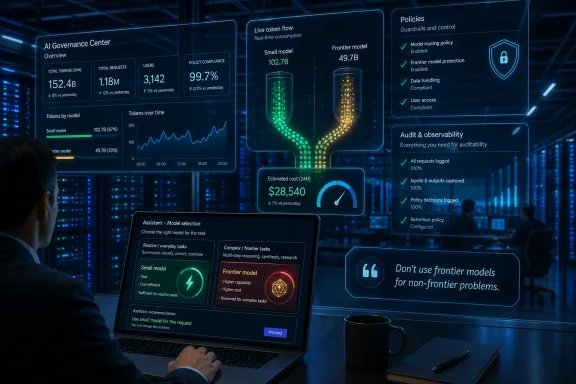
Nadella’s most direct instruction was simple: “Don’t use frontier models for non-frontier problems.” That sentence is going to echo because it exposes the hierarchy Microsoft and its rivals have spent years both marketing and obscuring.Frontier models are the expensive, high-capability systems at the edge of the industry’s current performance curve. They are the models you reach for when the task requires deep reasoning, complex synthesis, code generation across a large project, ambiguous planning, or multi-step work where mistakes are costly. They are also slower, costlier, and more resource-intensive than smaller models that can handle routine tasks perfectly well.
The industry’s public demo culture has trained users to equate “best” with “biggest.” That made sense when the goal was wonder. It makes less sense when the task is extracting three action items from a meeting transcript or drafting a polite reply to a scheduling email. A frontier model can do that work, but so can a cheaper model, a smaller local model, or sometimes a traditional rules-based system.
This is why model routing is becoming the hidden battleground of AI products. Microsoft’s Copilot Chat documentation already describes an Auto mode that uses a real-time router to adjust the underlying model based on a prompt, with faster models for routine questions and deeper reasoning models for more complex requests. GitHub Copilot’s documentation similarly frames Auto model selection around choosing a model that can solve a task efficiently.
That sounds like plumbing, but it is actually product strategy. If Microsoft can make model choice invisible and economically rational, it can preserve the magic of Copilot while reducing the waste of manual over-selection. The user gets an answer; Microsoft gets a shot at sustainable margins.
Auto Mode Is a Business Model Disguised as a Convenience Feature
The most important AI interface may not be the chatbot box. It may be the selector behind it.When Nadella points to Copilot’s Auto mode, he is not merely praising a feature. He is describing how Microsoft wants to govern AI demand at planetary scale. The user should not need to know whether a task belongs on a frontier model, a smaller fast model, a tuned enterprise model, or a specialized agent. The system should decide.
That promise has obvious appeal. Most workers do not want to become model procurement specialists. Most IT departments do not want every employee picking models based on vibes, Reddit lore, or a leaderboard inside the company Slack. Model choice needs to become a policy-governed layer, not a personality test.
But Auto mode also shifts power. If the platform chooses the model, the platform shapes the economics, latency, capabilities, and sometimes the quality ceiling of the work. Users may not know when they have been routed to a cheaper model, when a deeper reasoning model was withheld, or when cost controls quietly changed the experience.
For Microsoft, this is familiar territory. Windows has long mediated hardware complexity for users. Microsoft 365 has long abstracted infrastructure, identity, storage, compliance, and collaboration behind admin settings and licensing tiers. Copilot extends that tradition into cognition itself: the user asks, the system routes, the tenant governs, and the bill arrives somewhere upstream.
The risk is that “right model for the job” becomes a euphemism for “right model for the margin.” That does not make the routing wrong. It means customers will eventually demand observability, auditability, and policy controls around model selection, just as they demanded them around cloud spend, endpoint security, and identity access.
The Copilot Pitch Is Moving From Magic to Metering
Microsoft’s first Copilot pitch was emotional. It promised relief from email overload, meeting fatigue, blank documents, and brittle workflows. The second pitch is operational: use AI everywhere, but use it efficiently.That transition is unavoidable. AI assistants are moving from executive keynote demos into procurement reviews, security assessments, budget committees, and admin consoles. A CIO does not buy a miracle; a CIO buys a controlled service with predictable cost, measurable benefit, and defensible risk.
The language around Microsoft 365 Copilot already reflects this shift. The company talks about security, compliance, privacy boundaries, model selection, tenant controls, and agent governance. GitHub Copilot now has cost indicators, model choices, and guidance about using Auto for most prompts while reserving more capable models for complex tasks. This is not the vocabulary of science fiction. It is the vocabulary of enterprise software growing up.
That maturity will feel deflating to some users. The early AI moment was defined by abundance: unlimited chat, giant context windows, tools that felt underpriced because venture capital and hyperscaler capex were absorbing the difference. The next phase is defined by allocation. Who gets the powerful model? For which tasks? Under which policy? At what price?
Nadella’s comment is therefore less a throwaway joke than a signal from the center of the AI economy. The experiment-everywhere era is not ending, but the blank-check era is. Microsoft wants enthusiasm without waste, adoption without runaway costs, and automation without every workflow becoming a frontier-model bonfire.
Nadella’s Own Vibe-Coded Tool Shows the Real Ambition
The most revealing part of the podcast appearance may not have been the tokenmaxxing line. It was Nadella’s description of a tool he recently vibe-coded to keep a software project up to date by following related workplace conversations.As described, the tool monitors discussions that might affect a project, creates a plan when relevant changes appear, makes the update, and keeps the code working without Nadella needing to be present in the meeting or thread. That is not just a chatbot helping with a task. It is an agent watching the organization, interpreting intent, and acting on software.
This is where Microsoft’s AI strategy becomes more consequential for WindowsForum readers than another round of “AI button in the sidebar” jokes. The goal is not merely to draft text faster. The goal is to wire AI into the nervous system of work: meetings, documents, repos, tickets, calendars, permissions, identity, and deployment pipelines.
If that works, it changes the shape of enterprise IT. Administrators will not just manage users and devices; they will manage agents. Developers will not just review pull requests from colleagues; they will review machine-generated plans derived from conversations they may not have attended. Security teams will not just ask whether a user had access; they will ask whether an agent acting on that user’s behalf had the right scope, sandbox, logging, and revocation path.
That is why Nadella’s cost discipline matters. Agentic workflows can burn far more tokens than a simple chat exchange because they reason, retrieve, plan, call tools, evaluate results, and loop. A company that cannot distinguish a frontier-worthy problem from a routine one will struggle even more when the model is not just answering but acting.
Microsoft Is Reorganizing Around AI, but Scale Cuts Both Ways
Nadella has been trying to remake Microsoft for the AI era without losing the advantages that made Microsoft Microsoft. That is a harder task than it looks.A smaller AI-native startup can standardize on a few workflows, move quickly, and accept chaos as the price of speed. Microsoft has roughly 220,000 employees, a vast partner channel, heavily regulated customers, legacy products with decades of compatibility expectations, and enterprise buyers who punish surprises. The company is expected to innovate like a startup while governing like a utility.
Recent leadership moves fit that pressure. Nadella appointed a new CEO for Microsoft’s commercial business in October, reportedly freeing himself to spend more time on technical work. In November, he tapped a new AI advisor to help rethink the company’s business model for the AI era. These are not cosmetic changes. They suggest a CEO trying to get closer to the technical substrate while forcing a sprawling organization to behave more like an AI platform company.
But Microsoft’s scale also makes internal behavior symbolically important. If Microsoft’s own employees are tokenmaxxing, customers can reasonably wonder what efficient AI adoption is supposed to look like in their own tenants. If Microsoft needs model routing, governance, and cultural restraint internally, then so does every Fortune 500 company being sold the Copilot future.
There is nothing hypocritical about that. It is actually useful. Microsoft’s internal messiness is a preview of everyone else’s. The difference is that Microsoft has the incentive to turn its own cost-control problem into a feature, a licensing model, an admin policy, and eventually a best-practice whitepaper.
The OpenAI T-Shirt Is a Joke With a Long Shadow
The live event’s lighter moment came when Kevin Roose handed Nadella a T-shirt reading “Microsoft Advanced AI Research.” Roose said he acquired it from an OpenAI employee who had it made in 2023, during the brief period when Sam Altman had been ousted and Microsoft was preparing to create a new AI lab for OpenAI employees. Altman returned days later, and the lab never materialized.Nadella laughed and accepted the shirt, but the gag worked because the alternate history remains plausible. For a few chaotic days in November 2023, Microsoft looked ready to absorb much of OpenAI’s talent and build a parallel AI research operation under its own roof. The fact that this did not happen does not make the episode irrelevant. It showed how tightly Microsoft’s AI future had become linked to a partner it did not fully control.
That tension is still present, even as Microsoft diversifies its model strategy. Microsoft 365 Copilot uses models from Azure OpenAI Service and, in some contexts, Anthropic models as well. Copilot Studio and enterprise agent features increasingly emphasize model choice, tuning, governance, and the ability to match capabilities to tasks.
In other words, the joke T-shirt points to the strategic destination Microsoft is still traveling toward: not dependence on one frontier lab, but control over an AI application platform that can route across models, enforce enterprise policy, and monetize the work layer above them. Microsoft does not need every model to be born in Redmond if every model reaches enterprise users through Microsoft’s identity, productivity, developer, and cloud stack.
That is why tokenmaxxing is more than a usage habit. It is a pressure test for the whole platform. If Microsoft can turn model sprawl into governed choice, it strengthens its position. If users experience routing as opacity, throttling, or degraded quality, the platform story gets shakier.
Windows Users Will Feel the Diet Before They See the Ledger
For Windows enthusiasts, the AI cost debate can feel distant, buried somewhere between Azure capex and Microsoft 365 licensing. It will not stay distant.Microsoft has been clear that it wants Windows to become a foundation for AI running from local devices to cloud infrastructure. That vision includes NPUs in PCs, local models, cloud models, and hybrid workflows that decide where work should happen. The same “right model for the job” logic applies to the device: some tasks should run locally, some in the cloud, and some through enterprise services governed by tenant policy.
This has practical implications. If Microsoft can push more routine inference onto capable local hardware, it can reduce cloud costs and improve latency. If it can reserve cloud frontier models for genuinely hard problems, it can make Copilot feel faster and more economical. If it cannot, users may encounter more limits, more confusing model switches, more premium tiers, and more admin-controlled access gates.
The Windows PC may therefore become part of the AI cost-control architecture. That helps explain the industry’s intense focus on AI PCs, NPUs, and local inference. Some of the marketing is overcooked, but the economic logic is real. A local model that handles routine summarization, search, classification, or light drafting can be strategically valuable even if it is not dazzling in a keynote.
For sysadmins, this creates a new category of planning. Hardware refresh cycles, endpoint policy, data governance, and AI capability will increasingly overlap. The old question was whether a PC could run the company’s applications. The new question is whether it can participate efficiently in the company’s AI fabric without leaking data, wasting cloud spend, or frustrating users with inconsistent behavior.
IT Departments Are About to Become Token Accountants
The uncomfortable truth for administrators is that AI usage will need the same discipline that cloud usage eventually required. The industry has seen this movie before.Early cloud adoption often began with speed and ended with FinOps. Developers could provision resources quickly, which was wonderful until idle instances, overprovisioned services, and poorly tagged workloads turned into budget shock. The answer was not to abandon cloud computing. It was to create governance: budgets, alerts, chargebacks, tagging, reserved capacity, policy enforcement, and architectural review.
AI is heading toward a similar reckoning. Tokens are not identical to compute instances, but they behave like a meter that can escape managerial intuition. A thousand employees using AI casually may be affordable. A thousand employees using long-context frontier reasoning agents for routine tasks may not be. A handful of automated workflows can consume more than a whole department of occasional chat users if they loop carelessly.
This is where Microsoft’s enterprise instincts could become an advantage. The company knows how to sell administrators the tools to manage complexity it helped introduce. Expect more dashboards, more usage analytics, more policy knobs, more role-based controls, and more language about aligning AI consumption to business value.
The hard part will be cultural. Workers have been told that using AI is modern, efficient, and expected. Now they will need to learn that using too much AI, or the wrong kind of AI, is wasteful. That is a subtle message, and subtle messages are not Silicon Valley’s strength.
The Productivity Story Needs Better Evidence
Nadella’s “what am I trying to create?” challenge should also be read as a demand for better evidence. The AI industry has leaned heavily on anecdotes, demos, and benchmark gains. Enterprises need proof at the workflow level.For developers, that means measuring more than generated lines of code. It means defect rates, review burden, onboarding time, incident frequency, maintainability, and whether AI-generated changes actually survive contact with production. For office workers, it means asking whether Copilot reduces time-to-decision or merely produces better-formatted ambiguity.
This is where tokenmaxxing becomes actively harmful. It can create the illusion of transformation while obscuring whether the underlying process improved. A team that generates more summaries, drafts, plans, and synthetic meeting notes may feel more productive even if it has added another layer of review work.
Microsoft’s own product direction implicitly acknowledges this. The push toward agents, Cowork-style delegation, Copilot Tuning, model routing, and integration with Microsoft Graph is an attempt to move AI from isolated text generation into repeatable business workflows. The value proposition improves when AI is grounded in organizational context, constrained by permissions, and evaluated against known tasks.
But that also raises the bar. Once AI is embedded in workflows, mistakes are not just weird answers in a chat window. They are bad updates, wrong plans, misrouted approvals, privacy incidents, and automated busywork at scale. The right model for the job is not only a cost question. It is a reliability question.
The New AI Discipline Starts With Saying No to the Big Model
The immediate lesson from Nadella’s remarks is not that Microsoft employees are abusing AI or that Copilot is about to be rationed. The lesson is that the industry’s AI maturity curve has reached the point where restraint is becoming a competitive advantage.That will be a difficult adjustment because the frontier model has become a status object. Users like knowing they are talking to the best available system. Developers like having the most capable coding model in the loop. Executives like telling investors and employees that the company is all-in on AI.
But disciplined AI use will require a less glamorous hierarchy. Routine tasks should go to routine models. Sensitive enterprise workflows should go through governed systems with appropriate audit trails. Complex reasoning should be reserved for situations where it changes the outcome. Local inference should be used when it is good enough and safer or cheaper. Frontier models should be treated like specialists, not office lighting.
That is not anti-AI. It is the only way AI becomes durable enterprise infrastructure rather than an expensive novelty. Nadella’s warning matters because Microsoft is both a vendor and a test case. If the company that put Copilot everywhere now says the biggest model is not always the right model, customers should hear that as permission to be more demanding, not less ambitious.
The Bill Comes Due in the Admin Center
The most concrete implications of Nadella’s tokenmaxxing moment are not philosophical. They are going to show up in product defaults, licensing language, governance controls, and the daily habits of workers who have been told to automate more thoughtfully.- Microsoft is trying to normalize model routing as the default way to control AI cost and performance without asking every user to become an expert in model selection.
- Frontier models are being repositioned as tools for genuinely complex work rather than the universal default for every prompt.
- Enterprise IT should expect AI usage management to resemble cloud cost management, with policies, dashboards, budgets, and internal accountability.
- Windows PCs with capable local AI hardware will matter more if Microsoft can offload routine inference from expensive cloud systems.
- Agentic workflows will make cost, identity, permissions, and auditability more important because AI will increasingly act across meetings, documents, code, and business systems.
- The real measure of Copilot adoption will not be token volume but whether work becomes faster, safer, cheaper, and easier to verify.
References
- Primary source: Business Insider
Published: 2026-06-11T04:19:09.651174
Satya Nadella Has a Message for Microsoft's Tokenmaxxers - Business Insider
Microsoft's CEO said workers should use the right AI model for the job as companies look for ways to control rising AI costs.www.businessinsider.com - Related coverage: windowscentral.com
Satya Nadella says AI agents deserve real "identities" — after another Microsoft CEO said the tech would take white-collar jobs | Windows Central
Despite AI's big threat to job security, Microsoft's CEO says AI agents should be treated more like human employees.www.windowscentral.com - Official source: podcasts.apple.com
Satya Nadella on making human …–Possible – Apple Podcasts
Reid sits down with Microsoft CEO Satya Nadella fresh off Microsoft Build 2026. The conversation goes wide: how AI is reshaping work, business, and society—and podcasts.apple.com
- Official source: commandline.microsoft.com
No Priors x Latent Space crossover special featuring Satya Nadella
Long-time listener, first-time caller. Dive into a detailed conversation that breaks down the news from Build and what it means for the developer ecosystem.commandline.microsoft.com - Related coverage: joshbersin.com
Addressing High Cost of AI, Frontier Fine Tuning, Edge Computing, Microsoft and NVIDIA – JOSH BERSIN
The high cost of AI leads to massive growth in PC edge computing, coupled with Frontier Fine Tuning from Microsoft. MSFT, NVIDIA take stage.joshbersin.com - Related coverage: latent.space
⚡️Satya Nadella: No Priors x Latent Space Crossover Special at Microsoft Build
The legendary Microsoft CEO makes his first Latent Space appearance!www.latent.space
- Related coverage: tomshardware.com
Microsoft CEO says AI needs to have a wider impact or else it risks quickly losing ‘social permission’ — also says that the technology should benefit more people to avoid a bubble | Tom's Hardware
Satya Nadella talked about how AI should benefit people and how it can avoid a bubble.www.tomshardware.com - Related coverage: techradar.com
Microsoft CEO urges AI developers 'to get to a point where we are using this to do something useful,' or 'lose even the social permission...to generate these tokens' | TechRadar
Nadella tells Davos that AI’s legitimacy hinges on making people's lives betterwww.techradar.com - Related coverage: tech.yahoo.com
Satya Nadella says AI agents should be treated like employees with identities, permissions, and audits
Microsoft CEO Satya Nadella says companies should manage AI agents like employees, giving them identities and permissions.tech.yahoo.com - Related coverage: itpro.com
Microsoft CEO Satya Nadella wants an end to the term ‘AI slop’ and says 2026 will be a ‘pivotal year’ for the technology – but enterprises still need to iron out key lingering issues | IT Pro
The Microsoft chief believes “AI slop” arguments need to be put on the back burnerwww.itpro.com - Related coverage: superdatascience.com
SDS 992: Tokenmaxxing vs AI Hardware Bottlenecks - Podcasts - SuperDataScience | Machine Learning | AI | Data Science Career | Analytics | Success
While “tokenmaxxing”, the social media trend of maximizing AI token consumption as a vanity metric, takes off online, the physical infrastructure behind AI is slamming into serious bottlenecks. In this Five-Minute Friday, Jon Krohn maps out the four overlapping supply-chain constraints choking...www.superdatascience.com - Official source: learn.microsoft.com
Select a primary AI model for your agent - Microsoft Copilot Studio | Microsoft Learn
Choose an AI model for your Microsoft Copilot Studio agent. You can select default models and try out experimental models.learn.microsoft.com - Official source: microsoft.com
Get Started with Frontier for IT Admins | Microsoft Frontier
Learn how to enable Frontier experimental AI features in Microsoft 365. Manage tenant level access, assign licenses, and view admin documentation.www.microsoft.com
- Related coverage: podscripts.co
TBPN Live - Meta Tokenmaxxing, Intel Joins Terafab, Frontier AI vs. China | Diet TBPN Transcript and Discussion
Meta Tokenmaxxing, Intel Joins Terafab, Frontier AI vs. China | Diet TBPN - TBPN Live Transcript and Discussionpodscripts.co - Related coverage: crn.com
Microsoft Q2 Earnings: CEO Nadella Defends AI Investments
Microsoft CEO Satya Nadella talks Copilot, Azure, AI, agents, OpenAI and more on the company’s Q2 earnings call.www.crn.com - Official source: adoption.microsoft.com