

Microsoft announced Cloud-Initiated Driver Recovery for Windows Update on May 13, 2026, giving its driver shiproom a cloud-controlled way to roll back faulty drivers on affected PCs without waiting for users or hardware vendors to manually intervene. The feature is narrow, technical, and easy to underestimate. But it is also a revealing admission: Windows Update’s driver pipeline has become important enough, and risky enough, that Microsoft now needs a recovery mechanism built into the same machinery that caused the problem.
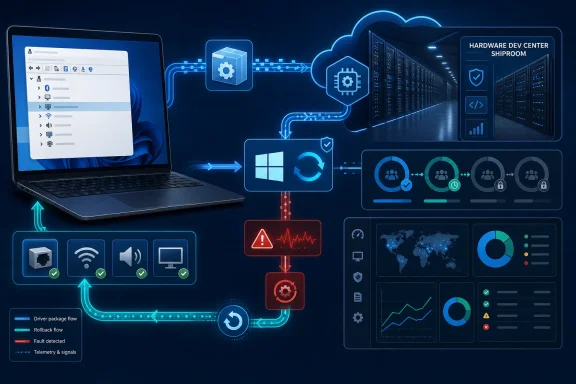
The pitch is simple: when a driver distributed through Windows Update is identified as bad, Microsoft can trigger a recovery action from the Hardware Dev Center driver shiproom and use Windows Update to replace it with a previously known-good version or the next best approved driver available. The affected machine does not need a new client agent. The OEM does not need to rush out a replacement package before remediation begins. The user, in the best case, does not need to learn which unsigned-looking device entry in Device Manager corresponds to the Wi-Fi card that just ruined their afternoon.
That sounds like a modest operational improvement, but for Windows it marks a meaningful shift in authority. Historically, the driver lifecycle has been a three-way negotiation among Microsoft, hardware vendors, and the person or organization stuck with the machine. Microsoft provided the channel, vendors provided the payloads, and users absorbed the consequences when the channel delivered something that did not behave like the test lab said it would.
Cloud-Initiated Driver Recovery, or CIDR, changes that balance. Microsoft is not merely pausing a rollout, hiding an update, or waiting for a partner to upload a corrected package. It is building a controlled reversal path directly into the Windows Update driver distribution process.
The company is validating the system from May through August 2026, with automatic support in the Hardware Dev Center publishing process planned from September 2026 onward. That timeline matters because it frames CIDR not as a speculative Windows Insider experiment, but as a backend change to the driver publication machinery that hardware partners already use.
For years, the practical answer was manual recovery. Roll back the driver in Device Manager. Boot into Safe Mode. Use System Restore. Download the “real” package from the OEM. Block driver updates through policy. Hope Windows Update does not re-offer the same driver after the next scan.
That model made sense when updates were less frequent, hardware stacks were simpler, and most people expected driver management to be a chore. It makes less sense in a Windows 11 world where Microsoft wants update delivery to be continuous, cloud-scored, staged, and largely invisible. If the operating system is going to behave like a managed service, then recovery has to behave like one too.
CIDR is Microsoft accepting that the old split between “we delivered it” and “the vendor must fix it” is not good enough for the scale of modern Windows. The user does not care which dashboard accepted the submission. The admin does not care whether the bad package came from Redmond or from a hardware partner’s certification workflow. They care that the machine stopped working after Windows Update touched it.
But process is the point. Trust in Windows Update has never been only about whether most updates work. It is about what happens when one does not.
For consumers, a driver failure is often experienced as betrayal. A PC that was stable yesterday suddenly loses Bluetooth, Wi-Fi, display brightness, audio output, sleep reliability, or access to some external device. The update came through an official Microsoft channel, so the distinction between Microsoft and the hardware vendor collapses in the user’s mind.
For IT departments, the problem is more quantifiable but no less painful. A bad driver can create a support spike, disrupt carefully staged deployments, or require emergency policy changes. In managed environments, the real cost is not merely fixing one machine. It is identifying the blast radius, proving causality, communicating risk, and preventing recurrence.
CIDR is designed to shrink that period of uncertainty. If Microsoft can detect or confirm that a driver is unhealthy, reject or flag the problematic submission, and initiate recovery through the same update infrastructure, the mean time to remediation can fall dramatically. That does not make the original mistake harmless, but it changes the shape of the incident.
Still, the broader lesson is impossible to miss. Kernel-adjacent code has become a systemic risk surface. When software running at that level fails widely, the recovery problem is not just technical; it is logistical. Who can reach the device? Can it boot? Can it get a network connection? Can the bad component be removed automatically? Can enterprises recover thousands of endpoints without sending people desk to desk?
CIDR lives in that same category of thinking. It assumes that some failures must be remediated centrally because manual endpoint-by-endpoint recovery is too slow. It assumes that Windows needs more than prevention; it needs rollback paths that can operate at scale.
That is a healthier posture than pretending testing can catch everything. Driver compatibility is a combinatorial nightmare. The same package can behave differently across firmware revisions, peripheral combinations, security settings, regional SKUs, and enterprise configurations. A staged rollout helps, but it does not eliminate late-emerging failures.
That matters because many enthusiasts and admins deliberately avoid Microsoft-delivered drivers for certain hardware classes. GPU drivers often come directly from Nvidia, AMD, or Intel. Audio packages may come from OEM support pages. Docking station firmware and peripheral utilities frequently live in vendor ecosystems that orbit Windows Update rather than fully inhabiting it.
CIDR also depends on there being an approved driver to fall back to. Microsoft’s described behavior is not “remove anything suspicious and improvise.” If the system cannot identify a shiproom-approved replacement for the affected device, cloud-initiated recovery is not attempted. That restraint is good engineering, but it also means some failures will remain outside the safety net.
The feature is therefore best understood as a controlled rollback path for Microsoft’s own driver distribution channel. That is valuable, but it does not abolish the need for vendor testing, enterprise rings, device inventory, and traditional recovery planning.
What changes is the waiting period between “this driver is bad” and “affected users can be moved away from it.” In the old model, Microsoft and users often depended on the partner to produce and submit the next fix. In the new model, Microsoft can use an already-approved alternative when one exists.
That distinction is crucial. CIDR does not let OEMs treat the Windows Update channel like a fire-and-forget conveyor belt. If anything, it creates a more visible quality loop. A vendor whose driver triggers recovery has created an incident inside Microsoft’s publishing process, not just a vague support complaint scattered across forums.
For large OEMs, this may become part of the normal telemetry-and-remediation dance. For smaller hardware vendors, it may raise the operational bar. If the driver ecosystem is going to be managed more like cloud software, partners will need to behave more like cloud software suppliers: measurable, responsive, and accountable after release.
The practical questions come quickly. Which devices received the recovery action? Which driver version was removed? Which replacement was installed? Was the replacement the previously installed version or another approved package from Windows Update? Did the rollback affect devices in a paused update ring? How does it interact with Windows Autopatch, Intune driver policies, and organizations that exclude drivers from quality updates?
Microsoft’s announcement, as reported, focuses on the recovery mechanism rather than the administrative reporting story. That is understandable for a first-stage feature aimed at the Hardware Dev Center pipeline, but it leaves a gap. IT teams will not judge CIDR only by whether it works on a lab machine. They will judge it by whether the change is visible in their management plane before the help desk starts correlating symptoms by hand.
The best version of CIDR would produce clean telemetry for admins: driver identity, device population, trigger reason, recovery status, and failure cases. The weakest version would act as an opaque cloud correction that fixes many machines but leaves administrators guessing about what changed.
On the other hand, many power users have been burned by Windows replacing a working driver with a “newer” one that is worse for their specific hardware. The pain is especially sharp when a manually chosen driver is overwritten, when a device-specific OEM package is replaced by a generic version, or when a driver update reappears after a user thought they had removed it.
CIDR will not end that tension. In fact, some users will see it as another example of Windows treating the cloud as the final authority over local hardware state. The same mechanism that can rescue a broken device can also feel like one more piece of control moving away from the person sitting at the keyboard.
That concern should not be dismissed as paranoia. Windows has a long history of burying user intent under servicing logic. If Microsoft wants CIDR to be trusted by enthusiasts, it needs to be clear about scope, triggers, and override behavior. A cloud rollback that only touches drivers distributed through Windows Update is easier to defend than a vague promise that Microsoft will “fix” drivers remotely.
Security hardening often looks like breakage to the affected user. If Windows blocks a vulnerable driver, Microsoft may be correct from a platform-security standpoint while still causing a backup workflow to fail. The answer may be for the backup vendor to update its components, but the person staring at a failed job sees a Windows update that changed the rules overnight.
CIDR will help with one category of failure: problematic drivers delivered by Windows Update where a known-good replacement exists. It will not solve the messier category where Microsoft intentionally changes driver trust, kernel policy, or blocklist behavior for security reasons and downstream software has to adapt.
That distinction matters because the Windows driver ecosystem is now squeezed from both sides. Microsoft wants fewer unstable drivers because they hurt reliability. Microsoft also wants fewer vulnerable drivers because they are useful to attackers. Both goals are defensible. Both can break things.
Rollback reduces damage; it does not erase it. A bad storage or network driver can still disrupt work, corrupt confidence, and generate support tickets before recovery lands. Some devices may be offline. Some may fail in ways that prevent clean remediation. Some may not have a valid approved fallback. Some may sit in environments where update policy, metered connectivity, or management tooling complicates the path back.
The better interpretation is that CIDR adds a second line of defense after staged rollout, telemetry, certification, and vendor validation. It should make Microsoft more willing to halt and reverse a bad driver decisively, not less careful about accepting one.
This is the same lesson cloud services learned years ago. Feature flags, rings, and rollback systems are essential because failures happen, but mature engineering cultures do not use them as an excuse to ship carelessly. They use them to reduce blast radius while improving the gates that failed.
CIDR fits neatly into that trajectory. The driver shiproom identifies a problem; Windows Update carries the instruction; the local Plug and Play stack cooperates in replacing the driver; the machine returns to a healthier state. That is not merely updating. That is fleet management at consumer scale.
For managed organizations, this convergence is both powerful and unsettling. The same infrastructure that reduces toil also centralizes decision-making. The line between Microsoft’s responsibility and the customer’s change-control process becomes harder to draw when remediation is initiated from the cloud but executed on endpoints the customer owns.
The challenge for Microsoft is to make the control plane legible. Admins can tolerate automation when they can audit it. Enthusiasts can tolerate automation when they can understand and, where appropriate, constrain it. Consumers can tolerate automation when it quietly works. CIDR has to serve all three constituencies without pretending they want the same thing.
That kind of invisibility is the highest compliment a recovery system can earn. Nobody buys a PC because the driver rollback pipeline is elegant. They notice only when it fails.
For Microsoft, the win would be a reduction in long-tail driver incidents that currently linger because they depend on manual user action or partner resubmission. For OEMs, the win would be fewer customers trapped on broken packages while a fixed driver crawls through the pipeline. For admins, the win would be faster containment, provided Microsoft exposes enough data to make the event manageable.
The risk is a half-visible system: automatic enough to change machines, but not transparent enough to explain them. That would turn CIDR from a reliability feature into another source of Windows Update folklore.
The most concrete read is this:
Source: Tom's Hardware Microsoft launches Cloud‑Initiated Driver Recovery for remote rollback of faulty updates — no user action or OEM intervention will be needed to handle broken drivers delivered via Windows Update
Source: Petri IT Knowledgebase Windows Update Gets Cloud‑Based Driver Recovery to Fix Faulty Updates
 Microsoft Moves the Rollback Button Into the Cloud
The pitch is simple: when a driver distributed through Windows Update is identified as bad, Microsoft can trigger a recovery action from the Hardware Dev Center driver shiproom and use Windows Update to replace it with a previously known-good version or the next best approved driver available. The affected machine does not need a new client agent. The OEM does not need to rush out a replacement package before remediation begins. The user, in the best case, does not need to learn which unsigned-looking device entry in Device Manager corresponds to the Wi-Fi card that just ruined their afternoon.That sounds like a modest operational improvement, but for Windows it marks a meaningful shift in authority. Historically, the driver lifecycle has been a three-way negotiation among Microsoft, hardware vendors, and the person or organization stuck with the machine. Microsoft provided the channel, vendors provided the payloads, and users absorbed the consequences when the channel delivered something that did not behave like the test lab said it would.
Cloud-Initiated Driver Recovery, or CIDR, changes that balance. Microsoft is not merely pausing a rollout, hiding an update, or waiting for a partner to upload a corrected package. It is building a controlled reversal path directly into the Windows Update driver distribution process.
The company is validating the system from May through August 2026, with automatic support in the Hardware Dev Center publishing process planned from September 2026 onward. That timeline matters because it frames CIDR not as a speculative Windows Insider experiment, but as a backend change to the driver publication machinery that hardware partners already use.
The Old Driver Model Was Built for a Slower Windows
Windows drivers have always been a peculiar kind of software. They are small enough to be invisible to most users, privileged enough to crash the machine, and vendor-specific enough that responsibility becomes slippery the moment something breaks. A graphics driver can bring down a game, a storage driver can break backup workflows, and a network driver can turn a perfectly healthy laptop into a device that appears haunted by intermittent latency.For years, the practical answer was manual recovery. Roll back the driver in Device Manager. Boot into Safe Mode. Use System Restore. Download the “real” package from the OEM. Block driver updates through policy. Hope Windows Update does not re-offer the same driver after the next scan.
That model made sense when updates were less frequent, hardware stacks were simpler, and most people expected driver management to be a chore. It makes less sense in a Windows 11 world where Microsoft wants update delivery to be continuous, cloud-scored, staged, and largely invisible. If the operating system is going to behave like a managed service, then recovery has to behave like one too.
CIDR is Microsoft accepting that the old split between “we delivered it” and “the vendor must fix it” is not good enough for the scale of modern Windows. The user does not care which dashboard accepted the submission. The admin does not care whether the bad package came from Redmond or from a hardware partner’s certification workflow. They care that the machine stopped working after Windows Update touched it.
A Rollback System Is Also a Trust System
Microsoft’s language around CIDR is deliberately operational. The company talks about shiproom evaluation, publishing services, approved drivers, and the Windows Update pipeline. That is the vocabulary of process, not apology.But process is the point. Trust in Windows Update has never been only about whether most updates work. It is about what happens when one does not.
For consumers, a driver failure is often experienced as betrayal. A PC that was stable yesterday suddenly loses Bluetooth, Wi-Fi, display brightness, audio output, sleep reliability, or access to some external device. The update came through an official Microsoft channel, so the distinction between Microsoft and the hardware vendor collapses in the user’s mind.
For IT departments, the problem is more quantifiable but no less painful. A bad driver can create a support spike, disrupt carefully staged deployments, or require emergency policy changes. In managed environments, the real cost is not merely fixing one machine. It is identifying the blast radius, proving causality, communicating risk, and preventing recurrence.
CIDR is designed to shrink that period of uncertainty. If Microsoft can detect or confirm that a driver is unhealthy, reject or flag the problematic submission, and initiate recovery through the same update infrastructure, the mean time to remediation can fall dramatically. That does not make the original mistake harmless, but it changes the shape of the incident.
The CrowdStrike Shadow Still Hangs Over Windows Reliability
Microsoft’s CIDR announcement is not the same kind of event as the global CrowdStrike outage of July 2024, and it should not be lazily treated as a direct response to it. CrowdStrike’s failure involved a security vendor’s content update, not an ordinary Windows Update driver package. The mechanics were different, the accountability chain was different, and the impact was extraordinary.Still, the broader lesson is impossible to miss. Kernel-adjacent code has become a systemic risk surface. When software running at that level fails widely, the recovery problem is not just technical; it is logistical. Who can reach the device? Can it boot? Can it get a network connection? Can the bad component be removed automatically? Can enterprises recover thousands of endpoints without sending people desk to desk?
CIDR lives in that same category of thinking. It assumes that some failures must be remediated centrally because manual endpoint-by-endpoint recovery is too slow. It assumes that Windows needs more than prevention; it needs rollback paths that can operate at scale.
That is a healthier posture than pretending testing can catch everything. Driver compatibility is a combinatorial nightmare. The same package can behave differently across firmware revisions, peripheral combinations, security settings, regional SKUs, and enterprise configurations. A staged rollout helps, but it does not eliminate late-emerging failures.
The Feature Is Narrower Than the Headline Suggests
The most important limitation is that CIDR applies to drivers delivered through Windows Update. It is not a universal driver undo button for every installer a user downloads, every GPU package installed from a vendor app, or every enterprise-deployed driver pushed through separate management tooling. If the broken component did not come through the relevant Windows Update driver pipeline, CIDR is not magic.That matters because many enthusiasts and admins deliberately avoid Microsoft-delivered drivers for certain hardware classes. GPU drivers often come directly from Nvidia, AMD, or Intel. Audio packages may come from OEM support pages. Docking station firmware and peripheral utilities frequently live in vendor ecosystems that orbit Windows Update rather than fully inhabiting it.
CIDR also depends on there being an approved driver to fall back to. Microsoft’s described behavior is not “remove anything suspicious and improvise.” If the system cannot identify a shiproom-approved replacement for the affected device, cloud-initiated recovery is not attempted. That restraint is good engineering, but it also means some failures will remain outside the safety net.
The feature is therefore best understood as a controlled rollback path for Microsoft’s own driver distribution channel. That is valuable, but it does not abolish the need for vendor testing, enterprise rings, device inventory, and traditional recovery planning.
The OEM Gets Less Excuse, Not Less Responsibility
One tempting reading of CIDR is that Microsoft is taking over driver quality from hardware partners. That is too generous to vendors and too grandiose for Microsoft. Hardware partners still write, package, validate, and submit the drivers. They still need to monitor quality metrics in the Hardware Dev Center dashboard. They still need to respond when Microsoft’s shiproom rejects a submission or flags a problem.What changes is the waiting period between “this driver is bad” and “affected users can be moved away from it.” In the old model, Microsoft and users often depended on the partner to produce and submit the next fix. In the new model, Microsoft can use an already-approved alternative when one exists.
That distinction is crucial. CIDR does not let OEMs treat the Windows Update channel like a fire-and-forget conveyor belt. If anything, it creates a more visible quality loop. A vendor whose driver triggers recovery has created an incident inside Microsoft’s publishing process, not just a vague support complaint scattered across forums.
For large OEMs, this may become part of the normal telemetry-and-remediation dance. For smaller hardware vendors, it may raise the operational bar. If the driver ecosystem is going to be managed more like cloud software, partners will need to behave more like cloud software suppliers: measurable, responsive, and accountable after release.
Admins Will Want Visibility Before They Want Automation
For enterprise IT, automatic remediation is welcome only when it is observable. A rollback that silently fixes a consumer laptop is a win. A rollback that silently changes a fleet’s driver state without sufficient reporting is a governance headache.The practical questions come quickly. Which devices received the recovery action? Which driver version was removed? Which replacement was installed? Was the replacement the previously installed version or another approved package from Windows Update? Did the rollback affect devices in a paused update ring? How does it interact with Windows Autopatch, Intune driver policies, and organizations that exclude drivers from quality updates?
Microsoft’s announcement, as reported, focuses on the recovery mechanism rather than the administrative reporting story. That is understandable for a first-stage feature aimed at the Hardware Dev Center pipeline, but it leaves a gap. IT teams will not judge CIDR only by whether it works on a lab machine. They will judge it by whether the change is visible in their management plane before the help desk starts correlating symptoms by hand.
The best version of CIDR would produce clean telemetry for admins: driver identity, device population, trigger reason, recovery status, and failure cases. The weakest version would act as an opaque cloud correction that fixes many machines but leaves administrators guessing about what changed.
Enthusiasts Will See Both Rescue and Overreach
Windows enthusiasts have a complicated relationship with driver updates through Windows Update. On one hand, automatic driver delivery is a genuine public good. It gets basic functionality working after a clean install, keeps commodity hardware alive, and spares nontechnical users from searching dubious download pages for chipset packages.On the other hand, many power users have been burned by Windows replacing a working driver with a “newer” one that is worse for their specific hardware. The pain is especially sharp when a manually chosen driver is overwritten, when a device-specific OEM package is replaced by a generic version, or when a driver update reappears after a user thought they had removed it.
CIDR will not end that tension. In fact, some users will see it as another example of Windows treating the cloud as the final authority over local hardware state. The same mechanism that can rescue a broken device can also feel like one more piece of control moving away from the person sitting at the keyboard.
That concern should not be dismissed as paranoia. Windows has a long history of burying user intent under servicing logic. If Microsoft wants CIDR to be trusted by enthusiasts, it needs to be clear about scope, triggers, and override behavior. A cloud rollback that only touches drivers distributed through Windows Update is easier to defend than a vague promise that Microsoft will “fix” drivers remotely.
The Timing Is Awkward Because Windows Update Has Been Busy Breaking Things
CIDR arrives in a period when Windows update reliability remains a live issue, not an abstract historical complaint. Recent reporting around April 2026 updates highlighted backup failures tied to driver blocklist changes, with some third-party backup products affected because Windows began blocking a vulnerable kernel driver. That case is not the same as a bad driver update being rolled back through CIDR, but it illustrates the broader problem: driver policy, kernel hardening, and update delivery can have real operational side effects.Security hardening often looks like breakage to the affected user. If Windows blocks a vulnerable driver, Microsoft may be correct from a platform-security standpoint while still causing a backup workflow to fail. The answer may be for the backup vendor to update its components, but the person staring at a failed job sees a Windows update that changed the rules overnight.
CIDR will help with one category of failure: problematic drivers delivered by Windows Update where a known-good replacement exists. It will not solve the messier category where Microsoft intentionally changes driver trust, kernel policy, or blocklist behavior for security reasons and downstream software has to adapt.
That distinction matters because the Windows driver ecosystem is now squeezed from both sides. Microsoft wants fewer unstable drivers because they hurt reliability. Microsoft also wants fewer vulnerable drivers because they are useful to attackers. Both goals are defensible. Both can break things.
Rollback Is Not a Substitute for Better Gates
The danger with any recovery feature is that it becomes a psychological permission slip for riskier deployment. If Microsoft can roll back bad drivers quickly, why worry so much about letting them through? That would be the wrong lesson.Rollback reduces damage; it does not erase it. A bad storage or network driver can still disrupt work, corrupt confidence, and generate support tickets before recovery lands. Some devices may be offline. Some may fail in ways that prevent clean remediation. Some may not have a valid approved fallback. Some may sit in environments where update policy, metered connectivity, or management tooling complicates the path back.
The better interpretation is that CIDR adds a second line of defense after staged rollout, telemetry, certification, and vendor validation. It should make Microsoft more willing to halt and reverse a bad driver decisively, not less careful about accepting one.
This is the same lesson cloud services learned years ago. Feature flags, rings, and rollback systems are essential because failures happen, but mature engineering cultures do not use them as an excuse to ship carelessly. They use them to reduce blast radius while improving the gates that failed.
Windows Update Is Becoming a Control Plane
The deeper story is that Windows Update is no longer just a patch delivery service. It is becoming a control plane for operating-system health. It installs cumulative updates, delivers drivers, enforces compatibility holds, distributes security intelligence, participates in recovery scenarios, and increasingly mediates between local state and cloud-side decisions.CIDR fits neatly into that trajectory. The driver shiproom identifies a problem; Windows Update carries the instruction; the local Plug and Play stack cooperates in replacing the driver; the machine returns to a healthier state. That is not merely updating. That is fleet management at consumer scale.
For managed organizations, this convergence is both powerful and unsettling. The same infrastructure that reduces toil also centralizes decision-making. The line between Microsoft’s responsibility and the customer’s change-control process becomes harder to draw when remediation is initiated from the cloud but executed on endpoints the customer owns.
The challenge for Microsoft is to make the control plane legible. Admins can tolerate automation when they can audit it. Enthusiasts can tolerate automation when they can understand and, where appropriate, constrain it. Consumers can tolerate automation when it quietly works. CIDR has to serve all three constituencies without pretending they want the same thing.
The Best Case Is Boring, Which Is Exactly the Point
If CIDR succeeds, most users will never know it exists. A bad driver will be flagged. A recovery action will be triggered. Windows Update will replace the driver with an approved fallback. The device will keep working. The support thread that might have stretched for weeks will never gather momentum.That kind of invisibility is the highest compliment a recovery system can earn. Nobody buys a PC because the driver rollback pipeline is elegant. They notice only when it fails.
For Microsoft, the win would be a reduction in long-tail driver incidents that currently linger because they depend on manual user action or partner resubmission. For OEMs, the win would be fewer customers trapped on broken packages while a fixed driver crawls through the pipeline. For admins, the win would be faster containment, provided Microsoft exposes enough data to make the event manageable.
The risk is a half-visible system: automatic enough to change machines, but not transparent enough to explain them. That would turn CIDR from a reliability feature into another source of Windows Update folklore.
The Driver Rollback Era Will Be Judged by the Incidents It Prevents
Microsoft’s announcement gives us enough to see the architecture, but not enough to declare victory. The feature is entering validation now, with broader automatic support planned later in 2026. Its real reputation will be built during the first ugly driver incident where it either shortens the pain or fails to reach the devices that need it.The most concrete read is this:
- Microsoft is adding a cloud-triggered rollback path for problematic drivers distributed through Windows Update.
- The recovery action is initiated from the Hardware Dev Center driver shiproom and delivered through existing Windows Update infrastructure.
- The replacement driver must be a previously installed or otherwise approved package available through the Windows Update pipeline.
- The feature is being manually validated from May through August 2026, with automatic support planned from September 2026.
- The feature does not eliminate the need for OEM driver quality, enterprise deployment rings, or administrator visibility.
- The biggest unanswered question is how clearly Microsoft will expose recovery events to IT teams and advanced users.
Source: Tom's Hardware Microsoft launches Cloud‑Initiated Driver Recovery for remote rollback of faulty updates — no user action or OEM intervention will be needed to handle broken drivers delivered via Windows Update
Source: Petri IT Knowledgebase Windows Update Gets Cloud‑Based Driver Recovery to Fix Faulty Updates
