

Microsoft announced Cloud-Initiated Driver Recovery on May 12, 2026, a Windows Update recovery mechanism that lets Microsoft roll back problematic drivers from the cloud to a known-good version, with validation running through August and automatic support planned for September 2026. The pitch is simple: when Windows Update delivers a bad driver, the fix should not depend on every user becoming a part-time device administrator. The more important shift is institutional. Microsoft is turning driver recovery from an OEM support chore into a platform-level responsibility.
Bad Windows drivers have always occupied a special category of PC misery. A flawed app can crash, a bad cumulative update can usually be uninstalled, but a driver can destabilize the operating system in ways that look random, intermittent, and expensive to diagnose. A Wi-Fi card starts dropping packets, a GPU begins flickering after sleep, a storage controller throws timeouts, or a laptop refuses to resume cleanly, and the user’s first suspect is rarely the precise driver package that arrived silently through Windows Update.
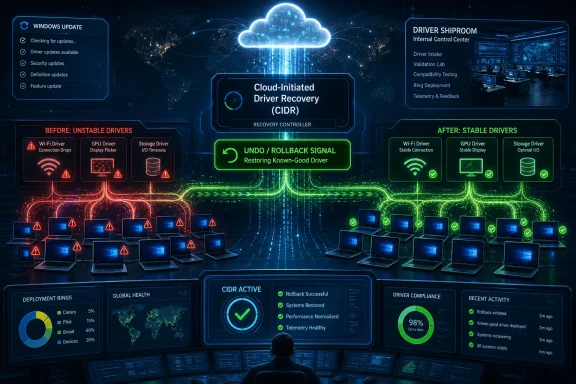
Cloud-Initiated Driver Recovery, or CIDR, is Microsoft’s attempt to make that class of failure less sticky. When a driver distributed through Windows Update is identified as problematic during Microsoft’s Driver Shiproom evaluation process, Microsoft can initiate a recovery action from the cloud. The affected devices are then offered a previous or otherwise approved driver through the existing Windows Update infrastructure.
That last phrase matters. Microsoft is not describing a new rescue agent, an OEM utility, or a customer support workflow. It is using the same machinery that delivered the driver to deliver the retreat. In modern Windows terms, this is not a rollback button for the user; it is a rollback decision embedded in the update service.
The practical consequence is that a bad driver can be treated more like a failed cloud deployment. Stop the rollout, identify the affected target, restore the known-good package, and keep the user out of the blast radius as much as possible. That sounds obvious only because the rest of the software world has spent years normalizing staged rollouts and server-side kill switches. Windows drivers have been slower to fit that model because PCs are not uniform cloud instances. They are messy, aging, vendor-specific machines full of hardware IDs, firmware quirks, and policy constraints.
That model makes sense only if failures are small, obvious, and slow-moving. Windows Update is none of those things. A driver can reach a large number of devices before enough signal accumulates to prove that something is wrong. Once it does, every hour matters, especially for businesses where affected machines may belong to sales staff, clinicians, factory operators, students, or remote workers with no local IT help.
The pain is not just the crash. It is the ambiguity. Driver regressions frequently masquerade as unrelated problems: battery drain, Bluetooth instability, display corruption, audio glitches, network latency, webcam failures, or blue screens that only appear under specific workloads. The longer the broken package remains installed, the more support time gets burned proving what changed.
CIDR does not remove the need for quality control before a driver ships. It acknowledges that quality control will fail sometimes, and that the platform needs a faster way to reverse course. In that sense, the feature is less about convenience than about reducing the half-life of bad updates.
The mechanism begins when a driver update request is rejected during shiproom review for quality reasons. Microsoft can then trigger recovery through the Hardware Dev Center Driver Shiproom, and Windows Update attempts to replace the problematic driver on the devices and hardware targets associated with the specific shipping label. The recovery target is not the entire Windows ecosystem; it is the affected slice.
That targeting is crucial. A driver package is not merely “for Windows.” It is tied to hardware IDs, compatible IDs, component targeting, driver metadata, operating system applicability, and often OEM-specific context. If Microsoft gets that targeting wrong, it risks turning a recovery feature into another source of instability.
Microsoft’s stated guardrail is that recovery does not proceed if the system cannot identify an approved replacement driver. That is the right constraint. A rollback mechanism that blindly downgrades driver code could create security problems, revive old bugs, or strand devices on an unsupported package. CIDR has to be conservative because the cure is still driver installation, and driver installation remains one of the most privileged operations on a PC.
That does not mean users will suddenly understand what happened. In the best-case version of this feature, many people may never know CIDR ran at all. A device that was about to enter a support spiral simply receives a replacement driver through Windows Update and stabilizes.
There is a trade-off here. Invisible recovery is good for reducing user pain, but it can make root-cause awareness harder. Power users and administrators will want clear logs, update history entries, and management visibility. If Windows silently changes a driver to repair one issue but creates a smaller regression elsewhere, the person troubleshooting the second issue needs to know the recovery occurred.
This is where Microsoft’s consumer and enterprise priorities diverge. Home users generally want the system to fix itself. IT departments want the system to fix itself and leave a clean audit trail. CIDR will be judged partly on how well it satisfies both constituencies without turning every recovery event into another confusing Windows Update mystery.
The reason is simple: Microsoft can recover only from the failures it detects, can target, and can replace with an approved package. A driver might be problematic only in a company’s particular hardware mix, security baseline, VPN stack, peripheral environment, or legacy application dependency. Those failures may not produce broad enough telemetry to trigger a fast cloud-initiated rollback.
There is also the matter of timing. A cloud recovery action still depends on devices checking in, receiving Windows Update metadata, accepting the replacement, and successfully installing it. Machines that are offline, paused, policy-blocked, bandwidth-constrained, or already unbootable may not benefit immediately. In other words, CIDR improves the recovery channel; it does not abolish the realities of endpoint management.
For IT teams, the more useful question is how CIDR will surface in administrative tooling. If a recovery action affects a fleet, admins need to know which driver was replaced, which devices were targeted, which devices succeeded, and which devices remain exposed. Without that telemetry, CIDR could reduce user-facing incidents while leaving help desks partially blind.
That shift reflects the reality of blame. Users may own a Realtek Wi-Fi card, an Intel graphics adapter, an AMD chipset, a Synaptics touchpad, or an OEM-customized camera module, but when Windows Update breaks the experience, many users blame Windows. Microsoft owns the distribution channel and the platform reputation, so it has a strong incentive to own the first stage of remediation too.
Partners are not being cut out of the loop. Microsoft says they will be informed through existing shiproom communication channels when recovery action is taken, and partners can submit an updated driver through the normal Hardware Dev Center publishing process. Once that revised driver passes evaluation, it can be published to Windows Update as usual.
Still, the power dynamic changes. A partner can no longer assume that remediation waits entirely on its release cadence. If Microsoft’s quality systems decide the driver is bad enough, the platform can move first. That may be uncomfortable for vendors, but it is hard to argue against from the user’s perspective.
CIDR is not a vulnerable-driver blocklist, and Microsoft has not presented it as one. But any mechanism that can rapidly replace problematic driver packages has security implications. A driver that causes stability problems may also expose attack surface. A driver that conflicts with a security feature may tempt users to disable that feature. A driver that should never have shipped widely may need to be removed before attackers, support forums, or opportunistic malware authors learn to rely on it.
The difficult part is rollback safety. Older is not automatically safer. A previous driver may be more stable but contain a known vulnerability. A newer driver may be more secure but trigger crashes on a subset of hardware. A recovery system must therefore choose from approved candidates, not merely from whatever package happens to be older.
This is the quiet complexity behind Microsoft’s “known-good” language. In a driver context, known-good cannot mean perfect. It means good enough across compatibility, reliability, security, and targeting constraints to be used as the emergency landing zone. That is a high bar, and Microsoft will need to prove its selection logic under real-world pressure.
That context matters because Windows Update has often been accused of being too aggressive with drivers. Enthusiasts complain when Windows replaces a vendor-installed graphics driver with an older or less capable package. Laptop owners complain when an OEM-specific driver is superseded by something that technically matches but behaves differently. Administrators complain when driver updates arrive as another variable in an already complex patching calendar.
Microsoft is trying to solve a paradox of its own making. It wants Windows Update to be trusted as the default maintenance channel, but trust suffers when updates break hardware. It wants hardware partners to use the centralized pipeline, but centralization magnifies mistakes. It wants fewer users hunting for random driver downloads, but that means Windows Update must behave more like a responsible release system and less like a one-way conveyor belt.
CIDR is one answer to that paradox. It does not say every driver will be perfect. It says Microsoft is building a return path when the pipeline gets it wrong.
The September milestone is where the feature becomes more than an internal capability. If automatic inclusion works as described, rejected drivers during flighting or gradual rollout can trigger recovery without waiting for a partner-authored replacement path to reach every affected user. That changes the operational rhythm of driver incidents.
But the first real judgment will come during a messy event. The ideal CIDR incident will be boring: a driver shows elevated failure signals, Microsoft rejects it, affected devices receive a stable replacement, and support volume drops before the story becomes widespread. The less ideal incident will involve partial targeting, confused update histories, enterprise policy conflicts, or devices that remain stuck because the approved replacement is unavailable.
Microsoft will learn from those incidents, and so will the community. Windows enthusiasts will watch whether CIDR respects user-installed vendor drivers. Admins will watch whether it produces usable reporting. Hardware partners will watch how often Microsoft chooses recovery over waiting for a revised package. Security researchers will watch whether rollback logic avoids reviving risky code.
A broken driver can make a modern machine feel haunted. The keyboard misses wake events, the fan curve changes, the screen flashes, the dock disconnects, or network latency spikes during video calls. The user does not care that the Windows kernel, the OEM package, and the component vendor each own a different layer of the stack. The user cares that the computer worked yesterday.
That is why recovery matters as much as prevention. Perfect prevention is impossible in an ecosystem as varied as Windows. Faster recovery is achievable. A platform that can admit a driver rollout went wrong and reverse it centrally is more trustworthy than one that insists every user and every partner absorb the cost of delay.
CIDR also aligns Windows with the operational norms of cloud services, even if client PCs remain harder to manage. Modern software teams do not merely ship; they monitor, pause, rollback, and re-ship. Windows Update has been moving in that direction for years, but drivers have remained one of the stubborn places where old PC complexity resists service-style control.
Source: gHacks Microsoft Introduces Cloud-Initiated Driver Recovery to Roll Back Problematic Windows Update Drivers Automatically - gHacks Tech News
 Microsoft Is Building an Undo Button for the Driver Pipeline
Bad Windows drivers have always occupied a special category of PC misery. A flawed app can crash, a bad cumulative update can usually be uninstalled, but a driver can destabilize the operating system in ways that look random, intermittent, and expensive to diagnose. A Wi-Fi card starts dropping packets, a GPU begins flickering after sleep, a storage controller throws timeouts, or a laptop refuses to resume cleanly, and the user’s first suspect is rarely the precise driver package that arrived silently through Windows Update.Cloud-Initiated Driver Recovery, or CIDR, is Microsoft’s attempt to make that class of failure less sticky. When a driver distributed through Windows Update is identified as problematic during Microsoft’s Driver Shiproom evaluation process, Microsoft can initiate a recovery action from the cloud. The affected devices are then offered a previous or otherwise approved driver through the existing Windows Update infrastructure.
That last phrase matters. Microsoft is not describing a new rescue agent, an OEM utility, or a customer support workflow. It is using the same machinery that delivered the driver to deliver the retreat. In modern Windows terms, this is not a rollback button for the user; it is a rollback decision embedded in the update service.
The practical consequence is that a bad driver can be treated more like a failed cloud deployment. Stop the rollout, identify the affected target, restore the known-good package, and keep the user out of the blast radius as much as possible. That sounds obvious only because the rest of the software world has spent years normalizing staged rollouts and server-side kill switches. Windows drivers have been slower to fit that model because PCs are not uniform cloud instances. They are messy, aging, vendor-specific machines full of hardware IDs, firmware quirks, and policy constraints.
The Old Recovery Model Was Too Slow for the Systems It Served
Until now, Microsoft’s driver recovery story had a gap that Windows veterans knew well. If a driver published through Windows Update caused trouble after distribution, remediation often depended on the hardware partner submitting a corrected package or the user manually uninstalling the bad driver. In some cases, administrators could script mitigations, hide updates, or steer fleets through management tooling, but that still required human diagnosis and response.That model makes sense only if failures are small, obvious, and slow-moving. Windows Update is none of those things. A driver can reach a large number of devices before enough signal accumulates to prove that something is wrong. Once it does, every hour matters, especially for businesses where affected machines may belong to sales staff, clinicians, factory operators, students, or remote workers with no local IT help.
The pain is not just the crash. It is the ambiguity. Driver regressions frequently masquerade as unrelated problems: battery drain, Bluetooth instability, display corruption, audio glitches, network latency, webcam failures, or blue screens that only appear under specific workloads. The longer the broken package remains installed, the more support time gets burned proving what changed.
CIDR does not remove the need for quality control before a driver ships. It acknowledges that quality control will fail sometimes, and that the platform needs a faster way to reverse course. In that sense, the feature is less about convenience than about reducing the half-life of bad updates.
The Shiproom Is Becoming an Enforcement Engine
Microsoft’s Driver Shiproom has long sounded like the sort of internal process name only a hardware partner could love. But the shiproom is central to this story because it is where Microsoft evaluates whether a driver should continue moving through the Windows Update pipeline. CIDR gives that decision-making layer a more direct consequence on already affected devices.The mechanism begins when a driver update request is rejected during shiproom review for quality reasons. Microsoft can then trigger recovery through the Hardware Dev Center Driver Shiproom, and Windows Update attempts to replace the problematic driver on the devices and hardware targets associated with the specific shipping label. The recovery target is not the entire Windows ecosystem; it is the affected slice.
That targeting is crucial. A driver package is not merely “for Windows.” It is tied to hardware IDs, compatible IDs, component targeting, driver metadata, operating system applicability, and often OEM-specific context. If Microsoft gets that targeting wrong, it risks turning a recovery feature into another source of instability.
Microsoft’s stated guardrail is that recovery does not proceed if the system cannot identify an approved replacement driver. That is the right constraint. A rollback mechanism that blindly downgrades driver code could create security problems, revive old bugs, or strand devices on an unsupported package. CIDR has to be conservative because the cure is still driver installation, and driver installation remains one of the most privileged operations on a PC.
Users Get Less Drama, Not Full Control
For ordinary Windows users, the appeal is obvious. If a driver installed through Windows Update is bad enough for Microsoft to reject it during evaluation, the user should not have to search Device Manager, guess which package changed, click through rollback dialogs, or wait for an OEM utility to notice. The machine should quietly return to a driver that works.That does not mean users will suddenly understand what happened. In the best-case version of this feature, many people may never know CIDR ran at all. A device that was about to enter a support spiral simply receives a replacement driver through Windows Update and stabilizes.
There is a trade-off here. Invisible recovery is good for reducing user pain, but it can make root-cause awareness harder. Power users and administrators will want clear logs, update history entries, and management visibility. If Windows silently changes a driver to repair one issue but creates a smaller regression elsewhere, the person troubleshooting the second issue needs to know the recovery occurred.
This is where Microsoft’s consumer and enterprise priorities diverge. Home users generally want the system to fix itself. IT departments want the system to fix itself and leave a clean audit trail. CIDR will be judged partly on how well it satisfies both constituencies without turning every recovery event into another confusing Windows Update mystery.
Enterprise IT Will Still Keep Its Rings and Guardrails
No administrator should read this announcement as permission to abandon deployment discipline. CIDR is a safety net, not a change-management strategy. Businesses that already use deployment rings, Windows Update for Business, Intune, Autopatch, driver approval workflows, or OEM validation processes will still need them.The reason is simple: Microsoft can recover only from the failures it detects, can target, and can replace with an approved package. A driver might be problematic only in a company’s particular hardware mix, security baseline, VPN stack, peripheral environment, or legacy application dependency. Those failures may not produce broad enough telemetry to trigger a fast cloud-initiated rollback.
There is also the matter of timing. A cloud recovery action still depends on devices checking in, receiving Windows Update metadata, accepting the replacement, and successfully installing it. Machines that are offline, paused, policy-blocked, bandwidth-constrained, or already unbootable may not benefit immediately. In other words, CIDR improves the recovery channel; it does not abolish the realities of endpoint management.
For IT teams, the more useful question is how CIDR will surface in administrative tooling. If a recovery action affects a fleet, admins need to know which driver was replaced, which devices were targeted, which devices succeeded, and which devices remain exposed. Without that telemetry, CIDR could reduce user-facing incidents while leaving help desks partially blind.
Hardware Partners Lose Some Practical Control
For OEMs and component vendors, CIDR is both a relief and a warning. The relief is that Microsoft can limit the damage when a driver submission goes sideways. The warning is that Microsoft is no longer content to wait for the partner to publish a correction before undoing the mistake on affected devices.That shift reflects the reality of blame. Users may own a Realtek Wi-Fi card, an Intel graphics adapter, an AMD chipset, a Synaptics touchpad, or an OEM-customized camera module, but when Windows Update breaks the experience, many users blame Windows. Microsoft owns the distribution channel and the platform reputation, so it has a strong incentive to own the first stage of remediation too.
Partners are not being cut out of the loop. Microsoft says they will be informed through existing shiproom communication channels when recovery action is taken, and partners can submit an updated driver through the normal Hardware Dev Center publishing process. Once that revised driver passes evaluation, it can be published to Windows Update as usual.
Still, the power dynamic changes. A partner can no longer assume that remediation waits entirely on its release cadence. If Microsoft’s quality systems decide the driver is bad enough, the platform can move first. That may be uncomfortable for vendors, but it is hard to argue against from the user’s perspective.
The Security Angle Is Bigger Than Stability
Most people hear “bad driver” and think of crashes. Security teams hear something broader. Drivers run close to the kernel, interact with hardware, and can become a route around platform protections when they are vulnerable, over-permissive, improperly signed, or simply old. The Windows driver ecosystem has therefore become a recurring focus for hardening efforts.CIDR is not a vulnerable-driver blocklist, and Microsoft has not presented it as one. But any mechanism that can rapidly replace problematic driver packages has security implications. A driver that causes stability problems may also expose attack surface. A driver that conflicts with a security feature may tempt users to disable that feature. A driver that should never have shipped widely may need to be removed before attackers, support forums, or opportunistic malware authors learn to rely on it.
The difficult part is rollback safety. Older is not automatically safer. A previous driver may be more stable but contain a known vulnerability. A newer driver may be more secure but trigger crashes on a subset of hardware. A recovery system must therefore choose from approved candidates, not merely from whatever package happens to be older.
This is the quiet complexity behind Microsoft’s “known-good” language. In a driver context, known-good cannot mean perfect. It means good enough across compatibility, reliability, security, and targeting constraints to be used as the emergency landing zone. That is a high bar, and Microsoft will need to prove its selection logic under real-world pressure.
The Feature Arrives During a Broader Driver Cleanup
CIDR should not be viewed in isolation. Microsoft has been tightening driver publishing rules, cleaning up legacy driver content, revising targeting policies, and putting more pressure on the Hardware Dev Center pipeline. The company’s broader message to partners is that Windows driver distribution must become more predictable, more measurable, and less tolerant of low-quality packages.That context matters because Windows Update has often been accused of being too aggressive with drivers. Enthusiasts complain when Windows replaces a vendor-installed graphics driver with an older or less capable package. Laptop owners complain when an OEM-specific driver is superseded by something that technically matches but behaves differently. Administrators complain when driver updates arrive as another variable in an already complex patching calendar.
Microsoft is trying to solve a paradox of its own making. It wants Windows Update to be trusted as the default maintenance channel, but trust suffers when updates break hardware. It wants hardware partners to use the centralized pipeline, but centralization magnifies mistakes. It wants fewer users hunting for random driver downloads, but that means Windows Update must behave more like a responsible release system and less like a one-way conveyor belt.
CIDR is one answer to that paradox. It does not say every driver will be perfect. It says Microsoft is building a return path when the pipeline gets it wrong.
September Is the Real Test, Not the Announcement
The schedule is cautious. Microsoft is validating and testing CIDR from May through August 2026, with automatic support planned for September 2026. That phased approach is appropriate because rollback systems are themselves risky. A bad recovery decision can be nearly as disruptive as a bad driver.The September milestone is where the feature becomes more than an internal capability. If automatic inclusion works as described, rejected drivers during flighting or gradual rollout can trigger recovery without waiting for a partner-authored replacement path to reach every affected user. That changes the operational rhythm of driver incidents.
But the first real judgment will come during a messy event. The ideal CIDR incident will be boring: a driver shows elevated failure signals, Microsoft rejects it, affected devices receive a stable replacement, and support volume drops before the story becomes widespread. The less ideal incident will involve partial targeting, confused update histories, enterprise policy conflicts, or devices that remain stuck because the approved replacement is unavailable.
Microsoft will learn from those incidents, and so will the community. Windows enthusiasts will watch whether CIDR respects user-installed vendor drivers. Admins will watch whether it produces usable reporting. Hardware partners will watch how often Microsoft chooses recovery over waiting for a revised package. Security researchers will watch whether rollback logic avoids reviving risky code.
The Windows Update Trust Problem Is Really a Recovery Problem
For years, the emotional center of Windows Update criticism has been the fear that updates happen to the user rather than for the user. Some of that criticism is exaggerated, some of it is earned, and much of it is shaped by memorable failures that linger longer than routine successes. Driver updates are especially vulnerable to this dynamic because they touch the physical experience of the PC.A broken driver can make a modern machine feel haunted. The keyboard misses wake events, the fan curve changes, the screen flashes, the dock disconnects, or network latency spikes during video calls. The user does not care that the Windows kernel, the OEM package, and the component vendor each own a different layer of the stack. The user cares that the computer worked yesterday.
That is why recovery matters as much as prevention. Perfect prevention is impossible in an ecosystem as varied as Windows. Faster recovery is achievable. A platform that can admit a driver rollout went wrong and reverse it centrally is more trustworthy than one that insists every user and every partner absorb the cost of delay.
CIDR also aligns Windows with the operational norms of cloud services, even if client PCs remain harder to manage. Modern software teams do not merely ship; they monitor, pause, rollback, and re-ship. Windows Update has been moving in that direction for years, but drivers have remained one of the stubborn places where old PC complexity resists service-style control.
The Driver Rollback Era Will Be Judged by the Incidents It Prevents
The most concrete reading of Microsoft’s announcement is that the company has identified a weak point in the Windows Update driver lifecycle and is building a central recovery path for it. That should be welcomed, but not romanticized. The value of CIDR will depend less on the elegance of the announcement than on how accurately Microsoft targets recoveries when real driver failures appear.- Microsoft is adding a cloud-triggered rollback path for problematic drivers distributed through Windows Update.
- The recovery action is initiated from the Hardware Dev Center Driver Shiproom and delivered through the existing Windows Update infrastructure.
- The replacement driver must be an approved package available through the Windows Update pipeline.
- The feature is being validated from May through August 2026, with automatic support planned for September 2026.
- Hardware partners do not need to initiate the recovery, but they remain responsible for submitting corrected drivers through the normal publishing process.
- Enterprise IT should treat CIDR as a safety net rather than a replacement for rings, policy controls, testing, and fleet visibility.
Source: gHacks Microsoft Introduces Cloud-Initiated Driver Recovery to Roll Back Problematic Windows Update Drivers Automatically - gHacks Tech News
