

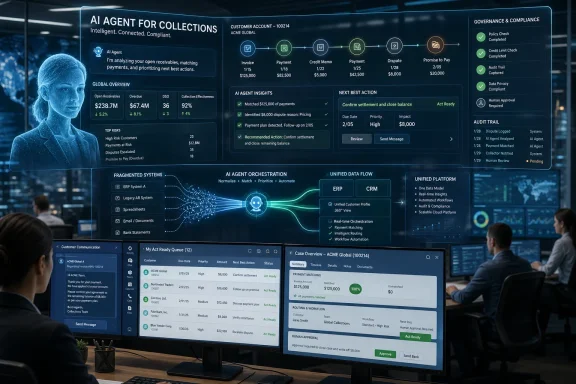
Microsoft said on June 4, 2026, that its Treasury division has built a human-led, AI agent-assisted collections system that consolidates SAP and Dynamics 365 data, helps more than 1,000 global collectors prioritize accounts, and automates payment matching, routing, summaries, and customer responses. The company is presenting the project as an internal proof point for agentic AI in finance, but the more interesting story is less glamorous: Microsoft’s gains came only after it rebuilt the operating model underneath the bot. In other words, the agent did not rescue a broken process. The process had to be made legible enough for the agent to help.
The temptation with any corporate AI success story is to jump straight to the model. Microsoft would probably prefer that, too, because a tale about agents that predict late payments and draft customer replies is tidier than a tale about fragmented systems, inconsistent handoffs, and case managers hunting for context before every call.
But the company’s own account makes the hierarchy clear. Its Global Collection team had a basic visibility problem: collectors did not always have a single view of what a customer owed, what conversations had already happened, or where an exception should go next. That is not an AI problem in the narrow sense. It is an enterprise systems problem that AI merely exposes faster.
Microsoft says it began by consolidating dispersed tools into an SAP and Microsoft Dynamics 365 environment, creating a shared foundation for customer, invoice, and payment data. Only then did it layer on Microsoft’s IQ intelligence platform, workflow standardization, and Copilot-style assistance inside the collectors’ daily tools.
That order matters. AI in finance is often sold as a leap forward, but Microsoft’s example reads more like a rebuke to companies hoping to sprinkle generative AI over unreconciled workflows. If your collectors are still relying on tribal knowledge, stale spreadsheets, and undocumented routing rules, an AI agent will not magically become a finance operations oracle. It will become a faster way to reveal that nobody agrees where the truth lives.
That is also where the claimed productivity gains become plausible. Microsoft says the agent helps predict late payments and possible disputes, summarizes customer case interactions, routes emails to the appropriate collections manager, matches payments to invoices, and responds to customer inquiries. Those are not exotic use cases. They are the repeated, friction-heavy tasks that make enterprise finance work slower than outsiders expect.
The power of the system is not that each individual feature sounds revolutionary. It is that they sit at the choke points where time vanishes. A collector preparing for a call needs to know the customer’s invoice state, recent interactions, likely objections, and appropriate next action. If that information is scattered across systems, the job becomes archaeology before it becomes negotiation.
Microsoft’s reported gains flow from collapsing that archaeology. Payment matching accuracy rose from 40 percent to 90 percent, according to the company, and standardized automated workflows allowed 98 percent of payments to be applied within 48 hours. Those numbers are internal and should be read as directional rather than universal. Still, they underline the central lesson: the agent’s value depends on how much operational ambiguity has already been removed.
In traditional enterprise software, users are often given more visibility but not necessarily less work. A new reporting view may show every overdue invoice, every open dispute, and every recent customer touchpoint, but the employee still has to decide what matters now. Microsoft is suggesting a different pattern: each morning, the agent prioritizes a case manager’s workload based on urgency and past client behavior.
That is where agentic AI becomes operationally interesting. Not because it talks like a person, but because it can reshape the sequence of the workday. If the system can identify which cases are likely to slip, which disputes are likely to arise, and which account needs human attention first, the collector starts the day closer to judgment and farther from triage.
The shift also explains why Microsoft emphasized change management and role-based training. Workers do not simply adopt AI because a tool appears in the interface. They adopt it when the tool reduces pain in the specific rhythm of their day. A collector who spends less time hunting for contact history and more time resolving exceptions has a clear reason to keep using the system.
It is also a useful counterweight to the current agent hype cycle. Vendors are increasingly describing agents as autonomous digital workers that can reason, plan, and execute across business systems. Some of that is real, some of it is roadmap theater, and much of it depends on how forgiving the underlying workflow is. Collections is a good test case precisely because errors have consequences: misapplied payments, mishandled disputes, irritated customers, and misstated cash positions are not minor UX defects.
Microsoft’s approach appears to recognize that risk. It did not describe the agent as replacing collectors. It described the system as reducing preparation time, improving routing, drafting responses, and surfacing knowledge inside existing workflows. That positioning is less spectacular than “AI runs finance,” but it is far more credible.
The lesson for WindowsForum’s IT pro audience is that the enabling work will often land on the people who maintain identity, access, data governance, integration pipelines, endpoint environments, collaboration platforms, and business applications. Finance transformation may be led by Treasury, but it is implemented through the messy estate of enterprise IT.
But Microsoft also notes that the metrics are based on internal data gathered during the article’s writing and may change as systems, processes, and behaviors evolve. That caveat should not be dismissed as boilerplate. It is the part of the story that separates a case study from a benchmark.
Internal AI metrics are notoriously sensitive to baseline conditions. If the starting process was highly fragmented, even modest workflow consolidation can produce large gains. If a team was already mature, standardized, and well-integrated, the same agent pattern might produce smaller returns. A 40 percent reduction in preparation time sounds dramatic, but it depends on how much time preparation consumed before the rollout.
There is also the question of whether productivity gains persist after the first wave of process cleanup. Early automation programs often capture the most obvious waste quickly, then move into harder optimization territory. Microsoft says it emphasized observability by tracking dollars collected and hours worked to create productivity metrics. That is the right instinct, because agent-assisted workflows need continuous measurement, not launch-day celebration.
That makes the finance back office a more realistic proving ground than many flashier AI demos. A chatbot that can produce a polished answer is interesting. A system that can reduce routing errors, prepare a collector for a high-value customer call, and match payments more accurately is operationally consequential.
The catch is that finance teams are also less tolerant of fuzziness. A hallucinated paragraph in a draft email can be corrected by a human reviewer. A hallucinated payment status or misrouted exception can create downstream damage. That is why Microsoft’s emphasis on governance, ownership, and standardized workflows is not corporate throat-clearing. It is the core of the deployment.
For IT leaders, the finance example also clarifies where AI assistance is likely to stick. The best targets are not merely tasks that are boring. They are tasks where the system can combine structured records, unstructured communication, and business rules to reduce the number of steps before a trained person acts.
That is a powerful idea, especially in large organizations where the biggest productivity losses are rarely caused by a single bad application. They are caused by the seams between applications. The collector is not slowed down only by SAP, or only by Dynamics, or only by email. The collector is slowed down by the act of connecting them under time pressure.
This is where Microsoft has a strategic advantage and a credibility problem at the same time. The advantage is obvious: it owns or sells much of the enterprise stack where this kind of workflow lives. Dynamics 365, Microsoft 365, Teams, Copilot, Azure, identity, compliance, and analytics can be woven into a convincing end-to-end narrative.
The credibility problem is that Microsoft is both the case study and the vendor. When Microsoft says Microsoft tools helped Microsoft save time inside Microsoft, readers should keep one eyebrow raised. That does not make the story false. It does mean the article is best read as a pattern to interrogate, not a neutral industry benchmark.
Collections does not work that way. If no one can explain why an invoice exception moves from one queue to another, the agent cannot responsibly automate the routing. If no one can define which customer behaviors predict late payment, the prediction model may simply reproduce noise. If no one owns the quality of customer and invoice data, the agent’s polished summary may become a confident wrapper around bad inputs.
This is why “know your process” is more than management advice. It is an AI governance requirement. Process knowledge defines what the agent is allowed to do, when a human must intervene, which metrics matter, and how errors are detected. Without that scaffolding, agentic AI becomes a compliance risk wearing a productivity costume.
The organizational challenge is that process knowledge is often distributed among frontline employees, managers, system owners, and finance policy teams. Microsoft says it included frontline users early and focused training on real day-to-day scenarios. That is exactly where many AI rollouts fail: they model the official process while ignoring the workaround process that actually keeps the business moving.
The modern Windows endpoint is increasingly a control surface for cloud-hosted workflows. The data may live in SAP, Dynamics 365, SharePoint, Exchange, Teams, or a custom line-of-business system. The user experiences it through the desktop, browser, Office applications, Teams meetings, notifications, authentication prompts, and now Copilot-style assistance embedded into the flow.
That means AI transformation will create familiar IT work under a new label. Admins will need to manage access boundaries, conditional access policies, data loss prevention rules, audit trails, app integrations, endpoint compliance, and user training. The AI layer may be new, but the failure modes are recognizable: too much access, too little monitoring, unclear ownership, brittle integrations, and users who bypass the system when it slows them down.
There is also a supportability issue. When an AI-assisted workflow gives a bad recommendation, who owns the ticket? The business process owner, the Dynamics admin, the data engineering team, the security team, the Copilot platform owner, or the vendor? Microsoft’s post points toward clear ownership as a trust requirement, but most enterprises will have to build those accountability lines themselves.
Trust begins with data quality, but it does not end there. A system can use accurate data and still make a poor recommendation because the business rule is incomplete, the context is unusual, or the customer relationship requires nuance. That is why human-led design matters. The point is not to make the collector irrelevant. It is to make the collector better prepared.
Governance also requires knowing what the AI system is doing over time. Microsoft says it tracked dollars collected and hours worked, but operational metrics should be paired with quality and risk metrics. An enterprise finance deployment should care not only whether inquiries are resolved faster, but whether they are resolved correctly, consistently, and in a way that customers accept.
This is where the next phase of enterprise AI will get less glamorous and more important. Organizations will need model evaluation, audit logging, escalation paths, prompt and response controls, data lineage, retention policies, and red-team thinking adapted to business process automation. The agent that drafts an email today may route a financial exception tomorrow. The governance model needs to be ready before the autonomy increases.
That distinction matters. Enterprises may buy the agent and underfund the cleanup, then wonder why they did not reproduce Microsoft’s results. The case study’s hidden warning is that the unglamorous work may have produced much of the value. AI may have accelerated the process, but the process first had to be redesigned.
There is also a customer-experience dimension that deserves scrutiny. Automated statements and drafted responses can reduce delay, but customers dealing with disputed invoices may not welcome a faster machine-mediated interaction if it feels less accountable. The best use of AI in collections may be to make the human representative more informed, not to make the customer feel processed by a system.
Microsoft’s “human-led” phrasing helps here, but the industry’s direction is clear. As organizations gain confidence, they will push agents from suggestion to execution. That will make governance, transparency, and escalation design more important than the demo-friendly features that dominate launch posts.
The strongest candidates for agent assistance are workflows where employees repeatedly gather context, classify requests, route exceptions, draft routine communications, and decide what deserves attention first. Those are the places where AI can reduce preparation time without pretending to replace professional judgment.
For IT and finance teams evaluating similar projects, the useful lessons are concrete:
 Microsoft’s Collections Story Is Really a Data Plumbing Story
The temptation with any corporate AI success story is to jump straight to the model. Microsoft would probably prefer that, too, because a tale about agents that predict late payments and draft customer replies is tidier than a tale about fragmented systems, inconsistent handoffs, and case managers hunting for context before every call.But the company’s own account makes the hierarchy clear. Its Global Collection team had a basic visibility problem: collectors did not always have a single view of what a customer owed, what conversations had already happened, or where an exception should go next. That is not an AI problem in the narrow sense. It is an enterprise systems problem that AI merely exposes faster.
Microsoft says it began by consolidating dispersed tools into an SAP and Microsoft Dynamics 365 environment, creating a shared foundation for customer, invoice, and payment data. Only then did it layer on Microsoft’s IQ intelligence platform, workflow standardization, and Copilot-style assistance inside the collectors’ daily tools.
That order matters. AI in finance is often sold as a leap forward, but Microsoft’s example reads more like a rebuke to companies hoping to sprinkle generative AI over unreconciled workflows. If your collectors are still relying on tribal knowledge, stale spreadsheets, and undocumented routing rules, an AI agent will not magically become a finance operations oracle. It will become a faster way to reveal that nobody agrees where the truth lives.
The Agent Arrives After the Operating Model Changes
Microsoft describes its system as human-led and AI agent-assisted, a phrase that does important reputational work. Finance leaders are not usually eager to announce that cash collection has been handed to a machine. The more credible pitch is that AI prepares the work, routes the work, summarizes the work, and drafts the routine communications, while humans remain responsible for judgment and exception handling.That is also where the claimed productivity gains become plausible. Microsoft says the agent helps predict late payments and possible disputes, summarizes customer case interactions, routes emails to the appropriate collections manager, matches payments to invoices, and responds to customer inquiries. Those are not exotic use cases. They are the repeated, friction-heavy tasks that make enterprise finance work slower than outsiders expect.
The power of the system is not that each individual feature sounds revolutionary. It is that they sit at the choke points where time vanishes. A collector preparing for a call needs to know the customer’s invoice state, recent interactions, likely objections, and appropriate next action. If that information is scattered across systems, the job becomes archaeology before it becomes negotiation.
Microsoft’s reported gains flow from collapsing that archaeology. Payment matching accuracy rose from 40 percent to 90 percent, according to the company, and standardized automated workflows allowed 98 percent of payments to be applied within 48 hours. Those numbers are internal and should be read as directional rather than universal. Still, they underline the central lesson: the agent’s value depends on how much operational ambiguity has already been removed.
“Act Ready” Work Is the Real Automation Prize
Microsoft’s most useful phrase in the post is not “AI agent.” It is the idea of moving toward act ready work. That is the difference between giving an employee another dashboard and giving them a queue that has already been prioritized, enriched, and prepared for action.In traditional enterprise software, users are often given more visibility but not necessarily less work. A new reporting view may show every overdue invoice, every open dispute, and every recent customer touchpoint, but the employee still has to decide what matters now. Microsoft is suggesting a different pattern: each morning, the agent prioritizes a case manager’s workload based on urgency and past client behavior.
That is where agentic AI becomes operationally interesting. Not because it talks like a person, but because it can reshape the sequence of the workday. If the system can identify which cases are likely to slip, which disputes are likely to arise, and which account needs human attention first, the collector starts the day closer to judgment and farther from triage.
The shift also explains why Microsoft emphasized change management and role-based training. Workers do not simply adopt AI because a tool appears in the interface. They adopt it when the tool reduces pain in the specific rhythm of their day. A collector who spends less time hunting for contact history and more time resolving exceptions has a clear reason to keep using the system.
Microsoft Is Selling Discipline, Not Magic
The quoted comments from Kathy Brustad, a director in Microsoft’s Global Treasury and Financial Services division, are unusually blunt for a corporate AI post. She says building the AI assistance was not the hard part; reimagining the collection experience and upgrading the underlying infrastructure was. That is the line finance and IT leaders should tape to the wall before approving their next AI pilot.It is also a useful counterweight to the current agent hype cycle. Vendors are increasingly describing agents as autonomous digital workers that can reason, plan, and execute across business systems. Some of that is real, some of it is roadmap theater, and much of it depends on how forgiving the underlying workflow is. Collections is a good test case precisely because errors have consequences: misapplied payments, mishandled disputes, irritated customers, and misstated cash positions are not minor UX defects.
Microsoft’s approach appears to recognize that risk. It did not describe the agent as replacing collectors. It described the system as reducing preparation time, improving routing, drafting responses, and surfacing knowledge inside existing workflows. That positioning is less spectacular than “AI runs finance,” but it is far more credible.
The lesson for WindowsForum’s IT pro audience is that the enabling work will often land on the people who maintain identity, access, data governance, integration pipelines, endpoint environments, collaboration platforms, and business applications. Finance transformation may be led by Treasury, but it is implemented through the messy estate of enterprise IT.
The Numbers Are Impressive, but the Disclaimer Is Doing Work
Microsoft reports hundreds of thousands of hours unlocked annually, a 40 percent reduction in call preparation time, twofold growth in automatic cash applications, a 2.5 times acceleration in customer inquiry resolution time, and up to a 60 percent reduction in inquiry handling time. For any global finance operation, those are meaningful claims. Faster collections can improve cash visibility, reduce manual effort, and let skilled staff focus on exceptions rather than rote follow-up.But Microsoft also notes that the metrics are based on internal data gathered during the article’s writing and may change as systems, processes, and behaviors evolve. That caveat should not be dismissed as boilerplate. It is the part of the story that separates a case study from a benchmark.
Internal AI metrics are notoriously sensitive to baseline conditions. If the starting process was highly fragmented, even modest workflow consolidation can produce large gains. If a team was already mature, standardized, and well-integrated, the same agent pattern might produce smaller returns. A 40 percent reduction in preparation time sounds dramatic, but it depends on how much time preparation consumed before the rollout.
There is also the question of whether productivity gains persist after the first wave of process cleanup. Early automation programs often capture the most obvious waste quickly, then move into harder optimization territory. Microsoft says it emphasized observability by tracking dollars collected and hours worked to create productivity metrics. That is the right instinct, because agent-assisted workflows need continuous measurement, not launch-day celebration.
Finance Is an Ideal AI Showcase Because the Work Is Structured but Still Human
Collections sits in a sweet spot for enterprise AI. The work is structured enough to benefit from automation, but human enough to resist full mechanization. Invoices have amounts, dates, payment terms, statuses, and customer identifiers. Customer communications have histories, stakeholders, objections, and exceptions. That combination gives AI systems enough data to summarize and prioritize, while preserving a clear role for human judgment.That makes the finance back office a more realistic proving ground than many flashier AI demos. A chatbot that can produce a polished answer is interesting. A system that can reduce routing errors, prepare a collector for a high-value customer call, and match payments more accurately is operationally consequential.
The catch is that finance teams are also less tolerant of fuzziness. A hallucinated paragraph in a draft email can be corrected by a human reviewer. A hallucinated payment status or misrouted exception can create downstream damage. That is why Microsoft’s emphasis on governance, ownership, and standardized workflows is not corporate throat-clearing. It is the core of the deployment.
For IT leaders, the finance example also clarifies where AI assistance is likely to stick. The best targets are not merely tasks that are boring. They are tasks where the system can combine structured records, unstructured communication, and business rules to reduce the number of steps before a trained person acts.
Copilot Is Becoming the Interface Layer for Business Process Change
Microsoft’s broader strategy is visible between the lines. Copilot is not just a productivity assistant bolted onto Office apps. It is becoming an interface layer across business processes, including finance, support, sales, and internal IT. The pitch is that workers should not have to leave the flow of work to search for context, draft routine messages, or decide which system owns the next step.That is a powerful idea, especially in large organizations where the biggest productivity losses are rarely caused by a single bad application. They are caused by the seams between applications. The collector is not slowed down only by SAP, or only by Dynamics, or only by email. The collector is slowed down by the act of connecting them under time pressure.
This is where Microsoft has a strategic advantage and a credibility problem at the same time. The advantage is obvious: it owns or sells much of the enterprise stack where this kind of workflow lives. Dynamics 365, Microsoft 365, Teams, Copilot, Azure, identity, compliance, and analytics can be woven into a convincing end-to-end narrative.
The credibility problem is that Microsoft is both the case study and the vendor. When Microsoft says Microsoft tools helped Microsoft save time inside Microsoft, readers should keep one eyebrow raised. That does not make the story false. It does mean the article is best read as a pattern to interrogate, not a neutral industry benchmark.
The Hard Part Is Knowing the Process Well Enough to Change It
Brustad’s strongest advice is that organizations need to understand their own process very well before designing an agent-enabled version of it. That sounds obvious until one remembers how many AI pilots begin with the opposite impulse: find a tool, pick a workflow, and hope the tool reveals the transformation.Collections does not work that way. If no one can explain why an invoice exception moves from one queue to another, the agent cannot responsibly automate the routing. If no one can define which customer behaviors predict late payment, the prediction model may simply reproduce noise. If no one owns the quality of customer and invoice data, the agent’s polished summary may become a confident wrapper around bad inputs.
This is why “know your process” is more than management advice. It is an AI governance requirement. Process knowledge defines what the agent is allowed to do, when a human must intervene, which metrics matter, and how errors are detected. Without that scaffolding, agentic AI becomes a compliance risk wearing a productivity costume.
The organizational challenge is that process knowledge is often distributed among frontline employees, managers, system owners, and finance policy teams. Microsoft says it included frontline users early and focused training on real day-to-day scenarios. That is exactly where many AI rollouts fail: they model the official process while ignoring the workaround process that actually keeps the business moving.
The Windows Angle Is the Enterprise Desktop as a Control Surface
At first glance, a Treasury collections system may not look like a Windows story. It is not a new Start menu, a kernel change, or a Copilot key on a keyboard. But for WindowsForum readers, the significance is in how Microsoft expects AI-assisted enterprise work to show up: inside the daily desktop, identity, productivity, and business application environment that IT already manages.The modern Windows endpoint is increasingly a control surface for cloud-hosted workflows. The data may live in SAP, Dynamics 365, SharePoint, Exchange, Teams, or a custom line-of-business system. The user experiences it through the desktop, browser, Office applications, Teams meetings, notifications, authentication prompts, and now Copilot-style assistance embedded into the flow.
That means AI transformation will create familiar IT work under a new label. Admins will need to manage access boundaries, conditional access policies, data loss prevention rules, audit trails, app integrations, endpoint compliance, and user training. The AI layer may be new, but the failure modes are recognizable: too much access, too little monitoring, unclear ownership, brittle integrations, and users who bypass the system when it slows them down.
There is also a supportability issue. When an AI-assisted workflow gives a bad recommendation, who owns the ticket? The business process owner, the Dynamics admin, the data engineering team, the security team, the Copilot platform owner, or the vendor? Microsoft’s post points toward clear ownership as a trust requirement, but most enterprises will have to build those accountability lines themselves.
Governance Is the Difference Between Assistance and Liability
Finance leaders’ two immediate questions, according to Microsoft, are whether they can trust the outputs and govern the process. That is the correct framing. AI adoption in collections is not simply about saving hours; it is about making sure saved hours do not come at the expense of control.Trust begins with data quality, but it does not end there. A system can use accurate data and still make a poor recommendation because the business rule is incomplete, the context is unusual, or the customer relationship requires nuance. That is why human-led design matters. The point is not to make the collector irrelevant. It is to make the collector better prepared.
Governance also requires knowing what the AI system is doing over time. Microsoft says it tracked dollars collected and hours worked, but operational metrics should be paired with quality and risk metrics. An enterprise finance deployment should care not only whether inquiries are resolved faster, but whether they are resolved correctly, consistently, and in a way that customers accept.
This is where the next phase of enterprise AI will get less glamorous and more important. Organizations will need model evaluation, audit logging, escalation paths, prompt and response controls, data lineage, retention policies, and red-team thinking adapted to business process automation. The agent that drafts an email today may route a financial exception tomorrow. The governance model needs to be ready before the autonomy increases.
The Vendor Case Study Still Leaves Open Questions
Microsoft’s post is useful, but it also leaves several questions unanswered. We do not know the full implementation timeline, the exact architecture of the IQ intelligence platform in this scenario, the extent of human review for automatically drafted responses, or how error rates changed alongside speed improvements. We also do not know how much of the gain came from AI specifically versus the consolidation and standardization work that preceded it.That distinction matters. Enterprises may buy the agent and underfund the cleanup, then wonder why they did not reproduce Microsoft’s results. The case study’s hidden warning is that the unglamorous work may have produced much of the value. AI may have accelerated the process, but the process first had to be redesigned.
There is also a customer-experience dimension that deserves scrutiny. Automated statements and drafted responses can reduce delay, but customers dealing with disputed invoices may not welcome a faster machine-mediated interaction if it feels less accountable. The best use of AI in collections may be to make the human representative more informed, not to make the customer feel processed by a system.
Microsoft’s “human-led” phrasing helps here, but the industry’s direction is clear. As organizations gain confidence, they will push agents from suggestion to execution. That will make governance, transparency, and escalation design more important than the demo-friendly features that dominate launch posts.
Microsoft’s Treasury Pilot Points to a Narrower, Better AI Playbook
The practical message from Microsoft’s collections work is not that every finance team should immediately build an agent. It is that the best AI deployments start where process pain, data availability, and measurable business value overlap. Collections checks all three boxes.The strongest candidates for agent assistance are workflows where employees repeatedly gather context, classify requests, route exceptions, draft routine communications, and decide what deserves attention first. Those are the places where AI can reduce preparation time without pretending to replace professional judgment.
For IT and finance teams evaluating similar projects, the useful lessons are concrete:
- Fragmented systems should be consolidated or at least made coherently accessible before AI is expected to reason across them.
- Agent assistance works best when it appears inside the normal workday at moments of prioritization, preparation, routing, and drafting.
- Productivity claims should be measured against cycle time, throughput, dollars collected, hours worked, handling time, and error quality rather than adoption enthusiasm alone.
- Human review and escalation paths should be designed into the workflow before automation expands from suggestions to actions.
- Frontline users should shape the deployment because they know where the official process differs from the real one.
- Vendor case studies should be treated as patterns to test, not performance guarantees to copy.
References
- Primary source: Microsoft
Published: 2026-06-04T16:42:07.029880
Streamlining finance cash collection at Microsoft with AI - Inside Track Blog
The cost of delays for our cash collection teams started to add up, so we redesigned our workflows with Microsoft 365 Copilot and Microsoft Dynamics 365.www.microsoft.com
