

Microsoft AI CEO Mustafa Suleyman predicted in a Financial Times interview earlier this year that most computer-based white-collar tasks could be fully automated by artificial intelligence within 12 to 18 months, a claim now drawing renewed criticism from users unimpressed with Microsoft Copilot’s real-world performance. The backlash is not simply anti-AI grumbling. It is a collision between executive timelines and office reality. For Windows users and IT departments, the question is less whether AI can draft an email and more whether Microsoft is selling automation faster than it can make automation trustworthy.
The line that lit the fuse was blunt: white-collar work where people are “sitting down at a computer,” including lawyers, accountants, project managers, and marketers, would soon see most tasks automated by AI. Suleyman also reportedly argued that hallucinations would be “largely eliminated,” citing the speed at which models have improved.
That is a huge promise from any technology executive. It lands differently coming from Microsoft, the company trying to make Copilot a default layer across Windows, Microsoft 365, Edge, Teams, GitHub, Azure, and enterprise workflows. Microsoft is not just commenting on the AI labor market from a distance; it is asking customers to believe that Copilot belongs inside the operating system of office life.
The most charitable reading of Suleyman’s prediction is that he is talking about tasks, not jobs. White-collar work is full of text transformation, summarization, document drafting, meeting follow-ups, spreadsheet cleanup, search, and status reporting. Those are exactly the kinds of chores large language models can compress when the inputs are clean and the output does not carry much legal, financial, reputational, or operational risk.
But the phrase “fully automated” does enormous work. It turns “AI can help with a task” into “AI can be trusted to complete the task without human intervention.” Anyone who has watched a chatbot confidently invent a policy, misread a table, ignore a constraint, or produce a plausible but wrong summary knows how wide that gap remains.
That gap is where the backlash lives. Users mocking Copilot are not necessarily denying that AI is useful. Many are saying that the product experience they have today does not support the executive forecast they are being asked to accept.
Copilot can be genuinely helpful in narrow lanes. It can summarize a Teams meeting, draft a polite reply, generate a first-pass slide outline, explain a script, or turn a messy note into a cleaner memo. But office work is rarely a clean prompt followed by a clean answer. It is permissions, context, exceptions, institutional memory, half-documented processes, and accountability.
If AI is going to automate “most” professional tasks, it must do more than write fluent paragraphs. It must know when not to act, when to ask for clarification, when a source is stale, when a number is suspicious, and when a decision belongs to a human because the consequences are not merely textual. That is the difference between an assistant and an operator.
When commenters say Copilot takes longer to correct than doing the work manually, they are describing a productivity tax that enterprise IT knows well. A tool does not have to fail dramatically to lose trust. It only has to be unreliable often enough that users begin checking every sentence, every formula, every recommendation, and every citation-like claim.
That is why hallucinations matter so much. The problem is not merely that AI systems sometimes make things up. The problem is that they make things up in the same confident register they use when they are right. In a consumer chatbot, that can be annoying. In a corporate workflow, it can become a governance problem.
Microsoft understands this, which is why its enterprise messaging increasingly emphasizes grounding, permissions, data boundaries, admin controls, auditability, and security. The company knows that CIOs do not buy “magic.” They buy systems that can survive procurement reviews, compliance questions, and angry department heads.
But the marketing aura around Copilot has often outrun that sober enterprise reality. Microsoft wants Copilot to feel inevitable. Users, meanwhile, experience it as uneven: sometimes impressive, sometimes baffling, and sometimes simply in the way.
That sounds logical until you inspect how professional work actually operates. A lawyer’s job is not just drafting text. It includes client judgment, strategy, negotiation, risk framing, ethical responsibility, and knowing which facts matter before the document exists. An accountant’s job is not just reconciling figures. It includes controls, interpretation, compliance, investigation, and signing off under regimes where being wrong has consequences.
Project management is even messier. A model can summarize a backlog and draft a status update. It cannot automatically create trust between teams, resolve a political dispute over resources, or decide whether a delivery date is fantasy dressed as optimism. Marketing, likewise, contains plenty of automatable content generation, but also taste, brand risk, audience judgment, and the uncomfortable art of deciding what not to say.
The task-versus-job distinction is not a pedantic objection. It is the core of the debate. If Microsoft says AI will automate most tasks, businesses may hear “reduce headcount.” Workers may hear “your profession is obsolete.” IT teams may hear “deploy this before your competitors do.” None of those interpretations maps neatly onto the actual state of the tools.
The more responsible claim is narrower and still consequential: AI will automate or accelerate a growing share of routine digital work, especially where the cost of error is low and the output is reviewed by humans. That is enough to reshape jobs. It is not the same as eliminating the need for people across entire white-collar categories within 18 months.
There are real improvements happening. Models are better at following instructions than they were two years ago. Retrieval-augmented systems can ground answers in company data. Tool use can let AI query live systems instead of guessing. Smaller, specialized models can outperform general chatbots in constrained workflows. Guardrails, evaluation pipelines, and human review loops are getting more mature.
Still, hallucination is not a single bug waiting for a patch. It is a family of failure modes produced by probabilistic systems operating under incomplete context, ambiguous instructions, flawed retrieval, weak source ranking, outdated data, and user pressure to produce something rather than admit uncertainty.
In an enterprise setting, “largely eliminated” must mean something measurable. Does it mean fewer fabricated facts in summaries? Fewer incorrect citations? Fewer bad spreadsheet transformations? Fewer unsafe recommendations? Fewer workflow actions taken on wrong assumptions? Each of those requires different testing.
This matters because Microsoft’s AI layer is being woven into software people already use to make decisions. A hallucinated dinner recommendation is one thing. A hallucinated compliance obligation, contract clause, customer commitment, or security remediation step is another. The closer Copilot gets to action, the less tolerance there is for plausible nonsense.
The future Microsoft is selling depends on users trusting AI not just to suggest but to execute. That future cannot arrive through vibes. It requires repeatable evidence.
Microsoft’s strategy is understandable. Windows remains the default desktop environment for much of global business. If AI becomes a standard layer for productivity, Microsoft wants that layer tied to its identity system, documents, meetings, security stack, and device ecosystem. The prize is not a better chatbot; it is the workflow graph of the modern workplace.
That is also why user skepticism matters. If Copilot is perceived as another unwanted panel, another subscription upsell, or another feature that produces work requiring cleanup, the AI layer becomes clutter rather than infrastructure. Microsoft has seen this movie before with features that were technically ambitious but culturally unwelcome.
There is a difference between integrating AI and imposing it. Windows users are particularly sensitive to that difference because the operating system is personal in a way a cloud dashboard is not. People tolerate experimentation in a web app. They resent it when it appears inside the shell, the taskbar, search, settings, or productivity apps they depend on every day.
The more Microsoft frames AI as destiny, the more it must deliver control. Admins need policy switches. Users need clear boundaries. Organizations need logs, retention controls, data separation, and predictable behavior. The AI PC era will not be won by demos alone.
Even so, Huang’s point has merit. Corporate leaders have discovered that “AI efficiency” can make old-fashioned cost-cutting sound modern. A company can freeze hiring, offshore work, reduce headcount, or reorganize under pressure from investors and then wrap the decision in AI language. The technology becomes a narrative shield.
That does not mean AI has no labor impact. It clearly does. The ability to produce acceptable first drafts, summarize information, generate code, automate support flows, and analyze documents changes how many people are needed for certain processes. But attributing every layoff to AI is as lazy as claiming AI will leave employment untouched.
The more honest picture is uneven. Some teams will use AI to grow output without hiring at the same pace. Some will use it to eliminate junior roles, creating long-term talent pipeline problems. Some will discover that AI saves time in one place and creates review work elsewhere. Some will spend heavily and get little more than a new class of compliance meetings.
Microsoft’s challenge is that its own executives’ bold predictions can make it easier for other executives to overclaim. When a senior Microsoft AI leader says most computer-based professional tasks will soon be automated, he is not merely describing a technical possibility. He is giving boardrooms a sentence they can reuse.
The first hard problem is permissions. Copilot-style systems are only as safe as the data they can reach. If an organization has years of overshared SharePoint sites, permissive Teams channels, stale OneDrive links, and poorly classified documents, an AI assistant can make that mess more visible. It may not create the data governance problem, but it can surface it with uncomfortable speed.
The second hard problem is measurement. Productivity software has always suffered from fuzzy return-on-investment claims, but AI makes the fog thicker. A worker may save ten minutes drafting a memo and spend eight minutes checking it. A manager may get a clean summary that misses the one sentence that mattered. A developer may accept a code suggestion that works today but introduces maintenance debt tomorrow.
The third hard problem is liability. If an employee acts on Copilot-generated guidance, who owns the mistake? The user? The department? The vendor? The admin who enabled the feature? In regulated industries, “the AI said so” is not a defense strategy.
The fourth hard problem is morale. Deploying AI into a workplace where leaders are openly discussing job replacement changes how workers interpret the tool. The same feature that looks like assistance in a trusted culture can look like surveillance or pre-redundancy training in a fearful one.
Microsoft can help with documentation, controls, and security architecture. It cannot solve the organizational politics of introducing a tool that executives describe as capable of automating the people being asked to adopt it.
Microsoft has been especially aggressive because it has the distribution to make AI feel mainstream. Copilot does not need to win every enthusiast benchmark to matter. It can become important simply by being embedded where work already happens.
But ubiquity is not the same as satisfaction. A tool can be everywhere and still be resented. Microsoft Teams proved that enterprise adoption does not always equal affection. Copilot risks a similar fate if it is sold as a revolution and experienced as a sometimes-helpful autocomplete with a management-consulting vocabulary.
The comparison to rival tools such as Claude is revealing. Users who prefer competitors often cite tone, reasoning quality, coding help, document handling, or fewer irritating refusals. Those preferences may shift as models improve, but they show that the market is not passively accepting Microsoft’s default position. Distribution gives Microsoft a head start, not a permanent exemption from product judgment.
The company’s strongest path is not to insist that Copilot will replace whole classes of workers by a deadline. It is to make Copilot boringly dependable at specific jobs: summarizing this meeting accurately, drafting this kind of email safely, finding this policy without leaking that document, generating this report with traceable sources, and refusing when the context is insufficient.
That may sound less dramatic than “18 months.” It is also how enterprise software actually wins.
But beneath the jokes is a serious trust deficit. Users are being told that AI will transform their jobs by people whose products still make basic mistakes. They are being told hallucinations are on the road to elimination while they are still cleaning up confident errors. They are being told AI is an assistant while executives discuss automation timelines that sound like replacement schedules.
That tension is combustible. It makes every Copilot misfire feel symbolic. A bad summary is no longer just a bad summary; it becomes evidence that the emperor has a prompt window.
Microsoft’s problem is not that users lack imagination. Many office workers can imagine AI doing more of their work because they already use it. The problem is that they also know the parts of their jobs that do not fit cleanly into a demo: the exception, the missing context, the angry customer, the ambiguous policy, the politically sensitive decision, the spreadsheet nobody fully understands but everyone depends on.
The backlash is therefore a form of product feedback. It says: do not sell us autonomy when what you have delivered is assistance. Do not sell us certainty when what you have delivered is probability. Do not tell us our jobs are automatable while asking us to fix the output.
That puts Microsoft in a familiar position. The company has often won not by having the flashiest product, but by making its product manageable at scale. Active Directory, Group Policy, Intune, Defender, Microsoft 365 compliance tooling, and Azure integration are not glamorous, but they are the kind of plumbing that determines whether a technology becomes standard in business.
Copilot needs that same boring strength. It must respect tenant boundaries. It must make source grounding visible. It must give admins granular deployment options. It must let organizations test use cases before broad rollout. It must produce logs that help investigate failures. It must improve without constantly rearranging the user experience.
If Microsoft can do that, Copilot does not have to fulfill the most dramatic version of Suleyman’s prediction to matter. It can become a serious productivity layer. But if Microsoft keeps letting executives describe the product category in apocalyptic labor-market terms, it will invite resistance from the very people whose trust it needs.
The irony is that AI adoption may require less futurism, not more. Workers and admins do not need to be told that the machine will soon do everything. They need to be shown that it can do something reliably enough to deserve a place in the workflow.
The line that lit the fuse was blunt: white-collar work where people are “sitting down at a computer,” including lawyers, accountants, project managers, and marketers, would soon see most tasks automated by AI. Suleyman also reportedly argued that hallucinations would be “largely eliminated,” citing the speed at which models have improved.
That is a huge promise from any technology executive. It lands differently coming from Microsoft, the company trying to make Copilot a default layer across Windows, Microsoft 365, Edge, Teams, GitHub, Azure, and enterprise workflows. Microsoft is not just commenting on the AI labor market from a distance; it is asking customers to believe that Copilot belongs inside the operating system of office life.
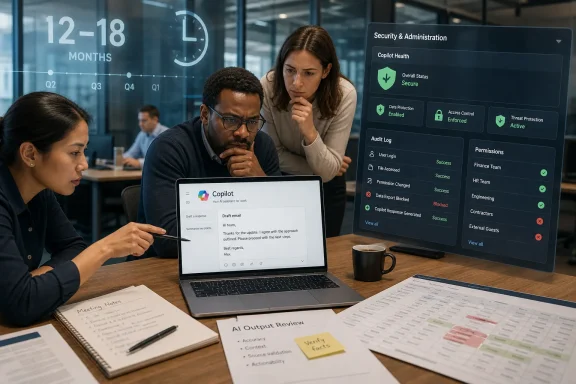 Microsoft’s 18-Month Clock Runs Faster Than the Office
The most charitable reading of Suleyman’s prediction is that he is talking about tasks, not jobs. White-collar work is full of text transformation, summarization, document drafting, meeting follow-ups, spreadsheet cleanup, search, and status reporting. Those are exactly the kinds of chores large language models can compress when the inputs are clean and the output does not carry much legal, financial, reputational, or operational risk.But the phrase “fully automated” does enormous work. It turns “AI can help with a task” into “AI can be trusted to complete the task without human intervention.” Anyone who has watched a chatbot confidently invent a policy, misread a table, ignore a constraint, or produce a plausible but wrong summary knows how wide that gap remains.
That gap is where the backlash lives. Users mocking Copilot are not necessarily denying that AI is useful. Many are saying that the product experience they have today does not support the executive forecast they are being asked to accept.
Copilot can be genuinely helpful in narrow lanes. It can summarize a Teams meeting, draft a polite reply, generate a first-pass slide outline, explain a script, or turn a messy note into a cleaner memo. But office work is rarely a clean prompt followed by a clean answer. It is permissions, context, exceptions, institutional memory, half-documented processes, and accountability.
If AI is going to automate “most” professional tasks, it must do more than write fluent paragraphs. It must know when not to act, when to ask for clarification, when a source is stale, when a number is suspicious, and when a decision belongs to a human because the consequences are not merely textual. That is the difference between an assistant and an operator.
Copilot Became the Evidence Against the Pitch
The irony for Microsoft is that Copilot is both the company’s strongest proof of AI’s potential and its most visible rebuttal to the more extravagant claims. It is the product most Windows and Microsoft 365 users associate with the AI push. It is also the product many users judge against the mundane reality of their workday.When commenters say Copilot takes longer to correct than doing the work manually, they are describing a productivity tax that enterprise IT knows well. A tool does not have to fail dramatically to lose trust. It only has to be unreliable often enough that users begin checking every sentence, every formula, every recommendation, and every citation-like claim.
That is why hallucinations matter so much. The problem is not merely that AI systems sometimes make things up. The problem is that they make things up in the same confident register they use when they are right. In a consumer chatbot, that can be annoying. In a corporate workflow, it can become a governance problem.
Microsoft understands this, which is why its enterprise messaging increasingly emphasizes grounding, permissions, data boundaries, admin controls, auditability, and security. The company knows that CIOs do not buy “magic.” They buy systems that can survive procurement reviews, compliance questions, and angry department heads.
But the marketing aura around Copilot has often outrun that sober enterprise reality. Microsoft wants Copilot to feel inevitable. Users, meanwhile, experience it as uneven: sometimes impressive, sometimes baffling, and sometimes simply in the way.
The Job Is Not the Task, and the Task Is Not the System
Suleyman’s prediction rests on a distinction that AI executives often invoke but the public hears differently. A job is a bundle of tasks. If AI can automate the tasks, the argument goes, the job changes or disappears.That sounds logical until you inspect how professional work actually operates. A lawyer’s job is not just drafting text. It includes client judgment, strategy, negotiation, risk framing, ethical responsibility, and knowing which facts matter before the document exists. An accountant’s job is not just reconciling figures. It includes controls, interpretation, compliance, investigation, and signing off under regimes where being wrong has consequences.
Project management is even messier. A model can summarize a backlog and draft a status update. It cannot automatically create trust between teams, resolve a political dispute over resources, or decide whether a delivery date is fantasy dressed as optimism. Marketing, likewise, contains plenty of automatable content generation, but also taste, brand risk, audience judgment, and the uncomfortable art of deciding what not to say.
The task-versus-job distinction is not a pedantic objection. It is the core of the debate. If Microsoft says AI will automate most tasks, businesses may hear “reduce headcount.” Workers may hear “your profession is obsolete.” IT teams may hear “deploy this before your competitors do.” None of those interpretations maps neatly onto the actual state of the tools.
The more responsible claim is narrower and still consequential: AI will automate or accelerate a growing share of routine digital work, especially where the cost of error is low and the output is reviewed by humans. That is enough to reshape jobs. It is not the same as eliminating the need for people across entire white-collar categories within 18 months.
Hallucinations Are a Product Problem, Not a Vocabulary Problem
The promise that hallucinations will be “largely eliminated” is perhaps the most important part of Suleyman’s forecast. It is also the part enterprise customers should interrogate hardest.There are real improvements happening. Models are better at following instructions than they were two years ago. Retrieval-augmented systems can ground answers in company data. Tool use can let AI query live systems instead of guessing. Smaller, specialized models can outperform general chatbots in constrained workflows. Guardrails, evaluation pipelines, and human review loops are getting more mature.
Still, hallucination is not a single bug waiting for a patch. It is a family of failure modes produced by probabilistic systems operating under incomplete context, ambiguous instructions, flawed retrieval, weak source ranking, outdated data, and user pressure to produce something rather than admit uncertainty.
In an enterprise setting, “largely eliminated” must mean something measurable. Does it mean fewer fabricated facts in summaries? Fewer incorrect citations? Fewer bad spreadsheet transformations? Fewer unsafe recommendations? Fewer workflow actions taken on wrong assumptions? Each of those requires different testing.
This matters because Microsoft’s AI layer is being woven into software people already use to make decisions. A hallucinated dinner recommendation is one thing. A hallucinated compliance obligation, contract clause, customer commitment, or security remediation step is another. The closer Copilot gets to action, the less tolerance there is for plausible nonsense.
The future Microsoft is selling depends on users trusting AI not just to suggest but to execute. That future cannot arrive through vibes. It requires repeatable evidence.
The Windows Angle Is Bigger Than a Chatbot
For WindowsForum readers, the story is not limited to Microsoft 365 subscriptions or office culture. Copilot is part of a broader attempt to recast Windows as an AI operating environment. That includes Copilot-branded features, local AI acceleration on newer PCs, cloud-connected assistants, developer tooling, and enterprise management controls.Microsoft’s strategy is understandable. Windows remains the default desktop environment for much of global business. If AI becomes a standard layer for productivity, Microsoft wants that layer tied to its identity system, documents, meetings, security stack, and device ecosystem. The prize is not a better chatbot; it is the workflow graph of the modern workplace.
That is also why user skepticism matters. If Copilot is perceived as another unwanted panel, another subscription upsell, or another feature that produces work requiring cleanup, the AI layer becomes clutter rather than infrastructure. Microsoft has seen this movie before with features that were technically ambitious but culturally unwelcome.
There is a difference between integrating AI and imposing it. Windows users are particularly sensitive to that difference because the operating system is personal in a way a cloud dashboard is not. People tolerate experimentation in a web app. They resent it when it appears inside the shell, the taskbar, search, settings, or productivity apps they depend on every day.
The more Microsoft frames AI as destiny, the more it must deliver control. Admins need policy switches. Users need clear boundaries. Organizations need logs, retention controls, data separation, and predictable behavior. The AI PC era will not be won by demos alone.
Nvidia’s Counter-Narrative Is Convenient, but Not Wrong
Jensen Huang’s criticism of CEOs who blame AI for layoffs adds a useful complication. Nvidia has every incentive to portray AI as expansive rather than destructive. The company sells the hardware that powers the boom, and fear of mass job destruction is not necessarily good for long-term political or customer acceptance.Even so, Huang’s point has merit. Corporate leaders have discovered that “AI efficiency” can make old-fashioned cost-cutting sound modern. A company can freeze hiring, offshore work, reduce headcount, or reorganize under pressure from investors and then wrap the decision in AI language. The technology becomes a narrative shield.
That does not mean AI has no labor impact. It clearly does. The ability to produce acceptable first drafts, summarize information, generate code, automate support flows, and analyze documents changes how many people are needed for certain processes. But attributing every layoff to AI is as lazy as claiming AI will leave employment untouched.
The more honest picture is uneven. Some teams will use AI to grow output without hiring at the same pace. Some will use it to eliminate junior roles, creating long-term talent pipeline problems. Some will discover that AI saves time in one place and creates review work elsewhere. Some will spend heavily and get little more than a new class of compliance meetings.
Microsoft’s challenge is that its own executives’ bold predictions can make it easier for other executives to overclaim. When a senior Microsoft AI leader says most computer-based professional tasks will soon be automated, he is not merely describing a technical possibility. He is giving boardrooms a sentence they can reuse.
IT Departments Will Be Asked to Operationalize the Hype
The practical burden falls on administrators, security teams, and platform owners. They are the ones asked to enable Copilot, justify licensing costs, manage data access, calm users, measure productivity, and explain what happens when AI output is wrong.The first hard problem is permissions. Copilot-style systems are only as safe as the data they can reach. If an organization has years of overshared SharePoint sites, permissive Teams channels, stale OneDrive links, and poorly classified documents, an AI assistant can make that mess more visible. It may not create the data governance problem, but it can surface it with uncomfortable speed.
The second hard problem is measurement. Productivity software has always suffered from fuzzy return-on-investment claims, but AI makes the fog thicker. A worker may save ten minutes drafting a memo and spend eight minutes checking it. A manager may get a clean summary that misses the one sentence that mattered. A developer may accept a code suggestion that works today but introduces maintenance debt tomorrow.
The third hard problem is liability. If an employee acts on Copilot-generated guidance, who owns the mistake? The user? The department? The vendor? The admin who enabled the feature? In regulated industries, “the AI said so” is not a defense strategy.
The fourth hard problem is morale. Deploying AI into a workplace where leaders are openly discussing job replacement changes how workers interpret the tool. The same feature that looks like assistance in a trusted culture can look like surveillance or pre-redundancy training in a fearful one.
Microsoft can help with documentation, controls, and security architecture. It cannot solve the organizational politics of introducing a tool that executives describe as capable of automating the people being asked to adopt it.
The Market Wants a Miracle, but Buyers Need a Maintenance Plan
The AI industry is trapped between two audiences. Investors want exponential narratives. Enterprise buyers want boring reliability. Workers want useful tools that do not turn them into unpaid quality-control layers for machine output.Microsoft has been especially aggressive because it has the distribution to make AI feel mainstream. Copilot does not need to win every enthusiast benchmark to matter. It can become important simply by being embedded where work already happens.
But ubiquity is not the same as satisfaction. A tool can be everywhere and still be resented. Microsoft Teams proved that enterprise adoption does not always equal affection. Copilot risks a similar fate if it is sold as a revolution and experienced as a sometimes-helpful autocomplete with a management-consulting vocabulary.
The comparison to rival tools such as Claude is revealing. Users who prefer competitors often cite tone, reasoning quality, coding help, document handling, or fewer irritating refusals. Those preferences may shift as models improve, but they show that the market is not passively accepting Microsoft’s default position. Distribution gives Microsoft a head start, not a permanent exemption from product judgment.
The company’s strongest path is not to insist that Copilot will replace whole classes of workers by a deadline. It is to make Copilot boringly dependable at specific jobs: summarizing this meeting accurately, drafting this kind of email safely, finding this policy without leaking that document, generating this report with traceable sources, and refusing when the context is insufficient.
That may sound less dramatic than “18 months.” It is also how enterprise software actually wins.
The Backlash Is a Warning About Trust, Not a Rejection of AI
It would be easy to dismiss the online reaction as predictable cynicism. Any Microsoft AI claim now attracts jokes about Clippy, forced Windows features, subscription fatigue, and the gap between demo videos and daily use. Some of that is just internet sport.But beneath the jokes is a serious trust deficit. Users are being told that AI will transform their jobs by people whose products still make basic mistakes. They are being told hallucinations are on the road to elimination while they are still cleaning up confident errors. They are being told AI is an assistant while executives discuss automation timelines that sound like replacement schedules.
That tension is combustible. It makes every Copilot misfire feel symbolic. A bad summary is no longer just a bad summary; it becomes evidence that the emperor has a prompt window.
Microsoft’s problem is not that users lack imagination. Many office workers can imagine AI doing more of their work because they already use it. The problem is that they also know the parts of their jobs that do not fit cleanly into a demo: the exception, the missing context, the angry customer, the ambiguous policy, the politically sensitive decision, the spreadsheet nobody fully understands but everyone depends on.
The backlash is therefore a form of product feedback. It says: do not sell us autonomy when what you have delivered is assistance. Do not sell us certainty when what you have delivered is probability. Do not tell us our jobs are automatable while asking us to fix the output.
The Copilot Era Will Be Judged in Admin Centers, Not Keynotes
The next stage of AI adoption will be less theatrical than the last. The big model jumps will still matter, but enterprise credibility will be built through controls, evaluations, audit logs, user training, and repeatable workflows. The future will be negotiated in admin centers as much as on keynote stages.That puts Microsoft in a familiar position. The company has often won not by having the flashiest product, but by making its product manageable at scale. Active Directory, Group Policy, Intune, Defender, Microsoft 365 compliance tooling, and Azure integration are not glamorous, but they are the kind of plumbing that determines whether a technology becomes standard in business.
Copilot needs that same boring strength. It must respect tenant boundaries. It must make source grounding visible. It must give admins granular deployment options. It must let organizations test use cases before broad rollout. It must produce logs that help investigate failures. It must improve without constantly rearranging the user experience.
If Microsoft can do that, Copilot does not have to fulfill the most dramatic version of Suleyman’s prediction to matter. It can become a serious productivity layer. But if Microsoft keeps letting executives describe the product category in apocalyptic labor-market terms, it will invite resistance from the very people whose trust it needs.
The irony is that AI adoption may require less futurism, not more. Workers and admins do not need to be told that the machine will soon do everything. They need to be shown that it can do something reliably enough to deserve a place in the workflow.
The 18-Month Claim Leaves Five Tests Microsoft Still Has to Pass
The backlash has clarified the real standard. Microsoft does not need to win a philosophical debate about artificial general intelligence to make Copilot successful. It needs to prove that its AI layer can improve work without turning trust, governance, and morale into collateral damage.- Microsoft must show that Copilot can complete specific enterprise tasks with measurable accuracy, not merely produce impressive demonstrations.
- Microsoft must make hallucination reduction visible through testing, source grounding, and failure reporting that administrators can understand.
- Microsoft must give Windows and Microsoft 365 customers meaningful control over where AI appears, what data it can access, and which users can invoke it.
- Microsoft must separate productivity claims from job-replacement rhetoric if it wants workers to adopt Copilot as a tool rather than view it as a threat.
- Microsoft must acknowledge that automating a task does not automatically automate the professional judgment surrounding that task.
- Microsoft must prove that Copilot saves time after review and correction costs are counted, because gross productivity gains are not the same as net value.
References
- Primary source: The Independent Singapore News
Published: 2026-06-02T06:02:39.813427
Microsoft Copilot draws backlash after AI chief says AI would soon automate white-collar jobs within 18 months - Singapore News
Microsoft Copilot has drawn backlash after Microsoft artificial intelligence (AI) CEO Mustafa Suleyman predicted that within 12 to 18 months, most tasks in whit theindependent.sg
- Related coverage: tomshardware.com
- Related coverage: windowscentral.com
Microsoft's head of AI says white‑collar jobs could vanish "within the next 12 to 18 months" — as automation bots replace you | Windows Central
Microsoft’s AI CEO, Mustafa Suleyman, paints a grim picture for workers as automation accelerates across organizations.www.windowscentral.com - Related coverage: ndtv.com
White-Collar Jobs Will Be Automated In 18 Months, Warns Microsoft AI Chief Mustafa Suleyman
Most white-collar jobs may be automated by artificial intelligence (AI) in the next 12 to 18 months, Microsoft AI chief Mustafa Suleyman has warned.www.ndtv.com - Related coverage: fortune.com
Microsoft AI chief gives it 18 months—for all white-collar work to be automated by AI | Fortune
Mustafa Suleyman believes current AI computational power will only accelerate, disrupting every kind of work you do “sitting down at a computer.”fortune.com
- Related coverage: techspot.com
AI could wipe out most white-collar jobs within 12 months, Microsoft AI chief warns | TechSpot
Speaking in an interview with the Financial Times, Suleyman talked about "professional-grade AGI" and how Microsoft expects it to capture a large share of the enterprise market.www.techspot.com
- Related coverage: business-standard.com
Most white-collar jobs will be automated in 12-18 months: Microsoft AI CEO
Microsoft AI CEO Mustafa Suleyman warns Automation: Microsoft AI CEO Mustafa Suleyman warns AI will automate most white-collar jobs within 12-18 months, as the company pushes self-sufficiency and expands into healthcare AIwww.business-standard.com - Related coverage: aieatingtheworld.com
Microsoft AI Chief: White-Collar Automation in 18 Months
Mustafa Suleyman predicts AI will fully automate most professional computer-based tasks within 18 months. Here's what the data actually shows.www.aieatingtheworld.com - Related coverage: unite.ai
Microsoft’s AI Chief Puts 18 Months on White-Collar Work – Unite.AI
Mustafa Suleyman, Microsoft's head of AI, told the Financial Times this week that "most, if not all" white-collar computer tasks will be "fully automated" within 12 to 18 months. Lawyers, accountants, project managers, m...www.unite.ai
- Related coverage: techradar.com
'A lot of people are saying AI is coming, we're going to run out of jobs - I think the opposite': Nvidia CEO Jensen Huang says we don’t need to fear AI | TechRadar
Nvidia CEO says we will feel “superhuman” if we embrace AI more.www.techradar.com - Related coverage: pcgamer.com
Microsoft AI CEO curiously omits 'Microsoft AI CEO' from list of white collar jobs that will be replaceable by AI in next 18 months | PC Gamer
I'm sure there's a good reason for the omission.www.pcgamer.com
