

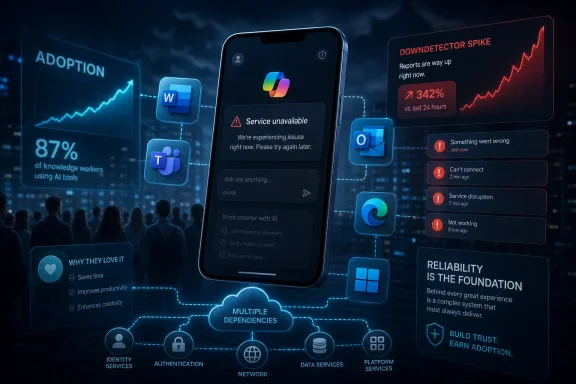
Microsoft Copilot appeared to suffer a service disruption on Monday, June 1, 2026, with Downdetector showing more than 2,600 user reports by 9:17 a.m. Pacific time and most complaints centered on the mobile app rather than the broader Microsoft 365 stack. That number does not prove a confirmed Microsoft outage by itself, but it is large enough to tell us something useful: Copilot has crossed from optional experiment into everyday dependency. When an AI assistant goes dark, users now notice the way they once noticed email, search, or Teams going dark. Microsoft’s AI strategy is no longer just a product roadmap; it is an availability promise.
There was a time when a Copilot hiccup would have been a curiosity, mostly interesting to AI watchers and early adopters. That time has passed. Microsoft has spent the last three years wiring Copilot into Windows, Edge, Bing, Office, Teams, mobile apps, enterprise workflows, and the general mental model of “how Microsoft software works now.”
That is why a few thousand Downdetector reports matter more than the raw number suggests. Downdetector is not a canonical incident tracker, and it does not distinguish cleanly between a global outage, a regional failure, login friction, app regressions, user confusion, and ordinary internet noise. But it is good at detecting pain that users feel quickly enough to complain about it.
The reported emphasis on the mobile app is especially telling. Microsoft has marketed Copilot as something more ambient than a desktop feature and more personal than a search box. If mobile access is where users most visibly hit trouble, the interruption lands not as an enterprise dashboard anomaly but as a broken daily habit.
That framing matters because Microsoft has attached Copilot to a much bigger bet than chatbot convenience. The company wants AI to become the interface layer across its software estate. Every outage tests whether users experience that layer as a dependable utility or as a clever add-on that still needs a fallback.
A spike can mean the service is down. It can also mean a login dependency is failing, a mobile app release has regressed, a DNS path is misbehaving, a regional provider is having trouble, or a popular account has told followers to check whether something is broken. The higher the spike and the more consistent the reports, the more seriously administrators should take it, but Downdetector alone cannot answer the operational question everyone cares about: what broke?
That limitation is more acute with Copilot than with older services. “Copilot” is not one thing. It is a consumer assistant, a Microsoft 365 work assistant, a Windows experience, a mobile app, a web surface, a browser feature, and a branding layer attached to multiple underlying systems.
When a user says Copilot is down, they may mean the iOS or Android app will not load. They may mean prompts stall. They may mean enterprise grounding is unavailable. They may mean sign-in fails. They may mean the model answers but cannot access work data. Those are very different incidents from an administrator’s point of view, even if they all collapse into the same public complaint: Copilot is not working.
But abstraction has a cost. The more Microsoft makes Copilot feel like a single assistant, the more users expect it to fail or recover like a single assistant. Under the hood, Copilot depends on a chain of services that includes identity, cloud routing, model access, safety systems, app-specific integrations, data indexing, and in many contexts Microsoft Graph.
For consumers, that chain can be invisible until the mobile app stalls. For businesses, it is part of a governance and support problem. A Copilot failure can look like an AI outage to the help desk, an authentication issue to identity teams, a Microsoft 365 incident to tenant admins, or a productivity problem to users who simply cannot summarize a meeting or draft a document.
That is the uncomfortable paradox of Microsoft’s Copilot push. The company wants users to stop thinking about where AI begins and ends. IT departments, meanwhile, need exactly that boundary to troubleshoot, communicate, and manage risk.
A desktop outage can sometimes be routed around. Users can open another browser, switch networks, try the web app, or fall back to the Office application they were already using. A mobile-app failure often feels more total because the app is the product in that moment.
Mobile also brings extra variables. App store releases roll out unevenly, push notifications and cached sessions behave differently across platforms, and mobile identity flows are notoriously sensitive to token, browser, and device-management interactions. When Copilot breaks there, the cause may not sit neatly in “AI” at all.
For Microsoft, that distinction may be technically fair but strategically irrelevant. Users do not judge the assistant by architectural nuance. They judge whether the thing they tapped opened, understood them, and responded.
AI assistants are being promoted into that same tier at extraordinary speed. Microsoft’s own product strategy encourages employees to depend on Copilot for summarization, drafting, meeting recall, search, document analysis, and workflow acceleration. That makes downtime more consequential even when the underlying business process still technically has a manual fallback.
The trouble is that the habits around AI availability are less mature than the marketing. Many organizations still do not have a clear internal definition of Copilot criticality. Is it a productivity enhancer? A supported line-of-business tool? A regulated data interface? A search layer? A shadow help desk? The answer changes how seriously an outage should be treated.
A brief consumer-facing disruption is not the same as a tenant-wide Microsoft 365 Copilot incident. Still, both belong to the same broader transition. AI is moving from novelty to infrastructure, and infrastructure is judged by boring metrics: uptime, transparency, administrative control, and predictable failure modes.
A user who asks Copilot to summarize a document can read the document manually. A salesperson who asks it to draft a follow-up can write the email. A manager who asks it to recap a meeting can scan the transcript. In isolation, those fallbacks sound trivial.
At scale, they are not. The entire business case for paid enterprise AI rests on shaving time from repeated knowledge-work tasks. If users learn that Copilot is intermittent, they stop trusting it for time-sensitive work. If they stop trusting it, adoption becomes shallower. If adoption becomes shallower, the return-on-investment case gets harder to defend.
That is why even short outages have reputational weight. AI tools do not merely compete on feature lists; they compete on confidence. The user has to believe the assistant will be there when called, and administrators have to believe they can explain failures when it is not.
But there is a communication gap between those two worlds. Downdetector spikes appear in public within minutes. Users flood social media, group chats, and help desks. Meanwhile, official incident notices may be scoped to administrators, delayed while Microsoft investigates, or limited to tenants Microsoft believes are affected.
That gap is not unique to Microsoft, and it is not easy to solve. Premature incident declarations can create confusion, especially for services with regional or partial impact. But the more Copilot becomes a mainstream productivity surface, the less sustainable it is for ordinary users to learn about service health primarily through crowd-sourced complaint graphs.
Microsoft has a particular challenge because Copilot crosses consumer and commercial boundaries. A consumer Copilot mobile issue may not belong in the Microsoft 365 admin center. A Microsoft 365 Copilot issue may not be visible to consumer users. A shared dependency could affect both in different ways. The brand is unified; the status model is not.
The company has consumer Copilot experiences aimed at general users, Microsoft 365 Copilot for work data and productivity apps, Copilot Pro for paid personal features, GitHub Copilot for developers, Security Copilot for security teams, and a long list of in-product copilots across Azure, Power Platform, Windows, and Dynamics. Some share infrastructure, some share concepts, and some share little beyond the brand architecture.
When public reports say “Microsoft Copilot is down,” readers should ask which Copilot. That sounds pedantic until a help desk has to decide whether to alert executives, whether to open a Microsoft support ticket, whether to tell users to switch to the web app, or whether to treat the issue as isolated to unmanaged mobile devices.
Brand simplification helps adoption, but it can blur accountability. If Microsoft wants Copilot to be perceived as a coherent assistant, it will be pressured to provide coherent service visibility. Otherwise, the company gets the downside of one brand without the operational clarity users expect from one service.
That makes outages feel different from old-fashioned application failures. If Notepad breaks, users blame Notepad. If Copilot fails inside Windows or alongside Microsoft 365, users may blame Windows, Microsoft accounts, Edge, Office, or “AI” generically. The service boundary is fuzzy enough that user frustration spreads across the ecosystem.
This matters for enthusiasts as well as administrators. Many Windows users have been skeptical of Copilot’s placement in the operating system, especially when AI features appear before they feel essential. An outage reinforces the argument that cloud-dependent AI should not be treated like a native OS capability unless its failure state is graceful.
The correct answer is not that Microsoft should keep AI out of Windows. That ship has sailed. The better question is whether Windows can make AI feel integrated without making the desktop feel dependent on a remote assistant that may be unavailable at inconvenient times.
In a managed environment, Copilot may be governed by tenant settings, conditional access, sensitivity labels, retention policies, audit requirements, and data-loss-prevention rules. Users may access it through Teams, Word, Outlook, Edge, the Microsoft 365 app, or mobile endpoints under device management. An apparent outage may involve any layer in that chain.
That complexity raises the bar for internal communications. Telling users “Copilot is down” may be too broad. Telling them “Microsoft has not confirmed an incident” may be technically accurate but practically useless if half the department cannot use the feature. Administrators need a middle path that acknowledges symptoms without overstating cause.
The best operational stance is boring but effective: check official tenant health, compare reports across platforms, test from managed and unmanaged devices, identify whether web access works when mobile does not, and document the time window. That gives the organization a usable incident record even if Microsoft later classifies the issue narrowly or never confirms it publicly.
An assistant that is brilliant but intermittent is hard to build habits around. An assistant that is slightly less magical but always available may be more valuable in routine work. This is an old lesson from enterprise software, now arriving in AI with uncomfortable speed.
Microsoft should know this better than almost anyone. The company’s dominance in productivity software was not built only on features; it was built on institutional trust, file compatibility, administrative control, and predictable availability. Copilot inherits that trust but does not automatically keep it.
That is why outages, even possible ones, deserve scrutiny. They reveal whether the AI layer is being operated with the seriousness of the productivity layer it is supposed to augment. If Copilot is the new front door to Microsoft work, then its uptime is not a side metric. It is the product.
That context shapes how users interpret a new Downdetector spike. One isolated outage can be forgiven. A pattern of visible disruptions makes customers more sensitive to each new incident, especially when the affected service is tied to Microsoft’s most heavily promoted strategic initiative.
To be fair, Microsoft operates at a scale where some service degradation is inevitable. The company supports enormous consumer platforms, enterprise tenants, developer services, cloud infrastructure, gaming networks, and identity systems. A zero-incident standard would be fantasy.
But scale cuts both ways. Microsoft’s size explains why reliability is hard, and it also explains why reliability expectations are high. The company is not selling a toy assistant from a startup lab. It is selling AI as the next layer of work for organizations that already depend on Microsoft for email, documents, meetings, endpoints, security, and identity.
This is the adoption cliff that enterprise AI vendors do not like to discuss. The first phase is curiosity. The second is experimentation. The third is habit. The fourth is dependency. Reliability failures can push users backward from dependency to experimentation, where every task once again requires the mental overhead of deciding whether AI is worth trying.
That overhead is deadly for productivity tools. A successful assistant should reduce decisions, not add them. If users must ask “Will Copilot work right now?” before asking Copilot anything else, Microsoft has already lost part of the interface battle.
The same applies to administrators. If IT teams cannot predict how Copilot fails, how Microsoft communicates those failures, and which controls remain available during degraded service, they will treat the tool more cautiously. That caution may be justified, but it slows the very transformation Microsoft is trying to accelerate.
Still, the episode gives Windows users and IT teams several concrete lessons.
 Copilot’s Outage Problem Is Really an Adoption Story
There was a time when a Copilot hiccup would have been a curiosity, mostly interesting to AI watchers and early adopters. That time has passed. Microsoft has spent the last three years wiring Copilot into Windows, Edge, Bing, Office, Teams, mobile apps, enterprise workflows, and the general mental model of “how Microsoft software works now.”That is why a few thousand Downdetector reports matter more than the raw number suggests. Downdetector is not a canonical incident tracker, and it does not distinguish cleanly between a global outage, a regional failure, login friction, app regressions, user confusion, and ordinary internet noise. But it is good at detecting pain that users feel quickly enough to complain about it.
The reported emphasis on the mobile app is especially telling. Microsoft has marketed Copilot as something more ambient than a desktop feature and more personal than a search box. If mobile access is where users most visibly hit trouble, the interruption lands not as an enterprise dashboard anomaly but as a broken daily habit.
That framing matters because Microsoft has attached Copilot to a much bigger bet than chatbot convenience. The company wants AI to become the interface layer across its software estate. Every outage tests whether users experience that layer as a dependable utility or as a clever add-on that still needs a fallback.
Downdetector Is a Smoke Alarm, Not a Fire Report
The first thing IT readers should do with any Downdetector spike is resist the urge to treat it as a postmortem. It is not. Downdetector collects user-submitted reports and aggregates signals from multiple sources, which makes it useful for early detection but imperfect for diagnosis.A spike can mean the service is down. It can also mean a login dependency is failing, a mobile app release has regressed, a DNS path is misbehaving, a regional provider is having trouble, or a popular account has told followers to check whether something is broken. The higher the spike and the more consistent the reports, the more seriously administrators should take it, but Downdetector alone cannot answer the operational question everyone cares about: what broke?
That limitation is more acute with Copilot than with older services. “Copilot” is not one thing. It is a consumer assistant, a Microsoft 365 work assistant, a Windows experience, a mobile app, a web surface, a browser feature, and a branding layer attached to multiple underlying systems.
When a user says Copilot is down, they may mean the iOS or Android app will not load. They may mean prompts stall. They may mean enterprise grounding is unavailable. They may mean sign-in fails. They may mean the model answers but cannot access work data. Those are very different incidents from an administrator’s point of view, even if they all collapse into the same public complaint: Copilot is not working.
Microsoft Built One Brand on Many Dependencies
Microsoft’s Copilot branding has been effective precisely because it simplifies the pitch. The user does not need to know which model, tenant boundary, app integration, identity provider, index, plugin, connector, retrieval pipeline, or compliance feature is involved. They ask, Copilot answers.But abstraction has a cost. The more Microsoft makes Copilot feel like a single assistant, the more users expect it to fail or recover like a single assistant. Under the hood, Copilot depends on a chain of services that includes identity, cloud routing, model access, safety systems, app-specific integrations, data indexing, and in many contexts Microsoft Graph.
For consumers, that chain can be invisible until the mobile app stalls. For businesses, it is part of a governance and support problem. A Copilot failure can look like an AI outage to the help desk, an authentication issue to identity teams, a Microsoft 365 incident to tenant admins, or a productivity problem to users who simply cannot summarize a meeting or draft a document.
That is the uncomfortable paradox of Microsoft’s Copilot push. The company wants users to stop thinking about where AI begins and ends. IT departments, meanwhile, need exactly that boundary to troubleshoot, communicate, and manage risk.
The Mobile App Is the Weakest Place for a Trust Test
If Monday’s reports were indeed concentrated around the mobile application, the outage sits in a revealing corner of the Copilot ecosystem. Mobile assistants are supposed to be immediate. They are used in gaps: between meetings, on commutes, while traveling, or when a user does not have the full desktop workspace in front of them.A desktop outage can sometimes be routed around. Users can open another browser, switch networks, try the web app, or fall back to the Office application they were already using. A mobile-app failure often feels more total because the app is the product in that moment.
Mobile also brings extra variables. App store releases roll out unevenly, push notifications and cached sessions behave differently across platforms, and mobile identity flows are notoriously sensitive to token, browser, and device-management interactions. When Copilot breaks there, the cause may not sit neatly in “AI” at all.
For Microsoft, that distinction may be technically fair but strategically irrelevant. Users do not judge the assistant by architectural nuance. They judge whether the thing they tapped opened, understood them, and responded.
AI Assistants Are Becoming Tier-One Services Before They Have Tier-One Habits
Traditional enterprise software earned its operational status over decades. Email became critical. Then collaboration platforms became critical. Then identity became existential. Each layer developed monitoring practices, escalation routes, admin portals, service-health norms, and a shared language for incidents.AI assistants are being promoted into that same tier at extraordinary speed. Microsoft’s own product strategy encourages employees to depend on Copilot for summarization, drafting, meeting recall, search, document analysis, and workflow acceleration. That makes downtime more consequential even when the underlying business process still technically has a manual fallback.
The trouble is that the habits around AI availability are less mature than the marketing. Many organizations still do not have a clear internal definition of Copilot criticality. Is it a productivity enhancer? A supported line-of-business tool? A regulated data interface? A search layer? A shadow help desk? The answer changes how seriously an outage should be treated.
A brief consumer-facing disruption is not the same as a tenant-wide Microsoft 365 Copilot incident. Still, both belong to the same broader transition. AI is moving from novelty to infrastructure, and infrastructure is judged by boring metrics: uptime, transparency, administrative control, and predictable failure modes.
The Cost of Failure Is Not Just Lost Prompts
The obvious cost of a Copilot outage is that users cannot get answers. That understates the problem. The deeper cost is workflow interruption at the exact point where Microsoft has encouraged users to insert AI into the middle of tasks.A user who asks Copilot to summarize a document can read the document manually. A salesperson who asks it to draft a follow-up can write the email. A manager who asks it to recap a meeting can scan the transcript. In isolation, those fallbacks sound trivial.
At scale, they are not. The entire business case for paid enterprise AI rests on shaving time from repeated knowledge-work tasks. If users learn that Copilot is intermittent, they stop trusting it for time-sensitive work. If they stop trusting it, adoption becomes shallower. If adoption becomes shallower, the return-on-investment case gets harder to defend.
That is why even short outages have reputational weight. AI tools do not merely compete on feature lists; they compete on confidence. The user has to believe the assistant will be there when called, and administrators have to believe they can explain failures when it is not.
The Admin Center Cannot Be the Only Source of Truth Users Understand
Microsoft’s official service-health channels remain the place administrators should check for confirmed Microsoft 365 incidents. That is the right hierarchy. Public outage trackers are noisy; tenant-specific health pages and admin advisories are closer to the operational source.But there is a communication gap between those two worlds. Downdetector spikes appear in public within minutes. Users flood social media, group chats, and help desks. Meanwhile, official incident notices may be scoped to administrators, delayed while Microsoft investigates, or limited to tenants Microsoft believes are affected.
That gap is not unique to Microsoft, and it is not easy to solve. Premature incident declarations can create confusion, especially for services with regional or partial impact. But the more Copilot becomes a mainstream productivity surface, the less sustainable it is for ordinary users to learn about service health primarily through crowd-sourced complaint graphs.
Microsoft has a particular challenge because Copilot crosses consumer and commercial boundaries. A consumer Copilot mobile issue may not belong in the Microsoft 365 admin center. A Microsoft 365 Copilot issue may not be visible to consumer users. A shared dependency could affect both in different ways. The brand is unified; the status model is not.
The Copilot Brand Is Carrying More Than the Product Can Neatly Contain
Microsoft has put Copilot almost everywhere, and that ubiquity has made the name both powerful and imprecise. For marketing, that is a feature. For incident response, it is a bug.The company has consumer Copilot experiences aimed at general users, Microsoft 365 Copilot for work data and productivity apps, Copilot Pro for paid personal features, GitHub Copilot for developers, Security Copilot for security teams, and a long list of in-product copilots across Azure, Power Platform, Windows, and Dynamics. Some share infrastructure, some share concepts, and some share little beyond the brand architecture.
When public reports say “Microsoft Copilot is down,” readers should ask which Copilot. That sounds pedantic until a help desk has to decide whether to alert executives, whether to open a Microsoft support ticket, whether to tell users to switch to the web app, or whether to treat the issue as isolated to unmanaged mobile devices.
Brand simplification helps adoption, but it can blur accountability. If Microsoft wants Copilot to be perceived as a coherent assistant, it will be pressured to provide coherent service visibility. Otherwise, the company gets the downside of one brand without the operational clarity users expect from one service.
Windows Users Are Now Part of the Blast Radius
For WindowsForum readers, the Copilot story is not confined to the mobile app. Windows itself has become a stage for Microsoft’s AI ambitions, even as the exact implementation has shifted over time. Copilot has moved through taskbar buttons, web-backed panes, app experiences, keyboard branding, and integrations that reflect Microsoft’s continuing search for the right balance between operating-system feature and cloud assistant.That makes outages feel different from old-fashioned application failures. If Notepad breaks, users blame Notepad. If Copilot fails inside Windows or alongside Microsoft 365, users may blame Windows, Microsoft accounts, Edge, Office, or “AI” generically. The service boundary is fuzzy enough that user frustration spreads across the ecosystem.
This matters for enthusiasts as well as administrators. Many Windows users have been skeptical of Copilot’s placement in the operating system, especially when AI features appear before they feel essential. An outage reinforces the argument that cloud-dependent AI should not be treated like a native OS capability unless its failure state is graceful.
The correct answer is not that Microsoft should keep AI out of Windows. That ship has sailed. The better question is whether Windows can make AI feel integrated without making the desktop feel dependent on a remote assistant that may be unavailable at inconvenient times.
Enterprise IT Sees a Different Outage Than Consumers Do
A consumer sees a broken app. Enterprise IT sees a support surface with policy, compliance, identity, licensing, and data-boundary implications. That difference is why Copilot incidents are more complicated than ordinary chatbot downtime.In a managed environment, Copilot may be governed by tenant settings, conditional access, sensitivity labels, retention policies, audit requirements, and data-loss-prevention rules. Users may access it through Teams, Word, Outlook, Edge, the Microsoft 365 app, or mobile endpoints under device management. An apparent outage may involve any layer in that chain.
That complexity raises the bar for internal communications. Telling users “Copilot is down” may be too broad. Telling them “Microsoft has not confirmed an incident” may be technically accurate but practically useless if half the department cannot use the feature. Administrators need a middle path that acknowledges symptoms without overstating cause.
The best operational stance is boring but effective: check official tenant health, compare reports across platforms, test from managed and unmanaged devices, identify whether web access works when mobile does not, and document the time window. That gives the organization a usable incident record even if Microsoft later classifies the issue narrowly or never confirms it publicly.
Reliability Is Now Part of the AI Feature Set
The AI market still talks as though model quality is the main event. Better reasoning, larger context windows, faster responses, richer multimodal input, more capable agents: these are the features that dominate demos. But for everyday users, reliability is becoming just as important.An assistant that is brilliant but intermittent is hard to build habits around. An assistant that is slightly less magical but always available may be more valuable in routine work. This is an old lesson from enterprise software, now arriving in AI with uncomfortable speed.
Microsoft should know this better than almost anyone. The company’s dominance in productivity software was not built only on features; it was built on institutional trust, file compatibility, administrative control, and predictable availability. Copilot inherits that trust but does not automatically keep it.
That is why outages, even possible ones, deserve scrutiny. They reveal whether the AI layer is being operated with the seriousness of the productivity layer it is supposed to augment. If Copilot is the new front door to Microsoft work, then its uptime is not a side metric. It is the product.
The User-Report Spike Arrived in a Crowded Microsoft Reliability Calendar
Monday’s Copilot reports did not appear in a vacuum. Microsoft services have had multiple high-profile disruptions over the last year, including incidents affecting Outlook, Microsoft 365 services, authentication, and regional cloud availability. Some were confirmed by Microsoft, some were primarily visible through user reports, and some had narrow scopes that nonetheless caused broad confusion.That context shapes how users interpret a new Downdetector spike. One isolated outage can be forgiven. A pattern of visible disruptions makes customers more sensitive to each new incident, especially when the affected service is tied to Microsoft’s most heavily promoted strategic initiative.
To be fair, Microsoft operates at a scale where some service degradation is inevitable. The company supports enormous consumer platforms, enterprise tenants, developer services, cloud infrastructure, gaming networks, and identity systems. A zero-incident standard would be fantasy.
But scale cuts both ways. Microsoft’s size explains why reliability is hard, and it also explains why reliability expectations are high. The company is not selling a toy assistant from a startup lab. It is selling AI as the next layer of work for organizations that already depend on Microsoft for email, documents, meetings, endpoints, security, and identity.
The Real Risk Is Habit Reversal
The most dangerous outcome for Microsoft is not a bad morning on Downdetector. It is users quietly deciding that Copilot cannot be trusted for important tasks. Once that happens, adoption metrics can hide a weaker reality: people may have access to Copilot, may occasionally try it, and may still avoid relying on it when deadlines matter.This is the adoption cliff that enterprise AI vendors do not like to discuss. The first phase is curiosity. The second is experimentation. The third is habit. The fourth is dependency. Reliability failures can push users backward from dependency to experimentation, where every task once again requires the mental overhead of deciding whether AI is worth trying.
That overhead is deadly for productivity tools. A successful assistant should reduce decisions, not add them. If users must ask “Will Copilot work right now?” before asking Copilot anything else, Microsoft has already lost part of the interface battle.
The same applies to administrators. If IT teams cannot predict how Copilot fails, how Microsoft communicates those failures, and which controls remain available during degraded service, they will treat the tool more cautiously. That caution may be justified, but it slows the very transformation Microsoft is trying to accelerate.
A Small Downdetector Spike With a Large Strategic Shadow
Monday’s reported Copilot disruption should not be inflated beyond the available facts. Public reports showed thousands of users experiencing problems, with mobile complaints leading the mix, but Downdetector is not a root-cause analysis and public reporting alone does not establish the precise scope of the incident.Still, the episode gives Windows users and IT teams several concrete lessons.
- Downdetector spikes should be treated as early-warning signals, not as definitive confirmation of a Microsoft service incident.
- Copilot failures are harder to interpret than traditional app outages because the Copilot brand spans consumer, enterprise, mobile, web, Windows, and Microsoft 365 experiences.
- Mobile-app disruption matters disproportionately because users expect an assistant on a phone to be immediate, personal, and available outside the desktop workflow.
- Enterprise administrators should compare Copilot behavior across web, desktop, mobile, and tenant-scoped Microsoft 365 experiences before declaring a broad outage.
- Microsoft’s AI ambitions make Copilot reliability a strategic issue, not merely a support issue, because user habits depend on confidence as much as capability.
- The more Microsoft presents Copilot as a unified assistant, the more pressure it will face to provide unified, understandable service-health communication.
References
- Primary source: GV Wire
Published: Mon, 01 Jun 2026 16:20:32 GMT
Microsoft Copilot Down for Thousands Monday, Downdetector Shows
Thousands reported issues with Microsoft Copilot on Monday, with many users affected by problems in the mobile application. gvwire.com
- Official source: learn.microsoft.com
How to check Microsoft 365 service health - Microsoft 365 Enterprise | Microsoft Learn
View the health status of Microsoft 365 services before you call support to see if there's an active service interruption.learn.microsoft.com - Related coverage: outage.report

Microsoft Copilot down? Outage map, service status, incidents history
See if Microsoft Copilot is down or it's just you. Check current status and outage map. Post yours and see other's reports and complaints
outage.report
- Related coverage: bleepingcomputer.com
Microsoft fixes outage affecting MFA setup, MySignIn service
Microsoft is working to address an ongoing incident preventing customers from setting up multi-factor authentication (MFA) or accessing the My Sign-Ins platform.www.bleepingcomputer.com - Related coverage: windowscentral.com
Is Microsoft 365 down? Microsoft confirms major outage of services in some regions | Windows Central
Microsoft 365 is down in some regions in North America, knocking offline services such as Outlook and Purview.www.windowscentral.com - Related coverage: support.nhs.net
- Related coverage: tomsguide.com
Outlook is down — the latest on the ongoing Microsoft outage | Tom's Guide
What's happening with Microsoft's popular service?www.tomsguide.com - Related coverage: androidauthority.com
Is Microsoft Copilot not working? Here's what's going on (Update: Back up)
If you're having problems with Microsoft Copilot and Azure, you're not alone. Multiple Microsoft services appear to be down.www.androidauthority.com - Related coverage: downdetector.fi
Microsoft Copilot down? Current problems and outages - FI
Real-time problems and outages for Microsoft Copilot. Is Microsoft Copilot down? Here you see what is going on.downdetector.fi - Related coverage: isdown.app
Microsoft Copilot Outage History
Complete Microsoft Copilot outage history. Browse past Microsoft Copilot incidents with detection times, duration, and resolution details. isdown.app
- Related coverage: downdetector.in
Microsoft Copilot down? Current problems and outages - IN
Real-time problems and outages for Microsoft Copilot. Is Microsoft Copilot down? Here you see what is going on.downdetector.in - Related coverage: techradar.com
Microsoft spent billions on Copilot, but only 3.3% of users are actually paying for the AI tools | TechRadar
Microsoft spent $37.5 billion on AI tools, with limited returns so farwww.techradar.com - Related coverage: gamesradar.com
Xbox CEO confirms it's "winding down" Microsoft Copilot on mobile and ending it on console | GamesRadar+
Xbox originally announced Copilot for console in Marchwww.gamesradar.com
