

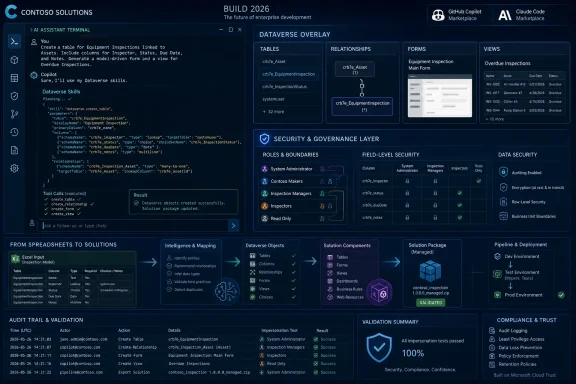
Microsoft used Build 2026 to show a Dataverse plugin for coding agents that lets GitHub Copilot and Claude Code act on enterprise data models, CRM records, and security configuration through natural-language prompts in a terminal, with availability now through the Claude and GitHub Copilot marketplaces. The demo matters because it reframes Dataverse not as another low-code back end waiting for a maker, but as a business platform that can be manipulated by an agent with enough guardrails to avoid the usual hallucination trap. Microsoft is not merely promising that AI can write code faster; it is arguing that AI can safely perform the messy middle of enterprise application work. That is a much bigger claim, and one IT departments should examine carefully.
The most interesting part of Microsoft’s Dataverse plugin announcement is not that an agent can create a table. We have been watching AI tools scaffold code, generate schemas, and spit out plausible configuration for years now. The leap here is that Microsoft wants the agent to operate directly inside Dataverse with awareness of solutions, relationships, forms, views, users, business units, field-level security, and deployment packaging.
That distinction matters. A general-purpose coding agent can guess at a schema from a prompt, but it does not inherently know the difference between a lookup, a many-to-many relationship, a choice column, a security role, or a component that must be explicitly added to a solution. In a consumer toy app, those mistakes are annoying. In a production Dataverse environment, they are the difference between a useful business system and a compliance incident wearing a friendly Copilot glow.
Microsoft’s thesis is that domain tooling is what turns an agent from an autocomplete engine into an enterprise operator. The plugin gives the agent a controlled vocabulary and a set of tools for acting on Dataverse objects. That is the same architectural direction Microsoft has been pushing elsewhere with MCP servers, Copilot extensions, and Power Platform governance: the agent should not simply be smarter; it should be better connected to the system of record.
The Build 2026 example wraps that idea in a fictional company, Zava Coffee Co., a B2B roaster and distributor stuck in the familiar swamp of spreadsheets, email threads, and copy-paste operations. The fictional framing is marketing, but the problems are painfully real. Every midmarket company has some version of Zava hiding in operations, sales, inventory, support, or finance.
She starts with the simplest possible request: connect me to my Dataverse environment. According to Microsoft’s demo, the agent discovers her environments from her Microsoft identity, configures the connection, and verifies it. That may sound like setup plumbing, but setup plumbing is where many enterprise tools quietly lose new users.
Microsoft is acknowledging a basic truth about platform adoption: the first ten minutes often decide whether a tool gets explored or abandoned. If a developer has to know an org URL, publisher prefix, CLI syntax, authentication model, and solution structure before getting a first success, the platform has already narrowed its audience. An agent that can discover and configure the environment makes Dataverse feel less like a gated administrative estate and more like a reachable development surface.
Maya then describes the business model in ordinary terms: beans, roast batches, quality checks, orders, and the relationships among them. The plugin-driven agent creates four tables, choice columns, lookups, a self-referential relationship for re-roasts, a many-to-many relationship between batches and orders, a main form, and a filtered view. Most importantly, it packages the work in a solution.
That last point is easy to overlook. A demo that creates tables is a toy; a demo that creates solution-contained components is gesturing toward lifecycle management. Dataverse shops live and die by whether their work can be moved, versioned, and governed across environments. Microsoft knows that “the agent made it” will not satisfy an admin who needs repeatable deployment.
That is the kind of task that exposes whether an agent is simply generating happy-path objects or actually handling enterprise mess. Business data rarely arrives normalized, perfectly keyed, or ready for a relational model. It arrives as Excel files maintained by different people with different habits, duplicate naming conventions, missing references, and column meanings that exist mostly in someone’s head.
The agent’s handling of dependency order is particularly important. Dataverse relationships impose sequencing constraints, and a naive importer can fail because it tries to create child records before parents exist. A self-referential hierarchy adds another wrinkle, because the system has to understand which records can be created first and which links must be resolved later.
There is also a subtle product-positioning win in the unlinked order example. A brittle automation script often treats a bad row as a hard stop. A useful enterprise tool reports the exception, preserves the rest of the migration, and gives the operator a tractable cleanup problem. That is the difference between a demo that looks magical on stage and a tool that survives Friday afternoon data reality.
The strategic pitch is clear: Microsoft wants Dataverse development to feel conversational without becoming casual. The agent lowers the front door, but the output still has to land in the formal structures that enterprise administrators expect. If Microsoft can maintain that balance, the plugin becomes more than a convenience layer.
Riya asks for Carlos’s open opportunities over $100,000 closing this quarter. The agent looks up Carlos in the system user table, translates “this quarter” into a date range, applies the open-state filter, and returns deal names, café names, amounts, and stages. The promise is not that the agent invents insight; it removes the syntax tax.
That syntax tax has always been one of enterprise software’s quiet productivity drains. Users know what they mean by “open,” “this quarter,” “Carlos’s deals,” and “over 100K,” but systems usually require them to express those ideas through specific fields, values, states, and date boundaries. Every CRM power user becomes a part-time translator between business language and database language.
The plugin’s value is that it translates without fully hiding the underlying system. The agent still acts against Dataverse tables and relationships. It still has to resolve users, states, dates, opportunities, accounts, and activities. The interface is conversational, but the work underneath remains structured.
This is where Microsoft’s approach differs from a generic chatbot layered over exported CRM data. A chatbot can summarize a snapshot. A Dataverse-aware agent can query, join, create notes, assign activities, and link records back to the live operational system. That is a more powerful pattern, and therefore a riskier one.
In Microsoft’s demo, Riya asks for cafés in Portland that have not reordered in 30 days. The agent has to infer that this is not a simple field lookup but a relationship-and-date calculation across accounts and closed-won opportunities. That is already a more advanced query than many business users comfortably build in Advanced Find or Excel.
Then Riya asks the agent to add a note to the Portland café opportunity. The agent finds the open deal on that account. It also logs a phone call on behalf of Carlos, marks the activity as completed, resolves the contact as a participant, and links the record to the proper account. Microsoft presents this as the moment the workflow stops being search and becomes operational assistance.
That is exactly where administrators will start asking hard questions. How does the agent decide which “Portland café opportunity” is the right one if there are multiple matches? What approval step appears before a write? How are ambiguous prompts handled? What audit trail distinguishes Riya’s request, the agent’s inference, and the resulting Dataverse change?
Microsoft’s demo emphasizes the positive path, but enterprise deployment will hinge on the gray areas. If the agent is too timid, it becomes another assistant that drafts suggestions but never completes work. If it is too confident, it becomes a record-writing machine with a pleasing interface and dangerous assumptions.
The right model is likely not full autonomy everywhere. It is bounded autonomy: read freely within permissions, propose writes when ambiguity exists, execute low-risk updates when confidence and policy thresholds are met, and preserve enough explanation that users and auditors can reconstruct what happened. That is not as flashy as “talk to your CRM,” but it is how these tools become survivable.
Zava has grown and opened a Seattle hub. Warehouse staff can see deal sizes, sales reps can see quality scores, and customer lifetime value is too broadly exposed. Amara, the platform admin, needs to impose boundaries across two regions and three job functions without clicking through a maze of portal screens.
The agent begins by verifying that Amara has System Administrator privileges before attempting destructive or sensitive work. That is a small but important signal. A credible enterprise agent should not merely obey; it should check posture, permissions, and preconditions before it acts.
Amara then describes a full security model in one prompt: Portland and Seattle business units, three custom roles scoped appropriately, field-level security for a sensitive lifetime value column, an access team template for cross-region collaboration, and user assignments, all packaged in a ZavaSecurity solution. This is not glamorous work, but it is exactly the kind of work that creates brittle configurations when rushed or performed manually.
Microsoft’s demo highlights a detail only platform practitioners tend to appreciate: field-level security has invisible prerequisites. The column must be enabled for field-level security at the schema level before the profile is created. The profile must be assigned properly or it does nothing. Security components must be added to a solution explicitly because they do not all magically appear there by association.
That is the kind of domain specificity that makes the plugin interesting. A general agent can produce a checklist. A Dataverse-aware agent can know the trapdoors.
That is the admin equivalent of a unit test, and it points toward the future of agentic IT operations. The value is not merely faster configuration. It is faster configuration followed immediately by validation against intended outcomes.
Enterprise platforms have long suffered from a gap between “I configured the thing” and “the thing behaves as intended.” Admin portals usually expose objects, toggles, permissions, and assignments. They rarely give a clear end-to-end proof that user A can do X, user B cannot do Y, and exception Z is logged as expected. Humans bridge that gap with test accounts, browser sessions, screenshots, and institutional memory.
An agent that can create a security model and then impersonate or simulate access changes the workflow. It can turn intent into configuration, and configuration into a testable assertion. If Microsoft continues down that path, the important artifact may not be the role itself but the evidence that the role works.
There is a caution here too. Security validation must be treated as first-class evidence, not stage-demo decoration. Admins will need logs, exportable results, environment context, timestamps, and clear differentiation between simulated access and actual impersonated behavior. The more authority the agent has, the more boring and rigorous its proof needs to be.
The distinction matters because enterprise buyers are becoming fluent in AI marketing. They know that every assistant demo looks competent when the prompt, dataset, user, and desired outcome are known in advance. They also know the real test comes when names collide, records are missing, permissions are partial, date language is ambiguous, and a user asks for something that violates policy.
Domain tooling helps because it gives the model structured actions and system feedback. Instead of inventing a Dataverse schema in text, the agent can call tools that inspect environments, list tables, create columns, resolve relationships, and validate results. Failed calls can be handled. Missing objects can be reported. Permission boundaries can be respected.
But the model still interprets intent. It still decides which tool to call, which object a user meant, and when a prompt is specific enough to act. The guardrail is not that the agent becomes infallible. The guardrail is that its actions are constrained by platform APIs, identity, permissions, and validation loops.
That makes governance the real product battleground. The winning enterprise agent will not be the one that sounds most confident. It will be the one that knows when to ask for confirmation, when to refuse, when to produce a dry run, when to explain a dependency, and when to leave a record untouched.
The Build 2026 plugin announcement turns that convergence into an agent story. If agents are going to act on business systems, they need a substrate that has identities, permissions, schemas, relationships, auditability, and deployment packaging. Dataverse is one of Microsoft’s answers to that requirement.
This also explains why the examples span three different personas. Maya represents the developer who does not want to become a Dataverse specialist before building a useful app. Riya represents the business operator who understands the process but not the query language. Amara represents the administrator who owns the consequences when access control is wrong.
The common thread is that each user speaks in intent, while the agent translates that intent into Dataverse operations. That is the product story Microsoft wants buyers to internalize: one platform, multiple skill levels, one agent-mediated interface. If it works, it reduces the friction between business knowledge and working software.
The risk is that Microsoft could make serious platform changes feel deceptively casual. Natural language has a way of making complex operations look smaller than they are. “Lock down customer lifetime value” is a sentence; the implementation touches schema, roles, profiles, users, auditing, testing, and deployment. The agent may compress the workflow, but it should not compress the accountability.
That matters because many organizations already have Power Platform sprawl. Departments build apps, flows, reports, and data stores because centralized IT cannot deliver every workflow fast enough. The result can be productive and chaotic at the same time. Dataverse, when governed well, gives those solutions a more durable foundation than disconnected spreadsheets and ad hoc SharePoint lists.
An agent that creates Dataverse solutions raises the stakes. It could help teams move faster into governed structures. It could also help them create more objects, more roles, more apps, and more dependencies than administrators can track if governance is not ready.
The practical question for IT is not whether the demo is impressive. It is whether the environment policies, data loss prevention rules, maker permissions, audit settings, lifecycle practices, and review processes are mature enough for agent-assisted creation. If they are not, the plugin may simply accelerate the existing mess.
This is a familiar Microsoft dynamic. The company ships capability first, then enterprise customers build operating models around it. The difference with agents is velocity. A user does not need to learn the portal deeply to create meaningful changes, which means training, approvals, and environment strategy become more important, not less.
The terminal is where many developers already trust automation. It is also where repeatability, scripts, logs, environment configuration, and source-adjacent workflows feel natural. By placing Dataverse skills inside coding agents such as GitHub Copilot and Claude Code, Microsoft is connecting Power Platform to the habits of professional development teams.
That does not mean every business analyst will become a terminal user. Riya’s persona is slightly idealized in that respect. But it does suggest Microsoft sees agentic workflows as a bridge between low-code and pro-code rather than a replacement for either.
The best version of this future is not “everyone works in chat.” It is that the portal, CLI, code repository, solution package, and agent all become different interfaces over the same governed platform. A maker might design a form visually. A developer might version the solution. An analyst might query records conversationally. An admin might validate access through an agent-assisted test run.
The danger is fragmentation. If the agent performs work that is difficult to inspect later, administrators will resent it. If the agent produces artifacts that fit cleanly into existing solution and ALM practices, it becomes a force multiplier.
The immediate governance questions are straightforward. Who can use the plugin? Which environments permit the Dataverse MCP server or related tooling? What permissions does the agent inherit? Are write operations logged clearly? Are generated changes packaged in managed or unmanaged solutions? Are production environments protected from direct experimentation?
There is also a vendor-boundary question. Microsoft is supporting availability through both GitHub Copilot and Claude marketplaces, which reflects the broader reality that enterprise AI tooling is becoming multi-agent and multi-client. The Dataverse back end may be Microsoft’s, but the user-facing coding agent may not always be.
That is good for adoption and complicated for governance. Enterprises will need policies that focus less on the brand of the chat window and more on the identity, permissions, tool calls, data exposure, and audit trails involved. If Claude Code and GitHub Copilot can both operate against Dataverse, the control point cannot simply be “which assistant do we like?”
Microsoft’s advantage is that it owns enough of the stack to offer coherent defaults. Its challenge is that enterprise customers will demand transparency across every layer where an agent reads, writes, infers, or stores context. The more useful the plugin becomes, the more scrutiny it deserves.
The first stage of modernization is almost always data modeling. What are the entities? Which fields matter? Which relationships are real? Which spreadsheet shortcuts represent hidden business logic? An agent can help with this work, but it cannot remove the need for business judgment.
The second stage is migration. Legacy spreadsheets contain implicit keys, broken references, and special cases. The Maya demo is strong because it acknowledges that import order, self-references, many-to-many links, and partial failures matter. A real deployment would still require review, reconciliation, and probably repeated dry runs.
The third stage is operational access. Riya’s scenario shows the daily value once the data is structured: fewer exports, fewer pivots, fewer manual notes, and faster review prep. This is where ROI becomes visible to the business, because the improvement is measured in repeated minutes and avoided mistakes.
The fourth stage is governance. Amara’s scenario shows the reckoning that comes after growth. As soon as the app matters, security boundaries matter. As soon as sensitive fields exist, field-level controls matter. As soon as multiple regions collaborate, sharing models matter. Modernization is not done when the app works; it is done when the app works safely.
But Microsoft is aiming at a different baseline. The real competition is the status quo: spreadsheets emailed around, CRM data queried by exports, security fixed after someone notices the wrong person saw the wrong number, and developers avoiding Dataverse because the first mile feels unfamiliar. Against that baseline, an agent with domain tools can be meaningfully better even if it is not perfect.
This is the same argument that powered low-code adoption in the first place. Central IT cannot build every departmental workflow. Business users will solve problems with whatever tools are available. The question is whether those tools create governable systems or private islands of process debt.
The Dataverse plugin is Microsoft’s attempt to make the governable path feel as easy as the ungoverned one. That is the right ambition. It is also difficult because governance is rarely frictionless, and enterprise software often becomes safe by becoming tedious.
If Microsoft can make the safe path fast, it has a real product breakthrough. If it merely makes the fast path look safe, administrators will spend the next few years cleaning up agent-generated enthusiasm.
Microsoft’s Dataverse plugin for coding agents is a convincing glimpse of where enterprise application work is heading: less portal choreography, fewer syntax rituals, and more intent translated into governed platform operations. The winners will not be the organizations that let agents do everything, nor the ones that block them out of reflex. They will be the ones that treat agentic Dataverse work as a new administrative surface — fast enough to matter, controlled enough to trust, and visible enough that the next clever prompt does not become tomorrow’s cleanup project.
 Microsoft Moves the Agent From Code Suggestion to Platform Operator
The most interesting part of Microsoft’s Dataverse plugin announcement is not that an agent can create a table. We have been watching AI tools scaffold code, generate schemas, and spit out plausible configuration for years now. The leap here is that Microsoft wants the agent to operate directly inside Dataverse with awareness of solutions, relationships, forms, views, users, business units, field-level security, and deployment packaging.That distinction matters. A general-purpose coding agent can guess at a schema from a prompt, but it does not inherently know the difference between a lookup, a many-to-many relationship, a choice column, a security role, or a component that must be explicitly added to a solution. In a consumer toy app, those mistakes are annoying. In a production Dataverse environment, they are the difference between a useful business system and a compliance incident wearing a friendly Copilot glow.
Microsoft’s thesis is that domain tooling is what turns an agent from an autocomplete engine into an enterprise operator. The plugin gives the agent a controlled vocabulary and a set of tools for acting on Dataverse objects. That is the same architectural direction Microsoft has been pushing elsewhere with MCP servers, Copilot extensions, and Power Platform governance: the agent should not simply be smarter; it should be better connected to the system of record.
The Build 2026 example wraps that idea in a fictional company, Zava Coffee Co., a B2B roaster and distributor stuck in the familiar swamp of spreadsheets, email threads, and copy-paste operations. The fictional framing is marketing, but the problems are painfully real. Every midmarket company has some version of Zava hiding in operations, sales, inventory, support, or finance.
The Spreadsheet Migration Demo Is Really a Test of Enterprise Memory
The first scenario follows Maya, a developer new to Dataverse, who wants to turn four operational spreadsheets into a working application. On paper, this is the classic low-code sales pitch: take messy business data, describe the model, and create an app without months of specialized platform work. The twist is that Maya does not open the maker portal or hand-assemble the pieces.She starts with the simplest possible request: connect me to my Dataverse environment. According to Microsoft’s demo, the agent discovers her environments from her Microsoft identity, configures the connection, and verifies it. That may sound like setup plumbing, but setup plumbing is where many enterprise tools quietly lose new users.
Microsoft is acknowledging a basic truth about platform adoption: the first ten minutes often decide whether a tool gets explored or abandoned. If a developer has to know an org URL, publisher prefix, CLI syntax, authentication model, and solution structure before getting a first success, the platform has already narrowed its audience. An agent that can discover and configure the environment makes Dataverse feel less like a gated administrative estate and more like a reachable development surface.
Maya then describes the business model in ordinary terms: beans, roast batches, quality checks, orders, and the relationships among them. The plugin-driven agent creates four tables, choice columns, lookups, a self-referential relationship for re-roasts, a many-to-many relationship between batches and orders, a main form, and a filtered view. Most importantly, it packages the work in a solution.
That last point is easy to overlook. A demo that creates tables is a toy; a demo that creates solution-contained components is gesturing toward lifecycle management. Dataverse shops live and die by whether their work can be moved, versioned, and governed across environments. Microsoft knows that “the agent made it” will not satisfy an admin who needs repeatable deployment.
Data Import Is Where the Toy Demo Either Grows Up or Falls Apart
The Maya scenario becomes more credible when the agent imports real spreadsheet data. Microsoft says the source files do not contain GUIDs, only business keys such as bean varieties and batch numbers. The agent determines dependency order, loads parent records first, resolves self-referential re-roast links, splits a comma-separated batch list into many-to-many associations, and leaves an unlinked order alone rather than crashing the whole import.That is the kind of task that exposes whether an agent is simply generating happy-path objects or actually handling enterprise mess. Business data rarely arrives normalized, perfectly keyed, or ready for a relational model. It arrives as Excel files maintained by different people with different habits, duplicate naming conventions, missing references, and column meanings that exist mostly in someone’s head.
The agent’s handling of dependency order is particularly important. Dataverse relationships impose sequencing constraints, and a naive importer can fail because it tries to create child records before parents exist. A self-referential hierarchy adds another wrinkle, because the system has to understand which records can be created first and which links must be resolved later.
There is also a subtle product-positioning win in the unlinked order example. A brittle automation script often treats a bad row as a hard stop. A useful enterprise tool reports the exception, preserves the rest of the migration, and gives the operator a tractable cleanup problem. That is the difference between a demo that looks magical on stage and a tool that survives Friday afternoon data reality.
The strategic pitch is clear: Microsoft wants Dataverse development to feel conversational without becoming casual. The agent lowers the front door, but the output still has to land in the formal structures that enterprise administrators expect. If Microsoft can maintain that balance, the plugin becomes more than a convenience layer.
Natural-Language CRM Is Less About Chat and More About Query Translation
The second scenario follows Riya, a Revenue Operations analyst preparing a sales pipeline review. This is the most accessible demo because nearly every organization has someone who spends too much time translating business questions into CRM filters, exports, pivots, and follow-up messages. Microsoft’s claim is that the Dataverse plugin collapses that work into a few natural-language prompts.Riya asks for Carlos’s open opportunities over $100,000 closing this quarter. The agent looks up Carlos in the system user table, translates “this quarter” into a date range, applies the open-state filter, and returns deal names, café names, amounts, and stages. The promise is not that the agent invents insight; it removes the syntax tax.
That syntax tax has always been one of enterprise software’s quiet productivity drains. Users know what they mean by “open,” “this quarter,” “Carlos’s deals,” and “over 100K,” but systems usually require them to express those ideas through specific fields, values, states, and date boundaries. Every CRM power user becomes a part-time translator between business language and database language.
The plugin’s value is that it translates without fully hiding the underlying system. The agent still acts against Dataverse tables and relationships. It still has to resolve users, states, dates, opportunities, accounts, and activities. The interface is conversational, but the work underneath remains structured.
This is where Microsoft’s approach differs from a generic chatbot layered over exported CRM data. A chatbot can summarize a snapshot. A Dataverse-aware agent can query, join, create notes, assign activities, and link records back to the live operational system. That is a more powerful pattern, and therefore a riskier one.
The Trust Moment Comes When the Agent Writes Back
Read-only natural-language CRM is useful. Write-back CRM is where the trust problem begins.In Microsoft’s demo, Riya asks for cafés in Portland that have not reordered in 30 days. The agent has to infer that this is not a simple field lookup but a relationship-and-date calculation across accounts and closed-won opportunities. That is already a more advanced query than many business users comfortably build in Advanced Find or Excel.
Then Riya asks the agent to add a note to the Portland café opportunity. The agent finds the open deal on that account. It also logs a phone call on behalf of Carlos, marks the activity as completed, resolves the contact as a participant, and links the record to the proper account. Microsoft presents this as the moment the workflow stops being search and becomes operational assistance.
That is exactly where administrators will start asking hard questions. How does the agent decide which “Portland café opportunity” is the right one if there are multiple matches? What approval step appears before a write? How are ambiguous prompts handled? What audit trail distinguishes Riya’s request, the agent’s inference, and the resulting Dataverse change?
Microsoft’s demo emphasizes the positive path, but enterprise deployment will hinge on the gray areas. If the agent is too timid, it becomes another assistant that drafts suggestions but never completes work. If it is too confident, it becomes a record-writing machine with a pleasing interface and dangerous assumptions.
The right model is likely not full autonomy everywhere. It is bounded autonomy: read freely within permissions, propose writes when ambiguity exists, execute low-risk updates when confidence and policy thresholds are met, and preserve enough explanation that users and auditors can reconstruct what happened. That is not as flashy as “talk to your CRM,” but it is how these tools become survivable.
Security Administration Is the Demo That Should Make IT Lean Forward
The third scenario is the one that matters most for WindowsForum’s audience of admins, sysadmins, and IT professionals. Maya’s demo is about creation. Riya’s demo is about productivity. Amara’s demo is about control.Zava has grown and opened a Seattle hub. Warehouse staff can see deal sizes, sales reps can see quality scores, and customer lifetime value is too broadly exposed. Amara, the platform admin, needs to impose boundaries across two regions and three job functions without clicking through a maze of portal screens.
The agent begins by verifying that Amara has System Administrator privileges before attempting destructive or sensitive work. That is a small but important signal. A credible enterprise agent should not merely obey; it should check posture, permissions, and preconditions before it acts.
Amara then describes a full security model in one prompt: Portland and Seattle business units, three custom roles scoped appropriately, field-level security for a sensitive lifetime value column, an access team template for cross-region collaboration, and user assignments, all packaged in a ZavaSecurity solution. This is not glamorous work, but it is exactly the kind of work that creates brittle configurations when rushed or performed manually.
Microsoft’s demo highlights a detail only platform practitioners tend to appreciate: field-level security has invisible prerequisites. The column must be enabled for field-level security at the schema level before the profile is created. The profile must be assigned properly or it does nothing. Security components must be added to a solution explicitly because they do not all magically appear there by association.
That is the kind of domain specificity that makes the plugin interesting. A general agent can produce a checklist. A Dataverse-aware agent can know the trapdoors.
Validation by Impersonation Is the Enterprise Pattern to Watch
The strongest part of the admin scenario is not that the agent creates business units or roles. It is that Amara asks the agent to simulate user access and return a pass/fail table. Microsoft describes the result as showing, for example, that Diego can read accounts but not lifetime value, Marcus can read roast batches but not accounts, and no one can see across business units.That is the admin equivalent of a unit test, and it points toward the future of agentic IT operations. The value is not merely faster configuration. It is faster configuration followed immediately by validation against intended outcomes.
Enterprise platforms have long suffered from a gap between “I configured the thing” and “the thing behaves as intended.” Admin portals usually expose objects, toggles, permissions, and assignments. They rarely give a clear end-to-end proof that user A can do X, user B cannot do Y, and exception Z is logged as expected. Humans bridge that gap with test accounts, browser sessions, screenshots, and institutional memory.
An agent that can create a security model and then impersonate or simulate access changes the workflow. It can turn intent into configuration, and configuration into a testable assertion. If Microsoft continues down that path, the important artifact may not be the role itself but the evidence that the role works.
There is a caution here too. Security validation must be treated as first-class evidence, not stage-demo decoration. Admins will need logs, exportable results, environment context, timestamps, and clear differentiation between simulated access and actual impersonated behavior. The more authority the agent has, the more boring and rigorous its proof needs to be.
The Plugin Is an Answer to Hallucination, Not a Cure for It
Microsoft frames the Dataverse plugin as a way to stop coding agents from hallucinating and producing broken solutions. That is directionally right, but it needs precision. A plugin does not eliminate hallucination. It narrows the surface area where hallucination can cause damage.The distinction matters because enterprise buyers are becoming fluent in AI marketing. They know that every assistant demo looks competent when the prompt, dataset, user, and desired outcome are known in advance. They also know the real test comes when names collide, records are missing, permissions are partial, date language is ambiguous, and a user asks for something that violates policy.
Domain tooling helps because it gives the model structured actions and system feedback. Instead of inventing a Dataverse schema in text, the agent can call tools that inspect environments, list tables, create columns, resolve relationships, and validate results. Failed calls can be handled. Missing objects can be reported. Permission boundaries can be respected.
But the model still interprets intent. It still decides which tool to call, which object a user meant, and when a prompt is specific enough to act. The guardrail is not that the agent becomes infallible. The guardrail is that its actions are constrained by platform APIs, identity, permissions, and validation loops.
That makes governance the real product battleground. The winning enterprise agent will not be the one that sounds most confident. It will be the one that knows when to ask for confirmation, when to refuse, when to produce a dry run, when to explain a dependency, and when to leave a record untouched.
Dataverse Becomes Microsoft’s Agent-Native Business Substrate
Dataverse has always been more strategically important than its public profile suggests. It sits underneath Power Apps, Dynamics 365 scenarios, Copilot Studio experiences, and a growing number of Microsoft business application patterns. For many customers, it is where operational data, business process metadata, security boundaries, and app definitions converge.The Build 2026 plugin announcement turns that convergence into an agent story. If agents are going to act on business systems, they need a substrate that has identities, permissions, schemas, relationships, auditability, and deployment packaging. Dataverse is one of Microsoft’s answers to that requirement.
This also explains why the examples span three different personas. Maya represents the developer who does not want to become a Dataverse specialist before building a useful app. Riya represents the business operator who understands the process but not the query language. Amara represents the administrator who owns the consequences when access control is wrong.
The common thread is that each user speaks in intent, while the agent translates that intent into Dataverse operations. That is the product story Microsoft wants buyers to internalize: one platform, multiple skill levels, one agent-mediated interface. If it works, it reduces the friction between business knowledge and working software.
The risk is that Microsoft could make serious platform changes feel deceptively casual. Natural language has a way of making complex operations look smaller than they are. “Lock down customer lifetime value” is a sentence; the implementation touches schema, roles, profiles, users, auditing, testing, and deployment. The agent may compress the workflow, but it should not compress the accountability.
Windows Shops Should See This as a Power Platform Story, Not Just an AI Story
For Windows-centric IT teams, the Dataverse plugin is not merely another Build announcement in the AI pile. It is part of Microsoft’s continuing effort to make Power Platform a controlled enterprise development surface rather than a shadow IT accelerator with nicer branding.That matters because many organizations already have Power Platform sprawl. Departments build apps, flows, reports, and data stores because centralized IT cannot deliver every workflow fast enough. The result can be productive and chaotic at the same time. Dataverse, when governed well, gives those solutions a more durable foundation than disconnected spreadsheets and ad hoc SharePoint lists.
An agent that creates Dataverse solutions raises the stakes. It could help teams move faster into governed structures. It could also help them create more objects, more roles, more apps, and more dependencies than administrators can track if governance is not ready.
The practical question for IT is not whether the demo is impressive. It is whether the environment policies, data loss prevention rules, maker permissions, audit settings, lifecycle practices, and review processes are mature enough for agent-assisted creation. If they are not, the plugin may simply accelerate the existing mess.
This is a familiar Microsoft dynamic. The company ships capability first, then enterprise customers build operating models around it. The difference with agents is velocity. A user does not need to learn the portal deeply to create meaningful changes, which means training, approvals, and environment strategy become more important, not less.
The Command Line Is an Oddly Sensible Place for Low-Code Work
One of the more telling details in Microsoft’s post is that the Zava examples happen from a GitHub Copilot terminal. That may seem counterintuitive for a platform associated with low-code makers and graphical portals. In practice, it makes sense.The terminal is where many developers already trust automation. It is also where repeatability, scripts, logs, environment configuration, and source-adjacent workflows feel natural. By placing Dataverse skills inside coding agents such as GitHub Copilot and Claude Code, Microsoft is connecting Power Platform to the habits of professional development teams.
That does not mean every business analyst will become a terminal user. Riya’s persona is slightly idealized in that respect. But it does suggest Microsoft sees agentic workflows as a bridge between low-code and pro-code rather than a replacement for either.
The best version of this future is not “everyone works in chat.” It is that the portal, CLI, code repository, solution package, and agent all become different interfaces over the same governed platform. A maker might design a form visually. A developer might version the solution. An analyst might query records conversationally. An admin might validate access through an agent-assisted test run.
The danger is fragmentation. If the agent performs work that is difficult to inspect later, administrators will resent it. If the agent produces artifacts that fit cleanly into existing solution and ALM practices, it becomes a force multiplier.
The Marketplace Availability Raises the Governance Clock
Microsoft says the Dataverse Skills plugin is available now on the Claude and GitHub Copilot marketplaces. That makes this more than a roadmap curiosity. If users can install it and start connecting to environments, administrators need to understand what controls exist before the first enthusiastic team turns a spreadsheet backlog into a weekend platform project.The immediate governance questions are straightforward. Who can use the plugin? Which environments permit the Dataverse MCP server or related tooling? What permissions does the agent inherit? Are write operations logged clearly? Are generated changes packaged in managed or unmanaged solutions? Are production environments protected from direct experimentation?
There is also a vendor-boundary question. Microsoft is supporting availability through both GitHub Copilot and Claude marketplaces, which reflects the broader reality that enterprise AI tooling is becoming multi-agent and multi-client. The Dataverse back end may be Microsoft’s, but the user-facing coding agent may not always be.
That is good for adoption and complicated for governance. Enterprises will need policies that focus less on the brand of the chat window and more on the identity, permissions, tool calls, data exposure, and audit trails involved. If Claude Code and GitHub Copilot can both operate against Dataverse, the control point cannot simply be “which assistant do we like?”
Microsoft’s advantage is that it owns enough of the stack to offer coherent defaults. Its challenge is that enterprise customers will demand transparency across every layer where an agent reads, writes, infers, or stores context. The more useful the plugin becomes, the more scrutiny it deserves.
Zava Coffee Is Fictional, but the Workflow Debt Is Not
The Zava Coffee scenario works because it is generic in the best possible way. Replace coffee beans with medical equipment, industrial parts, event bookings, nonprofit donors, field service visits, lab samples, or real estate leads, and the same pattern appears. A business process begins in spreadsheets because spreadsheets are flexible, then becomes operationally important enough that flexibility turns into fragility.The first stage of modernization is almost always data modeling. What are the entities? Which fields matter? Which relationships are real? Which spreadsheet shortcuts represent hidden business logic? An agent can help with this work, but it cannot remove the need for business judgment.
The second stage is migration. Legacy spreadsheets contain implicit keys, broken references, and special cases. The Maya demo is strong because it acknowledges that import order, self-references, many-to-many links, and partial failures matter. A real deployment would still require review, reconciliation, and probably repeated dry runs.
The third stage is operational access. Riya’s scenario shows the daily value once the data is structured: fewer exports, fewer pivots, fewer manual notes, and faster review prep. This is where ROI becomes visible to the business, because the improvement is measured in repeated minutes and avoided mistakes.
The fourth stage is governance. Amara’s scenario shows the reckoning that comes after growth. As soon as the app matters, security boundaries matter. As soon as sensitive fields exist, field-level controls matter. As soon as multiple regions collaborate, sharing models matter. Modernization is not done when the app works; it is done when the app works safely.
The Real Competition Is the Old Way of Doing Nothing
It is tempting to judge the Dataverse plugin against an idealized human expert: a careful platform architect who models data correctly, writes robust import scripts, builds clean forms, configures security perfectly, validates access, and packages everything for ALM. In that comparison, the agent will make some experts nervous and some skeptics smug.But Microsoft is aiming at a different baseline. The real competition is the status quo: spreadsheets emailed around, CRM data queried by exports, security fixed after someone notices the wrong person saw the wrong number, and developers avoiding Dataverse because the first mile feels unfamiliar. Against that baseline, an agent with domain tools can be meaningfully better even if it is not perfect.
This is the same argument that powered low-code adoption in the first place. Central IT cannot build every departmental workflow. Business users will solve problems with whatever tools are available. The question is whether those tools create governable systems or private islands of process debt.
The Dataverse plugin is Microsoft’s attempt to make the governable path feel as easy as the ungoverned one. That is the right ambition. It is also difficult because governance is rarely frictionless, and enterprise software often becomes safe by becoming tedious.
If Microsoft can make the safe path fast, it has a real product breakthrough. If it merely makes the fast path look safe, administrators will spend the next few years cleaning up agent-generated enthusiasm.
The Zava Demo Leaves IT With a Short but Serious Checklist
The Build 2026 story is strongest when treated as a preview of operating-model change, not just a product walkthrough. Before organizations encourage broad use, they should decide where agent-driven Dataverse work belongs and what proof must accompany it.- Administrators should decide which Dataverse environments may be accessed by coding agents before users discover the plugin on their own.
- Teams should require agent-created work to be packaged in solutions so it can be versioned, reviewed, moved, and retired like any other platform asset.
- Write-back scenarios should include confirmation, ambiguity handling, and audit review, especially when notes, activities, owners, security roles, or sensitive fields are involved.
- Security configuration should be paired with validation evidence, because role creation without tested access outcomes is only half the job.
- Business users should understand that natural-language prompts reduce syntax friction, but they do not remove responsibility for intent, data quality, or policy compliance.
Microsoft’s Dataverse plugin for coding agents is a convincing glimpse of where enterprise application work is heading: less portal choreography, fewer syntax rituals, and more intent translated into governed platform operations. The winners will not be the organizations that let agents do everything, nor the ones that block them out of reflex. They will be the ones that treat agentic Dataverse work as a new administrative surface — fast enough to matter, controlled enough to trust, and visible enough that the next clever prompt does not become tomorrow’s cleanup project.
References
- Primary source: Microsoft
Published: 2026-06-04T16:50:14.418920
Dataverse Plugin for Coding Agents: Three Enterprise Scenarios from Microsoft Build 2026
See how the Dataverse plugin for coding agents turns natural-language prompts into working apps, CRM operations, and enterprise security three real scenarios.www.microsoft.com
