

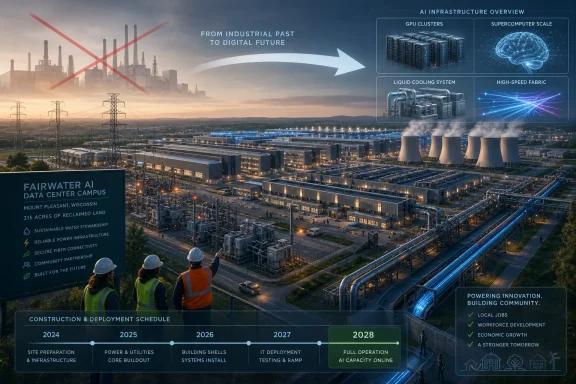
Microsoft said on June 23, 2026, that its first Fairwater data center in Mount Pleasant, Wisconsin, is fully operational on 315 acres of former Foxconn land, with nearly 550 full-time workers on-site and a second facility already under construction for 2028. That is the simple version: a failed manufacturing bet has become a functioning AI infrastructure bet. The more important story is that Microsoft has turned one of Wisconsin’s most infamous economic-development scars into a test case for the next decade of compute politics. Mount Pleasant is no longer waiting for the factory of the future; it is hosting the machine room of the present.
The symbolism is almost too neat. The Mount Pleasant land was once supposed to prove that high-tech manufacturing could be summoned into existence through subsidy, spectacle, and presidential photo ops. Foxconn’s promised megaproject became shorthand for overbuilt expectations, bulldozed land, and the difference between a press conference and a payroll.
Microsoft has now arrived with a very different kind of project, but it is still selling a future. Fairwater is not a consumer gadget factory, and it will not employ tens of thousands of line workers in the way politicians once implied Foxconn might. It is a hyperscale AI data center, a capital-intensive facility whose value lies in chips, power, cooling, fiber, and the ability to train and serve increasingly large AI models.
That distinction matters because it changes what success looks like. The first Fairwater building can be operational, expensive, and strategically important without resembling the old industrial bargain that many residents were originally sold. A data center can make a region more important to Microsoft’s cloud map while still raising hard questions about jobs, energy, water, noise, tax revenue, and local control.
Brad Smith’s claim that Wisconsin is now home to “the world’s most powerful supercomputer” is less a throwaway line than a statement of what the modern cloud has become. The supercomputer is no longer necessarily a national lab machine with a single marquee name. Increasingly, it is a private platform stitched together from hundreds of thousands of GPUs, designed not just to run scientific simulations but to manufacture AI capability at commercial scale.
The company wants the timeline to do some of the persuasion. Foxconn promised big and delivered small. Microsoft promised a huge data center campus and has delivered at least the first operational piece. That difference is why local officials are calling the milestone historic, and why the company is eager to emphasize construction jobs, full-time headcount, and local procurement.
But the calendar cuts both ways. Moving quickly can reassure a community that this is not another paper megaproject, but it can also compress the period in which residents understand what is being built around them. Data center campuses do not arrive as a single building; they arrive as a phase, then a second phase, then utility upgrades, then roadwork, then backup generation, then more buildings.
Mount Pleasant is already past the point where Fairwater can be described as a one-off. A second data center is under construction next door, with completion expected in 2028. Microsoft says full-time employment in Mount Pleasant should rise to around 800 after that second facility opens, and the company estimates that Wisconsin hyperscale construction spending will total roughly $4.7 billion from 2024 through 2028.
Those are large numbers, but they are also carefully framed numbers. Construction spending is not the same thing as permanent employment. A powerful AI data center is not the same thing as a broadly distributed technology cluster. The economic story is real, but it is not the old factory story, and pretending otherwise is how communities end up disappointed even when the project itself succeeds.
The company says the Wisconsin buildout includes purchases from electrical equipment manufacturers in Rock and Columbia Counties, a detail that belongs in the story because AI infrastructure has a supply chain beyond Nvidia GPUs. Transformers, switchgear, substations, liquid-cooling systems, fiber, and backup equipment are now part of the cloud arms race. The cloud may be sold as abstraction, but it is increasingly governed by the availability of very physical things.
That is why data centers have become local political events rather than invisible back-end facilities. The same GPU cluster that lets a developer call an AI model from a laptop also requires a community somewhere to host the load. Microsoft’s promise to be a good neighbor in Southeast Wisconsin is not a courtesy phrase; it is a recognition that the next generation of cloud growth depends on local consent.
The power question will loom largest. Even with efficient cooling and modern design, AI data centers are enormous electricity consumers. Microsoft’s public posture is that it can manage the load responsibly, avoid burdening local ratepayers, and build in ways that reduce water waste. Residents and regulators will still have to judge the company not by the architecture diagram but by utility filings, rate structures, construction impacts, and the cumulative effect of more buildings.
That cumulative effect is the phrase to watch. One Fairwater facility can be defended as a strategic investment. Two facilities can be defended as a campus. Fifteen additional data centers, approved in site plans by the Mount Pleasant village board in January, become something closer to an industrial region organized around AI compute.
Still, data center employment needs to be understood with precision. These facilities require skilled technicians, security staff, operations teams, engineers, logistics workers, and maintenance contractors. They also require massive capital investment per job, far more than many traditional industrial projects.
That is not an argument against the project. High-capital, high-wage infrastructure can be a perfectly rational economic-development strategy. But it is an argument against lazy rhetoric. If a community is trading land, infrastructure capacity, political attention, and environmental tolerance for a project, it deserves a clear account of what kind of employment is actually being created.
The employment case is strongest when the data center becomes a platform for adjacent investment. Training programs, electrical trades, technical education, equipment manufacturing, and local service contracts can spread the benefit beyond the fence line. Microsoft has talked broadly about community investment and workforce development in its data center markets, but the local test will be whether those programs produce durable careers rather than ceremonial partnerships.
Mount Pleasant’s leaders have reason to celebrate a project that is visible, operational, and tied to one of the most important technology shifts in the world. They also have reason to keep their negotiating posture. A functioning first building should not end the public conversation; it should begin the more serious one.
That does not mean all 15 buildings will necessarily rise exactly as planned, on the exact schedule imagined today. Hyperscale companies routinely phase projects based on demand, power availability, supply chains, financing, and regulatory conditions. But site-plan approval reveals intent, and the intent is unmistakable: Microsoft sees Mount Pleasant as a long-term AI infrastructure hub, not a rescued parcel of land with a single successful tenant.
This is where the public conversation has to mature. Local officials often evaluate projects one approval at a time, while companies plan them as systems. A road improvement here, a utility extension there, a building permit next quarter, a campus expansion next year — each step can look manageable in isolation. Together, they can remake the geography and economics of a community.
For WindowsForum readers, this is not some distant municipal planning issue. The AI features appearing in Windows, Microsoft 365, Azure, GitHub, Visual Studio, security tooling, and enterprise management products all depend on this buildout. Copilot is not just a sidebar in an app; it is a claim on data centers like Fairwater.
That should make enthusiasts and IT pros both impressed and skeptical. The infrastructure behind modern AI is extraordinary, and Microsoft has proved it can execute quickly when the strategic need is urgent. But the bill for that infrastructure lands somewhere — in electricity planning, in water policy, in land use, in neighborhood disruption, and eventually in the pricing of cloud services.
The example from Catawba County, North Carolina, is instructive. Residents near a separate Microsoft data center project have complained about construction noise and dust, with at least one neighbor telling a local reporter that she has to wash her car every other day. County leaders defended the project as a decade-long effort that supports good jobs and uses only a small share of Hickory’s daily water capacity.
Both sides of that argument can be true. A project can use a modest percentage of a municipal water system and still create real daily disruption for nearby households. It can support well-paying jobs and still produce dust, truck traffic, vibration, construction noise, and anxiety about what comes next.
That is the trap in much of the data center debate: companies answer system-level concerns while residents describe lived conditions. Microsoft may be right that a facility uses efficient cooling, or that it will pay for required utility improvements, or that it will add to the tax base. A neighbor may also be right that the construction phase has made ordinary life worse.
Good-neighbor claims therefore need operational detail. Communities should expect clear construction schedules, enforceable noise standards, dust mitigation, truck routing, complaint processes, water-use transparency, backup-generator disclosures, and post-construction monitoring. The more Microsoft wants Fairwater to represent the future of AI, the more it should be willing to make that future legible at ground level.
The Foxconn era was about manufacturing nationalism, display factories, and the idea that hardware assembly could be repatriated through incentives. The AI data center era is about compute sovereignty, energy access, and the idea that cloud platforms must secure enough infrastructure to train and run frontier models. Both eras use big numbers. Both involve local governments making long-term bets. Both can blur the line between public benefit and corporate necessity.
Microsoft’s advantage is that its demand is more credible. The company actually needs the compute. Azure is a central business, AI is being woven through the Microsoft product stack, and the company’s partnership-driven AI strategy requires capacity on a scale that smaller players cannot match. Fairwater is not a showroom; it is part of the machinery of Microsoft’s future revenue.
That credibility should not exempt the project from scrutiny. If anything, it should intensify scrutiny, because successful infrastructure is more consequential than failed spectacle. A failed factory leaves empty promises. A successful data center campus can lock in decades of power demand, land-use patterns, and public policy choices.
For Wisconsin, the opportunity is obvious. The state can capture investment, construction work, technical jobs, tax base, and a place in the AI supply chain. The risk is that local governments become so eager to avoid another Foxconn embarrassment that they under-negotiate with a company whose need for infrastructure is urgent.
When Microsoft adds AI summarization to Office, code assistance to GitHub, natural-language management to security tools, or Copilot experiences to Windows, the work is not happening magically inside the taskbar. Some inference happens locally, and more may move to NPUs over time, but the heaviest training and many service-side AI tasks depend on hyperscale infrastructure. Fairwater is part of the hidden substrate beneath features that users experience as software.
That has practical consequences for IT pros. AI adoption is no longer just a licensing or governance question; it is an infrastructure question. Enterprises evaluating Microsoft’s AI stack are indirectly buying into the company’s ability to operate, secure, power, and scale facilities like Fairwater.
It also changes the reliability conversation. Data centers built for AI training and inference must handle immense networking and thermal demands. If Microsoft is right that Fairwater represents a new class of AI supercomputer, then uptime, redundancy, energy procurement, and hardware lifecycle management become part of the trust model for everyday business software.
There is an irony here for Windows enthusiasts. The PC is being sold again as an AI device, with local accelerators and on-device models pitched as the next platform shift. Yet the biggest bets are still being poured into centralized compute. The future Microsoft is building is not purely local or purely cloud; it is a hierarchy in which the endpoint gets smarter while the data center gets vastly more powerful.
The company has a chance to make Fairwater the example it clearly wants it to be. That would mean not only hitting construction milestones, but also proving that large AI campuses can coexist with local communities on transparent terms. If Microsoft can show that it pays its way on electricity, limits water impact, handles construction responsibly, and delivers durable local economic value, Mount Pleasant becomes a strong argument for the company’s model.
If it cannot, Fairwater becomes another exhibit in the backlash against data centers. Residents elsewhere will point to it not as proof that AI infrastructure can be done well, but as proof that big tech arrives with polished language and leaves communities to manage the side effects. In that scenario, every future approval becomes harder, slower, and more adversarial.
The stakes are larger than one village board. AI companies are already discovering that chips are not the only bottleneck. Political legitimacy is a bottleneck, too. A company can buy GPUs, hire contractors, and sign power agreements, but it cannot indefinitely scale in places where residents believe the bargain is being hidden from them.
Microsoft’s Fairwater opening is therefore a product launch of sorts. Not a consumer launch, and not a Windows launch, but a launch of a new infrastructure argument: trust us to build the physical backbone of AI in your community. Mount Pleasant is the first audience, but it will not be the last.
 Microsoft Turns the Foxconn Hangover Into an AI Showcase
The symbolism is almost too neat. The Mount Pleasant land was once supposed to prove that high-tech manufacturing could be summoned into existence through subsidy, spectacle, and presidential photo ops. Foxconn’s promised megaproject became shorthand for overbuilt expectations, bulldozed land, and the difference between a press conference and a payroll.Microsoft has now arrived with a very different kind of project, but it is still selling a future. Fairwater is not a consumer gadget factory, and it will not employ tens of thousands of line workers in the way politicians once implied Foxconn might. It is a hyperscale AI data center, a capital-intensive facility whose value lies in chips, power, cooling, fiber, and the ability to train and serve increasingly large AI models.
That distinction matters because it changes what success looks like. The first Fairwater building can be operational, expensive, and strategically important without resembling the old industrial bargain that many residents were originally sold. A data center can make a region more important to Microsoft’s cloud map while still raising hard questions about jobs, energy, water, noise, tax revenue, and local control.
Brad Smith’s claim that Wisconsin is now home to “the world’s most powerful supercomputer” is less a throwaway line than a statement of what the modern cloud has become. The supercomputer is no longer necessarily a national lab machine with a single marquee name. Increasingly, it is a private platform stitched together from hundreds of thousands of GPUs, designed not just to run scientific simulations but to manufacture AI capability at commercial scale.
The Calendar Is Part of the Message
Microsoft first announced its Mount Pleasant plans in May 2024, and the company now says the first facility came online in April 2026, ahead of schedule. In infrastructure terms, that is fast. In political terms, it is even faster, because it lets Microsoft contrast itself with the ghosts already sitting on the property.The company wants the timeline to do some of the persuasion. Foxconn promised big and delivered small. Microsoft promised a huge data center campus and has delivered at least the first operational piece. That difference is why local officials are calling the milestone historic, and why the company is eager to emphasize construction jobs, full-time headcount, and local procurement.
But the calendar cuts both ways. Moving quickly can reassure a community that this is not another paper megaproject, but it can also compress the period in which residents understand what is being built around them. Data center campuses do not arrive as a single building; they arrive as a phase, then a second phase, then utility upgrades, then roadwork, then backup generation, then more buildings.
Mount Pleasant is already past the point where Fairwater can be described as a one-off. A second data center is under construction next door, with completion expected in 2028. Microsoft says full-time employment in Mount Pleasant should rise to around 800 after that second facility opens, and the company estimates that Wisconsin hyperscale construction spending will total roughly $4.7 billion from 2024 through 2028.
Those are large numbers, but they are also carefully framed numbers. Construction spending is not the same thing as permanent employment. A powerful AI data center is not the same thing as a broadly distributed technology cluster. The economic story is real, but it is not the old factory story, and pretending otherwise is how communities end up disappointed even when the project itself succeeds.
Fairwater Is a Building, but It Is Also a Claim on the Grid
The defining constraint of the AI boom is not whether Microsoft, Google, Amazon, Meta, or OpenAI can imagine new things to do with GPUs. It is whether they can acquire enough power, land, cooling capacity, networking, and political permission to keep scaling. Fairwater is best understood as Microsoft answering that constraint with concrete, steel, and electrical gear.The company says the Wisconsin buildout includes purchases from electrical equipment manufacturers in Rock and Columbia Counties, a detail that belongs in the story because AI infrastructure has a supply chain beyond Nvidia GPUs. Transformers, switchgear, substations, liquid-cooling systems, fiber, and backup equipment are now part of the cloud arms race. The cloud may be sold as abstraction, but it is increasingly governed by the availability of very physical things.
That is why data centers have become local political events rather than invisible back-end facilities. The same GPU cluster that lets a developer call an AI model from a laptop also requires a community somewhere to host the load. Microsoft’s promise to be a good neighbor in Southeast Wisconsin is not a courtesy phrase; it is a recognition that the next generation of cloud growth depends on local consent.
The power question will loom largest. Even with efficient cooling and modern design, AI data centers are enormous electricity consumers. Microsoft’s public posture is that it can manage the load responsibly, avoid burdening local ratepayers, and build in ways that reduce water waste. Residents and regulators will still have to judge the company not by the architecture diagram but by utility filings, rate structures, construction impacts, and the cumulative effect of more buildings.
That cumulative effect is the phrase to watch. One Fairwater facility can be defended as a strategic investment. Two facilities can be defended as a campus. Fifteen additional data centers, approved in site plans by the Mount Pleasant village board in January, become something closer to an industrial region organized around AI compute.
The Job Numbers Are Real, but They Are Not the Whole Bargain
Microsoft says the Mount Pleasant project provided work for 10,000 construction workers and is expected to bring 2,000 permanent jobs to the area. The first operational facility currently supports nearly 550 full-time employees on-site, and the two-building Mount Pleasant footprint is expected to reach roughly 800 full-time workers when the second facility opens. For a village of about 28,000 residents, those are not trivial figures.Still, data center employment needs to be understood with precision. These facilities require skilled technicians, security staff, operations teams, engineers, logistics workers, and maintenance contractors. They also require massive capital investment per job, far more than many traditional industrial projects.
That is not an argument against the project. High-capital, high-wage infrastructure can be a perfectly rational economic-development strategy. But it is an argument against lazy rhetoric. If a community is trading land, infrastructure capacity, political attention, and environmental tolerance for a project, it deserves a clear account of what kind of employment is actually being created.
The employment case is strongest when the data center becomes a platform for adjacent investment. Training programs, electrical trades, technical education, equipment manufacturing, and local service contracts can spread the benefit beyond the fence line. Microsoft has talked broadly about community investment and workforce development in its data center markets, but the local test will be whether those programs produce durable careers rather than ceremonial partnerships.
Mount Pleasant’s leaders have reason to celebrate a project that is visible, operational, and tied to one of the most important technology shifts in the world. They also have reason to keep their negotiating posture. A functioning first building should not end the public conversation; it should begin the more serious one.
The Fifteen-Building Shadow Changes the Scale of the Debate
The most important number in the Mount Pleasant story may not be 315 acres, 550 workers, or $4.7 billion. It may be 15. In January, the village board approved site plans that could allow up to 15 additional Microsoft data centers on the same broader campus over the next decade.That does not mean all 15 buildings will necessarily rise exactly as planned, on the exact schedule imagined today. Hyperscale companies routinely phase projects based on demand, power availability, supply chains, financing, and regulatory conditions. But site-plan approval reveals intent, and the intent is unmistakable: Microsoft sees Mount Pleasant as a long-term AI infrastructure hub, not a rescued parcel of land with a single successful tenant.
This is where the public conversation has to mature. Local officials often evaluate projects one approval at a time, while companies plan them as systems. A road improvement here, a utility extension there, a building permit next quarter, a campus expansion next year — each step can look manageable in isolation. Together, they can remake the geography and economics of a community.
For WindowsForum readers, this is not some distant municipal planning issue. The AI features appearing in Windows, Microsoft 365, Azure, GitHub, Visual Studio, security tooling, and enterprise management products all depend on this buildout. Copilot is not just a sidebar in an app; it is a claim on data centers like Fairwater.
That should make enthusiasts and IT pros both impressed and skeptical. The infrastructure behind modern AI is extraordinary, and Microsoft has proved it can execute quickly when the strategic need is urgent. But the bill for that infrastructure lands somewhere — in electricity planning, in water policy, in land use, in neighborhood disruption, and eventually in the pricing of cloud services.
The “Good Neighbor” Promise Is Now a Measurable Obligation
Microsoft says it remains committed to being a good neighbor in Southeast Wisconsin. That is the right thing for the company to say, and it is also the minimum thing. The data center industry has learned that vague assurances are no longer enough, because communities have watched similar projects elsewhere move from abstraction to irritation.The example from Catawba County, North Carolina, is instructive. Residents near a separate Microsoft data center project have complained about construction noise and dust, with at least one neighbor telling a local reporter that she has to wash her car every other day. County leaders defended the project as a decade-long effort that supports good jobs and uses only a small share of Hickory’s daily water capacity.
Both sides of that argument can be true. A project can use a modest percentage of a municipal water system and still create real daily disruption for nearby households. It can support well-paying jobs and still produce dust, truck traffic, vibration, construction noise, and anxiety about what comes next.
That is the trap in much of the data center debate: companies answer system-level concerns while residents describe lived conditions. Microsoft may be right that a facility uses efficient cooling, or that it will pay for required utility improvements, or that it will add to the tax base. A neighbor may also be right that the construction phase has made ordinary life worse.
Good-neighbor claims therefore need operational detail. Communities should expect clear construction schedules, enforceable noise standards, dust mitigation, truck routing, complaint processes, water-use transparency, backup-generator disclosures, and post-construction monitoring. The more Microsoft wants Fairwater to represent the future of AI, the more it should be willing to make that future legible at ground level.
Wisconsin Gets the Upside of the AI Boom and the Burden of Hosting It
There is a temptation to frame Mount Pleasant as redemption: Foxconn failed, Microsoft delivered, Wisconsin wins. That version is emotionally satisfying, but too tidy. The better reading is that Wisconsin has moved from one era of tech-industrial politics into another.The Foxconn era was about manufacturing nationalism, display factories, and the idea that hardware assembly could be repatriated through incentives. The AI data center era is about compute sovereignty, energy access, and the idea that cloud platforms must secure enough infrastructure to train and run frontier models. Both eras use big numbers. Both involve local governments making long-term bets. Both can blur the line between public benefit and corporate necessity.
Microsoft’s advantage is that its demand is more credible. The company actually needs the compute. Azure is a central business, AI is being woven through the Microsoft product stack, and the company’s partnership-driven AI strategy requires capacity on a scale that smaller players cannot match. Fairwater is not a showroom; it is part of the machinery of Microsoft’s future revenue.
That credibility should not exempt the project from scrutiny. If anything, it should intensify scrutiny, because successful infrastructure is more consequential than failed spectacle. A failed factory leaves empty promises. A successful data center campus can lock in decades of power demand, land-use patterns, and public policy choices.
For Wisconsin, the opportunity is obvious. The state can capture investment, construction work, technical jobs, tax base, and a place in the AI supply chain. The risk is that local governments become so eager to avoid another Foxconn embarrassment that they under-negotiate with a company whose need for infrastructure is urgent.
Windows Users Are Closer to Mount Pleasant Than They Think
It is easy for a Windows user to think of a data center in Wisconsin as unrelated to the PC on the desk. That separation no longer holds. Microsoft’s operating system, productivity suite, developer tools, identity platform, security products, and cloud management stack are increasingly designed around services that live far from the endpoint.When Microsoft adds AI summarization to Office, code assistance to GitHub, natural-language management to security tools, or Copilot experiences to Windows, the work is not happening magically inside the taskbar. Some inference happens locally, and more may move to NPUs over time, but the heaviest training and many service-side AI tasks depend on hyperscale infrastructure. Fairwater is part of the hidden substrate beneath features that users experience as software.
That has practical consequences for IT pros. AI adoption is no longer just a licensing or governance question; it is an infrastructure question. Enterprises evaluating Microsoft’s AI stack are indirectly buying into the company’s ability to operate, secure, power, and scale facilities like Fairwater.
It also changes the reliability conversation. Data centers built for AI training and inference must handle immense networking and thermal demands. If Microsoft is right that Fairwater represents a new class of AI supercomputer, then uptime, redundancy, energy procurement, and hardware lifecycle management become part of the trust model for everyday business software.
There is an irony here for Windows enthusiasts. The PC is being sold again as an AI device, with local accelerators and on-device models pitched as the next platform shift. Yet the biggest bets are still being poured into centralized compute. The future Microsoft is building is not purely local or purely cloud; it is a hierarchy in which the endpoint gets smarter while the data center gets vastly more powerful.
The Real Test Is Whether Microsoft Can Scale Without Making Every Town a Hostage
Microsoft is not alone in this race. Every hyperscaler is chasing AI capacity, and the United States is now dotted with fights over data center siting, transmission lines, power generation, water use, tax incentives, and neighborhood disruption. What makes Mount Pleasant unusual is the combination of symbolism, speed, and scale.The company has a chance to make Fairwater the example it clearly wants it to be. That would mean not only hitting construction milestones, but also proving that large AI campuses can coexist with local communities on transparent terms. If Microsoft can show that it pays its way on electricity, limits water impact, handles construction responsibly, and delivers durable local economic value, Mount Pleasant becomes a strong argument for the company’s model.
If it cannot, Fairwater becomes another exhibit in the backlash against data centers. Residents elsewhere will point to it not as proof that AI infrastructure can be done well, but as proof that big tech arrives with polished language and leaves communities to manage the side effects. In that scenario, every future approval becomes harder, slower, and more adversarial.
The stakes are larger than one village board. AI companies are already discovering that chips are not the only bottleneck. Political legitimacy is a bottleneck, too. A company can buy GPUs, hire contractors, and sign power agreements, but it cannot indefinitely scale in places where residents believe the bargain is being hidden from them.
Microsoft’s Fairwater opening is therefore a product launch of sorts. Not a consumer launch, and not a Windows launch, but a launch of a new infrastructure argument: trust us to build the physical backbone of AI in your community. Mount Pleasant is the first audience, but it will not be the last.
The Mount Pleasant Bargain Is Now Written in Concrete
The Fairwater milestone leaves several concrete lessons for anyone watching Microsoft, AI infrastructure, or local economic development. The story is not simply that a data center opened. It is that a community once defined by a failed factory promise is now being asked to host one of the most ambitious compute buildouts in the world.- Microsoft’s first Fairwater facility is operational, which makes the Mount Pleasant project materially different from the Foxconn promises that previously defined the site.
- The permanent job numbers are meaningful for a village of Mount Pleasant’s size, but the project’s economic impact depends heavily on construction work, supply chains, tax revenue, and technical workforce development.
- The approved path for up to 15 additional data centers means residents and officials should evaluate cumulative impact, not just individual buildings.
- Microsoft’s claims about efficient cooling and good-neighbor commitments will matter only if they are matched by transparent reporting and enforceable local standards.
- The same AI features arriving in Windows, Microsoft 365, Azure, GitHub, and enterprise security tools are tied directly to physical campuses like Fairwater.
- Mount Pleasant gives Microsoft a chance to prove that hyperscale AI infrastructure can be built quickly without repeating the political mistakes that have damaged other megaprojects.
References
- Primary source: Technobezz
Published: 2026-06-24T20:52:10.487047
Microsoft Opens Fairwater Data Center on Former Foxconn Site in Mount Pleasant | Technobezz
Microsoft's new Wisconsin data center on a former Foxconn site now houses a powerful supercomputer, with plans for 15 more facilities by 2034.www.technobezz.com - Related coverage: tomshardware.com
Microsoft announces 'world's most powerful' AI data center — 315-acre site to house 'hundreds of thousands' of Nvidia GPUs and enough fiber to circle the Earth 4.5 times | Tom's Hardware
The Wisconsin-based data center is set to go online in 2026www.tomshardware.com - Related coverage: wpr.org
Mount Pleasant approves site plans for Microsoft data center expansion
The tech giant plans to build 15 additional data centers in Mount Pleasant as part of two new campuses worth more than $13 billion.www.wpr.org - Related coverage: wgtd.org
Site Plans for Additional Data Centers Approved by Mt. Pleasant Board
Jan. 27, 2026 3p (WGTD)---The Mt. Pleasant Village Board unanimously approved site plans to pave the way for the construction of 15 more data centers in the village. Monday night's meeting drew several dozen trades workers who were there in support.www.wgtd.org - Official source: news.microsoft.com
Microsoft Builds World’s Most Powerful AI Datacenter - Microsoft Switzerland News Center
Microsoft is building the world’s most powerful AI datacenter in Mount Pleasant, Wisconsin. The Fairwater facility will deliver 10 times the performance of today’s fastest supercomputer, enabling AI training and inference workloads at a level never before seen, powered by hundreds of thousands...news.microsoft.com - Related coverage: cbs58.com
Mount Pleasant leaders approve Microsoft lots allowing for up to 15 more data centers
MOUNT PLEASANT, Wis. (CBS 58) -- Mount Pleasant leaders are moving forward with plans to build more than a dozen data centers. The village board has approved site plans for two locations around Highwaywww.cbs58.com
- Related coverage: thejobwalk.com
Microsoft’s Mount Pleasant Data Center Plans Add 15 More Buildings
Microsoft has submitted plans for 15 additional data center buildings in...thejobwalk.com - Related coverage: civicmedia.us
Mount Pleasant Board Approves Plans for 15 New Microsoft Data Centers - Civic Media
Microsoft can now move ahead with plans for 15 new data centers in Mount Pleasant after the village board gave its initial approval last night. The $13 billion development will sit partly on land once set aside for Foxconn and partly on land recently purchased by the tech giant. Most people at...civicmedia.us - Related coverage: wisn.com
- Related coverage: spectrumnews1.com
Mount Pleasant approves Microsoft data center expansion
The village board unanimously approved a proposal Monday night from Microsoft to build 15 new data centers on two additional campuses. spectrumnews1.com
- Related coverage: wrpn.fm
Microsoft Proposes 15 more Data Centers at Mount Pleasant Project - WRPN - Ripon
Fifteen new facilities on former Foxconn land could make Microsoft Racine County’s largest taxpayer yet doubt remains about energy and water wrpn.fm
- Related coverage: windowscentral.com
Microsoft's Fairwater datacenter could power the future of AI | Windows Central
Microsoft’s Fairwater AI datacenter pushes supercomputing power, renewable cooling, and a bold vision for the future of intelligence.www.windowscentral.com - Related coverage: uk.investing.com
Microsoft wins approval for 15 more data centers in Mt. Pleasant, Wisconsin By Investing.com
Microsoft wins approval for 15 more data centers in Mt. Pleasant, Wisconsinuk.investing.com - Related coverage: techradar.com
Microsoft announces "world's most powerful data center" in latest billion-dollar AI spending splurge | TechRadar
New Microsoft Wisconsin facility will begin operation soonwww.techradar.com - Official source: local.microsoft.com
1836662766
Aerial view of Racine, a city in Racine County, Wisconsin, on a sunny day in Fall.local.microsoft.com
- Related coverage: mtpleasantwi.gov
- Related coverage: mikezyda.com
Buddy, Can You Spare Me 44 Gigawatts of Power for My AI Data Center Collection?
Computer;2026;59;2;10.1109/MC.2025.3633825mikezyda.com
- Related coverage: charlottenewsroom.com
Microsoft Restarts $1B Data Center Construction in Catawba County After 10-Month Pause - Charlotte Newsroom
Microsoft has picked up where it left off on its $1 billion data center work in Catawba County. The halt lasted ten months. Between November and December, the company secured… charlottenewsroom.com
- Related coverage: cleanview.co
Stover North Data Center — Catawba, North Carolina
Stover North Data Center is a planned data center with 270 MW of capacity in Catawba, North Carolina. Developed by Microsoft. View location, capacity, developer details, and project status.cleanview.co - Related coverage: spectrumlocalnews.com
Microsoft makes plans for data center in North Carolina
Once the data center is built, it is expected to add about 50 jobs, including IT operations and electrical engineers. spectrumlocalnews.com
- Related coverage: stopohiodatacenters.org
Data Center Noise in Ohio: Cooling Towers, Generators, Decibel Limits | Ohio Data Centers
How loud is a data center? 24/7 cooling-tower hum, monthly diesel generator testing, and what Ohio noise ordinances actually allow. Real measurements from Mansfield GA, Prince William VA, and rural Ohio cases.stopohiodatacenters.org
- Related coverage: wilx.com
Dowagiac residents complain about constant noise from Hyperscale Data center
The data center campus sits next to a residential neighborhood. Residents say they hear white noise every time they step outside their homes or open their windows.www.wilx.com
- Related coverage: datacenter.fyi
Microsoft - Conove, NC | datacenter.fyi
Microsoft Corporation, CLT04 proposed data center in Conove, NC. 30.25MW power capacity. Permit details, specifications, and timeline. www.datacenter.fyi
- Related coverage: datacenterdynamics.com
Microsoft breaks ground on North Carolina data center campus - DCD
Company first announced Catawba County investment plans in 2022www.datacenterdynamics.com
