

Microsoft announced on June 23, 2026, that its first Fairwater datacenter facility in Mount Pleasant, Wisconsin, is fully operational after equipment came online in April, completing the first phase of a major AI infrastructure campus in Racine County. The milestone is less about a single building than about a new geography of computing power. Microsoft is turning a former symbol of industrial overpromising into one of the physical centers of the AI boom, and WindowsForum readers should see the Wisconsin campus as both a local economic story and a preview of the next cloud era.
The company’s message is deliberately concrete: nearly 10,000 construction workers over two years, about 550 full-time employees on site today, $4.7 billion in local hyperscale construction spending expected between 2024 and 2028, and a second adjacent facility already rising from the ground. Those numbers are meant to answer the first question any community asks when a hyperscaler arrives: what does this actually leave behind?
But the more important question for the technology industry is what this facility says about Microsoft’s AI strategy. Fairwater is not a regional server farm built to shave milliseconds from Office 365. It is infrastructure for frontier-scale AI: the kind of compute Microsoft needs for Azure, Copilot, OpenAI workloads, enterprise model training, and whatever succeeds the current generation of generative systems.
Microsoft’s Mount Pleasant announcement lands with unusual symbolism because the site is not just another greenfield datacenter parcel. Racine County has spent years living with the political and economic afterlife of the Foxconn project, which was once pitched as a transformative manufacturing campus and then became a national shorthand for inflated job projections and industrial-policy theater. Microsoft’s arrival does not erase that history, but it does repurpose the land for a different century’s supply chain.
That distinction matters. Foxconn’s Wisconsin promise was about screens, factories, and a version of advanced manufacturing that never quite materialized at the scale sold to the public. Microsoft’s bet is about power, cooling, networking, GPUs, fiber, and the industrialization of machine learning. The common thread is that both projects were sold as economic anchors, but the technology under the hood has changed from consumer electronics manufacturing to cloud-scale AI production.
The completed first facility gives Microsoft something it can point to that is not merely a rendering, a groundbreaking ceremony, or a political speech. Equipment came online in April, startup activities followed, and the company is now calling the facility fully operational. In the world of datacenters, that sequence is the difference between a promise and an asset.
For Wisconsin officials, the pitch is straightforward: hundreds of permanent jobs, thousands of construction jobs, new supplier relationships, and the kind of corporate presence that can make a region legible to other technology investors. For Microsoft, the pitch is larger. The company wants Fairwater to stand as proof that AI infrastructure can be built quickly, at massive scale, and with enough local buy-in to avoid becoming another datacenter backlash story.
The tension is that those two narratives are not identical. A community wants jobs, tax base, training pipelines, and manageable utility impacts. Microsoft wants compute density, land, energy access, and speed. The success of Mount Pleasant will depend on how long those interests remain aligned after the ribbon-cutting glow fades.
During the cloud’s first great buildout, datacenters were often framed around storage, virtualization, web services, and enterprise migration. The new AI datacenter is a more specialized beast. It is an electrical, thermal, and networking machine designed to keep vast clusters of accelerators fed with data and synchronized at high speed.
That is why Microsoft’s language around Fairwater has leaned so heavily on supercomputing. The company has described the campus as home to the world’s most powerful AI supercomputer, connected by enormous quantities of fiber and designed for workloads that conventional enterprise datacenters were never built to handle. The phrase may sound like marketing, but the underlying point is real: AI has collapsed the boundary between cloud infrastructure and supercomputing.
For Windows users, that may feel distant. A datacenter in Wisconsin does not obviously change the Start menu, File Explorer, or the next Patch Tuesday. But the Copilot features arriving in Windows, Microsoft 365, GitHub, Teams, Azure, and security tooling all depend on this backend arms race. The desktop experience is increasingly a client for remote intelligence.
That is a profound shift in Microsoft’s center of gravity. Windows once made Microsoft dominant because the valuable computation happened on the PC. In the AI era, Microsoft wants the PC, browser, IDE, collaboration suite, and security console to become surfaces for intelligence generated elsewhere. Fairwater is part of the “elsewhere.”
A GPU cluster is not just another pool of elastic capacity. It requires carefully planned power delivery, cooling systems, network topology, supply-chain coordination, and long-term procurement. If the old cloud was marketed as infinite and frictionless, the AI cloud is visibly finite and infrastructural. It has a location, a utility interconnection, a construction workforce, and neighbors.
Microsoft’s Wisconsin project makes that physicality plain. The company says it has purchased directly from 29 businesses across 11 Wisconsin counties, including construction suppliers, steel fabricators, electrical equipment manufacturers, and machinery makers. That detail is not accidental; it is a political and economic answer to the criticism that datacenters are capital-intensive but light on local employment.
Still, the employment profile is different from a factory. A hyperscale datacenter can require huge numbers of workers to build and comparatively fewer to operate. Microsoft’s current figure of roughly 550 full-time employees on site is significant for Mount Pleasant, but it is not the same as a mass manufacturing workforce. The second facility may bring the number to around 800 when fully operational, which is meaningful, not miraculous.
This is where the industry’s rhetoric often gets slippery. Datacenters are industrial infrastructure, but they are not factories in the old sense. They produce computation rather than finished goods, and their largest benefits may accrue to the platform owner and its global customers rather than the locality hosting the equipment. That does not make the project bad for Wisconsin; it means the economic claims need to be evaluated in the correct category.
The work is not only pouring concrete and erecting steel. It involves high-voltage electrical systems, underground utilities, cooling infrastructure, security systems, network pathways, and the choreography of installing and commissioning expensive computing equipment. For tradespeople, that can mean experience with infrastructure that will be increasingly common as AI campuses spread across the United States.
The permanent workforce is smaller but strategically important. Datacenter technicians, network engineers, facilities operators, security staff, logistics workers, and vendor teams keep these facilities alive after construction crews leave. Those are not throwaway jobs, and in regions that can build training pipelines around them, they can become durable career paths.
That explains Microsoft’s interest in local training partnerships. The company’s earlier Wisconsin package included education and workforce-development commitments, including datacenter training and AI skills programs. Those efforts are part goodwill, part labor strategy, and part ecosystem building. A campus is easier to expand when the surrounding region can supply people who understand the work.
Yet the broader labor question remains unresolved. AI infrastructure creates jobs, but AI software is also being sold as a way to reduce or reshape white-collar labor. Microsoft is simultaneously hiring people to build the AI backend and selling tools that may automate portions of work elsewhere. That contradiction is not unique to Microsoft, but Mount Pleasant puts it in sharp relief: the AI economy creates very physical jobs in one place while abstracting labor in many others.
But the output of that landmark will not primarily stay in Wisconsin. The compute produced in Mount Pleasant will serve Microsoft’s global AI ambitions. It will train and run models for customers, developers, researchers, and enterprise products around the world. The community hosts the infrastructure; the cloud distributes the value.
That is how hyperscale computing works, and it is not inherently exploitative. Localities can benefit from construction spending, taxes, infrastructure improvements, and high-skill jobs while the platform company benefits from global capacity. The problem comes when communities are asked to evaluate global infrastructure projects using only local ribbon-cutting language.
For enterprise IT, the Wisconsin facility is part of a different calculation. Microsoft needs enough AI capacity to make Copilot and Azure AI services reliable, performant, and available at enterprise scale. If customers are going to embed AI into workflows, ticketing, endpoint management, security operations, document creation, and software development, they need more than demos. They need capacity commitments.
That capacity race is now a competitive differentiator. Microsoft, Google, Amazon, Meta, Oracle, and specialized AI infrastructure providers are all chasing power, land, chips, and interconnect. The companies that can bring large facilities online fastest will have more room to cut deals, absorb demand spikes, and support frontier model development. Fairwater is one node in that contest, but it is a conspicuous one.
Microsoft has tried to get ahead of that skepticism with design claims around cooling and water use. The company has described newer AI datacenter approaches that rely heavily on closed-loop liquid cooling and recirculated water, with outside air carrying part of the cooling burden. The practical goal is to avoid the image of AI facilities as thirsty, opaque, utility-straining black boxes.
That image matters because AI has an energy-politics problem. The more companies promise AI in every app and workflow, the more the public asks where the electricity comes from. Even when a facility minimizes water use, it still needs enormous power capacity and grid planning. Datacenters can accelerate renewable-energy procurement, but they can also intensify pressure on transmission, generation, and local ratepayers.
Microsoft is not alone in this. Every hyperscaler is now navigating the gap between climate commitments and AI-driven infrastructure growth. The industry’s answer is typically a mix of power-purchase agreements, efficiency claims, grid investments, carbon-accounting frameworks, and new cooling designs. Some of that is substantive; some of it is reputational armor.
Mount Pleasant will be judged over years, not press cycles. Residents and regulators will care about noise, light, traffic, water, tax arrangements, emergency services, and utility bills. IT professionals will care about reliability, regional capacity, and whether the facility actually improves service availability. Microsoft’s challenge is that operational reality must now live up to construction-era promises.
Microsoft benefits from entering after that disappointment. The roads, land assembly, and political urgency around the site created conditions that a hyperscaler could use. But the company also inherits local skepticism. Communities that have been promised transformation before tend to listen more carefully the next time.
That is why finishing ahead of schedule matters. It gives Microsoft credibility that a mere announcement would not. It also gives local officials a tangible counterpoint to years of embarrassment around unrealized mega-project rhetoric. A functioning datacenter is not a guarantee of long-term success, but it is a radically different fact pattern from a stalled factory vision.
There is also a national-policy lesson here. The United States wants advanced infrastructure, AI capacity, domestic technology investment, and regional economic development. But the line between strategic investment and spectacle can be thin. Projects should be judged by what they build, how they operate, and what obligations they accept, not by the size of the number announced at a podium.
In that sense, Microsoft has now moved from the easy phase to the harder one. Construction can be measured in milestones; trust is measured in years. The first facility is complete. The second is under construction. The question becomes whether the campus keeps expanding in a way that makes the region feel like a partner rather than a host.
Fairwater belongs to the invisible Microsoft, but its effects will surface everywhere. When Microsoft adds AI agents to Microsoft 365, security copilots to SOC workflows, code assistants to developer environments, or local-plus-cloud AI features to Windows, those services depend on backend capacity. The quality of the user experience will be constrained by inference costs, model latency, service availability, and regional capacity.
That is why infrastructure announcements deserve more attention from sysadmins than they usually receive. A new AI facility is not merely a corporate real-estate story. It is a signal about where Microsoft expects demand to go and how much of its product roadmap assumes abundant accelerator capacity. The more AI becomes a default layer in enterprise software, the more compute supply becomes a product feature.
There is a risk here for customers. If AI capacity is expensive and scarce, vendors will package it carefully, meter it aggressively, and reserve the best capabilities for premium SKUs. If capacity becomes more abundant, AI features may spread into standard subscriptions and platform services more quickly. Facilities like Fairwater are part of the economic machinery that determines which future customers get.
Administrators should also expect more complexity. AI services introduce new governance questions around data residency, logging, retention, model access, privilege boundaries, and compliance. A Microsoft datacenter in Wisconsin may not change your tenant settings tomorrow, but the larger AI infrastructure buildout will shape the defaults Microsoft offers and the assumptions it makes about enterprise adoption.
The first operational facility proves execution. The second tests repeatability. Hyperscale companies do not win the AI infrastructure race by building one impressive site; they win by standardizing designs, securing supply chains, and reproducing capacity faster than competitors can. Fairwater is both a campus and a template.
Microsoft has also hinted at a broader Fairwater pattern beyond Wisconsin, with similar AI datacenter efforts planned or underway in other regions. That suggests the company is thinking in terms of a distributed AI supercomputing fabric rather than isolated facilities. In practical terms, Microsoft wants enough massive clusters to train frontier models while serving enterprise demand without starving one workload for another.
This is where the Wisconsin story becomes global. A second facility in Mount Pleasant would not simply double a local footprint. It would strengthen Microsoft’s position in a world where AI infrastructure is becoming a strategic asset comparable to semiconductor fabs, subsea cables, and energy infrastructure. Compute is no longer just a cloud SKU; it is geopolitical and industrial capacity.
For competitors, the lesson is obvious. Microsoft has the balance sheet, customer base, partner ecosystem, and OpenAI relationship to justify enormous AI infrastructure spending. But those advantages only hold if the company can turn capital expenditure into working capacity. Mount Pleasant is one place where that conversion is now visible.
The company’s message is deliberately concrete: nearly 10,000 construction workers over two years, about 550 full-time employees on site today, $4.7 billion in local hyperscale construction spending expected between 2024 and 2028, and a second adjacent facility already rising from the ground. Those numbers are meant to answer the first question any community asks when a hyperscaler arrives: what does this actually leave behind?
But the more important question for the technology industry is what this facility says about Microsoft’s AI strategy. Fairwater is not a regional server farm built to shave milliseconds from Office 365. It is infrastructure for frontier-scale AI: the kind of compute Microsoft needs for Azure, Copilot, OpenAI workloads, enterprise model training, and whatever succeeds the current generation of generative systems.
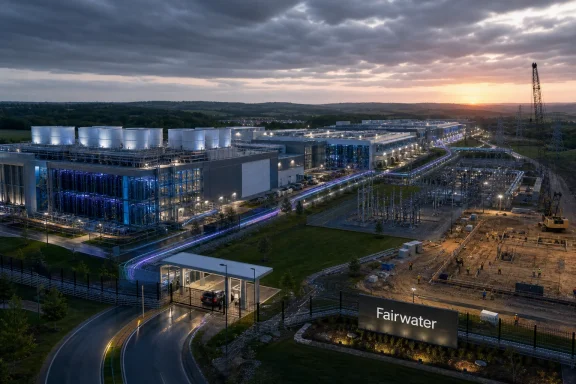 Microsoft Turns Racine County Into an AI Compute Argument
Microsoft’s Mount Pleasant announcement lands with unusual symbolism because the site is not just another greenfield datacenter parcel. Racine County has spent years living with the political and economic afterlife of the Foxconn project, which was once pitched as a transformative manufacturing campus and then became a national shorthand for inflated job projections and industrial-policy theater. Microsoft’s arrival does not erase that history, but it does repurpose the land for a different century’s supply chain.That distinction matters. Foxconn’s Wisconsin promise was about screens, factories, and a version of advanced manufacturing that never quite materialized at the scale sold to the public. Microsoft’s bet is about power, cooling, networking, GPUs, fiber, and the industrialization of machine learning. The common thread is that both projects were sold as economic anchors, but the technology under the hood has changed from consumer electronics manufacturing to cloud-scale AI production.
The completed first facility gives Microsoft something it can point to that is not merely a rendering, a groundbreaking ceremony, or a political speech. Equipment came online in April, startup activities followed, and the company is now calling the facility fully operational. In the world of datacenters, that sequence is the difference between a promise and an asset.
For Wisconsin officials, the pitch is straightforward: hundreds of permanent jobs, thousands of construction jobs, new supplier relationships, and the kind of corporate presence that can make a region legible to other technology investors. For Microsoft, the pitch is larger. The company wants Fairwater to stand as proof that AI infrastructure can be built quickly, at massive scale, and with enough local buy-in to avoid becoming another datacenter backlash story.
The tension is that those two narratives are not identical. A community wants jobs, tax base, training pipelines, and manageable utility impacts. Microsoft wants compute density, land, energy access, and speed. The success of Mount Pleasant will depend on how long those interests remain aligned after the ribbon-cutting glow fades.
Fairwater Is Microsoft’s Answer to the AI Bottleneck
The AI industry’s most important constraint is no longer whether a model can generate a plausible paragraph or image. It is whether companies can secure enough compute to train, serve, and continuously improve systems that customers increasingly expect to appear inside every product. Microsoft’s Mount Pleasant facility is best understood as a response to that bottleneck.During the cloud’s first great buildout, datacenters were often framed around storage, virtualization, web services, and enterprise migration. The new AI datacenter is a more specialized beast. It is an electrical, thermal, and networking machine designed to keep vast clusters of accelerators fed with data and synchronized at high speed.
That is why Microsoft’s language around Fairwater has leaned so heavily on supercomputing. The company has described the campus as home to the world’s most powerful AI supercomputer, connected by enormous quantities of fiber and designed for workloads that conventional enterprise datacenters were never built to handle. The phrase may sound like marketing, but the underlying point is real: AI has collapsed the boundary between cloud infrastructure and supercomputing.
For Windows users, that may feel distant. A datacenter in Wisconsin does not obviously change the Start menu, File Explorer, or the next Patch Tuesday. But the Copilot features arriving in Windows, Microsoft 365, GitHub, Teams, Azure, and security tooling all depend on this backend arms race. The desktop experience is increasingly a client for remote intelligence.
That is a profound shift in Microsoft’s center of gravity. Windows once made Microsoft dominant because the valuable computation happened on the PC. In the AI era, Microsoft wants the PC, browser, IDE, collaboration suite, and security console to become surfaces for intelligence generated elsewhere. Fairwater is part of the “elsewhere.”
The Cloud Is Becoming an Industrial System Again
The public cloud spent years selling itself as abstraction. Developers did not need to know where their workloads ran, which server hosted their VM, or what piece of land supported their storage bucket. AI is making that abstraction harder to sustain because the physical demands are too large to hide.A GPU cluster is not just another pool of elastic capacity. It requires carefully planned power delivery, cooling systems, network topology, supply-chain coordination, and long-term procurement. If the old cloud was marketed as infinite and frictionless, the AI cloud is visibly finite and infrastructural. It has a location, a utility interconnection, a construction workforce, and neighbors.
Microsoft’s Wisconsin project makes that physicality plain. The company says it has purchased directly from 29 businesses across 11 Wisconsin counties, including construction suppliers, steel fabricators, electrical equipment manufacturers, and machinery makers. That detail is not accidental; it is a political and economic answer to the criticism that datacenters are capital-intensive but light on local employment.
Still, the employment profile is different from a factory. A hyperscale datacenter can require huge numbers of workers to build and comparatively fewer to operate. Microsoft’s current figure of roughly 550 full-time employees on site is significant for Mount Pleasant, but it is not the same as a mass manufacturing workforce. The second facility may bring the number to around 800 when fully operational, which is meaningful, not miraculous.
This is where the industry’s rhetoric often gets slippery. Datacenters are industrial infrastructure, but they are not factories in the old sense. They produce computation rather than finished goods, and their largest benefits may accrue to the platform owner and its global customers rather than the locality hosting the equipment. That does not make the project bad for Wisconsin; it means the economic claims need to be evaluated in the correct category.
The Jobs Story Is Real, but It Is Not the Whole Story
Microsoft’s announcement emphasizes workers because infrastructure projects need a human frame. Nearly 10,000 construction workers contributed to the first facility over two years, and Operating Engineers Local 139 is featured prominently in the company’s account of the build. That is not mere decoration. Large AI datacenters are becoming some of the most technically demanding construction projects in the country.The work is not only pouring concrete and erecting steel. It involves high-voltage electrical systems, underground utilities, cooling infrastructure, security systems, network pathways, and the choreography of installing and commissioning expensive computing equipment. For tradespeople, that can mean experience with infrastructure that will be increasingly common as AI campuses spread across the United States.
The permanent workforce is smaller but strategically important. Datacenter technicians, network engineers, facilities operators, security staff, logistics workers, and vendor teams keep these facilities alive after construction crews leave. Those are not throwaway jobs, and in regions that can build training pipelines around them, they can become durable career paths.
That explains Microsoft’s interest in local training partnerships. The company’s earlier Wisconsin package included education and workforce-development commitments, including datacenter training and AI skills programs. Those efforts are part goodwill, part labor strategy, and part ecosystem building. A campus is easier to expand when the surrounding region can supply people who understand the work.
Yet the broader labor question remains unresolved. AI infrastructure creates jobs, but AI software is also being sold as a way to reduce or reshape white-collar labor. Microsoft is simultaneously hiring people to build the AI backend and selling tools that may automate portions of work elsewhere. That contradiction is not unique to Microsoft, but Mount Pleasant puts it in sharp relief: the AI economy creates very physical jobs in one place while abstracting labor in many others.
Wisconsin Gets the Campus, the World Gets the Compute
Brad Smith’s statement that Wisconsin is now home to the world’s most powerful supercomputer is designed to give the state a starring role in Microsoft’s AI narrative. It is a compelling line because it transforms a local datacenter into a point of civic pride. For Mount Pleasant, the claim says: this is not a warehouse of servers; this is a global technology landmark.But the output of that landmark will not primarily stay in Wisconsin. The compute produced in Mount Pleasant will serve Microsoft’s global AI ambitions. It will train and run models for customers, developers, researchers, and enterprise products around the world. The community hosts the infrastructure; the cloud distributes the value.
That is how hyperscale computing works, and it is not inherently exploitative. Localities can benefit from construction spending, taxes, infrastructure improvements, and high-skill jobs while the platform company benefits from global capacity. The problem comes when communities are asked to evaluate global infrastructure projects using only local ribbon-cutting language.
For enterprise IT, the Wisconsin facility is part of a different calculation. Microsoft needs enough AI capacity to make Copilot and Azure AI services reliable, performant, and available at enterprise scale. If customers are going to embed AI into workflows, ticketing, endpoint management, security operations, document creation, and software development, they need more than demos. They need capacity commitments.
That capacity race is now a competitive differentiator. Microsoft, Google, Amazon, Meta, Oracle, and specialized AI infrastructure providers are all chasing power, land, chips, and interconnect. The companies that can bring large facilities online fastest will have more room to cut deals, absorb demand spikes, and support frontier model development. Fairwater is one node in that contest, but it is a conspicuous one.
The Sustainability Claims Will Face a Longer Trial Than the Construction Schedule
Microsoft’s Wisconsin announcement presents the company as a good neighbor, guided by its Community-First AI Infrastructure commitment and attentive to local benefit. That language reflects a real problem for the entire datacenter industry: communities are increasingly wary of large facilities that consume land, electricity, and water while producing relatively few permanent jobs compared with traditional factories.Microsoft has tried to get ahead of that skepticism with design claims around cooling and water use. The company has described newer AI datacenter approaches that rely heavily on closed-loop liquid cooling and recirculated water, with outside air carrying part of the cooling burden. The practical goal is to avoid the image of AI facilities as thirsty, opaque, utility-straining black boxes.
That image matters because AI has an energy-politics problem. The more companies promise AI in every app and workflow, the more the public asks where the electricity comes from. Even when a facility minimizes water use, it still needs enormous power capacity and grid planning. Datacenters can accelerate renewable-energy procurement, but they can also intensify pressure on transmission, generation, and local ratepayers.
Microsoft is not alone in this. Every hyperscaler is now navigating the gap between climate commitments and AI-driven infrastructure growth. The industry’s answer is typically a mix of power-purchase agreements, efficiency claims, grid investments, carbon-accounting frameworks, and new cooling designs. Some of that is substantive; some of it is reputational armor.
Mount Pleasant will be judged over years, not press cycles. Residents and regulators will care about noise, light, traffic, water, tax arrangements, emergency services, and utility bills. IT professionals will care about reliability, regional capacity, and whether the facility actually improves service availability. Microsoft’s challenge is that operational reality must now live up to construction-era promises.
The Foxconn Shadow Makes Microsoft’s Delivery More Valuable
No serious account of Mount Pleasant can ignore the Foxconn comparison. The earlier project became politically radioactive because the scale of the original promise so dramatically exceeded what was ultimately delivered. That history makes Microsoft’s completion of the first facility more than a corporate milestone; it is a test of whether Wisconsin’s prepared land and infrastructure can finally anchor a real technology campus.Microsoft benefits from entering after that disappointment. The roads, land assembly, and political urgency around the site created conditions that a hyperscaler could use. But the company also inherits local skepticism. Communities that have been promised transformation before tend to listen more carefully the next time.
That is why finishing ahead of schedule matters. It gives Microsoft credibility that a mere announcement would not. It also gives local officials a tangible counterpoint to years of embarrassment around unrealized mega-project rhetoric. A functioning datacenter is not a guarantee of long-term success, but it is a radically different fact pattern from a stalled factory vision.
There is also a national-policy lesson here. The United States wants advanced infrastructure, AI capacity, domestic technology investment, and regional economic development. But the line between strategic investment and spectacle can be thin. Projects should be judged by what they build, how they operate, and what obligations they accept, not by the size of the number announced at a podium.
In that sense, Microsoft has now moved from the easy phase to the harder one. Construction can be measured in milestones; trust is measured in years. The first facility is complete. The second is under construction. The question becomes whether the campus keeps expanding in a way that makes the region feel like a partner rather than a host.
For Windows and Azure Shops, the Backend Is Becoming the Product
WindowsForum readers tend to live at the intersection of the visible and invisible Microsoft. The visible Microsoft is Windows 11, Copilot, Defender, Edge, Office, Intune, PowerShell, and the admin portals that shape daily work. The invisible Microsoft is the cloud infrastructure that increasingly determines whether those tools feel fast, capable, secure, and economically viable.Fairwater belongs to the invisible Microsoft, but its effects will surface everywhere. When Microsoft adds AI agents to Microsoft 365, security copilots to SOC workflows, code assistants to developer environments, or local-plus-cloud AI features to Windows, those services depend on backend capacity. The quality of the user experience will be constrained by inference costs, model latency, service availability, and regional capacity.
That is why infrastructure announcements deserve more attention from sysadmins than they usually receive. A new AI facility is not merely a corporate real-estate story. It is a signal about where Microsoft expects demand to go and how much of its product roadmap assumes abundant accelerator capacity. The more AI becomes a default layer in enterprise software, the more compute supply becomes a product feature.
There is a risk here for customers. If AI capacity is expensive and scarce, vendors will package it carefully, meter it aggressively, and reserve the best capabilities for premium SKUs. If capacity becomes more abundant, AI features may spread into standard subscriptions and platform services more quickly. Facilities like Fairwater are part of the economic machinery that determines which future customers get.
Administrators should also expect more complexity. AI services introduce new governance questions around data residency, logging, retention, model access, privilege boundaries, and compliance. A Microsoft datacenter in Wisconsin may not change your tenant settings tomorrow, but the larger AI infrastructure buildout will shape the defaults Microsoft offers and the assumptions it makes about enterprise adoption.
The Second Facility Is the Real Tell
Microsoft says construction of a second Mount Pleasant facility is already underway next to the first, with foundation installation, steel erection, and underground utility work in progress. The scheduled completion date is 2028. That timeline matters because it makes clear that this week’s announcement is not an endpoint.The first operational facility proves execution. The second tests repeatability. Hyperscale companies do not win the AI infrastructure race by building one impressive site; they win by standardizing designs, securing supply chains, and reproducing capacity faster than competitors can. Fairwater is both a campus and a template.
Microsoft has also hinted at a broader Fairwater pattern beyond Wisconsin, with similar AI datacenter efforts planned or underway in other regions. That suggests the company is thinking in terms of a distributed AI supercomputing fabric rather than isolated facilities. In practical terms, Microsoft wants enough massive clusters to train frontier models while serving enterprise demand without starving one workload for another.
This is where the Wisconsin story becomes global. A second facility in Mount Pleasant would not simply double a local footprint. It would strengthen Microsoft’s position in a world where AI infrastructure is becoming a strategic asset comparable to semiconductor fabs, subsea cables, and energy infrastructure. Compute is no longer just a cloud SKU; it is geopolitical and industrial capacity.
For competitors, the lesson is obvious. Microsoft has the balance sheet, customer base, partner ecosystem, and OpenAI relationship to justify enormous AI infrastructure spending. But those advantages only hold if the company can turn capital expenditure into working capacity. Mount Pleasant is one place where that conversion is now visible.
The Numbers That Matter After the Ribbon Cutting
The completion of Microsoft’s first Mount Pleasant facility gives Wisconsin a concrete win and gives Microsoft a new AI engine, but the durable importance of the project will be measured by operations, expansion, and community impact. The announcement’s most important details are not the celebratory quotes; they are the numbers that define what Microsoft has actually put in motion.- Microsoft says the first Fairwater facility in Mount Pleasant became fully operational after equipment came online and startup work began in April 2026.
- The first facility was completed ahead of schedule after nearly 10,000 construction workers contributed to the project over roughly two years.
- Microsoft says nearly 550 full-time employees are currently on site, with the number expected to rise to around 800 when the second adjacent facility becomes fully operational.
- The company estimates $4.7 billion in local hyperscale construction spending in Wisconsin between 2024 and 2028.
- Construction on the second Mount Pleasant facility is already underway, and Microsoft expects that building to be completed in 2028.
- The strategic value of Fairwater is not only local employment but Microsoft’s ability to feed Azure, Copilot, and frontier AI workloads with dedicated supercomputing-scale infrastructure.
References
- Primary source: Microsoft Source
Published: Tue, 23 Jun 2026 14:02:55 GMT
- Official source: blogs.microsoft.com
Made in Wisconsin: The world’s most powerful AI datacenter - Microsoft On the Issues
Today, we announced the newest AI @Microsoft datacenters in Wisconsin—some of the largest and most sophisticated AI training facilities ever built. By early 2026, our first datacenter will be operational, creating hundreds of jobs, with additional AI datacenters already underway to expand the...blogs.microsoft.com - Related coverage: tomshardware.com
Microsoft announces 'world's most powerful' AI data center — 315-acre site to house 'hundreds of thousands' of Nvidia GPUs and enough fiber to circle the Earth 4.5 times | Tom's Hardware
The Wisconsin-based data center is set to go online in 2026www.tomshardware.com - Related coverage: nasdaq.com
Microsoft announces $3.3 billion investment in Wisconsin to spur artificial intelligence innovation and economic growth | Nasdaq
"Wisconsin has a rich and storied legacy of innovation and ingenuity in manufacturing," said Brad Smith, Vice Chair and President of Microsoft. "We will use the power of AI to help advance the next generation of manufacturing companies, skills and jobs in Wisconsin and across the country...www.nasdaq.com - Related coverage: windowscentral.com
Microsoft will invest $3.3 billion in Wisconsin AI datacenter | Windows Central
Microsoft will invest $3.3 billion to create an AI datacenter in Racine County, Wisconsin. The new datacenter will be on the same site where Foxconn was supposed to drive $10 billion of investment into the area, though that plan was scaled back drastically.www.windowscentral.com - Related coverage: wpr.org
Biden announces $3.3B investment from Microsoft for AI data center in Mount Pleasant
President Joe Biden was in Racine County Wednesday to announce a $3.3 billion investment by Microsoft to build an artificial intelligence data center on land once slated for development by Foxconn in Mount Pleasant.www.wpr.org

- Related coverage: theinformation.com
Microsoft Announces New $3.3 Billion AI Data Center in Wisconsin — The Information
Microsoft will spend $3.3 billion in the next two years to build and run a new data center in Mt. Pleasant, Wisconsin, the company announced on Wednesday. President Joe Biden will travel to the site of the data center Wednesday afternoon, according to an announcement by the White House. The...www.theinformation.com - Related coverage: ciodive.com
Microsoft unveils $3.3B AI infrastructure plan as it grows US data center capacity | CIO Dive
The plan will feature a data center campus in Wisconsin, upskilling targets and an AI innovation lab focusing on manufacturers, the tech company said.www.ciodive.com
- Related coverage: khl.com
- Related coverage: wispolitics.com
Gov. Evers: Pres. Biden, Microsoft officials to celebrate historic investments in Mount Pleasant Datacenter, global co-innovation lab, and AI solutions for Wisconsin manufacturers - WisPolitics
RACINE — Gov. Tony Evers today is set to welcome President Joe Biden back to Wisconsin and join Microsoft officials to celebrate Microsoft’s investment of $3.3 billion between now and the end of 2026 to expand its national cloud and...www.wispolitics.com - Related coverage: roic.ai
Microsoft to Build World's Most Powerful AI Data Center in Wisconsin | Roic News
The Fairwater facility will house hundreds of thousands of Nvidia GPUs and deliver up to ten times the performance of today's fastest supercomputer when it comes online in early 2026 www.roic.ai
- Related coverage: techradar.com
Microsoft announces "world's most powerful data center" in latest billion-dollar AI spending splurge | TechRadar
New Microsoft Wisconsin facility will begin operation soonwww.techradar.com - Related coverage: axios.com
Bident to announce new Microsoft AI facility at Trump's Foxconn location
The White House is inviting voters to make a comparison with former President Trump.www.axios.com
- Official source: local.microsoft.com
1836662766
Aerial view of Racine, a city in Racine County, Wisconsin, on a sunny day in Fall.local.microsoft.com
