

Microsoft and its telecom partners are pitching “Frontier Firms” as AI-first organizations that will embed agents across daily operations by 2028, with telcos including Vodafone, T-Mobile, Lumen, and PLDT presented as early examples of the shift. The argument is not simply that carriers can automate more tickets or shave minutes from call-center scripts. It is that telecom networks, customer care, and enterprise services are becoming too complex to run with yesterday’s operating model. If Microsoft is right, the telco of the near future will be less a pipe operator than a managed system of human supervisors, software agents, governed data platforms, and autonomous workflows.
That is a bold claim, and it deserves some skepticism. Telecom has heard versions of this promise before: self-optimizing networks, zero-touch operations, predictive assurance, intent-based networking, and digital twins have all arrived with the same basic pitch. What is different now is that generative AI has given carriers a more usable interface for their existing automation ambitions. The danger is that “agentic AI” becomes another vendor slogan before it becomes an operating discipline.
The phrase Frontier Firm is Microsoft’s latest attempt to give enterprise AI adoption a shape executives can repeat in boardrooms. In Microsoft’s telling, these are companies moving beyond isolated pilots and putting AI at the center of how work gets assigned, monitored, and improved. The shift is not from human work to machine work, but from humans doing every step to humans orchestrating teams of digital agents.
For telecom operators, that framing is almost irresistible. A carrier is already a machine for coordinating countless interdependent systems: radio access networks, core networks, fiber plant, provisioning platforms, billing stacks, field operations, customer support, fraud systems, and enterprise service desks. If any industry can make the case that complexity has outgrown manual coordination, telecom can.
Microsoft’s projection that businesses could be running 1.3 billion agents by 2028 gives the pitch a sense of inevitability. But it also reveals the coming management problem. A billion-plus agents will not be valuable simply because they exist. They will need identity, permissions, observability, compliance controls, audit trails, and business owners who know when to trust them and when to shut them down.
That is where the WindowsForum audience should pay attention. This is not only a telecom story. It is a preview of how Microsoft wants enterprises to think about AI across Microsoft 365, Azure, Fabric, Copilot, Azure AI Foundry, and the security stack: agents everywhere, governed through Microsoft’s cloud, grounded in enterprise data, and increasingly treated as first-class participants in business processes.
That combination makes AI attractive in four places at once. Carriers want to improve employee productivity, reduce operating expense, make customer support less maddening, and develop new revenue streams from enterprise managed services. None of those goals is new. AI merely gives the industry a new way to attack old margin pressure.
The customer-care examples are the easiest to understand. PLDT’s use of WIZ.AI’s TalkbotPro on Azure, Vodafone’s work with Azure OpenAI Service and Copilot, and similar deployments are aimed at reducing friction in high-volume support environments. If AI can understand a customer’s problem, summarize context, recommend next steps, and help agents respond in multiple languages, the business case is obvious.
But customer care is also where the limits become visible first. A carrier that deploys AI badly can make support feel colder, not smarter. The bot that cannot solve a problem, the summary that misses a crucial detail, the automation that traps a customer in a loop — these are not theoretical risks. They are the everyday failure modes of enterprise software with a conversational gloss.
The language is ambitious: faster root-cause analysis, fewer resources needed per incident, reduced time to repair, and a new relationship between engineers and AI systems. Beneath the buzzwords is a practical reality every network operator understands. Modern networks generate more telemetry than human teams can interpret unaided, especially when faults cascade across layers and vendors.
A useful AI system in this context would not merely answer a natural-language query. It would correlate alarms, logs, topology, change events, performance counters, customer-impact data, and historical incident patterns. It would suggest likely causes, recommend safe remediation, open or enrich tickets, and learn from the outcome. That is not magic; it is a more fluid interface to the automation and analytics telcos have been trying to build for years.
The catch is that network operations are an unforgiving place to exaggerate maturity. An AI assistant that drafts a poor email is annoying. An AI agent that misdiagnoses a routing incident or triggers the wrong remediation can turn a partial outage into a wider one. Telecom AI therefore needs a trust model that is more like aviation than office productivity: clear authority, strict boundaries, human override, and post-incident review.
Averages hide the distribution. Some companies get real returns because they choose narrow, measurable workflows and integrate AI into existing systems. Others spend heavily on pilots, licenses, consultants, and cloud capacity, then discover that the missing ingredient was never the model. It was clean data, process ownership, change management, and a willingness to retire broken workflows rather than automate them.
The telecom examples in Microsoft’s orbit are strongest when they are specific. T-Mobile ingesting more than 800 terabytes of data per day into Azure-backed analytics is not a vague AI aspiration; it is a data-platform story. Lumen cutting 10,000 hours of manual effort with Microsoft Fabric is not just about a chatbot; it is about unifying ingestion, storage, analytics, and operational visibility.
That distinction matters. AI does not create operational intelligence from nowhere. It amplifies the quality of the data estate beneath it. A carrier with fragmented inventory systems, inconsistent service records, and opaque legacy platforms will not become a Frontier Firm by buying a Copilot license. It will simply give a more confident interface to unreliable information.
That does not mean carriers are handing Microsoft the keys to the network. Large operators will remain careful, multi-vendor, and deeply concerned about resilience, sovereignty, latency, and regulatory exposure. But Microsoft is not merely selling tools around the edge of telco operations. It is selling an architecture in which the carrier’s data, workflows, agents, and governance increasingly live in a Microsoft-shaped control plane.
For enterprise IT pros, the pattern should look familiar. Microsoft rarely wins by offering a single isolated product. It wins by making the product more valuable when it is connected to the rest of the Microsoft stack. In telecom AI, that means the more a carrier uses Fabric for data, Azure for AI infrastructure, Copilot for employee workflows, and Microsoft security tools for governance, the easier Microsoft’s agent story becomes to adopt.
That integration can be genuinely useful. It can also create dependency. The more deeply AI agents are woven into operations, the harder it becomes to swap platforms later. Telcos know this better than anyone; they have lived with vendor lock-in across network equipment, OSS/BSS systems, and managed services for decades. AI could either loosen those constraints through open interfaces or reproduce them in a new layer.
The better version of human-led AI is not sentimental. It means humans define the objectives, approve the risk boundaries, monitor the outputs, and remain accountable for the result. It also means the AI system is designed to expose its reasoning enough for engineers and support staff to challenge it. A black box with a friendly interface is not a teammate; it is an operational liability.
This is especially important in network automation. The industry has spent years trying to encode intent: what service should exist, what performance should be maintained, what policies should apply, and how the network should recover when reality disagrees. Agentic AI may make that intent easier to express, but it does not eliminate the need to verify the action.
Governance will also have to cover data boundaries. Telcos hold sensitive customer data, location-adjacent metadata, enterprise traffic information, lawful intercept obligations, and regulated operational records. AI systems that summarize, classify, or act on that information must be constrained by more than a terms-of-service checkbox. They need least-privilege access, retention rules, red-team testing, and logging that can survive legal and regulatory scrutiny.
Some of that will happen. It is easy to imagine experienced network engineers becoming dramatically more effective when AI handles correlation, documentation, and first-pass analysis. It is also easy to imagine junior staff relying too heavily on generated recommendations they do not yet know how to challenge. Productivity and deskilling can arrive together.
Telecom operators will need to decide whether AI becomes a training tool or a shortcut around training. If agents perform the routine diagnostic work, how do new engineers learn the instincts required for major incidents? If AI writes the customer summary, how do support teams preserve the habit of listening carefully? If automation closes the ticket, who verifies the customer’s problem is actually solved?
These are not arguments against AI adoption. They are arguments against lazy adoption. The carriers that get the most out of agentic systems will be the ones that redesign roles deliberately. They will treat AI fluency as an operational skill, not a motivational slogan.
AI can help if it connects those fragments. A well-grounded assistant could see that a customer’s outage aligns with a known local fault, that a recent provisioning change failed, or that a billing dispute is tied to a plan migration. It could help the human agent avoid asking the customer to repeat information for the fourth time. It could reduce the gap between what the company knows and what the support interaction reveals.
But AI can also become a shield between the company and the customer. If the system is optimized mainly to deflect calls, shorten handle time, or avoid escalation, it may improve the carrier’s metrics while worsening the customer’s lived experience. The difference between useful AI and hostile automation is often a management decision disguised as a technology decision.
Vodafone’s reported work with TOBi and SuperAgent points in the more promising direction: AI as augmentation for customer-care teams, not merely as a wall in front of them. The test will be whether these systems improve resolution quality, not just interaction volume. A faster wrong answer is not innovation.
AI workloads are hungry for bandwidth, low latency, predictable connectivity, secure access, and distributed data movement. Enterprises deploying AI across factories, retail sites, hospitals, campuses, and branch offices will need more than a chatbot subscription. They will need networks that can support data-intensive applications and security models that assume intelligence is distributed.
That could give carriers a stronger role in the AI economy than they had in the cloud economy. During the first cloud wave, telcos often provided the connectivity while hyperscalers captured the platform value. In the AI wave, carriers will try to climb higher in the stack by offering managed network services, security, edge capabilities, and data movement designed for AI-heavy enterprises.
Microsoft’s role here is complicated. It is both a partner and a gravitational force. The company wants carriers to use Azure and Fabric to modernize their operations, but it also wants those carriers to help sell Microsoft-enabled AI transformation to enterprise customers. The alliance makes sense. It also ensures that the economics of telco AI will be negotiated, not simply discovered.
That is why Fabric, Azure AI Search, and the broader data platform matter in these examples. The AI interface gets the attention, but the underlying consolidation determines whether the answer is useful. In many large enterprises, the hardest part of deploying AI is not model selection. It is discovering that nobody fully trusts the data the model is supposed to use.
This is also where Microsoft has an advantage. It can package the modernization story as an AI story. A data lakehouse project that might once have sounded like an expensive internal plumbing exercise can now be framed as the foundation for agents, copilots, and autonomous operations. That narrative may unlock budgets that traditional IT modernization could not.
Still, the better carriers will resist the temptation to declare every modernization project an AI initiative. AI should sharpen the business case, not obscure it. If a telco cannot explain which process changes, which metric improves, and who is accountable, then “agentic” is just a more fashionable word for “unproven.”
Telecom networks are already high-value targets for cyber espionage, fraud, and disruption. Adding AI-driven orchestration to operational workflows creates new paths for abuse if controls are weak. Prompt injection, data poisoning, excessive permissions, and unreviewed automation are not abstract risks in a carrier environment. They are potential incident reports waiting for a root-cause meeting.
This is where agent management becomes more than administrative hygiene. Enterprises will need inventories of agents, owners for agents, policies for agent behavior, and logs of agent actions. They will need to revoke, update, test, and retire agents with the same seriousness they apply to applications and privileged accounts.
For Microsoft, this is both a responsibility and a market opportunity. If the company can persuade enterprises that agents are the new apps, it can also sell the management, identity, compliance, and security fabric around them. The success of the agent era may depend less on the cleverness of individual agents than on whether organizations can govern them at scale.
That is a bold claim, and it deserves some skepticism. Telecom has heard versions of this promise before: self-optimizing networks, zero-touch operations, predictive assurance, intent-based networking, and digital twins have all arrived with the same basic pitch. What is different now is that generative AI has given carriers a more usable interface for their existing automation ambitions. The danger is that “agentic AI” becomes another vendor slogan before it becomes an operating discipline.
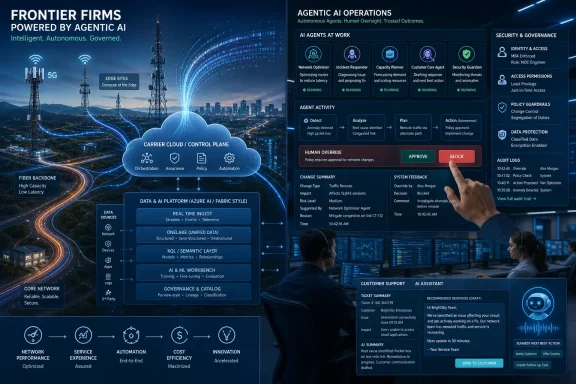 Microsoft Rebrands the Telco Automation Dream Around the Agent
The phrase Frontier Firm is Microsoft’s latest attempt to give enterprise AI adoption a shape executives can repeat in boardrooms. In Microsoft’s telling, these are companies moving beyond isolated pilots and putting AI at the center of how work gets assigned, monitored, and improved. The shift is not from human work to machine work, but from humans doing every step to humans orchestrating teams of digital agents.For telecom operators, that framing is almost irresistible. A carrier is already a machine for coordinating countless interdependent systems: radio access networks, core networks, fiber plant, provisioning platforms, billing stacks, field operations, customer support, fraud systems, and enterprise service desks. If any industry can make the case that complexity has outgrown manual coordination, telecom can.
Microsoft’s projection that businesses could be running 1.3 billion agents by 2028 gives the pitch a sense of inevitability. But it also reveals the coming management problem. A billion-plus agents will not be valuable simply because they exist. They will need identity, permissions, observability, compliance controls, audit trails, and business owners who know when to trust them and when to shut them down.
That is where the WindowsForum audience should pay attention. This is not only a telecom story. It is a preview of how Microsoft wants enterprises to think about AI across Microsoft 365, Azure, Fabric, Copilot, Azure AI Foundry, and the security stack: agents everywhere, governed through Microsoft’s cloud, grounded in enterprise data, and increasingly treated as first-class participants in business processes.
Telecom Is the Perfect Test Bed Because It Is Already Under Strain
Telecom operators have a strange business problem: they carry more of the digital economy every year, but they often struggle to capture the value created on top of their networks. Data demand rises, customer expectations rise, security risk rises, and capital intensity remains punishing. Meanwhile, customers still judge the provider by painfully simple measures: Is the connection up, is the bill right, and can I get help when something breaks?That combination makes AI attractive in four places at once. Carriers want to improve employee productivity, reduce operating expense, make customer support less maddening, and develop new revenue streams from enterprise managed services. None of those goals is new. AI merely gives the industry a new way to attack old margin pressure.
The customer-care examples are the easiest to understand. PLDT’s use of WIZ.AI’s TalkbotPro on Azure, Vodafone’s work with Azure OpenAI Service and Copilot, and similar deployments are aimed at reducing friction in high-volume support environments. If AI can understand a customer’s problem, summarize context, recommend next steps, and help agents respond in multiple languages, the business case is obvious.
But customer care is also where the limits become visible first. A carrier that deploys AI badly can make support feel colder, not smarter. The bot that cannot solve a problem, the summary that misses a crucial detail, the automation that traps a customer in a loop — these are not theoretical risks. They are the everyday failure modes of enterprise software with a conversational gloss.
The Real Prize Is Not the Chatbot, It Is the Network
The more consequential claim in Microsoft’s telecom pitch is not that AI can improve call centers. It is that agentic systems can transform network operations. That is where Microsoft’s NetAI framework enters the story, positioned as a way to move beyond basic automation into autonomous networking for hyperscale operations.The language is ambitious: faster root-cause analysis, fewer resources needed per incident, reduced time to repair, and a new relationship between engineers and AI systems. Beneath the buzzwords is a practical reality every network operator understands. Modern networks generate more telemetry than human teams can interpret unaided, especially when faults cascade across layers and vendors.
A useful AI system in this context would not merely answer a natural-language query. It would correlate alarms, logs, topology, change events, performance counters, customer-impact data, and historical incident patterns. It would suggest likely causes, recommend safe remediation, open or enrich tickets, and learn from the outcome. That is not magic; it is a more fluid interface to the automation and analytics telcos have been trying to build for years.
The catch is that network operations are an unforgiving place to exaggerate maturity. An AI assistant that drafts a poor email is annoying. An AI agent that misdiagnoses a routing incident or triggers the wrong remediation can turn a partial outage into a wider one. Telecom AI therefore needs a trust model that is more like aviation than office productivity: clear authority, strict boundaries, human override, and post-incident review.
The ROI Numbers Are Useful, But They Are Not a Strategy
The Microsoft-sponsored IDC figures cited in the broader AI conversation — an average return of $3.70 for every dollar invested in generative AI, with top performers reporting far higher returns — will be repeated in many executive decks. They are valuable as a signal that AI is moving beyond experimentation. They are less useful as a guarantee that any individual telco project will pay off.Averages hide the distribution. Some companies get real returns because they choose narrow, measurable workflows and integrate AI into existing systems. Others spend heavily on pilots, licenses, consultants, and cloud capacity, then discover that the missing ingredient was never the model. It was clean data, process ownership, change management, and a willingness to retire broken workflows rather than automate them.
The telecom examples in Microsoft’s orbit are strongest when they are specific. T-Mobile ingesting more than 800 terabytes of data per day into Azure-backed analytics is not a vague AI aspiration; it is a data-platform story. Lumen cutting 10,000 hours of manual effort with Microsoft Fabric is not just about a chatbot; it is about unifying ingestion, storage, analytics, and operational visibility.
That distinction matters. AI does not create operational intelligence from nowhere. It amplifies the quality of the data estate beneath it. A carrier with fragmented inventory systems, inconsistent service records, and opaque legacy platforms will not become a Frontier Firm by buying a Copilot license. It will simply give a more confident interface to unreliable information.
Microsoft’s Telco Pitch Is Also a Cloud Pitch
The telecom industry has spent years debating how much of the network should move to public cloud, how quickly, and under whose control. Microsoft’s AI message does not reopen that debate directly, but it changes the terrain. If the most valuable AI workflows depend on Azure AI Foundry, Azure OpenAI Service, Microsoft Fabric, Azure AI Search, Copilot, and cloud-scale data pipelines, then the operational center of gravity shifts toward the hyperscaler.That does not mean carriers are handing Microsoft the keys to the network. Large operators will remain careful, multi-vendor, and deeply concerned about resilience, sovereignty, latency, and regulatory exposure. But Microsoft is not merely selling tools around the edge of telco operations. It is selling an architecture in which the carrier’s data, workflows, agents, and governance increasingly live in a Microsoft-shaped control plane.
For enterprise IT pros, the pattern should look familiar. Microsoft rarely wins by offering a single isolated product. It wins by making the product more valuable when it is connected to the rest of the Microsoft stack. In telecom AI, that means the more a carrier uses Fabric for data, Azure for AI infrastructure, Copilot for employee workflows, and Microsoft security tools for governance, the easier Microsoft’s agent story becomes to adopt.
That integration can be genuinely useful. It can also create dependency. The more deeply AI agents are woven into operations, the harder it becomes to swap platforms later. Telcos know this better than anyone; they have lived with vendor lock-in across network equipment, OSS/BSS systems, and managed services for decades. AI could either loosen those constraints through open interfaces or reproduce them in a new layer.
Human-Led AI Is the Right Slogan, But Governance Is the Hard Part
Microsoft’s repeated emphasis on “human-led” AI is not accidental. It is meant to reassure workers, regulators, unions, and customers that agents will assist rather than replace people. In telecom, that reassurance is politically and operationally necessary. Networks are critical infrastructure, and the public will not accept a vague claim that an autonomous system was “probably right” after an outage.The better version of human-led AI is not sentimental. It means humans define the objectives, approve the risk boundaries, monitor the outputs, and remain accountable for the result. It also means the AI system is designed to expose its reasoning enough for engineers and support staff to challenge it. A black box with a friendly interface is not a teammate; it is an operational liability.
This is especially important in network automation. The industry has spent years trying to encode intent: what service should exist, what performance should be maintained, what policies should apply, and how the network should recover when reality disagrees. Agentic AI may make that intent easier to express, but it does not eliminate the need to verify the action.
Governance will also have to cover data boundaries. Telcos hold sensitive customer data, location-adjacent metadata, enterprise traffic information, lawful intercept obligations, and regulated operational records. AI systems that summarize, classify, or act on that information must be constrained by more than a terms-of-service checkbox. They need least-privilege access, retention rules, red-team testing, and logging that can survive legal and regulatory scrutiny.
The Workforce Story Is More Complicated Than Productivity
The optimistic version of the Frontier Firm says employees become managers of agents. Engineers stop hunting through dashboards and start supervising automated investigations. Customer-care staff stop reading from scripts and start resolving more nuanced issues. Sales and service teams get better recommendations because the data platform is finally coherent.Some of that will happen. It is easy to imagine experienced network engineers becoming dramatically more effective when AI handles correlation, documentation, and first-pass analysis. It is also easy to imagine junior staff relying too heavily on generated recommendations they do not yet know how to challenge. Productivity and deskilling can arrive together.
Telecom operators will need to decide whether AI becomes a training tool or a shortcut around training. If agents perform the routine diagnostic work, how do new engineers learn the instincts required for major incidents? If AI writes the customer summary, how do support teams preserve the habit of listening carefully? If automation closes the ticket, who verifies the customer’s problem is actually solved?
These are not arguments against AI adoption. They are arguments against lazy adoption. The carriers that get the most out of agentic systems will be the ones that redesign roles deliberately. They will treat AI fluency as an operational skill, not a motivational slogan.
The Customer Experience Could Improve, or Simply Become More Efficiently Bad
Telecom customers have low tolerance for futuristic language when their broadband is down. The industry’s challenge is that many customer problems are not hard because the words are hard to understand. They are hard because the provider’s internal systems are fragmented, the customer history is incomplete, and the authority to fix the issue is scattered across departments.AI can help if it connects those fragments. A well-grounded assistant could see that a customer’s outage aligns with a known local fault, that a recent provisioning change failed, or that a billing dispute is tied to a plan migration. It could help the human agent avoid asking the customer to repeat information for the fourth time. It could reduce the gap between what the company knows and what the support interaction reveals.
But AI can also become a shield between the company and the customer. If the system is optimized mainly to deflect calls, shorten handle time, or avoid escalation, it may improve the carrier’s metrics while worsening the customer’s lived experience. The difference between useful AI and hostile automation is often a management decision disguised as a technology decision.
Vodafone’s reported work with TOBi and SuperAgent points in the more promising direction: AI as augmentation for customer-care teams, not merely as a wall in front of them. The test will be whether these systems improve resolution quality, not just interaction volume. A faster wrong answer is not innovation.
The Enterprise Opportunity May Be Bigger Than Internal Savings
The most interesting telco AI story may eventually sit outside the carrier’s own operations. Lumen’s positioning around multi-cloud, AI-first enterprise connectivity hints at the bigger prize: telcos want to sell the infrastructure and managed services that other companies will need as AI adoption grows.AI workloads are hungry for bandwidth, low latency, predictable connectivity, secure access, and distributed data movement. Enterprises deploying AI across factories, retail sites, hospitals, campuses, and branch offices will need more than a chatbot subscription. They will need networks that can support data-intensive applications and security models that assume intelligence is distributed.
That could give carriers a stronger role in the AI economy than they had in the cloud economy. During the first cloud wave, telcos often provided the connectivity while hyperscalers captured the platform value. In the AI wave, carriers will try to climb higher in the stack by offering managed network services, security, edge capabilities, and data movement designed for AI-heavy enterprises.
Microsoft’s role here is complicated. It is both a partner and a gravitational force. The company wants carriers to use Azure and Fabric to modernize their operations, but it also wants those carriers to help sell Microsoft-enabled AI transformation to enterprise customers. The alliance makes sense. It also ensures that the economics of telco AI will be negotiated, not simply discovered.
Frontier Firms Will Be Built on Boring Foundations
The phrase “Frontier Transformation” sounds grand, but the implementation work will be stubbornly mundane. Telcos will need data catalogs, identity controls, API modernization, observability, service mapping, incident taxonomies, and clear ownership of workflows. They will need to know which systems of record are authoritative and which are merely historical accidents with a database attached.That is why Fabric, Azure AI Search, and the broader data platform matter in these examples. The AI interface gets the attention, but the underlying consolidation determines whether the answer is useful. In many large enterprises, the hardest part of deploying AI is not model selection. It is discovering that nobody fully trusts the data the model is supposed to use.
This is also where Microsoft has an advantage. It can package the modernization story as an AI story. A data lakehouse project that might once have sounded like an expensive internal plumbing exercise can now be framed as the foundation for agents, copilots, and autonomous operations. That narrative may unlock budgets that traditional IT modernization could not.
Still, the better carriers will resist the temptation to declare every modernization project an AI initiative. AI should sharpen the business case, not obscure it. If a telco cannot explain which process changes, which metric improves, and who is accountable, then “agentic” is just a more fashionable word for “unproven.”
The Security Model Must Grow Up as Fast as the Agents Do
Every agent introduced into a telco environment expands the question of trust. What can it read? What can it change? Which systems can it call? Can it trigger a workflow automatically, or only recommend one? What happens when an attacker manipulates the data it uses or the prompt it receives?Telecom networks are already high-value targets for cyber espionage, fraud, and disruption. Adding AI-driven orchestration to operational workflows creates new paths for abuse if controls are weak. Prompt injection, data poisoning, excessive permissions, and unreviewed automation are not abstract risks in a carrier environment. They are potential incident reports waiting for a root-cause meeting.
This is where agent management becomes more than administrative hygiene. Enterprises will need inventories of agents, owners for agents, policies for agent behavior, and logs of agent actions. They will need to revoke, update, test, and retire agents with the same seriousness they apply to applications and privileged accounts.
For Microsoft, this is both a responsibility and a market opportunity. If the company can persuade enterprises that agents are the new apps, it can also sell the management, identity, compliance, and security fabric around them. The success of the agent era may depend less on the cleverness of individual agents than on whether organizations can govern them at scale.
The Carrier’s AI Future Is Less Flashy Than the Demo
The concrete lesson from Microsoft’s telco showcase is that AI value appears first where the work is repeatable, measurable, and connected to usable data. The grand vision is autonomous operations; the near-term wins are narrower. That is not a weakness. It is how durable enterprise technology usually enters the bloodstream.- Telcos should treat customer-care AI as an augmentation layer until they can prove it improves resolution quality, not merely call deflection or handle time.
- Network operations AI should begin with decision support, correlation, and guided remediation before carriers allow broader autonomous action.
- The strongest ROI cases will come from workflows tied to clean data platforms, not from standalone chat interfaces placed on top of fragmented systems.
- Microsoft’s telecom AI strategy is inseparable from Azure, Fabric, Copilot, and its broader governance stack, which makes platform dependency a strategic consideration.
- Human-led AI will require new skills for engineers, support teams, and managers, especially the ability to supervise and challenge automated recommendations.
- Security teams should classify agents as operational actors with identities, permissions, logs, and lifecycle management, not as harmless productivity features.
References
- Primary source: Fierce Network
Published: 2026-06-04T15:31:25.858012
Telcos Among the New ‘Frontier Firms’ now Unlocking AI-driven Innovation and Creativity
By 2028, businesses are projected to have 1.3 billion agents autwww.fierce-network.com - Official source: news.microsoft.com
Microsoft’s 2025 Work Trend Index Report reveals the rise of the Frontier Firm, marking a new era of workforce dynamics - CEE Multi-Country News Center
The report underscores how intelligence on demand, hybrid human-AI agent teams, and evolving workplace structures are reshaping business operations and talent strategies. As organizations worldwide navigate the next wave of workplace transformation, Microsoft’s fifth annual Work Trend Index...news.microsoft.com - Official source: microsoft.com
2025: The year the Frontier Firm is born
Intelligence on tap will rewire business. Every leader needs a new blueprint. The time to act is now. The question is: how will you adapt?www.microsoft.com - Related coverage: techradar.com
'Every business leader knows the world is changing, but far fewer have a clear picture of what to do about it': Microsoft flags the changing world of AI at work, and why "Frontier Firms" are leading the way | TechRadar
Microsoft digs deep into how businesses are using AIwww.techradar.com
