

Microsoft’s Ignite 2025 framed a definitive pivot: AI is no longer a plug‑in feature added to finished apps — it’s being built into the fabric of how organizations design, run, govern and measure work, from the datacenter up to the people who rely on outcomes.
Microsoft used Ignite (Nov 18–21, 2025) to present an end‑to‑end vision for agentic AI — fleets of specialized Copilot agents that plan, act and can be governed like other enterprise services. That message stitched together updates to Copilot and Microsoft 365, new data semantics in Fabric, knowledge grounding in Foundry, lifecycle tooling in Copilot Studio and Azure AI Foundry, plus a governance and observability control plane Microsoft calls Agent 365. Two pieces of context matter for readers assessing the announcements. First, Microsoft framed this as an architectural shift: agents are intended to be identity‑bound actors with short‑lived credentials, telemetry, and policy controls so they can operate safely in production. Second, Microsoft repeatedly cites an IDC Info Snapshot predicting 1.3 billion AI agents in operation by 2028 to underline urgency — a projection Microsoft uses to justify governance and lifecycle investments; treat that number as an industry forecast rather than a hard certainty.
This matters because context is the single biggest limiter to AI usability in enterprise settings. Models alone are agnostic; value from agents comes when they reliably map prompts to the right data, the right system of record, and the right person to authorize actions.
At the same time, Microsoft continues to expand local inference/“Copilot+” hardware efforts for latency‑sensitive features. The practical architecture for most enterprises is hybrid: lightweight, privacy‑safe inference on device for UI responsiveness and larger, auditable actions in the cloud under Agent 365 controls.
The fundamental guidance for organizations evaluating these capabilities is straightforward: pilot deliberately, instrument aggressively, and govern strictly. When agents run with the same level of lifecycle discipline as any enterprise service, they can accelerate work and unlock new productivity frontiers. When they run without controls, they become a new class of shadow IT with higher systemic risk. The coming 12–24 months will show which enterprises become true “Frontier Firms” by building responsibly — and which ones learn the hard way that power without management invites problems.
Source: The Official Microsoft Blog From idea to deployment: The complete lifecycle of AI on display at Ignite 2025 - The Official Microsoft Blog
 Background
Microsoft used Ignite (Nov 18–21, 2025) to present an end‑to‑end vision for agentic AI — fleets of specialized Copilot agents that plan, act and can be governed like other enterprise services. That message stitched together updates to Copilot and Microsoft 365, new data semantics in Fabric, knowledge grounding in Foundry, lifecycle tooling in Copilot Studio and Azure AI Foundry, plus a governance and observability control plane Microsoft calls Agent 365. Two pieces of context matter for readers assessing the announcements. First, Microsoft framed this as an architectural shift: agents are intended to be identity‑bound actors with short‑lived credentials, telemetry, and policy controls so they can operate safely in production. Second, Microsoft repeatedly cites an IDC Info Snapshot predicting 1.3 billion AI agents in operation by 2028 to underline urgency — a projection Microsoft uses to justify governance and lifecycle investments; treat that number as an industry forecast rather than a hard certainty. What Microsoft announced (at a glance)
- Work IQ: an intelligence layer that models how people work, their relationships, content and habits to let Copilot and agents make contextual recommendations.
- Fabric IQ and Foundry IQ: data and knowledge layers that give agents live, semantically meaningful business context across analytic, time‑series, location and operational systems.
- Microsoft Agent Factory: a program to accelerate building agents with Foundry and Copilot Studio under a single metered plan and role‑based training (preview/eligibility caveats apply).
- Microsoft Agent 365: a governance and observability control plane designed to let IT discover, manage, secure and meter agents — including third‑party and open‑source agents — to treat them like first‑class enterprise services.
- Windows 365 for Agents and Cloud PC tuning: cloud desktops and runtime models optimized for running agents at scale under policy.
AI in the flow of human ambition: Work IQ and Copilot
What Work IQ is trying to solve
Work IQ is described as an intelligence layer built on an organization’s own data — emails, files, meetings, chats, habits and relationships — that supplies Copilot and agents with memory, preference signals and inferred context so outputs are actionable rather than generic. The pitch: make Copilot less of a generic assistant and more a work‑aware collaborator that can predict next steps and surface relevant business content.This matters because context is the single biggest limiter to AI usability in enterprise settings. Models alone are agnostic; value from agents comes when they reliably map prompts to the right data, the right system of record, and the right person to authorize actions.
Practical implications for teams
- Faster task completion: agents can propose multi‑step plans inside Word, Excel or PowerPoint and execute small tasks with human approval.
- Lower barrier to automation: business users can compose agents tuned to their workflows using Copilot Studio and Work IQ APIs, reducing the backlog that typically ties up platform engineering teams.
Ubiquitous intelligence: Fabric IQ + Foundry IQ explained
Fabric IQ — a semantic data model for real‑time operations
Fabric IQ brings together analytical, time‑series and location data with operational systems under a shared semantic model tied to business meaning. The benefit is simple: agents can query business concepts (orders, inventory, service incidents) instead of raw tables, making reasoning and action safer and faster. For customers using Power BI or Dataverse, existing modeling work accelerates agent readiness.Foundry IQ — a managed knowledge system for grounding
Foundry IQ is a managed knowledge layer that aggregates multiple data sources for agent grounding — Microsoft 365, Fabric IQ, custom apps and the web — with routing and quality controls built in. The goal is to provide a single endpoint agents can trust for factual context and to reduce hallucination risk by controlling provenance.Why both matter together
- Fabric IQ gives agents a live, connected view of business entities.
- Foundry IQ gives agents grounded knowledge and routing logic when multiple data sources conflict.
Combined, they reduce the “context gap” that turns agent outputs into unreliable suggestions, and they speed time to value by reusing prior BI investments.
Agent building and deployment: Microsoft Agent Factory and Copilot Studio
Agent Factory — the promise and the caveats
Microsoft Agent Factory is presented as a program that bundles Foundry, Copilot Studio and metered deployment into a single offering with training and support for eligible organizations. The aim is to remove upfront licensing friction and provide prescriptive role‑based training to boost AI fluency across teams. That sounds attractive, but the details matter: eligibility, pricing cadence, and exact support levels were described at a high level during Ignite and will require careful review before procurement. Treat specific cost and SLA statements as provisional until official commercial terms are published.Copilot Studio — low‑code agent creation
Copilot Studio continues to evolve as the low‑code/no‑code hub for turning business documentation and flows into agents, with Dataverse and Purview integration to enforce labeling and data governance at runtime. For developers and citizen builders, Copilot Studio aims to shrink the time from prototype to governed pilot. But the enterprise must still validate outputs, instrument telemetry and define rollback playbooks.Observability and governance: Microsoft Agent 365
What Agent 365 promises
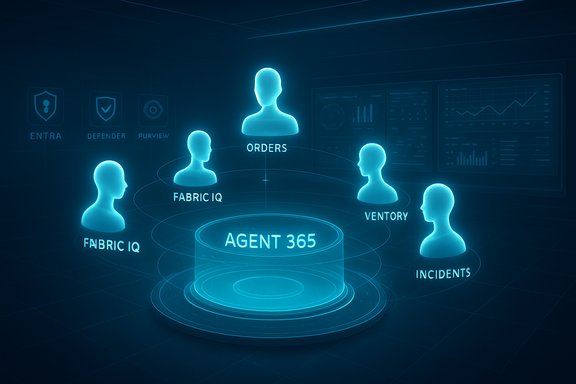
Agent 365 is Microsoft’s attempt to create a centralized control plane for agents — a registry, governance engine and monitoring fabric that treats agents like employees: they have identities, roles, telemetry and compliance signals. The platform is intended to integrate with Entra (identity), Defender (security), Purview (data governance) and Microsoft 365 admin tools, enabling discovery, quarantine and lifecycle actions across ecosystem agents (including third‑party ones). Reuters and other independent outlets reported the new product and its early access approach at Ignite.Why this is essential
- Agent sprawl is a real operational risk: if thousands or millions of agents proliferate unchecked, the attack surface grows, and cost and compliance problems multiply. Agent 365 aims to make agents observable and auditable.
- Identity‑first controls reduce mistaken privilege grants: tying agents to Entra identities and short‑lived credentials helps limit the blast radius of compromised agents.
Limits and unknowns
- Third‑party integration depth: Microsoft says Agent 365 will manage agents from multiple vendors, but the exact breadth of supported agent formats, open‑source runtimes and orchestration protocols requires validation in pilots. Independent reporting confirms the intent, but customers will need to test integrations with vendor agents they already use.
Windows, Cloud PCs and local inference: runtime considerations
Microsoft previewed Windows 365 for Agents and variations of Cloud PC tuned for agent workloads, positioning cloud desktops as safe runtime zones for autonomous agents that need stronger audit and segregation. For organizations wary of running agent workloads on user endpoints, the Cloud PC model centralizes runtime and policy enforcement.At the same time, Microsoft continues to expand local inference/“Copilot+” hardware efforts for latency‑sensitive features. The practical architecture for most enterprises is hybrid: lightweight, privacy‑safe inference on device for UI responsiveness and larger, auditable actions in the cloud under Agent 365 controls.
Security, privacy and compliance: the tradeoffs
Real risks to address now
- Data leakage and the “Confused Deputy” problem: agents with excessive privileges can inadvertently exfiltrate or misuse data unless strict connectors, Purview labeling and DLP policies are enforced. Microsoft’s security messaging and independent press both emphasize this risk.
- Shadow agents and sprawl: organizations that let business users create agents without IT guardrails will rapidly lose visibility into who’s doing what, increasing vulnerability to misconfiguration and compliance gaps.
- Cost and billing surprises: agent workloads are meterable and can multiply compute and media costs quickly; clear cost governance and budget controls are necessary.
Microsoft’s security posture and the reality on the ground
Microsoft embedded Defender, Entra and Purview integrations into the agent story and emphasized observability dashboards and short‑lived credentials. Independent reporting corroborated the new Agent 365 registry and governance features, while industry commentary urges rigorous pilot testing and extended SOC playbook updates before delegating production tasks to agents. Practical warning: some claims (such as the precise scope of Agent Factory metered pricing, or immediate GA timelines for specific features) were presented as programmatic promises at Ignite. Those specifics should be validated against Microsoft’s commercial documentation and purchase agreements before architectural commitments are made.Independently verifiable signals and what to trust
When evaluating platform claims, enterprises should cross‑check announcements against at least two independent sources and vendor documentation. Key verifiable signals from Ignite 2025:- Existence of Agent 365 and early access program — corroborated by Microsoft messaging and Reuters reporting.
- Work IQ, Fabric IQ and Foundry IQ as product themes — detailed on Microsoft product blogs and partner pages.
- IDC 1.3 billion agent projection — cited repeatedly by Microsoft and present in the sponsored IDC Infosnapshot; treat as a forecast used to justify product investments.
- Official service terms, pricing and SLA documents.
- Documentation on supported protocols and connectors for third‑party agents.
- Security design guides showing how Entra, Purview and Defender integrate with Agent 365.
If these are missing or ambiguous, treat claims about “no‑upfront licensing” or “single metered plan” as provisional.
A pragmatic rollout playbook for IT and security teams
Enterprises that want to pilot agentic capabilities responsibly should follow a staged approach:- Identify low‑risk, high‑value workflows suitable for agent pilots (reporting, customer triage, internal triage).
- Prepare a sanitized test tenant and representative telemetry for proof‑of‑concepts.
- Require evidence of lineage: every agent action must be traceable to a knowledge endpoint and an identity.
- Enforce least‑privilege: create policy templates for agent roles and short‑lived credentials via Entra.
- Instrument cost and consumption dashboards to detect runaway usage early.
- Add agents to regular access reviews and incident playbooks as first‑class “services.”
- Expand only after verifying accuracy, security and ROI against agreed KPIs.
Business and partner implications
- Vendors and ISVs: the new AI apps & agents category in the Microsoft Marketplace signals a commercial opportunity to package multi‑agent solutions and to offer resale‑enabled offers for partners. Being Marketplace‑ready and certified for Agent 365 compatibility will be a competitive advantage.
- Channel and services partners: there will be demand for packaged governance playbooks, COP (change control) templates, and managed agent runtimes for regulated industries.
- CIOs and legal teams: new contract terms for model routing, data residency and intellectual property in generated outputs will be required as agent usage expands.
Strengths, weaknesses and the path to production
Strengths
- Coherent platform story: Microsoft’s stack links identity, data semantics, knowledge grounding and lifecycle tooling in a way that helps IT see a path from prototype to production.
- Enterprise tooling emphasis: the focus on Entra identities, Defender integrations and Purview labeling acknowledges real enterprise security and compliance needs.
- Reuse of existing assets: Power BI and Dataverse work accelerate agent readiness for customers who already model business entities.
Weaknesses & risks
- Operational complexity: treating agents as first‑class services raises organizational demands for lifecycle management, SOC updates and runbook changes.
- Over‑reliance on forecasts: decisions driven by large market projections (the IDC 1.3B number) risk prioritizing scale over measured ROI. Validate pilots on your own KPIs.
- Integration gap risk: third‑party ecosystems and open‑source agent frameworks can be heterogeneous; Agent 365’s cross‑vendor breadth will be proven only through customer pilots.
Checklist: what to validate before you deploy
- Confirm commercial terms: metering, per‑agent pricing, metered plan details and SLA commitments.
- Test identity flows: Entra agent registration, conditional access, short‑lived creds and access reviews.
- Validate data routing and Purview labels: ensure Foundry and Fabric groundings respect classification and DLP settings.
- Stress test observability: validate that Agent 365’s telemetry shows full action provenance for sample failures and that you can quarantine rogue agents.
Conclusion
Ignite 2025 made one thing clear: Microsoft expects the next phase of enterprise AI to be agentic, identity‑aware and governed. The company shipped a coherent product narrative that joins Copilot, Copilot Studio, Fabric and Foundry with lifecycle and security tooling designed to let agents graduate from experiments to production services. That vision lowers the barrier to powerful automation — but it elevates the operational requirements for IT, security and legal teams.The fundamental guidance for organizations evaluating these capabilities is straightforward: pilot deliberately, instrument aggressively, and govern strictly. When agents run with the same level of lifecycle discipline as any enterprise service, they can accelerate work and unlock new productivity frontiers. When they run without controls, they become a new class of shadow IT with higher systemic risk. The coming 12–24 months will show which enterprises become true “Frontier Firms” by building responsibly — and which ones learn the hard way that power without management invites problems.
Source: The Official Microsoft Blog From idea to deployment: The complete lifecycle of AI on display at Ignite 2025 - The Official Microsoft Blog
