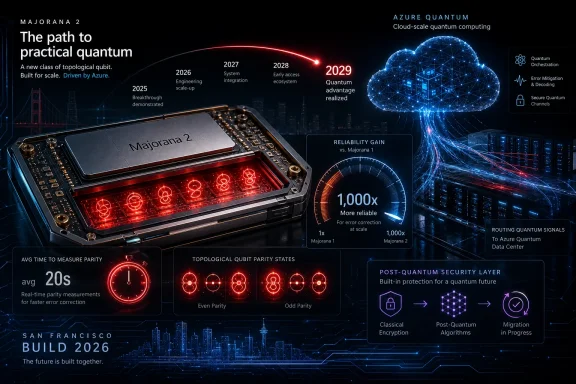
Microsoft unveiled Majorana 2 on June 2, 2026, at Build, presenting the next-generation topological quantum chip as a reliability breakthrough aided by its new Microsoft Discovery agentic AI platform and claiming it can reach a scalable quantum computer by 2029. That is the plain-news version. The more interesting version is that Microsoft is trying to turn quantum computing from a physics moonshot into a product roadmap. And it is doing so with the same argument now running through the rest of the company: AI is no longer just software that consumes compute; it is becoming a tool for inventing the next compute platform.
The center of Microsoft’s announcement is not merely that Majorana 2 exists. It is that Microsoft now says the chip has moved its expected timeline for a scalable quantum computer to 2029, roughly half the previous horizon the company had been describing. In an industry where “useful quantum computing” has often lived just beyond the next funding cycle, putting a year on the claim is a deliberate escalation.
That date matters because quantum computing has spent decades trapped between extraordinary theoretical promise and punishing engineering reality. Researchers can build systems that demonstrate quantum behavior, and vendors can sell access to cloud-connected quantum hardware, but useful, fault-tolerant machines remain a different class of achievement. Microsoft is now arguing that its long, lonely bet on topological qubits is beginning to pay off in a way that can be scheduled.
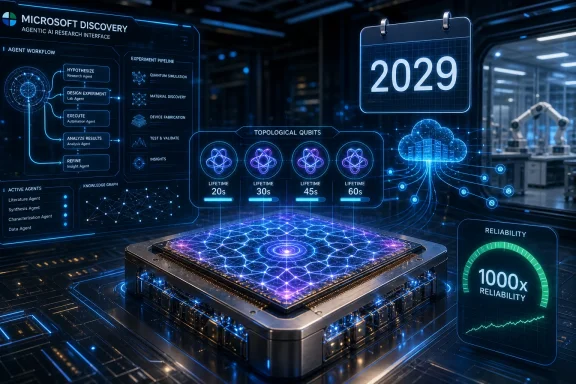
The company says Majorana 2 uses a new materials stack and qubits that are 1,000 times more reliable than the prior generation. Microsoft’s own framing emphasizes a mean qubit lifetime of 20 seconds, with some instances reportedly lasting up to a minute. In quantum computing, where fragile states are normally measured against noise, decay, and readout errors, that is the sort of number designed to make even skeptical observers pause.
But the bigger strategic move is that Microsoft is binding the chip to Microsoft Discovery, its agentic AI platform for scientific research. The company is not simply saying it improved a quantum device. It is saying AI-assisted research workflows helped improve the device, and that the same pattern can accelerate materials science, chemistry, and other fields that quantum computers themselves may eventually transform.
That protection is the seduction and the problem. If it works, it could reduce the scale of error correction required to build useful quantum computers. If it does not, Microsoft will have spent years chasing one of the most difficult paths through an already unforgiving field. The company’s quantum program has therefore carried a distinctly Microsoftian mix of patience, resources, abstraction, and occasional marketing overreach.
Majorana 1, announced in 2025, was Microsoft’s first major public claim that the topology-first strategy had crossed from theory and lab components into a processor architecture. Majorana 2 is meant to show that the first chip was not a one-off demonstration but the beginning of a generational progression. The shift from “we can build this” to “we can improve this predictably” is the critical distinction.
For WindowsForum readers, the analogy is less like a CPU generation and more like the early days of reliability engineering in storage, networking, or virtualization. A prototype is interesting. A roadmap is investable. A repeatable improvement curve is when infrastructure people start paying attention.
Classical computing hides error at almost every layer. Memory has correction, storage has redundancy, networks have retransmission, CPUs have validation paths, and operating systems assume the hardware is mostly deterministic. Quantum computing begins from the opposite premise: the information is fragile, measurement disturbs the system, and errors are not a rare exception but the central design constraint.
That is why Microsoft’s claim about longer-lived qubits matters. A qubit that holds state longer gives engineers more room to perform operations, measurements, and correction. It does not automatically create a useful quantum computer, but it changes the budget of what may be possible before the system loses coherence.
The company’s topological strategy is therefore less about winning a beauty contest over chip architecture and more about lowering the tax imposed by error correction. Useful quantum machines may require many physical qubits to produce one reliable logical qubit. If Microsoft’s approach can reduce that overhead, it could make the path to practical systems shorter than competing architectures require.
The word “if” remains load-bearing. Quantum history is littered with breakthroughs that later proved narrower than their press releases. Microsoft’s announcement is important because it points to measurable engineering progress, but the distance between a long-lived qubit and a fault-tolerant, programmable, scalable machine is still considerable.
This is a more consequential use of AI than another chatbot sidebar in an app. Scientific discovery is full of search problems: materials combinations, fabrication parameters, molecular structures, simulation outputs, failed trials, ambiguous correlations, and expensive experimental loops. If AI can shorten those loops, it becomes infrastructure for research rather than merely an interface for documents.
Microsoft’s quantum team reportedly used agentic AI to help manage and accelerate aspects of the materials and manufacturing challenge behind Majorana 2. That does not mean an AI invented the chip from scratch, and the distinction matters. The scientific work predates the current agentic AI boom, and the physics did not arrive as a prompt response.
Still, the business logic is obvious. Microsoft wants Discovery to be seen as the missing layer between today’s AI enthusiasm and tomorrow’s industrial R&D gains. Quantum computing gives it a prestige case study: a frontier technology supposedly accelerated by another frontier technology.
That is a powerful story, and perhaps too perfect a one. Microsoft is now selling the shovel, the mine, and the map to the gold. Its cloud runs AI workloads, its AI tools claim to accelerate scientific research, its quantum hardware may someday attack scientific problems beyond classical reach, and its enterprise platforms will be where customers are invited to consume the results.
The story Microsoft wants developers and enterprises to hear is straightforward: AI agents will write, test, coordinate, and discover; cloud infrastructure will orchestrate the work; specialized compute will expand what is computationally possible; and Microsoft will provide the control plane. Quantum is not expected to show up on a desktop near you next year, but it is being placed inside the future enterprise stack today.
That has consequences for how IT leaders should interpret the news. This is not a purchase recommendation. No sysadmin is about to deploy a Majorana 2 appliance next to the backup server. The relevance is strategic: Microsoft is telegraphing where it believes high-value computation is headed, and it wants enterprise customers to view Azure as the on-ramp.
The Windows connection is indirect but real. Windows has increasingly become the endpoint of a cloud-and-AI operating model rather than the whole computing environment. If Microsoft succeeds in turning quantum and agentic research into Azure services, the administrative surface will look familiar: identity, policy, compliance, cost controls, developer access, and governance.
In other words, the first practical quantum workloads most Microsoft customers encounter may not look like quantum hardware at all. They may appear as a specialized service inside a cloud workflow, called by an application, governed by Entra ID, monitored through familiar dashboards, and justified by a business unit that wants a better answer to a chemistry, logistics, security, or optimization problem.
That skepticism is healthy. Quantum computing is one of the few areas where a vendor can be simultaneously doing serious science and aggressive positioning. The gap between a published result, a lab demonstration, a working prototype, and a commercially useful machine is wide enough for misunderstanding to thrive.
The 2029 timeline is therefore best read as a public target rather than a delivered guarantee. Microsoft is telling investors, researchers, customers, and competitors that it believes its path has compressed. The burden now shifts to reproducible evidence, peer review, roadmap milestones, and eventual workload demonstrations that matter outside the lab.
There is also a measurement problem in the public conversation. Different quantum approaches use different metrics, and vendors naturally emphasize the numbers that make their architecture look strongest. Qubit count, coherence time, gate fidelity, logical qubit quality, error correction overhead, and algorithmic usefulness are related but not interchangeable.
For enterprise readers, the lesson is to avoid both extremes. Dismissing the announcement as hype ignores the seriousness of Microsoft’s investment and the potential significance of improved topological qubits. Treating it as proof that useful quantum computing has arrived would be just as mistaken.
But a research chip is not a cryptographic apocalypse. Breaking practical RSA or elliptic-curve deployments at scale would require a mature, fault-tolerant machine with substantial logical qubit capacity and operational reliability. Majorana 2 is a step in Microsoft’s claimed direction, not evidence that encrypted traffic is suddenly exposed.
The responsible response is boring, which is why it is the right one. Organizations should inventory cryptographic dependencies, understand vendor roadmaps for post-quantum support, track standards adoption, and identify systems with long confidentiality lifetimes. Data stolen today may still matter years from now, and that “harvest now, decrypt later” scenario is the reason security teams cannot wait until a quantum machine is commercially rentable.
Windows environments will feel this through certificate infrastructure, VPNs, TLS stacks, code signing, identity systems, hardware security modules, and compliance requirements. The migration will not be solved by flipping one Group Policy setting. It will be a long hygiene project involving vendors, legacy systems, procurement language, and risk classification.
That is why Microsoft’s own role is complicated. The company is both a potential accelerant of quantum risk and one of the vendors enterprises will rely on to manage post-quantum transition across operating systems, cloud services, developer tools, and identity platforms. The more credible its quantum roadmap becomes, the more pressure it faces to make the defensive migration practical.
That makes the cloud the natural delivery model. Customers will not buy a dilution refrigerator, hire a cryogenics team, and plug a quantum processor into a server rack. They will access quantum capability through APIs, managed services, hybrid workflows, and tools that hide much of the physical complexity.
Microsoft has been preparing for that model through Azure Quantum and related developer tooling. Majorana 2 strengthens the hardware side of the story, but the commercial product will be the platform around it. The winners in quantum may be determined not only by who builds the best qubits but by who makes them usable by chemists, materials scientists, financial modelers, logistics teams, and software developers who are not quantum physicists.
This is where Microsoft has a plausible advantage. The company understands enterprise abstraction layers. It knows how to package complex systems behind identity, billing, governance, SDKs, documentation, and partner ecosystems. If the hardware becomes viable, Microsoft is well positioned to turn it into something customers can consume.
The danger is that abstraction can also obscure limitations. Cloud dashboards make experimental systems look more mature than they are. IT leaders will need to distinguish between quantum-inspired algorithms, classical simulations of quantum systems, early quantum hardware experiments, and fault-tolerant quantum advantage. Those are not marketing variations of the same thing; they are different technical realities.
Still, dismissing quantum literacy as premature may be shortsighted for certain sectors. Chemistry, energy, pharma, advanced manufacturing, logistics, and national security are all areas where quantum computing could matter earlier than it does for ordinary business software. Developers in those ecosystems should at least understand the vocabulary and tooling landscape.
Microsoft’s broader Build message is that developers will increasingly work with agents, models, cloud services, and specialized compute as composable parts of applications. Quantum, in that view, becomes another backend capability. You may not write a quantum algorithm directly, but your application may someday call a service that uses one.
That future will require new forms of trust. Developers will need to know when a quantum-backed result is better, when it is merely different, and when the cost is unjustified. Observability and validation will matter because the worst enterprise technology failures often come from treating a specialized tool as magic.
The lesson from AI is fresh enough to be useful. Organizations rushed to deploy models before they had governance, evaluation, data controls, and clear ownership. Quantum will move more slowly, but the same temptation will appear: executive excitement ahead of operational readiness.
That is a profound shift if it works. Scientific research has always used software, but Microsoft is proposing something more integrated: AI agents that coordinate inquiry, cloud systems that scale computation, specialized hardware that attacks difficult simulations, and enterprise controls that make the whole process manageable. The lab notebook becomes a workflow. The experiment becomes a pipeline.
This is where the announcement’s ambition reaches beyond quantum computing. Microsoft is selling the idea that frontier R&D can be accelerated by general-purpose digital infrastructure. That has implications for drug discovery, battery chemistry, carbon capture, chip design, materials engineering, and any field where progress depends on searching enormous possibility spaces.
It also raises governance questions. If AI agents help propose experiments, rank materials, interpret results, and guide expensive scientific decisions, organizations will need audit trails and accountability. A bad recommendation in an office document is annoying. A bad recommendation in a laboratory or manufacturing process can waste millions or create safety risks.
Microsoft’s pitch therefore cuts both ways. The company wants credit for using AI to improve Majorana 2, but that means customers should ask how Discovery handles provenance, uncertainty, reproducibility, and human oversight. In serious science, speed is valuable only when it does not outrun verification.
That does not mean the story will resolve cleanly. Microsoft may hit an intermediate milestone and argue that scalability has been demonstrated. Critics may say the system is not useful enough. A machine may be scientifically impressive but commercially narrow. Quantum advantage may arrive first in a domain that matters enormously to chemists and hardly at all to ordinary enterprise IT.
Even so, the calendar changes the conversation. It invites procurement teams to ask when quantum-safe requirements belong in contracts. It invites security teams to accelerate cryptographic inventories. It invites developers in relevant sectors to learn the tooling before the tooling becomes urgent.
It also puts pressure on Microsoft’s competitors. If topological qubits begin to show a credible improvement curve, the field’s assumptions may shift. If they do not, the announcement will become another cautionary chapter in quantum marketing. Either outcome will be instructive.
The most likely near-term result is not a sudden winner but a more intense sorting of claims. Vendors will have to explain not just how many qubits they have, but what kind of errors they can survive, how logical qubits are constructed, what workloads can run, and what useful result has been produced.
 Microsoft Turns Quantum Progress Into a Calendar Promise
The center of Microsoft’s announcement is not merely that Majorana 2 exists. It is that Microsoft now says the chip has moved its expected timeline for a scalable quantum computer to 2029, roughly half the previous horizon the company had been describing. In an industry where “useful quantum computing” has often lived just beyond the next funding cycle, putting a year on the claim is a deliberate escalation.That date matters because quantum computing has spent decades trapped between extraordinary theoretical promise and punishing engineering reality. Researchers can build systems that demonstrate quantum behavior, and vendors can sell access to cloud-connected quantum hardware, but useful, fault-tolerant machines remain a different class of achievement. Microsoft is now arguing that its long, lonely bet on topological qubits is beginning to pay off in a way that can be scheduled.
The company says Majorana 2 uses a new materials stack and qubits that are 1,000 times more reliable than the prior generation. Microsoft’s own framing emphasizes a mean qubit lifetime of 20 seconds, with some instances reportedly lasting up to a minute. In quantum computing, where fragile states are normally measured against noise, decay, and readout errors, that is the sort of number designed to make even skeptical observers pause.
But the bigger strategic move is that Microsoft is binding the chip to Microsoft Discovery, its agentic AI platform for scientific research. The company is not simply saying it improved a quantum device. It is saying AI-assisted research workflows helped improve the device, and that the same pattern can accelerate materials science, chemistry, and other fields that quantum computers themselves may eventually transform.
The Majorana Bet Was Always the Weird One
Microsoft’s quantum strategy has long differed from the more visible approaches taken by rivals such as IBM, Google, and others pursuing superconducting qubits, trapped ions, neutral atoms, or photonic systems. Microsoft bet on topological qubits, a design based on exotic quasiparticles known as Majorana zero modes. The pitch is that topological qubits should be naturally more resistant to certain kinds of noise because quantum information is stored in a more protected form.That protection is the seduction and the problem. If it works, it could reduce the scale of error correction required to build useful quantum computers. If it does not, Microsoft will have spent years chasing one of the most difficult paths through an already unforgiving field. The company’s quantum program has therefore carried a distinctly Microsoftian mix of patience, resources, abstraction, and occasional marketing overreach.
Majorana 1, announced in 2025, was Microsoft’s first major public claim that the topology-first strategy had crossed from theory and lab components into a processor architecture. Majorana 2 is meant to show that the first chip was not a one-off demonstration but the beginning of a generational progression. The shift from “we can build this” to “we can improve this predictably” is the critical distinction.
For WindowsForum readers, the analogy is less like a CPU generation and more like the early days of reliability engineering in storage, networking, or virtualization. A prototype is interesting. A roadmap is investable. A repeatable improvement curve is when infrastructure people start paying attention.
Reliability Is the Real Product, Not the Chip
The headline number — 1,000 times more reliable — is doing a lot of work. In quantum systems, reliability is not a cosmetic metric. It is the difference between a machine that performs a scientific stunt and one that can run a meaningful computation before the answer dissolves into noise.Classical computing hides error at almost every layer. Memory has correction, storage has redundancy, networks have retransmission, CPUs have validation paths, and operating systems assume the hardware is mostly deterministic. Quantum computing begins from the opposite premise: the information is fragile, measurement disturbs the system, and errors are not a rare exception but the central design constraint.
That is why Microsoft’s claim about longer-lived qubits matters. A qubit that holds state longer gives engineers more room to perform operations, measurements, and correction. It does not automatically create a useful quantum computer, but it changes the budget of what may be possible before the system loses coherence.
The company’s topological strategy is therefore less about winning a beauty contest over chip architecture and more about lowering the tax imposed by error correction. Useful quantum machines may require many physical qubits to produce one reliable logical qubit. If Microsoft’s approach can reduce that overhead, it could make the path to practical systems shorter than competing architectures require.
The word “if” remains load-bearing. Quantum history is littered with breakthroughs that later proved narrower than their press releases. Microsoft’s announcement is important because it points to measurable engineering progress, but the distance between a long-lived qubit and a fault-tolerant, programmable, scalable machine is still considerable.
AI Enters the Lab as More Than a Demo Assistant
The most telling part of the Majorana 2 announcement may be Microsoft’s insistence that the chip was developed with help from Microsoft Discovery. That platform is being positioned as an agentic AI environment for research teams, where specialized agents can reason over data, propose experiments, coordinate workflows, and help scientists navigate complex design spaces.This is a more consequential use of AI than another chatbot sidebar in an app. Scientific discovery is full of search problems: materials combinations, fabrication parameters, molecular structures, simulation outputs, failed trials, ambiguous correlations, and expensive experimental loops. If AI can shorten those loops, it becomes infrastructure for research rather than merely an interface for documents.
Microsoft’s quantum team reportedly used agentic AI to help manage and accelerate aspects of the materials and manufacturing challenge behind Majorana 2. That does not mean an AI invented the chip from scratch, and the distinction matters. The scientific work predates the current agentic AI boom, and the physics did not arrive as a prompt response.
Still, the business logic is obvious. Microsoft wants Discovery to be seen as the missing layer between today’s AI enthusiasm and tomorrow’s industrial R&D gains. Quantum computing gives it a prestige case study: a frontier technology supposedly accelerated by another frontier technology.
That is a powerful story, and perhaps too perfect a one. Microsoft is now selling the shovel, the mine, and the map to the gold. Its cloud runs AI workloads, its AI tools claim to accelerate scientific research, its quantum hardware may someday attack scientific problems beyond classical reach, and its enterprise platforms will be where customers are invited to consume the results.
Build 2026 Reveals the Shape of Microsoft’s Ambition
Majorana 2 arrived in the broader context of Microsoft Build 2026, where the company also emphasized in-house AI models, agents, and developer tooling. That matters because Microsoft is not treating quantum as a separate research curiosity. It is folding quantum into the same platform narrative that now surrounds Azure, Copilot, GitHub, and Windows.The story Microsoft wants developers and enterprises to hear is straightforward: AI agents will write, test, coordinate, and discover; cloud infrastructure will orchestrate the work; specialized compute will expand what is computationally possible; and Microsoft will provide the control plane. Quantum is not expected to show up on a desktop near you next year, but it is being placed inside the future enterprise stack today.
That has consequences for how IT leaders should interpret the news. This is not a purchase recommendation. No sysadmin is about to deploy a Majorana 2 appliance next to the backup server. The relevance is strategic: Microsoft is telegraphing where it believes high-value computation is headed, and it wants enterprise customers to view Azure as the on-ramp.
The Windows connection is indirect but real. Windows has increasingly become the endpoint of a cloud-and-AI operating model rather than the whole computing environment. If Microsoft succeeds in turning quantum and agentic research into Azure services, the administrative surface will look familiar: identity, policy, compliance, cost controls, developer access, and governance.
In other words, the first practical quantum workloads most Microsoft customers encounter may not look like quantum hardware at all. They may appear as a specialized service inside a cloud workflow, called by an application, governed by Entra ID, monitored through familiar dashboards, and justified by a business unit that wants a better answer to a chemistry, logistics, security, or optimization problem.
The Skepticism Is Not Cynicism; It Is Due Diligence
Microsoft’s quantum claims deserve attention, but they also deserve scrutiny. The company’s Majorana program has faced skepticism from parts of the research community, particularly around the difficulty of proving that a device has achieved the topological behavior required for the architecture’s promised advantages. In this field, extraordinary claims do not become infrastructure merely because they are wrapped in a keynote.That skepticism is healthy. Quantum computing is one of the few areas where a vendor can be simultaneously doing serious science and aggressive positioning. The gap between a published result, a lab demonstration, a working prototype, and a commercially useful machine is wide enough for misunderstanding to thrive.
The 2029 timeline is therefore best read as a public target rather than a delivered guarantee. Microsoft is telling investors, researchers, customers, and competitors that it believes its path has compressed. The burden now shifts to reproducible evidence, peer review, roadmap milestones, and eventual workload demonstrations that matter outside the lab.
There is also a measurement problem in the public conversation. Different quantum approaches use different metrics, and vendors naturally emphasize the numbers that make their architecture look strongest. Qubit count, coherence time, gate fidelity, logical qubit quality, error correction overhead, and algorithmic usefulness are related but not interchangeable.
For enterprise readers, the lesson is to avoid both extremes. Dismissing the announcement as hype ignores the seriousness of Microsoft’s investment and the potential significance of improved topological qubits. Treating it as proof that useful quantum computing has arrived would be just as mistaken.
Security Teams Should Hear the Distant Alarm, Not Panic
Whenever quantum computing moves forward, cryptography enters the chat. A sufficiently capable fault-tolerant quantum computer could threaten widely used public-key cryptographic schemes, which is why governments and standards bodies have already been pushing post-quantum cryptography. Microsoft’s 2029 claim will inevitably sharpen that conversation.But a research chip is not a cryptographic apocalypse. Breaking practical RSA or elliptic-curve deployments at scale would require a mature, fault-tolerant machine with substantial logical qubit capacity and operational reliability. Majorana 2 is a step in Microsoft’s claimed direction, not evidence that encrypted traffic is suddenly exposed.
The responsible response is boring, which is why it is the right one. Organizations should inventory cryptographic dependencies, understand vendor roadmaps for post-quantum support, track standards adoption, and identify systems with long confidentiality lifetimes. Data stolen today may still matter years from now, and that “harvest now, decrypt later” scenario is the reason security teams cannot wait until a quantum machine is commercially rentable.
Windows environments will feel this through certificate infrastructure, VPNs, TLS stacks, code signing, identity systems, hardware security modules, and compliance requirements. The migration will not be solved by flipping one Group Policy setting. It will be a long hygiene project involving vendors, legacy systems, procurement language, and risk classification.
That is why Microsoft’s own role is complicated. The company is both a potential accelerant of quantum risk and one of the vendors enterprises will rely on to manage post-quantum transition across operating systems, cloud services, developer tools, and identity platforms. The more credible its quantum roadmap becomes, the more pressure it faces to make the defensive migration practical.
Useful Quantum Computing Will Arrive as a Service Before It Arrives as a Box
The phrase “useful quantum computing” can mislead because it invites people to imagine a new kind of general-purpose computer. That is not the likely first act. The first useful quantum systems will probably be narrow, expensive, specialized accelerators used for particular classes of problems where quantum methods offer an advantage.That makes the cloud the natural delivery model. Customers will not buy a dilution refrigerator, hire a cryogenics team, and plug a quantum processor into a server rack. They will access quantum capability through APIs, managed services, hybrid workflows, and tools that hide much of the physical complexity.
Microsoft has been preparing for that model through Azure Quantum and related developer tooling. Majorana 2 strengthens the hardware side of the story, but the commercial product will be the platform around it. The winners in quantum may be determined not only by who builds the best qubits but by who makes them usable by chemists, materials scientists, financial modelers, logistics teams, and software developers who are not quantum physicists.
This is where Microsoft has a plausible advantage. The company understands enterprise abstraction layers. It knows how to package complex systems behind identity, billing, governance, SDKs, documentation, and partner ecosystems. If the hardware becomes viable, Microsoft is well positioned to turn it into something customers can consume.
The danger is that abstraction can also obscure limitations. Cloud dashboards make experimental systems look more mature than they are. IT leaders will need to distinguish between quantum-inspired algorithms, classical simulations of quantum systems, early quantum hardware experiments, and fault-tolerant quantum advantage. Those are not marketing variations of the same thing; they are different technical realities.
The Developer Story Is Still Mostly Preparatory
For developers, Majorana 2 does not mean a sudden need to rewrite applications for quantum processors. The practical work remains exploratory: learning quantum programming models, understanding where hybrid algorithms fit, and tracking which problem domains are likely to benefit first. Most software teams have more urgent AI, security, and modernization work in front of them.Still, dismissing quantum literacy as premature may be shortsighted for certain sectors. Chemistry, energy, pharma, advanced manufacturing, logistics, and national security are all areas where quantum computing could matter earlier than it does for ordinary business software. Developers in those ecosystems should at least understand the vocabulary and tooling landscape.
Microsoft’s broader Build message is that developers will increasingly work with agents, models, cloud services, and specialized compute as composable parts of applications. Quantum, in that view, becomes another backend capability. You may not write a quantum algorithm directly, but your application may someday call a service that uses one.
That future will require new forms of trust. Developers will need to know when a quantum-backed result is better, when it is merely different, and when the cost is unjustified. Observability and validation will matter because the worst enterprise technology failures often come from treating a specialized tool as magic.
The lesson from AI is fresh enough to be useful. Organizations rushed to deploy models before they had governance, evaluation, data controls, and clear ownership. Quantum will move more slowly, but the same temptation will appear: executive excitement ahead of operational readiness.
Microsoft’s Real Message Is That Research Is Becoming Platformized
The most important through-line in this announcement is not the qubit, the chip name, or even the 2029 date. It is Microsoft’s attempt to platformize scientific research. Discovery, Majorana 2, Azure Quantum, Copilot-style agents, and cloud infrastructure all point toward a future where the lab becomes another software-mediated enterprise environment.That is a profound shift if it works. Scientific research has always used software, but Microsoft is proposing something more integrated: AI agents that coordinate inquiry, cloud systems that scale computation, specialized hardware that attacks difficult simulations, and enterprise controls that make the whole process manageable. The lab notebook becomes a workflow. The experiment becomes a pipeline.
This is where the announcement’s ambition reaches beyond quantum computing. Microsoft is selling the idea that frontier R&D can be accelerated by general-purpose digital infrastructure. That has implications for drug discovery, battery chemistry, carbon capture, chip design, materials engineering, and any field where progress depends on searching enormous possibility spaces.
It also raises governance questions. If AI agents help propose experiments, rank materials, interpret results, and guide expensive scientific decisions, organizations will need audit trails and accountability. A bad recommendation in an office document is annoying. A bad recommendation in a laboratory or manufacturing process can waste millions or create safety risks.
Microsoft’s pitch therefore cuts both ways. The company wants credit for using AI to improve Majorana 2, but that means customers should ask how Discovery handles provenance, uncertainty, reproducibility, and human oversight. In serious science, speed is valuable only when it does not outrun verification.
The 2029 Date Is a Bet IT Can Track
Microsoft has done the industry a favor by making a claim that can be watched. “Years, not decades” is elastic. “By 2029” is less so. It gives customers, competitors, researchers, and journalists a clock.That does not mean the story will resolve cleanly. Microsoft may hit an intermediate milestone and argue that scalability has been demonstrated. Critics may say the system is not useful enough. A machine may be scientifically impressive but commercially narrow. Quantum advantage may arrive first in a domain that matters enormously to chemists and hardly at all to ordinary enterprise IT.
Even so, the calendar changes the conversation. It invites procurement teams to ask when quantum-safe requirements belong in contracts. It invites security teams to accelerate cryptographic inventories. It invites developers in relevant sectors to learn the tooling before the tooling becomes urgent.
It also puts pressure on Microsoft’s competitors. If topological qubits begin to show a credible improvement curve, the field’s assumptions may shift. If they do not, the announcement will become another cautionary chapter in quantum marketing. Either outcome will be instructive.
The most likely near-term result is not a sudden winner but a more intense sorting of claims. Vendors will have to explain not just how many qubits they have, but what kind of errors they can survive, how logical qubits are constructed, what workloads can run, and what useful result has been produced.
A Practical Reading of Microsoft’s Quantum Shortcut
For all the exotic physics, the practical implications of Majorana 2 are fairly concrete. The announcement should neither trigger panic nor be filed away as distant science fiction.- Microsoft has claimed a major reliability improvement in its topological quantum hardware, centered on longer-lived qubits and a new materials stack.
- The company is now publicly aiming for a scalable quantum computer by 2029, which turns its quantum program into a schedule that outsiders can track.
- Microsoft is using Majorana 2 to promote Microsoft Discovery as an agentic AI platform for scientific research, not merely as another Copilot-branded productivity layer.
- Enterprise IT should treat the news as strategically relevant but not operationally immediate, because useful quantum capability will likely arrive first through cloud services and specialized workflows.
- Security teams should continue post-quantum cryptography planning with more urgency, while avoiding exaggerated claims that today’s encryption has already been broken.
- Developers in chemistry, materials, logistics, energy, and similar domains should pay closer attention than general application teams, because those are the places where early quantum value is most likely to appear.
References
- Primary source: The Verge
Published: Tue, 02 Jun 2026 18:15:00 GMT
Microsoft’s next-gen quantum chip cuts timeline to useful quantum computing | The Verge
Microsoft’s Majorana 2 chip uses a new material stack that promises quantum computing much sooner.www.theverge.com
- Independent coverage: Let's Data Science
Published: Tue, 02 Jun 2026 20:05:15 GMT
Microsoft unveils in-house AI models, agents and Majorana 2 chip | Let's Data Science
At Build 2026, Microsoft introduced a family of in-house "MAI" models, branded Microsoft AI, including `MAI-Thinking-1`, `MAI-Code-1-Flash`, `MAI-Image-2.5`, `MAI-Transcribe-1.5`, and `MAI-Voice-2`, per Microsoft's Build live blog and GeekWire, which frames the move as a bid for... letsdatascience.com
- Independent coverage: Firstpost
Published: Tue, 02 Jun 2026 19:11:55 GMT
- Official source: news.microsoft.com
Majorana 2, made more reliable with Microsoft Discovery agentic AI
How Microsoft’s new quantum chip was made 1,000x more reliable with the help of Microsoft Discovery's agentic AI.news.microsoft.com - Official source: quantum.microsoft.com
Microsoft Quantum | Microsoft Quantum Hardware
Learn about Majorana 2, Microsoft's most advanced quantum processor featuring scalable topological qubits resistant to errors at the hardware level.quantum.microsoft.com
- Official source: azure.microsoft.com
Microsoft unveils Majorana 1, the world’s first quantum processor powered by topological qubits - Microsoft Azure Quantum Blog
Majorana 1 from Microsoft is the world’s first Quantum Processing Unit (QPU) built with a topoconductor. Discover more. azure.microsoft.com
- Related coverage: investing.com
Microsoft unveils AI-designed quantum chip, targets 2029 launch By Investing.com
Microsoft unveils AI-designed quantum chip, targets 2029 launchwww.investing.com - Official source: techcommunity.microsoft.com
Qurious About Quantum? | Microsoft Community Hub
Why IT Should Care About Quantum Right Now – It’s Not Just A Research Problem Today on April 14th, 2026 we celebrate World Quantum Day! There has been a... techcommunity.microsoft.com
- Related coverage: tomsguide.com
Biggest Microsoft Build 2026 announcements — agentic AI, RTX Spark Dev Box, GitHub Copilot app, new MAI models, and more | Tom's Guide
All the big news from Microsoft's AI-focused eventwww.tomsguide.com - Related coverage: phys.org
- Related coverage: mckinsey.com