

Microsoft used a June 2, 2026 corporate blog post to argue that enterprise AI will be won not by standalone models or chatbots, but by integrated agent platforms spanning GitHub, Microsoft IQ, Foundry, Agent 365, Microsoft 365, Windows, Security, and Azure. The pitch is unmistakably bigger than another Copilot feature drop. Microsoft is trying to define the next enterprise stack before customers, rivals, and regulators settle on what “agentic AI” should actually mean. The bet is that whoever owns the system of record for agents may also own the next operating model of business.
The most important thing about Microsoft’s latest AI message is what it pushes into the background. The model is no longer the star. The chatbot is no longer the product. Even Copilot, the brand Microsoft has spent years hammering into Office, Windows, GitHub, and security, is being repositioned as one surface inside a larger machine.
That is a strategic shift. In the first phase of generative AI adoption, Microsoft could plausibly win by putting a conversational interface in front of familiar productivity apps and charging a premium for it. In the next phase, the company is arguing that the interface matters less than the operating system behind it: identity, governance, telemetry, evaluation, orchestration, policy, data grounding, and deployment lifecycle.
That is why the blog post’s central claim lands with unusual bluntness: “AI alone won’t change your business. The system running it will.” It is marketing, certainly, but it is also a useful diagnosis of why many enterprise AI pilots have stalled. A clever demo can draft an email, summarize a meeting, or answer a support question. A production system has to know who is asking, what they are allowed to see, what tool it may call, whether the answer is auditable, how much the task costs, and what happens when the agent gets something wrong.
Microsoft’s answer is to make agentic AI look less like a lab experiment and more like enterprise software. That means lifecycle management, access control, routing, observability, cataloging, and human oversight. It also means making AI agents legible to IT departments that have spent decades learning, often painfully, that unmanaged software eventually becomes unmanaged risk.
This is where Microsoft’s advantage is obvious. It already owns huge portions of the enterprise surface area: Windows endpoints, Entra identity, Microsoft 365 content, Teams collaboration, GitHub development workflows, Defender security tooling, Purview compliance, Fabric data infrastructure, Azure compute, and a growing AI platform in Foundry. The June 2 announcement is less about introducing one new product than about stitching those assets into a single argument: enterprises should not assemble the agent era themselves.
That is a much bigger claim, and a more contested one. If agents are going to perform work across functions, they need permission to touch real systems. They need context from business data, documents, tickets, CRM records, websites, repositories, policies, and workflows. They also need to leave traces behind so managers, auditors, and security teams can reconstruct what happened.
The vendor that provides that connective tissue gets enormous leverage. It can shape how agents are built, what counts as a trusted data source, how policies are expressed, which models are cheap enough to use at scale, and how organizations measure whether agentic work is actually improving. In older enterprise-software language, Microsoft is pitching a platform. In sharper terms, it is pitching a control plane for machine labor.
That control-plane framing is not incidental. Microsoft has been warming up this language for months through Agent 365, Frontier Suite messaging, Microsoft IQ, and Foundry. The June post pulls those threads together into a single stack narrative: build in GitHub, contextualize with Microsoft IQ, run in Foundry, govern with Agent 365, surface in Microsoft 365 and Teams, secure through Microsoft Security, scale on Azure, and extend to Windows devices.
For IT leaders, that is a seductive map because it replaces a chaotic market with a familiar enterprise promise: one vendor, one architecture, one set of controls. For rivals and customers wary of lock-in, it is also a warning. Microsoft’s “open” agent platform is open in the way many enterprise platforms are open: broad enough to ingest outside models and frameworks, but designed so the gravitational center remains Microsoft.
That is a strong argument because the alternative is already visible inside many companies. Teams build one-off AI assistants in scattered tools. Business units automate steps without central review. Prompts live in documents, low-code flows, private notebooks, or SaaS dashboards. Nobody knows which version produced which output, which model was used, or whether the agent’s behavior changed after a vendor update.
By anchoring agent development in GitHub, Microsoft is trying to pull AI work into the discipline of software engineering. That means code review, dependency awareness, issue tracking, pull requests, CI/CD, and a path from prototype to production. It also means Copilot remains adjacent to the work of building agents, not merely the product consumed after they are built.
This approach will appeal most immediately to engineering-heavy organizations. A bank, insurer, manufacturer, software vendor, or government agency with strict change-management practices can understand an agent lifecycle if it resembles the application lifecycle. Source, test, deploy, observe, improve: the verbs are familiar even if the artifact is new.
But there is tension here. Many of the most aggressive AI adopters inside large organizations are not professional developers. They are analysts, operations managers, finance specialists, support leads, and HR teams trying to automate local pain points. If Microsoft pulls too much of the agent story into GitHub, it risks making agent development feel like another developer-governed bottleneck. If it loosens the model too far, it risks the very agent sprawl Agent 365 is supposed to tame.
The likely answer is not one path but two. Professional developers will build durable agents in GitHub and Foundry. Business users will assemble or configure agents closer to Microsoft 365 and Teams. Microsoft’s challenge is making those two worlds share governance, context, policy, and telemetry without flattening them into the same workflow.
Microsoft IQ is the company’s attempt to package that missing layer. In the June post, Microsoft describes IQ as the mechanism that grounds agents in enterprise context across Microsoft 365, business systems, knowledge bases, websites, and, with Web IQ, selected information from the web. The argument is that context cannot simply be dumped into a model. It has to be organized, secured, surfaced, and shaped into forms that agents can use.
That is both true and commercially convenient. Microsoft has spent years building the substrate for this pitch: Microsoft Graph, SharePoint, OneDrive, Teams, Outlook, Purview, Fabric, Dynamics integrations, semantic layers, and security labels. If AI becomes a contest over context, Microsoft can say it already lives where the context is.
The risk is that the phrase “enterprise context” can hide as much as it reveals. Business data is messy, duplicated, stale, permissioned inconsistently, and full of tacit knowledge. A sales agent that can read CRM records is not necessarily ready to negotiate with a customer. A finance agent that can query a data warehouse is not necessarily ready to explain margin variance. A support agent that can search documentation is not necessarily ready to recommend a remediation path during an outage.
That is why Microsoft’s emphasis on IQ as organized intelligence is more important than the branding. Retrieval alone is not enough. Connectors alone are not enough. A useful agent needs a governed representation of how the business actually works, and in many companies that representation does not exist cleanly yet. Microsoft can provide the platform, but customers still have to do the organizational archaeology.
That is the dream version of enterprise AI: the system learns how work gets done, improves with feedback, and becomes more valuable the longer it runs. A support agent learns which resolutions actually closed incidents. A coding agent learns the house style and architecture constraints. A finance agent learns the difference between a normal variance and a material anomaly. An HR agent learns which policies require escalation rather than improvisation.
This is where Microsoft’s “system” language becomes more than rhetoric. If the loop from action to outcome to evaluation to improvement is real, the platform is no longer a static software tool. It becomes an adaptive production environment. The competitive advantage comes not just from adopting AI, but from accumulating operational learning faster than competitors.
The hard part is that feedback loops can amplify mistakes as easily as they amplify expertise. If agents learn from flawed workflows, biased decisions, incomplete approvals, or short-term metrics, they may optimize the wrong thing. If human oversight becomes perfunctory, the loop can acquire the appearance of governance without the substance. If business units tune agents locally without enterprise coordination, organizations may end up with a patchwork of optimized silos.
Microsoft appears aware of this, which is why the post repeatedly emphasizes human oversight, controlled rollout, evaluation, and governance. Still, the operational burden will be significant. Enterprises will need to decide which outcomes count, who validates improvements, how agents are promoted between environments, how regressions are detected, and when an agent’s learned behavior becomes a compliance issue.
The phrase “the learning stays yours” is also doing a lot of work. Customers are increasingly sensitive to whether their proprietary data, workflows, and fine-tuned behavior leak into a vendor’s broader model ecosystem. Microsoft’s promise that custom or post-trained models remain in the customer’s environment is aimed directly at that concern. In regulated sectors, that assurance may be the difference between a pilot and a deployment.
The runtime problem is real. Agents behave differently from traditional applications. They do not simply execute deterministic code paths. They reason, call tools, retrieve context, invoke APIs, coordinate with other agents, and sometimes fail in ways that are probabilistic rather than neatly reproducible. A production environment for agents therefore needs logging, replay, policy enforcement, cost controls, sandboxing, evaluation, and model routing.
Microsoft’s model-diversity pitch is central here. The company says enterprises need to balance quality, speed, and cost by selecting the right model for each job, including Microsoft models, partner models, and open models. That is sensible because the economics of AI at enterprise scale will not support using the most expensive frontier model for every task. A lightweight classifier, an open coding model, a specialized speech model, and a heavyweight reasoning model may all coexist inside the same workflow.
The addition of Fireworks AI on Foundry fits that story by emphasizing efficient inference for open models. Microsoft does not want customers to conclude that openness requires leaving Azure or Foundry. It wants to be the place where open, partner, and first-party models are all consumed under the same operational controls.
There is a familiar platform pattern here. Microsoft is not insisting that every agent be built with its own framework. The post explicitly references agents built with the Microsoft Agent Framework, LangGraph, the GitHub Copilot SDK, Claude Agent SDK, or a custom harness. That acknowledgment is practical; the agent ecosystem is too fragmented for any one vendor to pretend otherwise. But the destination is still Foundry, where Microsoft can provide the runtime, policy, observability, and optimization layer.
The question for customers is whether Foundry becomes a neutral control surface or a velvet funnel. Microsoft will likely support enough heterogeneity to satisfy enterprise procurement and architecture boards. But the deepest integration, easiest governance, and most polished lifecycle will almost certainly favor customers already invested in the Microsoft stack.
This is the piece administrators will recognize immediately. Every major technology wave creates a visibility problem. SaaS created shadow IT. Mobile created unmanaged endpoints. Cloud created surprise spending and sprawling identities. AI agents threaten to combine all of those problems into one: autonomous or semi-autonomous software entities with access to data, tools, and workflows.
Microsoft’s answer is to treat agents as governable objects. They appear in a catalog. They are tied to owners. Their permissions can be inspected. Their behavior can be monitored. Their costs can be tracked. Their access can be limited or revoked. Entra, Purview, Defender, and the broader Microsoft Security stack become the familiar enforcement machinery around a new class of actor.
That is compelling because the nightmare scenario for enterprise AI is not that agents are useless. It is that they are useful enough to proliferate before anyone can govern them. A department that saves time with a rogue agent may not care that the agent has excessive access until an auditor, regulator, or incident response team does. By then, the organization may not even know what the agent did.
Agent 365 also gives Microsoft a way to govern agents not built on Microsoft’s stack. That is strategically important. If the company can become the management layer for third-party agents, it can benefit even when customers use Anthropic, open-source frameworks, custom harnesses, or specialized vertical AI tools. In that world, Microsoft does not need to own every agent. It needs to own the enterprise trust boundary.
For WindowsForum readers, this should sound familiar. Microsoft has often won enterprise battles by making itself the administrative center of gravity. Active Directory did it for identity. System Center and Intune did it for device management. Defender and Purview are doing it for security and compliance. Agent 365 is the same play adapted to machine workers.
This matters because the cloud-only AI story has limits. Latency, privacy, cost, offline access, data residency, and local context all create reasons to run some inference or agent activity on-device. A Windows machine has access to local files, apps, user workflows, peripherals, and system state. That makes it powerful and dangerous.
Always-on agents on Windows will need serious containment. An agent that can observe user activity, act across applications, and call local or remote tools is qualitatively different from a chatbot in a browser tab. Sandboxing, identity boundaries, permission prompts, audit logs, and administrative policy will determine whether this becomes a productivity layer or a security headache.
Microsoft’s Windows AI ambitions have already generated skepticism, especially where local data capture and recall-like experiences are concerned. The company knows that trust on the endpoint is fragile. If enterprise agents are going to run locally, Microsoft will have to prove that Windows can host them without creating a new class of surveillance, data leakage, or persistence risk.
The upside is also real. Local agents could automate repetitive desktop workflows, bridge legacy applications without modern APIs, assist developers with repository-specific work, and support field or sovereign environments where cloud access is constrained. For organizations still deeply tied to Windows line-of-business applications, this may be the difference between AI that works in a demo and AI that works in the actual estate.
In that environment, integration is not a boring enterprise virtue. It is the product. The value of a single system is that it reduces the number of seams where policy, identity, cost, and accountability can break. Microsoft is betting that the pain of stitching tools together will push customers toward a more consolidated stack.
The company is also exploiting a timing advantage. Many businesses have already experimented with AI and discovered both its usefulness and its limits. They have seen productivity gains in writing, coding, summarization, and search, but they have also seen hallucinations, unclear ROI, data-access concerns, and difficulty moving beyond pilots. Microsoft’s new message lands precisely at that frustration point: the problem is not the absence of AI, but the absence of an operating system around it.
That framing is convenient, but not wrong. Enterprises do not transform around a text box. They transform when workflows, incentives, systems of record, controls, and accountability change. If agents are to become part of real operations, they must be managed like real operational components.
The danger is that “single integrated system” becomes a euphemism for platform dependency. Microsoft’s stack may reduce integration risk, but it also concentrates architectural power. Once agent development, context, runtime, governance, workplace surfaces, security, and compute all run through the same vendor’s system, switching costs rise dramatically. The more the AI learns from the business, the more embedded the platform becomes.
The agentic platform argument changes the unit of analysis. Microsoft is now talking about workflows, business functions, and enterprise-wide systems. ROI is not just “does one user save time?” but “does a process complete faster, with fewer handoffs, better auditability, and lower marginal cost?” That is a more serious business case, but also a harder one to prove.
Agents that execute long-running work across functions will need baseline measurements. How long did the process take before? What error rate was acceptable? Which human approvals were required? Which exceptions were escalated? What did the workflow cost? Without that instrumentation, organizations may mistake activity for value.
Microsoft’s emphasis on evals and traces is therefore more than technical garnish. Evaluations give organizations a way to define quality. Traces provide a way to inspect behavior. Together, they make agent performance measurable enough to improve and govern. In theory, this lets enterprises move from AI anecdotes to operational metrics.
But measuring agentic work will be politically difficult. If an agent reduces handoffs, whose team loses control? If an agent exposes that a process is slow because of policy rather than labor, who owns the fix? If an agent performs 80 percent of a task but leaves the hardest exceptions to humans, how should productivity be counted? The technology may be the easy part compared with the organizational negotiation it triggers.
This is why Microsoft’s “compounding” language is both powerful and slightly ominous. A system that compounds value can widen competitive gaps. It can also compound bad assumptions, hidden dependencies, and vendor lock-in. The enterprises that benefit will be those that treat AI governance as operational design, not procurement paperwork.
Traditional application security assumes that software has defined permissions and predictable behavior. Agentic systems complicate that picture because their actions may vary depending on prompts, retrieved context, tool results, and intermediate reasoning. The permission boundary has to account not only for what the agent can access, but for what it might infer, combine, disclose, or trigger.
Microsoft’s security story leans on Entra, Purview, Defender, Agent 365, and policy rails across the runtime. That is the right vocabulary for enterprise buyers. They do not want separate AI governance consoles that sit outside existing identity and compliance systems. They want AI artifacts to inherit familiar controls.
Still, security teams will need new habits. They will need to review agent permissions the way they review service principals, privileged apps, and automation accounts. They will need to monitor tool calls, not just logins. They will need to detect prompt injection, data exfiltration through generated outputs, suspicious agent-to-agent coordination, and runaway cost behavior. They will need incident playbooks for agents that acted incorrectly but not maliciously.
The hardest problems will be gray areas. What if an agent follows policy but produces a harmful recommendation? What if it accesses only permitted data but combines it in a way that reveals sensitive insight? What if a user delegates a task they were authorized to perform manually, but the automated scale of the agent changes the risk profile? These are not edge cases. They are the shape of the work ahead.
A developer building an agent must think about prompts, tools, policies, context sources, model routing, evals, traces, safety controls, cost budgets, and rollback plans. That is a broader surface than a typical application feature. The agent may be nondeterministic, model-dependent, and sensitive to changes in external data. It may also be judged by business outcomes rather than conventional uptime.
GitHub can make this manageable by putting agent assets near code and workflow management. Foundry can provide runtime primitives. Agent 365 can handle cataloging and governance. But the craft of building reliable agents is still young. Best practices will evolve through failures as much as through documentation.
This creates an opportunity for IT pros and platform engineers. Just as DevOps and cloud adoption created internal platform teams, agentic AI will create demand for paved roads: approved model patterns, secure connectors, evaluation templates, deployment gates, observability dashboards, and policy libraries. The organizations that succeed will not let every team invent its own agent stack from scratch.
It also creates a training problem. Business leaders may hear “agent” and expect autonomous digital employees. Developers may understand the fragility underneath. Bridging that expectation gap will be essential. A production agent is not magic; it is a software system with probabilistic components and a governance wrapper. Treating it otherwise is how companies end up with expensive demos and brittle automation.
Microsoft is betting that the agent era will not be won by the most dazzling model demo, but by the vendor that can make AI boring enough to trust and useful enough to reshape workflows. That is a plausible bet, and one that plays directly to Microsoft’s strengths. The company already owns the places where enterprise work is created, discussed, secured, deployed, and audited.
The counterargument is that customers should be careful about letting one vendor define the entire agentic stack. Openness matters most when the system starts to learn from the business itself. Enterprises should welcome integrated governance and lifecycle management, but they should also demand portability, clear data boundaries, model choice, transparent evaluation, and the ability to inspect how agent behavior changes over time.
For Windows users, sysadmins, and IT pros, the message is simple: AI is moving out of the sidebar and into the machinery of work. The next wave will not be judged by whether a chatbot can summarize a document. It will be judged by whether organizations can safely delegate real tasks to systems that know the business, respect policy, improve with evidence, and remain accountable to humans. Microsoft wants to be the company that supplies that machinery, and the rest of the enterprise software market now has to answer a harder question: if AI alone is not enough, whose system will run it?
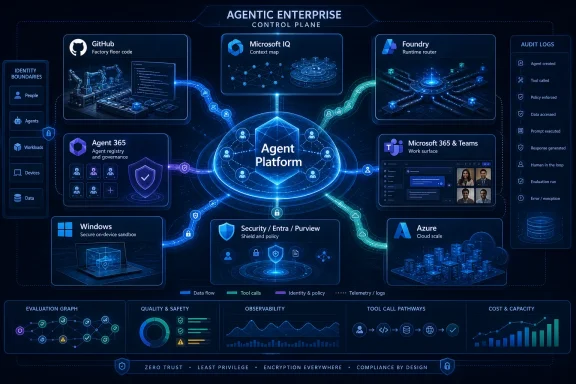 Microsoft Is Selling the Control Plane, Not the Chatbot
The most important thing about Microsoft’s latest AI message is what it pushes into the background. The model is no longer the star. The chatbot is no longer the product. Even Copilot, the brand Microsoft has spent years hammering into Office, Windows, GitHub, and security, is being repositioned as one surface inside a larger machine.That is a strategic shift. In the first phase of generative AI adoption, Microsoft could plausibly win by putting a conversational interface in front of familiar productivity apps and charging a premium for it. In the next phase, the company is arguing that the interface matters less than the operating system behind it: identity, governance, telemetry, evaluation, orchestration, policy, data grounding, and deployment lifecycle.
That is why the blog post’s central claim lands with unusual bluntness: “AI alone won’t change your business. The system running it will.” It is marketing, certainly, but it is also a useful diagnosis of why many enterprise AI pilots have stalled. A clever demo can draft an email, summarize a meeting, or answer a support question. A production system has to know who is asking, what they are allowed to see, what tool it may call, whether the answer is auditable, how much the task costs, and what happens when the agent gets something wrong.
Microsoft’s answer is to make agentic AI look less like a lab experiment and more like enterprise software. That means lifecycle management, access control, routing, observability, cataloging, and human oversight. It also means making AI agents legible to IT departments that have spent decades learning, often painfully, that unmanaged software eventually becomes unmanaged risk.
This is where Microsoft’s advantage is obvious. It already owns huge portions of the enterprise surface area: Windows endpoints, Entra identity, Microsoft 365 content, Teams collaboration, GitHub development workflows, Defender security tooling, Purview compliance, Fabric data infrastructure, Azure compute, and a growing AI platform in Foundry. The June 2 announcement is less about introducing one new product than about stitching those assets into a single argument: enterprises should not assemble the agent era themselves.
The Agentic Enterprise Is Also a Land Grab
Microsoft describes the emerging “agentic enterprise” as a company where teams of agents execute long-running work across software delivery, support, finance, HR, and operations. That phrasing matters because it moves the discussion away from individual productivity and toward organizational design. The company is no longer just promising that one employee can write a better memo. It is promising that the firm itself can become a continuously improving system.That is a much bigger claim, and a more contested one. If agents are going to perform work across functions, they need permission to touch real systems. They need context from business data, documents, tickets, CRM records, websites, repositories, policies, and workflows. They also need to leave traces behind so managers, auditors, and security teams can reconstruct what happened.
The vendor that provides that connective tissue gets enormous leverage. It can shape how agents are built, what counts as a trusted data source, how policies are expressed, which models are cheap enough to use at scale, and how organizations measure whether agentic work is actually improving. In older enterprise-software language, Microsoft is pitching a platform. In sharper terms, it is pitching a control plane for machine labor.
That control-plane framing is not incidental. Microsoft has been warming up this language for months through Agent 365, Frontier Suite messaging, Microsoft IQ, and Foundry. The June post pulls those threads together into a single stack narrative: build in GitHub, contextualize with Microsoft IQ, run in Foundry, govern with Agent 365, surface in Microsoft 365 and Teams, secure through Microsoft Security, scale on Azure, and extend to Windows devices.
For IT leaders, that is a seductive map because it replaces a chaotic market with a familiar enterprise promise: one vendor, one architecture, one set of controls. For rivals and customers wary of lock-in, it is also a warning. Microsoft’s “open” agent platform is open in the way many enterprise platforms are open: broad enough to ingest outside models and frameworks, but designed so the gravitational center remains Microsoft.
GitHub Becomes the Factory Floor for AI Labor
The first step in Microsoft’s architecture is GitHub, and that choice reveals how the company wants enterprises to think about agents. Agents are not merely prompts. They are production artifacts. They should have source control, tests, deployment pipelines, observability assets, evaluations, and versioned changes.That is a strong argument because the alternative is already visible inside many companies. Teams build one-off AI assistants in scattered tools. Business units automate steps without central review. Prompts live in documents, low-code flows, private notebooks, or SaaS dashboards. Nobody knows which version produced which output, which model was used, or whether the agent’s behavior changed after a vendor update.
By anchoring agent development in GitHub, Microsoft is trying to pull AI work into the discipline of software engineering. That means code review, dependency awareness, issue tracking, pull requests, CI/CD, and a path from prototype to production. It also means Copilot remains adjacent to the work of building agents, not merely the product consumed after they are built.
This approach will appeal most immediately to engineering-heavy organizations. A bank, insurer, manufacturer, software vendor, or government agency with strict change-management practices can understand an agent lifecycle if it resembles the application lifecycle. Source, test, deploy, observe, improve: the verbs are familiar even if the artifact is new.
But there is tension here. Many of the most aggressive AI adopters inside large organizations are not professional developers. They are analysts, operations managers, finance specialists, support leads, and HR teams trying to automate local pain points. If Microsoft pulls too much of the agent story into GitHub, it risks making agent development feel like another developer-governed bottleneck. If it loosens the model too far, it risks the very agent sprawl Agent 365 is supposed to tame.
The likely answer is not one path but two. Professional developers will build durable agents in GitHub and Foundry. Business users will assemble or configure agents closer to Microsoft 365 and Teams. Microsoft’s challenge is making those two worlds share governance, context, policy, and telemetry without flattening them into the same workflow.
Microsoft IQ Is the New Name for an Old Enterprise Problem
Every enterprise AI vendor eventually rediscovers the same uncomfortable truth: the model does not know the business. It may know public language, code, and patterns of reasoning, but it does not know the latest contract revision, the weird exception in the pricing policy, the customer escalation buried in a Teams thread, or the data-quality problem in a revenue table.Microsoft IQ is the company’s attempt to package that missing layer. In the June post, Microsoft describes IQ as the mechanism that grounds agents in enterprise context across Microsoft 365, business systems, knowledge bases, websites, and, with Web IQ, selected information from the web. The argument is that context cannot simply be dumped into a model. It has to be organized, secured, surfaced, and shaped into forms that agents can use.
That is both true and commercially convenient. Microsoft has spent years building the substrate for this pitch: Microsoft Graph, SharePoint, OneDrive, Teams, Outlook, Purview, Fabric, Dynamics integrations, semantic layers, and security labels. If AI becomes a contest over context, Microsoft can say it already lives where the context is.
The risk is that the phrase “enterprise context” can hide as much as it reveals. Business data is messy, duplicated, stale, permissioned inconsistently, and full of tacit knowledge. A sales agent that can read CRM records is not necessarily ready to negotiate with a customer. A finance agent that can query a data warehouse is not necessarily ready to explain margin variance. A support agent that can search documentation is not necessarily ready to recommend a remediation path during an outage.
That is why Microsoft’s emphasis on IQ as organized intelligence is more important than the branding. Retrieval alone is not enough. Connectors alone are not enough. A useful agent needs a governed representation of how the business actually works, and in many companies that representation does not exist cleanly yet. Microsoft can provide the platform, but customers still have to do the organizational archaeology.
Frontier Tuning Turns Workflow Into Training Data
The most ambitious part of Microsoft’s argument is not that agents will access enterprise context. It is that agents will improve from enterprise outcomes. The company frames Frontier Tuning and reinforcement learning environments as ways to adapt models and agents to specific business processes, standards, and workflows.That is the dream version of enterprise AI: the system learns how work gets done, improves with feedback, and becomes more valuable the longer it runs. A support agent learns which resolutions actually closed incidents. A coding agent learns the house style and architecture constraints. A finance agent learns the difference between a normal variance and a material anomaly. An HR agent learns which policies require escalation rather than improvisation.
This is where Microsoft’s “system” language becomes more than rhetoric. If the loop from action to outcome to evaluation to improvement is real, the platform is no longer a static software tool. It becomes an adaptive production environment. The competitive advantage comes not just from adopting AI, but from accumulating operational learning faster than competitors.
The hard part is that feedback loops can amplify mistakes as easily as they amplify expertise. If agents learn from flawed workflows, biased decisions, incomplete approvals, or short-term metrics, they may optimize the wrong thing. If human oversight becomes perfunctory, the loop can acquire the appearance of governance without the substance. If business units tune agents locally without enterprise coordination, organizations may end up with a patchwork of optimized silos.
Microsoft appears aware of this, which is why the post repeatedly emphasizes human oversight, controlled rollout, evaluation, and governance. Still, the operational burden will be significant. Enterprises will need to decide which outcomes count, who validates improvements, how agents are promoted between environments, how regressions are detected, and when an agent’s learned behavior becomes a compliance issue.
The phrase “the learning stays yours” is also doing a lot of work. Customers are increasingly sensitive to whether their proprietary data, workflows, and fine-tuned behavior leak into a vendor’s broader model ecosystem. Microsoft’s promise that custom or post-trained models remain in the customer’s environment is aimed directly at that concern. In regulated sectors, that assurance may be the difference between a pilot and a deployment.
Foundry Is Where Microsoft Wants the Runtime War to End
Once agents are built and contextualized, Microsoft wants them to run in Foundry. That is the platform layer where the company groups model access, routing, tools, actions, traces, evaluations, and optimization. Foundry is being positioned as the production runtime for agentic workloads, not just another model catalog.The runtime problem is real. Agents behave differently from traditional applications. They do not simply execute deterministic code paths. They reason, call tools, retrieve context, invoke APIs, coordinate with other agents, and sometimes fail in ways that are probabilistic rather than neatly reproducible. A production environment for agents therefore needs logging, replay, policy enforcement, cost controls, sandboxing, evaluation, and model routing.
Microsoft’s model-diversity pitch is central here. The company says enterprises need to balance quality, speed, and cost by selecting the right model for each job, including Microsoft models, partner models, and open models. That is sensible because the economics of AI at enterprise scale will not support using the most expensive frontier model for every task. A lightweight classifier, an open coding model, a specialized speech model, and a heavyweight reasoning model may all coexist inside the same workflow.
The addition of Fireworks AI on Foundry fits that story by emphasizing efficient inference for open models. Microsoft does not want customers to conclude that openness requires leaving Azure or Foundry. It wants to be the place where open, partner, and first-party models are all consumed under the same operational controls.
There is a familiar platform pattern here. Microsoft is not insisting that every agent be built with its own framework. The post explicitly references agents built with the Microsoft Agent Framework, LangGraph, the GitHub Copilot SDK, Claude Agent SDK, or a custom harness. That acknowledgment is practical; the agent ecosystem is too fragmented for any one vendor to pretend otherwise. But the destination is still Foundry, where Microsoft can provide the runtime, policy, observability, and optimization layer.
The question for customers is whether Foundry becomes a neutral control surface or a velvet funnel. Microsoft will likely support enough heterogeneity to satisfy enterprise procurement and architecture boards. But the deepest integration, easiest governance, and most polished lifecycle will almost certainly favor customers already invested in the Microsoft stack.
Agent 365 Is Microsoft’s Answer to Shadow AI
The most enterprise-ready part of the June 2 pitch may be Agent 365. If GitHub is the factory, Microsoft IQ is the context layer, and Foundry is the runtime, Agent 365 is the registry and control plane that tells IT what agents exist, who owns them, what they can access, how they behave, and what they cost.This is the piece administrators will recognize immediately. Every major technology wave creates a visibility problem. SaaS created shadow IT. Mobile created unmanaged endpoints. Cloud created surprise spending and sprawling identities. AI agents threaten to combine all of those problems into one: autonomous or semi-autonomous software entities with access to data, tools, and workflows.
Microsoft’s answer is to treat agents as governable objects. They appear in a catalog. They are tied to owners. Their permissions can be inspected. Their behavior can be monitored. Their costs can be tracked. Their access can be limited or revoked. Entra, Purview, Defender, and the broader Microsoft Security stack become the familiar enforcement machinery around a new class of actor.
That is compelling because the nightmare scenario for enterprise AI is not that agents are useless. It is that they are useful enough to proliferate before anyone can govern them. A department that saves time with a rogue agent may not care that the agent has excessive access until an auditor, regulator, or incident response team does. By then, the organization may not even know what the agent did.
Agent 365 also gives Microsoft a way to govern agents not built on Microsoft’s stack. That is strategically important. If the company can become the management layer for third-party agents, it can benefit even when customers use Anthropic, open-source frameworks, custom harnesses, or specialized vertical AI tools. In that world, Microsoft does not need to own every agent. It needs to own the enterprise trust boundary.
For WindowsForum readers, this should sound familiar. Microsoft has often won enterprise battles by making itself the administrative center of gravity. Active Directory did it for identity. System Center and Intune did it for device management. Defender and Purview are doing it for security and compliance. Agent 365 is the same play adapted to machine workers.
Windows Gets a Role Beyond Being the Place Copilot Lives
Windows appears late in the June post, but its inclusion is not decorative. Microsoft says agents can be developed and run in an optimized and secure way on Windows, with models running both in the cloud and locally on the machine, plus sandboxing for always-on agents. That signals a future where the PC is not merely a client for cloud AI but part of the agent runtime.This matters because the cloud-only AI story has limits. Latency, privacy, cost, offline access, data residency, and local context all create reasons to run some inference or agent activity on-device. A Windows machine has access to local files, apps, user workflows, peripherals, and system state. That makes it powerful and dangerous.
Always-on agents on Windows will need serious containment. An agent that can observe user activity, act across applications, and call local or remote tools is qualitatively different from a chatbot in a browser tab. Sandboxing, identity boundaries, permission prompts, audit logs, and administrative policy will determine whether this becomes a productivity layer or a security headache.
Microsoft’s Windows AI ambitions have already generated skepticism, especially where local data capture and recall-like experiences are concerned. The company knows that trust on the endpoint is fragile. If enterprise agents are going to run locally, Microsoft will have to prove that Windows can host them without creating a new class of surveillance, data leakage, or persistence risk.
The upside is also real. Local agents could automate repetitive desktop workflows, bridge legacy applications without modern APIs, assist developers with repository-specific work, and support field or sovereign environments where cloud access is constrained. For organizations still deeply tied to Windows line-of-business applications, this may be the difference between AI that works in a demo and AI that works in the actual estate.
The Platform Story Is Strongest Where the Market Is Messiest
Microsoft’s June 2 argument is most persuasive when viewed against the current state of enterprise AI. The market is crowded with model providers, agent frameworks, vector databases, observability tools, orchestration layers, security vendors, browser agents, coding agents, copilots, RPA incumbents, and SaaS-native assistants. CIOs are being asked to build a strategy while the pieces are still changing shape.In that environment, integration is not a boring enterprise virtue. It is the product. The value of a single system is that it reduces the number of seams where policy, identity, cost, and accountability can break. Microsoft is betting that the pain of stitching tools together will push customers toward a more consolidated stack.
The company is also exploiting a timing advantage. Many businesses have already experimented with AI and discovered both its usefulness and its limits. They have seen productivity gains in writing, coding, summarization, and search, but they have also seen hallucinations, unclear ROI, data-access concerns, and difficulty moving beyond pilots. Microsoft’s new message lands precisely at that frustration point: the problem is not the absence of AI, but the absence of an operating system around it.
That framing is convenient, but not wrong. Enterprises do not transform around a text box. They transform when workflows, incentives, systems of record, controls, and accountability change. If agents are to become part of real operations, they must be managed like real operational components.
The danger is that “single integrated system” becomes a euphemism for platform dependency. Microsoft’s stack may reduce integration risk, but it also concentrates architectural power. Once agent development, context, runtime, governance, workplace surfaces, security, and compute all run through the same vendor’s system, switching costs rise dramatically. The more the AI learns from the business, the more embedded the platform becomes.
The ROI Argument Moves From Seats to Systems
For the first wave of Copilot adoption, pricing and ROI were often framed around users. How much productivity does a knowledge worker gain from a per-seat AI assistant? How many meetings are summarized? How many emails are drafted? How many minutes are saved?The agentic platform argument changes the unit of analysis. Microsoft is now talking about workflows, business functions, and enterprise-wide systems. ROI is not just “does one user save time?” but “does a process complete faster, with fewer handoffs, better auditability, and lower marginal cost?” That is a more serious business case, but also a harder one to prove.
Agents that execute long-running work across functions will need baseline measurements. How long did the process take before? What error rate was acceptable? Which human approvals were required? Which exceptions were escalated? What did the workflow cost? Without that instrumentation, organizations may mistake activity for value.
Microsoft’s emphasis on evals and traces is therefore more than technical garnish. Evaluations give organizations a way to define quality. Traces provide a way to inspect behavior. Together, they make agent performance measurable enough to improve and govern. In theory, this lets enterprises move from AI anecdotes to operational metrics.
But measuring agentic work will be politically difficult. If an agent reduces handoffs, whose team loses control? If an agent exposes that a process is slow because of policy rather than labor, who owns the fix? If an agent performs 80 percent of a task but leaves the hardest exceptions to humans, how should productivity be counted? The technology may be the easy part compared with the organizational negotiation it triggers.
This is why Microsoft’s “compounding” language is both powerful and slightly ominous. A system that compounds value can widen competitive gaps. It can also compound bad assumptions, hidden dependencies, and vendor lock-in. The enterprises that benefit will be those that treat AI governance as operational design, not procurement paperwork.
Security Teams Will Become Agent Traffic Controllers
The security implications of Microsoft’s agent platform are enormous. Agents are not just software; they are delegated actors. They can retrieve information, call tools, trigger workflows, and communicate outputs that humans may trust. That makes identity and access control central, not peripheral.Traditional application security assumes that software has defined permissions and predictable behavior. Agentic systems complicate that picture because their actions may vary depending on prompts, retrieved context, tool results, and intermediate reasoning. The permission boundary has to account not only for what the agent can access, but for what it might infer, combine, disclose, or trigger.
Microsoft’s security story leans on Entra, Purview, Defender, Agent 365, and policy rails across the runtime. That is the right vocabulary for enterprise buyers. They do not want separate AI governance consoles that sit outside existing identity and compliance systems. They want AI artifacts to inherit familiar controls.
Still, security teams will need new habits. They will need to review agent permissions the way they review service principals, privileged apps, and automation accounts. They will need to monitor tool calls, not just logins. They will need to detect prompt injection, data exfiltration through generated outputs, suspicious agent-to-agent coordination, and runaway cost behavior. They will need incident playbooks for agents that acted incorrectly but not maliciously.
The hardest problems will be gray areas. What if an agent follows policy but produces a harmful recommendation? What if it accesses only permitted data but combines it in a way that reveals sensitive insight? What if a user delegates a task they were authorized to perform manually, but the automated scale of the agent changes the risk profile? These are not edge cases. They are the shape of the work ahead.
Developers Get Power, but Also a New Burden
Microsoft says it is designing the platform with developers at the center. That is sensible because durable agents will need engineering discipline. But it also means developers are being asked to absorb a new category of production responsibility.A developer building an agent must think about prompts, tools, policies, context sources, model routing, evals, traces, safety controls, cost budgets, and rollback plans. That is a broader surface than a typical application feature. The agent may be nondeterministic, model-dependent, and sensitive to changes in external data. It may also be judged by business outcomes rather than conventional uptime.
GitHub can make this manageable by putting agent assets near code and workflow management. Foundry can provide runtime primitives. Agent 365 can handle cataloging and governance. But the craft of building reliable agents is still young. Best practices will evolve through failures as much as through documentation.
This creates an opportunity for IT pros and platform engineers. Just as DevOps and cloud adoption created internal platform teams, agentic AI will create demand for paved roads: approved model patterns, secure connectors, evaluation templates, deployment gates, observability dashboards, and policy libraries. The organizations that succeed will not let every team invent its own agent stack from scratch.
It also creates a training problem. Business leaders may hear “agent” and expect autonomous digital employees. Developers may understand the fragility underneath. Bridging that expectation gap will be essential. A production agent is not magic; it is a software system with probabilistic components and a governance wrapper. Treating it otherwise is how companies end up with expensive demos and brittle automation.
The Pieces Microsoft Wants Customers to Remember
Microsoft’s June 2 post is dense because it is trying to collapse a whole enterprise architecture into a single narrative. Strip away the branding, and the practical message is clearer: the next phase of AI adoption is about lifecycle, context, runtime, governance, and continuous improvement.- Enterprises should treat agents as production software artifacts, not as disposable prompts or isolated chatbot experiments.
- GitHub is being positioned as the development home for agents, with source control, testing, deployment, observability, and evaluation folded into the lifecycle.
- Microsoft IQ is the company’s attempt to turn enterprise context into a governed intelligence layer that agents can use without simply rummaging through raw data.
- Foundry is being framed as the runtime for model routing, tool use, traces, evaluations, open-model performance, and agent execution at production scale.
- Agent 365 is the governance play that gives IT and security teams visibility into agent ownership, permissions, behavior, cost, and policy compliance.
- Windows and Azure give Microsoft a path to span local, cloud, sovereign, and hybrid agent workloads under the same broad platform story.
The Future of Enterprise AI Looks Suspiciously Like Enterprise IT
The most revealing thing about Microsoft’s agentic enterprise pitch is how little it resembles the consumer AI fantasy of a single omniscient assistant. Instead, it looks like enterprise IT: directories, policies, catalogs, runtimes, logs, approvals, sandboxes, deployment pipelines, cost management, and compliance. That may sound less glamorous than artificial general intelligence, but it is much closer to how large organizations actually change.Microsoft is betting that the agent era will not be won by the most dazzling model demo, but by the vendor that can make AI boring enough to trust and useful enough to reshape workflows. That is a plausible bet, and one that plays directly to Microsoft’s strengths. The company already owns the places where enterprise work is created, discussed, secured, deployed, and audited.
The counterargument is that customers should be careful about letting one vendor define the entire agentic stack. Openness matters most when the system starts to learn from the business itself. Enterprises should welcome integrated governance and lifecycle management, but they should also demand portability, clear data boundaries, model choice, transparent evaluation, and the ability to inspect how agent behavior changes over time.
For Windows users, sysadmins, and IT pros, the message is simple: AI is moving out of the sidebar and into the machinery of work. The next wave will not be judged by whether a chatbot can summarize a document. It will be judged by whether organizations can safely delegate real tasks to systems that know the business, respect policy, improve with evidence, and remain accountable to humans. Microsoft wants to be the company that supplies that machinery, and the rest of the enterprise software market now has to answer a harder question: if AI alone is not enough, whose system will run it?
References
- Primary source: The Official Microsoft Blog
Published: 2026-06-02T19:42:10.222182

AI alone won't change your business. The system running it will. - The Official Microsoft Blog
Become an AI-first enterprise with Microsoft’s agent platform. blogs.microsoft.com
