

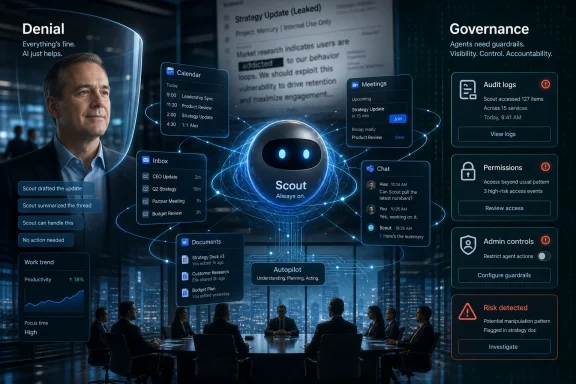
Microsoft unveiled Scout at Build 2026 as an always-on Microsoft 365 AI agent, but the launch was immediately overshadowed by a leaked internal strategy document saying the first phase was to “make people addicted.” The embarrassment is not simply that an ugly phrase escaped Redmond. It is that the phrase described, with uncomfortable clarity, the business model behind persistent workplace agents. Satya Nadella’s denial may calm a news cycle, but it does not answer the harder question: what does Microsoft think “success” looks like when an AI system is designed to sit inside every meeting, inbox, deadline, and document?
Scout is not another chatbot bolted onto a sidebar. Microsoft is presenting it as the first of a new category of “Autopilot” agents: software that does not wait for a prompt, does not live in a single app, and does not measure usefulness only by the quality of a generated paragraph. Scout is meant to watch the shape of work as it happens and intervene before the user asks.
That is a meaningful shift. Copilot, for all its branding excess, has largely been an assistant summoned into a task. Scout is being pitched as an ambient participant in work itself, capable of preparing meetings, detecting coordination failures, managing schedules, and moving routine tasks along in the background.
This is exactly where enterprise AI has been heading. The prize is not a better search box or a more fluent email draft. The prize is the workflow layer — the place where professional judgment, calendar pressure, organizational memory, and administrative friction all collide.
The leaked strategy document matters because it appears to say the quiet part in the plainest possible language. “Addiction” is a radioactive word in technology because it collapses the distinction between usefulness and compulsion. Microsoft would prefer to talk about productivity, agency, and time saved. The document reportedly talked about dependence.
But the denial creates a second problem. The document was reportedly credited to senior Microsoft figures tied closely to Scout, including Omar Shahine, who has been publicly associated with the product’s launch. If that reporting is accurate, this was not an offhand Slack joke from a junior growth marketer. It was a strategy artifact connected to the product’s own leadership.
That distinction matters to customers. Enterprise buyers do not merely purchase features; they purchase an operating model. If the strategy around a persistent agent can be framed internally in terms that the CEO later disowns, customers are entitled to ask how product governance works before those agents gain more autonomy.
There is also a credibility issue. Nadella has spent years positioning Microsoft as the grown-up in AI: commercially disciplined, security-minded, enterprise-ready, and more responsible than the consumer platforms chasing raw engagement. That positioning is harder to maintain when a leak suggests the company’s internal language has absorbed the same retention logic that made social platforms so politically toxic.
The CEO’s memo may be sincere. It may also be technically true that he had not read that specific document. But the stronger Microsoft’s claim of ignorance, the more it invites a different criticism: that its most strategic AI products can be framed internally in ways top leadership does not know about until reporters ask.
The modern enterprise software business is built on this kind of stickiness. Outlook is sticky because it holds communications history. Teams is sticky because it captures organizational behavior. SharePoint and OneDrive are sticky because they become the default map of a company’s knowledge. Scout, if it works, would be stickier than all of them because it would learn the connective tissue between those systems.
The uncomfortable truth is that Microsoft does not need Scout to be “addictive” in the TikTok sense for the strategic logic to be obvious. It needs Scout to become habit-forming enough that users stop imagining work without it. It needs the agent to know enough about a user’s rhythms that switching costs become personal, not merely contractual.
That is not inherently sinister. Plenty of good tools become indispensable because they are genuinely useful. The problem is that AI agents blur the line between utility and behavioral capture. A spreadsheet does not decide when to interrupt you. An autonomous work agent might.
This is where language matters. “Make people addicted” may have been shorthand for adoption, retention, and daily active use. But in a product category that can initiate actions, monitor behavior, and shape attention, shorthand is not harmless. It reveals what the builders optimize for when they believe only colleagues are listening.
That inheritance gives Scout credibility among developers. Microsoft is not simply inventing a marketing category and hoping the technology catches up. It is packaging a framework that already captured the imagination of builders who wanted agents that could operate across tools rather than sit politely inside a chat window.
But the same inheritance raises the risk profile. OpenClaw’s appeal was precisely that it enabled broad action. Enterprise IT departments tend to get nervous when software that can read, decide, and act is placed near email, files, identity systems, and business workflows.
Microsoft’s answer is the Microsoft 365 trust envelope. Scout is supposed to operate inside the permissions, compliance rules, and administrative controls organizations already use. In theory, that is the strongest argument for Microsoft’s approach: if autonomous agents are coming anyway, better to run them inside a managed enterprise platform than through a collection of unsanctioned browser extensions and local scripts.
In practice, the question is whether legacy governance models are ready for persistent agents. Access control was designed around users and applications. Scout represents something more ambiguous: a delegated actor that observes a user, acts for a user, and may eventually develop operational patterns that no single administrator has explicitly scripted.
If Scout blocks time on a calendar, that is minor. If it drafts a meeting brief, that is useful. If it nudges a stalled decision, that may be valuable. But if it sends the wrong document, exposes confidential context, over-prioritizes the wrong stakeholder, or takes action based on a misread chain of messages, the organization needs to know where accountability lands.
The more successful Scout becomes, the harder that question gets. A low-usage assistant is a feature. A high-retention agent that mediates daily work becomes infrastructure. Infrastructure failures are judged differently.
That is why the addiction language stings. Enterprise IT wants vendors to optimize for reliability, auditability, controllability, and reversibility. “Addiction” suggests optimization for repeat behavior first and careful governance second, even if that was not the intent.
Microsoft knows this audience. Its security and compliance story is usually built around the idea that Redmond understands regulated organizations better than fast-moving AI startups do. Scout now forces Microsoft to prove that claim in the most sensitive layer of all: not the data layer, not the app layer, but the human workflow layer.
For years, consumer platforms optimized for attention. The damage was measurable: compulsive scrolling, outrage incentives, algorithmic dependency, and business models that treated human focus as inventory. Enterprise software escaped some of that criticism because work tools were presumed to serve a task rather than manufacture desire.
AI agents complicate that distinction. A good agent is supposed to be proactive. It must surface things before the user asks. It must learn what matters. It must decide when intervention is helpful. Those are the same design moves that can slide into attention capture if the system is rewarded for engagement rather than outcomes.
Microsoft’s public line — “more time back” — is the right aspiration. But time back is notoriously difficult to measure. Engagement is easy to measure. If product teams are rewarded for activity, intensity, and retention, then the agent has every incentive to become more present in the workday, not less.
That is the contradiction Microsoft must resolve. The best agent may be the one that quietly reduces the need to interact with software. The best business metric may be the one that shows users returning constantly. Those goals are not naturally aligned.
That reputation is now the foundation of its AI strategy. Microsoft is not merely asking users to try a clever assistant. It is asking organizations to let agents operate across their most sensitive business surfaces. That requires more than model quality. It requires institutional trust.
The company has been here before in another form. Windows users remember telemetry fights, default browser battles, unwanted prompts, and the long campaign to make Microsoft accounts feel inevitable. Enterprise administrators remember feature rollouts that arrived faster than policy controls, and preview features that looked optional until they became part of the baseline.
Scout will be judged against that memory. Microsoft can say the rollout is thoughtful. It can emphasize private preview, Frontier customers, Intune configuration, and existing Microsoft 365 controls. Those details matter. But they do not erase the broader suspicion that Microsoft’s definition of user benefit sometimes overlaps too neatly with Microsoft’s definition of platform capture.
That is why the leaked wording is so damaging. It activates an old fear in a new category: that Microsoft’s most useful tools eventually become systems users cannot easily refuse.
The logic is obvious. The agent that sees the calendar, email, files, chats, meetings, tickets, code, and customer records becomes the control point. Once it understands a user’s context, it can recommend tools, route tasks, summarize decisions, and eventually choose which applications matter less. That is not just a product. It is a new operating layer.
Microsoft’s advantage is distribution. It already owns many of the places knowledge workers spend their days. Scout does not have to persuade a company to upload its work life into an unknown environment; much of that work life is already inside Microsoft 365. The company’s challenge is to turn that distribution into trust rather than resentment.
The leaked document reportedly described a staged plan: build dependency, expand capabilities, and grow an ecosystem around skills and tools. Strip away the bad word and that is a standard platform strategy. First, make the product useful enough to become routine. Then, make it extensible enough that third parties build around it. Finally, make it central enough that leaving it feels costly.
The scandal is not that Microsoft has a platform strategy. The scandal is that the strategy was expressed in a vocabulary borrowed from the worst habits of the attention economy.
Microsoft should treat this leak as a product governance warning, not merely a communications problem. The company has an opportunity to define what responsible agent adoption looks like in a way that smaller AI firms cannot. That requires sharper commitments than “thoughtful rollout.”
For administrators, the key issues are concrete. Can Scout be disabled globally and selectively? Can its actions be reviewed in a human-readable audit trail? Can organizations restrict the data sources it uses? Can users see why it made a recommendation? Can risky action categories require confirmation? Can the model’s memory of work patterns be exported, reset, or deleted?
These are not edge cases. They are the difference between an assistant and an unaccountable shadow employee. The more Microsoft wants Scout to operate autonomously, the more it must expose the machinery of that autonomy to the people responsible for the tenant.
Preview programs are often where vendors test enthusiasm. Scout’s preview also needs to test refusal. A responsible enterprise agent should be designed not only for adoption, but for graceful non-adoption: departments that opt out, users who limit scope, admins who pause features, and organizations that decide some workflows should remain agent-free.
That is why Windows enthusiasts should pay attention. The desktop has been losing conceptual importance for years, even as it remains operationally essential. Agentic AI gives Microsoft a reason to redefine the PC not as the place where apps live, but as the endpoint where agents observe, act, and negotiate between local and cloud contexts.
This could be genuinely useful. Windows is full of friction that agents could reduce: file chaos, notification overload, meeting sprawl, context switching, update timing, device management, and the endless clerical work of modern computing. A well-governed agent could make the PC feel less like a pile of windows and more like a coherent workspace.
It could also become exhausting. If every application and platform layer wants to host an agent, users may face a new version of notification fatigue: not pings from apps, but interventions from systems claiming to know what matters. The agentic desktop could become calmer, or it could become the most overmanaged workplace interface yet invented.
Microsoft’s advantage is that it can integrate deeply. Its burden is that deep integration makes mistakes harder to escape.
That would require unusual discipline. Most software businesses reward visible usage. Teams want dashboards that show growth. Executives want evidence of adoption. Investors want proof that expensive AI infrastructure is generating engagement. A quiet agent that saves time may be harder to celebrate than a noisy one that produces impressive activity metrics.
This is where Microsoft could make a meaningful break from consumer software logic. It could define Scout’s success around completed tasks, reduced meeting load, fewer missed commitments, faster decision cycles, and user-controlled automation — not around intensity of interaction. It could publish administrative controls that make it easier to limit Scout than to expand it. It could treat opt-out not as a failure, but as evidence of trust.
That would be a more radical position than any launch demo. The industry already knows how to make software engaging. It has much less experience making software responsibly invisible.
If Microsoft wants to argue that “addiction” is not the goal, it should prove it in the metrics it celebrates, the controls it ships, and the defaults it chooses.
Microsoft’s Scout controversy will fade faster than the product category it exposed. The company can survive an embarrassing phrase in a leaked document; what it cannot do is ask enterprises to trust always-on agents while acting surprised that people care how those agents are optimized. If the next era of Windows and Microsoft 365 is built around software that works while users look elsewhere, then the governing question is not whether people become addicted to AI. It is whether Microsoft can build AI powerful enough to depend on without making dependence the point.
 Microsoft’s Agent Ambition Has Finally Met Its Vocabulary Problem
Scout is not another chatbot bolted onto a sidebar. Microsoft is presenting it as the first of a new category of “Autopilot” agents: software that does not wait for a prompt, does not live in a single app, and does not measure usefulness only by the quality of a generated paragraph. Scout is meant to watch the shape of work as it happens and intervene before the user asks.That is a meaningful shift. Copilot, for all its branding excess, has largely been an assistant summoned into a task. Scout is being pitched as an ambient participant in work itself, capable of preparing meetings, detecting coordination failures, managing schedules, and moving routine tasks along in the background.
This is exactly where enterprise AI has been heading. The prize is not a better search box or a more fluent email draft. The prize is the workflow layer — the place where professional judgment, calendar pressure, organizational memory, and administrative friction all collide.
The leaked strategy document matters because it appears to say the quiet part in the plainest possible language. “Addiction” is a radioactive word in technology because it collapses the distinction between usefulness and compulsion. Microsoft would prefer to talk about productivity, agency, and time saved. The document reportedly talked about dependence.
Nadella’s Denial Solves the PR Problem and Leaves the Governance Problem Intact
Satya Nadella’s reported response was forceful. He called the addiction objective “absolutely a non goal” and said he was not sure what the document was or who was writing and leaking it. In the narrow theater of crisis management, that is the expected move: draw a bright line between the CEO’s values and the offending language.But the denial creates a second problem. The document was reportedly credited to senior Microsoft figures tied closely to Scout, including Omar Shahine, who has been publicly associated with the product’s launch. If that reporting is accurate, this was not an offhand Slack joke from a junior growth marketer. It was a strategy artifact connected to the product’s own leadership.
That distinction matters to customers. Enterprise buyers do not merely purchase features; they purchase an operating model. If the strategy around a persistent agent can be framed internally in terms that the CEO later disowns, customers are entitled to ask how product governance works before those agents gain more autonomy.
There is also a credibility issue. Nadella has spent years positioning Microsoft as the grown-up in AI: commercially disciplined, security-minded, enterprise-ready, and more responsible than the consumer platforms chasing raw engagement. That positioning is harder to maintain when a leak suggests the company’s internal language has absorbed the same retention logic that made social platforms so politically toxic.
The CEO’s memo may be sincere. It may also be technically true that he had not read that specific document. But the stronger Microsoft’s claim of ignorance, the more it invites a different criticism: that its most strategic AI products can be framed internally in ways top leadership does not know about until reporters ask.
Scout Is Sticky by Design, Whether Microsoft Uses the Word or Not
Microsoft’s defense is that Scout is built to help people accomplish tasks, not to encourage dependency. That distinction is morally important but commercially slippery. A tool that becomes indispensable to daily work is, by definition, a tool users become reluctant to stop using.The modern enterprise software business is built on this kind of stickiness. Outlook is sticky because it holds communications history. Teams is sticky because it captures organizational behavior. SharePoint and OneDrive are sticky because they become the default map of a company’s knowledge. Scout, if it works, would be stickier than all of them because it would learn the connective tissue between those systems.
The uncomfortable truth is that Microsoft does not need Scout to be “addictive” in the TikTok sense for the strategic logic to be obvious. It needs Scout to become habit-forming enough that users stop imagining work without it. It needs the agent to know enough about a user’s rhythms that switching costs become personal, not merely contractual.
That is not inherently sinister. Plenty of good tools become indispensable because they are genuinely useful. The problem is that AI agents blur the line between utility and behavioral capture. A spreadsheet does not decide when to interrupt you. An autonomous work agent might.
This is where language matters. “Make people addicted” may have been shorthand for adoption, retention, and daily active use. But in a product category that can initiate actions, monitor behavior, and shape attention, shorthand is not harmless. It reveals what the builders optimize for when they believe only colleagues are listening.
The OpenClaw Inheritance Cuts Both Ways
Scout’s technical lineage is part of the story. Microsoft says Scout is built on OpenClaw, the open-source agent framework that surged through the AI engineering community earlier this year. OpenClaw became famous because it made autonomous agents feel less like demos and more like unruly software organisms: powerful, flexible, and occasionally chaotic.That inheritance gives Scout credibility among developers. Microsoft is not simply inventing a marketing category and hoping the technology catches up. It is packaging a framework that already captured the imagination of builders who wanted agents that could operate across tools rather than sit politely inside a chat window.
But the same inheritance raises the risk profile. OpenClaw’s appeal was precisely that it enabled broad action. Enterprise IT departments tend to get nervous when software that can read, decide, and act is placed near email, files, identity systems, and business workflows.
Microsoft’s answer is the Microsoft 365 trust envelope. Scout is supposed to operate inside the permissions, compliance rules, and administrative controls organizations already use. In theory, that is the strongest argument for Microsoft’s approach: if autonomous agents are coming anyway, better to run them inside a managed enterprise platform than through a collection of unsanctioned browser extensions and local scripts.
In practice, the question is whether legacy governance models are ready for persistent agents. Access control was designed around users and applications. Scout represents something more ambiguous: a delegated actor that observes a user, acts for a user, and may eventually develop operational patterns that no single administrator has explicitly scripted.
The Enterprise Buyer Is Not Afraid of AI; It Is Afraid of Unbounded Agency
The lazy reading of this controversy is that people are frightened by AI hype. That misses the point. Enterprise customers have been paying for automation for decades. They are not allergic to machines doing work. They are allergic to systems that do work without a clear account of responsibility.If Scout blocks time on a calendar, that is minor. If it drafts a meeting brief, that is useful. If it nudges a stalled decision, that may be valuable. But if it sends the wrong document, exposes confidential context, over-prioritizes the wrong stakeholder, or takes action based on a misread chain of messages, the organization needs to know where accountability lands.
The more successful Scout becomes, the harder that question gets. A low-usage assistant is a feature. A high-retention agent that mediates daily work becomes infrastructure. Infrastructure failures are judged differently.
That is why the addiction language stings. Enterprise IT wants vendors to optimize for reliability, auditability, controllability, and reversibility. “Addiction” suggests optimization for repeat behavior first and careful governance second, even if that was not the intent.
Microsoft knows this audience. Its security and compliance story is usually built around the idea that Redmond understands regulated organizations better than fast-moving AI startups do. Scout now forces Microsoft to prove that claim in the most sensitive layer of all: not the data layer, not the app layer, but the human workflow layer.
The Consumer Internet’s Engagement Logic Has Entered the Office
The deeper issue is that workplace AI is importing the metrics culture of consumer software. Daily usage, retention, intensity, habit formation, and ecosystem lock-in are not new concepts. What is new is their migration into autonomous systems that present themselves as productivity tools.For years, consumer platforms optimized for attention. The damage was measurable: compulsive scrolling, outrage incentives, algorithmic dependency, and business models that treated human focus as inventory. Enterprise software escaped some of that criticism because work tools were presumed to serve a task rather than manufacture desire.
AI agents complicate that distinction. A good agent is supposed to be proactive. It must surface things before the user asks. It must learn what matters. It must decide when intervention is helpful. Those are the same design moves that can slide into attention capture if the system is rewarded for engagement rather than outcomes.
Microsoft’s public line — “more time back” — is the right aspiration. But time back is notoriously difficult to measure. Engagement is easy to measure. If product teams are rewarded for activity, intensity, and retention, then the agent has every incentive to become more present in the workday, not less.
That is the contradiction Microsoft must resolve. The best agent may be the one that quietly reduces the need to interact with software. The best business metric may be the one that shows users returning constantly. Those goals are not naturally aligned.
Nadella’s Microsoft Has Spent a Decade Selling Trust
This controversy lands differently because of Microsoft’s recent history. Nadella’s tenure has been defined by a successful repositioning of the company from Windows-first monopolist to cloud platform steward. Microsoft became the dependable vendor that could sell productivity, identity, security, compliance, and developer infrastructure as one coherent enterprise stack.That reputation is now the foundation of its AI strategy. Microsoft is not merely asking users to try a clever assistant. It is asking organizations to let agents operate across their most sensitive business surfaces. That requires more than model quality. It requires institutional trust.
The company has been here before in another form. Windows users remember telemetry fights, default browser battles, unwanted prompts, and the long campaign to make Microsoft accounts feel inevitable. Enterprise administrators remember feature rollouts that arrived faster than policy controls, and preview features that looked optional until they became part of the baseline.
Scout will be judged against that memory. Microsoft can say the rollout is thoughtful. It can emphasize private preview, Frontier customers, Intune configuration, and existing Microsoft 365 controls. Those details matter. But they do not erase the broader suspicion that Microsoft’s definition of user benefit sometimes overlaps too neatly with Microsoft’s definition of platform capture.
That is why the leaked wording is so damaging. It activates an old fear in a new category: that Microsoft’s most useful tools eventually become systems users cannot easily refuse.
The Word “Addicted” Was Impolitic, but the Strategy Was Familiar
It would be too easy to pretend Microsoft is uniquely cynical. The race to build persistent agents is an industry-wide race to own the user relationship. Google, OpenAI, Anthropic, Apple, Salesforce, ServiceNow, and every major enterprise platform vendor are trying to place their AI systems closer to the user’s daily decisions.The logic is obvious. The agent that sees the calendar, email, files, chats, meetings, tickets, code, and customer records becomes the control point. Once it understands a user’s context, it can recommend tools, route tasks, summarize decisions, and eventually choose which applications matter less. That is not just a product. It is a new operating layer.
Microsoft’s advantage is distribution. It already owns many of the places knowledge workers spend their days. Scout does not have to persuade a company to upload its work life into an unknown environment; much of that work life is already inside Microsoft 365. The company’s challenge is to turn that distribution into trust rather than resentment.
The leaked document reportedly described a staged plan: build dependency, expand capabilities, and grow an ecosystem around skills and tools. Strip away the bad word and that is a standard platform strategy. First, make the product useful enough to become routine. Then, make it extensible enough that third parties build around it. Finally, make it central enough that leaving it feels costly.
The scandal is not that Microsoft has a platform strategy. The scandal is that the strategy was expressed in a vocabulary borrowed from the worst habits of the attention economy.
Private Preview Is the Right Place for the Fight to Happen
Scout is still in private preview, which means the product has not yet reached the broad population of Microsoft 365 customers. That is important. The best time to argue about permissions, defaults, audit logs, reversibility, user consent, and administrative control is before an agent becomes a normal part of the workday.Microsoft should treat this leak as a product governance warning, not merely a communications problem. The company has an opportunity to define what responsible agent adoption looks like in a way that smaller AI firms cannot. That requires sharper commitments than “thoughtful rollout.”
For administrators, the key issues are concrete. Can Scout be disabled globally and selectively? Can its actions be reviewed in a human-readable audit trail? Can organizations restrict the data sources it uses? Can users see why it made a recommendation? Can risky action categories require confirmation? Can the model’s memory of work patterns be exported, reset, or deleted?
These are not edge cases. They are the difference between an assistant and an unaccountable shadow employee. The more Microsoft wants Scout to operate autonomously, the more it must expose the machinery of that autonomy to the people responsible for the tenant.
Preview programs are often where vendors test enthusiasm. Scout’s preview also needs to test refusal. A responsible enterprise agent should be designed not only for adoption, but for graceful non-adoption: departments that opt out, users who limit scope, admins who pause features, and organizations that decide some workflows should remain agent-free.
Windows Is Becoming the Stage for Agentic Work
Although Scout is currently described through Microsoft 365, the implications reach Windows. Microsoft’s long-term AI strategy is not confined to web apps or cloud dashboards. It points toward a computing model in which agents coordinate across local devices, cloud services, identity systems, and enterprise data.That is why Windows enthusiasts should pay attention. The desktop has been losing conceptual importance for years, even as it remains operationally essential. Agentic AI gives Microsoft a reason to redefine the PC not as the place where apps live, but as the endpoint where agents observe, act, and negotiate between local and cloud contexts.
This could be genuinely useful. Windows is full of friction that agents could reduce: file chaos, notification overload, meeting sprawl, context switching, update timing, device management, and the endless clerical work of modern computing. A well-governed agent could make the PC feel less like a pile of windows and more like a coherent workspace.
It could also become exhausting. If every application and platform layer wants to host an agent, users may face a new version of notification fatigue: not pings from apps, but interventions from systems claiming to know what matters. The agentic desktop could become calmer, or it could become the most overmanaged workplace interface yet invented.
Microsoft’s advantage is that it can integrate deeply. Its burden is that deep integration makes mistakes harder to escape.
The Real Test Is Whether Microsoft Optimizes for Absence
The most interesting promise of Scout is that users might interact with software less. A background agent that prepares, schedules, summarizes, and coordinates could remove layers of busywork. In that best-case version, success would not be measured by how often users open Scout, but by how often they do not have to.That would require unusual discipline. Most software businesses reward visible usage. Teams want dashboards that show growth. Executives want evidence of adoption. Investors want proof that expensive AI infrastructure is generating engagement. A quiet agent that saves time may be harder to celebrate than a noisy one that produces impressive activity metrics.
This is where Microsoft could make a meaningful break from consumer software logic. It could define Scout’s success around completed tasks, reduced meeting load, fewer missed commitments, faster decision cycles, and user-controlled automation — not around intensity of interaction. It could publish administrative controls that make it easier to limit Scout than to expand it. It could treat opt-out not as a failure, but as evidence of trust.
That would be a more radical position than any launch demo. The industry already knows how to make software engaging. It has much less experience making software responsibly invisible.
If Microsoft wants to argue that “addiction” is not the goal, it should prove it in the metrics it celebrates, the controls it ships, and the defaults it chooses.
The ClawPilot Leak Gave IT the Checklist Microsoft Did Not
For all the drama around the leaked word, the practical lesson for Windows and Microsoft 365 administrators is straightforward. Scout is a preview of a broader class of tools that will demand new policies, not just new licenses.- Organizations should evaluate Scout as a delegated actor inside Microsoft 365, not merely as another Copilot-branded assistant.
- Administrators should insist on tenant-level controls, granular permissions, and clear audit trails before allowing broad deployment.
- Security teams should test failure modes involving oversharing, mistaken action, prompt injection, and unauthorized workflow execution.
- Business leaders should ask Microsoft how it measures Scout’s success and whether those metrics reward time saved or engagement increased.
- Users should be told when an agent is acting on their behalf, what data it can see, and how to limit or revoke that access.
- Microsoft should clarify how preview learnings, internal usage data, and customer feedback will shape the product before general availability.
Microsoft’s Scout controversy will fade faster than the product category it exposed. The company can survive an embarrassing phrase in a leaked document; what it cannot do is ask enterprises to trust always-on agents while acting surprised that people care how those agents are optimized. If the next era of Windows and Microsoft 365 is built around software that works while users look elsewhere, then the governing question is not whether people become addicted to AI. It is whether Microsoft can build AI powerful enough to depend on without making dependence the point.
References
- Primary source: The Eastern Herald
Published: 2026-06-08T08:30:06.590186
Microsoft Scout 'Addictive' Plan: Nadella's Denial Backfires
A leaked Microsoft document reveals plans to make Scout AI 'addictive.' CEO Satya Nadella denied it — but his rebuttal confirmed the strategy was already working.easternherald.com - Related coverage: techradar.com
'A new category of agents': Microsoft reveals Scout, its first "Autopilot", which wants to change how you work for good | TechRadar
Say hello to Autopilots from Microsoftwww.techradar.com - Related coverage: tomshardware.com
Microsoft unveils Project Solara AI, a chip-to-cloud platform built to power a new generation of 'agent-first' enterprise devices — hardware designed to run AI agents instead of traditional apps | Tom's Hardware
Microsoft ditches Windows to build OS on Androidwww.tomshardware.com - Related coverage: axios.com
Microsoft debuts Scout agent, homegrown reasoning model
Microsoft is seeking to show it is a serious player in AI.www.axios.com
- Related coverage: windowscentral.com
Satya Nadella denies claims Microsoft wants to “make people addicted" to AI — as the company shifts from Bill Gates’ software vision to an agentic future | Windows Central
Microsoft's pivot from traditional software to agentic AI is off to a rocky start.www.windowscentral.com - Related coverage: tomsguide.com
Biggest Microsoft Build 2026 announcements — agentic AI, RTX Spark Dev Box, GitHub Copilot app, new MAI models, and more | Tom's Guide
All the big news from Microsoft's AI-focused eventwww.tomsguide.com
- Related coverage: techcrunch.com
Microsoft launches Scout, an OpenClaw-inspired personal assistant | TechCrunch
Launched at Build, Microsoft Scout is a new AI assistant meant to bring the power and flexibility of OpenClaw into the Microsoft 365 system.techcrunch.com - Official source: blogs.microsoft.com
Microsoft Build 2026: Be yourself at work - The Official Microsoft Blog
Platforms shift when developers build. We explore, choose tools, dream, create. This platform shift comes with more information than ever, ready at your fingertips. This shift, it’s about building fast AND THEN: it’s about building, operating, optimizing and observing. Securing your...blogs.microsoft.com - Related coverage: notebookcheck.net
AI addiction is Microsoft's primary ClawPilot goal, leaked documents reveal - Notebookcheck News
Microsoft not only accepts AI addiction, but declares it as the primary goal of the brand new Scout AI agent. As leaked documents show, functionality only plays a subordinate role in the first phase of the rollout; Microsoft primarily wants users to become addicted to the AI agent. www.notebookcheck.net
- Related coverage: 404media.co
Microsoft Wants to 'Make People Addicted' to its New AI Assistant, Internal Documents Reveal
Planning documents for "Scout" say the plan is to "make people addicted" to the tool before adding new features. www.404media.co
- Official source: news.microsoft.com
Microsoft Build Live
The home for real-time coverage of the news as it is announced from Microsoft Build, June 2-3, 2026.news.microsoft.com - Related coverage: gigazine.net
MicrosoftがOpenClawベースの常時稼働型AIエージェント「Scout」を発表、ユーザーの代わりに仕事を進める「Autopilot」第1弾 - GIGAZINE
Microsoftが、Microsoft 365向けの常時稼働型AIエージェント「Microsoft Scout」を発表しました。ScoutはAIエージェントフレームワークである「OpenClaw」の技術を基盤としており、ユーザーが毎回指示を出さなくてもバックグラウンドで作業を進める「Autopilot」という新カテゴリの最初のエージェントとして位置付けられています。gigazine.net - Related coverage: gate.com
Buy/Sell Bitcoin, Ethereum and 4,700+ Altcoins | Cryptocurrency Exchange | Gate.com
Gate - Leading cryptocurrency exchange with over 4,700 cryptocurrencies & stablecoins such as Bitcoin ✓ Ethereum ✓ Dogecoin ✓ Start trading crypto with Gate.com now!www.gate.com - Related coverage: financialexpress.com
Why Microsoft chose OpenClaw to build Scout – its first agentic AI offering - Technology News | The Financial Express
Created by Peter Steinberger, OpenClaw emerged as a breakout open-source project in early 2026. www.financialexpress.com
- Related coverage: singtaousa.com
微軟內部文件揭示Scout AI助手策略,首要目標是「讓用戶上癮」
微軟內部文件揭示,其新AI個人助理「Scout」的首要目標是「讓用戶上癮」。該計劃旨在將OpenClaw人工智能工具整合至Microsoft 365產品套件中。 | 星島日報www.singtaousa.com - Related coverage: cloudwars.com
With 'Autopilots,' Microsoft Delivers Enterprise-Grade AI Agents Tapping OpenClaw - Cloud Wars
Autopilots increase the level of AI autonomy and automation. Build event also places major focus on agentic AI development -- and controls -- at the desktop.cloudwars.com - Related coverage: computerwoche.de
Build 2026: Microsoft stellt autonomen KI-Agenten auf Basis von OpenClaw vor | Computerwoche
Scout ist der erste einer neuen Generation von „Autopilot“-Agenten in Microsoft 365, die Aufgaben selbstständig ausführen können. www.computerwoche.de
- Related coverage: decrypt.co
Microsoft Turns OpenClaw Into an Enterprise AI Agent With Scout - Decrypt
Tech people will say everyone's already using OpenClaw. They're right. But Microsoft is the one with 1.4 billion Windows users ready to adopt it.decrypt.co
