

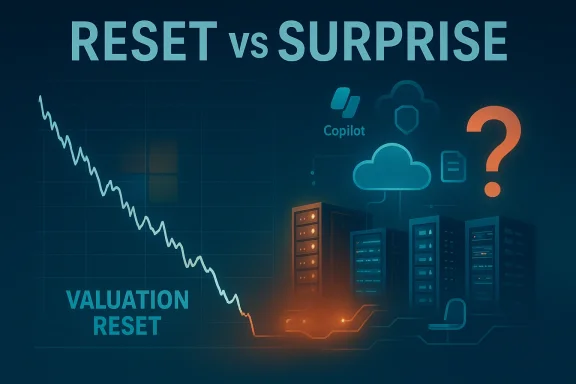
Microsoft’s recent pullback has revived an old market debate: is the stock simply resetting after a spectacular run, or is the AI story finally losing some of its power to surprise? At roughly 23x earnings and near the lower end of its 52-week range, MSFT is no longer priced like a perfect growth machine, even as the company continues to post enormous cash generation and dominant enterprise traction. The real question for investors is not whether Microsoft is still a great company, but whether its next phase of AI spending can translate into enough monetizable demand to keep the stock ahead of the market from here.
Microsoft enters this next leg of the AI cycle from a position of unusual strength, but also unusual scrutiny. The company is still one of the world’s most profitable software and cloud platforms, yet the market has begun to discount the pace and quality of the next wave of returns. That shift matters because Microsoft has spent the last two years selling investors on a simple thesis: AI will be both a growth engine and a margin unlock. Now investors are asking whether the spending required to make that true is arriving faster than the monetization.
The backdrop is straightforward. Microsoft’s fiscal 2025 results showed a company still growing at scale, with revenue of $281.7 billion and net income of $101.8 billion, while Azure continued to expand and overall cloud demand remained robust. At the same time, Microsoft also made clear that AI infrastructure is consuming extraordinary capital. Its own earnings commentary has emphasized that the company is directing massive spend toward long-lived assets and GPU-rich server capacity to support future monetization.
That is why the stock’s valuation has become a focal point. If a business like Microsoft can grow earnings, maintain high free cash flow, and still invest aggressively, then a lower multiple can be a gift rather than a warning. But if AI spend rises faster than commercial adoption, the market may keep compressing the multiple until evidence catches up. That is the core tension now, not whether Microsoft is still a high-quality franchise.
The company’s latest investor updates reinforce both sides of the argument. Microsoft said it now has 15 million paid Microsoft 365 Copilot seats and more than 450 million paid Microsoft 365 commercial seats, showing real platform breadth, but it also acknowledged that the OpenAI contract signed in October 2025 represents substantial demand that will create quarterly volatility in bookings and RPO growth. In other words, the AI story is still alive, but it is becoming more complicated, more capital intensive, and more dependent on execution than on narrative.
A lower multiple does not automatically mean cheap. It means the market is pricing in more uncertainty. In Microsoft’s case, that uncertainty comes from two directions at once: the possibility that AI monetization scales slower than expected, and the possibility that CapEx stays elevated for longer than investors are comfortable modeling. The stock is effectively asking investors to prove the thesis, not just admire it.
There is also a psychological shift here. When a stock rises relentlessly, any slowdown in price momentum can trigger a harsh reassessment of fundamentals. That is especially true for mega-cap tech, where expectations are often embedded in the share price long before they appear in earnings. The market is no longer paying simply for Microsoft to be excellent; it wants proof that Microsoft can be excellent enough to justify the next phase of AI investment.
That strategy has worked before in cloud computing, where early infrastructure investment helped establish scale and lock in enterprise relationships. But AI infrastructure has a more uncertain payback profile. Demand is still forming, use cases are still maturing, and customers are still testing which AI tasks actually deserve premium pricing. Microsoft is right to spend, but investors are right to ask how quickly that spend turns into durable revenue.
The problem is that long-lived assets do not guarantee short-term returns. Data centers and GPU clusters can be monetized efficiently only if customer demand materializes at scale. If demand is delayed, the market can treat the spend as a drag rather than an advantage. That is why investors are increasingly sensitive to commentary around utilization, backlog conversion, and gross margin trends in Microsoft Cloud.
That is a critical distinction. Many AI startups are fighting to survive their own infrastructure bills. Microsoft is funding its AI expansion from a fortress balance sheet and a giant existing customer base. The question is not whether it can afford the buildout; it clearly can. The question is whether the return on that buildout ultimately deserves a premium multiple. Those are not the same question.
That gap matters because AI adoption in enterprise software is not only about user interest; it is about workflow conversion, budget approval, and measurable productivity gains. In other words, a company can like the demo and still delay the purchase. Microsoft has to prove not only that Copilot is useful, but that it is indispensable enough to justify recurring spending on top of an already expensive software stack.
Even so, large-seat deployments do not automatically translate into category-defining revenue. Enterprise software usually expands through slow seat growth, usage intensity, and renewals, not through viral consumer-style adoption. Microsoft appears to understand this, which is why it keeps emphasizing seat expansion and usage intensity rather than one-time launch metrics. The pace is encouraging, but the commercial model is still in its early innings.
That is why the consumer side matters strategically but not yet decisively. It can expand brand familiarity and keep Microsoft relevant in everyday AI usage, but it is unlikely to drive the same economics as enterprise seat expansion. For now, the best monetization story remains commercial, where Microsoft can bundle AI into a broader productivity and security stack.
The issue is not merely financial. It is structural. Microsoft has built a substantial portion of its AI branding around the OpenAI relationship, but the partnership is no longer as cleanly aligned as it once was. OpenAI’s scale, financing needs, and evolving compute strategy make the relationship more complex than a simple vendor-client dynamic. That complexity does not automatically weaken Microsoft, but it does make forecasting harder.
More broadly, the OpenAI relationship enhances Microsoft’s strategic posture against rivals that may have stronger consumer brands but weaker enterprise distribution. Microsoft can pair models, infrastructure, and workplace software in a way that very few companies can replicate. That integration remains a major moat.
That is not necessarily a red flag, but it is a forecasting challenge. Investors tend to reward clarity, and the more sprawling the AI ecosystem becomes, the less clarity there is around who captures the economics. Microsoft may still win big, but the path may be more uneven than the market once assumed.
That matters because Microsoft does not need every AI initiative to succeed on its own. Azure can absorb, distribute, and monetize many different workloads, from model training and inference to hosting, analytics, and enterprise application integration. This broader platform architecture gives Microsoft a degree of resilience that pure-play AI vendors do not enjoy.
The company’s recent results show that cloud demand remains healthy even in a more skeptical market. Revenue growth in Microsoft Cloud, coupled with ongoing gains in commercial seats and productivity software, suggests the platform is still expanding. The challenge is that AI workloads may be more expensive to serve, which can lift revenue while pressuring gross margins.
The best-case scenario is that these margin pressures are temporary and that scale eventually offsets the higher compute costs. The less favorable scenario is that AI demand is strong enough to drive revenue growth but not efficient enough to restore prior margin levels quickly. That is why Azure remains central to the bull case, but also central to the bear case.
In technical terms, the market is digesting a period of rich expectations. That process often looks ugly even when the long-term thesis remains intact. Microsoft’s fundamentals have not collapsed; what has collapsed is certainty about how quickly those fundamentals will justify the prior valuation.
A few technical features stand out:
For longer-term investors, that can actually be attractive. A stock that is still fundamentally healthy but technically washed out often offers a better entry than one making new highs on perfection-priced optimism. The key is to distinguish between a temporary reset and an actual change in business quality.
This is why Microsoft’s AI execution matters beyond its own stock. If Microsoft proves it can embed AI into a huge installed base and monetize it profitably, it raises the bar for everyone else. If it struggles, the market may become more skeptical of AI spending across the whole software sector.
But bundling cuts both ways. If customers view AI features as incremental rather than indispensable, Microsoft may find itself giving away too much value inside broader subscriptions. Rivals will try to argue that niche AI tools, vertical AI products, or cheaper cloud alternatives offer better ROI. That competitive pressure could keep Microsoft’s monetization curve from steepening as quickly as bulls expect.
Microsoft’s advantage is its distribution. Its risk is that the economics of AI infrastructure may be less favorable than the economics of traditional cloud workloads. If the margin structure becomes too pressured, competitors with different cost structures or customer acquisition models may have a chance to narrow the gap.
Microsoft’s own disclosures show a business that continues to convert earnings into cash at a remarkable rate. That gives management flexibility to keep investing in AI even if the timing of monetization remains imperfect. It also gives shareholders a cushion: when the business is producing this much cash, temporary valuation compression can be survivable rather than alarming.
It also means investors can afford to be patient. Microsoft does not need to prove the entire AI thesis in one quarter or even one year. It needs to show that monetization is broadening, customer adoption is deepening, and the infrastructure being built today can generate returns over a multiyear horizon.
That is a subtler risk than business deterioration, but it is a real one. The stock market often punishes companies not for failing, but for failing to exceed an already generous model.
Microsoft also needs to show that the AI economy is broad enough to support more than a few flagship use cases. Large enterprise deployments are encouraging, but the next phase requires repeatable adoption across industries, regions, and budget cycles. If that happens, the market may eventually reward Microsoft for spending early. If it does not, the stock could stay cheap for reasons that look uncomfortable in the moment but rational in hindsight.
A few milestones deserve close attention:
Source: Investing.com Microsoft’s Next AI Leg: Can MSFT Still Outperform From Here? | investing.com
 Overview
Microsoft enters this next leg of the AI cycle from a position of unusual strength, but also unusual scrutiny. The company is still one of the world’s most profitable software and cloud platforms, yet the market has begun to discount the pace and quality of the next wave of returns. That shift matters because Microsoft has spent the last two years selling investors on a simple thesis: AI will be both a growth engine and a margin unlock. Now investors are asking whether the spending required to make that true is arriving faster than the monetization.The backdrop is straightforward. Microsoft’s fiscal 2025 results showed a company still growing at scale, with revenue of $281.7 billion and net income of $101.8 billion, while Azure continued to expand and overall cloud demand remained robust. At the same time, Microsoft also made clear that AI infrastructure is consuming extraordinary capital. Its own earnings commentary has emphasized that the company is directing massive spend toward long-lived assets and GPU-rich server capacity to support future monetization.
That is why the stock’s valuation has become a focal point. If a business like Microsoft can grow earnings, maintain high free cash flow, and still invest aggressively, then a lower multiple can be a gift rather than a warning. But if AI spend rises faster than commercial adoption, the market may keep compressing the multiple until evidence catches up. That is the core tension now, not whether Microsoft is still a high-quality franchise.
The company’s latest investor updates reinforce both sides of the argument. Microsoft said it now has 15 million paid Microsoft 365 Copilot seats and more than 450 million paid Microsoft 365 commercial seats, showing real platform breadth, but it also acknowledged that the OpenAI contract signed in October 2025 represents substantial demand that will create quarterly volatility in bookings and RPO growth. In other words, the AI story is still alive, but it is becoming more complicated, more capital intensive, and more dependent on execution than on narrative.
The valuation reset and why it matters
The first thing investors notice is that Microsoft no longer trades like a momentum darling with no gravity. A P/E ratio around 23x is still premium in absolute terms, but it is far less demanding than the valuation Microsoft carried during the early AI enthusiasm phase. For a company with Microsoft’s scale, recurring revenue base, and balance-sheet strength, that lower multiple changes the risk-reward equation substantially.A lower multiple does not automatically mean cheap. It means the market is pricing in more uncertainty. In Microsoft’s case, that uncertainty comes from two directions at once: the possibility that AI monetization scales slower than expected, and the possibility that CapEx stays elevated for longer than investors are comfortable modeling. The stock is effectively asking investors to prove the thesis, not just admire it.
Why 23x earnings is a different setup
Microsoft has historically deserved a premium because it combines software margins, cloud growth, and one of the strongest enterprise distribution engines in the world. But when the market begins comparing the company not to its own history but to faster-moving AI beneficiaries, the multiple compresses. That compression can be healthy if the company remains in the top tier of growth but simply loses a little narrative heat.There is also a psychological shift here. When a stock rises relentlessly, any slowdown in price momentum can trigger a harsh reassessment of fundamentals. That is especially true for mega-cap tech, where expectations are often embedded in the share price long before they appear in earnings. The market is no longer paying simply for Microsoft to be excellent; it wants proof that Microsoft can be excellent enough to justify the next phase of AI investment.
What the market is discounting
The market appears to be discounting several concerns simultaneously:- AI infrastructure costs may rise faster than monetization.
- Copilot adoption may be real but slower than the most bullish forecasts.
- Azure may face margin pressure from AI-heavy workloads.
- OpenAI-related revenue recognition may be lumpier than expected.
- A broad tech multiple reset could keep the stock suppressed even if fundamentals remain strong.
AI spending: necessary investment or margin drag?
Microsoft’s AI strategy is capital intensive by design. The company has made it clear in recent earnings commentary that it is spending heavily on servers, data-center infrastructure, and long-lived assets intended to support monetization over many years. That is rational for a platform trying to own the AI stack, but it also means near-term margin math becomes harder to read. The company is choosing to build capacity ahead of demand instead of waiting for demand to arrive.That strategy has worked before in cloud computing, where early infrastructure investment helped establish scale and lock in enterprise relationships. But AI infrastructure has a more uncertain payback profile. Demand is still forming, use cases are still maturing, and customers are still testing which AI tasks actually deserve premium pricing. Microsoft is right to spend, but investors are right to ask how quickly that spend turns into durable revenue.
The burden of infrastructure
Microsoft has repeatedly highlighted that much of its cloud and AI spend is being directed into long-lived assets that should support monetization over the next 15 years and beyond. That framing is important because it suggests management sees CapEx as strategic rather than cyclical. It also signals confidence that current investments will outlast one product cycle or one model generation.The problem is that long-lived assets do not guarantee short-term returns. Data centers and GPU clusters can be monetized efficiently only if customer demand materializes at scale. If demand is delayed, the market can treat the spend as a drag rather than an advantage. That is why investors are increasingly sensitive to commentary around utilization, backlog conversion, and gross margin trends in Microsoft Cloud.
The upside case for aggressive CapEx
There is another way to look at this: Microsoft may be buying the scarce resource in the AI era, namely compute capacity. If AI remains supply constrained, then the company with the deepest balance sheet and the broadest enterprise reach is better positioned to capture share. Microsoft can afford to spend ahead of the curve because it already generates enormous cash flow and because its cloud, productivity, and developer tools all reinforce one another.That is a critical distinction. Many AI startups are fighting to survive their own infrastructure bills. Microsoft is funding its AI expansion from a fortress balance sheet and a giant existing customer base. The question is not whether it can afford the buildout; it clearly can. The question is whether the return on that buildout ultimately deserves a premium multiple. Those are not the same question.
Copilot and the challenge of monetization
Copilot is the most visible test of Microsoft’s AI monetization thesis, and so far the rollout has looked promising but not explosive. Microsoft reported 15 million paid Microsoft 365 Copilot seats, which is meaningful at enterprise scale. Yet that number also sits against a base of more than 450 million Microsoft 365 commercial seats, which means penetration remains shallow relative to the company’s installed base.That gap matters because AI adoption in enterprise software is not only about user interest; it is about workflow conversion, budget approval, and measurable productivity gains. In other words, a company can like the demo and still delay the purchase. Microsoft has to prove not only that Copilot is useful, but that it is indispensable enough to justify recurring spending on top of an already expensive software stack.
Enterprise adoption is real, but uneven
Microsoft’s own commentary shows that larger enterprise customers are adopting Copilot, with meaningful deployments across sectors and geographies. The company said customers continue to adopt Microsoft 365 Copilot at a faster rate than any other new Microsoft 365 suite, and it highlighted large-seat deployments at firms such as Publicis, Fiserv, ING, NASA, and others. That is a sign that Copilot is not a toy; it is becoming part of procurement conversations in the enterprise.Even so, large-seat deployments do not automatically translate into category-defining revenue. Enterprise software usually expands through slow seat growth, usage intensity, and renewals, not through viral consumer-style adoption. Microsoft appears to understand this, which is why it keeps emphasizing seat expansion and usage intensity rather than one-time launch metrics. The pace is encouraging, but the commercial model is still in its early innings.
Consumer-side momentum is smaller than the enterprise story
Consumer AI is a different market, and Microsoft’s results there have not been as flashy. The company said Copilot apps had surpassed 100 million monthly active users across commercial and consumer, but paid subscriber conversion remains the real test. Microsoft 365 consumer subscription growth has been steady, yet consumer AI is harder to monetize because users are much less likely to accept premium add-ons unless the benefits are obvious and immediate.That is why the consumer side matters strategically but not yet decisively. It can expand brand familiarity and keep Microsoft relevant in everyday AI usage, but it is unlikely to drive the same economics as enterprise seat expansion. For now, the best monetization story remains commercial, where Microsoft can bundle AI into a broader productivity and security stack.
OpenAI partnership: asset or liability?
Microsoft’s relationship with OpenAI remains one of the most strategically important and most closely watched parts of the investment case. In October 2025, Microsoft said OpenAI had contracted to purchase an incremental $250 billion of Azure services, while Microsoft’s own ownership stake in OpenAI Group PBC was valued at approximately $135 billion after recapitalization. That is a huge strategic asset on paper, but it also introduces a new layer of dependency and uncertainty.The issue is not merely financial. It is structural. Microsoft has built a substantial portion of its AI branding around the OpenAI relationship, but the partnership is no longer as cleanly aligned as it once was. OpenAI’s scale, financing needs, and evolving compute strategy make the relationship more complex than a simple vendor-client dynamic. That complexity does not automatically weaken Microsoft, but it does make forecasting harder.
The opportunity
The upside is obvious. If OpenAI continues to expand, Microsoft benefits through Azure consumption, product integration, and platform credibility. A deep OpenAI relationship gives Microsoft a front-row seat to frontier-model innovation without having to shoulder the full research burden alone. It also gives Microsoft a differentiated pitch to enterprises that want access to leading AI capabilities through a familiar stack.More broadly, the OpenAI relationship enhances Microsoft’s strategic posture against rivals that may have stronger consumer brands but weaker enterprise distribution. Microsoft can pair models, infrastructure, and workplace software in a way that very few companies can replicate. That integration remains a major moat.
The concern
The concern is that Microsoft is now exposed to external decisions it cannot fully control. OpenAI’s contractual commitments, financing arrangements, and compute strategy could all affect how smoothly Microsoft recognizes revenue from the relationship. Microsoft itself said the new OpenAI contract will create quarterly volatility in bookings and RPO growth, which is a polite way of saying the pattern may be lumpy and hard to read.That is not necessarily a red flag, but it is a forecasting challenge. Investors tend to reward clarity, and the more sprawling the AI ecosystem becomes, the less clarity there is around who captures the economics. Microsoft may still win big, but the path may be more uneven than the market once assumed.
Azure, the cloud engine behind the AI story
Azure remains the core economic engine beneath Microsoft’s AI narrative. The company’s fiscal 2025 results showed Azure revenue surpassing $75 billion, up 34% year over year, underscoring that cloud growth is still a major part of the Microsoft thesis. In practical terms, Azure is where AI demand, enterprise migration, and infrastructure economics converge.That matters because Microsoft does not need every AI initiative to succeed on its own. Azure can absorb, distribute, and monetize many different workloads, from model training and inference to hosting, analytics, and enterprise application integration. This broader platform architecture gives Microsoft a degree of resilience that pure-play AI vendors do not enjoy.
Why Azure is still central
Azure is not merely a cloud service. It is Microsoft’s connective tissue between developer tools, enterprise software, data services, and AI capabilities. The more customers build on Azure, the harder it becomes for them to leave the Microsoft ecosystem. That stickiness is one of the reasons the market has historically granted Microsoft a premium valuation.The company’s recent results show that cloud demand remains healthy even in a more skeptical market. Revenue growth in Microsoft Cloud, coupled with ongoing gains in commercial seats and productivity software, suggests the platform is still expanding. The challenge is that AI workloads may be more expensive to serve, which can lift revenue while pressuring gross margins.
The margin question
Investors are understandably watching Microsoft Cloud gross margin percentage closely. Microsoft said in its fiscal Q2 2026 update that cloud gross margin percentage decreased due to continued investments in AI infrastructure and growing AI product usage, even as Azure and Microsoft 365 Commercial delivered efficiency gains. That is a classic phase-transition signal: the company is buying future growth with current margin sacrifice.The best-case scenario is that these margin pressures are temporary and that scale eventually offsets the higher compute costs. The less favorable scenario is that AI demand is strong enough to drive revenue growth but not efficient enough to restore prior margin levels quickly. That is why Azure remains central to the bull case, but also central to the bear case.
Technical picture: a reset, not a collapse
From a market-structure standpoint, Microsoft’s chart still looks more like a correction within a long-term uptrend than the start of a terminal breakdown. The stock has pulled back enough to attract attention, but not enough to imply the market has abandoned the company’s structural strengths. The key question is whether support holds and whether the stock can build a new base around a more realistic AI premium.In technical terms, the market is digesting a period of rich expectations. That process often looks ugly even when the long-term thesis remains intact. Microsoft’s fundamentals have not collapsed; what has collapsed is certainty about how quickly those fundamentals will justify the prior valuation.
Support, momentum, and sentiment
The stock’s recent weakness appears consistent with investor de-rating rather than panic liquidation. That distinction matters because de-rating can last for a while without changing the underlying business quality. If the stock stabilizes near long-term trend support and the company continues to deliver strong cash generation, sentiment can reverse faster than many investors expect.A few technical features stand out:
- The stock is trading materially below recent highs.
- Oversold conditions suggest the risk of a reflexive bounce.
- Long-term trend support still matters more than short-term volatility.
- Volume trends imply distribution, but not necessarily capitulation.
- A basing phase would be more constructive than a sharp V-shaped recovery.
Why technicians care about this setup
The technical setup matters because Microsoft is a widely owned institutional name. When institutional investors rotate out, they rarely do so quietly. They trim exposure, reassess AI assumptions, and wait for the next catalyst. That can create a prolonged period where the chart looks weak even though the business remains strong.For longer-term investors, that can actually be attractive. A stock that is still fundamentally healthy but technically washed out often offers a better entry than one making new highs on perfection-priced optimism. The key is to distinguish between a temporary reset and an actual change in business quality.
Competitive implications: who benefits if Microsoft stumbles?
Microsoft’s AI ambitions do not exist in a vacuum. Every time the market questions Microsoft’s ability to convert AI spend into earnings, rivals gain an opening. Alphabet can argue that it has multiple AI distribution surfaces through Search, Android, and cloud. Amazon can lean into AWS’s infrastructure scale. Oracle and other cloud vendors can pitch themselves as alternative AI compute partners. The competitive field is broader than it was even a year ago.This is why Microsoft’s AI execution matters beyond its own stock. If Microsoft proves it can embed AI into a huge installed base and monetize it profitably, it raises the bar for everyone else. If it struggles, the market may become more skeptical of AI spending across the whole software sector.
The enterprise software angle
For enterprise software competitors, Microsoft’s biggest advantage remains bundling. It can sell AI as part of productivity, security, collaboration, and cloud infrastructure rather than as a standalone line item. That makes customer conversion easier and reduces the risk of AI becoming a novelty purchase. It is a formidable moat.But bundling cuts both ways. If customers view AI features as incremental rather than indispensable, Microsoft may find itself giving away too much value inside broader subscriptions. Rivals will try to argue that niche AI tools, vertical AI products, or cheaper cloud alternatives offer better ROI. That competitive pressure could keep Microsoft’s monetization curve from steepening as quickly as bulls expect.
The cloud battle
In cloud, Microsoft’s ability to convert AI demand into Azure growth is central to how it competes against AWS and Google Cloud. Each provider is investing heavily in AI infrastructure, and each is under pressure to show that the spend produces real enterprise demand. The winner will not simply be the company with the biggest model story; it will be the one that can turn AI into a durable, profitable workload layer.Microsoft’s advantage is its distribution. Its risk is that the economics of AI infrastructure may be less favorable than the economics of traditional cloud workloads. If the margin structure becomes too pressured, competitors with different cost structures or customer acquisition models may have a chance to narrow the gap.
The free cash flow cushion is the bull case’s backbone
One of the strongest arguments for owning Microsoft remains the cash flow engine. The company generated enormous operating cash in fiscal 2025 and continues to produce enough free cash flow to fund growth, capital returns, and strategic investment without balance-sheet strain. That matters because the market is increasingly intolerant of growth stories that depend on perpetual external funding.Microsoft’s own disclosures show a business that continues to convert earnings into cash at a remarkable rate. That gives management flexibility to keep investing in AI even if the timing of monetization remains imperfect. It also gives shareholders a cushion: when the business is producing this much cash, temporary valuation compression can be survivable rather than alarming.
Why cash flow changes the debate
Cash flow is the reason Microsoft can absorb AI risk better than almost any other large-cap software company. If CapEx rises but operating cash flow remains enormous, the company can continue building while still returning capital to shareholders. That reduces the chance that the AI cycle becomes a financing crisis.It also means investors can afford to be patient. Microsoft does not need to prove the entire AI thesis in one quarter or even one year. It needs to show that monetization is broadening, customer adoption is deepening, and the infrastructure being built today can generate returns over a multiyear horizon.
What could go wrong despite the cushion
Still, cash flow is not a free pass. A company can produce mountains of cash and still underperform if the market believes future growth is slower or less efficient than expected. In Microsoft’s case, that is the danger of a prolonged AI CapEx cycle: the business may stay healthy while the stock stays dead money relative to investor expectations.That is a subtler risk than business deterioration, but it is a real one. The stock market often punishes companies not for failing, but for failing to exceed an already generous model.
Strengths and Opportunities
Microsoft still offers one of the cleanest combinations of scale, recurring revenue, and AI optionality in the market. The company is not relying on a single product to carry the thesis; instead, it is embedding AI across cloud, productivity, developer tools, security, and enterprise workflows. That breadth is exactly why many long-term investors remain constructive even after the recent pullback.- Massive cash generation provides room to invest aggressively without financing risk.
- Azure growth remains a major engine for both cloud and AI monetization.
- Copilot adoption is real, especially in the enterprise.
- Bundling power lets Microsoft sell AI through existing customer relationships.
- OpenAI exposure can amplify distribution and strategic relevance.
- Enterprise stickiness lowers churn and raises lifetime customer value.
- A lower valuation multiple creates a better entry point than in the peak-optimism phase.
Risks and Concerns
The main concern is not whether Microsoft is good, but whether the market will keep paying for its quality while AI spend escalates. If the company’s infrastructure buildout expands faster than monetization, the shares could remain range-bound even if operations stay strong. That creates a frustrating but very real investment outcome: excellent business, mediocre stock.- CapEx intensity could weigh on margins longer than expected.
- Copilot monetization may be slower than bulls hope.
- OpenAI-related volatility may complicate revenue visibility.
- AI workload economics could pressure Azure gross margin.
- Valuation compression may persist if sentiment stays cautious.
- Competitive pressure from AWS, Google, and others is intensifying.
- Execution risk rises when expectations are high and the AI stack is evolving quickly.
Looking Ahead
The next few quarters should tell investors whether Microsoft’s AI monetization story is maturing or merely expanding in cost. The company’s ability to grow paid Copilot usage, preserve Azure momentum, and convert heavy infrastructure spend into durable revenue will likely decide whether today’s valuation reset becomes a long-term buying opportunity or just the first stage of a longer de-rating process. That is why upcoming guidance will matter more than the latest headline multiple.Microsoft also needs to show that the AI economy is broad enough to support more than a few flagship use cases. Large enterprise deployments are encouraging, but the next phase requires repeatable adoption across industries, regions, and budget cycles. If that happens, the market may eventually reward Microsoft for spending early. If it does not, the stock could stay cheap for reasons that look uncomfortable in the moment but rational in hindsight.
A few milestones deserve close attention:
- Copilot seat growth and whether it accelerates beyond early enterprise adopters.
- Azure revenue growth versus AI-related margin pressure.
- Microsoft Cloud gross margin trends as AI usage scales.
- Bookings and RPO volatility tied to the OpenAI relationship.
- Management commentary on CapEx and whether the spending pace normalizes.
Source: Investing.com Microsoft’s Next AI Leg: Can MSFT Still Outperform From Here? | investing.com
Last edited:
