

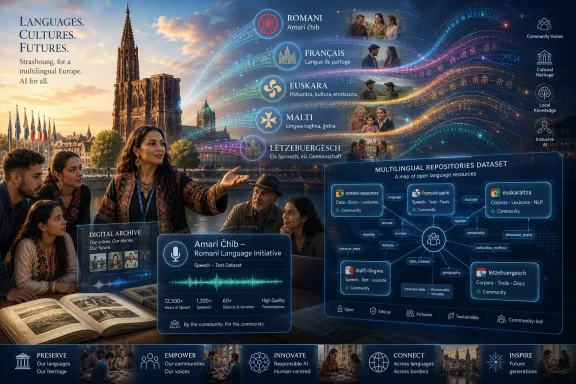
On June 16, 2026, Microsoft announced a new European multilingual AI push from Strasbourg, pairing a Roma-led Romani language initiative with a GitHub metadata dataset meant to help researchers identify public repositories where multilingual software collaboration may be happening. The announcement is not a product launch in the Windows sense, and it will not show up as a Patch Tuesday payload or a Copilot toggle tomorrow morning. But it is still a Microsoft platform story, because the company is trying to shape the raw material from which future AI systems, developer tools, public-sector services, and productivity assistants will learn. The bet is simple: if Europe’s languages are missing from the data layer, they will be missing from the AI layer too.
Most public arguments about AI still orbit the model: which chatbot is smarter, which benchmark was beaten, which vendor has the bigger context window, which accelerator cluster was rented at horrifying cost. Microsoft’s European announcement points to a less glamorous but more durable battleground. Before a model can answer in a language, summarize a document, generate software documentation, or safely handle a public-service request, that language has to exist in machine-readable form at sufficient scale and quality.
That sounds obvious until you look at the way today’s AI economy actually works. English, and to a lesser extent a handful of other high-resource languages, enjoys a compounding advantage. It dominates web text, developer documentation, technical forums, research papers, issue trackers, and software projects. The languages with the most digital exhaust become the easiest to model, and the easiest-to-model languages become the ones that receive the best tools.
Microsoft is now framing that imbalance as a European inclusion problem. The company’s post argues that many European languages remain underrepresented in current AI systems, making it harder for people to access services, participate in the digital economy, and benefit from new technology. That is vendor language, but it is not empty. Anyone who has used machine translation, speech recognition, or code assistants outside a major language knows the experience can degrade from “slightly awkward” to “functionally unusable” very quickly.
The interesting part is that Microsoft is not only talking about translation. It is talking about representation: the presence of language, culture, dialect, context, and community governance inside the data pipelines that feed AI systems. That distinction matters because Europe’s language problem is not just a matter of swapping dictionaries. A model that can produce grammatically plausible text may still fail at cultural nuance, minority-language variation, legal terminology, local idiom, or the messy multilingual reality of public life.
The new announcement ties MOIC to Microsoft’s AI for Good Lab and to European organizations working on language and cultural heritage. That matters because Microsoft is presenting the initiative as something more than corporate research philanthropy. The company wants to be seen as a partner in Europe’s digital sovereignty conversation, especially as regulators and public institutions scrutinize the power of American cloud and AI companies.
There is a strategic logic here. Microsoft has spent the last several years positioning itself as the acceptable hyperscaler for governments and enterprises that want access to large-scale AI without surrendering every policy concern to Silicon Valley. The European AI story gives the company another plank in that platform: not just compliant infrastructure, but culturally aware infrastructure.
For WindowsForum readers, the connection may seem indirect at first. Yet Windows, Microsoft 365, GitHub, Azure, Visual Studio, Teams, and Copilot all sit on the same strategic map. Microsoft does not need every language dataset to become a Windows feature immediately. It needs an ecosystem in which its AI services are politically viable, technically useful, and locally credible across Europe’s public and private sectors.
Romani is a revealing case because it resists the neatness that tech platforms prefer. Microsoft notes that the language is spoken by millions of Roma across Europe but is considered endangered, with significant dialectal diversity, varying degrees of mutual intelligibility, limited harmonization efforts, and insufficient digitized content. In other words, this is not a simple data-import problem. It is a governance problem, a preservation problem, and a design problem.
The planned work includes collecting Romani-language text and speech datasets, building an open community-driven digital archive, and prototyping AI-powered solutions. The phrase “community-driven” is doing real work here. Minority-language AI can easily become extractive: a company, university, or government body gathers language data from a community, packages it into a dataset, and leaves the community with little control over how it is used.
Microsoft’s framing acknowledges that risk by emphasizing Roma leadership. That does not automatically solve the problem, but it sets the right test. If the people whose language is being digitized do not shape collection practices, consent norms, licensing, access rules, dialect handling, and downstream uses, then “inclusion” becomes a softer word for appropriation.
This is also where AI ethics becomes practical rather than ceremonial. A Romani speech dataset is not just a technical asset; it can contain identity, geography, cultural memory, and vulnerability. The decisions around what is collected, what is excluded, who annotates it, who can train on it, and who can commercialize derived systems are not implementation details. They are the project.
That distinction is important. In the AI copyright wars, “GitHub data” can sound like a flashing red light. A metadata dataset that helps identify multilingual collaboration is a different proposition from a training corpus of source code and comments. It can still matter, because researchers and tooling builders need ways to discover where language diversity already exists in open-source development.
Software has its own linguistic hierarchy. English dominates documentation, comments, issue templates, commit messages, and discussions even when the users and contributors are not native English speakers. That dominance is partly practical; English is the lingua franca of global software. But it also shapes who feels welcome, whose bug reports are understood, and whose local requirements are treated as mainstream rather than edge cases.
A dataset that surfaces multilingual collaboration could help researchers quantify these patterns. It could reveal which languages show up in documentation, which communities maintain localized resources, which repositories support multilingual issue discussion, and where non-English participation is clustered or absent. That kind of map is useful for AI, but it is also useful for open-source governance.
For Microsoft, the GitHub piece is especially significant because GitHub is no longer just a developer hosting platform. It is one of the central data and workflow layers for AI-assisted software development. Copilot, code search, issue summarization, automated documentation, dependency analysis, and repository intelligence all become more useful if the platform understands the multilingual reality of developers rather than pretending that everyone writes and works in English.
That makes the dataset a plausible piece of research infrastructure. It can lower the cost of asking better questions about language in software. Which communities document in local languages? Which projects mix English source-code identifiers with non-English discussion? Which repositories attract multilingual contributors but lack tooling to support them? Which language communities are visible in public software development, and which remain hidden?
But metadata also has limits. It does not magically produce high-quality language corpora. It does not tell you whether the underlying language use is accurate, respectful, representative, or consented for AI training. It can indicate where multilingual collaboration may be happening; it cannot, by itself, determine whether a model should learn from that material or how it should weigh it.
That caveat matters because AI vendors often treat “more data” as a universal solvent. Multilingual AI needs more data, yes, but it also needs better provenance, better labeling, better evaluation, and better community accountability. A metadata release can support that work. It cannot substitute for it.
That number is the point. Low-resource does not necessarily mean small. A language can have many speakers and still lack the digitized datasets, speech corpora, evaluation benchmarks, annotated text, and licensing clarity required to perform well in modern AI systems. A language can be alive in homes, schools, broadcasts, literature, and local government while still being thinly represented in the machine-readable web.
LINGUA’s selected projects, as described by Microsoft Research, include open dataset creation, digitization, heritage-language preservation, and evaluation resources such as safety benchmarks. That last category deserves more attention. It is one thing to make a model speak a language; it is another to know whether it behaves safely in that language. Safety testing that works in English may miss culturally specific harms, idioms, political references, medical terminology, or misinformation patterns in another language.
The practical consequence is that multilingual AI cannot be bolted on at the end. If safety, usefulness, and inclusion are measured primarily in English, then non-English users become second-class testers in production. Microsoft’s emphasis on datasets, tools, models, and evaluation resources recognizes that the pipeline has to be multilingual from the start.
This is where the promise and tension of the project sharpen. Digitization can preserve fragile collections, widen access, and support research. It can make archives searchable, translatable, and useful in education. For cultural institutions, AI can turn static collections into living resources for historians, students, journalists, and citizens.
At the same time, cultural heritage is not raw ore for model training. Archives carry rights, context, sensitivity, and historical gravity. The legacy of dissidents, minority communities, and political movements should not be flattened into generic machine-learning fuel without careful governance.
Microsoft’s language around preservation and civic engagement is therefore doing double duty. It presents AI as a tool for access while signaling that Europe’s values and institutional frameworks will shape how that access is built. The credibility of that claim will depend less on blog posts than on licensing terms, dataset documentation, community oversight, and whether public institutions retain meaningful control.
For individual users, the gap appears as uneven quality. A Copilot prompt in English may produce polished output, while the same task in a smaller European language may become vague, awkward, or wrong. Speech dictation may stumble on names and dialects. Summaries may miss context. Search may rank English results above local-language material. Translation may sound technically correct but socially off.
For administrators, the issue becomes operational. Public-sector IT departments, schools, hospitals, courts, and municipalities cannot deploy AI tools responsibly if those tools perform unevenly across the languages their users actually speak. Europe’s multilingual reality is not a marketing edge case. It is a service-delivery requirement.
For developers, the GitHub angle is equally practical. AI coding tools increasingly summarize issues, suggest documentation, generate changelogs, and interpret user feedback. If those tools assume English as the default language of software collaboration, they will be less useful in repositories serving local communities. Worse, they may quietly pressure projects to abandon local-language workflows in favor of whatever the model handles best.
Language diversity fits neatly into that debate because it lets Microsoft argue that its scale can serve European goals. The company can say, in effect, that hyperscale infrastructure and open collaboration are not opposed to sovereignty if they are used to strengthen local languages, institutions, and cultural assets. That is a politically useful argument.
It is also a competitive one. European leaders have worried for years about dependence on American platforms, and AI has intensified those concerns. Microsoft’s response has been to localize commitments: data boundary promises, cloud sovereignty language, partnerships with European institutions, and now multilingual AI work centered in Strasbourg.
None of this turns Microsoft into a neutral public utility. It remains a commercial actor with obvious incentives to make Azure, GitHub, Copilot, and Microsoft 365 indispensable. But the announcement shows how the company wants to compete in Europe: not only by selling models, but by helping define the public-interest infrastructure around them.
Microsoft’s strongest claim here is not simply that data will be more open. It is that underrepresented language communities need access to the digital foundations required to participate in AI. That is a better frame because it keeps the focus on capability rather than branding.
Still, openness is not automatically equitable. An open dataset can be used by the community that created it, by public researchers, by startups, by large corporations, or by bad actors. If the dataset contains a vulnerable language community’s speech and text, the benefits and risks are not evenly distributed.
This is why the Romani initiative’s emphasis on Roma leadership matters more than the word “open.” The same will be true for other minority-language projects. The central questions will be who decides what gets released, under what license, with what documentation, and with what protections against misuse. Community governance is not a decorative layer; it is the difference between inclusion and extraction.
Europe’s language diversity makes that constraint visible. Languages with rich oral traditions, fragmented dialects, smaller publishing markets, limited digitized archives, or historically marginalized speakers do not automatically appear in the training mix. When they do appear, they may show up in inconsistent, low-quality, or context-poor form.
Microsoft’s announcement is a sign that major AI vendors now understand the missing-input problem. If the industry wants AI to be used in public services, education, healthcare, cultural institutions, and everyday work across Europe, it cannot rely on whatever multilingual scraps happen to be available online. It needs purposeful data work.
That work is slower and less glamorous than model demos. It involves libraries, universities, nonprofits, broadcasters, community organizations, metadata, licensing, annotation, digitization, and evaluation. It looks less like a moonshot and more like infrastructure maintenance. But that is exactly why it matters.
When organizations evaluate Copilot, Azure AI services, translation systems, speech tools, or developer assistants, they should ask how those systems perform in the languages their users actually use. They should test local terminology, dialects, accessibility needs, and domain-specific vocabulary. They should also ask what data was used to evaluate the system, not merely what languages the vendor says it “supports.”
The same applies to public-sector and education deployments. If a municipality serves citizens in multiple languages, the AI interface has to be assessed in those languages. If a school uses AI tutoring tools, language quality affects equity. If a hospital deploys summarization or chatbot systems, linguistic failure is not an inconvenience; it can become a safety risk.
Microsoft’s announcement gives customers better questions to ask Microsoft. How will LINGUA outputs flow into products? Which datasets will remain open? How will minority-language communities control downstream use? How will GitHub’s multilingual repository metadata affect Copilot, search, and developer tooling? Which improvements will be measurable, and when?
The most concrete near-term indicators are not hard to name:
Microsoft’s Strasbourg announcement is therefore best read as a bid to make language infrastructure part of the AI platform wars. The company is telling Europe that its future AI systems can reflect European diversity rather than merely sell into it, and it is tying that promise to GitHub, open datasets, cultural archives, and community-led language work. The hard proof will come later, when users in underrepresented languages discover whether Copilot, developer tools, public services, and cultural search systems actually understand them better. If they do, this week’s announcement will look less like corporate diplomacy and more like the beginning of a necessary correction in the data foundations of AI.
 Microsoft Moves the AI Debate Below the Model Layer
Most public arguments about AI still orbit the model: which chatbot is smarter, which benchmark was beaten, which vendor has the bigger context window, which accelerator cluster was rented at horrifying cost. Microsoft’s European announcement points to a less glamorous but more durable battleground. Before a model can answer in a language, summarize a document, generate software documentation, or safely handle a public-service request, that language has to exist in machine-readable form at sufficient scale and quality.That sounds obvious until you look at the way today’s AI economy actually works. English, and to a lesser extent a handful of other high-resource languages, enjoys a compounding advantage. It dominates web text, developer documentation, technical forums, research papers, issue trackers, and software projects. The languages with the most digital exhaust become the easiest to model, and the easiest-to-model languages become the ones that receive the best tools.
Microsoft is now framing that imbalance as a European inclusion problem. The company’s post argues that many European languages remain underrepresented in current AI systems, making it harder for people to access services, participate in the digital economy, and benefit from new technology. That is vendor language, but it is not empty. Anyone who has used machine translation, speech recognition, or code assistants outside a major language knows the experience can degrade from “slightly awkward” to “functionally unusable” very quickly.
The interesting part is that Microsoft is not only talking about translation. It is talking about representation: the presence of language, culture, dialect, context, and community governance inside the data pipelines that feed AI systems. That distinction matters because Europe’s language problem is not just a matter of swapping dictionaries. A model that can produce grammatically plausible text may still fail at cultural nuance, minority-language variation, legal terminology, local idiom, or the messy multilingual reality of public life.
Strasbourg Is Not an Accidental Stage
Microsoft established the Microsoft Open Innovation Center in Strasbourg, France, as part of a broader set of European Digital Commitments announced last July. The choice of Strasbourg gives the project an unmistakably institutional flavor. This is a city associated with European governance, cross-border politics, and the Council of Europe, not a random satellite office chosen for cheap real estate.The new announcement ties MOIC to Microsoft’s AI for Good Lab and to European organizations working on language and cultural heritage. That matters because Microsoft is presenting the initiative as something more than corporate research philanthropy. The company wants to be seen as a partner in Europe’s digital sovereignty conversation, especially as regulators and public institutions scrutinize the power of American cloud and AI companies.
There is a strategic logic here. Microsoft has spent the last several years positioning itself as the acceptable hyperscaler for governments and enterprises that want access to large-scale AI without surrendering every policy concern to Silicon Valley. The European AI story gives the company another plank in that platform: not just compliant infrastructure, but culturally aware infrastructure.
For WindowsForum readers, the connection may seem indirect at first. Yet Windows, Microsoft 365, GitHub, Azure, Visual Studio, Teams, and Copilot all sit on the same strategic map. Microsoft does not need every language dataset to become a Windows feature immediately. It needs an ecosystem in which its AI services are politically viable, technically useful, and locally credible across Europe’s public and private sectors.
Romani Shows Why “Multilingual AI” Is Too Tidy a Phrase
The most concrete new partnership is with the European Roma Institute for Arts and Culture, a Roma-led organization established by the Council of Europe. The work will support the Amarí Čhib – Romani Language Initiative, which Microsoft describes as a Roma-led effort to address the underrepresentation of Romani in AI systems.Romani is a revealing case because it resists the neatness that tech platforms prefer. Microsoft notes that the language is spoken by millions of Roma across Europe but is considered endangered, with significant dialectal diversity, varying degrees of mutual intelligibility, limited harmonization efforts, and insufficient digitized content. In other words, this is not a simple data-import problem. It is a governance problem, a preservation problem, and a design problem.
The planned work includes collecting Romani-language text and speech datasets, building an open community-driven digital archive, and prototyping AI-powered solutions. The phrase “community-driven” is doing real work here. Minority-language AI can easily become extractive: a company, university, or government body gathers language data from a community, packages it into a dataset, and leaves the community with little control over how it is used.
Microsoft’s framing acknowledges that risk by emphasizing Roma leadership. That does not automatically solve the problem, but it sets the right test. If the people whose language is being digitized do not shape collection practices, consent norms, licensing, access rules, dialect handling, and downstream uses, then “inclusion” becomes a softer word for appropriation.
This is also where AI ethics becomes practical rather than ceremonial. A Romani speech dataset is not just a technical asset; it can contain identity, geography, cultural memory, and vulnerability. The decisions around what is collected, what is excluded, who annotates it, who can train on it, and who can commercialize derived systems are not implementation details. They are the project.
GitHub Becomes a Map of Europe’s Software Languages
The second piece of Microsoft’s announcement comes through GitHub: the GitHub Multilingual Repositories Dataset. Microsoft describes it as a metadata dataset designed to help developers find public GitHub repositories where multilingual collaboration may be happening. The dataset is positioned as a tool for studying language representation in software development, not as a dump of repository contents.That distinction is important. In the AI copyright wars, “GitHub data” can sound like a flashing red light. A metadata dataset that helps identify multilingual collaboration is a different proposition from a training corpus of source code and comments. It can still matter, because researchers and tooling builders need ways to discover where language diversity already exists in open-source development.
Software has its own linguistic hierarchy. English dominates documentation, comments, issue templates, commit messages, and discussions even when the users and contributors are not native English speakers. That dominance is partly practical; English is the lingua franca of global software. But it also shapes who feels welcome, whose bug reports are understood, and whose local requirements are treated as mainstream rather than edge cases.
A dataset that surfaces multilingual collaboration could help researchers quantify these patterns. It could reveal which languages show up in documentation, which communities maintain localized resources, which repositories support multilingual issue discussion, and where non-English participation is clustered or absent. That kind of map is useful for AI, but it is also useful for open-source governance.
For Microsoft, the GitHub piece is especially significant because GitHub is no longer just a developer hosting platform. It is one of the central data and workflow layers for AI-assisted software development. Copilot, code search, issue summarization, automated documentation, dependency analysis, and repository intelligence all become more useful if the platform understands the multilingual reality of developers rather than pretending that everyone writes and works in English.
The Dataset Is Metadata, and That Is Both a Strength and a Limit
Metadata has a reputation for being boring until someone builds a system on top of it. In this case, the GitHub dataset’s value lies in discovery. It can help researchers and developers find repositories where multilingual activity may exist, then study patterns without starting from an impossibly broad search across public GitHub.That makes the dataset a plausible piece of research infrastructure. It can lower the cost of asking better questions about language in software. Which communities document in local languages? Which projects mix English source-code identifiers with non-English discussion? Which repositories attract multilingual contributors but lack tooling to support them? Which language communities are visible in public software development, and which remain hidden?
But metadata also has limits. It does not magically produce high-quality language corpora. It does not tell you whether the underlying language use is accurate, respectful, representative, or consented for AI training. It can indicate where multilingual collaboration may be happening; it cannot, by itself, determine whether a model should learn from that material or how it should weigh it.
That caveat matters because AI vendors often treat “more data” as a universal solvent. Multilingual AI needs more data, yes, but it also needs better provenance, better labeling, better evaluation, and better community accountability. A metadata release can support that work. It cannot substitute for it.
LINGUA Turns Language Preservation Into Infrastructure
Microsoft’s broader LINGUA Europe program sits behind the announcement as the longer-running structure. The company says the first cohort spans 16 languages across 10 countries, including Maltese, Luxembourgish, Basque, Romani, and several other regional or minority languages. Microsoft also says the effort covers communities of more than 65 million speakers.That number is the point. Low-resource does not necessarily mean small. A language can have many speakers and still lack the digitized datasets, speech corpora, evaluation benchmarks, annotated text, and licensing clarity required to perform well in modern AI systems. A language can be alive in homes, schools, broadcasts, literature, and local government while still being thinly represented in the machine-readable web.
LINGUA’s selected projects, as described by Microsoft Research, include open dataset creation, digitization, heritage-language preservation, and evaluation resources such as safety benchmarks. That last category deserves more attention. It is one thing to make a model speak a language; it is another to know whether it behaves safely in that language. Safety testing that works in English may miss culturally specific harms, idioms, political references, medical terminology, or misinformation patterns in another language.
The practical consequence is that multilingual AI cannot be bolted on at the end. If safety, usefulness, and inclusion are measured primarily in English, then non-English users become second-class testers in production. Microsoft’s emphasis on datasets, tools, models, and evaluation resources recognizes that the pipeline has to be multilingual from the start.
Cultural Heritage Is Becoming Training Ground and Public Memory
Microsoft also points to work with the National Library of the Czech Republic to digitize and preserve historically significant archives, including the legacy of Václav Havel and the works of the signatories of Charter 77. This expands the discussion from language access into cultural memory. AI systems do not only need contemporary web text; societies also want their archives, literature, political history, and civic documents to remain discoverable and usable in digital form.This is where the promise and tension of the project sharpen. Digitization can preserve fragile collections, widen access, and support research. It can make archives searchable, translatable, and useful in education. For cultural institutions, AI can turn static collections into living resources for historians, students, journalists, and citizens.
At the same time, cultural heritage is not raw ore for model training. Archives carry rights, context, sensitivity, and historical gravity. The legacy of dissidents, minority communities, and political movements should not be flattened into generic machine-learning fuel without careful governance.
Microsoft’s language around preservation and civic engagement is therefore doing double duty. It presents AI as a tool for access while signaling that Europe’s values and institutional frameworks will shape how that access is built. The credibility of that claim will depend less on blog posts than on licensing terms, dataset documentation, community oversight, and whether public institutions retain meaningful control.
Europe’s AI Problem Is Also a Windows Ecosystem Problem
Windows users may not think of multilingual AI as a platform issue, but Microsoft certainly does. The company’s AI stack increasingly runs through familiar surfaces: Windows 11, Copilot, Microsoft 365, Edge, Teams, Azure AI, GitHub, Visual Studio, and enterprise management tools. If those surfaces work best in English and a few dominant languages, then Microsoft’s global platform inherits the same inequality as the datasets behind it.For individual users, the gap appears as uneven quality. A Copilot prompt in English may produce polished output, while the same task in a smaller European language may become vague, awkward, or wrong. Speech dictation may stumble on names and dialects. Summaries may miss context. Search may rank English results above local-language material. Translation may sound technically correct but socially off.
For administrators, the issue becomes operational. Public-sector IT departments, schools, hospitals, courts, and municipalities cannot deploy AI tools responsibly if those tools perform unevenly across the languages their users actually speak. Europe’s multilingual reality is not a marketing edge case. It is a service-delivery requirement.
For developers, the GitHub angle is equally practical. AI coding tools increasingly summarize issues, suggest documentation, generate changelogs, and interpret user feedback. If those tools assume English as the default language of software collaboration, they will be less useful in repositories serving local communities. Worse, they may quietly pressure projects to abandon local-language workflows in favor of whatever the model handles best.
The Regulatory Subtext Is Impossible to Miss
Microsoft’s announcement arrives in a Europe that is actively defining the rules of AI deployment, data governance, and digital sovereignty. The company does not need to say “AI Act” in every paragraph for the context to be obvious. European policymakers are not merely buying AI services; they are deciding what kind of AI economy they want to permit.Language diversity fits neatly into that debate because it lets Microsoft argue that its scale can serve European goals. The company can say, in effect, that hyperscale infrastructure and open collaboration are not opposed to sovereignty if they are used to strengthen local languages, institutions, and cultural assets. That is a politically useful argument.
It is also a competitive one. European leaders have worried for years about dependence on American platforms, and AI has intensified those concerns. Microsoft’s response has been to localize commitments: data boundary promises, cloud sovereignty language, partnerships with European institutions, and now multilingual AI work centered in Strasbourg.
None of this turns Microsoft into a neutral public utility. It remains a commercial actor with obvious incentives to make Azure, GitHub, Copilot, and Microsoft 365 indispensable. But the announcement shows how the company wants to compete in Europe: not only by selling models, but by helping define the public-interest infrastructure around them.
Open Data Is the Right Slogan, but the Hard Part Is Governance
The phrase “open” appears throughout this story: open innovation, open datasets, open archives, open collaboration. In AI policy, openness has become a moral credential, a technical strategy, and sometimes a fog machine. It can mean anything from fully public-domain data to limited-access research resources to model weights released under restrictive licenses.Microsoft’s strongest claim here is not simply that data will be more open. It is that underrepresented language communities need access to the digital foundations required to participate in AI. That is a better frame because it keeps the focus on capability rather than branding.
Still, openness is not automatically equitable. An open dataset can be used by the community that created it, by public researchers, by startups, by large corporations, or by bad actors. If the dataset contains a vulnerable language community’s speech and text, the benefits and risks are not evenly distributed.
This is why the Romani initiative’s emphasis on Roma leadership matters more than the word “open.” The same will be true for other minority-language projects. The central questions will be who decides what gets released, under what license, with what documentation, and with what protections against misuse. Community governance is not a decorative layer; it is the difference between inclusion and extraction.
The AI Race Is Discovering Its Missing Inputs
The tech industry spent the first phase of the generative AI boom pretending scale would solve most problems. Bigger models, more compute, more tokens, more synthetic data, more benchmarks. That approach delivered impressive systems, but it also exposed a basic constraint: the internet is not an evenly distributed representation of human knowledge.Europe’s language diversity makes that constraint visible. Languages with rich oral traditions, fragmented dialects, smaller publishing markets, limited digitized archives, or historically marginalized speakers do not automatically appear in the training mix. When they do appear, they may show up in inconsistent, low-quality, or context-poor form.
Microsoft’s announcement is a sign that major AI vendors now understand the missing-input problem. If the industry wants AI to be used in public services, education, healthcare, cultural institutions, and everyday work across Europe, it cannot rely on whatever multilingual scraps happen to be available online. It needs purposeful data work.
That work is slower and less glamorous than model demos. It involves libraries, universities, nonprofits, broadcasters, community organizations, metadata, licensing, annotation, digitization, and evaluation. It looks less like a moonshot and more like infrastructure maintenance. But that is exactly why it matters.
The Strasbourg Bet Gives IT a More Realistic AI Checklist
For IT pros, the immediate lesson is not that Microsoft has solved multilingual AI. It has not. The lesson is that language support should be treated as a deployment criterion, not a brochure claim.When organizations evaluate Copilot, Azure AI services, translation systems, speech tools, or developer assistants, they should ask how those systems perform in the languages their users actually use. They should test local terminology, dialects, accessibility needs, and domain-specific vocabulary. They should also ask what data was used to evaluate the system, not merely what languages the vendor says it “supports.”
The same applies to public-sector and education deployments. If a municipality serves citizens in multiple languages, the AI interface has to be assessed in those languages. If a school uses AI tutoring tools, language quality affects equity. If a hospital deploys summarization or chatbot systems, linguistic failure is not an inconvenience; it can become a safety risk.
Microsoft’s announcement gives customers better questions to ask Microsoft. How will LINGUA outputs flow into products? Which datasets will remain open? How will minority-language communities control downstream use? How will GitHub’s multilingual repository metadata affect Copilot, search, and developer tooling? Which improvements will be measurable, and when?
The Details That Will Decide Whether This Becomes More Than a Press Release
Microsoft’s European language push is promising because it targets the substrate of AI rather than only the interface. But the difference between durable infrastructure and reputation management will be in the implementation. The company has announced partnerships, datasets, and convenings; now it has to show that these efforts change real systems.The most concrete near-term indicators are not hard to name:
- Microsoft’s Romani partnership will matter most if Roma-led governance remains central after the initial dataset collection phase.
- The GitHub Multilingual Repositories Dataset will be useful if researchers can use it to produce reproducible findings about language representation in software collaboration.
- LINGUA will have practical impact if its open datasets and evaluation resources improve measurable model performance in low-resource European languages.
- Cultural heritage digitization will earn trust if public institutions and communities retain meaningful control over access, licensing, and context.
- Enterprise and public-sector customers should treat multilingual AI quality as a procurement and testing requirement, not a vendor checkbox.
- Windows, Copilot, Microsoft 365, Azure, and GitHub users should expect the benefits to arrive gradually through services and tooling rather than as a single visible product release.
Microsoft’s Strasbourg announcement is therefore best read as a bid to make language infrastructure part of the AI platform wars. The company is telling Europe that its future AI systems can reflect European diversity rather than merely sell into it, and it is tying that promise to GitHub, open datasets, cultural archives, and community-led language work. The hard proof will come later, when users in underrepresented languages discover whether Copilot, developer tools, public services, and cultural search systems actually understand them better. If they do, this week’s announcement will look less like corporate diplomacy and more like the beginning of a necessary correction in the data foundations of AI.
References
- Primary source: The Official Microsoft Blog
Published: 2026-06-16T14:10:07.859721
AI for Europe, in Europe’s own languages - EU Policy Blog
Microsoft expands multilingual AI in Europe through new partnerships, open datasets, and initiatives to better represent linguistic diversity.blogs.microsoft.com - Official source: microsoft.com
LINGUA: Expanding Europe’s Voices in AI - Microsoft Research
On the European Day of Languages celebrating Europe’s rich linguistic and cultural diversity, we released the LINGUA Open Call. The call invited proposals that advanced digital inclusion for Europe’s low-resource languages. These are languages with limited online content and datasets, leading to...www.microsoft.com - Related coverage: slator.com
