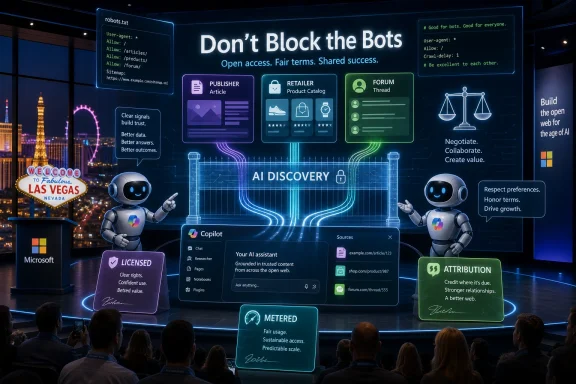
Microsoft is urging publishers and retailers to stop treating AI crawlers as intruders and start making their sites readable to bots, after Nikhil Kolar, Microsoft AI’s vice president of publisher product, argued at AdExchanger’s Programmatic AI event in Las Vegas that blocking agents risks disappearing from AI-driven discovery. The pitch is simple enough to fit on a conference slide and complicated enough to reshape the economics of the open web. Microsoft wants site owners to believe that the next traffic war will not be won by hiding content, but by making it available on terms that machines can understand. The unresolved question is whether those terms will be set by publishers, retailers, and independent site owners — or by the platforms building the agents.
Kolar’s warning lands because it reframes robots.txt from a dusty webmaster file into a commercial strategy document. For decades, the decision to let a crawler in was mostly about search visibility, server load, and the odd bad actor. Now Microsoft is saying that the same file may determine whether an AI assistant knows a product exists, recommends a recipe, cites a review, or routes a purchase intent toward a merchant.
That is not a small semantic shift. In the search era, crawling was the first step toward a blue link, and the blue link was at least theoretically a path back to the publisher. In the AI era, crawling can become the first step toward an answer, a recommendation, or an automated transaction that may not look like traffic at all.
This is why the advice sounds both practical and menacing. If four out of five websites are blocking AI bots, as Kolar said, then a large portion of the web is effectively invisible to the systems that Microsoft, Google, OpenAI, Perplexity, and others are racing to put between users and websites. Microsoft’s line is that invisibility means lost discovery. The publisher’s fear is that visibility means extraction.
The tension is not academic. Windows users already see Copilot in the operating system, Edge, Microsoft 365, and Bing-adjacent experiences. Sysadmins are being asked to evaluate AI agents inside corporate workflows. Retailers and publishers are being told that the agentic web is coming whether they like it or not. Microsoft is not merely commenting on the future; it is trying to sell the infrastructure for it.
AI systems scramble that bargain because they can consume pages without preserving the user journey that made publishing viable. A chatbot that summarizes a review, compares products, or answers a technical question may satisfy the user before a click ever happens. An agent that buys a product on behalf of a user may never expose the user to the retailer’s carefully designed landing page, upsell path, loyalty program, or ad stack.
That is why publishers have become more aggressive about blocking crawlers. They are not only worried about copyright or server costs. They are worried that the web’s economic plumbing is being rerouted around them, with AI companies taking the role once played by search engines while offering fewer guarantees of referral traffic.
Microsoft’s counterargument is that blocking everything may solve the wrong problem. If agents become a major interface for discovery, then refusing to be read by them could leave a site outside the recommendation layer entirely. A publisher may protect its archives from one kind of exploitation while also removing itself from the next distribution channel.
The hard part is that both things can be true. A website can be exploited by unrestricted scraping and harmed by total invisibility. The strategic problem is no longer whether to allow crawlers in some abstract sense; it is how to distinguish useful, licensed, accountable access from industrial-scale vacuuming.
That is the halo version of the story, and it has real appeal. Publishers have spent the past two years watching AI companies debate fair use in court, sign bespoke deals with large media companies, and leave smaller operators guessing about whether their work has already been absorbed into model training. A marketplace at least suggests rules, reporting, and money.
But the marketplace is also a tollbooth, and Microsoft owns the road, the cloud beneath the road, and one of the largest vehicles driving on it. If Copilot uses licensed publisher content, Azure compute handles the inference, Microsoft brokers or facilitates the transaction, and the company strengthens its position as the enterprise-grade middleman for AI content access. That does not make the model illegitimate. It does mean the incentives deserve scrutiny.
Jonathan Roberts of People Inc. captured the business logic neatly when he reportedly noted that the arrangement is not simply a cost for Microsoft. If real-time AI use of licensed content runs on Azure, Microsoft is not just paying publishers; it is monetizing the compute layer that makes the transaction possible. In other words, Microsoft can tell publishers it is building a compensation system while telling investors it is building an AI infrastructure business.
That dual identity is the defining feature of Microsoft’s AI strategy. It wants to be the productivity interface, the cloud provider, the model platform, the agent framework, and now the clearinghouse for publisher licensing. The company’s message to publishers is not just “let the bots in.” It is “let the bots in through a system we can help operate.”
Publishers often collapse those categories because, from their perspective, both can involve their work being used to make AI products more valuable. But legally, technically, and commercially, the distinction matters. A model trained on archived material is different from an assistant that consults a live or licensed feed to answer a current question.
Microsoft wants the marketplace conversation to center on grounding because grounding is easier to productize as a recurring commercial relationship. It fits the needs of news, shopping, reviews, financial information, health content, and technical documentation — areas where stale answers are dangerous, embarrassing, or useless. It also lets Microsoft pitch publishers on being compensated for ongoing value rather than arguing endlessly about whether past scraping was fair use.
That framing is convenient for Microsoft, but it is not empty. Grounding genuinely is where many AI products will either earn or lose user trust. A Windows user asking Copilot about a current driver issue, a patch regression, or a product compatibility problem needs current information, not a statistical memory of old web pages. An enterprise user asking an agent to summarize a vendor’s latest security guidance needs freshness and provenance.
Still, publishers should be wary of letting the grounding conversation erase the training dispute. The industry’s core grievance is not merely that AI systems need current facts. It is that years of published work may have helped create commercial models without permission, payment, or transparency. A licensing marketplace for future grounding can be useful without settling the argument over past ingestion.
That sounds contradictory until you separate publishers from retailers. A merchant selling shoes, appliances, or PC components may want AI shopping agents to understand its inventory, pricing, availability, shipping policies, and return terms. If agents become the next comparison-shopping interface, a retailer that blocks them may be absent from the moment of purchase intent.
A traditional publisher lives under a different set of incentives. Its content is not merely a catalog of goods waiting to be bought. It is the product itself, and once that product is summarized into an AI answer, the publisher may lose the pageview, the ad impression, the subscription prompt, and the relationship with the reader.
Even retailers are not uniformly aligned with Microsoft’s advice. A large retailer may want consumer-facing agents to recommend its products while blocking competitors, price scrapers, counterfeiters, and data brokers from building shadow catalogs. The same robot-readable product feed that helps Copilot recommend a laptop could also help a rival undercut prices or scrape assortment strategy.
That is why “don’t block the bots” is too blunt as operational advice. The better version is: know which bots matter, what they do, what commercial rights they claim, how they identify themselves, and what you get in return. For large publishers and retailers, that means bot management becomes a boardroom issue. For smaller sites, it means the AI web may deepen an already familiar power imbalance.
That worked tolerably well when the main actors were search crawlers and the reward for cooperation was traffic. It works less well when crawlers might feed model training, retrieval-augmented generation, commercial recommendations, pricing intelligence, ad verification, spam operations, or outright content theft. A line in a text file cannot negotiate price, audit usage, distinguish training from grounding, or enforce deletion.
Publishers have responded by layering more tools on top: bot detection, content delivery network rules, authentication gates, licensing contracts, and selective API access. That is rational, but it is also expensive and technically uneven. People Inc. can talk about allowing dozens of known crawlers while blocking tens of thousands of attempts a day. A small independent technical blog cannot run that kind of operation without sacrificing time it would otherwise spend publishing.
This is where Microsoft’s pitch has its strongest opening. A standardized marketplace with identifiable buyers, usage reporting, and payments could reduce transaction costs. Instead of every publisher trying to negotiate separately with every AI developer, a clearinghouse could make licensing legible at scale.
But standardization can become dependency. If Microsoft’s marketplace becomes the default path by which AI agents access premium content, publishers may gain compensation while losing leverage over pricing, packaging, and measurement. The open web has seen that movie before, with search, social platforms, mobile app stores, and ad-tech intermediaries all promising distribution before becoming unavoidable gatekeepers.
Delegation changes the economics of attention. If a user asks an agent to plan a trip, buy a monitor, compare antivirus products, or summarize the best advice on a Windows update problem, the agent may consult many sources while presenting only one synthesized result. The sources become inputs, not destinations.
For publishers, that threatens the very metrics by which value has been measured. Pageviews, sessions, time on site, newsletter conversions, ad impressions, affiliate clicks, and subscription starts all assume some form of user arrival. An agent-mediated recommendation might create influence without traffic, value without attribution, and commerce without a conventional referral path.
For retailers, the shift is equally profound. If agents become shoppers, then product data quality becomes as important as search-engine optimization once was. Retailers will need inventory, pricing, product specifications, reviews, return policies, and fulfillment data in formats that machines can parse reliably. The website remains visible to humans, but the decisive customer may be a software agent acting on their behalf.
Microsoft is effectively telling businesses to prepare for that interface now. It is not wrong. The mistake would be to assume that machine legibility automatically produces fair compensation or brand control. Being readable to agents is necessary if agents matter; it is not sufficient if the agent’s owner controls the answer, the attribution, and the transaction path.
That means the quality of publisher licensing and AI grounding will affect ordinary technical tasks. When Copilot answers a question about Windows settings, recommends a troubleshooting path, summarizes a security story, or compares software products, the system’s usefulness depends on the quality and freshness of the sources it can reach. If reputable sources block crawlers while low-quality content farms remain open, AI answers may get worse precisely when users rely on them more.
This is the uncomfortable irony behind publisher blocking. Blocking may be a rational defense against uncompensated extraction, but broad blocking can also degrade the information environment. The sources most careful about accuracy and ownership may become less visible to AI systems, while the least scrupulous sites become overrepresented because they optimize aggressively for machine consumption.
Microsoft’s marketplace is one answer to that problem, but it also gives Microsoft a curatorial role. If Copilot’s grounded answers depend on a roster of licensed publishers, then Microsoft has influence over which sources are available, how they are weighted, and how their value is measured. That may improve quality compared with unfiltered scraping, but it also concentrates power inside a private licensing ecosystem.
Sysadmins and IT leaders should watch this closely. The enterprise version of the same issue involves internal data, SharePoint sites, Teams chats, email, knowledge bases, and vendor documentation. The question is not only whether AI can access information. It is whether access is permissioned, auditable, current, and aligned with the organization’s risk tolerance.
Search trained publishers to optimize for algorithms they could not see. Social platforms trained them to chase distribution only to watch referral traffic collapse when priorities changed. Mobile shifted audiences into app stores, feeds, and notification systems where platform owners controlled the interface. Each wave arrived with promises of new reach and ended with publishers absorbing much of the volatility.
AI looks like the next and perhaps most severe version of that pattern. It can learn from publisher content, summarize it, compete with it, and redirect demand before a user ever reaches the source. It also arrives at a moment when many publishers are already weakened by declining search referrals, ad-market pressure, subscription fatigue, and platform fragmentation.
That history explains why Roberts’ block-first posture is not reactionary. It is an attempt to establish leverage before the market norms harden. If a publisher waits until agents are already extracting value at scale, its negotiating position may be worse. Blocking creates scarcity, and scarcity creates the possibility of licensing.
But scarcity only works for those with content that AI companies cannot easily replace. A major magazine publisher, financial data provider, scientific publisher, or product-review powerhouse may have leverage. A small site may not. Microsoft’s claim that the whole open web can be signed up to a marketplace runs into the brutal reality that the open web is not one market; it is a hierarchy of bargaining power.
The practical strategy is selective legibility. Publishers and retailers should make high-value, machine-readable content available through controlled channels, while maintaining the ability to block, meter, audit, and price access. That may involve robots.txt, but it cannot stop there. It requires contracts, technical enforcement, metadata standards, APIs, crawler identity, and a willingness to walk away from deals that offer exposure instead of value.
Microsoft would prefer the industry to move quickly because speed benefits the platform builders. The more publishers and retailers accept AI agents as a distribution layer, the more urgent it becomes to plug into Microsoft’s marketplace, Azure-backed inference, Copilot experiences, and associated advertising systems. The company can then present itself as the responsible alternative to chaotic scraping.
Publishers should welcome responsible licensing without mistaking it for charity. Microsoft is not rescuing the web out of nostalgia for independent publishing. It is building a business around AI answers, enterprise agents, cloud usage, advertising, and content access. Those incentives can align with publishers, but they will not always align.
The best outcome would be a competitive licensing ecosystem with transparent measurement and multiple routes to market. The worst outcome would be a new platform dependency in which publishers block the open web, license into a handful of AI marketplaces, and then discover that the terms are once again dictated by the companies controlling distribution.
That distinction is familiar to IT pros. Nobody serious says a corporate network should be open because connectivity is valuable. Nobody serious says it should be entirely sealed off because threats exist. The work is identity, permissions, logging, segmentation, policy, and enforcement. The AI web needs the same mindset.
Retailers will need to decide which agents can see which product data and under what commercial terms. Publishers will need to decide which content can be used for grounding, which archives are available for licensing, and which crawlers are unwelcome. Developers will need clearer standards for bot identity and usage signaling. Users will need to understand when an answer is grounded in licensed, current sources rather than vague model memory.
Microsoft’s strongest point is that doing nothing is still a decision. If publishers wait for courts, regulators, standards bodies, and platforms to resolve the issue, AI products will continue evolving around them. If retailers ignore agentic discovery, they may find that their carefully optimized human-facing storefronts matter less when software intermediaries make the first cut.
Microsoft’s weakest point is the implication that visibility itself is the prize. Publishers learned from social platforms that reach without durable economics is a trap. They learned from search that optimization can become dependency. They should not need to learn from AI that being included in an answer is not the same as being paid for the value behind it.
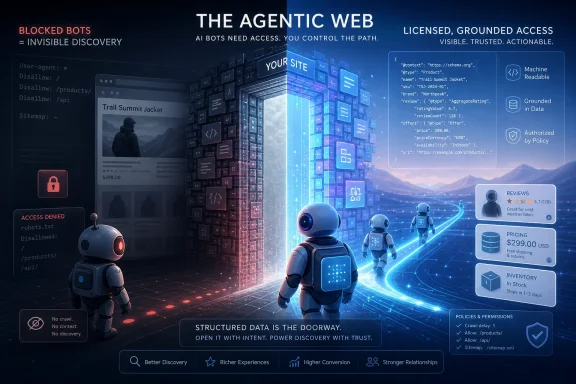 Microsoft Wants the Web to Become Legible to Machines
Kolar’s warning lands because it reframes robots.txt from a dusty webmaster file into a commercial strategy document. For decades, the decision to let a crawler in was mostly about search visibility, server load, and the odd bad actor. Now Microsoft is saying that the same file may determine whether an AI assistant knows a product exists, recommends a recipe, cites a review, or routes a purchase intent toward a merchant.That is not a small semantic shift. In the search era, crawling was the first step toward a blue link, and the blue link was at least theoretically a path back to the publisher. In the AI era, crawling can become the first step toward an answer, a recommendation, or an automated transaction that may not look like traffic at all.
This is why the advice sounds both practical and menacing. If four out of five websites are blocking AI bots, as Kolar said, then a large portion of the web is effectively invisible to the systems that Microsoft, Google, OpenAI, Perplexity, and others are racing to put between users and websites. Microsoft’s line is that invisibility means lost discovery. The publisher’s fear is that visibility means extraction.
The tension is not academic. Windows users already see Copilot in the operating system, Edge, Microsoft 365, and Bing-adjacent experiences. Sysadmins are being asked to evaluate AI agents inside corporate workflows. Retailers and publishers are being told that the agentic web is coming whether they like it or not. Microsoft is not merely commenting on the future; it is trying to sell the infrastructure for it.
The Old Crawling Bargain Is Breaking Under AI’s Weight
The open web has always run on an uneasy bargain. Publishers made pages visible to search engines, search engines indexed them, users clicked results, and advertising or subscription funnels did the rest. It was never a perfectly fair system, but it was intelligible: crawl, rank, click, monetize.AI systems scramble that bargain because they can consume pages without preserving the user journey that made publishing viable. A chatbot that summarizes a review, compares products, or answers a technical question may satisfy the user before a click ever happens. An agent that buys a product on behalf of a user may never expose the user to the retailer’s carefully designed landing page, upsell path, loyalty program, or ad stack.
That is why publishers have become more aggressive about blocking crawlers. They are not only worried about copyright or server costs. They are worried that the web’s economic plumbing is being rerouted around them, with AI companies taking the role once played by search engines while offering fewer guarantees of referral traffic.
Microsoft’s counterargument is that blocking everything may solve the wrong problem. If agents become a major interface for discovery, then refusing to be read by them could leave a site outside the recommendation layer entirely. A publisher may protect its archives from one kind of exploitation while also removing itself from the next distribution channel.
The hard part is that both things can be true. A website can be exploited by unrestricted scraping and harmed by total invisibility. The strategic problem is no longer whether to allow crawlers in some abstract sense; it is how to distinguish useful, licensed, accountable access from industrial-scale vacuuming.
Microsoft’s Marketplace Is a Tollbooth With a Halo
Microsoft’s Publisher Content Marketplace is designed to make that distinction look manageable. Announced in February, the marketplace offers publishers a way to license content for AI uses, initially around Copilot and then, according to Microsoft’s broader positioning, for other AI developers as well. The company presents this as a cleaner value exchange: publishers get paid when their content helps ground AI responses, while AI builders get access to trusted, current material.That is the halo version of the story, and it has real appeal. Publishers have spent the past two years watching AI companies debate fair use in court, sign bespoke deals with large media companies, and leave smaller operators guessing about whether their work has already been absorbed into model training. A marketplace at least suggests rules, reporting, and money.
But the marketplace is also a tollbooth, and Microsoft owns the road, the cloud beneath the road, and one of the largest vehicles driving on it. If Copilot uses licensed publisher content, Azure compute handles the inference, Microsoft brokers or facilitates the transaction, and the company strengthens its position as the enterprise-grade middleman for AI content access. That does not make the model illegitimate. It does mean the incentives deserve scrutiny.
Jonathan Roberts of People Inc. captured the business logic neatly when he reportedly noted that the arrangement is not simply a cost for Microsoft. If real-time AI use of licensed content runs on Azure, Microsoft is not just paying publishers; it is monetizing the compute layer that makes the transaction possible. In other words, Microsoft can tell publishers it is building a compensation system while telling investors it is building an AI infrastructure business.
That dual identity is the defining feature of Microsoft’s AI strategy. It wants to be the productivity interface, the cloud provider, the model platform, the agent framework, and now the clearinghouse for publisher licensing. The company’s message to publishers is not just “let the bots in.” It is “let the bots in through a system we can help operate.”
Training and Grounding Are Not the Same Fight
One useful distinction in Kolar’s comments is the difference between training and grounding. Training refers to the creation of the model’s underlying capabilities, often using vast datasets gathered from the web and other sources. Grounding refers to connecting an AI system to current, authoritative information at the moment it generates an answer.Publishers often collapse those categories because, from their perspective, both can involve their work being used to make AI products more valuable. But legally, technically, and commercially, the distinction matters. A model trained on archived material is different from an assistant that consults a live or licensed feed to answer a current question.
Microsoft wants the marketplace conversation to center on grounding because grounding is easier to productize as a recurring commercial relationship. It fits the needs of news, shopping, reviews, financial information, health content, and technical documentation — areas where stale answers are dangerous, embarrassing, or useless. It also lets Microsoft pitch publishers on being compensated for ongoing value rather than arguing endlessly about whether past scraping was fair use.
That framing is convenient for Microsoft, but it is not empty. Grounding genuinely is where many AI products will either earn or lose user trust. A Windows user asking Copilot about a current driver issue, a patch regression, or a product compatibility problem needs current information, not a statistical memory of old web pages. An enterprise user asking an agent to summarize a vendor’s latest security guidance needs freshness and provenance.
Still, publishers should be wary of letting the grounding conversation erase the training dispute. The industry’s core grievance is not merely that AI systems need current facts. It is that years of published work may have helped create commercial models without permission, payment, or transparency. A licensing marketplace for future grounding can be useful without settling the argument over past ingestion.
Retailers Have a Different Incentive Than Newsrooms
The most interesting wrinkle in the AdExchanger account is the apparent disagreement between Kolar and Roberts over blocking. Kolar’s message was to avoid restrictions that make content illegible to AI agents. Roberts said People Inc. begins by blocking broadly, then permitting specific crawlers once it understands their purpose and value.That sounds contradictory until you separate publishers from retailers. A merchant selling shoes, appliances, or PC components may want AI shopping agents to understand its inventory, pricing, availability, shipping policies, and return terms. If agents become the next comparison-shopping interface, a retailer that blocks them may be absent from the moment of purchase intent.
A traditional publisher lives under a different set of incentives. Its content is not merely a catalog of goods waiting to be bought. It is the product itself, and once that product is summarized into an AI answer, the publisher may lose the pageview, the ad impression, the subscription prompt, and the relationship with the reader.
Even retailers are not uniformly aligned with Microsoft’s advice. A large retailer may want consumer-facing agents to recommend its products while blocking competitors, price scrapers, counterfeiters, and data brokers from building shadow catalogs. The same robot-readable product feed that helps Copilot recommend a laptop could also help a rival undercut prices or scrape assortment strategy.
That is why “don’t block the bots” is too blunt as operational advice. The better version is: know which bots matter, what they do, what commercial rights they claim, how they identify themselves, and what you get in return. For large publishers and retailers, that means bot management becomes a boardroom issue. For smaller sites, it means the AI web may deepen an already familiar power imbalance.
Robots.txt Is Being Asked to Do a Lawyer’s Job
The humble robots.txt file was never designed to carry this much legal and economic weight. It is a voluntary convention, not a rights-management system. Well-behaved crawlers read it; bad actors ignore it; ambiguous actors interpret it in ways that conveniently serve their business model.That worked tolerably well when the main actors were search crawlers and the reward for cooperation was traffic. It works less well when crawlers might feed model training, retrieval-augmented generation, commercial recommendations, pricing intelligence, ad verification, spam operations, or outright content theft. A line in a text file cannot negotiate price, audit usage, distinguish training from grounding, or enforce deletion.
Publishers have responded by layering more tools on top: bot detection, content delivery network rules, authentication gates, licensing contracts, and selective API access. That is rational, but it is also expensive and technically uneven. People Inc. can talk about allowing dozens of known crawlers while blocking tens of thousands of attempts a day. A small independent technical blog cannot run that kind of operation without sacrificing time it would otherwise spend publishing.
This is where Microsoft’s pitch has its strongest opening. A standardized marketplace with identifiable buyers, usage reporting, and payments could reduce transaction costs. Instead of every publisher trying to negotiate separately with every AI developer, a clearinghouse could make licensing legible at scale.
But standardization can become dependency. If Microsoft’s marketplace becomes the default path by which AI agents access premium content, publishers may gain compensation while losing leverage over pricing, packaging, and measurement. The open web has seen that movie before, with search, social platforms, mobile app stores, and ad-tech intermediaries all promising distribution before becoming unavoidable gatekeepers.
The Agentic Web Makes Discovery Less Visible
The phrase agentic web sounds like conference jargon, but it points to a real shift. In the browser era, a user navigates. In the search era, a user queries. In the agent era, a user delegates.Delegation changes the economics of attention. If a user asks an agent to plan a trip, buy a monitor, compare antivirus products, or summarize the best advice on a Windows update problem, the agent may consult many sources while presenting only one synthesized result. The sources become inputs, not destinations.
For publishers, that threatens the very metrics by which value has been measured. Pageviews, sessions, time on site, newsletter conversions, ad impressions, affiliate clicks, and subscription starts all assume some form of user arrival. An agent-mediated recommendation might create influence without traffic, value without attribution, and commerce without a conventional referral path.
For retailers, the shift is equally profound. If agents become shoppers, then product data quality becomes as important as search-engine optimization once was. Retailers will need inventory, pricing, product specifications, reviews, return policies, and fulfillment data in formats that machines can parse reliably. The website remains visible to humans, but the decisive customer may be a software agent acting on their behalf.
Microsoft is effectively telling businesses to prepare for that interface now. It is not wrong. The mistake would be to assume that machine legibility automatically produces fair compensation or brand control. Being readable to agents is necessary if agents matter; it is not sufficient if the agent’s owner controls the answer, the attribution, and the transaction path.
Windows Users Will Meet This Fight Through Copilot
For WindowsForum.com readers, the publisher debate may sound like a media-industry fight until it appears inside everyday tools. Copilot is no longer just a chatbot tab somewhere on the web. Microsoft has spent the past several product cycles placing AI assistance across Windows, Edge, Microsoft 365, developer tooling, and cloud services.That means the quality of publisher licensing and AI grounding will affect ordinary technical tasks. When Copilot answers a question about Windows settings, recommends a troubleshooting path, summarizes a security story, or compares software products, the system’s usefulness depends on the quality and freshness of the sources it can reach. If reputable sources block crawlers while low-quality content farms remain open, AI answers may get worse precisely when users rely on them more.
This is the uncomfortable irony behind publisher blocking. Blocking may be a rational defense against uncompensated extraction, but broad blocking can also degrade the information environment. The sources most careful about accuracy and ownership may become less visible to AI systems, while the least scrupulous sites become overrepresented because they optimize aggressively for machine consumption.
Microsoft’s marketplace is one answer to that problem, but it also gives Microsoft a curatorial role. If Copilot’s grounded answers depend on a roster of licensed publishers, then Microsoft has influence over which sources are available, how they are weighted, and how their value is measured. That may improve quality compared with unfiltered scraping, but it also concentrates power inside a private licensing ecosystem.
Sysadmins and IT leaders should watch this closely. The enterprise version of the same issue involves internal data, SharePoint sites, Teams chats, email, knowledge bases, and vendor documentation. The question is not only whether AI can access information. It is whether access is permissioned, auditable, current, and aligned with the organization’s risk tolerance.
Publishers Remember the Last Three Platform Shocks
Kolar reportedly told the conference that publishers repeatedly said social, mobile, and search “happened” to them, and that they do not want AI to happen to them too. That line matters because it captures the emotional backdrop to the whole debate. Publishers are not approaching AI from a position of trust.Search trained publishers to optimize for algorithms they could not see. Social platforms trained them to chase distribution only to watch referral traffic collapse when priorities changed. Mobile shifted audiences into app stores, feeds, and notification systems where platform owners controlled the interface. Each wave arrived with promises of new reach and ended with publishers absorbing much of the volatility.
AI looks like the next and perhaps most severe version of that pattern. It can learn from publisher content, summarize it, compete with it, and redirect demand before a user ever reaches the source. It also arrives at a moment when many publishers are already weakened by declining search referrals, ad-market pressure, subscription fatigue, and platform fragmentation.
That history explains why Roberts’ block-first posture is not reactionary. It is an attempt to establish leverage before the market norms harden. If a publisher waits until agents are already extracting value at scale, its negotiating position may be worse. Blocking creates scarcity, and scarcity creates the possibility of licensing.
But scarcity only works for those with content that AI companies cannot easily replace. A major magazine publisher, financial data provider, scientific publisher, or product-review powerhouse may have leverage. A small site may not. Microsoft’s claim that the whole open web can be signed up to a marketplace runs into the brutal reality that the open web is not one market; it is a hierarchy of bargaining power.
Microsoft’s Advice Is Right Only If Control Comes First
The defensible version of Microsoft’s argument is not that publishers should simply open the gates. It is that they should avoid sleepwalking into irrelevance by treating all AI access as equally harmful. There is a difference between being crawled without permission, being licensed for grounding, being included in a product feed, and being scraped by an anonymous botnet.The practical strategy is selective legibility. Publishers and retailers should make high-value, machine-readable content available through controlled channels, while maintaining the ability to block, meter, audit, and price access. That may involve robots.txt, but it cannot stop there. It requires contracts, technical enforcement, metadata standards, APIs, crawler identity, and a willingness to walk away from deals that offer exposure instead of value.
Microsoft would prefer the industry to move quickly because speed benefits the platform builders. The more publishers and retailers accept AI agents as a distribution layer, the more urgent it becomes to plug into Microsoft’s marketplace, Azure-backed inference, Copilot experiences, and associated advertising systems. The company can then present itself as the responsible alternative to chaotic scraping.
Publishers should welcome responsible licensing without mistaking it for charity. Microsoft is not rescuing the web out of nostalgia for independent publishing. It is building a business around AI answers, enterprise agents, cloud usage, advertising, and content access. Those incentives can align with publishers, but they will not always align.
The best outcome would be a competitive licensing ecosystem with transparent measurement and multiple routes to market. The worst outcome would be a new platform dependency in which publishers block the open web, license into a handful of AI marketplaces, and then discover that the terms are once again dictated by the companies controlling distribution.
The Real Choice Is Not Open or Closed
The AdExchanger exchange between Kolar and Roberts is useful because it breaks the false binary. “Allow all bots” is reckless. “Block all bots forever” is self-defeating. The future will belong to organizations that can distinguish between access and surrender.That distinction is familiar to IT pros. Nobody serious says a corporate network should be open because connectivity is valuable. Nobody serious says it should be entirely sealed off because threats exist. The work is identity, permissions, logging, segmentation, policy, and enforcement. The AI web needs the same mindset.
Retailers will need to decide which agents can see which product data and under what commercial terms. Publishers will need to decide which content can be used for grounding, which archives are available for licensing, and which crawlers are unwelcome. Developers will need clearer standards for bot identity and usage signaling. Users will need to understand when an answer is grounded in licensed, current sources rather than vague model memory.
Microsoft’s strongest point is that doing nothing is still a decision. If publishers wait for courts, regulators, standards bodies, and platforms to resolve the issue, AI products will continue evolving around them. If retailers ignore agentic discovery, they may find that their carefully optimized human-facing storefronts matter less when software intermediaries make the first cut.
Microsoft’s weakest point is the implication that visibility itself is the prize. Publishers learned from social platforms that reach without durable economics is a trap. They learned from search that optimization can become dependency. They should not need to learn from AI that being included in an answer is not the same as being paid for the value behind it.
The Bot Gate Is Becoming the New Front Page
The immediate lesson from Microsoft’s Las Vegas pitch is less dramatic than the slogan but more useful for anyone running a site, store, or content business. The AI crawler decision is becoming a distribution decision, a licensing decision, and a security decision at the same time.- Publishers should treat crawler policy as commercial infrastructure, not as a one-time technical setting buried in robots.txt.
- Retailers should assume that AI agents will increasingly read product data before human shoppers ever see a product page.
- Microsoft’s Publisher Content Marketplace is promising because it pays for grounded use, but it also strengthens Microsoft’s role as an AI distribution intermediary.
- Blocking can create leverage for large publishers, but smaller sites may need collective standards or marketplaces to avoid being ignored.
- Training and grounding should remain separate negotiations because future licensing does not automatically settle disputes over past data use.
- The safest strategy is controlled machine readability, where trusted agents get structured access and unknown crawlers meet a locked door.
References
- Primary source: AdExchanger
Published: 2026-05-26T05:30:12.446254
Microsoft To Publishers: Don’t Block The AI Bots | AdExchanger
Rather than fighting AI, Microsoft AI's Nikhil Kolar says publishers should license access to their sites and create content that speaks to AI crawlers.www.adexchanger.com - Related coverage: techcrunch.com
People Inc. forges AI licensing deal with Microsoft as Google traffic drops | TechCrunch
People Inc. signs an AI licensing deal with Microsoft, which will use its media content in Copilot.techcrunch.com - Official source: about.ads.microsoft.com
Building Toward a Sustainable Content Economy for the Agentic Web | Microsoft Advertising
See how Microsoft’s Publisher Content Marketplace supports transparent licensing, sustainable publisher revenue, and higher-quality AI experiences.about.ads.microsoft.com - Related coverage: searchengineland.com
- Related coverage: mediacopilot.ai
Microsoft Launches AI Licensing Marketplace for Publishers
Microsoft's new Publisher Content Marketplace lets publishers set AI licensing terms and earn pay-per-use revenue from AI developers.mediacopilot.ai - Related coverage: windowscentral.com
Publishers vs. AI — Microsoft just picked a side with its new marketplace | Windows Central
AI models have been stealing content for years. Microsoft is the first tech juggernaut to fight back.www.windowscentral.com
- Related coverage: thenewpublishingstandard.com
Microsoft Launches Publisher Content Marketplace. Book Publishers Look The Other Way - The New Publishing Standard
Microsoft's AI content marketplace excludes book publishers. Why fiction and minor-language content could reshape AI licensing—if publishers act now. thenewpublishingstandard.com
- Related coverage: wearetenet.com
Microsoft Launches AI Content Licensing Marketplace
Microsoft launched the Publisher Content Marketplace on 3 February 2026, a new platform for licensing content used by AI.www.wearetenet.com - Related coverage: computerworld.com
Microsoft aims to reward publishers for content used by AI – Computerworld
Publisher Content Marketplace offers a way to get paid for feeding answers to AI. www.computerworld.com
- Related coverage: insightswire.com
- Related coverage: axios.com
Microsoft wants to build the infrastructure behind the AI internet
Microsoft sees an opportunity to continue owning enterprise relationships in the AI era.www.axios.com
- Official source: cdn-dynmedia-1.microsoft.com
- Official source: techcommunity.microsoft.com
- Official source: fpc.microsoft.com